

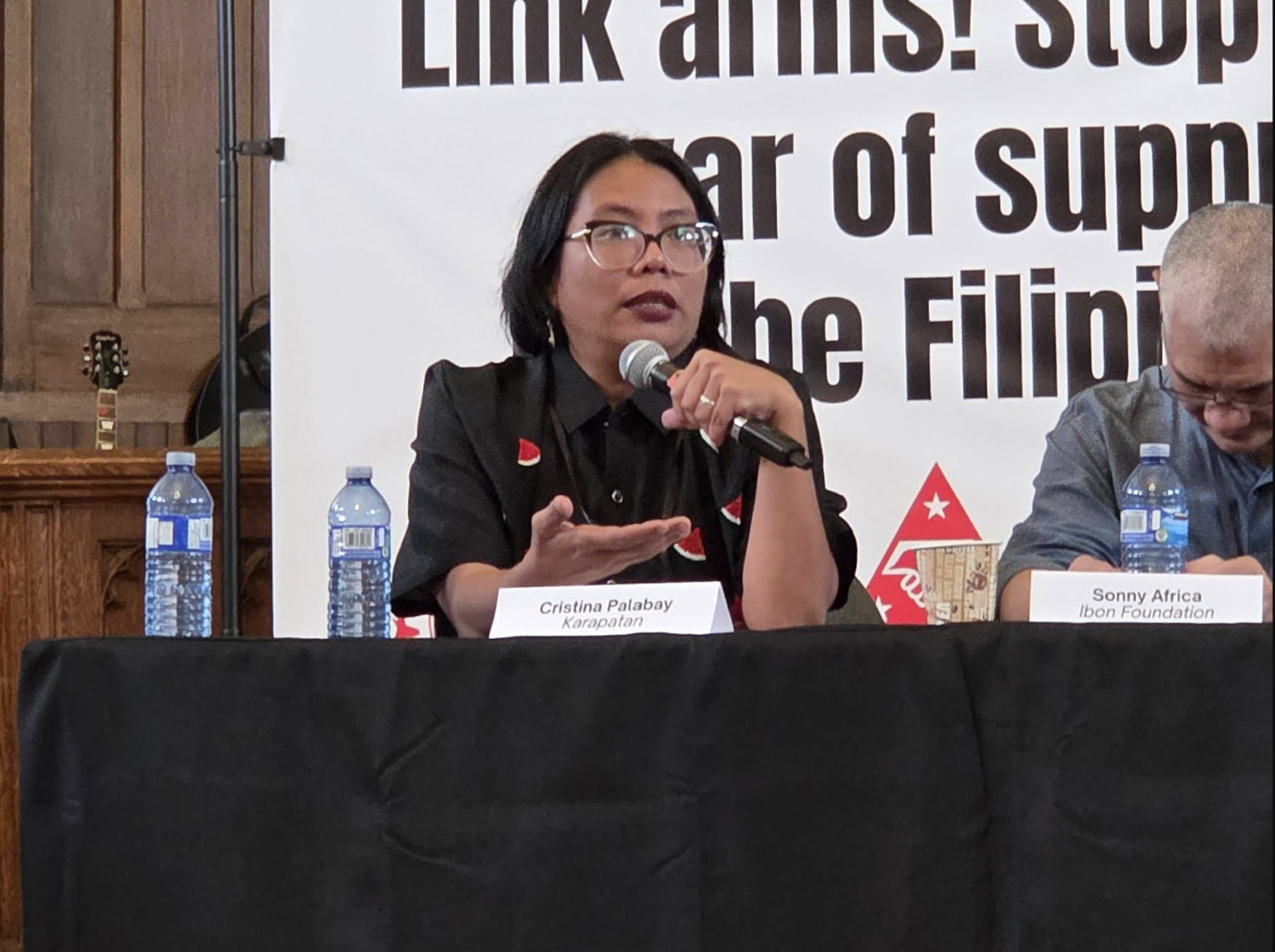
Cristina Palabay, the Secretary General of KARAPATAN – the Alliance for the Advancement of People’s Rights-Philippines, spoke at the recent Kapit Bisig: Linking Arms Across the World Against the US War of Suppression on the Filipino People conference that was held on September 25-26, 2026, in Toronto.
The KARAPATAN website explains: “KARAPATAN is an alliance of individuals, groups and organizations working for the promotion and protection of human rights in the Philippines. Its founders and members have been at the forefront of the human rights struggle in the Philippines since the time of Marcos’ martial law regime.”

Palabay stated: “Marcos Jr.’s National Action Plan on Unity, Peace and Development (NAP-UPD) which is being implemented by the National Task Force to End Local Communist Armed Conflict [NTF-ELCAC], maintains and implements a ‘whole of nation’ approach, utilizing the civilian bureaucracy and employing psywar tactics to bury the grave violations of human rights and international humanitarian law.”
What is NAP-UPD?
The National Action Plan for Unity, Peace and Development (NAP-UPD) 2025–2028 has also been criticized by the National Union of Peoples’ Lawyers (NUPL), a voluntary association of human rights lawyers in the Philippines.
NUPL comments: “Beneath the rhetoric of peace-building, it revives and reinforces a state apparatus long implicated in red-tagging, arbitrary arrests, enforced disappearances, and other forms of politically motivated persecution.”
What is NTF-ELCAC?
NUPL further notes: “The NTF-ELCAC lies at the core of this machinery of repression. Thus, UN Special Rapporteurs Ian Fry and Irene Khan, citing its central role in red-tagging and attacks on civil society, have both called for its abolition.”
In March 2023, the Philippines News Agency reported: “The [NTF-ELCAC] Legal Cooperation Cluster (LCC) … said House Bill (HB) No. 77 or the proposed Human Rights Defenders Protection Act is a threat to the country’s democratic of way life once enacted into law.” Inquirer.net has reported that Bill No. 77 sought to protect rights including the right to promote and protect human rights, the right to peaceful assembly, and the right to freedom of movement. It would have also established a Human Rights Defenders Protection Committee (HRDPC).
According to the FOCUS Observatory on Public Policies for the Protection of Human Rights Defenders: “Currently the bill waits for an approval by both the House of representatives and the Senate.”
The situation for human rights defenders
Global Witness has documented the killing of 318 defenders in the Philippines since 2012, including 12 defenders killed in 2025.
Global Witness adds: “Indigenous Peoples account for a staggering one-third of land and environmental defender killings in the Philippines in 2012-23. Neary half of these cases were linked to mining. The military was responsible for 64 out of 117 killings of Indigenous defenders between 2012-23.”
Despite this, in November 2025, Canadian defence minister McGuinty commented: “The Philippines has shown true leadership in upholding international law … and for that [it has] Canada’s greatest and deepest respect.”
The situation for political prisoners
In June 2026, KARAPATAN, the organization led by Palabay, documented that there were 685 political prisoners in the Philippines.
Their report further noted: “Political prisoners come from different walks of life. In the Philippines, they are ordinary people like farmers, workers, fisherfolk, indigenous and Moro peoples, women, youth, activists, human rights defenders, leaders and members of organizations.”
They also highlight: “Political prisoners are not criminals. They are not terrorists. It is their right and mission to advance the interests and rights of the common people.”
And on July 18, 2026, Nelson Mandela International Day, KARAPATAN reiterated their demand to “Free All Political Prisoners!”.
Peace Brigades International has accompanied the Committee in Solidarity with Political Prisoners (CSPP) in Colombia; the Cerezo Committee in Mexico (this started when the co-founders were in prison); Bernardo Caal Xol while he was in prison in Guatemala; and the imprisoned Guapinol River defenders in Honduras.
Canada and the Philippines
On July 20, 2026, Palabay stated: “For years, successive Philippine governments have followed [the US counterterrorism] framework through security agreements, military cooperation, and legislation such as the Anti-Terrorism Act of 2020 and the Terrorism Financing Prevention and Suppression Act.”
She further highlighted: “These [US-backed] measures have been used to red-tag, surveil, arbitrarily arrest, detain, and prosecute activists, trade unionists, peasant and indigenous leaders, humanitarian workers, journalists, lawyers, church people, and human rights defenders because of their people’s rights advocacies and dissent.”
On the same day that Palabay was criticizing the US counterterrorism framework, Canadian defence minister David McGuinty told reporters that there’s “really little daylight” between Canada and the United States on military and intelligence affairs.
“Defence cooperation”
Canada continues to deepen its political, economic, and military relationship with the Philippines, including negotiations on a Canada-Philippines Free Trade Agreement that could be finalized by November 2026 along with ongoing efforts to, as National Defence has noted, “Canada and the Philippines take defence cooperation to new heights”.
This past February 2026, Canadian Prime Minister Mark Carney announced “Canada’s first Defence Industrial Strategy” that includes the pledge to “increase our defence exports by 50%” and “ramp up Canada’s presence at major global defence and aerospace trade shows”, such as the Asian Defense & Security (ADAS) exhibition held biennially in Pasay City, Metro Manila.
The next ADAS will take place on June 28-30, 2027, at SMXCITE, Metro Manila, that will include a “Canada Partnership Pavilion”.
Just prior to that, a delegation from the Philippines is expected at the annual CANSEC arms fair in Ottawa on June 2-3, 2027. CANSEC is “Canada’s largest defence, security & emerging tech tradeshow where $1B+ in business deals happen every year.”
It is also notable that Canada signed a contract in December 2017 to sell 16 Bell 412 combat utility helicopters, built at the Bell plant near Montreal, Quebec, for $233 million to the Philippines. The deal was canceled by then-president Rodrigo Duterte in February 2018 after public concern about human rights abuses resulted in the Canadian government reviewing the deal.
Accompaniment
In April 2026, Peace Brigades International (PBI) launched a Southeast Asia Project to accompany human rights defenders in the Philippines, Cambodia, Malaysia, Myanmar, and Thailand. This project is focused on the acute exposure to extractive industries, land conflicts, and climate-related violence defenders face.
Additional reading
–Filipino human rights defender Cristina Palabay speaking at the Kapit Bisig conference in Toronto (PBI-Canada, September 21, 2026)
–Hundreds march in Toronto to “Shut Down Pax Silica”, stop the displacement of Indigenous and local communities in the Philippines (PBI-Canada, September 26, 2026).


