


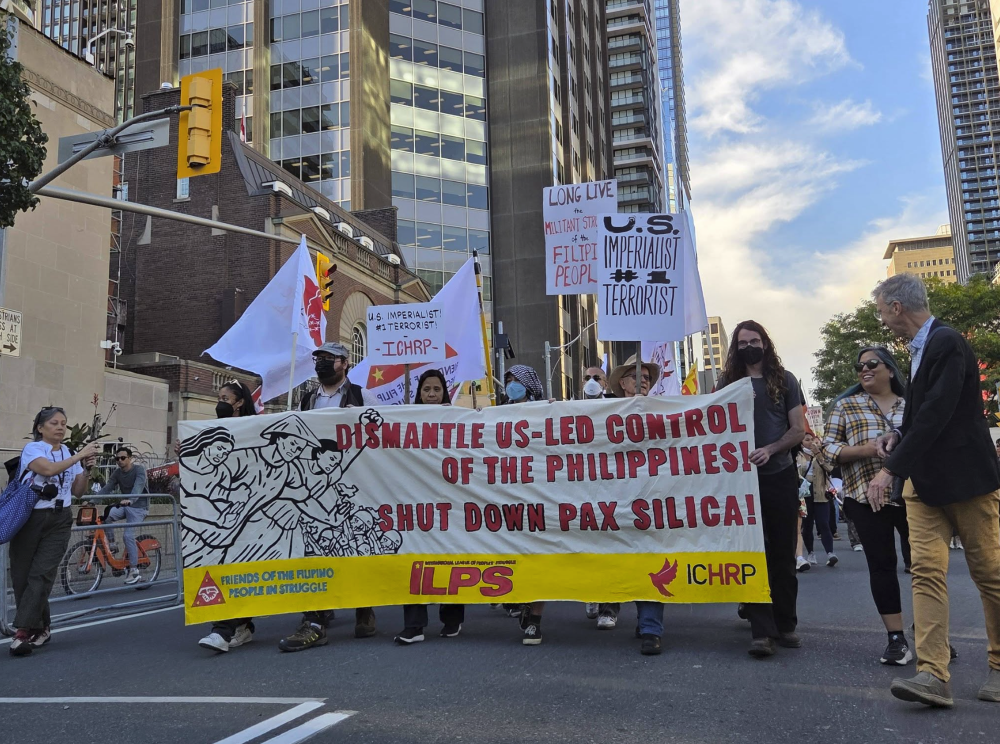
On September 25, hundreds of people from multiple countries took part in the March United Against U.S.-led War and Plunder: Shut Down Pax Silica! that began across the street from the US Consulate in Toronto.
The march then took University Avenue and headed south to Queen Street West where it concluded with speeches in front of Toronto City Hall.
“Canadian troops out of the Philippines”
In his speech to those gathered for the march, Danilo “Ka Daning” Ramos, the National Chairperson of the Peasant Movement of the Philippines (KMP) stated: “We want land, not Pax Silica. Canadian troops joined the visiting forces in the Philippines from April 20 to May 8 this year. We urge the Canadian government, not only US troops out in the Philippines, but also Canadian troops out in the Philippines.”

We also recall that on April 19, the day before Canada participated “shoulder-to-shoulder” in Exercise Balikatan in the Philippines, the Armed Forces of the Philippines (AFP) killed the Negros 19, including human rights and environmental defenders, community researchers, and a journalist, in the Toboso Massacre.

The United States launched Pax Silica as a “flagship effort” to secure their supply chain for the critical minerals and rare earths required for semiconductors, artificial intelligence (AI), high-level technologies, and advanced military equipment.
The Pax Silica website prominently features a quote from Jacob Helberg, the Under Secretary for Economic Affairs, who says: “If the 20th century ran on oil and steel, the 21st century runs on compute and the minerals that feed it.”
The initial seven signatories to the Pax Silica declaration in December 2025 includes the United States, the United Kingdom and Israel. The Philippines, the European Union, India, El Salvador, Argentina and other countries joined in 2026. Canada is not a signatory but is an observer and participates in related discussions.
The International Coalition for Human Rights in the Philippines comments: “The U.S. backed Marcos Jr. regime made the Philippines the only country to commit over 4,000 acres of land to establish an AI industrial hub. The Indigenous Aeta communities, farmers, fisherfolk, and workers will be the ones to suffer the brunt of mining, militarization, land grabbing, violent displacement, human rights violations, and the devastation of the climate crisis accelerated by the AI industry.”
Radio Free Asia has reported that Indigenous Aeta families in the village of Sapang Kawayan, about 75 kilometres north of Manila, have already received a letter from the Bases Conversion and Development Authority (BCDA) informing them they must relocate from the village. Tribal leader Petronila Capiz, 63, told RFA that allowing the government to erect a facility here would be a death knell to their way of life.
Mongabay has also reported: “The Luzon Economic Corridor, or LEC, is an economic initiative focused on the Philippines’ biggest island… In April 2026, Washington and Manila announced plans to build a 1,620-hectare (4,000-acre) high-tech manufacturing hub in the Central Luzon region. …The Pax Silica hub will be built within New Clark City, a government-planned ‘smart’ city inside the greater 32,000-hectare (79,000-acre) Clark area, a former U.S. military complex [established in 1903 on the ancestral territory of the Aetas when the Philippines was under U.S. colonial rule].”
The human rights alliance KARAPATAN, the Peasant Movement of the Philippines (KMP), the Philippine Alliance of Human Rights Advocates (PAHRA), many other organizations, defenders and communities reject Pax Silica.

Peace Brigades International-Canada is following the opposition to Pax Silica with the awareness that the Philippines is an extremely dangerous country for land and environmental defenders.
Global Witness has documented the killing of 318 defenders in the Philippines since 2012, including 12 defenders killed in 2025.
Global Witness adds: “Indigenous Peoples account for a staggering one-third of land and environmental defender killings in the Philippines in 2012-23. Neary half of these cases were linked to mining. The military was responsible for 64 out of 117 killings of Indigenous defenders between 2012-23.”
Earlier this year, Peace Brigades International (PBI) launched a Southeast Asia Project to accompany human rights defenders in the Philippines, Cambodia, Malaysia, Myanmar, and Thailand. This project is focused on the acute exposure to extractive industries, land conflicts, and climate-related violence defenders face.
The Kapit Bisig conference
The march against Pax Silica took place on the afternoon of the first day of the Kapit Bisig: Linking Arms Across the World Against the US War of Suppression on the Filipino People conference on September 25-26 in Toronto.
For daily recaps, excerpts from presents and more about the conference and march, visit kapitbisigconference on Instagram.
A short video clip by Radyo Migrante of the march can be seen here.


