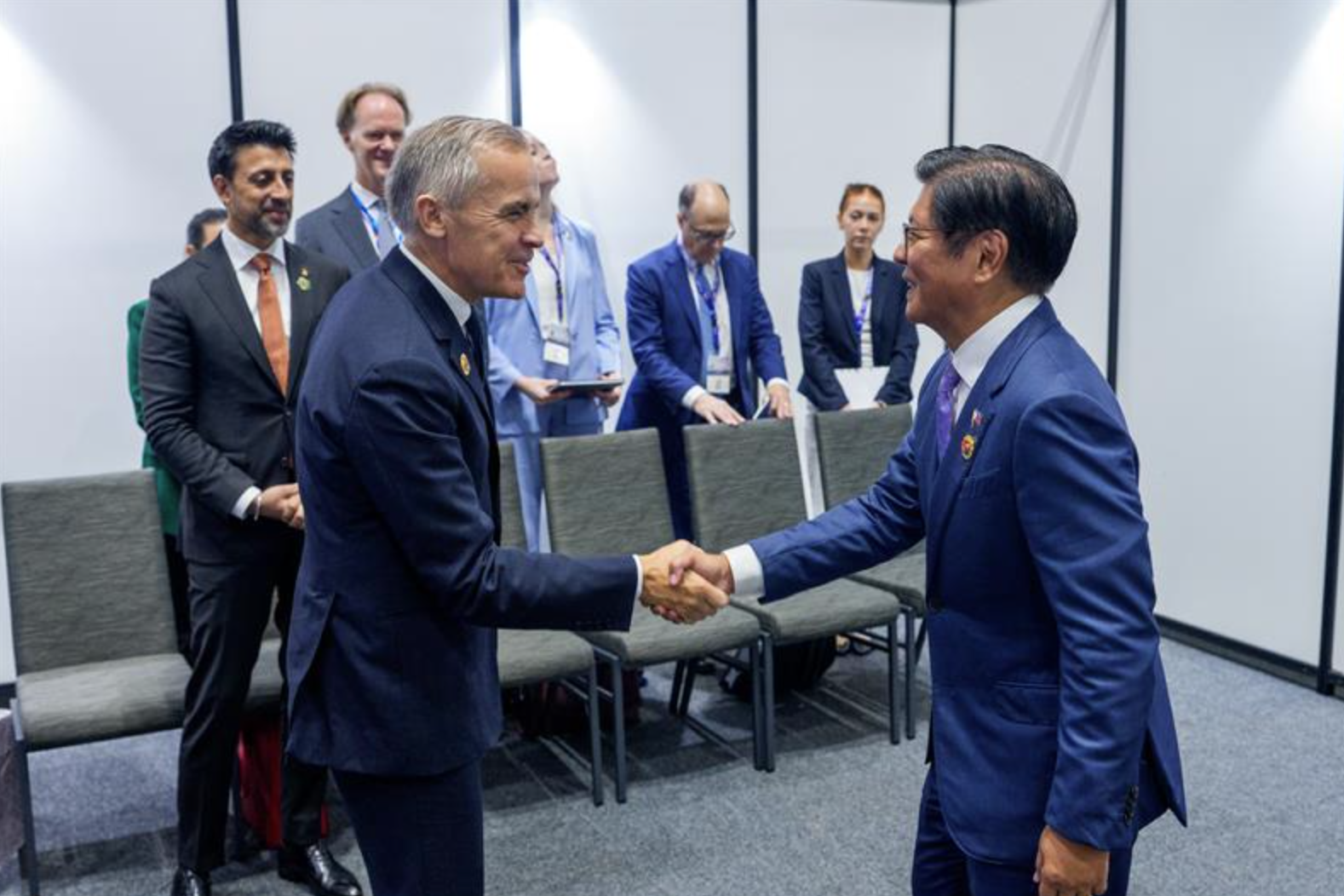
Photo: Canadian Prime Minister Mark Carney meets Filipino President Ferdinand Marcos Jr. at the ASEAN summit in Malaysia, October 2025.
PBI-Canada is attentive to the implications for Filipino land and environmental defenders from the new Canada-Philippines free trade agreement that is to be finalized in the coming days, the Luzon Economic Corridor (LEC) and Pax Silica, and the risk of human rights violations linked to weapons exports, including sales that could be facilitated through the ADAS and CANSEC arms shows.
A statement from the Office of the Prime Minister of Canada says: “Mark Carney, will travel to Ireland, the Philippines, Cambodia, and China, from November 11 to 19, 2026. He will represent Canada at four major international summits to advance Canada’s interests in trade, investment, culture, and security.”
The statement continues: “The Prime Minister will then travel to Manila, Philippines, to attend the Association of Southeast Asian Nations (ASEAN) Summit as Guest of the Chair. He will work to finalise the ASEAN-Canada free trade agreement, unlocking exports of more than $3.5 billion to one of the world’s fastest-growing economic regions.”
The eleven ASEAN member states include the Philippines, Cambodia, Malaysia, Myanmar, and Thailand.
The statement adds: “During his visit, the Prime Minister will also aim to conclude negotiations on a new Canada-Philippines free trade agreement that is expected to triple bilateral trade between our two countries by 2035.”
The Prime Minister is expected to arrive in Manila on Sunday November 15 in advance of the ASEAN summit (November 16-18).
Radio Canada International reports: “Already, in July, the two countries had signed agreements in Vancouver to strengthen cooperation in the trade, energy, defence and tourism sectors.”
The Connect Media Network notes: “The Philippines plays a key role in Canada’s Indo-Pacific strategy. The importance of the relationship is reflected in the fact that Canada’s embassy in Manila is now its second-largest diplomatic mission worldwide in terms of staffing, after Washington.”
Human rights and arms exports
Global Witness has documented that at least 318 land and environmental defenders have been killed in the Philippines between 2012 and 2025.
Global Witness and Kalikasan People’s Network for the Environment (Kalikasan PNE) have also reported: “Since 2012, the Philippines has been ranked as the deadliest country in Asia for people protecting land and the environment, with mining linked to a third of all killings documented by Global Witness. …The military has been linked to the highest number of documented killings and detentions of land and environmental defenders in the Philippines over the past decade.”
Despite this, in November 2025, Canadian defence minister McGuinty commented: “The Philippines has shown true leadership in upholding international law … and for that [it has] Canada’s greatest and deepest respect.”
In February 2026, Prime Minister Carney announced a new Defence Industrial Strategy that includes the pledge to “increase our defence exports by 50%” and “up Canada’s presence at major global defence and aerospace trade shows”.
That will include a “Canada Partnership Pavilion” at the Asian Defense & Security (ADAS) exhibition in Metro Manila on June 28-30, 2027.
Just a few weeks earlier, the Philippines is likely to be among the 100+ international delegations at the CANSEC arms show on June 2-3, 2027, at Cohere Centre in Ottawa. CANSEC is described by its organizers as “Canada’s largest defence, security & emerging tech tradeshow where $1B+ in business deals happen every year.”
Canada and Pax Silica
The United States launched Pax Silica as a “flagship effort” to secure their supply chain for the critical minerals and rare earths required for semiconductors, artificial intelligence (AI), high-level technologies, and advanced military equipment.
The Pax Silica Forum has explained in further detail: “Every aircraft, submarine, missile system, satellite and autonomous platform depends on a complex network of critical minerals. Without secure access to silica, rare earth elements, lithium, graphite and other essential materials, even the most advanced defence manufacturers face strategic vulnerability.”
Canada is currently an observer in the Pax Silica initiative.
Junior Stocks has commented: “Canada attended the [inaugural Pax Silica Summit] discussions on advanced manufacturing, mineral refining, and resilient logistics but contributed as an observer-level participant. No public friction has emerged; instead, the phased approach allows the coalition to start tight-knit and scale up reliably. Given Canada’s vast reserves of rare earths and other critical minerals, plus existing bilateral ties, full integration seems more a matter of when than if, as the initiative operationalizes projects and aligns policies.”
Luzon Economic Corridor
While Canada was an observer at this December 2025 summit, it became the 11th member of the Luzon Economic Corridor (LEC) initiative in May 2026. Inquirer.net reported at that time that the LEC Steering Committee “underscored efforts to position the corridor as a ‘critical node’ in trusted global technology supply chains through digital connectivity and advanced manufacturing projects linked to the Pax Silica initiative, which the Philippines joined in April”.
The International Coalition for Human Rights in the Philippines (ICHRP) has explained: “The proposed Pax Silica hub in Tarlac [in the Luzon Economic Corridor] could affect around 1,620 hectares of agricultural and ancestral lands. Local groups report that around 20,000 farmers and Indigenous residents face serious risks of land conversion and displacement. For communities, it is losing more than land – it means losing livelihoods, food security, and ancestral territories.”
ICHRP has also cautioned: “Communities have reported experiences of military red-tagging when raising concerns about the project.”
Red-tagging is a practice where individuals or groups (often progressive political activists or land and environmental defenders) are labelled as communists, terrorists or subversives. This can lead to serious consequences, including further harassment, threats, violence and even extrajudicial killings.
Shut the Pax Down
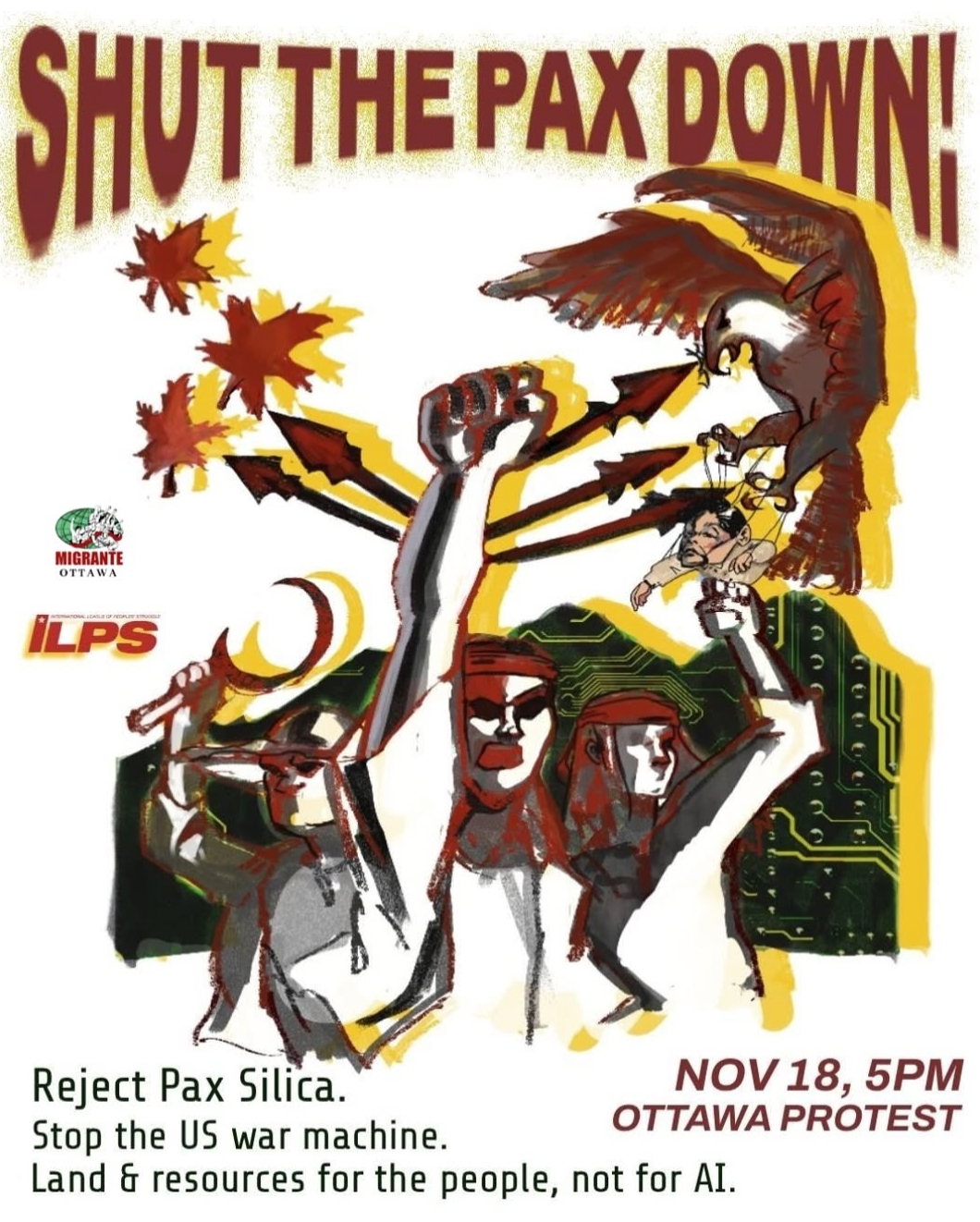
Anakbayan Ottawa, “a chapter of a worldwide national democratic comprehensive mass organization for the Filipino youth”, has posted on social media: “Join us on November 18th for a countrywide day of action to SHUT THE PAX DOWN. This is a US-led initiative to secure the critical mineral and AI supply chain to compete with rival imperialist China that will only lead to the destruction of land and livelihood.”
Earlier this year, Peace Brigades International (PBI) launched a Southeast Asia Project to accompany human rights defenders in the Philippines, Cambodia, Malaysia, Myanmar, and Thailand. This project is focused on the acute exposure to extractive industries, land conflicts, and climate-related violence defenders face.