

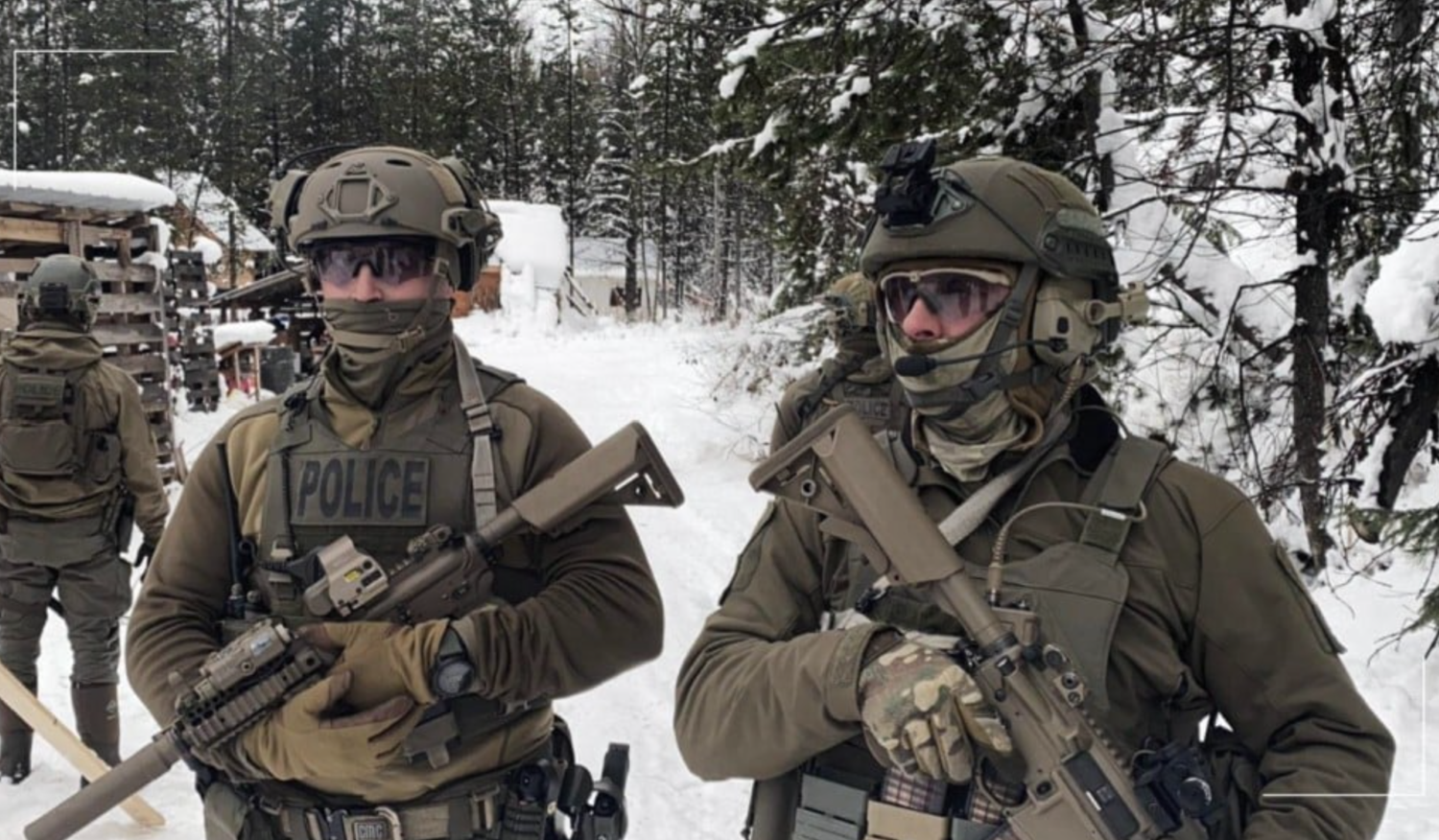
Photo: Heavily-armed RCMP C-IRG officers on Wet’suwet’en territory in November 2021. Photo by Michael Toledano.
The release of the report on the systemic investigation of the Royal Canadian Mounted Police (RCMP) Community-Industry Response Group (C-IRG) by the Civilian Review and Complaints Commission (CRCC) has been delayed until after the provincial election in British Columbia that will be held on October 24.
The CRCC says the election would make it difficult for “relevant provincial authorities to fully consider and respond to its findings and recommendations.”
The systemic investigation was launched on March 9, 2023. Around that time, the CRCC told PBI-Canada that the CRCC strives to complete these investigations within 12-18 months. It appears the investigation was completed after 36 months but its release was delayed by the absence of a CRCC chairperson.
If the report comes out on October 26, 2026, the Monday after the provincial election, it will be closer to 41 months since it was announced.
The decision made by the CRCC has been met with disappointment by Indigenous leaders.
Wet’suwet’en Hereditary Chief Na’Moks (John Ridsdale) told CBC News journalist Brett Forester: “With this delay, they’re ignoring all the harms that have been committed. We’re concerned here that they’ve been present at, like, pro-Palestinian encampments, UBC, and continued to expand their agenda. There’s no doubt this will be increased given Carney’s agenda and widespread opposition.”
Carney’s stated agenda includes advancing the LNG Canada Phase 2 as a major project. That would involve the construction of compressor stations on Wet’suwet’en territory that Chief Na’Moks rejects.
And Terry Teegee, regional chief of the B.C. Assembly of First Nations, told Forester: “Many people, especially those that are affected by this, are disappointed and I think there’s no excuses. It should be released right away considering that it may have implications on issues we’re dealing with in the future.”
Teegee further commented: “The West Coast oil pipeline or any other projects in the near future will be heavily scrutinized and perhaps this issue of protests will come up again. And then how does the RCMP react? Is this going to happen again?”
The West Coast Oil Pipeline would be constructed in part on Secwepemc territory along the path of the Trans Mountain pipeline that was opposed by Secwepemc land defenders and Tiny House Warriors.
The Canadian Association of Journalists (CAJ) is disappointed too.
Brent Jolly, the president of the CAJ, told APTN News: “C-IRG has been the subject of intense scrutiny from the public and press freedom advocates for many years due to its repeated use of so-called ‘exclusion zones’ during demonstrations over the development of natural resource projects in Wet’suwet’en territory and Fairy Creek. These tactics have been deemed to have caused ‘serious interference’ with press freedoms. As an independent watchdog, however, it appears the CRCC is making what amounts to a political decision by withholding this report. The public’s right to know is a fundamental principle of a free and democratic society. Transparency matters because accountability depends on the public having access to information about decisions, institutions, and matters of legitimate public concern.”
The CAJ spoke out against the RCMP C-IRG arrests of journalists on Wet’suwet’en territory during a C-IRG enforcement action in November 2021.
PBI-Canada continues to follow this.

