Home Blog Page 66

RCMP apologizes to Ricochet senior editor and Gitxsan reporter for C-IRG breaching reporter’s Charter rights in 2020

Video still: Turner at 44km on Gidimt’en territory as RCMP helicopter buzzes overhead at the time of the 2020 C-IRG raid on Wet’suwet’en territory.

The CBC reports: “The RCMP [Community-Industry Response Group/C-IRG] seriously interfered with press freedoms, unreasonably blocked media access and arbitrarily detained a reporter during a 2020 raid on Wet’suwet’en-led blockades in northern British Columbia, [the Civilian Review and Complaints Commission/CRCC] says.”

That article continues: “Five years after that operation, the Mounties formally apologized to complainant Ethan Cox, senior editor at independent news outlet Ricochet Media, and Gitxsan reporter Jerome Turner, for breaching Turner’s Charter rights.”

Turner says: “I accept [the apology from the RCMP], with the caveat that they don’t do this to journalists ever again.”

But that is far from certain.

Cox and Turner comment in Ricochet: “There is a certain frustration at the oversight body [the CRCC] that the RCMP’s leadership continues to agree with and accept their rebukes, while ground-level officers continue to commit the same offences.”

Cox and Turner further note: “The one recommendation that the RCMP commissioner did not fully accept, happens to be one on which the media industry largely agrees with the police force, and must disagree with the oversight body.”

They add: “The CRCC recommended that the RCMP establish a method of accrediting journalists for planned and unplanned events. The RCMP considers this logistically unworkable, while the media industry largely agrees with the Supreme Court of Canada that a journalist is defined by their actions, not their affiliations. …In the modern world, as the Supreme Court has noted, anyone can serve a journalistic function by pulling out their phone. …The RCMP should not be put in a position where they are empowered to decide who is and is not a ‘real’ journalist, as that power could easily lead to the type of abuses considered in this report.”

The second-year mark of the CRCC “systemic investigation” is approaching this coming March 8 with no definite date for the conclusion of that report.

We continue to follow this.

From the Civilian Review and Complaints Commission “Summaries of Reviewed Public Complaints” website.

Status: Final Report

Background:

In February 2020, the RCMP was enforcing a civil injunction against obstructive protests by members of the Indigenous Wet’suwet’en people opposed to the Coastal GasLink pipeline project in their territories in British Columbia. The Wet’suwet’en have a long-standing claim to these lands and, while the Wet’suwet’en elected band councils supported the pipeline project, the hereditary chiefs of 12 of the 13 Wet’suwet’en houses opposed it.

A media editor assigned a reporter to cover the protests and the police response. The reporter travelled to the injunction area, intending to visit some protest camps to document what he anticipated would be significant police action, but he was stopped at an RCMP access control point on the road.

Although the reporter had previously been granted access to the area, an RCMP member told him that the “rules had changed,” and he was turned away. The reporter was eventually permitted to enter, but over the next two days the restrictions continued as the RCMP threatened to arrest him if he did not leave the area, detained him for hours at a time, and strictly controlled his movements.

Complaint:

The media editor complained that the RCMP’s use of access control points and exclusion zones interfered with the reporter’s access to the area, violating the reporter’s individual constitutional rights as well as the constitutionally protected freedom of the press. The editor also complained that the RCMP arbitrarily detained the reporter, interfering with his ability to cover the story.

RCMP’s investigation and decision:

The RCMP investigated the allegation and determined that the restrictions on journalists were within the authority of the police, and that they did not unreasonably interfere with the reporter’s ability to take photographs or report on the situation. The Commission was asked to review the matter.

Commission’s review:

The Commission’s review determined that the RCMP recognized journalists without a consistent standard. At times the RCMP had accepted a letter of assignment from the media outlet as credentials, but on this occasion the reporter was turned away despite being admitted three times before. He had to drive back down the remote forest service road to where he started, 27 kilometres away. He contacted his editor, who tried to get assurances from the RCMP that the reporter would be admitted.

However, after the editor told the reporter that he could return to the access control point with his letter of assignment and that he would be admitted, the reporter was again refused entry. He was told again that he did not have approved media credentials. It was only after ongoing discussions, a request to speak to a superior, and the reporter giving a list of the news outlets with which he had published stories that the RCMP permitted him through.

The reporter travelled to the first of the Wet’suwet’en protest camps. He walked five more kilometres to the next camp and stayed the night. He was awakened before 5 a.m. by news that the RCMP had moved in and made arrests at the first camp, including two journalists. The editor was alarmed by this news and he wrote to the RCMP for answers, questioning the legal authority of the RCMP to act. He also asked the RCMP if the reporter he had assigned would get the same treatment if he tried to do his job.

The RCMP replied, “Currently your reporter is within the exclusion zone and subject to all the same restrictions as anyone else within the zone. Your reporter will be given the opportunity to leave on his own accord and return to the Access Control . . . or be subject to arrest . . . .” The British Columbia Civil Liberties Association and the Canadian Association of Journalists condemned the police actions as unlawful.

Amidst this criticism, the RCMP released a statement, explaining that the RCMP “respected the fundamental freedom of the press under the [Canadian Charter of Rights and Freedoms (Charter)], as detailed in recent decisions by courts across Canada” and that the RCMP would “make every reasonable effort to allow media personnel to get as close as possible to the enforcement area, while ensuring no interference with police operations” and subject to “reasonable limitations for public safety and police officer safety.”

Nevertheless, the Commission’s review determined that RCMP interference with the media continued. As RCMP members moved in to make arrests at the Wet’suwet’en protest camp, police officers stopped the reporter and other members of the media before they could approach a blockade within which were several protesters.

The Commission found that the media members were detained under threat of arrest for approximately four hours. They were kept approximately 60 feet from the area, so they could not see or hear everything. RCMP members told the press members that if they tried to move freely or failed to follow any instructions, they would be arrested.

After the arrests were completed, police drove the reporter to the camp where his car was parked. He and a small group of others learned that other protesters had blocked the way back by parking vehicles across the forest road. RCMP members had to clear the obstructions.

The small group was detained there by another RCMP member. The RCMP member later explained that he had been told to wait with the group until the way was clear and the industry convoy got through. Although the journalists had self‑identified as media, they did not seem to have legitimate credentials. The RCMP members were concerned that the reporter might use his car to block the road. After several hours, the reporter was permitted to drive out. The reporter stated that, in all, his two detentions lasted eight hours.

The RCMP’s use of access control points and exclusion zones to restrict the access and movements of the media was unreasonable, as were the threats to arrest the reporter and the reporter’s detention

The Commission analyzed the authority claimed by the RCMP to stop people from entering areas otherwise open to the public unless the people met certain conditions, or to keep them out altogether. In these circumstances, such a power could only come from what is called an “ancillary power” under the common law.

The RCMP believed that the exclusion zones and access control points were necessary because the remoteness, size, and terrain of the injunction area created special challenges, and there were concerns about protesters potentially setting traps or using violence. The RCMP also wanted to prevent the escalation of the blockades.

The Commission’s review determined that the RCMP had set up an access control point on the forest service road. At that time, the RCMP stopped all vehicles at the checkpoint, and the police only permitted passage if the occupants provided their identification, stated their purpose, and got approval from the RCMP Operational Commander or their delegate. In general, the people permitted included hereditary and elected chiefs, elected and government officials, accredited journalists, and people providing food, medical care, or other supplies or services necessary for the well-being of the people at the blockades.

The RCMP also believed that it was reasonable to suspect that anyone leaving the injunction area had been committing offences within, and that anyone entering the area intended to commit offences, meaning that they had grounds to detain them. Anyone entering the area was given a copy of the civil injunction because it informed them that certain activities would put them in breach of the court order and liable to arrest. The RCMP also detained anyone leaving the area to get their identification and to give them a copy of the court order before sending them on their way.

With the enforcement about to begin, the RCMP restricted almost all access to the area. The media exclusion was relaxed in the days that followed because of public criticism, but the RCMP continued to impose many restrictions. The following day, RCMP liaison team members were instructed to keep the reporter and other media members “on [the] far side out of [the] way.” 

Even without specific statutory authority, police do have the power to restrict access to certain areas that are normally open to the public, but this is not a general power. Rather, it is “confined to proper circumstances, such as fires, floods, car crash sites, and the like.” The law also recognizes that the police have the power to cordon off an area in certain circumstances to carry out their duties. To be justified under the ancillary powers doctrine, the action must be “reasonably necessary for the fulfillment of the duty.” While the common law police duties of preserving the peace, preventing crime, and protecting life and property can lead to the ability to act preventatively where appropriate, actions that interfere with individual liberty will be especially hard to justify when a person is not suspected of any wrongdoing.

The Commission found that the RCMP’s use of the checkpoint and exclusion zone to restrict the access and movements of journalists on the dates in question were unreasonable. The Commission also found that the RCMP’s threat to arrest the reporter if he did not leave the exclusion zone was unreasonable.

The Commission further concluded that the reporter’s detention was not authorized under the ancillary powers doctrine.

The Commission found that the RCMP did not fulfill the Charter obligation to inform the reporter of the reasons for his detention or of his right to legal counsel. The Commission also found that the RCMP’s conduct caused serious interference with the freedom of the press.

In terms of the reporter’s second detention while waiting for the road to be cleared, the jurisprudence grants more leeway to the police in controlling traffic than it does for interfering with other rights and liberties. Driving is a heavily regulated activity, and the Commission was satisfied that the RCMP had the general authority to direct and restrict traffic on the narrow forest service road until the way was cleared of the new obstructions.

Nevertheless, the restraint on the reporter’s freedom was greater than being told that the way was blocked. While the RCMP members permitted the reporter and the others to examine and photograph the area, they were not allowed to leave, and they could not walk away from the police. The Commission found that the group was detained.

The Commission wondered why the RCMP member did not ask for the reporter’s cooperation in remaining where he was until the way was cleared. The explanation appeared to be the RCMP members’ distrust of the media members, and the concern that the reporter could have blocked the road with his car if he had been allowed to move sooner. The RCMP members’ skepticism about the reporter’s legitimacy as a reporter, and about his intentions regarding the injunction, were not objectively reasonable. Journalists in Canada have no accreditation regime, but this does not mean that anyone claiming to be a reporter is suspect. If the RCMP members had a reasonable suspicion that the reporter was connected to a recent or ongoing crime, they could have detained him under the law for investigative purposes, but they did not do so.

The unreasonableness of the detention was compounded by its length and by the fact that the reporter and the others were not advised about their Charter rights or even the full reason for their detention. The Commission found that the detention was inconsistent with section 10 of the Charter and RCMP policy.

Recommendations

In a recent report, the Commission recommended that the RCMP develop national guidance for the enforcement of civil injunctions that is consistent with the prevailing jurisprudence about the limited size and duration of exclusion zones and the courts’ cautions about claiming invasive ancillary police powers that are preventative in nature and are not exercised in responding to or investigating a past or ongoing crime. The Commission reiterated that recommendation.

The Commission concluded that new national policy was needed about how to treat the media during RCMP enforcement of civil injunctions and at other public order events. The Commission recommended that the RCMP develop standardized national policy for accrediting media for access to areas where the RCMP is conducting enforcement or otherwise has authority over a scene. The Commission recommended the following general parameters:

The accreditation policy should favour inclusion rather than exclusion of a reporter, reflecting the trend within Canada’s media landscape of smaller, online-only news outlets as well as independents like freelancers and independent filmmakers who may not have a letter of assignment. Accredited media should be issued a badge or other pass that entitles them to be present for protests and other public order events where the RCMP is conducting enforcement, or for other RCMP press events (subject to constraints like space and demand).

The Commission recommended that RCMP members maintain only a very modest buffer zone during injunction enforcement and other public order events that is no larger than necessary to permit the RCMP members carrying out arrests to work safely. The Commission stated that the RCMP should also grant freedom of movement to the press within the enforcement area so long as they remain outside the modest buffer and do not interfere.

The Commission also recommended that, although RCMP media liaisons and/or escorts may be necessary in certain circumstances, such escorts should not otherwise interfere with the media’s freedom of movement except where there is a demonstrated and objectively reasonable operational necessity, and then only to the minimum extent possible.

Lastly, the Commission recommended that an appropriate member of the RCMP apologize to the editor and the reporter for the RCMP’s unreasonable interference with the reporter’s work as a reporter by turning him away from the checkpoint, threatening to arrest him for being within an exclusion zone, and detaining him and controlling his movements.

Commissioner’s response:

The RCMP Commissioner agreed with all the Commission’s findings, and he fully supported almost all the Commission’s recommendations.

However, the RCMP Commissioner wrote that he could not fully support the Commission’s recommendation about a standardized national policy for accrediting media access, although he supported the intention behind the recommendation. The RCMP Commissioner did not believe that this would be feasible for unplanned events. He acknowledged that there was little clarity or consistency in how the reporter was treated in this case. He stated that, as a result, he would direct RCMP policy centres to study the creation a standard method of accrediting journalists that would be useful for both planned and unplanned events.

Commission’s final report:

The Commission welcomed the RCMP Commissioner’s response. The Commission noted that the RCMP Commissioner’s reservations about devising a suitable policy are understandable. The Commission stated that, whatever the standard to be used by the RCMP to accredit media, it should be permissive and include not only journalists who are employed by a media outlet, but also those who are freelancers or who are otherwise independent. The Commission also stated that any RCMP media standard be liberally interpreted and subject to only limited discretion on the ground. Police officers should not normally decide who is or is not a journalist, nor should they react as though a journalist has breached an injunction or obstructed the police merely by doing their job.

The Commission wrote that the RCMP Commissioner’s reservations might be addressed by a simpler policy that incorporated a practice eventually used by the RCMP in 2021 at Fairy Creek, British Columbia, after a court ordered greater media access. The practice was to check identification and ask the reporter their media affiliation before admitting them.

PBI-organized “Who Bears the Cost?” webinar highlights the impacts of transnational corporations, the situation in Buenaventura

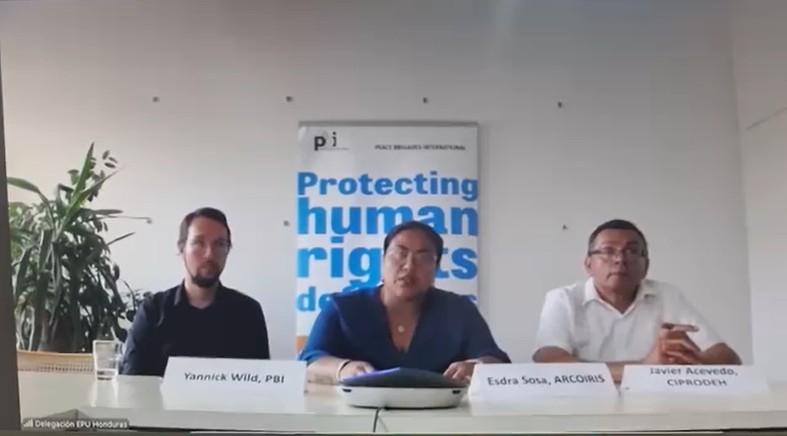
On Monday February 24, Peace Brigades International organized a webinar, hosted by Lorena Miguel of PBI-Catalunya, that highlighted a new report “Who Bears the Cost?” and included perspectives and analysis from several countries.

We include excerpts of their comments below.

Milbia Andrea Díaz, Inter-Church Commission for Justice and Peace, Colombia

“In Colombia, many of the missing people lie in the sea. “[Specifically, in the San Antonio estuary in Buenaventura], there must be about a thousand people in water graves. We know the difficulties of finding remains in the sea and in the mangrove swamp, but there is technology that would make it possible to find them.”

“[Families] ask that the estuary be kept as a place of historical memory, because that is where their disappeared rest. It would be an act of justice, feasible within the framework of the special mechanism for the issue of memory.”

“There is a high level of corruption, violence and state neglect of fundamental rights, which has turned into a scenario of harassment and abuse of illegal armed structures, with strong links to the Public Force. Responsibility of the state for action, omission and lack of respect for the state. Today it is being challenged by a totally failed peace proposal, which only relies on criminal gangs of perpetrators of violence and misery in Buenaventura.”

Vicente Vallies, author of “Who Bears the Cost?” report

“With the dredging of the estuaries, the right to search would be violated. Reparation involves being able to bury your loved one in a dignified way… It is difficult to think that people can talk about coexistence and positive construction if they are prevented from recovering the bodies of their loved ones.”

“[In Buenaventura] everyone pays extortion: the fishmonger, the displaced person who goes to get his subsidy check, everyone pays the illegal armed actors. This represents a risk for companies.”

“The European delegations in Colombia would do well to believe the local population, the fishermen, the people who are looking… If they supported them in their desire not to dredge that estuary, which is a large cemetery, it would be a great step.”

Ixmukane Quib, the Committee for Peasant Unity (CUC), Guatemala

“It is important to mention that Guatemala is a country made up of an indigenous population, present in territories in which there is a high interest on the part of national and transnational extractive companies.”

“The capitalist system is based on dispossession and mainly responds to the economic accumulation of a minority and that these are strongly linked to financial organizations such as the IDB, WB, which finance extractive companies. These financial resources serve to dispossess the common goods of the communities, destroy biodiversity, territories and the social fabric.”

“In my territory, because it is a territory rich in water resources and highly productive lands due to its diversity, there is a high interest from transnational companies and consequently greater conflict, the dispute over the territory then is between extractive companies, palm oil monoculture that currently occupies just over 180,614 hectares nationwide and this has caused serious contamination in the rivers, a decrease in the quality of life of the communities, precarious health, violation of locomotion and the human rights of those who inhabit the territory and that for these projects to be carried out triggers a series of land dispossessions and the concession of national lands to private companies.”

Brent Patterson, Peace Brigades International, Canada

“A key connecting point for us with the port of Buenaventura is the Canada-Colombia free trade agreement.”

“In 2010, the year before this Agreement came into force, two-way trade between Canada and Colombia totaled $1.4 billion. By 2023, with twelve years of the Agreement, two-way merchandise trade dramatically increased to $2.6 billion.”

Despite the expansion of the port that comes with increased trade, the displacement of communities and human rights violations that happens with the expansion of the port, and the associated push to dredge the harbour to allow for a deepwater port and bigger cargo ships, and disturb the water graves, Global Affairs Canada, continues to conclude that they are ‘unable to demonstrate that any actions taken by the Government of Canada … through the implementation of the [free trade agreement] … have had a direct impact on human rights in Canada or Colombia.’”

Laia Otero, CooperAcció, Catalunya/Spain

“At CooperAcció we are part of the Catalan Group for Business and Human Rights, a working group made up of 22 entities and 2 second-level platforms that is working towards the creation of the Centre for Business and Human Rights.”

“In June 2015, the situation in Buenaventura was denounced in the Parliament of Catalonia and the European Union, where foreign investments for the expansion of the port have a direct relationship with the violence and poverty that develops in the territory and where the then Catalan company TCB- Barcelona Container Terminal invests in the expansion of the port through its subsidiary TCBuen, with the idea of ​​turning it into a large infrastructure for the country’s trade, ignoring the authoritative voices that denounce how these megaprojects aggravate the situation of violence in Buenaventura.”

“In addition to the Buenaventura case, the group has generated investigations of human rights violations by companies operating in our territory and we have collected them on the AlertaDH website, where we have more than 20 cases and to which we continue to add new investigations today, not only to generate advocacy strength but also to raise awareness and inform the Catalan population about the practices carried out by companies in the global south.”

“We hope that 2025 will be the year of the creation of the Catalan Center for Business and Human Rights.”

Lorena Miguel, Peace Brigades International, Catalunya

Lorena Miguel, who organized, introduced and moderated this webinar, concluded the discussion with highlighting the new “Who Bears the Cost?” report.

That report can be found here.

The Executive Summary can also be read in English here: Inglés_Digital_REjecutivo_PBI

Further reading: “With the dredging of the estuaries, the right to search would be violated”: Vicente Vallies, author of PBI report on Buenaventura (PBI-Canada), The Canada-Colombia free trade agreement and “aquafosas” (water graves) in the San Antonio estuary of Buenaventura (PBI-Canada) and PBI-Canada to participate in “Who Bears the Cost?” webinar on the port of Buenaventura in Colombia and transnational corporations (PBI-Canada).
The Canada-Colombia free trade agreement and “aquafosas” (water graves) in the San Antonio estuary of Buenaventura

Photo by PBI-Colombia.

To register for the “Who Bears the Cost?” webinar on Monday February 24, click here.

Speaking notes:

In the ten minutes that we have, we would like to highlight the role that Canada could play in stopping further violations of human rights, and upholding the right to search the “aquafosas” or “acuafosas” (water graves), by speaking against the dredging of the San Antonio estuary where the port of Buenaventura is situated.

Milbia Andrea Díaz of the Inter-Church Commission for Justice and Peace recently told the German newspaper Deutsche Welle (DW): “In Colombia, many of the disappeared people rest in the sea. …There must be about a thousand people in the acuafosas [of the San Antonio estuary of Buenaventura].”

That article highlights: “The dredging of that estuary for the expansion of the port of Buenaventura would end any possibility of finding them.”

Precautionary measures for the estuary of the “disappeared”

In April 2021, the Special Jurisdiction for Peace (JEP) granted protection status that paused the dredging of the estuary.

It was most recently reported by the Colombian publication Cambio on February 18, 2025, that the JEP had decided “to maintain the protection of areas of forensic interest in the mangrove” for another 10 months, essentially until the end of this year.

As such, there is time for the Government of Canada to, as Vicente Vallies (the author of a new PBI report on the port of Buenaventura) has asked of European delegations in Colombia, “to believe the local population [and support] them in their desire not to dredge that estuary, which is a large cemetery.”

Photo: Kerstin Reemtsma (PBI-Guatemala), Vicente Vallies (report author) and Milbia Andrea Díaz (Justice and Peace Commission) at the European Parliament in Brussels, Belgium, on February 19, 2025.

The Canada-Colombia free trade agreement

A key connecting point for us is the Canada-Colombia free trade agreement.

In 2010, the year before this Agreement came into force, two-way trade between Canada and Colombia totaled $1.4 billion. By 2023, with twelve years of the Agreement, two-way merchandise trade dramatically increased to $2.6 billion.

We believe that a significant portion of that two-way trade would be between the Port of Vancouver on the Pacific coast of Canada and Buenaventura, approximately 5,000 nautical miles apart and about 20-25 days by ship.

The Canada-Colombia free trade agreement came into force on August 15, 2011, just a few months prior to the United States-Colombia Trade Promotion Agreement (CTPA) going into effect on May 15, 2012.

Paramilitaries and private companies

Independent researchers have highlighted that Colombian human rights defender Enrique Chimonja “sees the continuing paramilitary group activity [in Buenaventura] as a strategy by private companies to evict people living on their collective lands to accommodate port expansion required not only by the free-trade agreement with the United States but also by the 16 other FTAs Colombia has signed.”

In November 2022, Julian Streit of the Peace Brigades International-Colombia Project further cautioned: “Enforced disappearances in Buenaventura mainly benefit the port companies that want to dredge the San Antonio Estuary without hindrance and ensure the navigation of ocean-going ships in the sector, regardless of the tide.”

Researchers have also noted: “As a result of the FTAs, Buenaventura has seen a 42-percent growth in international trade during the decade of 2010 to 2020. It has also undergone a number of port expansions including a $200 million mega-project, the Buenaventura Containers Terminal (TC Buen), which has also displaced people from surrounding neighbourhoods to make way for construction.”

Dredging the harbour

In June 2020, Mongabay reported: “Today, Buenaventura is Colombia’s only Pacific coast port that serves North America and Southeast Asia. But it’s not a deepwater port. This means large ships with heavy cargo have to wait for high tide to be able to enter the harbor, and only have a four–hour window to unload and load their cargo before the tide goes out again.”

In February 2021, Valentina Carvajal of the Peace Brigades International-Colombia Project wrote: “One of the projects that began in 2019 is the dredging of the San Antonio estuary. This work – financed with public and private money – aims to achieve a greater depth of the waters of the Bay of Buenaventura to enable the entry of larger ships. The problem is that the San Antonio estuary is one of the largest mass graves in Colombia and relatives of victims of the armed conflict are still searching for the disappeared.”

As noted above, just a few months later in April 2021, the JEP granted protection status that temporarily paused the dredging of the estuary.

Our submission to Global Affairs Canada

In 2021, PBI-Canada wrote to Global Affairs Canada (the Canadian ministry of foreign affairs) about the situation in Buenaventura.

In the words of Global Affairs Canada: “This submission highlighted the increased violence and forced displacements in the city of Buenaventura, as well as the negative impact of the city’s port activities and infrastructure development on human rights and the living conditions of the local community.”

Global Affairs Canada then noted: “The information shared has been taken into consideration in the elaboration of the relevant section of this report.” It is not clear to us what they meant by this, but significantly they ultimately found “no human rights impacts which could be directly associated with Canada’s 2020 tariff reductions.”

Most recently Global Affairs Canada once again concluded that in 2023 that they were “unable to demonstrate that any actions taken by the Government of Canada … through the implementation of the [free trade agreement] … have had a direct impact on human rights in Canada or Colombia.”

Their call for submissions for 2024 is now open with a deadline of March 16, 2025 for comments.

Port blocked during Civic Strike of 2017

We also want to mention that the North American Congress on Latin America (NACLA) has noted: “In May 2017, Buenaventura residents held a 22-day civic strike to protest ongoing investment in its port instead of investing in local residents.”

NACLA highlighted: “In an impressive show of organizational capacity, Afro-Colombian and Indigenous communities and organizations united to shut down the city, blocking the port and flooding the streets. Residents demanded resources to invest in building a local hospital, more economic opportunities, and potable water.”

The Public Service Alliance of Canada (PSAC) has highlighted that concessions were won including “a new framework agreement to protect the rights of port workers.”

In November 2018, the PSAC cautioned: “Since May 2017, threats against strike leaders have continued as plans go forward to expand and modernize the port, while the government fails to implement its agreement with the strikers.”

Vanessa Renteria Valencia

In closing, we also want to remember Vanessa Renteria Valencia.

Her sister Sandra has noted: “Vanessa worked for 12 years in the port of Buenaventura and was a union activist in SNTT (National Union of Branch Labor, Transport and Logistics Services of Colombia).”

Vanessa arrived in Canada in 2022 as a refugee fleeing violence and death threats.

She settled in the city of Surrey, a municipality within the Metro Vancouver regional district (where the Port of Vancouver that ships to and receives good from the port in Buenaventura is situated).

On September 19, 2024, Vanessa was killed by the Royal Canadian Mounted Police (RCMP) who had received a call about a “disturbance” in her home. Five months later, there are still questions about what happened.

Conclusion

We thank you for the opportunity to participate in this forum.

NOTE: These are speaking notes for a webinar taking place on Monday February 24. To register for this webinar, click here. The webinar will have simultaneous Spanish-English interpretation. (Photo left to right): Webinar speakers Milbia Andrea Díaz, Vicente Vallies, Ixmukane Quib, Laia Otero, Brent Patterson.

Photo: PBI-Canada visits Buenaventura, July 4, 2022.

“With the dredging of the estuaries, the right to search would be violated”: Vicente Vallies, author of PBI report on Buenaventura

A Peace Brigades International (PBI) organized webinar on Monday February 24 will feature Milbia Andrea Díaz, of the Inter-Church Commission for Justice and Peace, and Vicente Vallies, author of the new PBI report “Who Bears the Cost?”.

To register for this webinar that happens at 10:00 am in Colombia/ Ontario/ Quebec/ Nunavut and at 4:00 pm in Catalunya/ Spain, click here.

Deutsche Welle article: “The missing in the port of Buenaventura”

Diaz recently told Deutsche Welle: “In Colombia, many of the disappeared people rest in the sea. There must be about a thousand people in [the estuary in Buenaventura]. We know the difficulties of finding remains in the sea and in the mangrove swamp, but there is technology that would make it possible to find them.”

Diaz adds: “For this reason, they ask that this estuary be maintained as a place of historical memory, because its disappeared rest there. It would be an act of justice.”

The newspaper article highlights: “The dredging of that estuary for the expansion of the port of Buenaventura would end any possibility of finding them. Together with groups of women searchers, the CIJP and other organizations have obtained a precautionary measure to stop the works in that estuary. For the moment.”

Vallies also tells DW: “With the dredging of the estuaries, the right to search would be violated. Reparation involves being able to bury your loved one in a dignified way… It is difficult to think that people can talk about coexistence and positive construction if they are prevented from recovering the bodies of their loved ones.”

Vallies also notes: “[In Buenaventura] everyone pays extortion: the fishmonger, the displaced person who goes to get his subsidy check, everyone pays the illegal armed actors. This represents a risk for companies.”

Vallies further highlights in his comments to Deutsche Welle: “The European delegations in Colombia would do well to believe the local population, the fishermen, the people who are looking… If they supported them in their desire not to dredge that estuary, which is a large cemetery, it would be a great step.”

Webinar, Monday February 24

To register for the webinar this coming Monday February 24, click here. The webinar will have simultaneous Spanish-English interpretation.

Along with Vallies and Diaz, the speakers will also include Ixmukane Quib from the Committee for Peasant Unity (CUC) in Guatemala, Laia Otero from CooperAcció in Catalunya, and Brent Patterson from PBI-Canada.

(Photo left to right): Webinar speakers Milbia Andrea Díaz, Vicente Vallies, Ixmukane Quib, Laia Otero, Brent Patterson.

The “Who Pays the Cost?” report can be downloaded from the PBI-Spanish State website here.

UN Special Rapporteur Mary Lawlor highlights Wet’suwet’en and Gitxsan land defenders prior to March 6 report to Human Rights Council

Mary Lawlor, the United Nations Special Rapporteur on human rights defenders, has posted on Instagram:

“On 6 March I’ll present my latest report to the @humanrightscouncil, on human rights defenders in isolated, remote & rural contexts. In the lead up, I am sharing stories illustrating how the risks & challenges these defenders face are often linked to their location.”

Lawlor has also posted this on X, Bluesky and Facebook.

UN Web TV

We will be following the presentation by Lawlor on Thursday March 6 on UN Web TV.

“Land defenders labelled criminals”

The sketches of the defenders featured in the image shared by Lawlor are Indigenous land defenders Sleydo’ (Wet’suwet’en, Gidimt’en Clan), Kolin Sutherland-Wilson (Gitxsan) and Freda Huson (Wet’suwet’en, Unist’ot’en Clan).

A focal point of their resistance to the Coastal GasLink fracked gas pipeline being built without consent is near the town of Houston, British Columbia, situated about 1,100 kilometres north of the city of Vancouver.

The Royal Canadian Mounted Police (RCMP) Community-Industry Response Group (C-IRG) has launched three highly-militarized raids on Wet’suwet’en territory and arrested more than 74 land defenders, legal observers and members of the media.

Huson was arrested during the RCMP C-IRG raid on February 10, 2020.

Sleydo’ was arrested at gunpoint by the RCMP C-IRG on November 19, 2021.

And Sutherland-Wilson was arrested on October 27, 2022, after Likhts’amisyu Hereditary Chief Dsta’hyl decommissioned ten pieces of heavy construction equipment being used to build the Coastal GasLink pipeline.

PBI accompanies

On November 19-22, 2021, Brent Patterson of PBI-Canada visited Wet’suwet’en and Gitxsan territories in response to this video appeal from Sleydo’ to “come to the yintah now” and to “amplify the message”. We met Huson at the Unist’ot’en Healing Centre and Sutherland-Wilson overlooking CN Rail tracks where a solidarity blockade with the Wet’suwet’en had taken place at the time of the RCMP C-IRG raid.

On September 28, 2022, Kim-Mai Vu of PBI-Switzerland presented to the United Nations Human Rights Council in Geneva during the Interactive Dialogue with the Expert Mechanism on the Rights of Indigenous Peoples.

She stated: “The Committee on the Elimination of Racial Discrimination has called on Canada to stop construction of the Coastal GasLink pipeline on Wet’suwet’en territory. Canada ratified this International Convention in 1970 and said in 2016 that it supported the Declaration on the Rights of Indigenous Peoples, however, the construction of this gas pipeline without consent continues as does the criminalization of land defenders.”

On June 26, 2024, PBI-Canada met with Mary Lawlor and Michael Phoenix, her Head of Research and Campaigns, in Ottawa. We appreciate her work highlighting issues about Indigenous land defenders in Canada as well as the impact of Canadian extractive companies in Latin America.

Further reading: RCMP C-IRG snipers repeatedly deployed against Wet’suwet’en land defenders and water protectors (PBI-Canada, February 20, 2025).

PBI-Mexico accompanies the FPDTA-MPT at march in Mexico City on the 6th anniversary of the murder of Samir Flores Soberanes

PBI-Mexico has posted:

This Friday, February 21, PBI accompanies the People’s Front in Defense of Land and Water of Morelos, Puebla and Tlaxcala (FPDTA-MPT) in the march to claim justice in the case of Samir Flores Soberanes.

From PBI Mexico, we express our deep concern for the six years of impunity in the murder of this defender. We call on the authorities to uphold the right to truth and justice, and pledge to ensure the protection of human rights defenders. We reaffirm our commitment to continue supporting communities in their fight for self-determination and the protection of their territories.

Mario Marlo reports in Somos el Medio:

Six years after the murder of land defender Samir Flores Soberanes, social organizations, communities and family members marched from the Ministry of the Interior to the Zócalo [a main square in central] Mexico City as part of the ‘Global Day of Struggle: Justice for Samir Flores Soberanes’.

Photo outside the Ministry of the Interior.

With slogans such as ‘Samir Lives, the struggle goes on and on’, the demonstrators demanded justice and the clarification of his murder, which occurred in 2019.

The People’s Front in Defense of Land and Water (FPDTA) led the mobilization, carrying a bust of Samir Flores… The march culminated in the capital’s Zócalo, where a rally was held in which Liliana Velásquez, widow of Samir Flores, took the floor to demand justice and remember her husband’s legacy.

Photo of Teresa Castellanos and Liliana Velazquez at the march. Photo by Mario Marlo.

‘It is not fair that at the whim of the government, which hinders those who fight for life, fathers and mothers, children stay at home crying,’ said Liliana Velasquez, who also spoke on behalf of her children, especially her youngest son, who was just two years old when his father was murdered. ‘Today, at 8 years old, little by little the memory of his father is erased. It’s not fair,’ she added with emotion.

During the rally, Liliana Velásquez demanded that the government of Claudia Sheinbaum thoroughly investigate the case and bring those responsible to justice. ‘We demand that Hugo Eric Flores, President López Obrador’s envoy to operate the PIM consultation, and the former governor of Morelos Cuauhtémoc Blanco be investigated,’ she declared.

In addition, she denounced that one of the alleged members of an organized crime group in Morelos, linked to the case, enjoys privileges in his detention, which shows the lack of political will to punish the culprits.

‘The greatest justice for Samir will be to continue fighting from our spaces and not forget him,’ said Velásquez, who thanked the support of the organizations, communities and people present at the march. ‘Samir has been a seed, and his fight is still alive,’ she concluded.

This article can be read at A seis años del asesinato de Samir Flores, organizaciones y comunidades marchan exigiendo justicia en la CDMX.

And El Universal reported:

Activists pointed out that the Morelos Integral Project [the PIM] is high risk and includes a thermoelectric plant in Huexca and a mega gas pipeline that would cross Popocatepetl [an active stratovolcano] and the states of Morelos, Puebla and Tlaxcala: ‘The thermoelectric plant would leave dozens of towns without water and pollute the air and the remaining water. The pipeline would be a time bomb running through a highly seismic area,’ they warned.

The groups expressed that [the murder of Samir] is added to a list of more than 200 defenders of the territory and the rights of the peoples, especially the CNI [National Indigenous Congress], in recent years.

Video still from CNI.

They also marched for their missing sisters and brothers [including the 43 students from Ayotzinapa], in the fight against the ‘Military Train wrongly called Maya’ and against the interoceanic corridor [linked to the recent murder of three members of UCIZONI]. As well as against xenophobia and forced migration, against the mine, the dam, fracking, the real estate cartel and the garbage business, as they indicated.

‘Justice, in the struggle for the defense of rivers, seas and bodies of water, of forests and autonomous spaces on land or in the air. Justice! it is what Samir built during his life.’

This article can be read at “Ni perdón ni olvido, Samir Flores vive”: protestan por asesinato de activista; acusan a AMLO de lavarse las manos.

Accompaniment

At PBI-Canada we continue to highlight that the FPDTA-MPT has linked the PIM megaproject to Toronto-based Alamos Gold and its Esperanza mine. In November 2020, they posted: “[Mexican president] Lopez Obrador’s [support for the PIM] betrays the peasant and the promise of change of his government, to favour transnational corporations [including] Canadian miners like Alamos Gold.”

PBI-Mexico has accompanied the People’s Front in Defense of Land and Water of Morelos, Puebla and Tlaxcala (FPDTA-MPT) since early 2020.

Further reading: PBI-Mexico accompanies activities in Amilcingo on the 6th anniversary of the murder of Indigenous Nahua defender Samir Flores Soberanes (PBI-Canada, February 21, 2025).

PBI-Guatemala observes trial of PAC members accused of violations against Indigenous Achi women during the internal armed conflict

On February 20, PBI-Guatemala posted: “Yesterday #PBI observed a hearing of a second trial in the case of the #MujeresAchí [Indigenous Achi women], who after 40 years of struggle seek to achieve justice for the sexual violations and crimes against humanity suffered. Three former civilian self-defence patrol members are accused for the events that occurred between 1981 and 1985 in the municipality of Rabinal.”

CRN Noticias has previously explained: “The defendants [three former members of the Civil Self-Defence Patrols paramilitary force] face charges of sexual violence against more than 30 Mayan women of the Achí people during the 1980s, in the context of the internal armed conflict. [The Prosecutor’s Office has presented evidence] that the defendants sexually abused at least five women. These women were detained for more than 25 days in a military barracks in Rabinal, Baja Verapaz.”

Memoria Virtual has noted that the Civil Self-Defence Patrols (las Patrullas de Autodefensa Civil or PAC) “were paramilitary organizations … organized, armed, supervised, and directed by the military forces … [established] to monitor and defend the villages, to pursue and detect suspects of belonging to the guerrillas and to participate in military actions or punishment of the [mostly Indigenous] population.”

The internal armed conflict killed an estimated 200,000 people and displaced more than one million people between 1960 and 1996.

45,000 people are still unaccounted, including 5,000 children.

The conflict between state military forces and guerilla combatants was underpinned by the poverty, marginalization and racism against Indigenous peoples.

The United Nations-backed Commission for Historical Clarification established in June 1994 determined that the Guatemalan military was responsible for 93 per cent of the atrocities – including forced disappearances, massacres and torture – and that 83 per cent of the victims were Indigenous Maya peoples.

The Commission concluded that acts of genocide occurred during the war.

Radio FGER has noted: “The ‘Mujeres Achi’ case is emblematic of sexual violence during the internal armed conflict, evidencing the use of rape as a weapon of war by the Army and paramilitary groups to attack women and subjugate indigenous communities. …Violations in these contexts were particularly degrading, as many victims were abused while in detention, and at times, in front of family members, which intensified their suffering.”

We continue to follow this.

Further reading: PBI-Guatemala accompanies the Association for Justice and Reconciliation (AJR) at #MujeresAchí trial (PBI-Canada, January 30, 2025).

Amnesty International could designate three Indigenous land defenders in Canada as prisoners of conscience

Photo: Corey Jocko, Sleydo’ and Shaylynn Sampson. Photo by Amanda Follett Hosgood/The Tyee.

On Tuesday February 18, CBC reported that BC Supreme Court Justice Michael Tammen ruled that the Royal Canadian Mounted Police (RCMP) Community-Industry Response Group (C-IRG) breached the Charter rights of three Indigenous land defenders during a militarized raid on Wet’suwet’en territory in 2021.

Those land defenders are Sleydo’ (Wet’suwet’en), Shaylynn Sampson (Gitxsan) and Corey Jocko (Kanien’kehá:ka-Mohawk).

Amnesty International now says that it “is reviewing the implications of Tuesday’s decision. Should they receive a sentence that arbitrarily deprives them of their liberty, Amnesty will designate the affected land defenders as prisoners of conscience.”

Ana Piquer, Americas director at Amnesty International, says: “If the Canadian state decides to unjustly criminalize and confine Sleydo’, Shaylynn, and Corey, Amnesty International will not hesitate to designate them as prisoners of conscience. Canada is on the sadly long list of countries in the Americas where land defenders remain at risk for their essential work.”

France-Isabelle Langlois, general director of Amnistie internationale Canada francophone, adds: “The Court’s decision to uphold the convictions of the three land defenders is part of a broader context of shrinking civic space in Canada, where Indigenous land defenders, environmentalists, and human right defenders are frequently the victims of political or police repression.”

Photo by Amnesty International

Maximum sentence of five years

Justice Tammen found the three land defenders guilty last year of criminal contempt of court for breaking an injunction against blocking work on the Coastal GasLink pipeline on Wet’suwet’en territory. CBC reports: “Tammen said the maximum sentence for criminal contempt is no more than five years imprisonment.”

APTN adds: “The case will be back in court on April 3 to fix a date for sentencing.”

Chief Dsta’hyl

Video: Chief Dsta’hyl and Gitxsan land defender Kolin Sutherland-Wilson detained by the RCMP C-IRG, October 27, 2021.

The Amnesty International statement further notes: “If Amnesty International names Sleydo’, Sampson and Jocko prisoners of conscience, it will be the second time the organization has applied that designation to a person held by Canada. In July 2024, Amnesty declared another Wet’suwet’en land defender – Likhts’amisyu Clan Wing Chief Dsta’hyl – a prisoner of conscience after the British Columbia court sentenced him to 60 days of house arrest.”

We continue to follow this.

Further reading: RCMP C-IRG snipers repeatedly deployed against Wet’suwet’en land defenders and water protectors (PBI-Canada, February 20, 2025).

PBI-Canada social media post.

Click here: The Yintah Access link to donate to help support the legal costs of the land defenders challenging RCMP C-IRG violence.

PBI-Mexico accompanies activities in Amilcingo on the 6th anniversary of the murder of Indigenous Nahua defender Samir Flores Soberanes

On February 20, PBI-Mexico posted: “Today in Amilcingo #PBI accompanied the mass and the procession for the 6th anniversary of the murder of the defender and community communicator Samir Flores Soberanes. In the framework of the international accompaniment to the Front of Peoples in Defense of Land and Water – Morelos, Puebla and Tlaxcala, we remember the nonviolent work of Samir for his community, his territory, and the dignity of the Indigenous Peoples, and that violence against human rights defenders continues threatening their legitimate work in their fight for rights and justice.”

La Jornada San Luis reports:

“Around 8 a.m. a mass was held in the house of Samir’s children and his partner Liliana, near the home of his parents, and a few meters from where he was killed in 2019.

Video still.

Afterwards, those present marched with flowers and candles to the center of the community; they made a stop and political act in front of the Amiltzinko community radio station, which Samir founded to organize the resistance of this town and others in the eastern zone of Morelos.

Video still.

Around 10 a.m., the contingent arrived at the elementary school located in the center of Amilcingo, named after Samir Flores Soberanes. In this school the students sang songs to remember the struggle of the environmental defender.

In this act, the plastic artist Carmen Jiménez Cacho gave the school a painting in which she painted the body of Emiliano Zapata, with the face of Samir Flores; on the sides she placed the faces of Genaro Vázquez, Lucio Caballas, Rubén Jaramillo and Isidro Baldenegro [other social fighters who died to defend the land, the environment and life].”

Video still.

El Sol de Cuautla further reports: “The march concluded at the municipal cemetery, where flowers covered his grave. As every February 20 in recent years, the community renewed the promise not to forget and not to forgive until justice is done.”

Photo by CNI (National Indigenous Congress) México.

Other commemorations

The Mexico Times adds: “As part of the day of struggle for the six years since Samir’s murder, the People’s Front in Defense of Land and Water of Morelos, Puebla and Tlaxcala and the National Indigenous Congress called for a march on February 21 [starting at 4 pm] in Mexico City.” Periodistas Unidos further notes: “[The massive mobilization] will depart from the Ministry of the Interior to the Zócalo.”

Diario de Morelos also notes: “On Saturday, February 22, at the cultural space La Bigotona, in Cuernavaca, there will be one more day of artistic and cultural activities, with Hugo Mazatl and Abril Luna (dance), Son de Chía, La Mosca con Smoking, El Viejo Luna, La Internacional Cananea and his Tiro de Piedra, who will continue to raise their voices for Samir.”

The demand for justice

El Sol de Cuautla also reports that the march took place “a day after President Claudia Sheinbaum said she would ask the Attorney General’s Office (FGR) to make progress in the investigation of the case.”

And La Jornada San Luis reports: “In an interview, Juan Carlos Flores, Jaime Domínguez and Jorge Velázquez, members of the [Peoples Front in Defence of Land and Water], complained that the investigations did not advance in the State Attorney General’s Office or in the Attorney General’s Office, which took the case. They assured that if they really want to clarify this, the main line of investigation must be that it was a ‘narco-political crime’, ordered from the highest spheres of power, and that it was carried out by members of an organized criminal gang that operates in the state.”

Educa Oaxaca adds: “Two of the probable perpetrators of Samir’s murder are said to be dead, one of the detainees is about to be tried and another is a fugitive from the law. Of the three main witnesses, two are also dead. ‘This shows the terrible network of power behind Samir’s murder’, the [People’s] Front said.”

Up next, El Sol de Cuautla reports: “On March 10, a hearing will be held in the Judicial City of Atlacholoaya, where alleged perpetrators of the homicide will be summoned.”

Further reading: PBI-Mexico accompanies the People’s Front at press conference demanding justice for Samir Flores Soberanes (PBI-Canada, February 15, 2025).

We continue to follow this.

LINK TO CANADIAN MINING COMPANIES

Alamos Gold and Zacatecas Silver

We would also highlight that the People’s Front has linked the PIM megaproject to Toronto-based Alamos Gold and its Esperanza mine. In November 2020, they posted: “[Mexican president] Lopez Obrador’s [support for the PIM] betrays the peasant and the promise of change of his government, to favour transnational corporations [including] Canadian miners like Alamos Gold.”

In February 2022, Toronto-based Alamos Gold Inc. announced “it has entered into a binding agreement to sell its non-core Esperanza Gold Project located in Morelos State, Mexico to [Vancouver-based] Zacatecas Silver Corp. for total consideration of up to $60 million.”

Avispa Midia has also reported: “Gathered [at the ‘First Assembly of the Nahua people of Morelos against mining and megaprojects of death’ in April 2022], the Nahua peoples denounced the mining project ‘paradoxically called Esperanza’, for the exploitation, in open-pit pits, of gold and silver. This concession, for the Canadian companies Alamos Gold and Zacatecas Silver, is located just 500 meters from the Xochicalco site [an archaeological site and UNESCO World Heritage Site].”

PBI-Nicaragua accompanies the REMUPI-organized Pinolera Fair of “resistance and sisterhood” in Costa Rica

PBI-Nicaragua has posted on Instagram and Facebook:

On Sunday, February 16, PBI accompanied the 41st edition of the Pinolera Fair, a space organized by the Pinolera Women’s Network [REMUPI] systematically for more than four years. In this edition, REMUPI joined forces with the Feminist Collective Las Volcánicas in the framework of the ‘Raíces que unen’ (Roots that Unite) Campaign, promoted by Oxfam Central America.

Defenders Fernanda and Egda from the Network animated the space recalling the importance of strengthening the spaces of articulation of women’s organizations, solidarity among peoples, to promote feminist economy and to promote art and culture as an expression of women’s resistance and struggle.

The fair ended with a concert, where the voices of artists from Nicaragua and Costa Rica joined the audience with messages full of shared stories between cultures, empathy with exiles and commitment to the construction of inclusive societies where xenophobia, discrimination, inequality, violence and injustice have no place.

The Pinolera Fair

Intertextual has previously reported: “Mixtli T Córdoba has been exiled in Costa Rica for 5 years. For her, the Pinolera Fair, one of the spaces offered by Remupi, means ‘following the living flame’ of what Nicaragua means outside the territory, this being a space of ‘resistance and sisterhood’ among feminist women and activists.”

That article further notes: “According to Córdoba, what Nicaraguan women are seeking by organizing this fair is to follow their roots and cultures from a place of resistance, creating a space where their voices can be heard and their demands for freedom for political prisoners in their country can reach the ears of the international community.”

In September 2024, República18 also reported: “Fernanda Martínez, a member of the feminist organization, pointed out that for four years, the Pinolera Fair has been held every month. She pointed out that within her lines of work is political advocacy around the promotion and defense of the human rights of Nicaraguan women.”

That Republica18 article highlights: “The 36th Pinolera Fair that took place in San José, Costa Rica, on September 15, was dedicated to journalist Fabiola Tercero, who has been missing since July 12, 2024.”

Photo: The whereabouts of Tercero are still unknown.

Accompaniment of REMUPI

PBI-Nicaragua has previously explained: “The Red de Mujeres Pinoleras, also known as REMUPI, was founded in 2020 by Nicaraguan women refugees in Costa Rica, following the socio-political crisis of 2018 in Nicaragua.”

They have also noted: “The organisation accompanies and guides women fleeing state violence in Nicaragua, generating and strengthening networks so that they can sustain themselves emotionally and economically, as a strategy for resilience. It is a political space where women seek a dignified life, not only in exile but in a Nicaragua that respects all people. It is a network of solidarity, collective care, memory and struggle.”

Context

In June 2018, University of Saskatchewan professor Lori Hanson and Nicaraguan professor Miguel Gomez wrote in Briarpatch Magazine: “On April 18, university students calling themselves the autoconvocados (self-organized) launched national protests against government foot-dragging in controlling widespread fires in the Indio Maiz biosphere [a protected reserve in southeastern Nicaragua].”

Hanson and Gomez add: “At the time, the protests were organized using the hashtag #SOSIndioMaiz. And while those fires were still smouldering, [Nicaraguan president Daniel] Ortega proceeded to pass reforms to Nicaragua’s social security system (INSS) into law without consultation. The focus quickly shifted: in social networks #SOSIndioMaiz became #SOSINSS. Students joined pensioners in protest, much as they had in 2013 (#ocupaINSS).”

As of December 2022, close to 200,000 Nicaraguans have sought refugee status in Costa Rica since the state repression of those 2018 protests began.

El Pais has also reported: “In 2021, [Dora María] Téllez [a leader of the Sandinista Revolution] was one of dozens of Nicaraguan dissidents rounded up and sentenced to prison for ‘crimes against the nation’ in sham trials ordered by Ortega and his wife, Rosario Murillo. After surviving 606 days of solitary confinement in the dungeons of El Chipote prison, in February 2023, Téllez was taken out of her cell, loaded onto a plane, and sent into exile in the United States along with 221 other political prisoners, including her partner.”

In December 2024, citing the case of Brooklyn Rivera, a leader of the Miskito Indigenous people and now prisoner of conscience, Amnesty International called on the Nicaraguan government “to put an immediate end to all repressive practices, respect the human rights of the entire population, and end the criminalization of dissident voices.”

PBI-Nicaragua

Along with REMUPI, PBI-Nicaragua also accompanies Las Malcriadas (a feminist organisation founded in 2018 in Nicaragua by young women who come from diverse experiences of feminist activism and organising), the University Coordinator for Democracy and Justice/CUDJ (that demands justice for the young people killed, injured and imprisoned for speaking out against government policies) and the Reflection Group of Former Political Prisoners/GREX (that was formed by survivors of arbitrary detention, inhumane and degrading treatment, and physical and psychological torture).

We continue to follow this situation.