Home Blog Page 65

Thoughts on the Global Affairs Canada “Voices at Risk” guidelines and the Export and Import Permits Act on “military goods”

Video still of Nomadesc president Berenice Celeita speaking on a PBI-Canada webinar about Canadian arms exports, May 2022.

Amnesty International has highlighted: “191 cases of police violence during the first year of President Petro’s government (August 2022 to July 2023), a 59% decrease compared with the previous year. Forty-three cases occurred in the context of protests.” Colombia’s National Police is part of the Ministry of Defense. In 20222023, Canada exported almost $1 million of military goods to Colombia. During the CANSEC arms show in 2022, the PBI-Colombia accompanied Nomadesc tweeted: “Colombians do not want more weapons. Don’t send us any more weapons.”

Ottawa-based Quaker peace activist Murray Thomson co-founded Peace Brigades International (PBI) in 1981 and Project Ploughshares in 1976. PBI accompanies human rights defenders at risk of violence, while Ploughshares is a peace research institute with a focus that includes the arms trade and the protection of civilians.

We honour the legacy of Murray (who passed away in May 2019) by identifying shared concerns between PBI and Ploughshares.

Video still of Murray Thomson.

The Government of Canada’s “Voices at Risk: Canada’s Guidelines on Supporting Human Rights Defenders” was first published in 2016. The guidelines were then updated in June 2019 to “reflect Canada’s feminist foreign policy”.

This article suggests the guidelines could be further updated to reflect Canada joining the Arms Trade Treaty (ATT) in September 2019 just as it accordingly amended the Export and Import Permits Act (EIPA) that same year.

Global Affairs Canada says: “Under the Export and Import Permits Act (EIPA), the Minister of Foreign Affairs must deny export permits applications if he or she has determined that there is a substantial risk that the export would result in a serious violation of international humanitarian law or human rights.”

In its singular reference to human rights, the Act states: “7.3 (1) In deciding whether to issue a permit under subsection 7(1) or 7.1(1) in respect of arms, ammunition, implements or munitions of war, the Minister shall take into consideration whether the goods or technology specified in the application for the permit … (b) could be used to commit or facilitate (i) a serious violation of international humanitarian law, (ii) a serious violation of international human rights law…”

Steps the Government of Canada could take include:

1- Make a clear statement in “Voices at Risk” that state violence against human rights defenders is both “a serious violation of international humanitarian law” and “a serious violation of international human rights law”.

2- Develop and maintain a watch-list of countries where human rights defenders are under attack, specifically highlighting the countries where defenders experience violence from state security forces including the police and military.

3- Stop the direct sale of “military goods” to countries where there is evidence of state violence against defenders.

4- Sanction any transnational corporation that violates the United Nations Guiding Principles on Business and Human Rights by selling weapons used in the commission of violations against defenders.

5- Stop the export of components that put the lives of defenders at risk through indirect weapons sales and transfers through a review of the Defence Production Sharing Agreement (DPSA) between Canada and the United States.

The Government of Canada could also provide diplomatic support to legislation that link the impact of “military goods” on defenders, such as the Berta Cáceres Human Rights in Honduras Act that would prohibit “U.S. assistance to the police or military of Honduras” and “instruct U.S. representatives of multilateral development banks to vote against providing loans to the Honduran police or military.”

Arms embargoes

Additionally, Global Affairs Canada says that it can impose an “arms embargo” in order to “prevent weapons and military equipment from leaving or reaching a targeted country.” Currently, “Canada’s sanctions apply an arms and related materials embargo” on thirteen countries, though none explicitly mention attacks on human rights defenders in the “Background” section on the rationale for the embargo.

GAC funding of CADSI

We further express our concern that for at least the past three years, Global Affairs Canada (GAC) has provided funding to the Canadian Association of Defence and Security Industries (CADSI) that describes itself as “the national voice representing” the “leading defence and security companies” in Canada.

In 2024, GAC provided $291,400.00 to CADSI. In 2023 it gave them $208,600.00, and in 2022 another 241,752,00.

CADSI organizes the annual CANSEC arms show in Ottawa that features 300 exhibitors including some of the world’s largest weapons companies, notably the top two: Lockheed Martin Corp. and RTX. It is not clear why the “voice” of some of the most profitable weapons companies requires this subsidy.

The countries with questionable records towards human rights defenders that have sent delegations to CANSEC include Indonesia, the Philippines, Hungary, the United Arab Emirates and Qatar, as well as Colombia, Argentina, Bahrain, and Peru. A condition of public funding could be to make the list of the “50+ international delegations” that attend CANSEC a publicly accessible document.

COP30 on the horizon

The Geneva-based UN Human Rights Council has affirmed that “human rights defenders, including environmental human rights defenders, must be ensured a safe and enabling environment to undertake their work free from hindrance and insecurity, in recognition of their important role in supporting States to fulfil their obligations under the Paris Agreement [reached at COP21].”

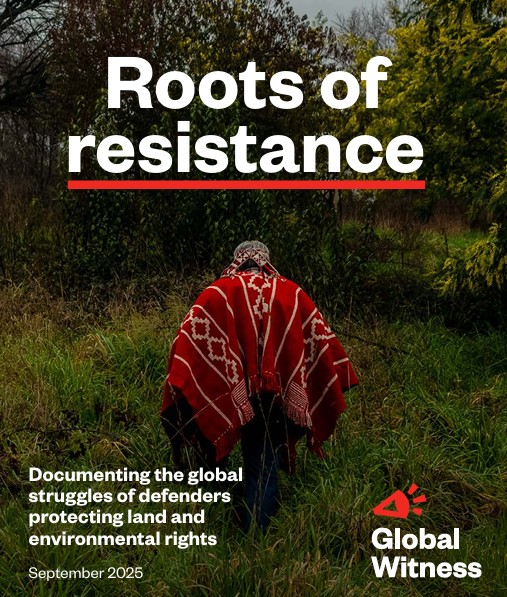
Global Witness has documented on an annual basis the number of defenders killed and that “over 1,500 defenders have been murdered since the adoption of the Paris Agreement on climate change on 12 December 2015.”

COP30 begins on November 10 this year.

While “Voices at Risk” does provide direction to Canadian missions with respect to “Land rights and environmental human rights defenders”, it does not specifically mention the prohibition of military goods to countries whose state forces are implicated in repression and violence against frontline climate defenders.

Conclusion

In July 2024, Mary Lawlor, the United Nations Special Rapporteur on human rights defenders, told The Globe and Mail that Canadian embassies, despite “Voices at Risk”, have failed to respond adequately to those raising serious concerns about the impacts of Canadian mining and oil activities abroad.

This critique by Lawlor is backed in reports from the Justice and Corporate Accountability Project (December 2022), MiningWatch Canada (June 2024), and Professor Kirsten Francescone and law student Lisa Rankin (February 2025), as well as this statement from Amnesty International (June 2019).

We add to their concerns the impact of “defence and security companies” notably the makers of weapons and military components that may be implicated in the repression and deaths of human rights defenders.

Further reading: Canadian Government Stonewalls Questions About Peru Arms Export Permit (Alex Cosh, The Maple, December 2023).

Nicaragua Side Event: A Systematic Erosion of Rights

Written by Yannick Wild, PBI-Switzerland.

At the UN Side event ‘Nicaragua: Contemporary architecture ‘, organized by Peace Brigades International at the Human Rights Council 58, UN experts and human rights defenders provided critical insight on the ongoing human rights crisis in Nicaragua, where systematic repression has intensified since 2018.

Jan-Michael Simon (UN Expert): The government is using “violent suppression, arbitrary detentions, and torture” to maintain control.

The UN Group of Human Rights Experts on Nicaragua, represented by Jan-Michael Simon and Ariela Peralta, documented the government’s intensifying methods of control – including violent suppression of protests, arbitrary detentions, torture, and targeted elimination of political opposition. Since February 2023, the government has further escalated its repression by stripping hundreds of Nicaraguans of their citizenship, rendering them stateless and facilitating asset confiscations. Peralta emphasized that these actions not only silence political opposition but also create significant challenges for international legal accountability and human rights protection.

Andrés Sánchez Thorin (OHCHR): The government has institutionalized repression, “dismantling fundamental guarantees of due process.”

Andrés Sánchez Thorin, from the Office of the UN High Commissioner for Human Rights, underscored how recent constitutional reforms have legalized violations, effectively dismantling fundamental guarantees of due process. “These changes are compounded by the elimination of the separation of powers, as these legislative and judicial branches have been redefined as bodies coordinated by the presidency”. Thorin furthered warned that the elimination of the express prohibition of torture and the legalization of paramilitary groups will aggravate the human rights crisis.

Salvador Marenco (Colectivo Derechos Humanos Nicaragua Nunca Más): The government’s “illegitimate constitutional reforms have dismantled democracy and enabled systematic repression.”

Salvador Marenco of the ‘Colectivo Derechos Humanos Nicaragua Nunca Más’, reinforced these concerns by highlighting how the de facto state of emergency and illegitimate constitutional reforms have effectively eliminated Nicaragua’s remaining democratic institutions. The legal framework now facilitates impunity, enabling systematic repression, arbitrary detentions, and enforced disappearances. Marenco urged the international community to denounce these crimes before bodies such as the International Court of Justice, aligning with recent European Parliament resolutions.

Eugenia Valle de Boitano (Wife of victim): “Nicaragua is an all-encompassing prison… my husband disappeared in April 2024, and we still don’t know what happened.”

Providing a powerful personal testimony, Eugenia S. Valle de Boitano described Nicaragua as an “all-encompassing prison” where freedom of expression has been extinguished. She recounted her husband’s enforced disappearance in April 2024, a case emblematic of the widespread repression affecting numerous families. Her plea to the international community was clear: stronger action is needed to prevent further atrocities. “To this day, we don’t know what is happening,” she stated, emphasizing that her family’s ordeal is not unique – dozens of others share the same fate.

Wilmer Gutiérrez Gomez (Advocate for Indigenous Rights): Indigenous and Afro-descendant communities face “forced displacement, assassinations, and repression.”

Wilmer Gutiérrez Gomez, an advocate for Indigenous rights, concluded the event by addressing the ongoing marginalization of Indigenous and Afro-descendant communities under Nicaragua’s new constitutional framework. He warned that the militarization of Indigenous lands, the imposition of government-aligned authorities, and the lack of legal protections have led to forced displacements, assassinations, and the silencing of their historical demands. Gutiérrez called for urgent measures to protect these communities, stressing that true constitutional reform must uphold the human rights of all Nicaraguans.

The event painted a stark picture of the worsening human rights crisis in Nicaragua, underscoring the need for sustained international attention and action to hold the government accountable and support those affected by its repressive policies.

The Group of Expert on Nicaragua presents its report to the Human Rights Council on the 28th of February and the council will decide upon renewal of its mandate at the end of the session.

Peace Brigades International has long accompanied the struggle against the Fortuna Silver mine in Oaxaca

Photo: PBI-Mexico attended Educa Oaxaca’s 25th anniversary colloquium ‘Challenges of the social and popular movement in the times of transformations in Mexico 1994-2019’.

Peace Brigades International, through its previous accompaniment of Services for Alternative Education A.C. (Educa Oaxaca), has long followed the situation of Vancouver-based Fortuna Silver mining operation in San José del Progreso, Mexico.

Jonathan Treat has reported: “In 2009 roughly three hundred opponents to Fortuna Silver’s mining operation participated in a blockade of the entrance to the Trinidad/Cuzcatlán. After 40 days, the blockade was brutally broken when some 700 police stormed into the community in full anti-riot gear, with automatic weapons, tear gas, attack dogs and a helicopter. People were beaten and more than 23 people were arrested; some were detained for three months.”

That blockade began on March 14, 2009, and the police attack against the blockade occurred in May 2009.

As the struggle against the mine continued, Bernardo Méndez was killed on January 18, 2012, and Bernardo Vásquez was killed on March 15, 2012.

In her eulogy for Vásquez, independent journalist Dawn Paley stated: “Bernardo Vasquez was a clear spoken Zapotec activist, a brother, son, and cousin, who dared to stand up against a mining project in the territory of his people. He was well aware that a paramilitary group was operating in San José Progreso, Oaxaca, and that it was organized to snuff out opposition to a gold mine, owned by Vancouver based Fortuna Silver. … One thing is clear: this was a political hit. Bernardo was murdered because he dared to speak out, ignoring the climate of fear imposed upon his people.”

Bernardo Vásquez.

A protest outside the Canadian consulate in Oaxaca days after Bernardo Vásquez, an opponent of the Fortuna mine, was murdered on March 15, 2012.

In November 2012, PBI-Mexico accompanied a “Misión Civil de Observación” that included two future members of the PBI-Canada team (Meera Karunananthan and Brent Patterson). Karunananthan told CBC News: “This is part of an international pattern with Canadian mining companies violating human rights in communities abroad.”

A company security guard checks a truck entering the San José Mine, November 2012. Photo by Brent Patterson.

Karunananthan speaks at the ‘Misión Civil de Observación’ media conference on the impacts of the Fortuna Silver mine, November 22, 2012.

PBI-Canada continued to monitor this struggle and in November 2018 organized an advocacy tour to Toronto and Ottawa, a virtual meeting with Global Affairs Canada officials in March 2021, then a webinar in collaboration with Amnesty International in November 2021, as well as posting regular updates on our website and social media.

During a PBI organized advocacy tour in Canada in November 2018, Neftalí Reyes Méndez (Educa Oaxaca) and Salvador Martínez Arellanes (an Indigenous leader from Santa Carina Minas) highlighted their concerns about Fortuna Silver.

This meeting with Global Affairs Canada officials in March 2021 was an opportunity for frontline voices to express concerns about Canadian mining operations, including the Fortuna Silver mine.

Our webinar in November 2021 that again featured Neftalí Reyes Méndez from Educa Oaxaca speaking about the Fortuna Silver mine.

Implications of the sale of the mine

On January 15, 2025, Promineria reported: “Fortuna Mining has signed a binding agreement to sell its 100% stake in Minera Cuzcatlán to Mexico’s Minas del Balsas. Minera Cuzcatlán owns the San José silver-gold mine in the state of Oaxaca. Following the sale, Fortuna will cease to participate in that mine, except for a royalty on the net smelter yield.”

That Promineria article further notes that while “the mine was scheduled to begin a phased closure process earlier this year”, Fortuna CEO Jorge Ganoza says “Minera del Balsas is well positioned to continue extracting value” from the mine, suggesting that the mine will continue to operate rather than close.

We have reached out to Educa Oaxaca for their comments on the implications of this sale.

We continue to follow this.

PBI-Colombia accompanies CAHUCOPANA at meeting with Canadian Embassy on self-protection mechanisms in Antioquia

On February 24, the Humanitarian Action Corporation for Coexistence and Peace in Northeast Antioquia (CAHUCOPANA) posted:

“Today in the city of #Bogota, in the premises of the Canadian Embassy Cahucopana Nordeste socialized the results of the project Segovia resists, Segovia for Peace! Funded by the Canadian Fund for Local Initiatives (FCIL), in which we presented the updating of self-protection mechanisms and consolidation of a specific mechanism for the protection of women, youth and girls in rural areas of our region.”

CAHUCOPANA further posted about this: “For the permanence of the Peasant Communities of the territory Yes to peace, no to war!!!!”

On September 17, 2024, the Embassy announced that it had granted CAHUCOPANA funds to “strengthen community protection and self-protection mechanisms in rural areas of the municipality of Segovia, through the strengthening of knowledge in human rights, international humanitarian law, women’s rights and gender equality, and the consolidation of capacities for participation, leadership and enforceability.”

On October 15, 2024, PBI-Colombia accompanied CAHUCOPANA at a community meeting, as CAHUCOPANA explained in a social media post, to “analyze and evaluate our community self-protection mechanisms for the defence and permanence of mining, peasant and ethnic communities in the territories.”

In this social media post, CAHUCOPANA gives “thanks to the international cooperation of the Embassy of Canadá in Colombia.”

Mining in Antioquia

PBI-Colombia has previously explained: “The abundance of natural resources in these lands [of northeast Antioquia] and the arrival of multinational companies, such as the Canadian Gran Colombia Gold, has provided the illegal armed groups who are present in the region with an extremely lucrative funding source in mining.”

In December 2024, Lital Khaikin reported in the independent media outlet The Breach: “Gran Colombia Gold merged into Vancouver-based Aris Mining in 2022, and continues to operate the Segovia mine in Antioquia, an underground mine currently being expanded to produce over 300,000 ounces of gold per year.”

She adds: “Canadian multinationals like Aris Mining and Quimbaya Gold have entangled themselves in a community already deeply marked by human right abuses, cartel networks, and sustained armed conflict.”

She also notes: “As The Breach previously reported, Gran Colombia has worked with sub-contractors that are implicated in laundering illegal gold into legal markets and have ties to right-wing paramilitaries.”

Khaikin concludes: “Canadian companies are relying on contract mining amid poor regulation, expanding without community consent into unprotected areas, and continuing to source gold in a murky territory run by Colombia’s most powerful cartel—all amid what the UN Refugee Agency has described as a deteriorating humanitarian situation.”

We continue to follow this.

PBI-Colombia has accompanied CAHUCOPANA since 2013.

Caravan for the Climate and Life set to travel from Mexico to Brazil for the UN COP30 climate conference

We are following the updates about the Mesoamerican Caravan for the Climate and Life that will begin in Mexico on October 12 and travel through various countries including Guatemala, Honduras and Colombia before arriving in Belém, Brazil on November 10 for the beginning of the UN COP30 climate summit.

This webpage notes: “Following the Agreements from the Global Meeting for Climate and Life held in November in Oaxaca, Mexico, and as part of the activities, meetings, and actions surrounding the UN Conference on Climate Change (COP30) in Belém, Brazil, we call for the Mesoamerican Caravan for the Climate and Life, to take place between October 12 and November 10, 2025.”

“The Caravan stands against the extractive mega-projects that are destroying our ecosystems and taking away our lands.”

“The violence in our communities is a consequence of armed conflicts between the state, paramilitary groups, and organized crime, operating with the permissiveness of corrupt governments. This violence, both direct and structural, has stripped communities of their dignity, land, and ability to live in peace.”

It concludes: “Let’s unite to mobilize, walk toward a common future where life, water, territory, and dignity are respected. Let’s go to Belém to challenge COP30 and all the powers that dispossess and destroy our lands and peoples. The fight for life, for land, for justice, is in our hands!”

The alternative forum in Belém

In his article Will COP30 Deliver for the Amazon — and the Planet?, Bernardo Jurema, a climate researcher at the Research Institute for Sustainability in Potsdam, Germany, further highlighted: “Alternative forums, like the ‘anti-COP’ and the People’s Summit gatherings, will likely draw attention to voices often marginalized in official negotiations, further intensifying the dialogue around justice and equity.”

More than 1,500 environmental defenders killed

At the conclusion of the Global Meeting for Climate and Life: ANTICOP 2024, its 250 participants agreed to a final statement that noted:

“Activism in defense of land, territory, water, and nature is dangerous, and many of our comrades face stigmatization, harassment, repression, criminalization, and even murder. Since the signing of the Paris Climate Agreement, over 1,500 environmental defenders have been killed around the world—the vast majority in Global South countries. We demand safe spaces for activists, where they can heal and protect themselves physically, emotionally, and legally. We also propose creating networks and support mechanisms for legal, communication, technological, psychological, and physical and digital security for human rights defenders, land defenders, and environmental activists in the most vulnerable territories.”

We continue to follow this.

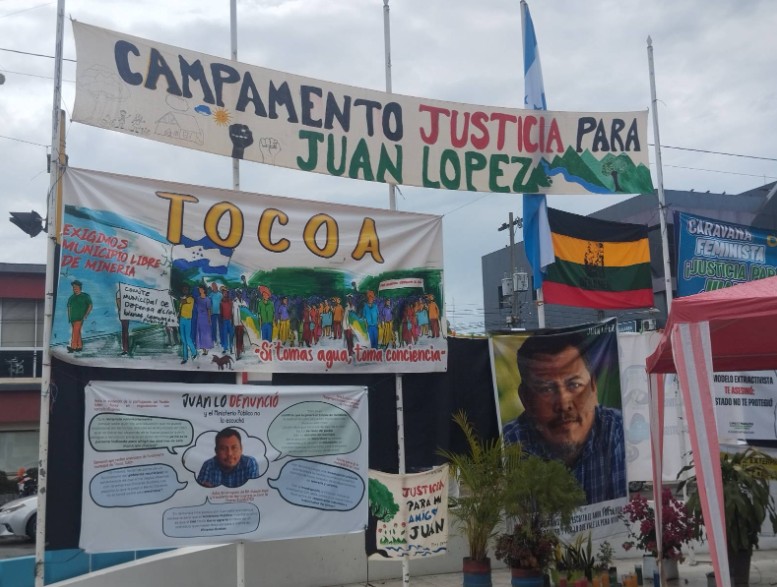
PBI-Honduras observes sit-in at Public Ministry demanding prosecution of criminal structure behind murder of Juan López

PBI-Honduras has posted:

Today we observed a sit-in by the Municipal Committee in Defence of Public and Common Goods (CMDBCP), demanding justice for Juan López. Before the media present, the CMDBCP highlighted the alleged existence of a criminal structure that would have penetrated state institutions in order to advance the implementation of the mining-energy project Inversiones Los Pinares-Ecotek in the Montaña de Botaderos Carlos Escaleras National Park. According to the CMDBCP, the murder of defender Juan López took place within the framework of the operation of this criminal structure.

Intimidating actions by police

Guapinol Resists highlighted: National Police arrive at press conference to monitor, note and photograph the defenders who demand justice for Juan López and the Carlos Escaleras National Park. …We demand that these arbitrary and intimidating actions by the National Police be investigated and that the State immediately fulfill its responsibilities to protect defenders and the environment.

The demand to prosecute the “criminal structure”

EFE now reports:

The Municipal Committee in Defense of Common and Public Goods of Tocoa, in the Caribbean of Honduras, demanded on Wednesday that the Public Ministry (Prosecutor’s Office) investigate and prosecute the “criminal structure” responsible for the murder of environmentalist Juan López, on September 14, 2024.

The demonstrators consider that although so far three people have been arrested, including the alleged perpetrator of the murder of Juan López, the intellectual authors are missing.

The Catholic Church, environmental and human rights organizations, among others, believe that executives of the mining company Pinares Ecotek and the mayor of Tocoa, Adán Fúnez, also from the LIBRE party and very close to former President Zelaya, overthrown on June 28, 2009, are involved in the murder of Juan López.

Edy Tábora speaks at press conference

The EFE article continues:

Edy Tábora, legal representative of the Municipal Committee in Defense of Common and Public Goods of Tocoa and Juan López’s family [says]  the damage that has been caused to natural resources since 2013 in the sector of Tocoa, department of Colón, involves “high-level personalities, former secretaries of state of the Ministry of Natural Resources, the Institute of Forest Conservation, deputies and many more people.

EFE video of Tábora.

Proceso Digital also reports:

For his part, lawyer Edy Tábora, commented that the Public Ministry notified them that it will not accept any request for an abbreviated procedure from the person who shot and took the life of the environmentalist.

“The process is moving forward, there is a preliminary hearing scheduled for March 4,” said the legal professional and then stressed: “They are anxious for the start of the trial.”

We continue to follow this.

PBI-Canada visited Tocoa and Guapinol, Honduras on October 29-30, 2024, and saw the pelletizing plant associated with the controversial Los Pinares megaproject.

Criterio.hn: Communities of Tocoa, Colón, organized in the Municipal Committee in Defense of Common and Public Goods, demand from the Public Prosecutor’s Office an impartial investigation that allows those responsible for the murder of environmentalist Juan López to be brought to justice, who was killed on September 14, 2024. López was a beneficiary of precautionary measures granted to him by the Inter-American Commission on Human Rights (IACHR). They also requested an investigation into the irregular installation of the Pinares-Ecotek mining-energy megaproject.

PBI-Guatemala accompanies the commemoration of the National Day of Dignity of the Victims of the Internal Armed Conflict

On February 25, PBI-Guatemala posted on social media:

“Today #PBIacompanies the march for the Day of Dignity of Victims of Internal Armed Conflict which honors the memory of loved ones missing and killed by the military in the war. The protesters remembered their lives and claim their struggles for land, community development and peace.”

EFE reports: “500 people [marched] in the main streets of Guatemala City on Tuesday in commemoration of the National Day of Dignity of the Victims of the Internal Armed Conflict, which is celebrated every February 25.”

The march went from the Supreme Court of Justice (CSJ) to the Plaza de las Niñas.

That article also highlights: “Hundreds of Guatemalan indigenous people, survivors and relatives of victims of the internal armed conflict (1960-1996) denounced that in recent years justice processes for war crimes have regressed, and demand that the government of President Bernardo Arévalo de León comply with the peace agreements.”

And it quotes Feliciana Macario, a member of the national platform of victims of the armed conflict who identifies as a Quiché Maya, who says: “The state has a commitment to the surviving families and it is a day to demand that they have not complied with the peace agreements after 40 years.”

Photo: PBI-Guatemala at the commemoration.

Prensa Comunitaria adds: “Approximately 200,000 people [were] murdered and 45,000 disappeared by the military dictatorships that sowed terror in the country from 1960 to 1996.”

Of those victims identified in the U.N.-sponsored Historical Clarification Commission, 83 percent were indigenous Maya. 93 percent of these human rights violations were carried out by government forces.

That article further notes: “During the activities, the Achi’ women, Ixil women and the grandmothers of Sepur Zarco; the National Coordinator of Widows of Guatemala (Conavigua), the Association of Relatives of Detainees of Guatemala (Famdegua), the Mutual Support Group (GAM), the Association of University Students (AEU), the Human Rights Office of the Archdiocese of Guatemala (ODHAG), Sentinels for the Dignity of the State, the Civil Association Truth and Life, and other organizations that make up the National Platform of Victims of the CAI, denounced the indifference of the Government of Bernardo Arévalo – who received massive support from the indigenous communities of the highlands – with the survivors and their families.”

Macario is also quoted in this article and says: “It has been more than 5 years without a single measure of reparation being delivered to the victims of the Internal Armed Conflict. Meanwhile, a budget expansion was approved to continue paying the military who participated in the crimes of the past.”

And Emisoras Unidas Digital also notes: “In this context, [Macario] indicated that they are demanding that President Bernardo Arévalo urgently approve the governmental agreement to create the National Plan for Dignification and Reparation, as well as the plans to search for missing persons. It is also necessary for the justice system to reverse the resolutions in cases related to the conflict where those involved in atrocious acts have benefited.”

We continue to follow this.

PBI-Canada says that the RCMP C-IRG that criminalizes and violates the rights of land defenders should be disbanded

Video still: Land defender Shaylynn Sampson arrested on Wet’suwet’en territory by RCMP C-IRG officers, November 2021.

On February 18, CBC reported that British Columbia (BC) Supreme Court Justice Michael Tammen ruled that the Royal Canadian Mounted Police (RCMP) Community-Industry Response Group (C-IRG) breached the Charter rights of three Indigenous land defenders during that unit’s militarized raid on Wet’suwet’en territory in 2021.

Those land defenders are Sleydo’ (Wet’suwet’en), Shaylynn Sampson (Gitxsan) and Corey Jocko (Kanien’kehá:ka-Mohawk).

Justice Tammen found the three land defenders guilty last year of criminal contempt of court for breaking an injunction against blocking work on the Coastal GasLink fracked gas pipeline on Wet’suwet’en territory.

Despite finding that the RCMP C-IRG violated the Section 7 rights – life, liberty and security of person – of the land defenders, Justice Tammen said it would be inappropriate to stay (suspend or stop) court proceedings.

CBC reports: “Tammen said the maximum sentence for criminal contempt is no more than five years imprisonment.”

APTN adds: “The case will be back in court on April 3 to fix a date for sentencing.”

Sleydo’ (Molly Wickham)

Following the ruling by Justice Tammen, Sleydo’ posted on Instagram: “The colonial court system is craaaazy and there’s no way to get out of it feeling any way but oppressed by the colonial state. I don’t have the words to describe the rage i feel at being forced to defend myself in a system where the rule of law allows for the destruction of these lands, my people, and my beloved- wedzinkwa [a sacred river on Wet’suwet’en territory].”

Peace Brigades International

Peace Brigades International-Canada states: “We call on judicial authorities in Canada to not further criminalize Indigenous land defenders upholding their right to free, prior and informed consent as they protect their territories from destructive megaprojects. We also call on the Government of Canada to disband the controversial Royal Canadian Mounted Police (RCMP) Community-Industry Response Group (C-IRG) implicated in the violations of the rights of Indigenous land defenders.”

Photo: RCMP C-IRG officers during the 2021 raid on Wet’suwet’en territory. Photo by Michael Toledano.

Front Line Defenders

Responding to this situation, the Dublin-based Front Line Defenders calls “on the judicial authorities to stay the proceedings against the three Wet’suwet’en HRDs, who are now facing criminalisation due to their human rights work.”

Amnesty International

Amnesty International has further noted: “Should they receive a sentence that arbitrarily deprives them of their liberty, Amnesty will designate the affected land defenders as prisoners of conscience.”

Global Witness

In September 2022, about a year after the third RCMP C-IRG raid on Wet’suwet’en territory in which Sleydo’, Sampson and Jocko were arrested, Washington, DC-based Global Witness stated: “The Canadian government should immediately cease the forcible eviction of Wet’suwet’en people; guarantee that no force will be used against Wet’suwet’en peoples; withdraw security and police forces from Wet’suwet’en territory; and prohibit the use of lethal weapons by the Royal Canadian Mounted Police against Indigenous peoples.”

Video still: Sleydo’, Sampson and others arrested at gunpoint by RCMP C-IRG officers, November 2021.

Global Witness also commented: “The geographic location of the Wet’suwet’en people is isolated and remote, making it difficult for human rights observers and media to monitor. This situation poses a grave danger to Wet’suwet’en people, territories and culture, and is made worse by the arrests of both legal observers and the media.”

UN Special Rapporteur Mary Lawlor

On March 6, Mary Lawlor, the United Nations Special Rapporteur on human rights defenders, will present her latest report to the UN Human Rights Council in Geneva, Switzerland on human rights defenders in isolated, remote and rural contexts.

In the lead-up to that session, Lawlor highlighted three Indigenous land defenders in Canada, including Sleydo’ who faces this sentencing hearing on April 3.

We will be following the presentation by Lawlor on Thursday March 6 on UN Web TV.

We continue to follow this situation closely.

Further reading: RCMP C-IRG snipers repeatedly deployed against Wet’suwet’en land defenders and water protectors (PBI-Canada, February 2025).

PBI-UK “stunned and disappointed” by UK Government’s decision to slash international aid to pay for increase in military spending

The CBC reports: “British Prime Minister Keir Starmer said on Tuesday [February 25] he would increase annual defence spending to 2.5 per cent of gross domestic product (GDP) by 2027 and target a three per cent level.”

“The increase would see Britain spending 13.4 billion pounds ($24.2 billion Cdn) more on defence every year from 2027. Britain’s Defence Ministry said it spent 53.9 billion pounds ($97.4 billion Cdn) in the 2023/24 financial year.”

That article adds: “With public spending already stretched in Britain, Starmer said the increase would be fully paid for by a 40 per cent cut to international aid… The international aid budget will be cut from 0.5 per cent of gross national income to 0.3 per cent in 2027.”

Reaction from PBI-UK

Peace Brigades International-United Kingdom has responded by stating:

We are stunned and disappointed by the UK Government’s decision to slash aid in order to fund defence spending. Following in the wake of the USAID freeze, this decision will leave even more civil society organisations and human rights defenders exposed at a time of escalating global crises. Cutting UK aid means cutting support for the very initiatives that prevent conflicts, avert climate change, and help communities to live peacefully on their land, rather than have to flee. The decision to reduce spending to less than half of our legal obligations will also dent the UK’s global reputation.

PBI is one of many NGOs that has long called for the UK to adjust the way in which it supports global civil society, in order to ensure it is as effective as possible. A holistic approach is needed: one of effective funding, diplomatic support, and protection for human rights defenders at risk. This would represent a cost-effective approach to building a resilient, democratic world and – in turn – underpin the UK’s own growth and security.

We urge the Government to reconsider its decision and to develop a holistic approach with civil society at its core, so that UK aid and diplomacy can be as impactful as possible both now and in the future.

PBI-UK director Ben Leather.

Canadian spending may be shifting too

The CBC article further notes: “With a defence budget of slightly more than $33 billion in 2024-25 and when spending on the Canadian Coast Guard and Veterans Affairs is added in, Canada hits roughly 1.37 per cent of GDP. Only a handful of countries have a lower percentage in the alliance, Spain and Belgium among them.”

Last month, the CBC also reported: “Facing U.S. President Donald Trump’s ongoing criticism about military spending, Defence Minister Bill Blair says it’s ‘absolutely achievable’ for Canada to meet NATO’s military investment benchmark of two per cent of gross domestic product within two years. That accelerated timeline to hit the target by 2027 is about five years earlier than what prime minister Justin Trudeau announced in July.”

And earlier this month the CBC reported: “Liberal leadership contender Mark Carney [who is very likely to be the next Prime Minister of Canada after the March 9 leadership convention] says if he becomes prime minister, he would meet the NATO defence spending benchmark two years ahead of the Trudeau government’s official target.”

Just over two weeks ago, the Canadian Press reported: “A Conservative government would build a permanent military base in Nunavut and pay for it by ‘dramatically cutting’ Canada’s foreign aid budget, Leader Pierre Poilievre said Monday in Iqaluit. ‘One hundred per cent of the cost of the base will come from the foreign aid budget’, he said. ‘In fact, today’s announcement will actually reduce the deficit because I plan to cut foreign aid more than the full cost of the announcement that I’ve made today’, he said.”

That article also noted: “According to a parliamentary report tabled last year, Canada spent $15.5 billion on foreign aid in the 2022-23 fiscal year. …Poilievre criticized foreign aid spending, saying much of it goes to ‘dictators, terrorists and global bureaucracies.’ …Poilievre did not offer a concrete estimate of the size of his proposed ‘massive’ cut to the foreign aid budget.”

CBC Poll Tracker now suggests there is a 75 percent probability the Poilievre Conservatives will form a majority government in Canada. That same poll says there is a 20 percent probability of the Conservatives winning the most seats but not a majority.

 The next federal election could come as soon as April-May of this year.

We continue to follow this.

“Citizen George” documentary includes George Lakey’s time as a PBI volunteer in Sri Lanka

The new documentary about George Lakey, now 87 years old, called “Citizen George” includes his time as a volunteer with Peace Brigades International in Sri Lanka 35 years ago.

The documentary presented by Bullfrog Films and directed by Glenn Holsten says: “CITIZEN GEORGE presents the life and work of Philadelphia-based Quaker activist George Lakey, a non-violent revolutionary who has worked his entire life for justice and peace, guided by his ideal of societal transformation.”

In the documentary, Lakey says:

In the late 80s, a small island off the tip of India, was struggling to deal with a mass movement of peasants that wanted economic justice that was being strongly supported by students.

So, they were arresting students and torturing them to get information on which students they knew were actually part of the peasant movement. If a student was seized the parents would go to a human rights lawyer and get that student out of the hands of the police. So, the police started assassinating human rights lawyers.

So, that’s what brought the issue to me.

There was an international organization called Peace Brigades International which came to me and said we want to put a team of civilian protection into Sri Lanka to accompany the human rights lawyers to keep them alive while they are doing this necessary work of protecting students.

The idea was that if the police came to assassinate a lawyer, we would be there. I was foreign, the hit squad wasn’t instructed to kill foreigners because that might make major trouble for the government which was responsible for the hit squads.

And so, I went to Sri Lanka. I remember one lawyer I was protecting who said I am very worried about somebody knocking at the door at night and I, thinking it a distraught parent who is saying quick, quick, quick, save my son, and I open the door, and it turns out it’s the assassination squad who shoots me down. So, I need you to open the door.

I was scared the whole time I was there. It was three months of fear; people were being killed around me. Every time I passed a religious institution I would duck in and call myself to pray and experience the love that reminds us why we are here on Earth. And if I should die here, so be it, but I did want to participate in this pioneering way of saving lives.

Peace Brigades International had teams in Sri Lanka from 1989 to 1998.

The trailer for “Citizen George” can be seen here.

The website for the documentary notes: “Grassroots supporters are going all-in to ensure that CITIZEN GEORGE can be offered to public television, streaming platforms, and active grassroots social justice groups. Please join us in making a donation now.”

Further reading: George Lakey’s time as a Peace Brigades International volunteer in Sri Lanka (PBI-Canada, September 2019).