Home Blog Page 56

Gitanyow sustainability director Tara Marsden warns Blackstone-backed PRGT pipeline would accelerate climate change

Photo: Tara Marsden, sustainability director for the Gitanyow hereditary chiefs. (Maggie MacPherson/CBC).

The CBC reports: “Tara Marsden, sustainability director for the Gitanyow hereditary chiefs, worries the current push to approve new projects [framed as breaking “Canada’s dependence on the U.S. energy economy”] will sideline environmental concerns.”

The article adds: “Marsden has helped organize opposition to a new pipeline in their traditional territory, the proposed Prince Rupert gas transmission [PRGT] line that would run 800 kilometres to a planned terminal on a coastal island, which Marsden warns will harm salmon habitat and accelerate climate change.”

The CBC article then highlights: “Marsden points out [that PRGT co-owner Texas-based Western LNG] has significant backing from Blackstone Inc., a major American asset manager whose CEO publicly endorsed Trump and contributed to his campaign — undermining any notion that the project is needed to push back against the American president. ‘This isn’t about getting out from under the thumb of Americans,’ she said. ‘It’s actually about enriching people who are in Trump’s inner circle.’”

Marsden: “Companies will bring in militarized police”

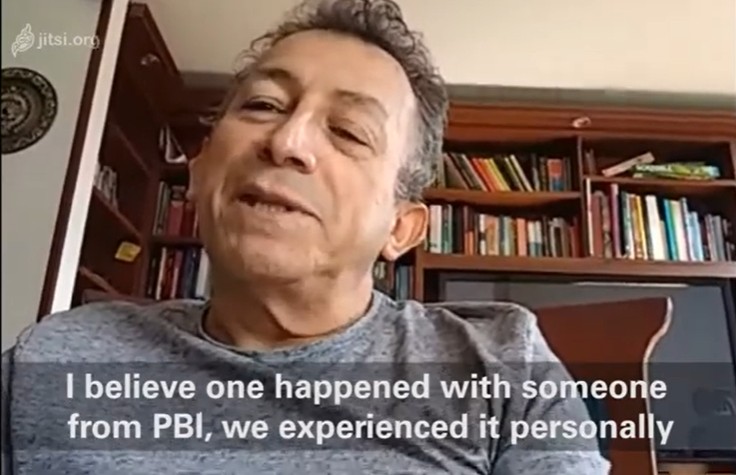
In the CBC-TV version of this report, Marsden says: “From the Coastal GasLink pipeline we learned that companies will do whatever it takes, they will bring in militarized police and they will remove Indigenous people from their lands.”

Video still from CBC National News.

On a PBI-Canada webinar last year, Marsden also commented: “Our learning is that consent only works when we say yes, if we say no, even if we say no with science behind us, and our knowledge and our laws behind us, then we will be met with force from the C-IRG, from militarized invasion and occupation and intimidation and harassment.”

The C-IRG refers to the Royal Canadian Mounted Police (RCMP) Community-Industry Response Group (C-IRG) now rebranded as the Critical Response Unit (CRU-BC).

The C-IRG is currently under systemic investigation by the Ottawa-based Civilian Review and Complaints Commission (CRCC) after the agency received nearly 500 formal complaints about the unit, including allegations of excessive force, illegal tactics, unprofessional behaviour, racism, discrimination and Charter violations.

Decision on PRGT expected this spring

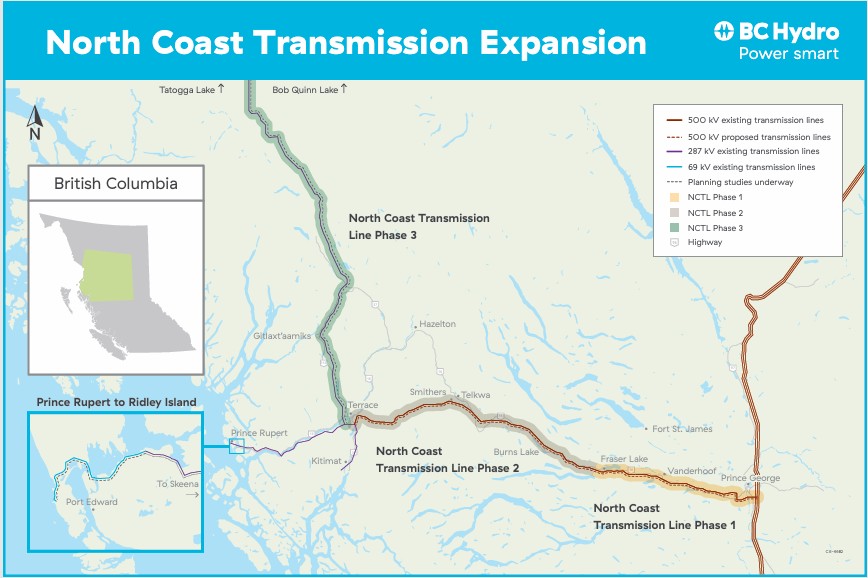
If approved and built, the 800-kilometre PRGT pipeline would carry fracked gas from Hudson’s Hope in northeastern British Columbia across an estimated 120 kilometres of Gitxsan territory as well as Gitanyow territory until it reaches the proposed the Ksi Lisims LNG terminal near the Nass River estuary on Nisga’a territory in northwestern BC.

In December 2024, the Pipeline Technology Journal reported that the British Columbia provincial government decision on the Prince Rupert Gas Transmission pipeline “is expected by March 2025”. On March 26, 2026, Global News reported: “The provincial government is expected to make a decision on an amendment to the pipeline’s original environmental assessment certificate this spring.”

We continue to follow this.

UN Special Rapporteur Mary Lawlor: “Canadian extractive mining companies are putting defenders at risk all over the world”

On April 11, Mary Lawlor, the United Nations Special Rapporteur on human rights defenders, posted on social media: “At #HRC58 [the 58th session of the UN Human Rights Council] I welcomed #Canada’s support for human rights defenders abroad. But I had to say it: Canadian extractive mining companies are putting defenders at risk all over the world. We need binding due diligence obligations, a stronger @CORE_Ombuds [Canadian Ombudsperson for Responsible Enterprise/CORE], and real accountability.”

Visa program

The visa program Lawlor notes in the video likely refers to the Canada Program – Canada Global Refugee Stream for Human Rights Defenders.

A July 2023 media release from Immigration, Refugees and Citizenship Canada notes: “Human rights defenders (HRDs) are active in every part of the world and play an essential role in promoting and protecting human rights internationally. In many countries, HRDs are increasingly at risk of violence… [As a result, the Government of Canada has] announced the expansion of the global human rights defenders stream, doubling the number of resettlement spaces from 250 to 500 for HRDs and their family members. The initiative, propelled by the belief that no one should face persecution for championing justice, reflects Canada’s unwavering commitment to providing a sanctuary for those who risk their lives in the pursuit of fundamental freedoms.”

PBI-Canada continues to call on the Government of Canada to implement a Temporary Relocation Programme that would allow human rights defenders at imminent threat a temporary refuge for a period of 3-6 months. We have highlighted that Ireland, Germany and the Netherlands have this program in place.

The need to strengthen the CORE

In November 2024, Lawlor also called for a “significant strengthening of the CORE.”

At that time, Lawlor commented: “I have long-standing concerns as to the adequacy of the CORE, in its current form, to provide any adequate form of redress for human rights defenders and the communities they represent when their rights have been violated or been put at risk by Canadian companies operating abroad. This has been reflected in conversations I have had with human rights defenders since taking up my mandate, who, where aware of the CORE, have repeatedly told me they have no confidence in its effectiveness.”

Specifically, Lawlor called on the Government of Canada to: “Provide the CORE with legally enforceable powers to compel evidence and testimony from companies, in line with international standards and best practice on ombudspersons’ offices, to enable effective investigations of all cases and overcome the barriers presented when companies refuse to meaningfully engage with the CORE.”

Canadian embassies and Voices at Risk guidelines

In July 2024, Lawlor also told The Globe and Mail: “[Canada] parades itself on the world stage as being the good guys … But when it comes to the conduct of companies in the context of business and human rights, the UN guiding principles and the obligations of Canadian embassies themselves abroad, they’re really found wanting.”

That article further noted: “[Lawlor] also singled out Canadian embassies, saying many have failed to respond adequately to those who raise serious concerns about the impacts of mining and oil activities abroad. Canada introduced ‘Voices at Risk’ guidelines in 2019, aimed at supporting human-rights defenders and giving advice to Canadian diplomats working overseas, but she says it hasn’t been properly implemented.”

Indigenous land defenders on territories in Canada

In February 2025, Lawlor also posted: “On 6 March I’ll present my latest report to the @humanrightscouncil, on human rights defenders in isolated, remote & rural contexts. In the lead up, I am sharing stories illustrating how the risks & challenges these defenders face are often linked to their location.”

The drawings of the defenders featured in the image shared by Lawlor are Indigenous land defenders Sleydo’ (Wet’suwet’en, Gidimt’en Clan), Kolin Sutherland-Wilson (Gitxsan) and Freda Huson (Wet’suwet’en, Unist’ot’en Clan).

PBI-Canada

Peace Brigades International-Canada continues to document violations by Canadian companies within Canada as well as in the countries where PBI physically accompanies land and environmental defenders, including Colombia, Guatemala, Honduras and Mexico where 119 defenders were killed in 2023.

Our initial research, utilizing the Business and Human Rights Resource Centre (BHRRC) database, found that 21 Canadian companies have been implicated in 88 attacks against human rights defenders over the past nine years.

We are additionally concerned that Lawlor’s office has registered 15 cases between June 2019 and March 2022 of retaliation against human rights defenders that she alleges can be linked to the activities of Canadian mining companies.

We continue to follow this.

PBI-Honduras accompanied Indigenous COPINH water protectors demand justice for the Palestinian people

The PBI-Honduras accompanied Civic Council of Grassroots and Indigenous Organisations in Honduras (COPINH) has posted on social media:

On World Earth Day, we cannot ignore the cry of a land that bleeds: Palestine.

This is not a war, this is genocide!

Palestine suffers, resists, cries, screams, endures, fights… lives!

Because defending life, dignity and land, is also defending Palestine.

From COPINH, we raise our voices loudly and demand justice for the Palestinian people.

No more silence. No more impunity.

Free Palestine now!

This is not the first COPINH has expressed solidarity with the people of Palestine.

On March 2, 2024, the eighth anniversary of the murder of COPINH co-founder Berta Cáceres, COPINH also posted: At the #8yearAniversary of the Sowing #BertaCáceres, we stand in solidarity with the people #palestine, who face a painful humanitarian and environmental crisis on the part of the State of Israel. We firmly believe in the importance of people’s solidarity and support in such adverse times, therefore, from these Lenca lands we join the global action for Gaza and Palestine.

About COPINH

COPINH is an Indigenous organization founded by the Lenca people in March 1993. More than 200 communities are currently members and more than 50 community groups actively participate in its work. The organization promotes the protection of territories and the recognition of the political, economic, social and cultural rights of Indigenous peoples in Honduras. Investigations into the murder of Berta Cáceres and COPINH’s work in communities where land conflicts have been ongoing for decades, have had a significant impact on the organization’s security situation. COPINH’s coordinators have been accompanied by PBI Honduras since May 2016.

Photo: COPINH co-founder Berta Cáceres was murdered on March 2, 2016 for her opposition to the construction of a hydroelectric dam on the Lenca River.

Other PBI accompanied organizations on Palestine

Numerous organizations, defenders and communities accompanied by Peace Brigades International – including CredhosdhColombiaNomadesc (in Colombia), the Cerezo Committee (in Mexico), as well as Maya Q’eqchi’ journalist Carlos Ernesto Choc (in Guatemala) – have expressed their concern about the situation in Palestine.

Photo: CREDHOS president Ivan Madero at the Palestine solidarity encampment in Munich, Germany in June 2024.

Human rights defenders targeted

Peace Brigades International (PBI) focuses on the protection and security needs of human rights defenders.

Dublin-based Front Line Defenders has stated in their report on the situation of human rights defenders in 2023/24: “Those defending the right to health and the right to life as doctors, nurses, or ambulance workers, those exposing and documenting war crimes as journalists, and those providing humanitarian support as volunteers or employees of aid agencies were all specifically targeted by Israeli bombs or guns.”

To date, as many as 1,586 human rights defenders have been killed in Gaza, including 175 journalists408 aid workersmore than 1,000 medical staff2 lawyers, and 1 International Solidarity Movement volunteer (in the West Bank).

In February 2024, the United Nations Special Rapporteur on human rights defenders Mary Lawlor endorsed this statement that says: “Any transfer of weapons or ammunition to Israel that would be used in Gaza is likely to violate international humanitarian law and must cease immediately.”

The Peace Brigades International statement on Gaza can be read here. It calls on the international community to “suspend the supply of arms to Israel and the armed groups involved in the conflict.” PBI-Canada also continues to call for a ceasefire and the Canadian civil society demand for an arms embargo on Israel.

PBI-Canada will also be present at the CANSEC arms show on May 28-29 in Ottawa where numerous weapons companies implicated in the genocide will be exhibiting their products.

Instagram image: @shut.down.cansec

Additional reading: The integration of Canadian and US military production puts Canada at risk of complicity in violence against human rights defenders (March 5, 2025).

PBI-Colombia tells DW that Colombia is unsafe for rights defenders as European Commission lists Colombia as a “safe country”

Photo: The western face of the European Parliament towards the Place du Luxembourg in Brussels, Belgium.

The Bonn, Germany-based news agency Deutsche Welle (DW) reports on Colombian human rights defender Claudia Álvarez who has been waiting for 30 months for asylum in Spain. Álvarez says: “I cannot return to Colombia; it is not a safe country.”

The article continues with the Peace Brigades International’s (PBI) Colombia representative in Europe telling DW: “Colombia continues to be an extremely dangerous and unsafe country for those who defend rights, territory, the environment.”

The PBI representative also tells DW: “In addition to these victimizing events, there are serious humanitarian crises in several regions of the country, in which legal and illegal armed actors dispute territorial control, causing massacres.”

The article further reports: “In 2024, of the 51,529 asylum requests from Colombians in European Union (EU) territory, 74% were submitted in Spain, 12% in Germany, 7% in Italy, 3% in France and 2% in Belgium.”

DW reporter Myrrh Banchon comments: “It is striking that, although none of these countries still considers Colombia a ‘safe country’, only less than five percent of asylum applications have been accepted. Most of them (20 percent) in Spain; none in Germany.”

The article then cautions: “The fact that the European Commission proposes to include Colombia in the list of ‘safe countries’ increases their fears.”

EU considers Colombia a “safe country”

On April 16, 2025, Politico.eu reported: “The European Union now considers seven countries to be safe for migrants to return to and will accelerate the asylum application process for those countries’ nationals… This likely means asylum applications will not be approved from those countries now that the EU has designated Kosovo, Colombia, Morocco, Tunisia, Egypt, Bangladesh and India as ‘safe’.”

Netherlands, Italy push on migration

The Politico.eu article also explains: “The move comes after EU capitals, led by Poland, urged the Commission in 2024 to draw up new guidelines on migration to facilitate deportations amid growing political pressure from right-wing and far-right parties. The determination to designate the seven countries as safe was made on the basis of reports by the EU’s foreign affairs branch, EU staff located in those countries, civil society organizations and media reports, plus other sources of information…”

France 24 adds: “Led by hawks including Italy, Denmark and the Netherlands, EU leaders called in October 2024 for urgent new legislation to increase and speed up returns and for the commission to assess ‘innovative’ ways to counter irregular migration.”

Approval process to come

France 24 reports: “The plan has to be approved by the European Parliament and member states before it can enter into force.”

Euractiv adds: “The list [of seven countries] is presented as an amendment to the EU’s asylum procedure regulation, part of the Migration Pact approved last year, and is expected to take effect in [June] 2026. It will apply across the bloc, though member states may still expand their national designations. “

It further notes: “The proposal [on safe countries] will now follow the ordinary legislative procedure, undergoing scrutiny by both the Council and the European Parliament, followed by interinstitutional negotiations. The discussions in the Council are set to kick off on 24 April within the Asylum Working Group, Euractiv has learned.”

We continue to follow this.

Note: The Government of Canada says: “To date, the United States is the only country that is designated as a safe third country by Canada under the Immigration and Refugee Protection Act.” This means that a Colombian who enters Canada via the United States seeking refugee status can be returned to the United States.

In 2019, the Immigration and Refugee Board of Canada received 9,298 refugee claims from Mexico (5,634 claims), Colombia (3,197), Honduras (300) and Guatemala (167). A total of 1,699 of those applications (about 18%) were accepted. In 2020 alone, 125 land and environmental rights defenders were killed in just these four countries.

Unlike Germany, the Netherlands and Ireland, Canada does not have a temporary relocation program for human rights defenders in urgent need.

The full Deutsche Welle article by Myrrh Banchon can be read at: Asilo de colombianos: “la única garantía es salir del país”.

PBI: “The dignity of people is beyond any border”

PBI-Guatemala accompanies Indigenous Ch’orti’ communities as they defend water and territory from mining, coffee production

On April 24, PBI-Guatemala posted:

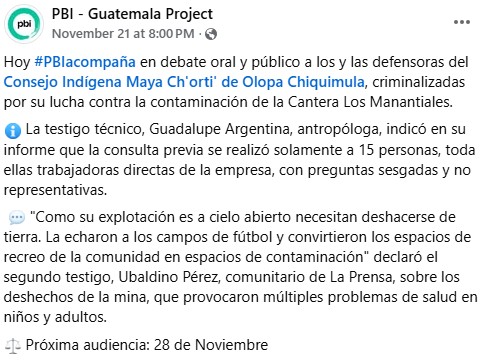
“For #WaterDay yesterday PBI accompanies the Indigenous Community of San Francisco Quezaltepeque and the Maya Ch’orti’ Indigenous Council of Olopa in their night walk.

Among other things, the communities thanked Mother Earth for the water. In addition, they declared the area of the source of the La Conquista river Azacualpa as patrimony [ancestral inheritance] of the Ch’orti’ people.

‘We hope that our daughters, grandchildren and great-grandchildren will not be ashamed of the struggle of their parents and grandparents; so that in the future they will continue on the path of ancestrality’ said one of the spiritual leaders of the communities.”

The day before, PBI-Guatemala also posted:

“Today PBI accompanies the San Francisco Quezaltepeque Indigenous Community and the Maya Ch’orti’ Indigenous Council of Olopa Chiquimula in the celebration of #WaterDay.

‘The Ch’orti people have self-convened to make a walk through the sacred points of our culture in defense of seeds, water sources and Mother Earth’ says Gregorio Pérez, ancestral authority and spiritual guide of Camotán.

‘We face an environmental crisis due to illegal logging, dispossession, mining and honey water [the wastewater produced during the wet processing of coffee cherries]’, he explains. ‘Water is a common good and we must protect it, that’s why we are against a Water Law [that currently doesn’t exist], that leaves out Indigenous peoples.’

During the pilgrimage, the Indigenous Authorities have recognized an area on the hill of Piedra de los Compadres [the spiritually significant “stone of friends” rock formation] as a common altar and sacred place for the Ch’orti people of Honduras, Guatemala and El Salvador.”

Threats to water

The Ch’orti’ of Quezaltepeque

PBI-Guatemala has previously explained:

The defense of water leads to confrontations between the Ch’orti’ People with economic interests that have been making private use of communal resources.

Coffee production

Coffee production in the area and, specifically, the discharge of polluting wastewater from the coffee cleaning process into the River Grande and artificial wells is affecting the lives of more than 10 communities and their water sources. The inhabitants, some 150 families, report foul odors, dead fish and skin diseases.

For the past five years, these communities have been unable to use the water sources for fishing, washing or drinking water. In order to defend their right to water, the communities filed a complaint against Ovidio Cardona and his company “Café La Conquista” in 2022. The investigations are being carried out by the environmental prosecutor’s office of Zacapa, but to date there has been no judicial resolution to the problem.

A water well drilled at a cemetery without consent

Another example is the granting of a permit to drill a water well in the community of San José Cubilete at the site of a sacred cemetery for the Ch’orti’ People without prior consultation with the communities.

Regarding this case, the Court of First Instance for Criminal and Narcoactivity of the Department of Chiquimula ruled in December 2023 that the municipality of Quezaltepeque did not conduct a prior dialogue with the communities involved and suspended the drilling of the well.

Mining

The exploitation of resources without their consent is another concern of the Ch’orti’ People who, in 2022, discovered the existence of five applications for mining exploration licenses filed in 2010 by Minerales Sierra Pacífico S.A., a subsidiary of the Canadian company Radius Gold Inc. for the exploration of gold, silver, copper, lead and zinc: “they are still in the application phase, but we are afraid that at any moment exploration could begin, again without us having been consulted.”

Olopa

Mining

PBI-Guatemala has also explained:

The communities of Olopa are confronting the company American Minerals S.A., which was granted a 25-year antimony extraction license in 2012, without prior consultation with the communities. In 2016, when mining activities began, the communities became aware of the negative impacts of these activities on water and the environment, and demanded the closure of the project.

On July 9, 2021, the Guatemalan Supreme Court of Justice (CSJ) granted an injunction to these communities, recognizing their right to consultation, as provided for in Convention 169 of the International Labor Organization (ILO), had been violated. The mining license has thus been suspended, which should result in the cessation of their work.

Accompaniment

Peace Brigades International accompanies both the Indigenous Community of San Francisco Quezaltepeque and the Maya Ch’orti’ Indigenous Council of Olopa.

We continue to follow this.

PBI-Guatemala shares statement from Indigenous ancestral authorities on the arrest of K’iche’ leader Luis Pacheco

Photo of Luis Pacheco by Emmanuel Andrés/Prensa Comunitaria.

PBI-Guatemala has shared a statement/official communication from Indigenous and ancestral authorities of the original peoples of Guatemala that is a “condemnation and rejection of the criminalization, arrest of authorities and leaders who defended democracy.”

The Associated Press reports: “Guatemalan authorities on Wednesday [April 23] arrested [Luis Pacheco] an Indigenous leader of nationwide protests in 2023 that sought to ensure then President-elect Bernardo Arévalo’s transition to power while also demanding the resignation of the country’s attorney general.”

That article continues: “The Attorney General’s Office [Consuelo Porras] accuses Luis Pacheco, now serving in Arévalo’s government [as the Deputy Minister for Sustainable Development], of terrorism and illicit association, according to an official who requested anonymity to speak about a case under seal.”

AP also explains: “In October 2023, Pacheco led an alliance of 48 Indigenous communities in peaceful protests that shut down highways across Guatemala for three weeks. Despite Arévalo’s resounding victory that August, the Attorney General’s Office continued to investigate the election and members of his party, accusing them among other things of improperly gathering signatures required for the party to form. Attorney General Consuelo Porras has been the focus of much of that ire as she has refused to step down or halt her investigations into Arévalo’s party.”

The Spanish news agency EFE adds: “The attempts led by Porras through the Attorney General’s Office were considered a coup by the Organization of American States and the European Union.

That article also notes: “[Pacheco] was arrested in a raid on his home in Guatemala City by the Prosecutor’s Office against Organized Crime and handed over to the judicial authorities, according to the National Civil Police (PNC).”

Commenting on the arrest of Pacheco, Guatemalan president Bernardo Arevalo stated at a press conference: “We are outraged as a government, we are outraged as citizens, because what is happening is an attack against democracy, on the resistance fight that the people made in 2023 to prevent these criminals from stealing the elections and mocking the popular will.”

And Agence France-Presse notes: “Arevalo has accused attorney general Consuelo Porras – who is sanctioned by the United States and the European Union for corruption – of seeking to overthrow him.”

We continue to follow this with concern.

PBI-Honduras accompanies National Union of Rural Workers (CNTC) as it requests file awarding land to the October 18 campesina organization

PBI-Honduras has posted on social media: “We accompany the CNTC [National Union of Rural Workers] Tegucigalpa to the National Agrarian Institute with the aim of requesting the file that accredits the awarding of land in the case of the peasant organization October 18 (Suyatal Cedro, Francisco Morazán). From PBI, we highlight the importance of respecting ancestral titles of communities and show concern for the criminalization processes faced by people who defend the land and territory in Honduras.”

According to the INA website: “The National Agrarian Institute (INA) is a Semi-Autonomous entity of the State, whose purpose is to carry out the process of agrarian reform in compliance with the national agricultural policy promoted by the Government, with the purpose of achieving the transformation of the agrarian structure of the country and incorporating the rural population into the integral development of the Nation.”

But as PBI-Honduras has previously noted: “As is common to almost all of Latin America, the question of unequal land ownership is an historic and persistent problem in the Republic of Honduras. Approximately 80% of land held in private hands does not have a corresponding or accurate land title. Legal uncertainty in land tenure, property rights, and land use; private land titles granted over ancestral lands; and authorities’ limited capacity to prevent and resolve land conflicts and guarantee peasant and indigenous communities’ rights to land and territory are some of the most alarming aspects of this issue.”

They have further explained: “Within this context [of land inequality], various peasant and indigenous movements have emerged over the years to fight for access to land and the defence of territory, leading to severe tensions with national landlords, private security companies, and state security forces.”

Accompaniment

The CNTC, created in 1985, is a small-scale farming and trade union organization that fights for the distribution of land.

PBI-Honduras has highlighted: “The lack of land titles remains a systemic issue that characterises these processes. Of the 404 communities that form the CNTC, just 20 per cent have titles to their lands. Many others have worked and lived on their lands for three or four decades, and have spent 15 years awaiting the official recognition of their rights that never seems to arrive.”

The CNTC is affiliated with the Unified Confederation of Honduran Workers (CUTH) which in turn is affiliated with the International Trade Union Confederation (ITUC), along with 150+ labour organizations including the Canadian Labour Congress.

Peace Brigades International has been accompanying the CNTC since May 2018.

PBI-Mexico calls for an end to the criminalization of 24 Indigenous land defenders opposed to Tehuantepec megaproject

Photo: The press conference in front of the National Museum of Anthropology in Mexico City. Photo by La Marea.

La Jornada reports: “In the context of World Mother Earth Day, more than 20 Indigenous, environmental and human rights organizations demanded this Tuesday [April 22] in a statement an end to the criminalization of 24 members of the Ayuujk and Binizaa communities, in the Isthmus of Tehuantepec, Oaxaca, for rejecting the expansion of the Interoceanic Corridor railway.”

The Peace Brigades International-Mexico Project is one of the organizations demanding an end to this criminalization of the 24 Indigenous land defenders.

Photo: José Alberto Cayetano Matus, member of the Union of Indigenous Communities of the northern zone of the Isthmus. Photo by CIMAC.

The La Jornada article continues: “José Alberto Cayetano Matus, a member of the Union of Indigenous Communities of the Northern Zone of the Isthmus of Tehuantepec [UCIZONI], said, when reading the text, that in the case of the community of Mogoñé Viejo, San Juan Guichicovi municipality, 16 indigenous women and men are accused of the crime of attacks on communication routes for preventing the construction of the train in their territories with a sit-in in 2019.”

“Cayetano pointed out that eight other people from Rincón Viejo, Petapa municipality, face criminal proceedings for the crime of invasion of rights of way. The defender, a victim in the case, stressed that the accusation is presented as a retaliation for his refusal to vacate his homes, after he refused to accept a single payment that does not fairly compensate the value of his patrimony.”

Photo: Juana Inés Ramírez Villegas, member of the Union of Indigenous Communities of the northern zone of the Isthmus. Photo by CIMAC.

“When reading the document, Juana Ramírez Villegaz, another of the defendants and a member of the union, stressed that the report issued two years ago by the Civilian Observation Mission, created by several national and international organizations [including PBI-Mexico] in 2023, highlights the seriousness of the aggressions perpetrated by officials at different levels of government.”

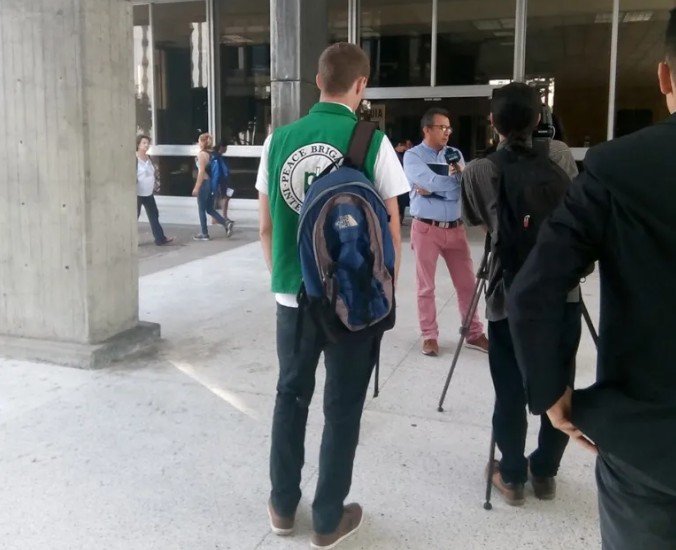
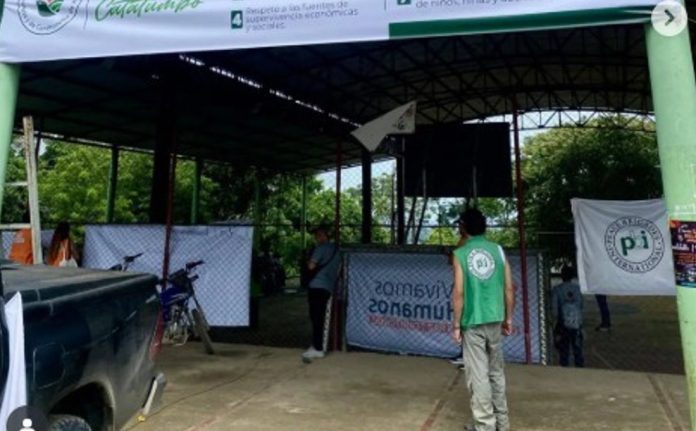
Video: A representative of PBI-Mexico (in green vest) speaks (starting at 35:26) at the observation mission media conference, July 27,2023.

The article highlights: “The signatory groups asked the federal authorities to establish a dialogue table and intervene to stop criminalization, desist from criminal actions and accusations against their members and reinforce and update the protection measures granted to those who are part of the Union of Indigenous Communities of the Northern Zone of the Isthmus of Tehuantepec.”

Video: The 33-minute Article 19 video of the press conference.

The Interoceanic Corridor of the Isthmus of Tehuantepec (CIIT)

The Interoceanic Corridor is a megaproject that has been described by a proponent as including “two deep sea ports, railroads, highways, three airports (Minatitlán, Ixtepec and Huatulco), a gas pipeline and a fiber optic network.”

The Jaltipan-Salina Cruz pipeline

The Jaltipan-Salina Cruz pipeline spans the Tehuantepec Isthmus, from Chinameca, Veracruz, to Salina Cruz, Oaxaca, where it connects to the floating Salina Cruz liquefied natural gas (LNG) export terminal.

Calgary-based TC Energy is building the Puerta del Sureste/ Southeast Gateway pipeline that will connect to Jáltipan-Salina Cruz Gas pipeline to transport gas across the Isthmus of Tehuantepec to the proposed Salina Cruz LNG export terminal.

Video still: On February 15, 2025, several coastal communities of the indigenous Nahua and Nuntaj++yi’ municipalities of Pajapan, Tatahuicapan and Mecayapan in southern Veracruz protested against the TC Energy Puerta del Sureste pipeline. The pipeline is expected to be operational on May 1, 2025.

The Toronto-headquartered Royal Bank of Canada and other Canadian banks are financing the US company Sempra Energy that through its Mexican subsidiary Sempra Infraestructura – a partner of TC Energy – that will develop that LNG terminal in Salina Cruz that would export gas to Europe and Asia.

The Trans-Isthmus Railway

Railway Gazette International has reported: “The ports in both cities, the railway and related terminal infrastructure are all managed by Ferrocarril del Istmo de Tehuantepec, a state-owned enterprise which is part of the Mexican Navy.”

That article notes: “The primary aim of the reconstruction of the Trans-Isthmus Railway is to develop freight traffic through the two ports; investment in the Minatitlán and Salina Cruz oil refineries is also expected to generate more rail flows.”

In January 2024, the International Railway Journal reported: “Freight operations began in September 2023 following an upgrade under the Isthmus of Tehuantepec Interoceanic Corridor (CIIT) project, which aims to provide a rail alternative to the Panama Canal for freight moving between the Atlantic and the Pacific.”

A railway for grain, petrochemicals, mining concessions

That article adds: “According CIIT director general, Mr Raymundo Morales Ángeles, the upgraded railway known as Line Z can accommodate freight trains up to 65 wagons in length, as well as double-stack trains carrying up to 260 containers or 5200 tonnes. Line Z is also expected to handle bulk traffic including grain, chemical products and petrochemicals.”

In October 2024, the Pulitzer Center quoted Binnizá environmental defender Martín Regalado saying that Line K “is a Trojan horse that is leaving unprecedented environmental disasters in its wake. No one will travel on this train because its purpose is to provide roads for mining concessions and extractive companies.”

Canadian wheat shipped on the railway

On January 10, 2025, Breakbulk Events & Media reported: “The Ferrocarril del Istmo de Tehuantepec (FIT) or Isthmus of Tehuantepec Railway [and] Mexico’s Ministry of the Navy announced in November that grain producer Viterra Mexico successfully transported 2,000 tons of wheat grain using the railway. The cargo, which was imported from Canada, arrived at the Port of Salina Cruz via the SSI Prudence and was then transshipped to bulk hoppers before heading to warehouses operated by wheat distributor Trimex near the Port of Coatzacoalcos.”

CPKC involvement

There are snippets of information available about a potential role being played by the Calgary-based Canadian Pacific Kansas City (CPKC) railway company in this megaproject.

In May 2023, Bnamericas reported: “Following a meeting between President Andrés Manuel López Obrador, US officials and CPKC executives in Mexico City, the government unveiled that it invited the company to participate in the 1,500km Maya train that will connect five states in the southeast and to the rehabilitation of the 300km Tehuantepec isthmus rail corridor between Oaxaca and Veracruz states. However, during his morning press conference on Thursday, López Obrador also said that he asked CPKC to take over the Mexico City-Querétaro high-speed train that the previous government attempted to construct.”

By March 2024, Mexico News Daily reported CPKC had submitted proposals for two routes not in the Isthmus: Mexico City-Querétaro and Querétaro-San Luis Potosí-Monterrey-Nuevo Laredo.

Furthermore, in January 2024, FreightWaves quoted Pawan Joshi, executive vice president of products and strategy of the Austin, Texas-based supply chain software provider e2open suggesting that the CIIT could offer another option when global disruptions or droughts interrupt trade flows in the Panama Canal.  Joshi says: “The Canadian Pacific Kansas City Southern railroad is looking to start to invest some money on the Panama side to build more infrastructure and provide an alternative.”

Further research needed

Further research is needed to document and map the role Canadian companies and investment capital may be playing in this megaproject.

We continue to follow this.

Additional reading

The press conference and statement were also noted in: Women defenders of the Isthmus of Tehuantepec criminalized, they oppose the expansion of the Interoceanic Corridor (Cimacnoticias), Stop the criminalization of Ayuujk and Binizaa indigenous people (CiudadaniaXpress), Demand to stop the criminalization of indigenous people in the Isthmus (La Coperacha), NGOs demand an end to the criminalization of opponents of the Interoceanic Corridor in the Isthmus (Estado20), Land defenders denounce criminalization in the face of the imposition of the Interoceanic Corridor of the Isthmus of Tehuantepec (La Marea) and Environmentalists of the Isthmus of Tehuantepec report threats (El Universal).

PBI-Guatemala accompanies the Maya Ch’orti’ Indigenous Council of Olopa as it files complaint against coffee company

On April 21, PBI-Guatemala posted:

“Today PBI accompanied the Maya Ch’orti’ Indigenous Council of Olopa Chiquimula who filed a complaint for water pollution and forest damage against Ovidio Cardona, owner of a coffee company whose waste would affect several communities in the area, including sources of drinking water.

In today’s hearing, presented studies noted the presence in the affected area of “a black and sticky substance”, which could be identified “by its smell and appearance, such as honey water and coffee pulp.” The document found that there is no permit for exploitation license in that area and a cost of more than Q179,800 in forest damage is calculated.

Next hearing: May 5.”

The Maya Ch’orti’ Indigenous Council of Olopa are fighting for recognition as indigenous communities, the recovery of their spirituality, the defense of their territory and the right to free, prior and informed consultation before the entry of mining projects into their territory.

They also seek to minimize the negative impacts of mining activities on the health of the people in their communities, denounce illegal logging and fight against gender violence in their communities.

Accompaniment

Peace Brigades International began accompanying the Maya Ch’orti’ Indigenous Council of Olopa in June 2021, following their request, which is based on the serious increase in security incidents, defamation and criminalization processes they are experiencing.

PBI-Honduras accompanies ARCAH in El Merendón as it rejects the privatization of drinking water services

PBI-Honduras has posted: “Today, on International Earth Day, we celebrate the important advocacy work ARCAH does to protect water. Recently, we accompanied members of ARCAH in an activity in El Merendón (Choloma, Cortes), in which concern was expressed about the privatization of water in Honduras. From PBI, we remind you that those who defend water in Honduras continue to receive threats for their work. In that sense, adherence to the Escazu Agreement could mean an improvement in the protection of persons defending the land and territory in the country.”

On March 22, ARCAH posted: “Today on World Water Day we demand the non-privatization of water in Honduras.”

In September 2022, Criterio.hn reported:

“At least 92 of Honduras’ 298 municipalities have reportedly privatized drinking water services through a scheme in which banks in the national financial system and transnational corporations have become the main administrative managers.

This was denounced by the Alternative for Community and Environmental Reclamation (ARCAH), an environmental platform opposed to the expansion of the extractive model of natural resources in Honduras.

The environmental organization denounced, through a statement, the execution of a privatization model of the drinking water service and warned of a gradual extinction of the National Autonomous Service of Aqueducts and Sewers (SANAA).

The organization denounced that the process of expansion of privatization has been promoted by national and transnational companies that ‘indirectly finance the gradual disappearance of SANAA.’”

The statement from ARCAH to the national and international community at that time further highlighted: “ARCAH once again denounces the process of privatization of water in Honduras, we strongly emphasize that water is a sacred element that, putting its future in the hands of the private sector, is nothing more than a hard blow to the peoples, which perpetuates the extractivist, mercantile and accumulating view of capital with which Ficohsa bank and other financial companies involved see the common goods of nature.”

The Dutch entrepreneurial development bank FMO has also noted: “Banco Financiera Comercial (Banco Ficohsa) is the largest bank in Honduras with total assets of US$ 2.9bn. FMO currently holds a 6% equity interest in Banco Ficohsa.”

Accompaniment

The Honduran Alternative for Community and Environmental Vindication (ARCAH) is a space for community articulation and an anti-capitalist, anti-racist, anti-patriarchal, anti-colonialist and anti-classist social movement that seeks to defend territories and common goods from any project that threatens the peace and cosmovision of communities.

Peace Brigades International has accompanied ARCAH since September 2022.