Home Blog Page 55

Amnesty International report documents “irresponsible arms transfers” by Canada

Amnesty International has released their 410-page report The State of the World’s Human Rights (April 2025).

In the section on Canada (on page 120), Amnesty International highlights:

IRRESPONSIBLE ARMS TRANSFERS: “Canada continued to export arms and military equipment to countries despite lack of accountability for past violations and substantial risks that they could be used in serious violations of international human rights and humanitarian law. Arms worth USD 6.4 million were exported to Saudi Arabia, representing 42% of the total of non-US military exports. Authorization of new export permits for transfers of military goods to Israel was reportedly paused in January, although no official “notice to exporters” was issued and at least 180 export permits remained active.”

Last year, Amnesty International had reported: “Canada continued to export weapons to countries where there was a substantial risk of them being used to commit or facilitate serious violations of international human rights or humanitarian law. Arms worth USD 1.2 billion were exported to Saudi Arabia, representing 57% of total arms exports. Since February, approximately USD 1 million of military goods, including “riot control agents”, were approved for export to Peru amid repression of protests. Canada issued 315 export permits to Israel for weapons and military technology in 2022 and approved over USD 21 million worth of military exports to Israel between October and December 2023.”

Photo: Organizations, defenders and communities came together in May 2024 to protest the CANSEC weapons show at th EY Centre in Ottawa.

The 2025 report also highlights in its section on FREEDOM OF ASSEMBLY globally: “Security forces often brutally and lethally dispersed protests, as well as using mass arbitrary arrests and enforced disappearances to suppress them. In 2024, killings and/or mass arrests of scores of protesters were documented in countries including Bangladesh, Egypt, Georgia, Guinea, India, Indonesia, Jordan, Kenya, Mozambique, Nepal, Nigeria, Pakistan and Senegal. In Bangladesh, the armed forces were deployed against student protests and “shoot-on-sight” orders issued, resulting in close to a thousand deaths, with many more injured.”

The complete Amnesty International report can be read at The State of the World’s Human Rights (April 2025).

SHUT DOWN CANSEC, May 28

Peace Brigades International-Canada will be present at the Shut Down CANSEC mobilization taking place on May 28 at the EY Centre in Ottawa.

On Instagram: @shut.down.cansec

Excerpts from Amnesty International: The State of the World’s Human Rights

Amnesty International has released their 410-page report The State of the World’s Human Rights (April 2025).

The Amnesty International report highlights the situation for human rights defenders in a dedicated section for Colombia, Guatemala, Honduras and Indonesia.

It also references the situation in Mexico, Nicaragua, Kenya, Nepal and Indonesia.

Furthermore it highlights issues of concern in other countries where PBI entities are present including the United Kingdom, Spain, Germany, the United States, the Netherlands, Italy, France, Switzerland, Belgium, Norway and Australia.

Key excerpts from their report include:

CANADA (page 119): “Four Wet’suwet’en and other Indigenous land defenders were found guilty of criminal contempt of court for protecting Wet’suwet’en territory against the construction of a pipeline, including Likhts’amisyu Clan Wing Chief Dsta’hyl, who served a 60-day house arrest.”

COLOMBIA (page 134): In June the Ministry of Interior issued a call for applications to the restructured Comprehensive Programme on Security and Protection for Communities and Organizations in the Territories. This collective protection initiative was aimed at enhancing the capacity of communities and organizations, with a specific focus on safeguarding human rights defenders. In July the government and human rights organizations reactivated the Guarantees National Roundtable, designed to facilitate dialogue between state institutions and civil society regarding the protection and promotion of the defence of human rights. In November, human rights organizations announced that the Roundtable had not met again because of postponements by some high-ranking officers who should have participated in the meetings. Nevertheless, violence against human rights defenders remained widespread. The situation in departments and regions such as Antioquia, Arauca, Cauca, Magdalena Medio, Norte de Santander and Valle del Cauca was particularly concerning. The We Are Defenders Programme recorded 355 attacks against 318 human rights defenders between January and June, including killings, threats, arbitrary detention, torture, enforced disappearance, abduction and forced displacement a 24% decrease in aggressions compared with the same period in 2023. Between July and September the programme recorded 205 attacks against 190 human rights defenders, a 23% increase compared with the same period in 2023. Between January and November the OHCHR reported 186 allegations of killings of human rights defenders in Colombia, of which 80 cases had been verified, 11 were still under verification and 95 were inconclusive. In March the Inter-American Court of Human Rights found Colombia responsible for a campaign of persecution against the Lawyers Collective “José Alvear Restrepo”. The court determined that from 1990 to at least 2005 various Colombian institutions conducted arbitrary intelligence activities targeting the collective and its members, violating their right to defend human rights, among others.

GUATEMALA (page 186) Local organization Unit for Attacks on Human Rights Defenders in Guatemala registered at least 2,763 attacks on human rights defenders between January and October. The body responsible for the analysis of risks to human rights defenders, convened by the Ministry of Interior, was reactivated. At the end of the year, the public policy for the protection of human rights defenders was still pending approval, and the state had not ratified the Escazú Agreement.

HONDURAS (page 190) Honduras was the most lethal country in the world for defenders of land and environment, according to Global Witness. They faced stigmatization, intimidation, arbitrary detention and criminalization, most of which went unpunished. Attacks mainly occurred in the context of disputes relating to mining projects, land-tenure insecurity, and violations of the rights of Indigenous Peoples and Afro-descendants, including Garifuna human rights defenders. Local organizations raised concerns over the weakness and ineffectiveness of the national protection mechanism for human rights defenders. In September, Juan López of the Municipal Committee for the Defence of Common and Public Goods of Tocoa was shot dead. In November, the Supreme Court of Justice confirmed sentences against eight men responsible for the murder of Indigenous defender Berta Cáceres in 2016. By the end of the year, the state had not signed the Escazú Agreement.

INDONESIA (page 198) At least 123 cases of physical assaults, digital attacks, threats and other forms of reprisals against 288 human rights defenders were reported during the year. Human rights defenders lacked adequate legal protection, leaving them vulnerable to threats and intimidation. Very few of those responsible for the attacks were brought to justice, with only a small number being convicted in court. On 17 July, Yan Christian Warinussy, a senior lawyer and human rights activist in Papua, was shot and injured by an unidentified person in Manokwari, West Papua province. The attack occurred after he attended a corruption trial involving local state auditors at the Manokwari anti-corruption court. By year’s end there was no known progress in a police inquiry.

MEXICO (page 254) Human rights defenders, journalists and protesters remained at risk of criminalization, excessive use of force, violence and death. Human rights violations by the military and National Guard continued, including possible extrajudicial executions; impunity persisted. Disappearances were a huge concern, but there were concerns that the government minimized the scale of the issue. Those searching for disappeared people were at serious risk.

NICARAGUA (page 276) Expulsions, deprivation of nationality and arbitrary detentions of dissenters and others continued, exposing them to severe vulnerability and violations of their rights. Authorities imposed strict restrictions on the media, threatening freedom of expression. Journalists were at risk of death and enforced disappearance. Indigenous Peoples remained at risk of displacement, enforced disappearance and attacks by pro-government armed groups.

KENYA (page 225) Sixty people were killed and hundreds injured when police used excessive and unnecessary force against people protesting a proposed Finance bill. Draft legislation threatened to impose further restrictions on the rights to freedom of expression and peaceful assembly. More than 600 protesters were arbitrarily arrested and detained, and dozens were forcibly disappeared. Extrajudicial executions continued to be reported. The government forcibly evicted thousands of people from the Mathare and Mukuru Kwa Njenga settlements, amid heavy rainfall and flooding.” 

NEPAL (page 272) Authorities used unlawful force against protesters and restricted freedoms of expression and assembly. A key step towards advancing transitional justice nonetheless contained significant gaps that could allow impunity. Violence against women and girls and caste-based discrimination persisted across the country. Forced evictions continued. Illegal recruitment of migrant workers continued.

The complete Amnesty International report can be read at The State of the World’s Human Rights (April 2025).

PBI-Guatemala accompanies Human Rights Law Firm at court hearing on Hogar Seguro fire where eight officials are accused of crimes

PBI-Guatemala has posted:

Today #PBIaccompanies the Human Rights Law Firm to a hearing of the #HogarSeguro case.

The case concerns the fire that occurred on March 8, 2017, inside Hogar Seguro Virgen de la Asunción, where 41 girls died and 15 were seriously injured. There are 8 people who have been charged for these facts.

In the hearing a witness proposed by the defense and who at that time exercised a role of president of Juvenile Deprivation of Liberty Centers of the Social Welfare Secretariat was presented. During his statement he affirmed that he was not present when the events took place and that he did not see the alleged threats made by the adolescents against the staff of the Hogar Seguro, affirming that the situation was under control when he arrived.

Next May 8, the debate stage will conclude with the last witnesses of the case to give way to the conclusions.

Photo inside the court room. Photo by Verdad y Justicia en Guatemala.

Soy 502 also reports:

Eight years have passed since the tragedy in which the minors were under the protection of the State of Guatemala and the families of the victims are still waiting for justice to be done.

In January 2024, the trial began against eight former officials, whom the Public Prosecutor’s Office accuses of several crimes. The oral and public debate has lasted for several months, in which the Prosecutor’s Office against the crime of Femicide has presented testimonial, documentary and expert evidence related to the case.

The trial is about to enter the last phase, it is expected that in April the conclusions of the trial will be issued and that at the latest, in May, the Seventh Court will issue a sentence.

[The eight people accused of crimes include] Carlos Rodas, who served as Secretary of Social Welfare, for the crimes of breach of duty, abuse of authority, culpable homicide and culpable injuries [and] Luis Armando Pérez Borja, former deputy commissioner of the PNC [National Civil Police].

The Prosecutor’s Office hopes that with all the evidence presented, a conviction will be achieved against the former officials indicated.

“In total there are 56 victims, 41 deceased and 15 survivors, minors, who received inhumane treatment by the authorities who were supposed to ensure their well-being. Many adolescents came to that Home because they were victims in their environments or because their responsible adults needed government support,” said one of the prosecutors who investigated the case from the beginning.

Accompaniment

PBI-Guatemala has accompanied this court process over these years.

They have highlighted: “PBI began to accompany Édgar Pérez Archila [who founded the Human Rights Law Firm] in August 2010, due to several security incidents Edgar had faced in relation to the high profile judicial processes he was working on. At the end of 2013, we extended the accompaniment to the other lawyers of the Human Rights Law Firm (BDH) who work in high-profile trials to fight against impunity and in defending criminalised human rights defenders.”

Further reading: PBI-Guatemala observes commemoration of the lives lost in the Hogar Seguro Virgen de la Asuncion shelter fire (September 2019).

PBI-Colombia accompanies Nomadesc at commemorations of the National Strike of 2021 and the demand for a Truth Commission

On April 28, PBI-Colombia posted on social media:

Four years after the social outbreak in Colombia, human rights organizations continue to demand truth, justice and reparation through the creation of a Truth Commission for the events that occurred during the protests from 2019 to 2021. In this week of commemoration, we were with Nomadesc and collectives of survivors and relatives of victims, accompanying their advocacy actions against impunity.

The day before, April 27, Association for Social Research and Action (NOMADESC) also posted:

It has been four years of walking the memory of #28A of 2021, the day when Colombia woke up, the monuments fell down and the streets of indignation became indignant. Impunity and oblivion have not been able to silence the voices of those who every day shout louder “Justice, truth and reparation”.

We walk more together for the profound transformation of this country, to put an end to police brutality, and the demands for truth about what happened in the social explosion.

So that it never happens again, we demand a #TruthCommissionNow

Radio Nacional de Colombia provides this context:

On April 28, 2021, the social outbreak began in Colombia

What began as a demonstration to reject the tax reform promoted by the government of Iván Duque, which hit the pockets of the middle class at a time marked by the pandemic, ended up turning into mass mobilizations around the country.

These citizen expressions not only rejected the tax reform project of the then government, but also served for citizens to express their discontent with the inequality and inequity that, historically, the country had experienced.

However, the then government repressed social protests and the figures of violence rose dramatically.

According to the report ‘Figures of violence in the framework of the 2021 national strike’ by Indepaz and Temblores, more than 3 thousand cases of physical violence were registered, among which they documented “75 murders in the framework of the national strike, of which 44 have been allegedly perpetrated by the Public Force”.

The traces of violence are still latent and there are many families who demand an answer for the disappearance and murder, according to them, of their children.”

Accompaniment

PBI-Colombia provided physical accompaniment throughout the national strike last year. For more on that, please see Updated photo journal: PBI-Colombia accompanies human rights defenders during the national strike (May 21, 2021).

Peace Brigades International has accompanied the Association for Social Research and Action (NOMADESC) since 2011 and its president Berenice Celeita since 1999.

We continue to follow this.
What are the implications of the Canadian election for land and water protectors?

Video still: Prime Minister Mark Carney on election night.

As of today, the morning after the April 28 federal election in Canada, it appears that there will be a Liberal minority government.

CBC chart highlights seat count and popular vote.

While any foreign policy was dominated by US-Canada relations (and not, for instance, the human rights implications of Canadian mining companies in Latin America), two key issues have implications for land defenders and water protectors.

Energy corridor

Both Liberal leader Mark Carney (who is the prime minister) and Conservative leader Pierre Poilievre (who lost his seat last night) promised energy corridors.

Speaking from Ottawa on election night, Carney said: “We are going to build — build, baby, build.” He added: “It’s time to build Canada into an energy superpower in both clean and conventional energy.” Poilievre had promised he would “fast-track approvals for transmission lines, railways, pipelines, and other critical infrastructure across Canada in a pre-approved transport corridor entirely within Canada.”

This has implications for Indigenous territories intersected by this corridor.

Ring of Fire mining

Both the Liberals and Conservatives had also promised accelerated approvals of critical mineral mining projects in an area of northern Ontario called the Ring of Fire.

The Narwhal has commented: “While Carney repeatedly emphasized the urgency and importance of natural resource and energy projects on the campaign trail, he also said he would not force projects through against the will of Indigenous nations. How he will fast-track projects while fulfilling the constitutional duty to consult remains to be seen.”

Palestine

The Dublin, Ireland-based organization Front Line Defenders has previously commented: “Those [human rights defenders] defending the right to health and the right to life as doctors, nurses, or ambulance workers, those exposing and documenting war crimes as journalists, and those providing humanitarian support as volunteers or employees of aid agencies were all specifically targeted by Israeli bombs or guns.”

In their election report card, Canadian for Peace and Justice in the Middle East (CJPME) highlighted: “Carney initially claimed that Canada has an ‘arms embargo’ on Israel but then walked it back and said that Canada continues to export defensive arms for the Iron Dome. The Liberal party has [also] continued to allow the export of F-35 and Apache Helicopter parts and components to the US, which are then supplied to Israel. …The Conservative Party does not support any restriction on arms exports to Israel, and Poilievre says he will ‘remove any ban on the sale of military equipment to Israel.’”

Military spending

CBC has also reported: “Liberal Leader Mark Carney said he’d bring defence spending up to two per cent of Canada’s GDP — in line with the NATO benchmark — by 2030. Conservative Leader Pierre Poilievre promised to ‘work toward’ that target, as did the NDP.” A two-percent expenditure is about $64 billion a year, up billions from last year’s 1.37 per cent expenditure of $41 billion.

International development

And TVO has noted: “Poilievre [would] cut international assistance, which is now about $16 billion a year. He has made that his top international priority. He talks about cutting wasteful foreign aid ‘to dictators, terrorists, and multinational bureaucracies,’ though he doesn’t say which ones. Or by how much.”

CBC has also reported: “Under Mark Carney’s leadership, global investment firm Brookfield was accused of breaching Indigenous rights or harming the environment in at least four countries, CBC Indigenous has found.”

That article highlights: “In northern Colombia, the Sogamoso Dam, owned by Brookfield’s Colombian business Isagen, caused significant damage to ecosystems and local communities, according to a 2023 collaborative report by some 50 civil society groups. Meanwhile, the Wayuu people are resisting an Isagen wind farm in La Guajira, Colombia’s northernmost peninsula. Nacion Wayuu, a local NGO, accuses Isagen of invading their ancestral territories and advancing the project without consent.”

Photo: Opposition to the Brookfield-owned Isagen “invad[ing] Wayuu indigenous territories and desecrat[ing] sacred sites to install wind power projects without consultation.” 

Another election in the coming months?

The life expectancy of a minority government in Canada is about 20 months. During CBC TV’s election coverage last night, Toronto Star national columnist Althia Raj suggested Canada could see another election “later this year” or in 2026.

Further reading: What implications could Canada-US trade and security talks have on the safety of human rights defenders? (PBI-Canada, April 15, 2025)

Mexican environmental defender Suástegui Muñoz who opposed the CFE La Parota dam and challenged the Navy-backed Maribús project is killed

The Tlachinollan Human Rights Centre has posted on social media: “After Marco Antonio Suástegui Muñoz, historical leader of CECOP, was attacked by a gunman when he was leaving Icacos beach, today we unfortunately received the news that he lost his life, after 8 days in the hospital in Acapulco trying to survive.”

Marco Antonio Suástegui Muñoz died on Friday April 25 after being shot as many as eight times on Good Friday April 18 as he was finishing work as a tourist service provider on Icacos beach in the Costa Azul subdivision of the city of Acapulco, Guerrero.

Now, La Jornada reports that the burial of the 49-year-old Suástegui Muñoz, who was a spokesperson for the Council of Ejidos and Communities Opposed to the La Parota Dam (CECOP) and a leader of Tourists United in the Defense and Rescue of Icacos Beach (TUDERPI), took place on Sunday April 27 in the town of Cacahuatepec in the state of Oaxaca near the border with Guerrero.

Photo by Tlachinollan.

La Jornada further reports: “Abel Barrera, director of Tlachinollan, said that the attack against Marco Antonio ‘shows that there is a pattern of attacks against community and territory defenders, which the (government) authorities do not investigate’. Marco Antonio ‘was an icon of resistance, of struggle, of the dignity of the peoples, who rebuked power; he pointed out those responsible, however, they did not investigate and let the attacks go as far as depriving him of his life.’”

The struggle against the La Parota dam

Infobae reports: “Marco Antonio Suástegui Muñoz was a key figure in the fight against the construction of the La Parota hydroelectric dam [on the Papagayo River], a project that threatened to flood communal lands in Cacahuatepec, Guerrero.”

Proceso further explains the La Parota dam is “a CFE [Federal Electricity Commission] hydroelectric megaproject that has sought unsuccessfully to settle in those ejidos with the help of governors, businessmen and organized crime.”

La Unión also notes: “For more than 20 years, he led the struggle of 21 communities in Guerrero against the construction of the La Parota dam, a megaproject of the Federal Electricity Commission (CFE) that, if materialized, would affect more than 70,000 people and cause the forced displacement of some 20,000. The activist denounced that indigenous peoples and peasants were never adequately consulted.”

That article adds: “His commitment cost him three imprisonments, constant threats, the disappearance of his brother Vicente in 2021, and finally his life. In all the criminal proceedings faced, he was found innocent for lack of evidence.”

La Jornada reports: “During the commemoration of the 21st anniversary of CECOP, on July 28, 2024, in the town of Cacahuatepec, with the slogan For Agroecology, the spokesperson announced that the new mission was the fight against climate change and for sustainable agriculture, in addition to insisting that the decree of definitive cancellation of the La Parota project is still pending. because so far it is only suspended.”

In their 2007-08 Annual Review, PBI-Mexico noted: “The activities of the organisations we accompany [include] the Tlachinollan Human Rights Centre [whose] cases include human rights violations by the army, and defence of communities opposing the controversial La Parota hydroelectric dam project.”

PBI-Mexico also interviewed the Council of Ejidos and Communities Opposed to the La Parota Dam (CECOP) in December 2010 and shared that in this three-page report.

Defence of Icacos Beach in Acapulco

Suástegui Muñoz was also a leader of Tourists United in the Defense and Rescue of Icacos Beach (TUDERPI). Infobae explains: “He was involved in the defense of Acapulco beach against privatization projects and allegations of environmental crimes.”

La Unión highlights: “Since 2024 he had reported death threats while working in the tourist area of Acapulco.”

El Financiero adds: “In recent weeks, Marco Antonio Suástegui had actively participated in mobilizations linked to the interests of tourism service providers in various areas of the port of Acapulco, including Caleta, Caletilla and the so-called Golden Zone [an upscale district of the city]. …A day after the demonstration, on March 26, 2025, representatives of that sector announced the breakdown of dialogue with the National Fund for the Promotion of Tourism (FONATUR) and with local authorities, pointing out that there were attempts to fragment the movement and impose external leadership.”

That article highlights: “At that time, Suástegui Muñoz warned that, if the disagreement with the Federal Government persisted, they would oppose the execution of projects in Acapulco, including the so-called ‘Maribús’.”

Earlier this year, The Guerrero Post explained: “President Claudia Sheinbaum has confirmed the construction of Maribús, a public water transport system in the bay of Acapulco, Guerrero, aimed at enhancing the transport system of this tourist destination. …The Maribús will be built by Navy (SEMAR) personnel and financed with public resources.”

La Jornada notes: “On March 4, during a meeting that the leader described as ‘harsh’, in the Eighth Naval Region, in Icacos, where commanders of the Secretariat of the Navy [SEMAR] and directors of Fonatur [the National Fund for the Promotion of Tourism], as well as other beach leaders, attended, Marco Suástegui pointed out that ‘the Easter holidays will not represent a trial by fire, but by acid, to show that those who depend on the beaches are organized’.”

That article adds: “The murder of the activist took place in an environment of violence in the port, since the beginning of the Easter holiday period, on April 11, which left at least 25 people murdered and public transport in the western area of the port paralyzed, due to attacks on drivers and units.”

No protection measures

Proceso notes: “Suástegui did not have precautionary measures from the federal government despite having denounced death threats against him for his work as an opponent of the installation of the project and for the search for his brother Vicente Iván, who disappeared in 2021 and whom he never saw again.”

The call for an investigation

El Financiero reports: “The Tlachinollan organization expressed its position on the case, pointing out that it is a crime that requires investigation and clarification. The organization called on state authorities to carry out a thorough investigation and ensure that those responsible are brought to justice.”

PBI-Canada extends our condolences to the family, friends and colleagues of Marco Antonio Suástegui Muñoz.

PBI-Colombia accompanies CAHUCOPANA at assembly with ADESAN, ASOMEPABA, AMUSUNASB and municipalities

The Humanitarian Action Corporation for Coexistence and Peace in Northeast Antioquia (CAHUCOPANA) has posted on social media:

Barrancabermeja, Santander

Peace is built with communities!

We unite in a space for dialogue and coming together for the real transformation of Northeastern Antioquia and South Bolivar.

We met in an Intermunicipal Assembly between the Humanitarian Action Corporation for Coexistence and Peace in Northeast Antioquia (CAHUCOPANA), the Association of Displaced Victims of the Armed Conflict of Santa Rosa (ADESAN), the Association Women Entrepreneurs and Productive Women (ASOMEPABA), the Association of Women in Overcoming Northeast Antioquia and South Bolívar (AMUSUNASB) with the active participation of the three targeted municipalities: Santa Rosa, Remedios and Segovia.

This is a historic moment to listen to each other, propose and walk together towards a territory with social justice, dignity and peace.

Transformation is born from the territory!

With funding and support from the UN Verification Mission in Colombia.

Humanitarian crisis

On April 25, CAHUCOPANA also posted on X: “Remedios | ALERT At 10:00 am, two members of the Gulf Clan threw an explosive device at the @PoliciaColombia in the municipality of @MpioRemedios. We have long warned about the humanitarian crisis without any solution to the problem SOS.”

They added: “#HumanitarianCrisis #RemediosAntioquia #ClanDelGolfo Also, just a few days ago, on Sunday, April 20, another hitman attacked a @PoliciaColombia in @MpioRemedios, injuring two young people who were passing by. Urgent measures are needed!”

The call for a “participatory and transformative peace”

Earlier this month, CAHUCOPANA was one of “more than 150 social organizations that called for the construction of a participatory and transformative peace.”

That statement highlights:

We are convinced that a political solution to the various conflicts and armed violence is possible – and above all necessary. Because despite the different agreements between the State and armed organizations, the war persists.

The historical armed conflict that emerged in the 60s with the ELN [National Liberation Army] persists. A new conflict has been configured with the armed structures that emerged after the agreements with the FARC-EP [Revolutionary Armed Forces of Colombia – People’s Army] in 2016. We are experiencing the emergence of new and dissimilar criminal structures that dispute political and territorial power.

Paramilitarism remains a challenge to be solved if we want to overcome the armed conflict. After the 2006 agreements with the AUC [United Self-Defense Forces of Colombia], the paramilitary strategy multiplied in various techniques of urban and rural territorial social control. The policy of dismantling ‘groups inherited from paramilitarism’ was never implemented.

The security forces continue to be tied to the doctrine of the ‘internal enemy’, despite the current government’s announcements of a ‘human security’ approach. The expansion of the counterinsurgency strategy against social actors who mobilize for their rights – especially territorial rights – is directly associated with this doctrine. The lack of commitment of the security forces to peace is expressed in their calculated inaction, which stimulates tensions and confrontations between irregular armed groups of various kinds.

We invite Colombian society to unite and actively participate in this Social Movement for Peace, an autonomous space, for everyone. So that together with the irregular armed actors and the State, we focus on building an agenda of profound transformations that lay the foundations for a new social, economic and political scenario for the country.

The full statement can be read at Social Movement for Peace – it belongs to everyone (posted by the José Alvear Restrepo Lawyers’ Collective/CAJAR).

This statement was also signed by the Association for the Integral Sustainable Development of La Perla Amazonica-ADISPA (Putumayo), the Regional Corporation for the Defense of Human Right-CREDHOS, the Foundation Committee of Solidarity with Political Prisoners Tolima Sectional, the National Movement of Victims of State Crimes-MOVICE, and the Black Communities Process-PCN.

Accompaniment

Peace Brigades International has accompanied the Humanitarian Action Corporation for Coexistence and Peace in Northeast Antioquia (CAHUCOPANA) since 2013.

Canada participates in Balikatan exercise despite Philippine military implicated in killings of environmental defenders

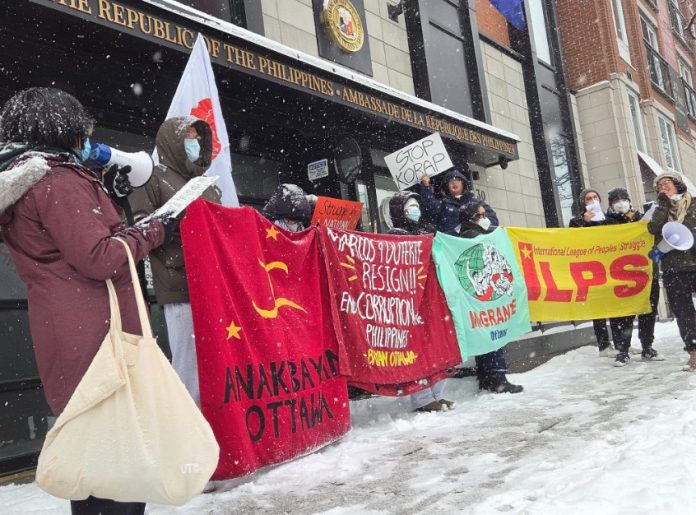
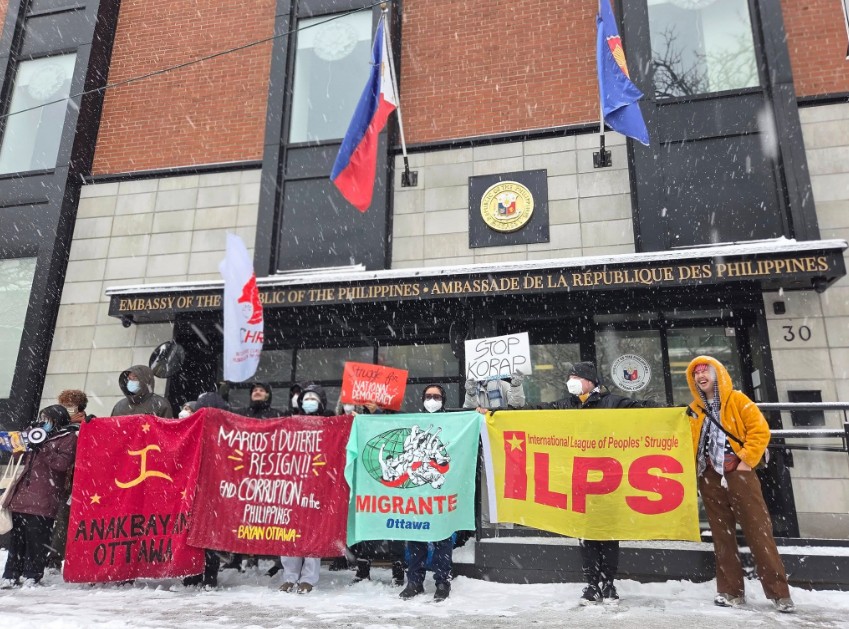
PBI-Canada photo: Protest in Ottawa against Balikatan.

“Balikatan” is an annual military training exercise held by the Philippines and the United States. This year it is taking place on the island of Luzon, the Batanes Islands and Zambales from April 21 to May 9 with Colombia, Indonesia, Germany, the UK, Canada and other countries participating as observers.

In their promotion of a protest in Ottawa today, the Ontario Committee for Human Rights in the Philippines (OCHRP) highlighted: “While Canada and the US claim to be building the defensive capabilities of the Philippines, in reality they are giving military support to a government accused of well-documented human rights abuses on activists human rights defenders, and Indigenous peoples in the name of counter-insurgency.”

OCHRP adds: “These annual war games regularly disrupt the lives of Filipinos in affected areas such as the blocking off of water used by fisherfolk, and live fire exercises can even lead to the displacement of Indigenous communities.”

More photos from today’s protest on Instagram here.

Globally, one land and environmental defender is killed every other day. Between 2012 and 2023, at least 298 defenders were killed in the Philippines (the third highest in the world after Colombia and Brazil). It continues to be the most dangerous country in Asia for land and environmental defenders.

Global Witness has noted: “The military has been linked to the highest number of killings and detentions of land and environmental defenders in the last decade… A Global Witness investigation published in December 2024 found that the government’s push to expand critical minerals mining in the country is putting frontline communities, especially Indigenous Peoples, at risk of militarisation and violence.”

Global Witness adds: “Indigenous Peoples account for a staggering one-third of land and environmental defender killings in the Philippines in 2012-23. Neary half of these cases were linked to mining. The military was responsible for 64 out of 117 killings of Indigenous defenders between 2012-23.”

In February 2024, following the visit of a delegation to the Philippines, the Public Service Alliance of Canada (PSAC) highlighted: “[Philippines president Ferdinand] Marcos Jr. is targeting anyone who criticizes state policies, including human rights defenders, social justice advocates, journalists, students and trade unionists. He is using the National Task Force to End Local Communist Armed Conflict, established by his predecessor Rodrigo Duterte, to attack and silence critics.”

Despite these well-documented human rights violations, Canada is seeking closer military collaboration with the Philippines.

On February 10, 2025, The Defense Post reported: “Canada and the Philippines are in the final stages of negotiating a pact to allow them to deploy troops on each other’s soil, [according to] the Canadian envoy to Manila.”

Canadian ambassador David Hartman says: “We are in the final stages of negotiating the agreement which will enable us to have deeper cooperation and more substantive participation in training to build capacity. …We are hopeful that the signing and ratification of the agreement by both governments can be expected before the end of 2025.”

Canada also continues to export “military goods” to the Philippines and weapons companies continue to enable the Philippines military.

In October 2024, Reuters reported: “From Lockheed Martin of the United States to Sweden’s Saab, Israel’s Rafael [and the state-run Israel Aerospace Industries], and the India-Russia joint venture BrahMos, a total of 291 firms showcased military technology and weapons systems” at the biennial Asia Defence and Security (ADAS) exhibition given the Philippines is seen as “an emerging market for the defence industry.”

Many of these same transnational corporations seeking to sell weapons and technology to the Philippines military will be at the annual CANSEC arms show this coming May 28-29 at the EY Centre in Ottawa.

It is likely an official delegation from the Philippines including military representatives will be at CANSEC this year as it has in previous years.

@shut.down.cansec on Instagram

Further reading

ICC arrest of Duterte raises questions about CANSEC and the export of “military goods” to the Philippines (PBI-Canada, March 12, 2025)

Filipino human rights defenders hold rally at Philippines Embassy in Canada as Duterte faces crimes against humanity charges (PBI-Canada, March 15, 2025)

Canada and the Philippines sign defence cooperation agreement despite the killings of human rights defenders (PBI-Canada, January 24, 2024)

Gitanyow sustainability director Tara Marsden warns Blackstone-backed PRGT pipeline would accelerate climate change

Photo: Tara Marsden, sustainability director for the Gitanyow hereditary chiefs. (Maggie MacPherson/CBC).

The CBC reports: “Tara Marsden, sustainability director for the Gitanyow hereditary chiefs, worries the current push to approve new projects [framed as breaking “Canada’s dependence on the U.S. energy economy”] will sideline environmental concerns.”

The article adds: “Marsden has helped organize opposition to a new pipeline in their traditional territory, the proposed Prince Rupert gas transmission [PRGT] line that would run 800 kilometres to a planned terminal on a coastal island, which Marsden warns will harm salmon habitat and accelerate climate change.”

The CBC article then highlights: “Marsden points out [that PRGT co-owner Texas-based Western LNG] has significant backing from Blackstone Inc., a major American asset manager whose CEO publicly endorsed Trump and contributed to his campaign — undermining any notion that the project is needed to push back against the American president. ‘This isn’t about getting out from under the thumb of Americans,’ she said. ‘It’s actually about enriching people who are in Trump’s inner circle.’”

Marsden: “Companies will bring in militarized police”

In the CBC-TV version of this report, Marsden says: “From the Coastal GasLink pipeline we learned that companies will do whatever it takes, they will bring in militarized police and they will remove Indigenous people from their lands.”

Video still from CBC National News.

On a PBI-Canada webinar last year, Marsden also commented: “Our learning is that consent only works when we say yes, if we say no, even if we say no with science behind us, and our knowledge and our laws behind us, then we will be met with force from the C-IRG, from militarized invasion and occupation and intimidation and harassment.”

The C-IRG refers to the Royal Canadian Mounted Police (RCMP) Community-Industry Response Group (C-IRG) now rebranded as the Critical Response Unit (CRU-BC).

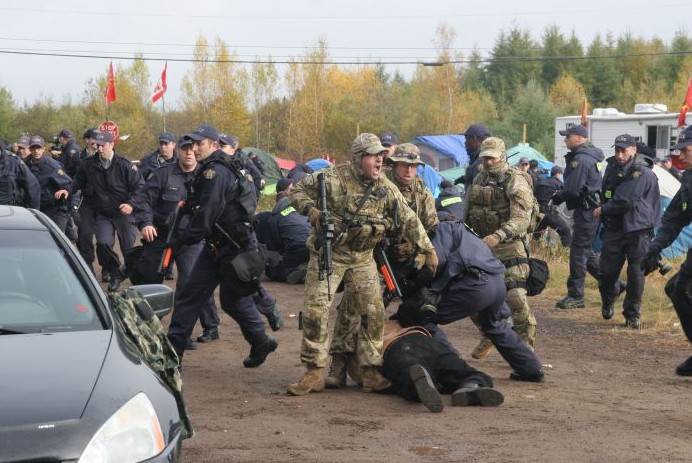
The C-IRG is currently under systemic investigation by the Ottawa-based Civilian Review and Complaints Commission (CRCC) after the agency received nearly 500 formal complaints about the unit, including allegations of excessive force, illegal tactics, unprofessional behaviour, racism, discrimination and Charter violations.

Decision on PRGT expected this spring

If approved and built, the 800-kilometre PRGT pipeline would carry fracked gas from Hudson’s Hope in northeastern British Columbia across an estimated 120 kilometres of Gitxsan territory as well as Gitanyow territory until it reaches the proposed the Ksi Lisims LNG terminal near the Nass River estuary on Nisga’a territory in northwestern BC.

In December 2024, the Pipeline Technology Journal reported that the British Columbia provincial government decision on the Prince Rupert Gas Transmission pipeline “is expected by March 2025”. On March 26, 2026, Global News reported: “The provincial government is expected to make a decision on an amendment to the pipeline’s original environmental assessment certificate this spring.”

We continue to follow this.
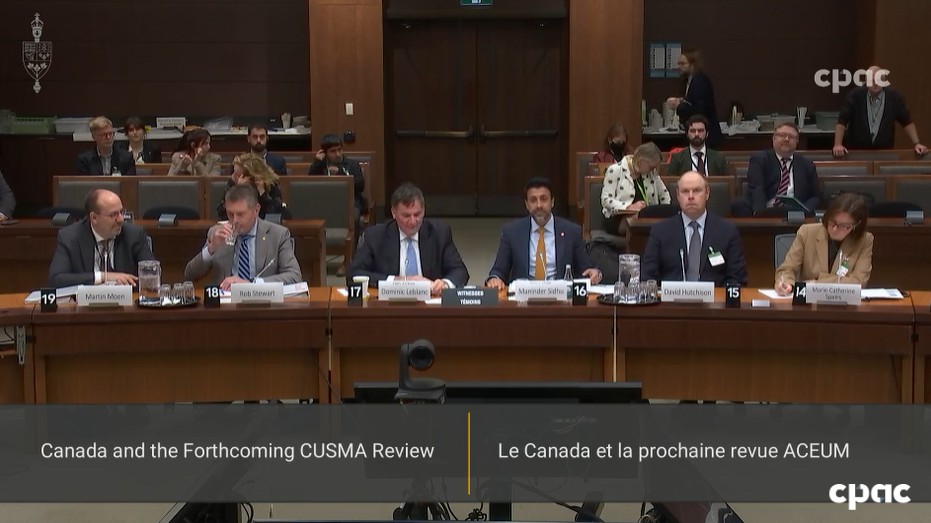
UN Special Rapporteur Mary Lawlor: “Canadian extractive mining companies are putting defenders at risk all over the world”

On April 11, Mary Lawlor, the United Nations Special Rapporteur on human rights defenders, posted on social media: “At #HRC58 [the 58th session of the UN Human Rights Council] I welcomed #Canada’s support for human rights defenders abroad. But I had to say it: Canadian extractive mining companies are putting defenders at risk all over the world. We need binding due diligence obligations, a stronger @CORE_Ombuds [Canadian Ombudsperson for Responsible Enterprise/CORE], and real accountability.”

Visa program

The visa program Lawlor notes in the video likely refers to the Canada Program – Canada Global Refugee Stream for Human Rights Defenders.
A July 2023 media release from Immigration, Refugees and Citizenship Canada notes: “Human rights defenders (HRDs) are active in every part of the world and play an essential role in promoting and protecting human rights internationally. In many countries, HRDs are increasingly at risk of violence… [As a result, the Government of Canada has] announced the expansion of the global human rights defenders stream, doubling the number of resettlement spaces from 250 to 500 for HRDs and their family members. The initiative, propelled by the belief that no one should face persecution for championing justice, reflects Canada’s unwavering commitment to providing a sanctuary for those who risk their lives in the pursuit of fundamental freedoms.”
PBI-Canada continues to call on the Government of Canada to implement a Temporary Relocation Programme that would allow human rights defenders at imminent threat a temporary refuge for a period of 3-6 months. We have highlighted that Ireland, Germany and the Netherlands have this program in place.

The need to strengthen the CORE

In November 2024, Lawlor also called for a “significant strengthening of the CORE.”

At that time, Lawlor commented: “I have long-standing concerns as to the adequacy of the CORE, in its current form, to provide any adequate form of redress for human rights defenders and the communities they represent when their rights have been violated or been put at risk by Canadian companies operating abroad. This has been reflected in conversations I have had with human rights defenders since taking up my mandate, who, where aware of the CORE, have repeatedly told me they have no confidence in its effectiveness.”

Specifically, Lawlor called on the Government of Canada to: “Provide the CORE with legally enforceable powers to compel evidence and testimony from companies, in line with international standards and best practice on ombudspersons’ offices, to enable effective investigations of all cases and overcome the barriers presented when companies refuse to meaningfully engage with the CORE.”

Canadian embassies and Voices at Risk guidelines

In July 2024, Lawlor also told The Globe and Mail: “[Canada] parades itself on the world stage as being the good guys … But when it comes to the conduct of companies in the context of business and human rights, the UN guiding principles and the obligations of Canadian embassies themselves abroad, they’re really found wanting.”

That article further noted: “[Lawlor] also singled out Canadian embassies, saying many have failed to respond adequately to those who raise serious concerns about the impacts of mining and oil activities abroad. Canada introduced ‘Voices at Risk’ guidelines in 2019, aimed at supporting human-rights defenders and giving advice to Canadian diplomats working overseas, but she says it hasn’t been properly implemented.”

Indigenous land defenders on territories in Canada

In February 2025, Lawlor also posted: “On 6 March I’ll present my latest report to the @humanrightscouncil, on human rights defenders in isolated, remote & rural contexts. In the lead up, I am sharing stories illustrating how the risks & challenges these defenders face are often linked to their location.”

The drawings of the defenders featured in the image shared by Lawlor are Indigenous land defenders Sleydo’ (Wet’suwet’en, Gidimt’en Clan), Kolin Sutherland-Wilson (Gitxsan) and Freda Huson (Wet’suwet’en, Unist’ot’en Clan).

PBI-Canada

Peace Brigades International-Canada continues to document violations by Canadian companies within Canada as well as in the countries where PBI physically accompanies land and environmental defenders, including Colombia, Guatemala, Honduras and Mexico where 119 defenders were killed in 2023.

Our initial research, utilizing the Business and Human Rights Resource Centre (BHRRC) database, found that 21 Canadian companies have been implicated in 88 attacks against human rights defenders over the past nine years.

We are additionally concerned that Lawlor’s office has registered 15 cases between June 2019 and March 2022 of retaliation against human rights defenders that she alleges can be linked to the activities of Canadian mining companies.

We continue to follow this.