Home Blog Page 54

Front Line Defenders Global Analysis report notes May 2024 attack against People’s Water Forum in Indonesia

Photo: “The People’s Water Forum (PWF) in Bali again experienced intimidation and forced dissolution by dozens of masses of the Garuda Nusantara Patriot Organization (PGN) on Monday, May 20, 2024. Photo: KRUHA”

The just-released Front Line Defenders GLOBAL ANALYSIS 2024/25 report notes: “The People’s Water Forum (PWF), which took place on the sidelines of the World Water Forum in Indonesia in May, was targeted by groups of masked men who acted with impunity. On 20 May, a PWF press conference was disrupted and HRDs attending were attacked. The following day, around 50 masked individuals imposed a blockade on the hotel where the PWF participants were staying, which lasted for three days. The U.N Special Rapporteur on the Human Rights to Safe Drinking Water and Sanitation attempted to enter the hotel but was prevented from doing so, intimidated and shoved. When he raised the issue of the blockade with a group of nearby police officers, he was told that “they could not intervene because the hotel entrance was in the hands of the civilians.” In the months following the PWF, Indonesian HRDs who attended continued to be subjected to intimidation and threats.”

Carleton University professor and PBI-Canada Board member Meera Karunananthan, who was at the People’s Water Forum with the Blue Planet Project, comments: “The intimidation of water defenders in Bali was not simply the act of a fringe paramilitary group. It was part of a coordinated effort that involved the Indonesian government and the World Water Council. We know from investigative media reports since the meeting in Bali that the repression was prompted by the World Water Council’s private conversations with members of the Indonesian government. Our venues were canceled. Many of us were interrogated at the airport when we landed in Bali, then surveilled at our hotel and followed by individuals we believe were part of Indonesian secret service. Every effort was made to prevent the PWF from meeting, sharing ideas and voicing our opposition to water privatization and the corporate control of water. We are alarmed by reports that comrades in Indonesia continue to face harassment and repression a year later.”

Video by Karunananthan: “Pedro Arrojo, UN Special Rapporteur, Rights to Water & Sanitation, threatened & assaulted in Bali” May 21, 2024.

Background

A year ago, on May 21, 2024, the People’s Water Forum highlighted: “We are deeply concerned by the attacks on local organizers, academics and academic institutions that has led to the cancellation and disruption of People’s Water Forum sessions over the last few days. A press conference that took place on the afternoon of May 20 was violently disrupted by a masked group supported by the Patriot Garuda Nusantara (PGN), a sort of paramilitary force. Posters, billboards and banners of the PWF were torn down, while many local attendees were pushed and threatened.”

Photo: Attack and dissolution of People’s Water Forum (PWF) activities.

Public Services International (PSI) also commented: “The government of Indonesia, no doubt prompted by the concerns of the World Water Council, has unfolded the full panoply of repressive tools to ensure that the local and global water justice movements are unable to meet. In doing so, the government has succeeded in drawing even more attention to the existence of our movements and our concerns.”

Some of the actions of the Indonesian government specified by Public Services International included: “Once the People’s Water Forum meetings started, having found a meeting venue and lodging, a paramilitary group known as Patriot Garuda Nusantara (PGN) invaded the press conference, violently tore banners down, shut off electricity in the meeting room and effectively blocked the press conference.”

PSI then noted: “This same group invaded the hotel where 40 Indonesian social movements were housed, confined them to the premises and blocked all access to them, including deliveries of food. Pedro Arrojo, the UN Special Rapporteur on the Human Rights to Safe Drinking Water and Sanitation arrived at the hotel, he was met by a cordon of police officers.  When Pedro showed his UN passport, the head of the police cordon indicated that he should speak to what appears to be a group of the PGN. Pedro was denied entry and forcibly ejected from the premises of the hotel which was effectively under blockade.”

An attack on peaceful assembly

At the time of the incident, Antara reported: “Public Works and Public Housing (PUPR) Minister Basuki Hadimuljono … said that he had coordinated with president of the World Water Council (WWC), Loic Fauchon, regarding the arrival of the participants of the People’s Water Forum. ‘I have consulted with him (Fauchon). We then decided to let them enter Indonesia,’ he revealed. He said that the WWC president, however, advised the Indonesian government to monitor the participants to ensure that they do not commit any acts that might provoke local residents.”

The Executive Director of Amnesty International Indonesia, Usman Hamid, concluded: “The intimidation and violent attack on the organizers and participants of the People’s Water Forum is a serious attack on a peaceful assembly. The repeated repression of government critics raises serious concerns about the Indonesian authorities’ commitment to freedom of peaceful assembly and association.”

Global Witness has documented that at least 20 land and environmental defenders were killed in Indonesia between 2012 and 2023. The newly-released Front Line Defenders Global Analysis report notes that at least three human rights defenders – Arbaini, Rico Sempurna Pasaribu and Russel – were killed in Indonesia in 2024.

For more about the Peace Brigades International-Indonesia Project, click here.

Further reading: UN Special Rapporteur calls for a stop to the criminalization of water defenders opposed to megaprojects in Canada (September 16, 2024)

PBI-Guatemala accompanies the Ecumenical Christian Council of Guatemala to the Public Prosecutor’s Office

On May 5, PBI-Guatemala posted:

Today #PBI accompanies the Ecumenical Christian Council of Guatemala to ratify before the Public Prosecutor’s Office the complaint for the recent break-in and robbery at its headquarters.

‘We are strengthened because all allies, independent media and society have approached these days to generate total solidarity to the Council,’ says Pastor Héctor Castañeda, who highlights ‘the importance of coming together again as Christians to face this wave of attacks on faith-based organizations.’

Prensa Comunitaria has reported: “The headquarters of the Ecumenical Christian Council of Guatemala (CECG) was assaulted on the night of Saturday, April 26 and the early morning of Sunday, April 27, according to its directors.”

“’It is important to highlight that the Ecumenical Christian Council of Guatemala accompanies communities that defend territorial autonomy, the correct use of their natural resources and the protection of their common home,’ said Reverend Jenner Miranda Calderón, a member of the Board of Directors.”

“The entity has been critical of the human rights situation in the country, this situation has caused the annoyance of sectors that provoke actions that violate the rights of the population, for which they have been targets of attacks from social networks, but never an act similar to the one they denounced today.”

That article further notes: “’The Ecumenical Council has always been subject to criminalization, there have always been some mishaps such as ways of intimidating or threatening, but not such a specific irruption, we have to clarify that here we share this space with different organizations, the attack was specifically on the headquarters of the Council,’ said Héctor Castañeda, a member of the collegiate general secretariat.”

The Ecumenical Christian Council of Guatemala is a partner of the United Church of Canada.

We continue to follow this.

Further reading: PBI-Guatemala accompanies the Ecumenical Christian Council of Guatemala at press conference following break-in at their office (May 1, 2025)

Front Line Defenders GLOBAL ANALYSIS report documents that at least 324 HRDs were killed in 2024

Dublin-based Front Line Defenders has released their 124-page GLOBAL ANALYSIS 2024/25 report.

The report notes: “At least 324 human rights defenders from 32 different countries were killed in 2024 in an attempt to silence them and their work.” It also notes: “At the time of publication, the HRD Memorial continued to research and conduct verifications on the additional killings of 77 people in Brazil, Cameroon, DRC, Guinea, Haiti, Iran, Iraq, Kenya, Lebanon, Myanmar (formerly Burma), Nigeria, Palestine, Tanzania and Ukraine.”

At least 230 of the human rights defenders killed were in countries where Peace Brigades International accompanies HRDs: Colombia (157), Mexico (32), Guatemala (29), Honduras (5), Nicaragua (4), and Indonesia (3).

Among the key findings in the report:

– The five deadliest countries for HRDs were: Colombia (where 157 defenders were killed), Mexico (32), Guatemala (29), Palestine (22) and Brazil (15).

– “20.4% of HRDs killed were land rights defenders.” Those killed were “in Brazil, Colombia, Guatemala, Mexico, Peru and the Philippines.”

– “17.9% of HRDs killed were Indigenous rights defenders.” Those killed were in “Brazil, Colombia, Ecuador, Guatemala, Mexico, Nicaragua, Peru, Venezuela and another country not listed for security reasons.”

– “Complex dynamics involving state and non-state actors and organised crime meant the environment for HRDs remained extremely dangerous in a number of countries, including Brazil, Colombia, Honduras, Ecuador, Mexico, Guatemala and Peru.”

– “In Guatemala, at least 29 HRDs were killed in 2024, the highest number of killings ever recorded by HRD Memorial partner UDEFEGUA since they started their documentation. The majority of HRDs killed, 21, worked for the protection of the land, the environment and indigenous rights.”

– “Numerous Palestinian HRDs were killed, injured, detained or forcibly disappeared by the Israeli army during the year in both targeted and untargeted attacks. Those in detention were frequently subjected to torture, and had their mobile phones and other electronic devices with which they worked confiscated.”

– “In 2024, the HRD Memorial was able to verify the killing of 59 HRDs directly or indirectly related to their human rights work challenging business or corporate interests.” This included Honduran environmental defender Juan Lopez.

Two references to Canadian companies include:

– “In Ecuador in the territory of Palo Quemado, in the province of Cotopaxi, the Prosecutor’s Office filed charges of ‘terrorism’ against more than 70 community members and HRDs. This followed their protests over a lack of meaningful consultation in relation to the La Plata project to mine gold, silver, copper and zinc on their territory by the [Vancouver-based] Canadian Atico Mining Corp (ATY).”

– “In May, six HRDs in the province of Las Naves [in Ecuador] were sentenced to three years of imprisonment and a $600 fine payable to the Canadian multinational mining company Curimining S.A. The defenders were found guilty of charges of illicit association. …In reality, their actions involved peaceful participation in marches and protests where they carried banners with slogans defending water and nature.”

Curimining S.A. is a joint venture between Canada’s Adventus Mining (whose parent organization is Vancouver-based Silvercorp Metals) and Vancouver-based Salazar Resources.

The full Front Line Defenders GLOBAL ANALYSIS 2024/25 can be read here. That report acknowledges: “For 2024, the HRD Memorial has counted on the invaluable support of the following organisations and individuals to verify and complete its dataset [including] Peace Brigades International – Honduras Project.”

PBI-Mexico and PBI-Spanish State highlight accompanied defender Margarita López on Voices of the Earth podcast

PBI-Mexico has posted on social media: “Magui from the @Ejido El Bajío spoke about the struggle for her territory in Sonora against mining projects on the #Voices of the Earth, podcast of @Carne Cruda [raw meat] radio. long with her, testimonies of women defenders from Nicaragua, Guatemala and Colombia were also shared.”

PBI-Spanish State has also posted on their Facebook page: “#MEXICO. A TOWN DEFEATS THE BIG MINING COMPANY. Living in the middle of the desert makes you resilient. Margarita López and the ejidatarios of El Bajio have used that ability to fight against the big global #mining company that illegally extracts gold in their territory. And they have succeeded in expelling it twice. Margarita is part of that collective struggle, but she has also had to carve out a niche for herself as a #defender.”

The Ejido El Bajío

Describing themselves on X, the Ejido El Bajío says: “We are a community in the Sonoran Desert, Mexico, resisting the dispossession of the Bailléres family.” And Pie de Página has noted that the company Fresnillo PLC is owned by the Baillères family.

The Ejido El Bajío also says: “For more than 10 years we have been fighting against the Penmont mining company, owned by the fourth richest man in Mexico, Alberto Baillères González. …The Penmont mining company has carried out exploration and mining exploitation in the territories of the ejido, illegally, since the nineties. …In July 1013, former magistrate Manuel Loya Valverde issued 44 rulings in favor of the ejido, in which he ruled that the mining company must vacate the territory, must return the lands to the state prior to the mining exploitation and must compensate the ejidatarios for the payment of land rents.”

In January 2025, Pie de Página reported: “The Unitary Agrarian Tribunal Number 28 accredited that the company Fresnillo PLC, owned by the Baillères family, owes the ejidatarios of the ejido El Bajío, in Sonora, the sum of 13,258,667,000 pesos. The amount corresponds to the illegal extraction of gold that the mining company carried out on ejido lands from 2005 to 2013, a temporality accredited as illegal in the 67 sentences that weigh in favor of the ejido.”

That article adds: “[The mine has] cost the lives of three ejidatarios (Raúl Ibarra de la Paz, José de Jesús Robledo Cruz, María de Jesús Gómez Vega). the disappearance of Noemi Elizabeth Lopez Gutierrez, and the arbitrary detention of 12 other peasants on the orders of the family of the former governor of Sonora, Claudia Pavlovich Arellano.”

Carne Cruda

PBI-Spanish State has explained that Voces de la Tierra (Voices of the Earth) is “PBI’s collaboration with the online radio program Carne Cruda [Raw Meat].” The podcast (from April 28, 2025) can be heard (in Spanish) here and on Spotify here.

Accompaniment

Peace Brigades International has provided security and advocacy support to members of the Ejido El Bajío due to the ongoing threats they face.

For more about the struggle of the Ejido El Bajío, see their website and their InstagramFacebook and X social media accounts.

 Further reading:

PBI-Mexico accompanied Ejido El Bajío stands in solidarity with Ejido Carrizalillo in struggle against Canadian mining company (PBI-Canada, April 20, 2025)

PBI-UK notes win by farmers against LSE listed mining company in Mexico, the environmental defenders killed after denouncing abuses (January 31, 2025)

CREDHOS marches on May Day in support of Popular Consultation and labour rights

Photo: CREDHOS marches in support of the popular consultation, May 1, 2025.

On May 1, the Regional Corporation for the Defense of Human Rights (CREDHOS), an organization accompanied by Peace Brigades International, posted on Facebook:

FOR THE DIGNITY OF THE WORKING PEOPLE, WE SAY YES TO POPULAR CONSULTATION!

In the face of attempts by militarist and oligarchic sectors to curb peace, block reforms and deepen inequality, we make an urgent call for the unity of the social and popular movement.

Barrancabermeja lives a serious crisis of violence: more than 70 homicides, mostly young, have plunged the city in fear and pain. This reality cannot be solved with more taxes and militarization.

We reject the overdose on energy bills imposed by Governor Juvenal Diaz and supported by Mayor Jonathan Vásquez. This tax does not represent security, but a blow to peace and the pockets of the working people.

Their full statement – available here – highlights: “We support the Popular Consultation as a legitimate mechanism for democratic participation that seeks to restore labor rights and guarantee decent conditions for workers.”

It also notes: “The surcharge on electricity … supposedly to strengthen the security strategy, is nothing more than a regressive war tax for peace and the economy of the people of Santander. The situation in the Magdalena Medio region of Santander demands comprehensive actions that overcome the vulnerable conditions of the communities most affected by the armed conflict, not permanent military intervention or the recycling of paramilitary practices in the pursuit of so-called security.”

Video still: CREDHOS president Ivan Madero marches in support of the popular consultation, May 1, 2025.

Photo: The march in Puerto Wilches in support of the Popular Consultation, May 1, 2025. Photo by CREDHOS.

Context

El Pais has reported: “The president [Gustavo Petro] has asked the Senate to endorse his call for a popular consultation* so that citizens can decide at the polls whether they support the labor reform that the Legislature rejected in April.”

The Spanish news agency EFE further explains: “The consultation, in order to occur, first has to pass a risky filter in Congress: the vote of the Senate, in which it does not have a majority. If the Upper House does not endorse it with 53 of its 105 votes, there will be no popular consultation. The second filter will be citizen participation. For it to be valid, at least 13.6 million people must participate in the vote, above the 11.2 million who voted for Petro in the 2022 runoff. If the threshold is exceeded, the questions with an affirmative answer will become a reality if they obtain half plus one of the valid votes.”

Infobae notes that since the President filed the request on May 1, 2025, the deadline for the Senate to approve it is June 1, 2025. That means the latest date for the popular consultation to take place would be September 1, 2025.

Petro became the president of Colombia on August 7, 2022. Under Colombian law, a president can also serve one four-year term. The next election is scheduled for May 31, 2026.

Labour movement support

The three main trade union confederations in Colombia support the popular consultation, notably the Unitary Central of Workers (CUT), the Confederation of Workers of Colombia (CTC) and the General Confederation of Labor (CGT). The National Union of Food  Workers (Sinaltrainal) has also expressed its support for the popular consultation. Furthermore, the Oil Industry Workers Union (USO) supports the call for a popular consultation.

Instagram post from the National Union of University Workers and Employees of Colombia (SINTRAUNICOL):

This is how May Day was experienced in Cali

With strength, unity and conviction, Sintraunicol Cali marched with thousands of workers to commemorate International Workers’ Day.

We vindicated our rights, raised our voices for labor dignity and supported the popular consultation as a democratic tool.

We continue in the struggle, with the working class at the forefront!

Popular Consultation questions

*The 12 questions for the proposed Popular Consultation are:

  1. Do you agree that the day work lasts a maximum of 8 hours and is between 6:00 a.m. and 6:00 p.m.?
  2. Do you agree with a 100% surcharge for work on Sunday or public holidays?
  3. Do you agree that micro, small and medium-sized productive enterprises, preferably associative, should receive preferential rates and incentives for their productive projects?
  4. Do you agree that people can have the necessary permits to attend medical treatments and leave for disabling menstrual periods?
  5. Do you agree that companies should hire at least 2 people with disabilities for every 100 workers?
  6. Do you agree that young apprentices from SENA and similar institutions should have an employment contract?
  7. Do you agree that workers on delivery platforms agree on their type of contract and are guaranteed the payment of social security?
  8. Do you agree with establishing a special labor regime for rural employers to guarantee labor rights and fair wages to agricultural workers?
  9. Do you agree with eliminating outsourcing and labor intermediation through union contracts that violate labor rights?
  10. Do you agree that domestic workers, community mothers, journalists, athletes, artists, drivers, among other informal workers, should be formalized or have access to social security?
  11. Do you agree to promote job stability through indefinite-term contracts as a general rule?
  12. Do you agree with setting up a special fund for the recognition of a pension bonus for peasants?

Accompaniment

Peace Brigades International has accompanied the Regional Corporation for the Defence of Human Rights (CREDHOS) since 1994.

We continue to follow this.

May Day march in Ottawa includes call to “shut down CANSEC” weapons exhibition on May 28

On May 1, 2025, a May Day march in downtown Ottawa included a stop outside the office of the Canadian Association of Defence and Security Industries (CADSI), that describes itself as “the national voice representing industry to government and offer platforms to connect companies with customers.”

The Board of Directors of CADSI includes representatives of transnational corporations implicated in human rights violations around the world, including: Stelia North America (that builds the shims that help open and close the weapons bay doors of F-35 fighter jets), Microsoft Canada (that supplies artificial intelligence technology to the Israeli military to select targets in Gaza), and General Dynamics Land Systems-Canada (that builds Light Armoured Vehicles for Saudi Arabia).

Photo: The police presence outside the CADSI office on Laurier Avenue on May 1, 2025.

Notably, CADSI organizes the annual CANSEC arms show that will be taking place at the EY Centre this year on May 28-29.

Last month, Amnesty International released their 410-page report The State of the World’s Human Rights. Reporting on Canada’s human rights record for 2024/25, Amnesty International highlighted (on page 120):

IRRESPONSIBLE ARMS TRANSFERS: “Canada continued to export arms and military equipment to countries despite lack of accountability for past violations and substantial risks that they could be used in serious violations of international human rights and humanitarian law. Arms worth USD 6.4 million were exported to Saudi Arabia, representing 42% of the total of non-US military exports. Authorization of new export permits for transfers of military goods to Israel was reportedly paused in January, although no official ‘notice to exporters’ was issued and at least 180 export permits remained active.”

The export of “military goods” to the United States

Last year, Project Ploughshares highlighted: “The Government of Canada does not regulate the majority of Canada’s military transfers to the United States.”

The “Berta Cáceres Human Rights in Honduras Act”, sponsored by US Representative Johnson, Henry C. “Hank,” Jr. in 2021, proposed: “To suspend United States security assistance with Honduras until such time as human rights violations by Honduran security forces cease and their perpetrators are brought to justice.”

Video still: Indigenous Lenca territorial defender Berta Cáceres was murdered in 2016. Peace Brigades International accompanies the organization she co-founded: The Civic Council of Grassroots and Indigenous Organizations in Honduras (COPINH).

The legislation also states: “The Honduran military and police are widely established to be deeply corrupt and commit human rights abuses, including torture, rape, illegal detention, and murder, with impunity.”

Project Ploughshares has recommended that Canada should “begin a full reporting of the transfer of military goods, including parts and components, to the United States.”

Without this transparency, we cannot know if Canadian exports to the U.S. help construct the “security assistance” they send to Honduran security forces that the “Berta Cáceres Human Rights in Honduras Act” is seeking to suspend.

Obligations under the UN Genocide Convention

The American Friends Service Committee (AFSC) Action Center for Corporate Accountability has documented this list of companies implicated in this violence and that arguably have obligations under the UN Genocide Convention and, as previously mentioned, the UN Guiding Principles on Business and Human Rights. Five CANSEC 2025 sponsors – Google, Lockheed Martin, Boeing, Cisco and Leonardo – are on the AFSC list.

Dublin-based Front Line Defenders has stated: “Those defending the right to health and the right to life as doctors, nurses, or ambulance workers, those exposing and documenting war crimes as journalists, and those providing humanitarian support as volunteers or employees of aid agencies were all specifically targeted by Israeli bombs or guns.”

To date, as many as 1,586 human rights defenders have been killed in Gaza, including 175 journalists408 aid workersmore than 1,000 medical staff2 lawyers, and 1 International Solidarity Movement volunteer (in the West Bank).

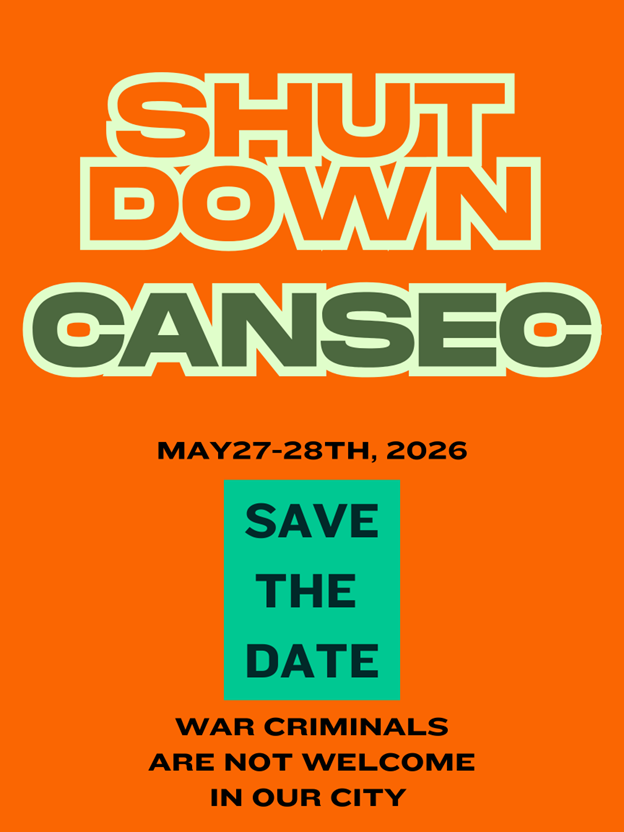
SHUT DOWN CANSEC, May 28

Peace Brigades International-Canada will be present at the Shut Down CANSEC mobilization taking place on May 28 at the EY Centre in Ottawa.

On Instagram: @shut.down.cansec

PBI-Colombia accompanies CREDHOS as it organizes to have the Magdalena River recognized as a victim of the armed conflict

PBI-Colombia has posted on Instagram:

On April 29, we accompanied CREDHOS [the Regional Corporation for the Defence of Human Rights] in the village of El Guayabo, rural area of the municipality of Puerto Wilches, Santander, to organize the event of declaration of the Magdalena River for its recognition as a subject of rights and victim of the internal armed conflict and special intervener before the JEP [Special Jurisdiction for Peace] in Case 08.

The schedule for this act of memory, recognition and dignification of the Magdalena River and the communities that have resisted alongside it, is as follows:

– May 10 in Corregimiento del Guayabo.

– May 11 in Puerto Yuma, Barrancabermeja.

The National University of Colombia has noted: “To counteract the socio-environmental conflicts of the Magdalena River, whose basin is inhabited by 77% of the Colombian population and 85% of the national gross domestic product (GDP) is produced, it would be necessary to provide protection to the tributary and the ecosystems that compose it, in addition to recognizing its importance as the country’s main waterway.”

In October 2021, lawyers Nathalia Bautista Pizarro and Juliette Vargas Trujillo commented in El Espectador: “This year the Magdalena River was declared a victim of the armed conflict, in a conviction against former paramilitary Ramiro Isaza and others in the framework of Justice and Peace. This series of sui generis recognitions seems to indicate a revolutionary trend in the field of transitional justice, beyond the anthropocentric approach.”

The two lawyers further highlight: “Acknowledging the victimization of ethnic territories, ecosystems, and other natural entities opens a window of opportunity for transitional justice. The traditional way of achieving peace according to classical liberal principles is thus overcome, by including perspectives of territorial and environmental peacebuilding from the community level.”

In October 2024, Agencia Prensa Rural explained: “Social and human rights organizations presented a request for accreditation of the Magdalena River as a victim to the Special Jurisdiction for Peace (JEP) on October 18 at a symbolic event in Bogotá.”

That article adds: “Case 08 refers to crimes committed by state agents in alliance with paramilitaries or civilian third parties, and includes some emblematic territories, including the Magdalena Medio region.”

It also notes: “According to the JEP, the main crimes directly attributed to public forces are homicides; forced displacement; threats; torture; and enforced disappearance. In some regions, these incidents occurred on a varying scale due to the stigmatization of social and political sectors and entire communities as guerrilla aides or members based on their social role or the fact that they live in those territories.”

In November 2024, El Espectador reported: “Yesid Payares [is] one of the peasant leaders of the township of El Guayabo who asked a few weeks ago that the Magdalena River be recognized by the Special Jurisdiction for Peace (JEP) as a victim of the armed conflict in Colombia.”

That article adds: “If the Magdalena River is recognized as a victim, it would become an ecosystem under protection and it would be ensured that there are no effects such as in the dumping of chemicals or the diversion of its flow for other projects, as happened, for example, in Ituango with the construction of the hydroelectric plant.”

And it notes: “The CNMH [National Centre for Historical Memory] has pointed out that at least 1,080 people were thrown into 190 rivers in the country during the years of the conflict and that the figure could be even higher, taking into account that many of the bodies were mutilated in acts of torture.”

CREDHOS president Ivan Madero says: “The river has been used as a mass grave. Bodies were thrown into it to erase the traces of crimes. It has also been used as a corridor by all armed groups.”

Peace Brigades International has accompanied the Regional Corporation for the Defence of Human Rights (CREDHOS) since 1994.

Photo: CREDHOS president Ivan Madero, PBI-Colombia and PBI-Canada on the banks of the Magdalena River in Puerto Wilches, June 28, 2022.

Human rights defenders continue to be at risk as G7 Summit meets in Canada, June 15-17

Photo: The G7 Summit will take place at the Pomeroy Kananaskis Mountain Lodge.

The G7 Summit will happen this coming June 15-17 in Kananaskis, Alberta.

It is expected to bring together the leaders of France (Emmanuel Macron), the United Kingdom (Keir Starmer), Italy (Giorgi Meloni), Germany (Olaf Scholz), Japan (Shigeru Ishiba), the United States (Donald Trump) and Canada (Mark Carney).

The 27 member-countries of the European Union will also be represented at the summit by the President of the European Commission (Ursula von der Leyen) and the President of the European Council (António Costa).

The G7 Summit will take place at the Pomeroy Kananaskis Mountain Lodge on “the traditional territory of the Treaty 7 Nations of The Tsuut’ina Nation, the Stoney Nakoda Nation, comprised of the Chiniki, Bearspaw, Goodstoney and Wesley First Nations, and the Blackfoot Confederacy, including the Kainai-Blood Tribe, Siksika, Peigan-Piikani and Aamskapi Pikun [and] the Treaty 3 region of the Mètis Nation of Alberta.”

The G7 and human rights defenders

The 2021 Open Societies Statement that accompanied the final communique from the G7 Summit in Cornwall, UK affirmed: “The importance of civic space and partnership with diverse, independent and pluralistic civil societies, including human rights defenders, in promoting human rights and fundamental freedoms.”

Most recently, the 36-page Apulia G7 Leaders’ Communiqué from last year’s G7 Summit in Italy did not mention human rights defenders.

On May 6, Front Line Defenders will be releasing its report on attacks against human rights defenders in 2024/25.

Their previous report found that: “At least 300 human rights defenders from 28 countries were killed in 2023 in an attempt to silence them and stop their work.”

In countries where Peace Brigades International accompanies human rights defenders, 142 defenders were killed in Colombia, 30 in Mexico, 19 in Honduras, 9 in Nicaragua, 6 in Guatemala and 1 in Indonesia in 2023.

Significantly, that report noted: “Indigenous peoples’ rights defenders were the most targeted group in 2023, with a total of 92 killings registered in Brazil, Colombia, Ecuador, Guatemala, Honduras, Indonesia, Mexico, Nicaragua, Paraguay, Peru and the Philippines. A total of 64 people who defended environmental and land rights were killed in Brazil, Colombia, Guatemala, Honduras, India, Mexico, Peru and the Philippines.”

Furthermore, Global Witness, an organization that publishes an annual report on attacks specifically against land and environmental defenders, has recommended: “Governments and states should create a safe environment for land and environmental defenders; systematically identify, document, and analyse attacks against land and environmental defenders; and facilitate access to justice.”

They highlight: “Defenders should be able to freely exercise their roles without fearing for their lives. Existing laws and mechanisms that protect and recognise defenders – while tackling the causes of attacks against them – need to be prioritised and enforced. …New laws should include safeguards to prevent their misuse as tools to criminalise defenders. Existing laws that specifically target or criminalise defenders or protestors should be revoked.”

State obligations to human rights defenders

At the recent intersessional consultations for the legally binding instrument on transnational corporations and human rights that took place on April 15-16 in Geneva, the International Service for Human Rights (ISHR) called on States “to center defender protections in the treaty, urging strong safeguards against reprisals and recognition of the right to defend rights.”

The ISHR further “stressed the obligation of States to ensure a safe environment for defenders, including environmental human rights defenders” and “alerted to the risk of weakening language on human rights defenders, including the removal of references to the UN Declaration on Human Rights Defenders in the preamble.”

“Shrinking space”

Instead of the meeting the obligations highlighted by the ISHR, or establishing new safeguards recommended by Global Witness to prevent the criminalization of human rights defenders, a pattern of criminalization appears to be emerging in both the Global South and the Global North.

The Amsterdam-based Transnational Institute has critically explained: “The term ‘shrinking space’ can be understood as a concept or framework that captures the dynamic relationship between repressive methods and political struggle, including the ways in which political struggle responds to these methods to reclaim space, and the impact this response has upon how political struggles relate to one another.”

Almost two years ago, in October 2023, The Guardian’s environment correspondents Matthew Taylor and Damien Gayle along with senior reporter Nina Lakhani wrote: “The Guardian has found striking similarities in the way governments from Canada and the US to Guatemala and Chile, from India and Tanzania to the UK, Europe and Australia, are cracking down on activists trying to protect the planet.”

That article in The Guardian quoted Mary Lawlor, the Dublin, Ireland-based United Nations Special Rapporteur on the situation of human rights defenders, who said: “[Criminalization is] about maintaining the power structures in place. This is true regardless of whether it’s a dictatorship, democracy or a corrupt narco-state, and regardless of the state’s professed commitment to human rights, protecting the environment and combating climate change. What’s clear is that states learn from each other.”

RCMP plans “demonstration zone”

CTV now reports: “Officials with the Town of Banff are speaking out about against a plan to set up a demonstration zone for this spring’s G7 in the mountain town.”

The “demonstration zone” in Banff is about 80 kilometres away from the Pomeroy Kananaskis Mountain Lodge where the G7 Summit will take place.

The article explains: “Because the public won’t be allowed near the site of the summit itself, demonstration zones need to be set up for protestors. One of those sites appears to be in Banff Central Park’s west parking lot on June 16 and 17.”

It then notes: “While [Town Manager Kelly] Gibson said the town appreciates the efforts to facilitate freedom of speech and the right to peaceful protest, the concern is there are more appropriate places where the demonstration zone could be located, specifically where G7 leaders would be able to ‘see and hear’ their messages.”

The RCMP Integrated Safety and Security Group (ISSG) says: “Although we cannot restrict the movement of protesters, we will be installing a fence around the parking lot to clearly indicate the demonstration zone.”

The RCMP C-IRG

It is not clear if the Critical Response Unit, formerly the Community-Industry Response Group (C-IRG), is connected to or liaising with the RCMP Integrated Safety and Security Group (ISSG) on G7 Summit security.

The Tyee has reported that RCMP Staff Sgt. Clark says the C-IRG’s approach to public disorder has been adopted as a “national best practice”.

The RCMP has explained: “Now named CRU-BC, its members will continue to assist in civil and public order events for natural or human caused disasters, conduct proactive engagement and, if required, enforcement duties specific to the critical incident. This assistance and support are independent of local detachment/unit operations, and operates in conjunction with other RCMP specialized units and police agencies to ensure intelligence-led and impartial policing of disputes.”

The RCMP C-IRG is currently under a “systemic investigation” by the Civilian Review and Complaints Commission (CRCC) receiving nearly 500 formal complaints about the unit in relation to land defence struggles including on Wet’suwet’en territory against the Coastal GasLink fracked gas pipeline.

ILPS protest planned in Calgary

At this time, Rocky Mountain Outlook reports: “[Apart from Banff] no other additional designated demonstration zones are planned for the Bow Valley area at this time. Calgary Police Service have yet to publicly confirm their designated demonstration zones.”

The International League of Peoples’ Struggles (ILPS) in Canada is organizing both a counter-summit and a rally in Calgary to challenge the G7.

Civil liberties concerns re: “protest zones”

On June 25-26, 2010, a G8 summit was held in Muskoka, Ontario, followed by a G20 summit on June 26-27, 2010, in Toronto.

In total, 1,118 people were arrested during the G20 Summit in Toronto that year, 39 of who reported being injured during their arrest. Following this, the Canadian Civil Liberties Association (CCLA) called for: “The implementation of better guidelines for the establishment of security perimeters.”

In May 2012, the Office of the Independent Police Review Director issued a 313-page report titled Policing the Right to Protest.

At that time, CityNews in Toronto reported: “Police violated civil rights, detained people illegally and used excessive force during the G20 summit two years ago, a new report concludes. …The report takes aim at police tactics at the provincial legislature, which had been set up in advance as a protest zone. It says the force used for crowd control and in making arrests was ‘in some cases excessive’.”

By August 2020, Toronto Police had also agreed to reform their methods in policing future mass protests and paid $16.5 million as part of a settlement reached in a class action suit that followed the G20 summit.

We continue to follow this.

PBI-Guatemala accompanies the Ecumenical Christian Council of Guatemala at press conference following break-in at their office

On April 30, PBI-Guatemala posted:

Today #PBI accompanies the Ecumenical Christian Council of Guatemala at a press conference in response to the violent raid and kidnapping of information suffered by its headquarters in the early hours of Sunday, April 27.

“In Guatemala we will never again succumb to fear, we will never again remain silent, in #Guatemala Never Again” said Pastor Héctor Castañeda, on this event that occurred in the commemorative framework of the 27th anniversary of the assassination of Bishop [Juan José] Gerardi.

“We are in solidarity with the capture of [Indigenous leaders] Luis Pacheco and Hector Chaclán and we believe that everything is part of a national process that seeks to aorillar [get around] organizations like ours that defend the common home, life and territory”, adds the coordinator of the Pastoral, Luis Lopez.

Prensa Comunitaria now reports: “The headquarters of the Ecumenical Christian Council of Guatemala (CECG) was assaulted on the night of Saturday, April 26 and the early morning of Sunday, April 27, according to its directors.”

“’It is important to highlight that the Ecumenical Christian Council of Guatemala accompanies communities that defend territorial autonomy, the correct use of their natural resources and the protection of their common home,’ said Reverend Jenner Miranda Calderón, a member of the Board of Directors.”

“The entity has been critical of the human rights situation in the country, this situation has caused the annoyance of sectors that provoke actions that violate the rights of the population, for which they have been targets of attacks from social networks, but never an act similar to the one they denounced today.”

That article further notes: “’The Ecumenical Council has always been subject to criminalization, there have always been some mishaps such as ways of intimidating or threatening, but not such a specific irruption, we have to clarify that here we share this space with different organizations, the attack was specifically on the headquarters of the Council,’ said Héctor Castañeda, a member of the collegiate general secretariat.”

The full Prensa Comunitaria article can be read at El Concejo Ecuménico Cristiano denuncia robo en su sede.

Several video clips from the media conference as well as photos of the office after the break-in can be found on the Prensa Comunitaria X account here.

More about the Ecumenical Christian Council of Guatemala

As noted on their Facebook page: “The Ecumenical Christian Council of Guatemala is a common home for Christian people of different traditions and for people of different religious communities. It seeks to dialogue with all persons, communities and civil organizations.”

Global Ministries further explains: “The Ecumenical Christian Council of Guatemala is a place for Christian encounter, reflection, and action for those committed to working for peace, reconciliation, and ecumenism in Guatemala.  The Ecumenical Council takes on the challenge of maintaining the kairos of the Guatemalan Peace Agreements, upholding a prophetic voice of denunciation and declaration of facts and situations of injustice, and other realities that hinder the fulfillment of the Realm of God on earth.”

Global Ministries also notes that one of the six areas of work for the Ecumenical Christian Council of Guatemala is: “Stewardship of Creation—From an ecumenical and intercultural perspective, give support to communities for the defense of territory and creation, ecological protection, risk management, and humanitarian aid in alliance with other spaces.”

The United Church of Canada

The Ecumenical Christian Council of Guatemala is a partner of the United Church of Canada.

The United Church of Canada notes: “In the Caribbean and Latin America, the United Church works with Mission and Service partners to secure community access to food and sustainable practices, to provide education for young children and adults, and to build and sustain safe water supplies. Partners also work to promote respect for human rights, including women’s and Indigenous peoples’ rights, as well as the right to a healthy environment in the context of resource extraction projects, such as mining. The United Church also supports Mission and Service partner work responding to humanitarian crises and, with others, advocates for strong development and aid policies that support people and communities in crisis.”

We continue to follow this.

Amnesty International report documents “irresponsible arms transfers” by Canada

Amnesty International has released their 410-page report The State of the World’s Human Rights (April 2025).

In the section on Canada (on page 120), Amnesty International highlights:

IRRESPONSIBLE ARMS TRANSFERS: “Canada continued to export arms and military equipment to countries despite lack of accountability for past violations and substantial risks that they could be used in serious violations of international human rights and humanitarian law. Arms worth USD 6.4 million were exported to Saudi Arabia, representing 42% of the total of non-US military exports. Authorization of new export permits for transfers of military goods to Israel was reportedly paused in January, although no official “notice to exporters” was issued and at least 180 export permits remained active.”

Last year, Amnesty International had reported: “Canada continued to export weapons to countries where there was a substantial risk of them being used to commit or facilitate serious violations of international human rights or humanitarian law. Arms worth USD 1.2 billion were exported to Saudi Arabia, representing 57% of total arms exports. Since February, approximately USD 1 million of military goods, including “riot control agents”, were approved for export to Peru amid repression of protests. Canada issued 315 export permits to Israel for weapons and military technology in 2022 and approved over USD 21 million worth of military exports to Israel between October and December 2023.”

Photo: Organizations, defenders and communities came together in May 2024 to protest the CANSEC weapons show at th EY Centre in Ottawa.

The 2025 report also highlights in its section on FREEDOM OF ASSEMBLY globally: “Security forces often brutally and lethally dispersed protests, as well as using mass arbitrary arrests and enforced disappearances to suppress them. In 2024, killings and/or mass arrests of scores of protesters were documented in countries including Bangladesh, Egypt, Georgia, Guinea, India, Indonesia, Jordan, Kenya, Mozambique, Nepal, Nigeria, Pakistan and Senegal. In Bangladesh, the armed forces were deployed against student protests and “shoot-on-sight” orders issued, resulting in close to a thousand deaths, with many more injured.”

The complete Amnesty International report can be read at The State of the World’s Human Rights (April 2025).

SHUT DOWN CANSEC, May 28

Peace Brigades International-Canada will be present at the Shut Down CANSEC mobilization taking place on May 28 at the EY Centre in Ottawa.

On Instagram: @shut.down.cansec