Home Blog Page 45

PBI-Canada notes urgency and challenges of COP30, looks to community-based solidarity with frontline defenders

Photo: PBI-Canada and PBI-Colombia visited the emerging frontline resistance to the Prince Rupert Gas Transmission (PRGT) fracked-gas pipeline on Gitxsan and Gitanyow territories in June 2025. Photo by Brent Patterson.

The Guardian reports: “Brazil has issued an urgent call for all countries to come forward with strengthened national plans on the climate, in a last-ditch attempt to meet a key September deadline. Only 28 countries have so far submitted carbon-cutting proposals to the UN, with some of the biggest emitters of greenhouse gases – including China and the EU – still to produce their plans.”

The United Nations registry of countries that have submitted their “nationally determined contributions” can be found here.

The United States

The current situation is not looking promising.

On July 29, 2025, CNN reported: “The Trump administration fired the last of the US climate negotiators earlier this month, helping cement America’s withdrawal from international climate diplomacy. It may also have handed a huge victory to China. … [This] leaves the world’s largest historical polluter with no official presence at one of the most consequential climate summits in a decade: COP30, the annual UN climate talks in Belém, Brazil, in November.”

That article comments: “Experts fear the US absence may derail climate ambition. Wealthy countries, including those in Europe, may use it as a ‘license to backtrack’, said Chiara Martinelli, director of Climate Action Network Europe.”

Canada

The Canadian government of Prime Minister Justin Trudeau submitted its plan in February 2025. Canada’s current prime minister, Mark Carney, was sworn into office in March. By June 26, the Carney government had passed Bill C-5 with the intention of speeding up the approval process for new megaprojects, including pipelines.

Indigenous land defenders have stated the C-5 violates their rights and that there will be resistance to megaprojects that lack their consent.

Palestine

This past May, climate justice reporter Nina Lakhani also highlighted: “A study shared exclusively with the Guardian found the long-term climate cost of destroying, clearing and rebuilding Gaza could top 31m tonnes of carbon dioxide equivalent (tCO2e).”

Lakhani adds: “This is more than the combined 2023 annual greenhouse gases emitted by Costa Rica and Estonia, yet there is no obligation for states to report military emissions to the UN climate body.”

She further notes: “Hamas bunker fuel and rockets account for about 3,000 tonnes of CO2e, the equivalent of just 0.2% of the total direct conflict emissions, while 50% were generated by the supply and use of weapons, tanks and other ordnance by the Israeli military (IDF), the study found.”

Climate summit, September 24

The Guardian now additionally reports: “Brazil has markedly stepped up its diplomatic efforts in the past week, as the prospects for Cop30 look increasingly difficult.”

Next up, the next General Assembly session in New York from September 22-30 will include a “climate summit” on September 24.

The United Nations highlights: “The UN Secretary-General is convening a Climate Summit to serve as a platform for world leaders to present their new national climate action plans… Ahead of COP30 in Brazil, the Summit will focus on demonstrating commitment and accelerating action to protect people and the planet in line with the goals of the Paris Agreement.”

Land and environmental defenders

Last year, Global Witness documented “that 196 defenders were murdered in 2023 after exercising their right to protect their lands and the environment from harm. The actual number is likely to be higher.”

Global Witness estimates that the total number of defenders killed since 2012 now stands at 2,106 murders.

The next Global Witness report that will document attacks and the killings of defenders in 2024 is expected to be released in September.

“Blatant attempts” to eliminate references to defenders

Still, it does not appear that land and environmental defenders will be on the official agenda of COP30. Furthermore, despite the increasing number of environmental defenders killed – at least 1,500 since COP21 in Paris in 2015 – the texts emerging from these summits have failed to both address or even acknowledge this situation.

And it appears that the dynamic is not just that defenders are not mentioned, but rather that any references to them are being removed.

A week into COP29 last year, Camilla Pollera of the Center for International Environmental Law commented: “The blatant attempts to eliminate reference to the protection of environmental human rights defenders and human rights is especially alarming.”

And Floridea Di Como of CambiaMO in Spain added: “To take out from the text reference to Land and Environmental Human Rights defenders is to make a deep injustice from the recognition, procedural and distributive points of view.”

Michel Forst, the UN Special Rapporteur on Environmental Defenders (Aarhus Convention), has also previously commented on a PBI-Canada organized webinar: “There are people who are willing to push for good results and at the same time we know that we also have people who are not our allies who are pushing also for counter-results and trying to delete paragraphs and good wording that some of us, some of them, would like to introduce.”

Declining credibility of COPs

As States push against needed action, the credibility of the COP process declines.

Swedish climate activist Greta Thunberg has described COP26 as a “failure” and a “PR exercise”, declined to attend COP27 calling it a forum for “greenwashing”, and last year tweeted: “As the COP29 climate meeting is reaching its end, it should not come as a surprise that yet another COP is failing.”

This summer, renowned Canadian environmentalist David Suzuki also stated: “We’ve had 28 COP meetings on climate change and we haven’t been able to cap emissions. We’re on our way to more than a three-degree temperature rise by the end of this century, and scientists agree we shouldn’t rise above one and half degrees. …I’m saying, as an environmentalist, we have failed to shift the narrative and we are still caught up in the same legal, economic and political systems.”

Ways forward

With the credibility of the UN COP process in steep decline, the climate crisis worsening, and the situation for land and environmental arguably deteriorating in this context, how do we move forward?

Suzuki has commented: “For me, what we’ve got to do now is hunker down. The units of survival are going to be local communities, so I’m urging local communities to get together.”

It remains to be seen how this context informs the strategies and approaches to protect the lives of land and environmental defenders. But as we continue to support calls for States and businesses to take action, PBI-Canada is also reflecting on community-based strategies for strengthening the safety and security of frontline defenders.

PBI-Turtle Island

In the context of government inaction and the failure of COPs, we recall the Indigenous Resistance Against Carbon report produced by the Indigenous Environmental Network and Oil Change International in August 2021.

That study found that “the work of countless Tribal Nations, Indigenous water protectors, land defenders, pipeline fighters, and many other grassroots formations” to resist numerous extractive megaprojects on Turtle Island “including ongoing struggles, victories against projects never completed, and infrastructure unfortunately in current operation — adds up to 1.8 billion metric tons CO2e, or roughly 28 percent the size of 2019 U.S. and Canadian pollution.”

This is, in part, why PBI-Canada is building on PBI’s accompaniment experience in Latin America to develop a new model of physical accompaniment on Indigenous lands and territories within Canada.

Upcoming webinar

On Tuesday November 18, Peace Brigades International (PBI) is planning to bring together a United Nations Special Rapporteur and PBI accompanied defenders to talk about the risks and protection needs of those on the frontlines challenging the extractive industries that are accelerating the climate crisis.

You can pre-register for this webinar by clicking here.

COP30 takes place from November 10 to 21 in Brazil.

Additional reading

PBI notes COP30 caravans, assemblies and calls for the protection of environmental defenders (PBI-Canada, March 25, 2025)

COP30 in the Amazon: Crucial summit or climate carnival? (Marcos Colón, El Pais, August 4, 2025).

Checkpointparent opposes Bill 97, defends the ancestral family territories of the Nehirowisiw Aski nations in Quebec

Photo: Image from Checkpointparent.

Social media posts on checkpointparent note: “The Echaquan/Weizineau family is holding the front line to defend their great traditional territory—all the ancestral family territories of the Nehirowisiw Aski nations.”

Checkpointparent describe themselves on their Instagram account as a “Sovereignty Camp at KM 133, Chemin Parent” and as “guardians of the land in exercising their sovereignty against Bill 97. MAMO!”

KM 133, Chemin Parent

A more precise map and directions will follow, but for now our understanding is that the Checkpoint is located about a 3.5 hour drive north of Ottawa.

Bill 97

In June, APTN News reported: “Quebec’s proposed new forestry law Bill 97 has become a lightning rod for anger in the province as Indigenous leaders, concerned that the proposed law would erode their inherent and treaty rights, are at the head of opposition to the changes. …Indigenous objections are centred around the bill’s lack of recognition of inherent Indigenous rights, coupled with the proposal to privatize one third of the land in Quebec, nearly half of it unceded and not subject to treaties.”

MAMO

The APTN article also explains: “On April 11, two weeks before the legislation was tabled, members of the Innu and Atikamekw nations, as well as the Abenaki nations on the south side of the Saint-Lawrence river, formed the group Mamo-Mamu First Nations. Mamo-Mamu, named for the Atikamekw and Innu terms for ‘together’, describes itself as an alliance of hereditary chiefs and land defenders and does not represent elected chiefs and councils.”

Defending ancestral territory

This week, Sandrine Giérula provided further context in Le Devoir: “Since May 28, Mamo and the Guardians of the Nehirowisiw Aski territory have been exercising their ancestral sovereignty by declaring logging operations on their lands illegal, evicting machinery and preventing trucks from refueling. They have been there 24 hours a day for more than two months, to defend the forests and our future.”

Giérula also notes: “At kilometer 133, there is a camp. Guardians of the territory stand as tall as conifers to say no to this ransacking… [as] …forestry company trucks drive day and night to get out of the woods.”

Instagram photo.

Lampron Inc.

The Checkpointparent social media posts suggest that it is the Mélanie Lampron Forest Management Inc.,  a company whose head office is in Saint-Aimé-du-Lac-des-Îles (about 160 kilometres north of Ottawa), that is currently logging on their ancestral territory.

Video still.

Land defenders seek support

The Checkpointparent social media posts highlight: “To continue their resistance, they need gas to power the generator, supplies, food, and above all… solidarity!” Interac e-transfers can be made to robertechaquan2018@gmail.com and to “support the movement more broadly” donations can also be made at this GoFundMe page.

Instagram video still.

In September 2024, Global Witness reported that 196 land and environmental defenders were killed worldwide in 2023. 85 of those defenders killed were Indigenous peoples. We continue to follow this situation in Quebec with concern.

Further reading

 Innu and Atikamekw blockades seek to defend ancestral territories in Quebec from logging (PBI-Canada, June 9, 2023)

 Nehirowisiw land defenders establish blockade to stop clearcutting on unceded Nitaskinan territory in northern Quebec (April 12, 2024)

PBI-Mexico accompanies COFADDEM at ceremony on the anniversary of the forcible disappearance of the Guzmán Cruz family

On July 23, PBI-Mexico posted on Facebook:

“Accompaniment in Michoacán
Last Wednesday [July 16], PBI Mexico accompanied Cofaddem ‘Alzando Voces’ [the Committee of Relatives of Detained and Disappeared Persons in Mexico – Raising Voices] during the Cultural Ceremony for the Disappeared of the Purépecha People in Morelia, Michoacán.
Together with indigenous communities from the Purépecha Plateau, they commemorated 51 years since the disappearance of the Guzmán Cruz family and reiterated their call for their case to be reviewed by the Inter-American Court of Human Rights.
The Centro Prodh, a member of our Support Network in the state of Guerrero, also participated in the event.
At PBI Mexico, we continue to accompany those who defend the right to truth, justice, and memory.
#Michoacán #Disappearances #Justice #HumanRights #InternationalAccompaniment #PBI”

Prior to the event, Evangelio News had reported: “To commemorate 51 years of impunity and renew the demand for justice, relatives and groups will hold a Political-Cultural Act this Wednesday, July 16 at 11:00 a.m. at the Clavijero Cultural Center, in the city of Morelia. The day seeks to be a space of memory, but also of denunciation. ‘It is no longer just a disappearance, we are the resistance’, said members of the Guzmán Cruz family, also remembering the mother of the disappeared, who dedicated her life to the search without receiving a response from the State. The event will bring together activists, academics and artists, in an effort to make visible that the wound is still open and that justice, after half a century, is still a pending debt.”

And on July 3, Somoselmedio had explained: “The history of resistance of the Guzmán Cruz family, originally from the P’urhépecha community of Tarejero in Zacapu, Michoacán, is still valid after 51 years of impunity. Between 1974 and 1976, José de Jesús Guzmán Jiménez and his four children—Amafer, Solón Adenauer, Armando, and Venustiano Guzmán Cruz—were detained, tortured, and disappeared by the Mexican Army and the now-defunct Federal Security Directorate, in a context of systematic repression against social movements. His crime, described as ‘against humanity’, marks the first documented case of forced disappearances in Michoacán.”

We continue to follow this.

PBI-Colombia accompanies CREDHOS on Verification Mission in Puerto Matilde following armed clashes and forced displacement

On August 12, PBI-Colombia posted on Instagram:

“PBI Colombia accompanied @credhos_paz [the Regional Corporation for the Defence of Human Rights], a member of the Magdalena Medio Humanitarian Roundtable, to the Verification Commission in the village of Puerto Matilde in the municipality of Yondó.

The purpose of this visit was to document serious violations of international humanitarian law, the impact on the civilian population, and the demand for guarantees for safe return and permanence in the territory, following the forced displacement of the community after armed clashes between illegal groups on July 8, 2025.”

Photo by CREDHOS.


CREDHOS also posted on Instagram:

“As members of the Magdalena Medio Humanitarian Roundtable, we participated in the Verification Commission in the village of Puerto Matilde, in the municipality of Yondó, in order to document the serious human rights violations and breaches of international humanitarian law that led to the forced displacement of the community due to armed clashes between illegal groups in the village and its surrounding areas on July 8, 2025.

With the participation of social organizations, community leaders, and local and national authorities, the impact on the civilian population was reported, as well as the demand for guarantees for safe return and permanence in the territory.”

On July 10, W Radio reported: “The Peasant Association of the Cimitarra River Valley (ACVC-RAN) denounced the presence of fighting between the [paramilitary] Gulf Clan and the ELN [National Liberation Arm] in the vicinity of the village of Puerto Matilde, jurisdiction of Yondó, Antioquia, and part of the nucleus of the Peasant Reserve Zone of the Cimitarra River Valley.”

Last week, Caracol Radio noted: “The mayor’s office of Yondó, in the Middle Magdalena region of Antioquia, reported that this Wednesday [August 6] the return of the 26 families who remained displaced in the peasant house in the urban area, where they were sheltered for 27 days, was carried out. The displaced families returned to the village of Puerto Matilde, from where they had left due to fighting between illegal groups ELN and Clan del Golfo that generated anxiety among the population.”

We continue to follow this situation.

Video posted by Leidy Barroso Amaya.

PBI-Honduras accompanies Municipal Committee at court hearing 11 months after murder of Juan López

On August 14, PBI-Honduras posted:

“Today, 11 months after the murder of human rights defender Juan López, we are accompanying the Municipal Committee for the Defense of Common and Public Goods (CMDBCP) in a hearing against the alleged perpetrators of the crime. According to the CMDBCP, the Honduran Public Prosecutor’s Office has all the necessary evidence to arrest and prosecute the masterminds behind the crime. At PBI, we reiterate that in order to achieve justice, it is necessary to secure the conviction of all those responsible for the murder, as well as adequate protection for the Carlos Escaleras Botaderos Mountain National Park and the people who continue to defend the territory and Juan’s legacy.”

That same day, La Vanguardia reported: “The hearing scheduled for Thursday [August 14] against the three alleged perpetrators of the murder eleven months ago of Honduran environmentalist Juan Lopez has been postponed to the 21st of this month, an official source in San Pedro Sula, northern Honduras, reported.”

That article adds: “The court decision led to a protest in front of the courts by members of environmental groups.”

Criterio.hn also reported: “For the third time, the preliminary hearing against three of the alleged perpetrators of the murder of the socio-environmental leader, Juan López, was suspended. The action, which was scheduled for next Thursday, August 21 at 9:00 a.m., occurs a month before the first anniversary of the crime.”

That article also notes: “Juana Zúniga, coordinator of the CMDBCPT, said that eleven months after the murder of Juan López they continue to demand comprehensive justice and the capture of the intellectual authors of the crime.”

Zúniga says: “The State of Honduras has not filed any accusation against the intellectual authors who planned, financed and ordered this crime to order.”

Emco Group

Yesterday, Hondudiario further reported: “The Committee linked López’s murder to his strong opposition to extractive projects by the Emco Group that they warned threaten the communities of Tocoa.”

Criterio.hn has noted that Inversiones Los Pinares is a subsidiary of the Emco Holding Group.

An investigative report by Contra Corriente and Drilled reveals that U.S.-based Nucor maintained a relationship with Inversiones Los Pinares, the company behind a controversial mining megaproject in Honduras, at least until September 30, 2023, despite having claimed to have ended their ties in October 2019.

Investors in Nucor have included the Caisse de depot et placement du Quebec (an institutional investor that manages the Québec Pension Plan), the Royal Bank of Canada, the Bank of Montreal, and the Canada Pension Plan Investment Board.

Photo: On October 30, 2024, PBI-Canada visited Guapinol and saw the pelletizing plant associated with the Los Pinares megaproject.

Accompaniment

Peace Brigades International has accompanied Municipal Committee for the Defence of Common and Public Goods of Tocoa (CMDBCPT) processes and Guapinol River defenders since January 2019.

PBI-Kenya raises concerns about police violence against protests on June 25 and July 7

Still from Amnesty International video of police repression of June 25 protests.

On July 7, 2025, the Police Reforms Working Group posted this social media message: “On #SabaSaba2025, Kenyans protested in 20 counties. At least 9 were shot dead, per @HakiKNCHR [the Kenya National Commission on Human Rights]. Police used military-grade weapons, unmarked vehicles and masked officers. Protesters were blocked, brutalized and denied medical aid. #FreeToProtest.”

The Peace Brigades International-Kenya Project is a member of the Police Reforms Working Group. The group is an alliance of national and grassroots organizations committed to professional and rule of law policing.

By July 9, Al Jazeera reported: “The death toll from antigovernment protests in Kenya has surged to at least 31 people, the country’s human rights commission said, with at least 107 others wounded during the nationwide marches.” In their most recent e-newsletter, PBI-Kenya notes that there were 38 fatalities.

June 25 protests

These fatalities followed the deaths at protests two weeks earlier.

On June 26, the Associated Press reported: “The number of Kenyans who died during Wednesday [June 25] nationwide protests over police brutality and bad governance has doubled to 16, according to the state-funded human rights commission. …Many protesters were enraged by the recent death of a blogger in custody and the shooting of a civilian during protests over the blogger’s death.”

Human rights defenders arrested

On June 26, the Kenya Human Rights Commission also posted on Facebook: “We were in court today for the mention of a case against Francis Mutunge, John Mulingwa, and Mark Amiani. The human rights defenders were arrested on June 26, and trumped-up charges of incitement, theft, and malicious damage to property, which they deny, were leveled against them, following the June 25 anniversary protests.”

On July 1, PBI-UK tweeted: As President Ruto visits the UK to discuss the UK-Kenya Strategic Partnership, PBI joins others in raising concern over the arbitrary arrest of social justice HRDs on 26 June. The working environment for defenders in Kenya is worsening, with rising threats & criminalisation.”

PBI-United Kingdom tweet.

UK arms sales to Kenya

The same day as this PBI-UK tweet was posted, Kenyans.co.ke reported: “The Kenyan government has agreed to buy military equipment worth Ksh12.5 billion from the United Kingdom, according to a disclosure from the British government.”

The British government has previously noted that the Kenya government was invited to and in fact attended the Defence and Security Equipment International (DSEI) arms show in London, UK in September 2023.

The next DSEI takes place on September 9-12 of this year.

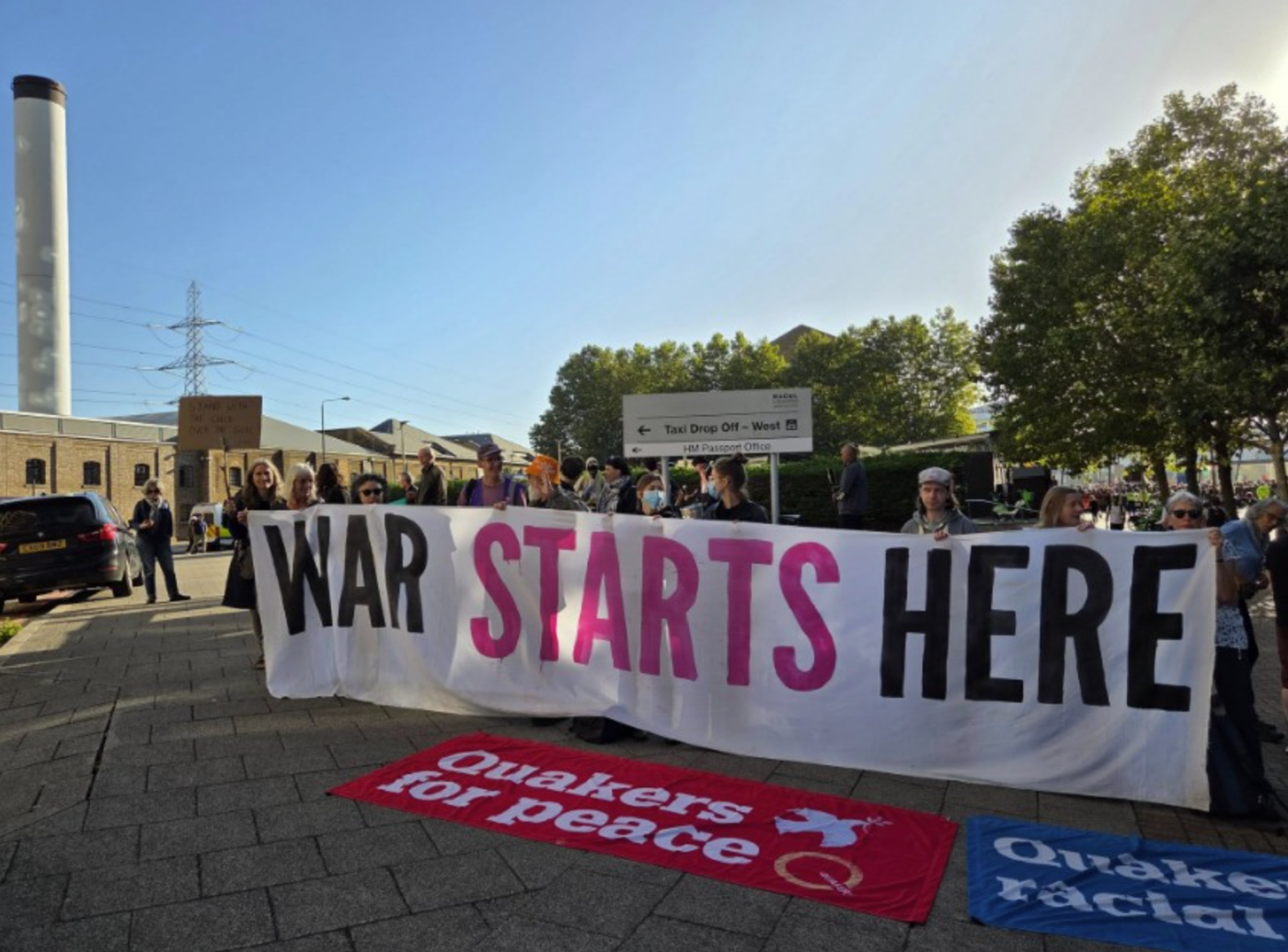
More than 65 groups will be taking action on September to shut down DSEI. They highlight: “This is where war starts. This is where repressive border policies start. This is where torture starts. This is where the contacts are made and the lucrative deals done that fuel genocide, war crimes and human rights abuses around the world.”

Image from Shut DSEI Down on Instagram.

1,500 arrested at July 7 protests in Kenya

The Guardian has also reported that “nearly 1,500 Kenyans [have been] arrested and charged after the nationwide 7 July protests” this year.

This article continues: “Data shared with the Guardian from the Police Reforms Working Group, a civil society coalition focused on strengthening oversight and the rule of law, documents 316 such arrests. The majority are of men below the age of 25. Of the 316, 70% – or 221 of those arrested – have been charged with terrorism, robbery with violence, theft and arson – offences that carry high bail conditions of up to KSh1,000,000 [that converts to more than CAD $10,000.].”

“Lawfare”: new laws constrain the right to protest

The Guardian article further notes: “Mwaura Kabata, vice-president of the Law Society of Kenya, says: ‘This is ‘lawfare’. The government is weaponising existing acts of parliament as well as trying to introduce new ones, such as the assembly and demonstration bill, in order to address both offline and online dissent.’”

In April 2025, Utsav Biswas, a second year student of National Law University Odisha, wrote: “The Kenyan government has passed the ‘Assembly and Demonstration Bill 2024’ where its provisions under the pretence of establishing neutral time/place/manner regulations in forming assemblies and demonstrations effectively impose disproportionate restrictions on the basic freedom of assembly and demonstration, recognised by Article 37 of the Kenyan Constitution.”

And on July 2, 2025, Citizen Digital reported: “The State, through parliament has once more come up with a contentious Bill to control when, how and where the public should hold demonstrations. The Public Order Amendment Bill, 2025 is no different from the Assembly and Demonstrations Bill, of 2024, which ran contrary to the bill of rights as it imposed disproportionate restrictions upon the fundamental right to assembly and to demonstrate, as protected by Article 37 of the Kenyan Constitution.”

PBI-Kenya commentary

PBI-Kenya has recently commented: “There is a noticeable gap between the promises made by the current administration, particularly those related to peace, security, and improving conditions for the most vulnerable, and the reality faced by many Kenyans, marked by increasing human rights concerns and economic strain. What is also evident is a shifting societal landscape: a new generation is informed, engaged, and eager to participate in shaping the country’s direction. Their calls for accountability and inclusion reflect a growing demand for participatory and transparent governance and social justice.”

We continue to follow this.

Further reading: Questions and concerns continue one year after the #RejectFinanceBill2024 protests in Kenya (PBI-Canada article on PBI-Kenya website, May 29, 2025).

PBI-Guatemala notes cancellation of environmental licences for Canadian mining company on Q’eqchi’ lands

Video still: Rosmeri Rivera, representative of the communities of the Sierra Santa Cruz in Izabal, comments on the cancellation of the licences. Video by @lahoragt.

PBI-Guatemala has posted on Facebook: “The environmental licenses were handled by Rio Nickel and Atlantic Producers companies, with Canadian capital. Since January, 54 communities in Livingston, Izabal demanded the government to cancel projects.”

On July 30, Prensa Comunitaria reported: “The Ministry of Environment and Natural Resources (MARN) informed the representatives of the communities of the Maya Q’eqchi’, Garifuna and mestizo people of Livingston and El Estor, Izabal, that the ten environmental licenses in the Sierra Santa Cruz, granted in the government of Alejandro Giammattei, were canceled.”

This article adds: “According to information from the Extractive Industries Observatory, the licenses in the department of Izabal were requested by the companies Río Nickel S.A. and Nichromet Guatemala, subsidiaries of the Canadian Central American Nickel (CAN).”

The Mining Injustice Solidarity Network (MISN) has previously highlighted that: “Rio Nickel is a subsidiary of the Canadian-owned company, Central America Nickel, which is headquartered in Montréal, Quebec.”

Enrique Che, an Indigenous authority of Río Pita, in the municipality of Livingston, told Prensa Comunitaria: “We value our struggles, that we found out what the Canadian mining company was doing, now we get up and put our chests up and then ask God that our children value the work we are doing.”

Telesur also reported: “The Minister of Environment, Patricia Orantes, had previously confirmed that complaints were filed with the Public Ministry for the illegal excavations detected in the mining projects. The news of the cancellation of the licenses was received with relief and as a victory for the protection of the environment and the rights of local communities, demonstrating that the will and strength of the Guatemalan peoples to preserve their territory is decisive.”

And the Extractive Industries Observatory (OIE) tweeted: “The cancellation of these licenses, which threatened the forest, water and biodiversity of the Sierra Santa Cruz, was only possible thanks to territorial surveillance and denunciation by local communities.”

The Canadian organization Rights Action comments: “Rights Action is heartened by the cancellation of CAN’s very questionable licenses in the Q’eqchi’ lands of the Sierra Santa Cruz, Livingston, Guatemala. This short, successful, land-rights-environmental defense struggle (that we helped support) is successful … for now. Stay tuned. The global mining industry seemingly never gives up.”

We continue to follow this.

Further reading

Mayan community journalist Carlos Ernesto Choc reports on march in Izabal demanding cancellation of mining licences (PBI-Canada, May 25, 2025)

Mining resistance member Misael Mata Asencio killed in Guatemala within week of hike to look at mining exploration wells (PBI-Canada, May 20, 2025).

PBI-Guatemala accompanies court hearing in which officials sentenced to prison for the Hogar Seguro fire

On August 12, PBI-Guatemala posted:

“Justice for the girls of Safe Home

Today #PBIaccompanies the Bureau of Human Rights (BDH) in the reading of the sentence of the #CasoHogarSeguro [Safe Home Case].

The judge, Ingrid Vanessa Cifuentes, has imposed sentences between 6 and 25 years for crimes of abuse of minors, guilty homicide, abuse of power and failure of duties for the ex-director of the Safe House, Santos Torres; the ex-secretary of Social Welfare, Carlos Antonio Rodas Mejía, the ex-agent of the PNC, Lucinda Eva Marroquín, the former instructor of the PNC Luis Armando Perez Borja and the workers Gloria Patricia Castro and Brenda Julissa Chamán Pacay. Harold Flores, a former employee of the Nation’s Attorney General’s Office, was acquitted.

In addition, the court ordered the MP [Public Ministry] to take other measures, including opening a criminal investigation against former president Jimmy Morales, who had broken the chain of command and ordered to increase the presence of police officers at the scene of the incident.

On August 14, the hearing of dignified repair measures will take place.

#Justice #WeAreMissing41 #WeMourn56”

Sentences of up to 25 years in prison

The New York Times further reports: “Six former Guatemalan public officials were convicted on Tuesday [August 12] in connection with a 2017 fire that killed 41 girls who had been locked in a classroom in a government-run group home. Ingrid Cifuentes, a judge in Guatemala City, handed down cumulative prison sentences as long as 25 years and some as short as six years against the six defendants, who had pleaded not guilty. Prosecutors had sought longer sentences.”

The BBC has notes: “The highest sentences were for Santos Torres, former director of the Safe Home, and Carlos Rodas, former secretary of Social Welfare, sentenced to 25 years in prison each.”

And El Pais reports: “At the end of the sentence, the relatives of the deceased and survivors shouted ‘Justice!’, applauded and hugged each other to celebrate the ruling.”

Sentences may be appealed

The New York Times article adds: “Edgar Pérez, a human rights lawyer who represented some of the victims and their families, said that it was unlikely that the former public officials would soon end up in jail because the sentences may be appealed. But he said the sentencing showed ‘that the state failed and the public officials that oversaw the child-protection system didn’t fulfill their duties.’”

Former Guatemalan president could be investigated

Prensa Comunitaria also highlights: “Unexpectedly, the Court also determined that two of the highest-level officials at the time of the fire must also be investigated, after years of having remained unpunished: former President Jimmy Morales and his former advisor, Carlos Beltetón.”

El Pais explains: “Morales was mentioned by some witnesses as part of the chain of command that ordered the minors to be locked up.”

Background

Forty-one girls, who were 14 to 17 years of age, died in a fire at the Hogar Seguro Virgen de la Asuncion shelter south-east of Guatemala City on March 8, 2017.

In November 2017, The Guardian reported: “It has emerged that 56 girls had been locked inside a room measuring 6.8 metres by 7 metres as punishment for organising a protest the day before against cramped conditions and abuse by staff. More than 700 children lived at the home, which had capacity for 400-500.”

In July 2024, The Guardian also reported: “In January, the trial of eight government officials and police officers charged in connection with the fire finally got under way. …The trial is expected to last for months… [BDH lawyer Edgar] Pérez says that from the testimonies given at the trial so far, ‘if the staff at the home had acted more promptly, many lives would have been saved’. ‘In fact, [the fire] could have been avoided altogether if there had been trained personnel, people with conscience [working there] and real policies for the care of children and adolescents in the country.’”

Accompaniment

PBI-Guatemala has accompanied this case for more than six years.

Further reading:

PBI-Guatemala observes commemoration of the lives lost in the Hogar Seguro Virgen de la Asuncion shelter fire (PBI-Canada, September 20, 2019)

PBI-Guatemala accompanies law firm at hearing related to the Hogar Seguro shelter fire (PBI-Canada, January 10, 2020).

PBI-Guatemala stands in solidarity with CCDA leader and Kaqchikel Maya defender Leocadio Juracán Salome

PBI-Guatemala has posted on Facebook:

“We stand in solidarity with Leocardio and CCDA Guatemala for repressive actions taken against the defender of human rights and access to land for indigenous communities and farmworkers This action shows what Balakrishnan Rajagopal, Rapporteur of the United Nations on the Right to Adequate Housing, that in Guatemala there is ‘a clear pattern of criminalization and intimidation towards those who attempt to protest or report these forced evictions.’”

Juracán is Kaqchikel Maya with a long history of activism.

On August 13, Prensa Comunitaria reported: “Leocadio Juracán Salome, leader of the Peasant Committee of the Altiplano (CCDA), was arrested this morning at La Aurora Airport when he was about to travel to South Africa for an international conference. According to information from his defense lawyers, the crimes for which Juracán was arrested are aggravated usurpation and provocation of forest fires.”

That article in Prensa Comunitaria further notes: “Juracán remains one of the representatives of the CCDA, an organization dedicated to the promotion of rural development of indigenous and peasant communities, which was founded in 1982, in the midst of the military dictatorships and came to light in 1989. Currently, the peasant organization accompanies indigenous communities and defenders of the territory in the face of eviction and criminalization issues in several departments of the country, including El Estor, Izabal and Alta Verapaz.”

On August 13, the Maritimes-Guatemala Breaking the Silence (BTS) Network posted on Instagram: “URGENT: BTS condemns today’s arrest of Leocadio Juracán, Agrarian Reform Coordinator of @ccdagt. TAKE ACTION NOW: Write to Guatemalan and Canadian government officials demanding Leocadio’s immediate release: LINK. Leocadio was detained this morning at La Aurora Airport as he was leaving the country to participate in a Translocal Social Movement Learning conference in South Africa. He is being criminalized for his work as a land and human rights defender. Leocadio is currently facing multiple charges, including Aggravated Trespass (usurpación), directly related to his advocacy for Indigenous and campesino communities across Guatemala.”

BTS highlights: “We call for Leocadio’s immediate release and an end to the ongoing criminalization of Indigenous and campesino leaders and communities.”

This morning (August 14), Prensa Comunitaria reported: “Leocadio Juracán was sent to prison at Mariscal Zavala. The judge authorized his transfer to said detention center until the judge who issued the arrest warrant schedules the first declaration hearing, which will take place in Izabal.”

Video still from lahoragt.

The Canadian Union of Public Employees (CUPE) has previously highlighted: “The CCDA has lost 12 leaders to assassinations, and many more face imprisonment or threats. More than 1,060 CCDA members have capture orders against them.”

PBI-Guatemala accompanies the Campesino Committee of the Highlands (CCDA) of the Verapaces in the departments of Alta and Baja Verapaz, the municipality of El Estor in the department of Izabal and the Zona Reina in Quiché.

We continue to follow this.

PBI-Guatemala has also now shared this on their Facebook page. The message from the Forum of International Organizations in Guatemala (FONGI) says:

LEOCADIO JURACAN

“With pride and satisfaction, I encourage my colleagues to continue the fight, because it is a just fight.”

Peasant leader, former CCDA coordinator, and promoter of the Comprehensive Rural Development Law

From the Non-Governmental Organizations Forum, we stand in solidarity with Leocadio Juracan.

FONGI Guatemala”

Front line defenders of Indigenous territory in Quebec confronted by worker who makes jokes about Palestine

Video still from checkpointparent.

This short video posted yesterday on Instagram by checkpointparent reports (in French): “A Lampron network worker took sides in the conflict by making jokes about Palestine, claiming they were Israel and we were the people of Palestine, even going so far as to evoke genocide through the insults he hurled at us. From Nehirowisiw Aski to Palestine, we loudly denounce this colonialism and this violence.”

The social media post further explains: “The Echaquan/Weizineau family is holding the front line to defend their great traditional territory—all the ancestral family territories of the Nehirowisiw Aski nations.”

Checkpointparent describe themselves on their Instagram account as a “Sovereignty Camp at KM 133, Chemin Parent” and as “guardians of the land in exercising their sovereignty against Bill 97. MAMO!”

KM 133, Chemin Parent

A more precise map and directions will follow, but for now our understanding is that the Checkpoint is located about a 3.5 hour drive north of Ottawa.

Bill 97

In June, APTN News reported: “Quebec’s proposed new forestry law Bill 97 has become a lightning rod for anger in the province as Indigenous leaders, concerned that the proposed law would erode their inherent and treaty rights, are at the head of opposition to the changes. …Indigenous objections are centred around the bill’s lack of recognition of inherent Indigenous rights, coupled with the proposal to privatize one third of the land in Quebec, nearly half of it unceded and not subject to treaties.”

MAMO

The APTN article also explains: “On April 11, two weeks before the legislation was tabled, members of the Innu and Atikamekw nations, as well as the Abenaki nations on the south side of the Saint-Lawrence river, formed the group Mamo-Mamu First Nations. Mamo-Mamu, named for the Atikamekw and Innu terms for ‘together’, describes itself as an alliance of hereditary chiefs and land defenders and does not represent elected chiefs and councils.”

Lampron

The Checkpointparent social media post notes a “Lampron worker”.  This appears to refer to Mélanie Lampron Forest Management Inc.,  a company whose head office is in Saint-Aimé-du-Lac-des-Îles (about 160 kilometres north of Ottawa).

Video still.

Defending ancestral territory

This week, Sandrine Giérula provided further context in Le Devoir: “Since May 28, Mamo and the Guardians of the Nehirowisiw Aski territory have been exercising their ancestral sovereignty by declaring logging operations on their lands illegal, evicting machinery and preventing trucks from refueling. They have been there 24 hours a day for more than two months, to defend the forests and our future.”

Giérula also notes: “At kilometer 133, there is a camp. Guardians of the territory stand as tall as conifers to say no to this ransacking… [as] …forestry company trucks drive day and night to get out of the woods.”

Instagram photo.

Land defenders seek support

The Checkpointparent social media posts highlight: “To continue their resistance, they need gas to power the generator, supplies, food, and above all… solidarity!” Interac e-transfers can be made to robertechaquan2018@gmail.com and to “support the movement more broadly” donations can also be made at this GoFundMe page.

Instagram video still.

In September 2024, Global Witness reported that 196 land and environmental defenders were killed worldwide in 2023. 85 of those defenders killed were Indigenous peoples. We continue to follow this situation in Quebec with concern.

Further reading

Innu and Atikamekw blockades seek to defend ancestral territories in Quebec from logging (PBI-Canada, June 9, 2023)

Nehirowisiw land defenders establish blockade to stop clearcutting on unceded Nitaskinan territory in northern Quebec (April 12, 2024)

Photo: The vigil for Joyce Echaquan on October 1, 2020, on Algonquin territory (Parliament Hill). Elder Claudette Commanda called on Canadians to end the racism and hate that killed the 37-year-old mother from the Atikamekw nation of Manawan in a Quebec hospital. Photo by Brent Patterson.