Home Blog Page 44

PBI-Guatemala accompanies the Maya Ch’orti’ Indigenous Council of Olopa on peaceful walk around the Los Manantiales mine

On August 27, the Peace Brigades International-Guatemala Project posted on social media:

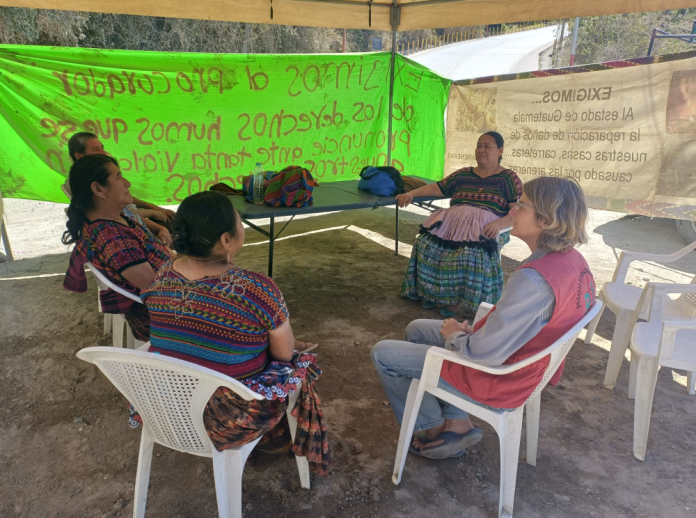
“#PBI accompanies the Ch’orti Maya Indigenous Council of Olopa Chiquimula on a peaceful walk around the Los Manantiales Mine to denounce the company’s failure to respect the Constitutional Court rulings, which included the injunction for the suspension of its operations, the reforestation of the waste dump, and the cleanup of ballast and waste dumped in the communities. The Council requested the presence of the municipal mayor, who ultimately did not attend.

‘The Ch’orti are an intelligent people, a hardworking people, and we are driven by justice. We are a people in resistance who lend our time and sacrifice our lives and bodies to defend our common home from mining’, said Ovidio Alonzo, Indigenous and Ancestral Authority.”

The Maya Ch’orti’ Indigenous Council of Olopa also posted on social media:

“The Ch’orti’ Maya Indigenous Council of Olopa, together with the Communities in resistance against mining, are holding a peaceful march to denounce the pollution, criminalization and human rights violations at the Los Manantiales Quarry mine located between the communities of La Prensa and Carrizal in the municipality of Olopa, Chiquimula. In Guatemala City, the Nim Ajpu Association of Mayan Lawyers and Notaries of Guatemala met with the Presidential Commission for Conflict Resolution (COPRECON) to expose that the company continues to operate without an environmental license. #ChortiOlopaResistance #righttoresistance”

The Council

PBI-Guatemala has previously explained: “The Maya Ch’orti’ Indigenous Council of Olopa are fighting for recognition as indigenous communities, the recovery of their spirituality, the defense of their territory and the right to free, prior and informed consultation before the entry of mining projects into their territory. They also seek to minimize the negative impacts of mining activities on the health of the people in their communities, denounce illegal logging and fight against gender violence in their communities.”

Accompaniment

Peace Brigades International began accompanying the Maya Ch’orti’ Indigenous Council of Olopa in June 2021, following their request, which is based on the serious increase in security incidents, defamation and criminalization processes they are experiencing.

PBI-Mexico accompanies mobilizations in Puebla and Morelos on the International Day of the Victims of Enforced Disappearances

Photo: PBI-Mexico accompaniment of march in Puebla, August 30, 2025.

On August 30, PBI-Mexico posted on social media:

“Today marks the International Day of the Victims of Enforced Disappearances, a day to honor the memory of the victims and highlight the tireless struggle of thousands of families seeking truth, justice, and guarantees of non-repetition.

At this time, PBI Mexico is supporting the mobilizations in Puebla and Morelos, where groups and organizations are demanding recognition of this serious problem and public policies that listen to the voices of the victims.

In our role as international accompaniment, we express solidarity and reiterate the importance of recognizing and protecting these families and groups as human rights defenders.”

Morelos

This same day, the Morelos Post tweeted: “THEY MARCH FOR THE DISAPPEARED OF MORELOS. To demand the location of their relatives, people are marching this Saturday morning to the main square in the center of Cuernavaca, in commemoration of the International Day of Victims of Forced Disappearance.”

Multimagen also tweeted: “On International Day Against Forced Disappearance, collectives of searching mothers march. According to the National Registry of Missing Persons, as of July 25, 2025, there were 1,662 missing persons in Morelos, 315 not located, 4,518 located alive, and 449 deceased.”

Puebla

And Gremio 51 tweeted: “Members of the Colectivo Voz de los Desaparecidos (@VozdelosDesapa) gather at Casa Aguayo to begin a peaceful march toward the Zócalo of #Puebla, to commemorate the International Day of the Victims of Enforced Disappearance.”

Enforced disappearances in Mexico

This past March, Al Jazeera reported: “Countrywide, the official tally of victims of enforced disappearance and missing people reached 125,802 on March 26, although this figure is without doubt a grave underestimate given the frequent reluctance of family members of the missing to denounce such crimes for fear of reprisal.”

They further comment: “Cases of enforced disappearance in Mexico began to soar – along with homicides – in 2006, the year that then-Mexican President Felipe Calderon launched the so-called ‘war on drugs’ with the encouragement and backing of his charitable gringo counterpart George W Bush.”

Disappeared journalists

This week, Reporters without Borders (RSF) further posted: “On 29 August — one day before the International Day of the Victims of Enforced Disappearances — Reporters Without Borders (RSF) and the Mexican NGO Propuesta Cívica submitted two complaints against the Mexican state to the UN Human Rights Committee in Geneva concerning missing journalists. The complaints denounce the enforced disappearance of two news professionals and highlight the systemic failures in the country’s investigative system that foster impunity for crimes against journalists in a country plagued by widespread violence against the press. In Mexico, at least 28 journalists have gone missing, most of them for nearly two decades, with no information about their fate or whereabouts.”

We continue to follow this.
 

PBI-Colombia accompanies ACVC at Ecological Camp for Water, Life and Peace as conflict between armed groups continues

Photo by PBI-Colombia.

On August 28, PBI-Colombia posted on Instagram:

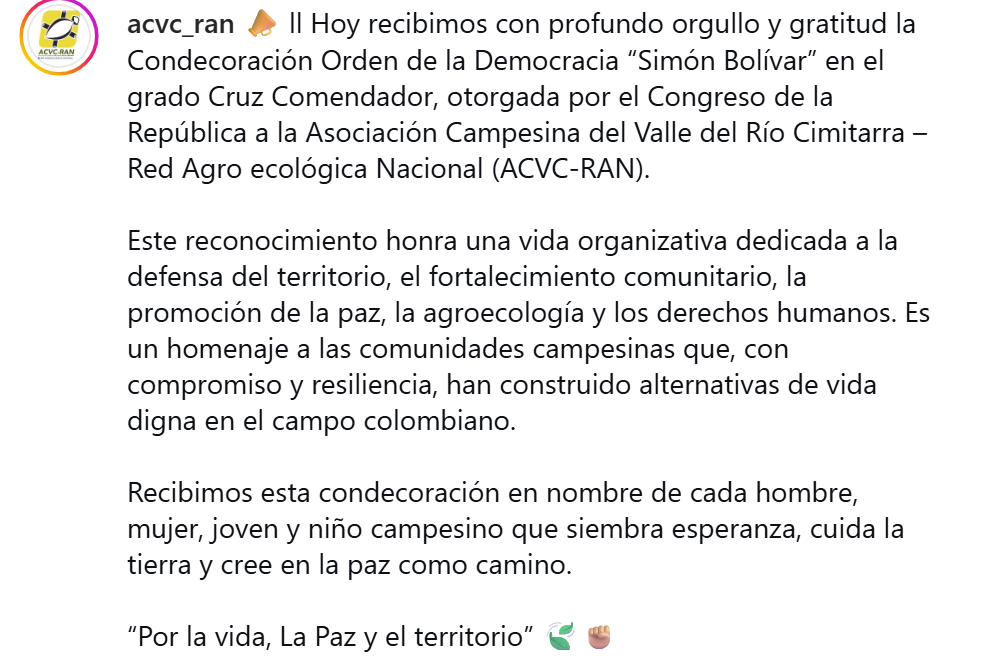
“We accompanied @acvc_ran [the Small-Scale Farmer Association of the Cimitarra River Valley] on the Spectacled Bear Route (Remedios, Antioquia) during the 8th edition of the Ecological Camp.

The Ecological Camp is an opportunity to establish connections between university students and rural communities through tours of the territory, sharing stories and experiences of its inhabitants defending the land and human rights.

This tour reminds us of the importance of collective care and the care of the rural community.”

ACVC is “a regional organization that integrates the purposes of the community through Community Action Boards, cooperatives, fishing committees and other groups of rural workers, within the framework of the integral defense of human rights and the struggle for land.”

On August 14, ACVC posted on Facebook: “The VIII Ecological Camp for Water, Life and Peace begins! From the heart of the Peasant Reserve Zone of the Cimitarra River Valley, peasant communities, youth, women and social organizations gather under the motto: ‘For the protection of the jaguar as an umbrella species’.”

It highlighted: “For several days we will collectively build actions to defend biodiversity, care for the territory and strengthen peace from our roots.”

The next day it further posted: “This camp is a collective effort to strengthen the peasant organization, articulation with the academic sector and peacebuilding from the heart of the Peasant Reserve Zone of the Cimitarra River Valley.”

Then ACVC posted: “As part of the VIII Ecological Camp, the Spectacled Bear Route toured the municipality of Remedios, Antioquia, recognizing the importance of protecting this emblematic species. With tours and community activities, participants from youth, women, universities, and rural communities shared lessons about territorial defense, human rights, and peace. The Spectacled Bear reminds us that life in our forests depends on collective care and rural organization.”

At the conclusion of the ecological camp, ACVC published this article that further explains the security context they work within: “In the midst of the difficult security situation and humanitarian crisis suffered by the Middle Magdalena region due to the armed conflict due to the economic dispute, territorial and social control between the illegal armed groups that are present in the territory, we successfully carried out the ‘VIII Ecological Camp of the Peasant Reserve Zone of the Cimitarra River Valley’ for the protection of the jaguar as an umbrella species, from August 14 to 19, 2025.”

Their article also notes: “We urge the illegal armed groups to commit, abide by and respect the initiatives and community norms of coexistence for the conservation and environmental protection adopted by the communities and their social organizations, protected by IHL [international humanitarian law].”

Peace Brigades International has accompanied ACVC since 2007.

Photo by PBI-Colombia.

PBI-Mexico accompanies Morelos Puebla Tlaxcala Peoples’ Front at Indigenous protest against water concessions

PBI-Mexico has posted:

“#PBIAcompanies in Puebla

Last Tuesday, August 26, PBI Mexico accompanied the Morelos Puebla Tlaxcala Peoples’ Front during a sit-in in front of the CONAGUA offices in the city of Puebla.

The communities of Nealtican, Acuexcomac, Xoxtla, and San Andrés Cholula demanded the termination of SOAPAP/Agua de Puebla concessions and the immediate suspension of water extraction in their territories.

In our role as international observers, we witnessed that the action took place peacefully and recognize the work of the communities in defending their rights and resources. We reiterate the importance of guaranteeing their safety and free exercise of social protest.”

Terms

CONAGUA is the National Water Commission (Comisión Nacional del Agua).

SOAPAP refers to the Drinking Water and Sewerage Services Operating System of the Municipality of Puebla (Sistema Operador de los Servicios de Agua Potable y Alcantarillado del Municipio de Puebla).

Agua de Puebla describes itself as a “Concession for public drinking water, drainage, sewage, and sanitation services in the municipality of Puebla.”

News reports and further context

Prior to the protest Urbano Puebla reported:

“Under the argument that the National Water Commission (Conagua) has allowed the massive extraction of the vital liquid [water] in 22 wells of the communities of Nealtican, Acuexcomac in San Pedro Cholula, Xoxtla and San Antonio Cacalotepec in San Andrés Cholula, on August 26 indigenous communities defending natural resources will hold a forum-sit-in in front of the offices of said commission.

The objective is to demand that Conagua not authorize the renewal of the concessions of the vital liquid in Cholultec territories for the company commercially known as Agua de Puebla.

This is because the company has allegedly plundered a total of 26 billion liters of water annually from the aforementioned communities since 1994 and 1997.”

On August 27, Desinformémonos reported:

“Cholultec peoples protested on Tuesday in front of the offices of the National Water Commission (Conagua) to demand an end to water concessions to private companies and demand the right to manage the resource autonomously in their territories.

During the protest, members of the towns of Xoxtla, Nealtican and Acuexcomac affirmed that they are no longer looking for solutions from the State, but for the definitive exit of Conagua from their territories. ‘We want Conagua to disappear’, they said, and accused that since their arrival the systematic dispossession of water in favor of companies began.

The mobilization was part of a caravan of communities, who arrived at the facilities of the federal agency with banners, slogans and complaints about the exploitation of wells without the consent of the communities.

They demanded that the agreements between Conagua not be renewed and warned that they will not allow new extractions without consultation and collective decision. They affirmed that the struggle does not seek to negotiate with the State, but to reaffirm the right of the peoples to decide on water as a common good.”

And on August 28, Desinformémonos also reported on a statement from Cholultec peoples and organizations in defence of water who said:

“We demand an end to the criminalization of defenders of water and life! …They are scandalized because some windows were painted as a symbol of protest. Because you can clean your windows, but we cannot recover our ameyales and rivers that were stolen from us by taking more than 26 billion liters of water every year, for 30 years from our communities, without any permission.”

Accompaniment

Peace Brigades International has accompanied the Peoples’ Front in Defence of Land and Water – Morelos, Puebla and Tlaxcala since early 2020. In August 2022, that accompaniment was extended for another three years.

The Peoples’ Front describes themselves as an: “Organization of Indigenous Peoples of the Popocatepetl Volcano Region in the States of Morelos, Puebla, and Tlaxcala. We fight for the self-determination of peoples and in defense of life, land, and water.”

We continue to follow this.

PBI-Guatemala accompanies Maya Q’eqchi’ journalist Carlos Choc in El Estor who reports on police eviction of community

“This week, #PBI is accompanying Maya Q’eqchi’ journalist Carlos Choc in El Estor. On this occasion, we visited the COCODE [Community Councils for Urban and Rural Development] of the El Renacer community. They are currently working on measuring the plots and land of the entire community so that they can be properly registered in the RIC [the Cadastral Information Registry] and become the owners of the homes in their community.”

On August 27, Choc posted several updates from El Estor (that we share in chronological order):

#Urgent More than 3,000 National Civil Police (PNC) officers gathered at the soccer field in the San Jorge neighborhood of El Estor, Izabal. According to confidential sources, this is an eviction procedure. #CommunityJournalism Video Aj Ral Ch’och’.

#Urgent PNC agents are traveling to the village of Río Zarco to carry out an eviction order. Justice of the Peace Sandra Ayala Tello is accompanying this proceeding. We will be sharing more information from the scene. #CommunityJournalism

#Eviction Police arrive at the community of La Ceiba, El Estor, Izabal. According to community members, they were not notified. There are more than 30 families living in the community. #CommunityJournalism

#Eviction Sandra Nineth Ayala, justice of the peace for the municipality of El Estor, Izabal, orders the eviction of Maya Q’eqchi’ families from the community of La Ceiba, El Estor. Community members request that the proceedings be suspended because they were not notified in advance. #CommunityJournalism

#Urgent Eviction suspended in the community of La Ceiba, El Estor, Izabal, at the request of the Maya Q’eqchi’ families, who said they were never notified. Judge Sandra Nineth Ayala Tello also notified the people who claim to be the owners. #CommunityJournalism Video Aj Ral Ch’och’

Officers with high-calibre weapons

Prensa Comunitaria also reported:

“Q’eqchi’ families living in the community of La Ceiba, Río Zarco, in El Estor, Izabal, were about to be evicted by thousands of National Civil Police (PNC) officers, prosecutors from the Public Prosecutor’s Office, and Justice of the Peace Sandra Ayala Tello. This legal action is in addition to other evictions in that department during the administration of Bernardo Arévalo.

However, due to opposition from the public forces, they desisted from carrying out the procedure, only firing tear gas and then withdrawing from the site. The press at the scene documented personnel from the Public Prosecutor’s Office carrying high-caliber weapons.

During the two years of President Bernardo Arévalo’s administration, evictions of indigenous and peasant families have continued, as have arrests of community leaders, ancestral authorities, journalists, and human rights defenders. The recent arbitrary arrest of Leocadio Juracán exemplifies the use of the justice system to criminalize those who defend the land in the country.

The problem of evictions, land dispossession, and forced displacement was brought to the attention of the United Nations Special Rapporteur on the Right to Housing, Balakrishnan Rajagopal, during his visit to Guatemala. The rapporteur urged the Guatemalan state to stop the evictions.”

Other news articles on this also include Judge orders eviction of La Ceiba community in Izabal (TN23, August 27) and Eviction in El Estor suspended after confrontation (24 7 Prensa Digital, August 27).

Accompaniment

The Monthly Information Package (April 2025) from the Peace Brigades International-Guatemala Project noted:

“At our twice-yearly assembly this April, we completed our analysis of the accompaniment request that we received from Carlos Choc, a Q’eqchi’ Maya journalist, human rights defender, and environmentalist known for his important work in journalism, his reporting on human rights violations, and his support for communities that are victims of violations, environmental injustices, and evictions. He works in Q’eqchi’ territory, in the departments of Izabal, Alta Verapaz, and Petén. Carlos was involved in a lengthy legal process in which he was criminalized but ultimately acquitted. However, because he has continued his work, he remains at risk, which led him to request our accompaniment. After reviewing his request, we decided to begin accompanying him this April.”

PBI-Canada coordinator Brent Patterson met with Choc in Guatemala City in May 2023 and then did a follow-up webinar with him on August 18, 2023. More on that at PBI-Canada conversation with Maya Q’eqchi’ frontline journalist Carlos Ernesto Choc (August 19, 2023).

From Canada we continue to follow the work of Carlos Choc.

PBI-Colombia accompanied Nomadesc demands an end to the genocide in Palestine

The Peace Brigades International-Colombia Project accompanies the Association for Social Research and Action (Nomadesc) and its president Berenice Celeita.

Nomadesc has posted on Instagram:

Gaza, I say your name.

Gaza is us.

We are called Nomadesc and the Intercultural University of the Peoples.

From Cali, city of resistance, from the southwestern region of Colombia that has experienced genocide at the hands of Álvaro Uribe Vélez and his subordinate Iván Duque Márquez, we reject the genocide in Palestine and join the voices around the world that are rising up to demand an end to the genocide.

For #Palestine, for life.

NO MORE GENOCIDE.

We pass the word.

Nomadesc

The Peace Brigades International-Colombia Project has highlighted: “Founded in 1999, the Association for Research and Social Action Nomadesc has been defending human rights in the southwestern part of Colombia for more than twenty years. It advises and accompanies social, union, women’s, indigenous, Afro-descendant and peasant organizations. As a result of her work in this area, its president, Berenice Celeita, was the victim of persecution by State agents in operations with the alleged purpose of assassinating her. In this emblematic case of the Colombian armed conflict, some of the State officials involved in her persecution were sanctioned by the Colombian justice system in 2018.”

Photo: Berenice Celeita wears a keffiyeh in solidarity with the people of Palestine at a public forum in Ottawa, October 30, 2023.

At the conclusion of a Peace Brigades International-Canada organized webinar on October 24, 2024, Celeita poignantly stated:

“We can’t forget that we are facing a genocide, the people of Palestine, we see you, we have marched and mobilized, we will continue to do this because we see there are huge, powerful entities who are trying to ignore us but the people will continue to come together and fight for the dignity of all people because dignity is the only option that we have.”

We continue to accompany and amplify the work of Nomadesc.

PBI-Colombia accompanies Nomadesc at general assembly held by Buenaventura Civic Strike Committee

Photo by the Buenaventura Civic Strike Social Movement.

PBI-Colombia has amplified this post from Nomadesc on Instagram:

“On Saturday, August 23, the Executive Committee of the Buenaventura Civic Strike held its Ordinary General Assembly, a meeting that brought together communities to discuss the progress made in the movement’s nine thematic working groups.

During the meeting, spokespersons reminded attendees that the Civic Strike is still alive and that collective efforts have not stopped. ‘Our commitment continues, because the struggle is for the well-being of Buenaventura and for the dreams of those who are reborn,’ said the organizers.

The Assembly also served to reaffirm the importance of maintaining community unity as the basis of the process. Attendees agreed that the aspirations of the people will remain strong as long as the communities remain organized and in resistance.”

Photo by Nomadesc.

The Buenaventura Civic Strike Social Movement also posted on Facebook:

“On Saturday, August 23rd, the Assembly of the Civic Strike Social Movement of Buenaventura came to an end, more than 280 grassroots organizations met to discuss the progress of the agreements and strengthen the organizational process.

The meeting allowed to renew ties, resolve doubts, share first-hand information and reaffirm the commitment to continue demanding from the National and Departmental Government for compliance with the pact.

Active participation demonstrates that the community is still alive, united and willing to fight for the well-being of the territory.”

Photo by the Buenaventura Civic Strike Social Movement.

2017 Civic Strike

The Public Service Alliance of Canada (PSAC) has previously explained: “In 2017, [there was] a massive civic strike—also known as a general strike—in Buenaventura, home to Colombia’s key port on its Pacific coast, to protest the city’s deepening socioeconomic and human rights crisis. For three weeks in May, one hundred and fourteen social organizations took over the streets, holding protest marches, community kitchens and cultural festivals, effectively shutting down Colombia’s most important trading hub.”

In June 2017, WOLA highlighted: “The initial response of the government was to violently repress and attack protestors, who were non-violent and included women, the elderly, and children. The Civic Strike Committee reported multiple instances of excessive use of force by the anti-riot police ESMAD. Numerous videos and photos support these claims. The ombudsman’s office reported 91 complaints of excessive use of force by ESMAD, of which 39 were reported to the Attorney General’s Office due to their severity.”

The Canadian Union of Public Employees (CUPE) has also noted: “The strike forced the Colombian government to negotiate an agreement to provide critical public services that would serve the entire community. Organizers agreed to suspend the strike in exchange for a list of demands that included safe drinking water and basic sanitation infrastructure, health care coverage for medical procedures and traditional medicine, access to quality public education, justice and reparations for victims of the conflict, and a community consultation process for land use planning.”

The nine thematic working groups

The social media post from Nomadesc noted at the top of this article says that the assembly “brought together communities to discuss the progress made in the movement’s nine thematic working groups.”

On April 1, 2025, Semana reported: “The Civic Strike Social Movement of Buenaventura sent a letter to President Gustavo Petro…”

Semana notes that the letter stated: “In the midst of the country’s current fiscal conditions, send a message of continuity in the operation of the nine thematic tables of the civic strike agreements, through face-to-face and virtual sessions, according to the requirements. …Buenaventura cannot stand any more indifference.”

Recent news reports

From Canada, we continue to follow news and updates about the situation in Buenaventura and the work of the Civic Strike Committee.

The Civic Strike Committee is noted in an article by Radio Nacional Colombia that notes Ministry of Health will make an investment of more than $143,000 million for the construction of health centers in Buenaventura (August 26, 2025); in El Tiempo reporting on continued displacements and the construction of new homes commenting the “process has been fragile” (August 15, 2025); ; ConsultorSalud noting “the Ministry of Health and Social Protection reported that the National Government has allocated $265,005 million pesos to strengthen the health system in the special district between 2022 and 2025” (July 21, 2025); Soy de Buenaventura reporting on participation in the “Buenaventura Siempre Viva” Peace Festival that was held on Thursday, July 17, 2025, as well as reporting on “the inauguration of the Multimodal Center…, a space aimed at providing comprehensive care to victims of the armed conflict and people in vulnerable situations”; and EMCALI noting that 1345 homes will benefit from electrification “through the Fund for the Development of the Plan We Are All PEACEcifico, (FTSP) [that] was formed as a result of the civic strike that occurred in Buenaventura” (in 2024).

Accompaniment

Peace Brigades International has accompanied the Association for Social Research and Action (Nomadesc) since 2011 and its president Berenice Celeita since 1999. PBI-Canada and PBI-Colombia, alongside a delegation of Canadian labour activists, visited Buenaventura on July 3-4, 2022.

Video: Nomadesc president Berenice Celeita speaks about state violence against the Civic Strike in 2017 and PBI accompaniment.

Megaprojects in Canada bring concerns of the RCMP C-IRG model replicated across the country, increased security risks for land defenders

Photo: Royal Canadian Mounted Police (RCMP) C-IRG officers during the November 2021 raid on Wet’suwet’en territory. Photo by Michael Toledano.

The Toronto Star now reports: “Prime Minister Mark Carney signalled Tuesday [August 26] that two port proposals could be among the first major projects approved under a contentious Liberal law, amid a European tour where he sought to bolster Canada’s economic and security influence abroad.”

One of those projects, the prime minister noted, could be “a new port, effectively, in Churchill, Manitoba, which would open up enormous (liquified natural gas) plus other opportunities, and other east coast ports” for Canada’s critical metals and minerals.

The Canadian Press also notes: “Carney also mentioned the possibility of projects coming for ports on the East Coast related to critical minerals and metals.”

Announcements coming soon

Raffy Boudjikanian, a senior reporter with the CBC’s Parliamentary Bureau in Ottawa, further reports “we are expecting an official list of the projects the government wants to prioritize to be released in just about two weeks right before MPs head back to the House of Commons for the fall [on September 15] and that “the Major Projects Office” that will oversee and fast-track these megaprojects “should happen by Labour Day” which is September 1.

Canadian-backed megaprojects in Mexico

Also, within this time frame the prime minister is expected to meet with the Mexican president in Mexico City on September 18.

Toronto Star business columnist David Olive has recently commented that discussions between Canada and Mexico so far have included “developing direct port-to-port trade routes between Canada and Mexico.”

Olive notes this could include liquefied natural gas exports and crude oil transported by the Trans Mountain pipeline expansion and link in some way with the TC Energy Corp. Southeast Gateway gas pipeline in southern Mexico and the Canadian Pacific Kansas City (CPKC) rail network in Mexico.

The Southeast Gateway pipeline and the expansion of major rail projects – including the Mayan Train and Isthmus of Tehuantepec megaprojects – have seen significant opposition from Indigenous Peoples in Mexico.

Earlier this year, the Peace Brigades International-Mexico Project called for an end to the criminalization of twenty-four Indigenous land defenders opposed to Tehuantepec megaproject.

Other megaprojects in Canada

Along with the megaprojects expected to be announced by the Canadian government within the next few weeks, PBI-Canada is also monitoring the safety and security situation for Indigenous land defenders opposed to the Prince Rupert Gas Transmission (PRGT) pipeline on Gitxsan and Gitanyow territories (who we visited this past June), the building of compressor stations as part of the Coastal GasLink pipeline infrastructure on Wet’suwet’en territory (that we also visited in June), and on-the-ground resistance to the proposed mining of critical minerals in the so-called “Ring of Fire” area on Indigenous lands in northern Ontario.

We are also following the Checkpoint Parent blockade in Quebec: Checkpointparent opposes Bill 97, defends the ancestral family territories of the Nehirowisiw Aski nations in Quebec (August 15, 2025).

C-IRG model coming to other provinces?

It is in this context that we also highlight a recent article titled Controversial B.C. RCMP unit to police opposition to fast-tracked resource projects by Shiri Pasternak and Tia Dafnos (The Breach, August 21, 2025).

Pasternak and Dafnos write: “A RCMP [Royal Canadian Mounted Police] unit criticized for violent and unlawful conduct will be involved in enforcing new laws in British Columbia that will fast-track resource and infrastructure projects…”

They explain: “Newly obtained documents show the RCMP’s Community-Industry Resource Group (C-IRG) will work with secretive provincial committees that monitor and respond to opposition to major projects…”

They also caution: “With its policing of pipeline and logging demonstrations having been deemed a ‘national best practice’ by the RCMP, there is potential that this model—and its criminalization of Indigenous and climate protest—could be replicated in other provinces, as resistance heats up against a wave of environmental deregulation being pushed by Prime Minister Mark Carney and several premiers.”

No release date in sight for systemic investigation

On March 9, 2023, the Civilian Review and Complaints Commission for the RCMP (CRCC) announced a “systemic investigation” of the C-IRG.

The investigation was launched almost 30 months ago after the CRCC had received nearly 500 formal complaints about this RCMP unit. As CBC has reported: “More than 100 grievances accepted for investigation contain allegations of excessive force, illegal tactics, unprofessional behaviour, racism, discrimination and charter violations by the force’s Community-Industry Response Group (C-IRG).”

The CRCC now tells PBI-Canada: “The investigation continues and most of the material collected by the CRCC has been reviewed. Currently, investigators are analyzing this material and interviews with RCMP members are nearly completed. CRCC investigations consider all relevant information to make findings and recommendations, including a significant volume of records and video footage in this case.”

With no estimated date for the completion of this report, we recall that there had been demands for this unit to be suspended during this investigation.

The risk of OPP violence

In response to the warning of Indigenous blockades against Ring of Fire mining, Ontario Premier Doug Ford has stated: “You can’t break the law. Simple as that. … They need to move on or they’ll be dealt with appropriately.”

Sudbury.com notes: “[NDP member of the provincial legislature Sol Mamakwa asks] ‘What is the OPP [Ontario Provincial Police] going to do to the First Nations, once they start fighting on the land? That’s the scary part.’”

That article adds: “One of the people who spoke at Monday’s [June 2] anti-Bill 5 rally at Queen’s Park was the sister of Dudley George.”

30th anniversary of OPP killing of Dudley George

George was killed by an OPP sniper on September 6, 1995.

On September 10, 1995, the Peace Brigades International-North America Project (PBI-NAP) reported that it had received a verbal invitation to: “be observers for First Nations people if needed; be present during discussions between the different groups as a nonpartisan witness; do accompaniment for anyone fearing further violence on the part of the police; write nonpartisan reports on what we witness and hear.”

By July/August 1996, PBI-NAP reported: “PBI has made three more visits to the area of Ipperwash.”

PBI-Canada also recalls that the Ipperwash Inquiry that followed the murder of Dudley George was included recommendations on how Indigenous protests and occupations could be addressed to prevent the killing of another land defender.

Sentencing of land defenders, October 15-17

During a Keepers of the Water-organized webinar this past spring on the criminalization of Indigenous land defenders in Canada, Frances Mahon, a Vancouver-based criminal defence lawyer, stated: “We are moving on to the sentencing process [for Sleydo’, Shaylynn Sampson and Corey Jayohcee Jocko], that will happen October 15th, 16th and 17th on Gidimt’en territory in Smithers, British Columbia. I really encourage anybody who is in the area or is able to travel to actually come up and to witness that.”

We continue to follow this.

PBI-Canada notes Unifor resolution in support of Palestinian workers and their call for an arms embargo on Israel

Photo: Aminah Sheikh, Vice President of the Canadian Freelance Union (CFU), speaks in support of the resolution at the Unifor convention. Photo by Laura Avalos.

The Unifor Constitutional Convention in Vancouver has just passed a resolution that endorses “the call by Palestinian trade union for an arms embargo on Israel”.

This Instagram post highlights: “The resolution was introduced by the Canadian Freelance Union, a Unifor community chapter and Local 2025, representing union staff. It follows a recent report released by the Palestinian Youth Movement (PYM) and members of the Arms Embargo Now (AEN) coalition.”

The full text of the resolution states:

Resolution No. 14 – Support Palestinian Trade Unions and Palestinian Workers

UNIFOR WILL:

Work with Global Union Federation partners, national and international unions and other allied organizations and coalitions to support Palestinian Trade Unions and Palestinian workers who are affected by the ongoing genocide.

Endorse the call by Palestinian trade unions for an arms embargo on Israel.

Educate members on issues impacting Palestinians, including how to combat Islamophobia, anti-Arab racism, and antisemitism through Unifor’s Education program.

Continue to demand a permanent ceasefire, sustainable peace and end to the occupation of Palestinian territories.

BECAUSE:

Unifor has endorsed the Palestinian civil society call for boycott, divestment, and sanctions (BDS), and is committed to human rights and international solidarity.

Unifor has endorsed the Palestinian civil society call for boycott, divestment, and sanctions (BDS) at its 2017 Canada Council; and

Unifor is committed to human rights and international solidarity; and

As trade unionists, we must stand in solidarity with Palestinian trade unions.

International legal rulings have declared Israel’s occupation of Palestine (including the West Bank and East Jerusalem) to be a violation of laws that obligates governments to prevent, prohibit, and eradicate racial segregation and apartheid.

Respectfully submitted by Local 2025 and the Canadian Freelance Union

This resolution passed on August 26 follows this letter from Unifor National President Lana Payne to Canadian prime minister Mark Carney on June 25 that states: “Prime Minister, we call on your government to fulfil Canada’s obligations under domestic and international law and suspend exports to Israel of any and all arms and military equipment manufactured in Canada. Canada’s participation in a global arms embargo on Israel is the only reasonable course of action to end the genocide in Palestine.”

As noted on their website: “Unifor is Canada’s largest private sector union, with more than 320,000 members across the country, working in every major sector of the Canadian economy.”

As a signatory to the Arms Embargo Now demand for a “a full, immediate arms embargo on Israel” and a partner that receives the support of the Unifor Social Justice Fund, Peace Brigades International-Canada welcomes this resolution.

According to Government of Canada figures, Canada exported $30,641,495.83 of military goods to Israel in 2023 and $18,906,035.86 in 2024. On July 4, 2025, The Maple reported: “Data from Global Affairs Canada (GAC) shows that in February the Liberal government authorized two new military export permits to Israel worth a combined total of $37.2 million.” These figures do not include other “military goods”, including the crucial components for F-35 fighter jets, that are indirectly exported from Canada to Israel via the United States.

While the actual numbers are likely much higher, we note that at least 31 Palestinian human rights defenders (documented by Front Line Defenders) and 189 Palestinian journalists and media workers (Committee to Protect Journalists) are among the more than 62,000 Palestinians killed by Israel over the past 22 months.

Transparency in the supply chain of weapons components could help uphold international obligations, protect human rights defenders

Photo: A protest in front of the Gastops factory in Ottawa, November 2024. Photo by Brent Patterson.

The Dublin-based organization Front Line Defenders (the International Foundation for the Protection of Human Rights Defenders) has documented the killing of 31 Palestinian human rights defenders in 2023 and 2024.

And speaking about the targeted airstrike on August 10 against Al Jazeera journalist Anas al-Sharif, United Nations Special Rapporteur Irene Khan told Democracy Now!: “There are some — anything between 26 to 30 journalists who have been targeted in this campaign of assassination [by the Israeli military].”

One of the journalists killed in a targeted airstrike was 25-year-old Palestinian freelance photographer Fatma Hassona. She was killed along with several members of her family on April 16, 2025. The Guardian reports: “The investigative group Forensic Architecture studied the missile strike and declared it a targeted strike aimed at Hassona for her work as a journalist and witness.” A documentary about her life – Put Your Soul on Your Hand and Walk – opens in UK and Irish cinemas on August 22.

Use of F-35s

But what is beginning to be documented implicates F-35s in the deaths of Palestinian civilians in Gaza.

The Danish daily newspaper Dagbladet Information has reported that on July 13, 2024, several Israeli bombs struck a humanitarian area in Al-Mawasi in Gaza and killed at least 19 people and wounded 60 more.

Their article adds: “After the attack, Israeli Defense Minister Yoav Gallant went to Nevatim Air Base in southern Israel – where the Danish-equipped F-35 fighter jets are based – to thank the pilots for their participation in the attack. The Israeli military has since confirmed in a written response to Information and Danwatch that the F-35 planes took part in the attack on Mawasi on July 13. It is the first time in the course of the war that Israel has confirmed the use of the F-35 in connection with a specific attack that has resulted in civilian casualties.”

And in May 2025, Lawyer Charlotte Andrews-Briscoe, representing the Palestinian human rights group Al-Haq, told a British court that F-35s played a critical role on March 18, 2025, when Israeli airstrikes across the Gaza Strip killed more than 400 Palestinians, including 183 children and 94 women.

UN Special Rapporteurs

On February 23, 2024, the United Nations Special Rapporteur on human rights defenders endorsed this statement that says: “Any transfer of weapons or ammunition to Israel that would be used in Gaza is likely to violate international humanitarian law and must cease immediately.”

Court cases

Along with weapons and ammunition, the components that make military systems are also increasingly coming under scrutiny.

Court cases about the legality of the export of components for F-35s have been heard in the Netherlands, Denmark and the United Kingdom.

In February 2024, the BBC reported: “A Dutch appeals court has ordered the government to block the delivery of parts for F-35 fighter aircraft to Israel over concerns they are being used to violate international law.” In June 2025, a Palestinian Youth Movement (PYM) report documents that the Netherlands is still supporting the F-35 supply chain through the Rotterdam port more than a year after this court ruling.

Similar court challenges have been dismissed on technical or procedural grounds in Denmark (April 2025) and the United Kingdom (June 2025).

International law

Guardian columnist Owen Jones has also commented: “International law leaves no room for doubt. When the UK ratified the arms trade treaty in 2014, it accepted that it must not ‘authorise any transfer of conventional arms … if it has knowledge at the time of authorisation … [that] would be used in the commission of genocide, crimes against humanity or war crimes’. It also accepted that this included ‘parts and components’ essential to the functioning of ‘combat aircraft’. [And yet British foreign minister David] Lammy’s government supplies Israel with components crucial for the functioning of F-35 jets, whose bombs indiscriminately destroy civilian infrastructure and shred the bodies of little children.”

The same obligations presumably could hold true for Canada, that ratified the Arms Trade Treaty in 2019, and to foreign affairs minister Anita Anand.

Gastops in Ottawa

In May 2025, an online campaign was also launched to stop the construction of a new Gastops factory in Ottawa.

That petition highlighted: “In March, Gastops quietly submitted a building application to the City of Ottawa for a new, state of the art facility to be built at 3700 Twin Falls Place, in Gloucester. …Gastops is the only manufacturer of the specific engine sensors that go into Lockheed Martin’s F-35 bomber jets… These warplanes would not be able to fly without the Gastops engine sensors.”

An apparently small, but vital component

The Breach has reported: “Gastops makes unique Oil Debris Monitor (ODM) ‘Metalscan’ sensors that are designed to detect engine wear and tear and ‘keep aircraft in the air’, resulting in ‘less downtime, more flight time’, according to the company.”

Images found on the Gastops website, a Gastops video on YouTube, as well as on eBay, suggest the component may be relatively small in size and that a version of it could weigh as little as 1.5000 kilograms (3 pounds).

More F-35s en route to Israel

While the construction schedule for the new factory has apparently not been publicly disclosed, it is possible that the existing Gastops factory in Ottawa is producing engine sensors for the imminent delivery of additional F-35s to Israel.

The Breach has noted: “Their manufacturing operates on a vulnerable ‘just-in-time supply chain,’ with parts intended to arrive as needed.”

The Jerusalem Post has reported: “The IDF announced on Sunday [March 16, 2025] that three F-35i aircraft have landed at Nevatim Air Force Base, purchased from US defense giant Lockheed Martin, which increases Israel’s quantity of F-35 aircraft to 42 out of 50, which are already fully purchased.”

That article then highlights: “The Jerusalem Post has learned that in around two more months [which would have meant May-June], three more aircraft will be delivered, with another three being delivered later in 2025 [presumably at some point in July-December] and the last two of the existing order in 2026.”

And it further reports: “In 2023, Israel, the US government, and Lockheed Martin signed a deal for 25 additional F-35s to eventually raise the number of aircraft to 75, which will mean a third squadron, and additional steps in that process took place in mid-2024. The first third squadron of F-35 deliveries will start in 2027.”

Supply chain

It is not entirely clear the process by which engine sensors manufactured in Ottawa are incorporated into F-35s bound for Israel. 

The recent Arms Embargo Now campaign report Exposing Canadian Military Exports to Israel (July 29, 2025) notes: “Gastops supplies their sensors to Pratt & Whitney, who fit them into the F-35 engines, and then supply these engines to Lockheed Martin. Due to lack of transparency in the supply chain of military technologies, it is unknown if this fitting occurs in Canada or in the US.”

The Pratt & Whitney Canada Head Office and Main Manufacturing Facility is located in Longueuil, Quebec, approximately 215 kilometres east of Ottawa. The largest F-35 final assembly facility is in Fort Worth, Texas.

The Palestinian Youth Movement (PYM) report Exposing UK Arms Exports to Israel (May 2025) notes that research by Declassified UK and The Ditch shows that small quantities of F-35 parts have been made by El Al Airlines as well as by FedEx and UPS. It is possible that the Gastops component is shipped in similar ways.

The urgent need for transparency

In the Ploughshares report Global Production  of the Israeli F-35I  Joint Strike Fighter (January 2025), author Kelsey Gallagher highlighted: “The urgent need for greater transparency and traceability in the transfer of advanced weapons components, thereby reinforcing national and international arms-control obligations with a focus on the 2013 Arms Trade Treaty (ATT).”

We continue to follow this.