Home Blog Page 439

Canadian Centre for Policy Alternatives and allies link human rights and trade policy

The Beyond NAFTA 2.0: Toward a Progressive Trade Agenda for People and the Planet report (published in June 2019) by the Canadian Centre for Policy Alternatives, the Institute for Policy Studies, and the Rosa Luxemburg Stiftung examines in part the relationship between trade policy and human rights.

The editors highlight, “If international trade respects ecological limits and its benefits are fairly shared, it can be a positive force, both economically and socially. But in the current era of hyper-globalization, trade agreements have shown little regard for the planet’s environmental boundaries, the needs of workers and the poor, and society as a whole.”

They note that trade and investment agreements must be judged against key principles including, “Human rights in the broadest sense, including economic, social, cultural and environmental rights, must have primacy over corporate and investor rights, and there needs to be legally binding obligations on transnational corporations.”

The paper also highlights, “Respect for Indigenous Peoples, human rights, and environmental protection rights should be obligatory in international law and take precedence over other legislation, with binding mechanisms to ensure corporate accountability.”

“This has been the motivation behind organizations engaged in negotiations for an International Binding Treaty on Transnational Corporations and Human Rights, as well as national-level efforts to pursue legal mechanisms for corporate accountability.”

In the chapter on Indigenous Rights, Paulina Acevedo Menanteau writes that a progressive trade regime should include, “Reports on the human rights impact of all investment agreements, both in negotiation and those ratified and in force, with special consideration for the impacts on Indigenous Peoples.”

And in the chapter on Environmental Protection and Climate Change, Manuel Pérez-Rocha writes, “[The USMCA] rolls back the environmental standards of past trade deals, encourages fracking, and offers dangerous hand-outs to oil companies and other polluters.” For further commentary on this, please see this PBI-Canada article: The Supreme Court of the Netherlands rules human rights are jeopardized by climate breakdown.

Overall, the paper concludes with 10 principles for a progressive trade agenda notably including, “Fully recognize and respect gender and indigenous rights, including prioritizing women’s employment and economic well-being, and recognizing indigenous title to land and resources and the right to free, prior, and informed consent.”

Peace Brigades International has stated that the human rights, environmental rights and land defenders it accompanies often find themselves threatened, criminalized and at risk because of “powerful economic and political interests.”

PBI has commented, “In a system that favours profit over rights, economic models that encourage the forced displacement of those defending their resource-rich territories will continue and those at the forefront will remain at risk of violence.”

Given these realities, PBI continues to accompany and support human rights defenders “who defend their land and territory against the imposition of economic projects that will damage nature and contribute to climate change.”

For more, please see the following PBI-Canada articles: UN Special Rapporteur links “current development model” with risks faced by human rights defenders and PBI engaged in UN processes on human rights and transnational corporations and Human rights concerns and the Canada-Colombia Free Trade Agreement.

PBI-Honduras attends LGBT Rainbow Association Miss Arcoiris event

On December 28, the Peace Brigades International-Honduras Project posted, “On December 7 we attended the celebration of the Miss Arcoiris event, organized by the LGBT Rainbow Association of Honduras.”

PBI-Honduras adds, “They showed that, despite the violence they are going through, the LGBT group in Honduras faces the defence of the human rights in a positive way.”

The struggle for LGBTQI+ rights in Honduras is a critical one. Between 2009 and mid-2018, 296 members of the community were murdered.

And there is a high level of impunity. Of the 141 violent deaths reported between 2010 and 2014, less than one-quarter (30) of the cases have been prosecuted in the courts.

PBI-Honduras has accompanied the advocacy group Asociación LGTB Arcoiris de Honduras (LGTB Rainbow Association of Honduras) since July 2015. The organization faces violence, intimidation, harassment and physical attacks.

Arcoíris coordinator Donny Reyes has stated, “The biggest problem that we face is the violence of the state security forces towards the LGBT+ community: the armed forces, the police, the criminal investigation police, military police, municipal police.”

Most recently, Arcoíris has launched a court challenge. The Honduran Constitution bans same-sex marriage and refuses to recognize them even if they have been legally sanctioned in other countries, including in Canada where it has been legal since July 2005.

In July 2018, Reyes and Alex Soto of the Centre for LGBTI Development and Cooperation (Somos CDC) filed a constitutional challenge on marriage equality and adoption. That petition is pending before the Supreme Court of Honduras.

For more, please read Peace Brigades International and the human right to sexual orientation and gender identity.

PBI-Honduras expresses concern for the security situation of CNTC leader Sebastián Reyes

On December 27, the Peace Brigades International-Honduras Project posted on their Facebook page, “We express our concern for the security situation of defender Sebastián Reyes and in general of all the members of the CNTC [the National Union of Rural Workers] and request that the facts be investigated.”

This follows a statement from several organizations that says, “The comrade Sebastián Reyes Bardales, an unyielding fighter with the defense of our natural assets, has been subjected to death threats and his house has been besieged by hired hitmen, taking photographs.”

It says, “To the civil and police authorities we demand an immediate investigation of these criminal actions.”

PBI-Honduras has accompanied the CNTC since May 2018.

The full statement in Spanish can be read below:

Pronunciamiento

Ante la comunidad internacional en general y el pueblo Hondureño en particular el Consejo Coordinador de Organizaciones Populares de La Paz “C.C.O.P” a raíz de las amenazas de muerte que ha sido objeto el compañero Sebastián Reyes Bardales activo militante de nuestra organización y Secretario General de la Central Nacional de Trabajadores del Campo C.N.T. C nos pronunciamos en los siguientes términos:

  1. Denunciamos y repudiamos la actitud criminal de los depredadores del bosque en su afán de destruir nuestros recursos forestales con cuantiosas riquezas económicas para ellos.
  2. El compañero Sebastián Reyes Bardales inclauicable luchador pot la defensa de nuestos bienes naturales, ha sido objeto de amenazas de muerte y su casa de habitación ha sido sitiada por sicarios a sueldo, tomando fotografías
  3. Responsabilizamos al Señor Juan Fernando Pereira, contratista de madera por cualquier atentado o acciones en contra de nuestro compañero Sebastián Reyes Bardales o su família,
  4. Nuestra organización del pueblo que aglutina a campesinos, indigenas, gremios, juntas de agua, luchadores sociales y pobladores en general manifiesta su compromiso incondicional de lucha permanente por la defensa de nuestros recursos naturales (bosque, agua, tierra y minerales) en nuestro departamento y en nuestro país.
  5. A las autoridades civiles y policiales exigimos una inmediata investigación de estas acciones criminales.
  6. A los organizaciones de derechos humanos solicitamos su apoyo y protección al compañero Sebastián Reyes Bardales así como a todos los integrantes de la organización.

“PORQUE LOS RECURSOS NATURALES NO SE VENDEN, NI SE CONCESIONAN, SI NO QUE SE CUIDAN Y SE DEFIENDEN”

CONSEJO COORDINADOR DE ORGANIZACIONES POPULARES DE LA PAZ “C.C.O.P”: C.N.T.C, FORO SOCIAL DE DESARROLLO HUMANO LA PAZ, MILPAH, PLATAFORMA AMPLIADA DE MARCA LA, CILAH, U.T.C, F.N.R.P, CONSEJO INDÍGENA UNIÓN Y ESFUERZO, C.O.P.E.M.H, C.O.P.I.N, ASICIACION DE JUNTAS DE AGUA

The statement on the La Via Campesina website can be read here.

Trans rights activist Julie Berman killed in Canada

On December 27, Pink News reported, “A trans woman and activist who tirelessly worked to battle transphobia was allegedly murdered last weekend in Canada and a suspect has been arrested. Julie Berman, 51, based in Toronto, had for years exerted energy in raising awareness of the rocketing rates of anti-trans violence across the city.”

“According to authorities, she was killed in a downtown boarding home near the corner of Brunswick Avenue and Harbord Street, a residential neighbourhood with fish and chips eateries and university accommodation.”

“Pride Toronto confirmed her passing on December 24, describing Berman as a ‘staunch supporter […] and a good person.’”

The Globe and Mail adds, “When Julie Berman came up to the open mic at the trans day of remembrance event on Nov. 20, 2017, she delivered a speech about transphobia in Toronto. She talked about a trans friend of hers that was murdered.”

“’It’s really heartbreaking … the same thing that she was trying to be vocal about happened to her’, said Davina Hader, a friend of the victim and a member of The 519, an organization that advocates for the inclusion of LGBTQ communities’ members and provides services for them.”

“Ms. Berman used to be a hairdresser and was involved for almost three decades with community events at The 519. ‘She was struggling to survive as we all do’, Ms. Hader said. ‘It’s very unfortunate, very sad.’”

That article notes a 2015 study published by Trans PULSE says that 20 per cent of trans people in Ontario had been physically or sexually assaulted for being trans and another 34 per cent had been verbally threatened or harassed but not assaulted. The same study said 24 per cent reported having been harassed by police.

Olivia Nuamah, the executive director of Pride Toronto, says, “For many in the trans community, sadly, violence is a part of life.”

Peace Brigades International-Canada extends our condolences to Julie’s friends and loved ones. We mourn the loss of an advocate for trans human rights.

PBI accompanies human rights defenders around the world, including those engaged in struggles related to the right to sexual orientation and gender identity.

The Yogyakarta Principles were unanimously adopted in 2006 by a group of human rights experts and then updated in 2017. Those principles affirm that “sexual orientation and gender identity are integral to every person’s dignity and humanity and must not be the basis for discrimination or abuse.”

Principle 27 calls on all states to, “Ensure the protection of human rights defenders, working on issues of sexual orientation and gender identity, against any violence, threat, retaliation, de facto or de jure discrimination, pressure, or any other arbitrary action perpetrated by the State, or by non-State actors, in response to their human rights activities.”

For more on our work in defence of trans rights in Honduras, Mexico and Guatemala, please see PBI-Canada observes the 20th anniversary Transgender Day of Remembrance.

#TransRightsAreHumanRights

PBI-Guatemala visits Chinautla Multisector members who advocate for the human right to water

On December 27, the Peace Brigades International-Guatemala Project posted, “Yesterday we visited the members of the Chinautla Multisectorial that is still in peaceful resistance for its defense of the right to water.”

The UN has noted, “On 28 July 2010, through Resolution 64/292, the United Nations General Assembly explicitly recognized the human right to water and sanitation and acknowledged that clean drinking water and sanitation are essential to the realisation of all human rights.”

The Chinautla Multisector Urban Platform advocates for the human right to water to be respected and raises concerns about the nearby resource (sand) extraction that endangers homes and a massive garbage dump that pollutes water.

PBI-Guatemala has previously explained, “Since 1989, the Chinautla Multisector Urban Platform has defended its right to be consulted on the projects of several sand companies operating in its territory.”

It adds, “The region has been a sand area for decades, but it was in 1995 when large-scale sand extraction began with heavy machinery” with major consequences.

The Urban Platform proposal is to “Create a water law and government and municipal agreements that guarantee community and indigenous peoples’ participation to guarantee equal rights to water” within a two year period.

The PBI-Guatemala Project has accompanied the Chinautla Multisector Urban Platform since December 2018.

Colombian government opens public consultation period on fracking

El Colombiano reports, “The Ministry of Mines and Energy published on Thursday [December 26] the draft decree with the ‘guidelines for advancing exploration activities (…) on unconventional deposits.’”

The Minister, María Fernanda Suárez, says, “More than a year ago we convened a commission of experts and recommended doing pilot projects, then the State Council stops commercial exploitation, but allows pilots.”

Civil society responds

As noted in this Facebook post yesterday, “The Colombia Free Fracking Alliance rejects the publication today of the decree that would open the door to fracking in the country, because it should not be experimented with a technique that has been banned or suspended in various parts of the world due to impacts evidenced and demonstrated by science. Continuing with the pilots would involve putting the water, health and life of the communities that could be affected by these projects at risk.”

Furthermore, Carlos Andrés Santiago tweeted, “While thousands of us took to the streets to reject fracking in the National Strike, the government of Ivan Duque publishes today the draft decree to give free way to that nefarious technique in Colombia. This is how this government of the blind and deaf responds to citizen claims.”

Timeline

La Republica reports, “From the night of December 26, until January 20, the Government will have an open period to receive comments from all sectors.”

RCN reports that slightly differently as, “According to the Government, the document would be effective as of January 20, 2020 (in less than a month) and comments and observations will be received from the public until the 16th of the same month (4 days before its publication).”

The Ministry notes, “The National Government will hold a special meeting to listen to citizens on January 16, with the Environmental Bureau created within the framework of the Great National Conversation.”

The RCN article also highlights, “The project includes that companies must develop an institutional strengthening plan aimed at the fracking technique, no later than June 30, 2020.”

Ways to engage

RCN reports, “Comments and observations may be made through this web form.”

Similarly, El Tiempo notes, “According to [the Ministry], the observations, comments and proposals to the aforementioned draft standard must be completed by filling out a form to receive comments, which appears in the following link, https://www.minenergia.gov.co/foros?idForo=24162581 The form must be sent keeping the editable format to the email pciudadana@minenergia.gov.co, until next Monday, January 20, 2020.”

Eligibility for pilot projects

W Radio adds, “[The Minister] said that ‘for a company to participate in these projects, it needs to have been part of the blocks that the National Hydrocarbons Agency assigned at the time, and that they have some kind of concession with this entity today. This does not mean that they have permission, but instead acquired a right.’”

This eligibility standard would likely include Toronto-based Frontera Energy, and Calgary-based Parex Resources Inc., Gran Tierra Energy Inc. and Canacol Energy Ltd.

When fracking could start

On October 18, RCN reported, “The president of Ecopetrol, Felipe Bayón, told RCN News that the company has in its schedule of operations the date of the second half of 2020 to drill the first wells of the pilot programs with the exploration system known as fracking.”

Land defender Sleydo’ of the Wet’suwet’en Nation on resource extraction and territorial rights

The Wet’suwet’en Nation is opposed to a fracked gas pipeline crossing their territory in British Columbia without their free, prior and informed consent.

To assert their sovereignty over their territory and stop surveying and construction activities related to the pipeline, the Unist’ot’en and Gidimt’en clans of the Wet’suwet’en Nation established two checkpoints on key roadways on their lands.

On January 7 of this year, heavily armed Royal Canadian Mounted Police (RCMP) officers raided the Gidimt’en checkpoint. By January 10, the Hereditary Chiefs said they would open the Unist’ot’en checkpoint to avoid further police violence.

Now, almost a year later, The Guardian reports, “Canadian police were prepared to shoot Indigenous land defenders blockading construction of a natural gas pipeline in northern British Columbia… The RCMP commanders also instructed officers to ‘use as much violence toward the gate as you want’…”

Following this news, Sleydo’ (Molly Wickham), who helped establish the Gidimt’en checkpoint, commented, “The state has always removed our people from our lands to ensure control over the resources. The RCMP are occupying our territory for the sole purpose of protecting industry and ensuring extractive projects proceed unhindered.”

Assembly of Manitoba Chiefs Grand Chief Arlen Dumas has also stated, “This form of state violence is happening to Indigenous peoples around the world. It is disheartening to know that, even in Canada, this same type of planned violence is still being considered against First Nations.”

The United Nations Special Rapporteur on the rights of Indigenous peoples Victoria Tauli-Corpuz has previously stated, “Disregard of indigenous rights of traditional lands ownership breeds tensions, subsequent violence and criminalization, as indigenous peoples become trespassers or illegal occupants of their own lands.”

UN Special Rapporteurs Leo Heller and Michel Forst have also previously expressed concern about the risks faced by land and environmental rights defenders (LERDs) opposed to mega-projects on their territory.

Just days after the RCMP raid, the Civic Council of Popular and Indigenous Organizations of Honduras (COPINH), which is accompanied by the Peace Brigades International-Honduras Project, posted on Facebook:

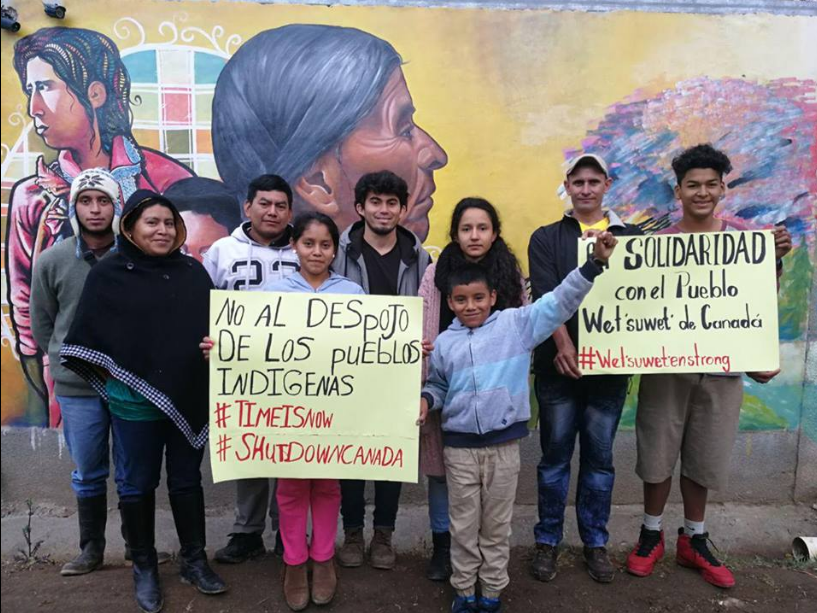
“Solidarity with the worthy struggle of Indigenous peoples in Canada! NO to the plunder of the Indigenous territories of the Wet’suwet’en People!”

Those assembled in the photograph, which includes the daughter of slain human rights defender Berta Cáceres, are holding signs that read: “No to the dispossession of Indigenous peoples!” and “Solidarity with the Wet’suwet’en people in Canada.”

Tauli-Corpuz highlights, “Protecting indigenous land rights defenders is not only a human rights imperative – but also urgent to mitigating the climate crisis.”

PBI-Honduras accompanies CEHPRODEC at public meeting on mining in San Esteban, Olancho

On December 30, the Peace Brigades International-Honduras Project posted, “On November 29, we accompanied CEHPRODEC to an informative open Cabildo (council) to publicize the negative consequences of open pit mining in San Esteban. This municipality is located in the department of Olancho, one of the most concessioned in the country.”

Defensores en linea has reported, “The department of Olancho is formed by 23 municipalities and in most of them concessions for exploration and exploitation have been granted, according to the report ‘The State of Mining in the Department of Olancho’, carried out by the Honduran Center for Development Promotion Community (CEHPRODEC).”

Carlos Padilla of CEHPRODEC explains, “Mining generates social conflicts, division of the Honduran family and communities, because since they arrive they start talking to them with promises of development and great benefits, but nobody really sees them.”

In April 2014, MiningWatch Canada’s then Latin America program coordinator Jennifer Moore expressed concern to a Canadian parliamentary committee about the Canadian-backed mining law that was passed in Honduras in January 2013.

Moore stated, “This law was developed and passed with strong diplomatic support from the Canadian embassy, and with contributions from the Department of Foreign Affairs and the former Canadian International Development Agency.”

And Nobel Peace Prize winner Jody Williams warned in the Ottawa Citizen newspaper not long before the mining law was passed:

“In creating this new law, the Honduran government has bent over backwards to meet the needs of Canadian and other mining companies, but has carried out almost no consultations with Honduran civil society and community organizations.”

In May 2014, CEHPRODEC contributed to the report ‘The impact of Canadian Mining in Latin America and Canada’s Responsibility’ that was submitted to the Inter-American Commission on Human Rights.

That report includes the recommendation that Canada, “refrain from providing any government support, whether through development programs, trade and/or association agreements, public financing or technical or political assistance, for the purpose of influencing the enactment of lax regulatory frameworks for mining investments and to the detriment of the obligation to guarantee human rights in the host countries of the extractive projects.”

PBI-Honduras began accompanying CEHPRODEC in May 2014.

The Supreme Court of the Netherlands rules human rights are jeopardized by climate breakdown

On December 20, CBS News reported, “The highest court in the Netherlands [has upheld] rulings that humans have a fundamental right to be protected from the potentially catastrophic effects of climate change by their government.”

“Presiding Judge Kees Streefkerk … ruled that Articles 2 and 8 of the European Convention for the Protection of Human Rights and Fundamental Freedoms (ECHR) — the right to life and the right to respect for private and family life — brings climate change under the umbrella of human rights protections.”

That court ruling calls on the Dutch government to cut greenhouse gas emissions by 25 per cent below 1990 levels by the end of 2020.

David Boyd, the United Nations Special Rapporteur on human rights and the environment, says this is “the most important climate change court decision in the world so far, confirming that human rights are jeopardized by the climate emergency.”

The Office of the High Commissioner for Human Rights has previously stated, “As a global environmental hazard, climate change affects the enjoyment of human rights as a whole and therefore, it is at the core of the indivisible, interdependent and interrelated nature of each and all human rights as initially emphasized by the Universal Declaration of Human Rights.”

The UN Environment Program report Climate Change and Human Rights also notes, “Although [the UN Human Rights Council] has not yet issued a clear declaration on the obligations of governments or other actors to respond to the human rights implications of climate change, there is ample evidence that certain obligations do exist.”

Some of the rights noted in that report include the right to life, right to health, right to housing, right to an adequate standard of living, right to food, right to water, right to property, and the right to self-determination.

John Knox, who was the UN Special Rapporteur on the issue of human rights obligations relating to the enjoyment of a safe, clean, healthy and sustainable environment from 2015 to 2018, has argued, “Human rights law requires each State to do more than merely refrain from interfering with human rights itself; it also requires the State to undertake due diligence to protect against such harm from other sources.”

Knox has also called on the UN General Assembly to recognize the human right to a healthy and sustainable environment.

In March 2018, The Guardian reported, “It is time for the United Nations to formally recognise the right to a healthy environment, according to the world body’s chief investigator of murders, beatings and intimidation of environmental defenders.”

That article adds, “His appeal, the culmination of more than five years of investigations, comes amid a major push for the UN and member states to do more to protect those who defend the land, water, air, forests and wildlife.”

Knox says, “If we can’t protect [land and environmental rights defenders], then how can we protect the environment we all depend on?”

In the Latin American countries where Peace Brigades International accompanies human rights defenders, 58 land and environmental rights defenders were killed in 2018. 24 were killed in Colombia, 16 in Guatemala, 14 in Mexico, and 4 in Honduras.

Land defenders also face risks in Canada.

The Guardian now reports, “Canadian police were prepared to shoot Indigenous land defenders blockading construction of a natural gas pipeline in northern British Columbia… The RCMP commanders also instructed officers to ‘use as much violence toward the gate as you want’… The RCMP were [also] prepared to arrest children and grandparents…”

This refers to the RCMP raid on unceded Wet’suwet’en territory on January 7, 2019. Land defenders had set up two checkpoints on that territory in opposition to the construction of a fracked gas pipeline (for a Liquefied Natural Gas export terminal) that does not have the free, prior and informed consent of the hereditary leadership of that nation. The Narwhal has reported, “According to the provincial government, phase one of the LNG Canada project is expected to emit about four megatonnes of greenhouse gas emissions annually, the equivalent of adding 856,531 cars to the road.”

After the raid, Bruce McIvor, lawyer, historian and principal of First Peoples Law commented, “Forget about wringing our hands over ‘reconciliation’—the fact that the Chiefs and their supporters found themselves facing heavily-armed RCMP officers is a testament to a complete and shameful failure of the rule of law.”

PBI-Guatemala and Indigenous land defenders criminalized for opposing open-pit mine, dam

On December 20, the Peace Brigades International-Guatemala Project posted, “Today we have accompanied the Law Office of Human Rights to Puerto Barrios at the initial debate hearing of Eduardo Bin Poou, Q’eqchi’ defender and vice president of the Fishermen’s Guild of El Estor, Izabal. The hearing was suspended and scheduled for next year.”

PBI-Guatemala adds, “Then we visited the Agustín Ramírez and Timoteo Suchité de Rosa indigenous authorities in the prison. The two defenders of the territory and members of Nuevo Dia of the Las Flores community, Jocotán, Chiquimula, are criminalized.”

Eduardo Bin Poou

Human rights defenders in the department of Izabal oppose the open-pit Fenix nickel mine in the municipality of El Estor because it is causing serious environmental damage and irreparable harm to Lake Izabal, Guatemala’s largest freshwater lake.

The mine was first developed by Toronto-based Inco, then owned by Toronto-based Hudbay and Vancouver-based Skye Resources, and is now operated by the Russian-owned Solway Group that is based in Zug, Switzerland.

Eduardo was charged in July 2018 with the crime of trespassing on protected areas. He was acquitted in May 2019, but not released from prison given he also faces a trial on charges of threats, instigation, illegal detention, damages and illicit association.

For more on this, please see PBI-Guatemala accompanied Q’eqchi fisherman opposed to now suspended Fenix nickel mine.

Agustín Ramírez and Timoteo Suchité

Just days after their arrest in April 2014, MiChiquimula.com reported, “Agustín Ramírez, 37, and Timoteo Súchite de Rosa, 40, [were] accused of threatening the supervisors of this large-scale project [a hydroelectric plant in the municipality of Jocoteco].”

And Nuevo Dia has previously noted, “Timoteo Suchite De Rosa and Agustín Días García, unjustly deprived of their liberty for the defense of their communal lands before the invasion of the Tres Niñas Hydroelectric Company.”

PBI-United Kingdom further explains, “CCCND [Nuevo Dia] members Agustín García and Timoteo Suchite, members of the Indigenous Council of the community of Las Flores were sentenced in May 2014 to 6 years in prison. The CCCND has denounced the lack of a proper investigation, due process and the failure to guarantee their rights. The organization also reported that both people have been subject to acts of intimidation and threats in prison from several local people visiting them.”

The UN Special Rapporteur on the rights of Indigenous peoples Victoria Tauli-Corpuz has stated, “Disregard of indigenous rights of traditional lands ownership breeds tensions, subsequent violence and criminalization, as indigenous peoples become trespassers or illegal occupants of their own lands.”