Home Blog Page 41

PBI-Colombia accompanies Corporation for Judicial Freedom and Humanitarian Caravan in Anorí amid armed clashes

On October 1, the Peace Brigades International-Colombia Project posted on social media:

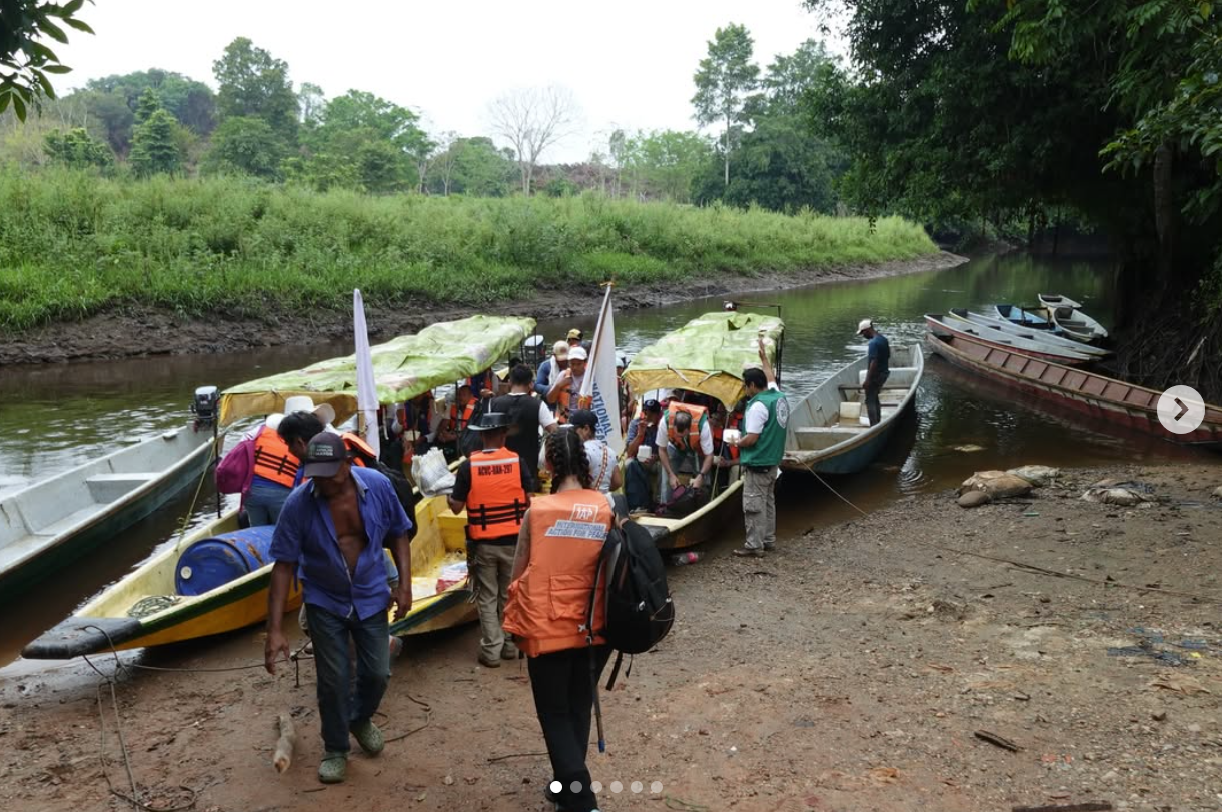
“PBI accompanied the Corporation for Judicial Freedom (CJL) in the Humanitarian Caravan for Peace and Dignity in Anorí, held on 28 and 29 September.

This caravan sought to raise awareness of the situation currently facing the municipality, with an emphasis on the forced displacements that have been occurring since November 2024, as well as to protest the lack of effective responses from state, departmental and national authorities.

Communities and leaders from various villages mobilised to the town centre of Anorí to raise their voices and demand guarantees of peace and dignity.

One of the main objectives of the caravan was to demonstrate that it is possible to create conditions for entering the territory and, above all, for remaining there. The commitment to culture, music and enjoyment as a form of resistance was a fundamental part of this mobilisation.”

CJL on social media

During the humanitarian caravan, CJL posted on social media:

September 28: “Today we are in Sanlino, a hamlet of Anorí, Antioquia. We are bringing the Humanitarian Caravan for peace and dignity to the territories that defend life, fight for permanence on their lands, and persist in building peace.”

September 28: “Art as a means for the visibility of the defense of the territory is also present in this #CaravanaHumanitariaEnAnorí”

September 28: “We also engage in outreach about the #13MínimosHumanitarios to bring tools for defense and dignity to the territories. We make a call for these to be represented and for their fulfillment to be guaranteed.”

September 30: “In Anorí, a Humanitarian Shelter was installed, a collective space for protection and dignity for the communities in the face of the serious security crisis that the territory is going through. This action seeks to make visible their demands for life and permanence on the land.”

September 30: “We call for respect for the autonomy of the communities and organizations of Anorí who seek refuge after being forcibly displaced from their territories.”

In the news

From an Infobae article, we also know: “A new episode of violence in northeastern Antioquia left a lieutenant dead and three soldiers wounded after harassment attributed to FARC dissidents in Anorí, Antioquia. The attack took place on Tuesday, September 30, as confirmed by the Government of Antioquia.”

After the attack, HSB Noticias reported: “The mayor’s office of Anorí (Antioquia) decreed a nighttime curfew in the urban area from 9:00 p.m. to 4:30 a.m., between September 30 and October 7.”

On October 2, Caracol further reported: “Due to the attack with explosives by the 36th front of the FARC dissidents in the municipality of Anorí, in northeastern Antioquia, local authorities insist on an abandonment of the State in the face of the escalation of violence. …The mayor of Anorí, Gustavo Silva, said that the population is trapped between the Gulf Clan and the FARC dissidents, who are advancing strongly in rural areas. ‘The State has been absent and the community lives in fear,’ he warned.”

And on October 4, El Pais reported: “In Antioquia, 3000 students from Amalfi and Anorí receive classes virtually after threats from FARC dissidents.”

Accompaniment

Corporation for Judicial Freedom (CJL) members have been subjected to different forms of threats and attacks throughout the organization’s existence. These include death threats and attempts to link its members to criminal proceedings.

Since mid-2019, the Corporation for Judicial Freedom has detected illegal interceptions and illegal followings, and during the social protests at the end of that year, unjustified actions were taken by the authorities against some lawyers, including false accusations and attempts to detain them.

Peace Brigades International has accompanied the Corporation for Judicial Freedom since 2000.

PBI-Mexico accompanies Espacio OSC on advocacy tour in Canada, notes Protection Mechanism does not recognize union activists as human rights defenders

Héctor Hugo Arreola Galván and Elizabeth Guadalupe Mosqueda Rivera from the Civil Society Space of Organizations (Espacio OSC) in Mexico recently concluded their visit to Ottawa where they highlighted proposals to improve the Protection Mechanism for Human Rights Defenders and Journalists.

They were accompanied by Manuel Jabonero Prieto, the advocacy coordinator for the Peace Brigades International-Mexico Project, and Brent Patterson, the coordinator of Peace Brigades International-Canada.

At meetings with Members of Parliament from all five parliamentary parties, officials at Global Affairs Canada, and the Office of the Canadian Ombudsperson for Responsible Enterprise (CORE), as well as with civil society allies, the delegation raised the concern of the threats faced by union activists in Mexico.

Workers and union leaders face threats

Mexican workers, most notably small-scale farmers, and union organizers continue to face a dangerous situation of threats, retaliations and killings.

Between 2012 and 2024, at least 23 small-scale farmers were killed in Mexico.

In July 2025, taxi union leader Mario N was killed in Cancun; in November 2024, workers attempting to union a Canadian-owned mine received death threats Zacatecas State leading to the independent Los Mineros union to request protection for its workers; in January 2021, labour lawyer Susana Terrazas Prieto issued a public plea to the Mexican President after receiving death threats for her efforts to organize an independent union at a U.S.-owned auto parts factory in Matamoros in the state of Tamaulipas; in May 2019, union leader Gilberto Muñoz Mosqueda was assassinated in the city of Salamanca, Guanajuato; and in June 2016, two people affiliated with National Coordinator of Education Workers (CNTE) were killed in Nochixtlan, Oaxaca.

The International Trade Union Confederation (ITUC) has also highlighted: “On 9 February 2024, the facilities of the daily newspaper’s union, Sindicato Independiente de los Trabajadores de La Jornada (SITRAJOR), in Mexico were raided and vandalised by the newspaper’s own management.”

Union activists are human rights defenders

The Special Rapporteur on human rights defenders has highlighted: “Leaders of trades unions undertake numerous tasks [and] when they are working specifically to promote or protect the human rights of workers they can be described as human rights defenders.”

Global Affairs Canada has also recognized workers as human rights defenders, the Investor Alliance for human rights has included labor union leaders in their definition, and the European Network of National Human Rights Institutions (ENNHRI) has included trade unions in their description of who can be a human rights defender.

Exclusion from Protection Mechanism

The Mexican federal government and states operate protection mechanisms for journalists and human rights defenders. These mechanisms provide a range of protections including camera systems, panic buttons, police protection, and relocation assistance for human rights defenders and journalists under threat.

Mosqueda and Arreola noted: “The Protection Mechanism does not recognize trade unionists as human rights defenders. Espacio OSC recognizes independent trade unionists as human rights defenders as well as the challenges and attacks they face because of their work.”

PBI-Canada and PBI-Mexico continue to accompany Espacio OSC in their work to strengthen the Protection Mechanism.

Further reading:

Photo-journal of PBI-Mexico accompanied Espacio OSC advocacy tour in Canada on Protection Mechanism and The Protection Mechanism as a tool to address threats and the worsening situation for independent trade union activists in Mexico.

PBI-Guatemala observes march in Guatemala City that denounces the ongoing genocide against Palestinians in Gaza

On October 5, the Peace Brigades International-Guatemala Project posted on social media:

“Today, #PBI observes the Guatemalan march denouncing the #Genocide in Gaza. Hundreds of people exercised their right to protest and free speech to show solidarity and denounce the various crimes suffered by the Palestinian people, recalling their own history.”

Photo: This photo shared by PBI-Guatemala features a placard at the march that says: “In honour of the heroes of the Sumud flotilla, the world is indebted to you.”

Prensa Comunitaria also reported on the protest:

“Civil society groups and organisations hold a march in Guatemala City to mark two years of genocide in Gaza.

The march began with around 200 people setting off from the Peace Monument to the Plaza of the Children.

The marchers said that the march was an act of solidarity with all the victims of the attacks in the Gaza Strip.

During the march, they called for the severing of relations with the State of Israel.”

Photo: This photo by PBI-Guatemala includes a placard that says: “Stop the genocide”.

Photo: This photo by PBI-Guatemala features a placard that says: “260 journalists assassinated”.

France 24 also reported “Pro-Palestinian demonstrations in Guatemala demand Arévalo take a stand”.

And No-Ficción, an independent collective of investigative journalists in Guatemala, further documents: “The government of Bernardo Arévalo has committed more than US$10.3 million in arms purchases from Israel, under a Memorandum of Understanding on military cooperation signed in 2023. The contracts include acquisitions from Elbit Systems and Marom Dolphin, two companies singled out by the UN as part of ‘the economy of genocide’ in Gaza.”

The No-Ficción article continues:

“One of the companies to which Israel made part of its military supplies purchase to Guatemala conditional is Elbit Systems. The Arévalo government, as reported by the Ministry of Finance’s Integrated Accounting System (SICOIN), has paid it nearly Q38 million (US$4.9 million) for the purchase of ammunition, microbinoculars, and advanced technology communication kits.

In total, Elbit has three current contracts with Guatemala worth around Q46,497,807 (US$6,077,130), according to the Memorandum of Understanding Implementation Agreements created by Bernardo Arévalo’s Ministry of Defence.

According to the UN report, Elbit Systems is not only Israel’s largest arms manufacturer, it is also an important cog in the wheel that ensures the continuity of the war machine in Gaza.”

“Recalling their own history”: the genocide in Guatemala

The 36-year-long war (internal armed conflict) in Guatemala began in November 1960 (after a US-backed coup in June 1954) and ended in December 1996 with signing of the Agreement for a Firm and Lasting Peace.

The internal armed conflict killed an estimated 200,000 people and displaced more than one million people between 1960 and 1996.

45,000 people are still unaccounted, including 5,000 children.

The conflict between state military forces and guerilla combatants was underpinned by the poverty, marginalization and racism against Indigenous peoples.

The United Nations-backed Commission for Historical Clarification established in June 1994 determined that the Guatemalan military was responsible for 93 per cent of the atrocities – including forced disappearances, massacres and torture – and that 83 per cent of the victims were Indigenous Maya peoples.

The Commission concluded that acts of genocide occurred during the war.

Spring Magazine further explains: “The US suspended military aid to Guatemala in 1977—their human rights abuses were a bad look, so Israel stepped in for them. Israeli president Ephrain Katzir [the president from 1973 to 1978] signed an agreement supplying the Guatemalan military with $38 million worth of arms during the civil war period, including rifles, helicopters, equipment for surveillance, and training.”

PBI in Canada

Peace Brigades International-Canada continues to call on Prime Minister Mark Carney and the Canadian government to immediately suspend any transfers of weapons, ammunition and military components to Israel and to stop any military assistance or support that is likely to violate international humanitarian law.

PBI-Canada has also signed the Arms Embargo Now statement that says: “As the catastrophe wrought by Israel’s continued assault on Gaza grows, Canadian civil society organizations across multiple sectors are calling on the Canadian government to immediately suspend all trade in arms and military technology with Israel.”

Photo: The Elbit display at the CANSEC arms show in Ottawa, May 2025.

We thank our colleagues at PBI-Guatemala for their observation of this march.

Further reading

PBI-Colombia accompanied Nomadesc demands an end to the genocide in Palestine (August 30, 2025)

PBI-Honduras accompanied Indigenous COPINH water protectors demand justice for the Palestinian people (April 25, 2025)

Photo-journal of PBI-Mexico accompanied Espacio OSC advocacy tour in Canada on Protection Mechanism

Héctor Hugo Arreola Galván and Elizabeth Guadalupe Mosqueda Rivera from the Civil Society Space of Organizations (Espacio OSC) in Mexico are in Ottawa with proposals to improve the Protection Mechanism for Human Rights Defenders and Journalists.

They are being accompanied by Manuel Jabonero Prieto, the advocacy coordinator for the Peace Brigades International-Mexico Project, and Brent Patterson, the coordinator of Peace Brigades International-Canada.

The Mexican federal government and states operate protection mechanisms for journalists and human rights defenders. These mechanisms provide a range of protections including camera systems, panic buttons, police protection, and relocation assistance for human rights defenders and journalists under threat.

The key points of concern that Hugo and Elizabeth are bringing are crucial: at least 222 land and environmental defenders have been killed since 2012 (the year the Mechanism was implemented); 88 journalists have been killed since 2016; the Mechanism is underfunded (the annual budget of CAD $44.8 million was recently cut by 5 per cent); the Mechanism is understaffed (8 staff handle all applications and the evaluation/oversight of more than 2,000 case files); applications for protection are being denied (245 of 361 applications from human rights defenders were denied between January 2023 and July 2025); wait times for applications far exceed the 9 hours for emergency applications promised in law; the Mechanism does not recognize union activists as human rights defenders and does not disclose the number of Indigenous human rights defenders protected; and with billions of more dollars of Canadian investment in extractive industries sought through the Comprehensive Strategic Partnership, there is great potential for more human rights violations.  

Just some of activities have included:

SPEAKING WITH A CABINET MINISTER

Speaking with the Minister of International Trade, Maninder Sidhu, just after he presented to the House of Commons Standing Committee on International Trade along with the Minister responsible for Canada-U.S. Trade, Dominic LeBlanc.

MEETING WITH MEMBERS OF PARLIAMENT

Meeting with Liberal Member of Parliament Judy Sgro, the Chair of the House of Commons Standing Committee on International Trade.

Meeting with Bloc Quebecois Member of Parliament Pierre-Simon Savard-Tremblay.

Meeting with New Democratic Party Member of Parliament Leah Gazan.

Meeting with Green Party Leader Elizabeth May.

Meeting with Olivier Tremblay-Venneri, legislative assistant to Conservative Member of Parliament Michael Chong.

Speaking with Liberal Member of Parliament Yasir Naqvi, the Parliamentary Secretary to the Minister of International Trade and to the Secretary of State (International Development), after his appearance at the House of Commons Standing Committee on International Trade.

MEETING WITH GLOBAL AFFAIRS CANADA

Meeting with Global Affairs Canada officials including Rachelle Daley, Senior Desk Officer for Mexico, Genevieve Bourget, Deputy Director of the Mexico, Trilateral Affairs and North American Platform Program Division, and Laeba Khan, of the International Organizations and Human Rights Bureau, Human Rights and Freedoms Division.

MEETING WITH THE DEPUTY CANADIAN OMBUDSPERSON FOR RESPONSIBLE ENTERPRISE

Meeting with Terrence Cowl, the Deputy Canadian Ombudsperson for Responsible Enterprise (CORE) and Elisabeth Wilson, the Director of Strategic Management. The CORE “reviews complaints about possible human rights abuses by Canadian companies when those companies work outside Canada in the garment, mining, and oil and gas sectors.” Their work also links with the National Contact Point (NCP) in Canada and Mexico City. The Organization of Economic Cooperation and Development (OECD) Guidelines call on companies to “pay special attention to potential harms from their business activity to human rights defenders among other marginalized and vulnerable groups.”

PRESENTING AT A UNIVERSITY

Presenting to Professor Meera Karunananthan’s “Environmental Studies 2001 Sustainable Futures” class and other interested students and faculty at Carleton University. The PowerPoint presentation shared can be found at Presentación.

SPEAKING AT A RALLY ON PARLIAMENT HILL

Speaking at the “A Day on Parliament Hill” rally that highlighted a Development and Peace-Caritas Canada petition signed by 52,000 people that calls on the House of Commons to “adopt human rights and environmental due diligence legislation that would require companies to prevent, report and remedy all violations of human and environmental rights throughout their global operations and supply chains; and establish a legal right for people who have been harmed to seek justice in Canadian courts.”

MEETING WITH UNION ALLIES

Meeting with Navjeet Sidhu, the Toronto-based Director of the Unifor International Department and Social Justice Fund. Unifor represents more than 320,000 members in Canada, including 10,000 media workers (journalists, camera operators, writers).

Meeting with Louise Casselman, Social Justice Fund Officer at the Public Service Alliance of Canada (PSAC). The PSAC represents 240,000 workers, including members who work for the federal government, universities and community service agencies.

Meeting up again with Louise Casselman from the Public Service Alliance of Canada (PSAC) at the Oxfam Canada “Let’s Talk Palestine” solidarity cultural evening at Club Saw that featured musician-painter Jenn Grant.

MEETING WITH CIVIL SOCIETY ALLIES

Meeting with Stuart Trew, Senior Researcher at the Canadian Centre for Policy Alternatives (CCPA), and Laura Macdonald, a Professor in the Department of Political Science and the Institute of Political Economy at Carleton University.

Meeting with Kathy Price, the Toronto-based National Coordinator of the Americas Policy Group (APG). The APG is a network of Canadian civil society organizations working for human rights and social and environmental justice in Latin America and the Caribbean.

Meeting with Aidan Gilchrist-Blackwood, the coordinator of the Canadian Network on Corporate Accountability (CNCA). The CNCA campaigns to pass a mandatory human rights and environmental due diligence law, empower Canada’s corporate watchdog, and end Canadian government support for corporate impunity.

Meeting with the Palestinian Youth Movement (PYM) in Ottawa. The PYM is a transnational, independent, grassroots movement of young Palestinians dedicated to the liberation of their homeland and people.

MEETING WITH DEFENDERS FROM GUATEMALA AND HONDURAS

Meeting with Marisol Guerra and Marta Muñoz, representatives from the Xinka Parliament in Guatemala, during their visit hosted by MiningWatch Canada. They are calling on the Canadian government to respect the Xinka People’s decision to seek the permanent closure of Pan American Silver’s Escobal mine.

Meeting with Melissa Torres, a Honduras-born artist living in Montreal, whose family has experienced first-hand the impacts of a Canadian mining company.

SPEAKING WITH THE MEDIA

Speaking with Paloma Martínez Méndez, a journalist with Radio Canada International (RCI), the international broadcasting service of the Canadian Broadcasting Corporation (CBC). RCI provides Canadian news to the world in seven languages.

Elizabeth and Hugo will also be speaking with Reuters bureau in Ottawa as well as Montreal-based independent journalist Lital Khaikin in the coming weeks.

REMEMBERING THE AYOTZINAPA 43

Commemorating at the Canadian Tribute to Human Rights monument in Nelson Mandela Square the 11th anniversary of the forcible disappearance of 43 students from the Ayotzinapa Rural Teachers’ College on September 26, 2014.

MEETING WITH MEMBERS OF THE PBI-CANADA BOARD OF DIRECTORS

Dinner at A La Istanbul on Rideau Street with two Ottawa-based members of the Peace Brigades International-Canada Board of Directors.

ALSO

Visiting the Prime Minister’s Office and Parliament Hill.

Along with these activities, clear proposals have been developed for government officials and civil society allies, an op-ed has been written to be sent to The Hill Times…

…and as they head home to Mexico we have a detailed campaign plan for the coming weeks and months to achieve a strengthened Protection Mechanism.

Further reading: Espacio OSC conducts advocacy tour in Canada to raise awareness of the situation of defenders and journalists.

Social media by Espacio OSC

More photos

Espacio OSC conducts advocacy tour in Canada to raise awareness of the situation of defenders and journalists

Photo: Héctor Hugo Arreola Galván and Elizabeth Guadalupe Mosqueda Rivera from Espacio OSC on Wellington Street in Ottawa in front of the Office of the Prime Minister of Canada.

The Civil Society Space of Organizations for the Protection of Human Rights Defenders and Journalists (Espacio OSC) has posted on social media:

STATEMENT ‼️

🇲🇽🤝🇨🇦 From Sep 22 to Oct 3, the #EspacioOSC conducts an advocacy tour in #Canadá with meetings with parliamentarians, government, unions, academia, and #human rights  organizations to raise awareness about the situation of human rights defenders and journalists

🔗 https://acortar.link/RT1Jhx

📢 From 2016 to 2025, 177 human rights defenders and 88 journalists have been murdered in 🇲🇽.

Although the @Mecanismo_MX exists, serious protection and access failures persist. Canada is urged to demand guarantees and a #HumanRights chapter in the #USMCA.

🔗 https://espacio.osc.mx

The first hyperlink in their social media post leads to the Espacio OSC website that further explains:

From September 22 to October 3, the CSO Space for the Protection of Human Rights Defenders and Journalists, through the Zeferino Ladrillero Human Rights Center and the Consortium for Parliamentary Dialogue and Equity Oaxaca, together with Peace Brigades International (PBI), are conducting an advocacy tour in Canada with meetings with parliamentarians, representatives of the government, trade unions, academia, journalists and human rights organizations.

The objective is to expose the serious situation in Mexico, where between 2016 and 2025 177 defenders and 88 journalists have been murdered, in addition to documenting attempted homicides, disappearances, criminalization and forced displacement.

Despite having the Federal Protection Mechanism for Human Rights Defenders and Journalists, created in 2012 and which has provided protection to 2,605 people, being an example at the regional level for its model of network governance and civil society participation, through an Advisory Council, critical challenges still persist: Between January 2023 and July 2025, only 116 of 361 applications from defenders and 136 out of 246 from journalists were admitted, which has led to a lack of protection and an increase in legal resources. In this same period, they have had to litigate, for which 85 amparos and 44 appeals of disagreement were filed against the Mechanism, leaving those who cannot take on litigation defenseless.

The tour also aims to highlight the relevance of the bilateral relationship between Mexico and Canada, marked by strong economic, social and investment ties. In particular, sectors such as mining and gas concentrate a significant presence of Canadian capital in Mexico. In this context, the organizations consider it essential that the next negotiation of the USMCA incorporates a specific section on human rights and the protection of human rights defenders and journalists, as part of the commitments shared by both countries in favor of human rights and democracy.

They also recall that in the 4th cycle of the Universal Periodic Review (UPR), Canada made recommendations to Mexico on key issues such as:

-Implement guidelines for the investigation of femicide in all states.

-Conduct prompt and impartial investigations into enforced disappearances.

-Adopt comprehensive policies for the protection of defenders, journalists, and religious leaders, ensuring sufficient resources and trained personnel in existing mechanisms.

-Ensure universal and non-discriminatory access to quality sexual and reproductive health services.

-Develop a legal framework and public policies to address forced displacement, which disproportionately affects indigenous communities.

In this regard, the organizations underscore the importance of Canada providing support and technical cooperation for the implementation of these recommendations, strengthening bilateral commitment to human rights and especially to guarantee the work of defenders and journalists

The organizations call on the Canadian authorities and international society to support the work of human rights defenders and journalists in Mexico, and to demand that the Mexican State fulfill its duty to guarantee their safety and protection.

Space for Civil Society Organizations for the Protection of Human Rights Defenders and Journalists (Espacio OSC). The organisations that make up the CSO Space: ARTICLE 19; Casa del Migrante Saltillo; Tlachinollan Mountain Human Rights Center; Zeferino Ladrillero Human Rights Center (CDHZL); Mexican Center for Environmental Law (CEMDA); National Center for Social Communication (Cencos); Communication and Information of Women A.C. (CIMAC); Consortium for Parliamentary Dialogue and Equity Oaxaca (Oaxaca Consortium); Institute of Environmental Law (IDEA), National Network of Civil Human Rights Organizations All Rights for All, All and All (RedTDT); SMR: Scalabrinianas, Mission with Migrants and Refugees; Services and Advice for Peace (Serapaz), Project on Economic, Social and Cultural Rights (PRODESC). The CSO Space is accompanied by Peace Brigades International (PBI) – Mexico Project.

Photo: Elizabeth and Hugo arrive in Ottawa accompanied by Peace Brigades International.

Research on the links between Canadian companies and the Interoceanic Corridor of the Isthmus of Tehuantepec in Mexico

Video: A representative of PBI-Mexico (in green vest) speaks (starting at 35:26) at the observation mission media conference, July 27, 2023.

Prior to the visit of Canadian prime minister Mark Carney to Mexico City on September 18-19, 2025, Canadian media reported on the megaprojects he might discuss during meetings with Mexican president Claudia Sheinbaum, including the Interoceanic Corridor of the Isthmus of Tehuantepec.

On September 16, 2025, The Globe and Mail reported: “A Mexican official, speaking on background, said Mexico is eager to attract Canadian investment as it modernizes six of its ports and assembles a new shipping route with its Interoceanic corridor that runs a railway line between the Pacific port of Salina Cruz and the Atlantic port of Coatzacoalcos on the Gulf of Mexico.”

In July 2023, the Peace Brigades International-Mexico Project participated in an international observation mission that documented abuses against Indigenous territorial defenders opposed to the Interoceanic Corridor of the Isthmus.

The Mission reported: “Among the authorities responsible for the human rights violations identified during the mission are the National Guard, the Navy, the Sedena [the Mexican Secretariat of National Defense], the State Police…”

On June 27, 2024, El Universal Oaxaca reported: “The Interoceanic Corridor of the Isthmus of Tehuantepec (CIIT) project has been developed in Oaxaca through authoritarian methods that include cases of disappearance and forced displacement of indigenous communities, as well as a total of 226 attacks on community defenders including women and children, reveals the report of the Civilian International Observation Mission.”

Educa Oaxaca, that was also part of the Observation Mission, specifies: “From May 1, 2021, to May 1, 2024, a total of 72 attacks were recorded, in which at least 226 various attacks were perpetrated against defenders.”

Significantly, the Mexican State is linked to “94 occasions out of the 72 documented attacks, with a permanent and leading presence of the Army, Navy and National Guard in the indigenous territories of the Isthmus.”

Pagina 3 adds: “At a press conference [that was held on June 27, 2024], members of the Observation Mission said that 92% of the victims of human rights belong to an indigenous people. In this context, the Mixe (Ayuujk) and Zapotec (Binnizá) peoples faced a greater number of aggressions against them.”

Further reading: On May 14, 2024, a federal judge in Mexico revoked a 46+ year prison sentence against Indigenous Binnizá land defender David Hernández Salazar, an opponent of the Interoceanic Corridor.

Avispa Midia has further reported that the Interoceanic Corridor megaproject was promoted by Mexican officials who visited Washington, DC in June 2024 and Germany, Belgium, Portugal and Spain in May 2024.

Avispa highlights: “In these places, working meetings were held with members of the European Union, the Association of European Chambers of Commerce and Industry, the European Commission, as well as representatives of governments, industrial sectors and investment conglomerates.”

The article notes: “Transnational corporations have also been targeted by the Mexican government’s actions. The Ministry of Economy reported that it initiated, since May 8, 2023, a round of actions to promote the corridor. At least 330 companies from 23 countries were hit by these actions, including Argentina, Belgium, Brazil, Canada, France, India, Italy, Japan, Luxembourg, the Netherlands, the Nordic countries, Spain, Switzerland, Taiwan, the United Kingdom and the United States.”

Canadian connections to the megaproject

The Interoceanic Corridor is a megaproject that has been described by a proponent as including “two deep sea ports, railroads, highways, three airports (Minatitlán, Ixtepec and Huatulco), a gas pipeline and a fiber optic network.”

That pipeline appears to be the Jaltipan-Salina Cruz Gas Pipeline Expansion (Interoceanic Corridor Gas Pipeline). Calgary-based TC Energy is building the Puerta del Sureste/ Southeast Gateway pipeline that will connect to Jáltipan-Salina Cruz Gas Pipeline to transport gas across the Isthmus of Tehuantepec to the proposed Salina Cruz LNG export terminal.

The Toronto-headquartered Royal Bank of Canada and other Canadian banks are financing the US company Sempra Energy that through its Mexican subsidiary Sempra Infraestructura -a partner of TC Energy- that will develop that LNG terminal in Salina Cruz that would export gas to Europe and Asia.

Video: On February 15, 2025, several coastal communities of the indigenous Nahua and Nuntaj++yi’ municipalities of Pajapan, Tatahuicapan and Mecayapan in southern Veracruz protested against the TC Energy Puerta del Sureste pipeline.

The Trans-Isthmus Railway

Railway Gazette International has reported: “The ports in both cities, the railway and related terminal infrastructure are all managed by Ferrocarril del Istmo de Tehuantepec, a state-owned enterprise which is part of the Mexican Navy.”

That article notes: “The primary aim of the reconstruction of the Trans-Isthmus Railway is to develop freight traffic through the two ports; investment in the Minatitlán and Salina Cruz oil refineries is also expected to generate more rail flows.”

In January 2024, the International Railway Journal reported: “Freight operations began in September 2023 following an upgrade under the Isthmus of Tehuantepec Interoceanic Corridor (CIIT) project, which aims to provide a rail alternative to the Panama Canal for freight moving between the Atlantic and the Pacific.”

A railway for grain, petrochemicals, mining concessions

That article adds: “According CIIT director general, Mr Raymundo Morales Ángeles, the upgraded railway known as Line Z can accommodate freight trains up to 65 wagons in length, as well as double-stack trains carrying up to 260 containers or 5200 tonnes. Line Z is also expected to handle bulk traffic including grain, chemical products and petrochemicals.”

In October 2024, the Pulitzer Center quoted Binnizá environmental defender Martín Regalado saying that Line K “is a Trojan horse that is leaving unprecedented environmental disasters in its wake. No one will travel on this train because its purpose is to provide roads for mining concessions and extractive companies.”

Canadian wheat shipped on the railway

On January 10, 2025, Breakbulk Events & Media reported: “The Ferrocarril del Istmo de Tehuantepec (FIT) or Isthmus of Tehuantepec Railway [and] Mexico’s Ministry of the Navy announced in November that grain producer Viterra Mexico successfully transported 2,000 tons of wheat grain using the railway. The cargo, which was imported from Canada, arrived at the Port of Salina Cruz via the SSI Prudence and was then transshipped to bulk hoppers before heading to warehouses operated by wheat distributor Trimex near the Port of Coatzacoalcos.”

CPKC involvement

There are snippets of information available about a potential role being played by the Calgary-based Canadian Pacific Kansas City (CPKC) railway company in this megaproject.

In May 2023, Bnamericas reported: “Following a meeting between President Andrés Manuel López Obrador, US officials and CPKC executives in Mexico City, the government unveiled that it invited the company to participate in the 1,500km Maya train that will connect five states in the southeast and to the rehabilitation of the 300km Tehuantepec isthmus rail corridor between Oaxaca and Veracruz states. However, during his morning press conference on Thursday, López Obrador also said that he asked CPKC to take over the Mexico City-Querétaro high-speed train that the previous government attempted to construct.”

By March 2024, Mexico News Daily reported CPKC had submitted proposals for two routes not in the Isthmus: Mexico City-Querétaro and Querétaro-San Luis Potosí-Monterrey-Nuevo Laredo.

Furthermore, in January 2024, FreightWaves quoted Pawan Joshi, executive vice president of products and strategy of the Austin, Texas-based supply chain software provider e2open suggesting that the CIIT could offer another option when global disruptions or droughts interrupt trade flows in the Panama Canal.  Joshi says: “The Canadian Pacific Kansas City Southern railroad is looking to start to invest some money on the Panama side to build more infrastructure and provide an alternative.”

Further research needed

Further research is needed to document and map the role Canadian companies and investment capital may be playing in this megaproject.

We continue to follow this.

Nomadesc calls for the annulment of Resolution 294 in Colombia, will commemorate union activists killed in the Banana Massacre

The Association for Social Research and Action (Nomadesc) is calling for social organizations, human rights defenders and Colombian social movements to join with them and sign a letter in opposition to Resolution 294.

The letter expresses “rejection and indignation at Resolution 294 issued by the Presidency of the Republic in which the Colombian government, through the Minister of the Interior Armando Benedetti, that recognizes the paramilitary group Clan del Golfo with the name of ‘Gaitanista Army of Colombia’.”

Resolution 294

On September 10, Infobae reported: “The National Government issued resolution 294 of 2025, through which it recognizes the Gaitanista Army of Colombia, also called Clan del Golfo, as an Organized Armed Group (GAO).”

Furthermore, Deutsche Welle reports: “The Colombian government and the Gulf Clan, the largest criminal gang in the South American country, formally began peace talks on Thursday (September 18, 2025) in Doha (Qatar)… For its part, the Colombian government ‘takes note’ that the Gulf Clan ‘refuses to be categorized as a paramilitary or neo-paramilitary group’…”

Annul resolution 294

The letter comments: “It is not by recognizing the political status of those who have benefited from the action of paramilitarism, drug trafficking and genocide in our country that peace will be achieved in Colombia.”

The letter concludes: “[In memory of] the thousands of victims of the paramilitarism of the Clan del Golfo, we ask you to annul resolution 294 that has generated a feeling of indignation and unnecessary pain. In coherence with historical memory and the overcoming of genocidal practices, we urgently demand the structural revision of the peace policy in Colombia.”

Paramilitarism in Colombia

The National Centre of Historical Memory has previously found that most of the killings during the internal armed conflict in Colombia were perpetrated by far-right militias backed by ranchers and cocaine traffickers to counter leftist rebels.

The Guardian reports: “The report documents 1,982 massacres between 1980 and 2012, attributing 1,166 to paramilitaries, 343 to rebels, 295 to government security forces and the remainder to unknown armed groups.”

Between 1986 and 2013, when the report cited above was published, more than 2,800 labor leaders and union members were killed in Colombia. It has also been reported: “Between 2000 and 2010, 63.12% of the global murders of trade unionists occurred in Colombia, leaving more than 2,800 labor rights defenders dead.”

Paramilitary groups and state security forces are seen as responsible for most of the killings of trade unionists.

Commemoration in 2028 of the Banana Massacre

The letter signed by Nomadesc also highlights: “In 2028, the centenary of the massacre against the workers who worked for the United Fruit Company, murdered on December 5, 1928, is commemorated. The undersigned organizations are coordinating the great pilgrimage in honor of the heroes of the banana strike…”

Time magazine has provided this history of the Banana Massacre:

“In October 1928, banana workers from UFC plantations in the Magdalena zone assembled and created a list of [nine] demands under the labor union Magdalena Workers Union (Unión Sindical de Trabajadores del Magdalena, USTM). Their demands were modest, ranging from higher pay and insurance to the discontinuance of company stores. The most important demand, however, was the recognition of UFC employees as formal company workers entitled to the full protections of Colombian labor law.

United Fruit’s general manager, Thomas Bradshaw, baulked. He refused to recognize and negotiate with the USTM.

In a final effort [after failed negotiations], crowds of workers gathered at Ciénaga to talk with the governor and United Fruit. Neither the governor nor a UFC representative ever arrived, but by nightfall, General Carlos Cortés Vargas, now armed with a new decree to restore order, demanded the crowd disperse and return home. When workers refused, the general’s soldiers lit the plaza up with gunfire.”

As many as 2,000 workers were killed that night.

The University of Toronto Visualizing the Americas project notes: “The people of the banana zone insisted that the military killed hundreds of strikers that night, but when daylight broke, according to official memory, just nine bodies lay in the plaza. Josefa María, who worked from Ciénaga to support the strike, noted that the military had deliberately left each corpse as a symbol: ‘They had only left nine dead bodies, equal to the nine demands that the workers made.’”

In 1970, the United Fruit Company merged with another company to form the United Brands Company.

In 1990, that company was renamed Chiquita Brands International.

Court ruling on the AUC paramilitary and Chiquita

In June 2024, a US federal court found Chiquita Brands International liable for the financing of the United Self-Defense Forces of Colombia (AUC), a right-wing paramilitary, and ordered Chiquita to pay $38.3 million in compensation to the families of eight people killed by the AUC between 1997 and 2004.

The Guardian has reported: “The civil cases were brought by the family members of trade unionists, banana workers and activists who were tortured, killed and disappeared by paramilitaries as they sought to control the vast banana-producing regions of Colombia. …Among the victims who presented evidence was the widow of a union leader who was tortured, decapitated and dismembered by the AUC in 1997.”

The BBC further notes: “The AUC engaged in widespread human rights abuses in Colombia, including murdering people it suspected of links with left-wing rebels. The victims ranged from trade unionists to banana workers.”

In an article about this court ruling, CNN reported: “Rights groups say powerful corporate interests continue to collude with local politicians and criminal groups to repress activism, particularly in defense of the environment, which can be a dangerous business in South America.”

The Clan del Golfo (AGC), that Resolution 294 recognizes as the ‘Gaitanista Army of Colombia’, was formed in part by paramilitary commanders who refused to demobilize in 2005 along with the rest of the AUC.

Accompaniment

Peace Brigades International has accompanied the Association for Social Research and Action (Nomadesc) since 2011, and its president Berenice Celeita since 1999.

PBI-Mexico accompanies Espacio OSC to meet with Secretariat of the Interior to discuss Protection Mechanism

The Civil Society Space of Organizations for the Protection of Human Rights Defenders and Journalists (Espacio OSC) has posted on social media:

“As part of the effort to strengthen the @Mecanismo_MX [Protection Mechanism for Human Rights Defenders and Journalists], we at #EspacioOSC met with staff from @SEGOB_mx [Secretariat of the Interior] to share concerns about its operation and the care provided to defenders and journalists at risk.

Some of the concerns expressed about the @Mecanismo_MX were: • Bureaucratization of incorporation • More rejections and case closures • Withdrawal of measures • Attacks and murders against beneficiaries • Increase in legal actions • Lack of staff.

The @Mecanismo_MX committed to speeding up incorporations, strengthening monitoring, and providing more information to people at risk.

The #EspacioOSC reiterated its support for the 2026 Work Plan, greater communication with defenders and journalists, and strengthening prevention actions.”

Quick facts

Mexico first created a Protection Mechanism for journalists in Autumn 2010. Two years later, the Law for the Protection of Human Rights Defenders and Journalists was passed in June 2012. That law obliges both federal and state authorities to protect the rights of journalists and human rights defenders.

– As of July 2023, the National Protection Mechanism for Human Rights Defenders and Journalists in Mexico supported 2,130 individuals.

– As of November 2023, there were 651 journalists enrolled in the Mechanism: 469 men and 182 women.

– In 2024, the approved budget for the Protection Mechanism was more than 599 million pesos (about CAD $45 million), which the Mexican state presented as an indication of its commitment to protection.

“Notable deficiencies and concerning failures”

At least 222 land and environmental defenders have been killed in Mexico between 2012 (the year the Mechanism was enacted) and 2024.

In March 2020, Peace Brigades International (PBI) commented: “The Mechanism continues to demonstrate notable deficiencies and concerning failures.”

The year before that, PBI also highlighted: “The Mechanism can’t possibly address its shortcomings with its current budget and staffing levels. Providing additional funding would be the first step the Mexican government can take to ensure the Mechanism has the resources necessary to manage its rapidly growing caseload.”

Mexican official reports have highlighted a 138% budget increase for the Mechanism between 2018 and 2023.

In their submission to the Universal Periodic Review of Mexico in July 2023, Human Rights Watch noted: “The federal Protection Mechanism for Human Rights Defenders and Journalists continues to lack sufficient staff and funding and struggles to coordinate with state and local officials, leaving it sometimes unable to meet protection needs.”

“As of May 2022, eight journalists and two human rights defenders had been killed while receiving protection from the mechanism since its creation in 2012.”

They recommended that Mexico: “Ensure sufficient staff and funding for the federal protection mechanism for journalists and human rights defenders.”

Canada’s position

The Government of Canada appears to acknowledge this.

At the United Nations (UN) Universal Periodic Review (UPR) session held on January 24, 2024, Canada recommended that Mexico: “Strengthen, from an intersectional and gender perspective, the federal Protection Mechanism for Human Rights Defenders and Journalists, specifically in the areas of prevention, protection, investigation, and reparation.”

Discussions in Ottawa

Next week, Elizabeth Guadalupe Mosqueda Rivera and Héctor Hugo Arreola Galván from the Civil Society Space of Organizations for the Protection of Human Rights Defenders and Journalists (Espacio OSC) will arrive in Ottawa for a wide-range of meetings with Members of Parliaments, officials and civil society to discuss this situation.

Accompaniment

Espacio OSC is a coordination platform of 18 civil society organizations from throughout Mexico. The Peace Brigades International-Mexico Project provides accompaniment and technical support to the platform.

Canada and Mexico launch a “Comprehensive Strategic Partnership”; Canadian Chamber of Commerce plans delegation for February 2026

Photo: “We received at the National Palace the Prime Minister of Canada, Mark Carney. We strengthen the friendship between nations for the good of our peoples.” – Mexican President Claudia Sheinbaum Pardo.

This evening, the Prime Minister’s Office announced in a statement from Mexico City: “Today, the Prime Minister, Mark Carney, alongside the President of Mexico, Claudia Sheinbaum, launched a new Comprehensive Strategic Partnership to deepen ties between our countries and make North America the most competitive, dynamic, and resilient economic region in the world.”

The 40-minute video of their closing media conference can be seen here.

The Canadian Press summarizes: “Canada and Mexico have signed a pact to deepen trade ties and partnerships to build infrastructure such as ports, rail and energy corridors while tackling crime and protecting the environment.”

Coverage in Mexico

Earlier today, the Spanish language Infobae had reported: “The bilateral agenda [for the meeting between Carney and Sheinbaum] includes a private meeting with a group of Mexican and Canadian businessmen, as well as a joint press conference scheduled for 5:00 p.m. local time, where both leaders are expected to detail the progress made on security, infrastructure, investment, energy and trade issues.”

Later in the day, Infobae reported: “[Carney and Sheinbaum] announced at the National Palace the agreement to strengthen the trade relationship prior to the review of the USMCA with the United States.”

That Infobae article highlighted: “Both supported reciprocal investments and increased cooperation on security and migration issues. …They also spoke of close cooperation on security, and thus facing challenges together. Sheinbaum thanked Carney for the increase in Canadian tourism to Mexico and pointed out that our country will promote measures to maintain this relationship.”

Expanding ocean trade routes

El Sol de Mexico also noted: “To promote a strategic partnership between Mexico and Canada, President Claudia Sheinbaum said that our country seeks to increase trade between the two countries through the ports of both the Pacific and Atlantic Oceans, so as not to pass by land through the United States.”

The Canadian Press also reported: “Sheinbaum said she and Carney would also discuss proposals to expand Mexico-Canada trade through ports on both the Pacific and Atlantic coasts.”

And CBC added: “Sheinbaum has been openly discussing her desire for Canada to build up its infrastructure, including ports, to create trade and energy corridors — a wish that would align with Carney’s push to build major projects.”

Short term work visas for farm workers

Prior to the partnership being announced, El Economista had reported: “The president added that they will talk about the continuity of an agreement on temporary visas for Mexican farm workers that the Latin American country seeks to expand.”

Bilateral security dialogue

investingLive notes: “Canada and Mexico will launch a new bilateral security dialogue, aimed at deepening collaboration on cross-border threats, law enforcement, and regional stability.”

The Canadian Press also reported: “Carney and Sheinbaum were also expected to discuss co-operation on security, with the aim of establishing regular communication and collaboration between the two countries.”

In Spanish, Milenio noted: “Mexican cartels have a presence in Canada, but there are also Canadian criminal organizations operating in Mexico, Canadian Prime Minister Mark Carney said Thursday during a meeting with President Claudia Sheinbaum at the National Palace. He added that gangs and cartels do not operate in one direction, but in both ways, which requires collaboration between the two governments through the exchange of information, surveillance and monitoring.”

Mining

The Canadian Press noted that at a media conference on Wednesday, Sheinbaum “added that Mexico also wants Canadian mining companies to do a better job of complying with Mexico’s environmental regulations.”

Upcoming trade missions

The Canadian Press reports: “[The partnership] includes a plan for a trade mission to Mexico, led by Canada-U.S. Trade Minister Dominic LeBlanc… [And Catherine Fortin-LeFaivre, senior vice-president of international policy and global partnerships at the Canadian Chamber of Commerce, says] ‘The Canadian Chamber will be taking a business delegation to Mexico in early Feb 2026 to turn this momentum into concrete opportunities.’”

Business and human rights

Peace Brigades International will be analyzing the new “Comprehensive Strategic Partnership” in the context of how it impacts the security situation and protection needs of human rights defenders in Mexico.

This week, Global Witness documented 18 killings and one disappearance of land and environmental defenders in Mexico in 2024.

The latest figures from the Global Witness database also indicate that over the 13-year period of 2012 and 2024 at least:

– 222 land and environmental defenders were killed or disappeared in Mexico

– 110 of the 222 defenders killed were Indigenous (in a country where 19% of the population is Indigenous)

– 17 of the 110 Indigenous defenders were killed by the police or private military actors

– 15 of the 110 Indigenous defenders killed were in a struggle related to mining and extractives

– 42 of the 222 defenders killed involved mining and extractives

– 28 of the 222 defenders were killed by the police or private military actors.

Next week, two Peace Brigades International accompanied human rights defenders will travel from Mexico to Ottawa for a series of meetings to discuss the Protection Mechanism for Human Rights Defenders and Journalists.

Stay tuned for more updates.

The Protection Mechanism as a tool to address threats and the worsening situation for independent trade union activists in Mexico

Photo: The Universal Periodic Review of Mexico expressed concern about the criminalization of Susana Prieto Terrazas, a labour rights lawyer and human rights defender, who was arrested in June 2020. She issued a public plea following death threats against her for her independent union efforts in January 2021.

Mexican union leaders and activists should be able to seek protection through the Protection Mechanism for Human Rights Defenders and Journalists.

Mexico first created a Protection Mechanism for journalists in Autumn 2010. Two years later, the Law for the Protection of Human Rights Defenders and Journalists was passed in June 2012. That law obliges both federal and state authorities to protect the rights of journalists and human rights defenders.

Union activists are human rights defenders

The Special Rapporteur on human rights defenders has highlighted: “Leaders of trades unions undertake numerous tasks [and] when they are working specifically to promote or protect the human rights of workers they can be described as human rights defenders.”

Global Affairs Canada has also recognized workers as human rights defenders, the Investor Alliance for human rights has included labor union leaders in their definition, and the European Network of National Human Rights Institutions (ENNHRI) has included trade unions in their description of who can be a human rights defender.

Hugo and Elizabeth in Ottawa

Photo: Elizabeth Guadalupe Mosqueda Rivera and Héctor Hugo Arreola Galván.

Two human rights defenders from Mexico will be in Ottawa next week to meet with Government of Canada officials, Members of Parliament, social movement and civil society allies, to raise awareness of the situation of human rights defenders and journalists in Mexico and find ways to support them.

Elizabeth Guadalupe Mosqueda Rivera from the Consortium for Parliamentary Dialogue and Equity Oaxaca (Consorcio Oaxaca) and Héctor Hugo Arreola Galván from the Zeferino Ladrillero Human Rights Center (CDHZL).

Both Hugo and Elizabeth are members of the Civil Society Space of Organizations for the Protection of Human Rights Defenders and Journalists (Espacio OSC). Their work includes monitoring and proposing reforms and improvements to Mexico’s Protection Mechanism for Human Rights Defenders and Journalists.

Threats to workers and union leaders

Mexican workers, most notably small-scale farmers, and union organizers continue to face a dangerous situation of threats, retaliations and killings.

Between 2012 and 2024, at least 23 small-scale farmers were killed in Mexico.

In July 2025, taxi union leader Mario N was killed in Cancun; in November 2024, workers attempting to union a Canadian-owned mine received death threats Zacatecas State leading to the independent Los Mineros union to request protection for its workers; in January 2021, labour lawyer Susana Terrazas Prieto issued a public plea to the Mexican President after receiving death threats for her efforts to organize an independent union at a U.S.-owned auto parts factory in Matamoros in the state of Tamaulipas; in May 2019, union leader Gilberto Muñoz Mosqueda was assassinated in the city of Salamanca, Guanajuato; and in June 2016, two people affiliated with National Coordinator of Education Workers (CNTE) were killed in Nochixtlan, Oaxaca.

The International Trade Union Confederation (ITUC) has also highlighted: “On 9 February 2024, the facilities of the daily newspaper’s union, Sindicato Independiente de los Trabajadores de La Jornada (SITRAJOR), in Mexico were raided and vandalised by the newspaper’s own management.”

Protection Mechanism

In March 2020, Peace Brigades International (PBI) commented: “The Mechanism continues to demonstrate notable deficiencies and concerning failures.”

The year before that, PBI also highlighted: “The Mechanism can’t possibly address its shortcomings with its current budget and staffing levels. Providing additional funding would be the first step the Mexican government can take to ensure the Mechanism has the resources necessary to manage its rapidly growing caseload.”

In their submission to the Universal Periodic Review of Mexico in July 2023, Human Rights Watch noted: “The federal Protection Mechanism for Human Rights Defenders and Journalists continues to lack sufficient staff and funding and struggles to coordinate with state and local officials, leaving it sometimes unable to meet protection needs.”

“As of May 2022, eight journalists and two human rights defenders had been killed while receiving protection from the mechanism since its creation in 2012.”

They recommended that Mexico: “Ensure sufficient staff and funding for the federal protection mechanism for journalists and human rights defenders.”

Canada’s position

The Government of Canada appears to acknowledge this.

At the United Nations (UN) Universal Periodic Review (UPR) session held on January 24, 2024, Canada recommended that Mexico: “Strengthen, from an intersectional and gender perspective, the federal Protection Mechanism for Human Rights Defenders and Journalists, specifically in the areas of prevention, protection, investigation, and reparation.”

Moving forward

With Prime Minister Mark Carney travelling to Mexico today with the intention of announcing a new strategic partnership with Mexico this Friday, Hugo and Elizabeth will be in Ottawa to highlight that the Protection Mechanism must be strengthened to better support journalists and all human rights defenders at risk.