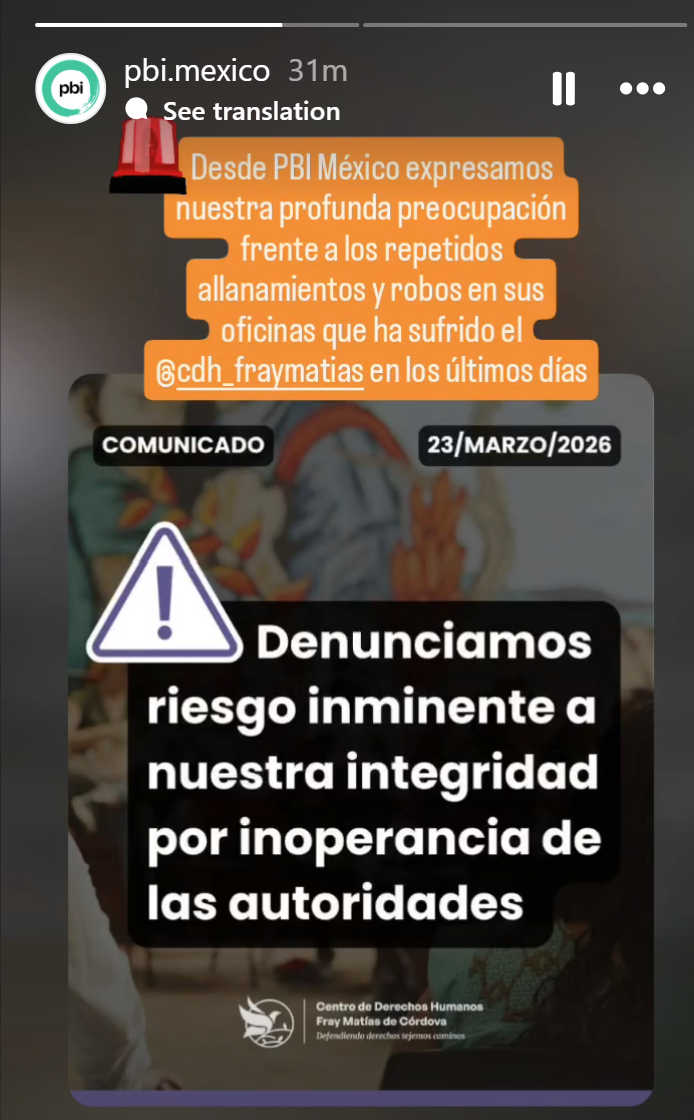
The Peace Brigades International-Mexico Project has commented on social media: “From PBI Mexico we express our deep concern over the repeated break-ins and robberies in their offices that has suffered the @cdh_fraymatias in the last days.”
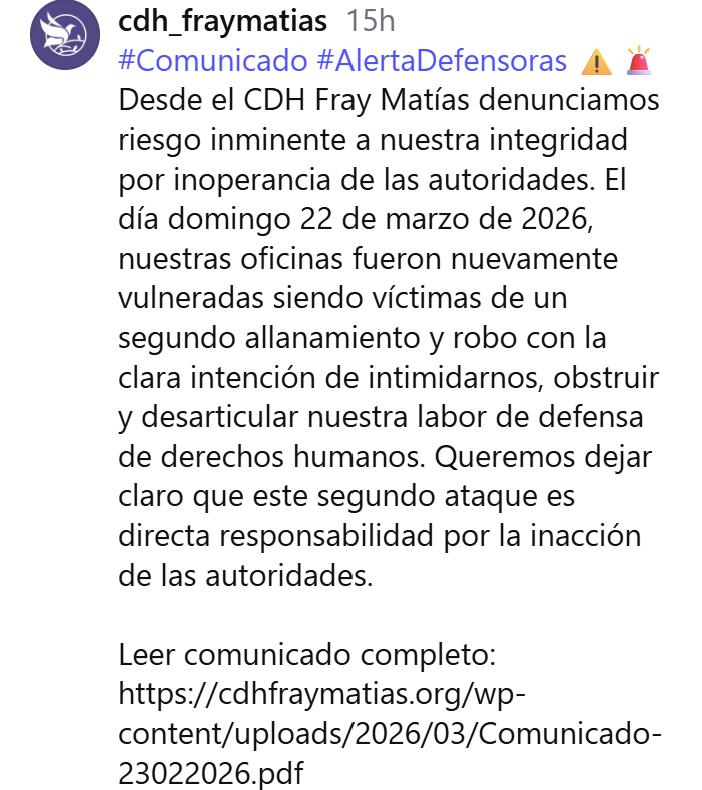
The Fray Matías de Córdova Human Rights Centre (CDH Fray Matías de Córdova), that is located in Tapachula, Chiapas, has posted on Instagram:
“#Statement #AlertForWomenHumanRightsDefenders
We at CDH Fray Matías denounce an imminent threat to our safety due to the authorities’ failure to act. On Sunday 22 March 2026, our offices were once again breached, as we fell victim to a second raid and burglary with the clear intention of intimidating us and obstructing and dismantling our work in defence of human rights. We wish to make it clear that this second attack is the direct responsibility of the authorities’ inaction.
The Miguel Agustín Pro Juárez Human Rights Center A.C. (Center Prodh) highlights: “Fray Matías pointed out that despite having measures from the Mechanism for the Protection of Human Rights Defenders and Journalists and requesting their support, their response took several hours to arrive.”
La Jornada also reports: “The center accused that it requested the support of the Mechanism for the Protection of Human Rights Defenders and Journalists – of which it is a beneficiary – but the response was late. …’We ask the federal government, in particular the Protection Mechanism, to promptly respond and implement adequate protection measures that guarantee the safety of the Fray Matías HRC team and allow us to continue our defense work,’ it said. The Center noted that the protection of information and the integrity of defenders is an obligation of the State.”
An Infobae reports: “The center recalled that in recent months it has faced other security incidents, already notified both to the Mechanism for the Protection of Human Rights Defenders and Journalists and to the corresponding authorities. Despite having protection measures from the Mechanism for the Protection of Human Rights Defenders and Journalists, the center’s team reported that the response of the security elements was late, as they came several hours after the warning. In this regard, they asked the Federal Government, in particular the Protection Mechanism, to implement adequate measures to guarantee the safety of the team and the continuity of its defense work.”
The work of Fray Matías de Córdova
Proceso explains: “On the southern border of Mexico, the Fray Matías de Córdova Human Rights Center A.C. is the most prominent reference for its independent work and direct accompaniment of people in contexts of mobility (migrants, asylum seekers, refugees and displaced persons).”
Advocacy to strengthen the Protection Mechanism
PBI-Canada, alongside PBI-Mexico and the Civil Society Space of Organizations (Espacio OSC), continues to highlight the importance of strengthening the Protection Mechanism for Human Rights Defenders and Journalists in Mexico.
It is in this context that we recall the Government of Canada has called for the strengthening of the Protection Mechanism during the United Nations (UN) Universal Periodic Review (UPR) of Mexico in January 2024.
At that time, Canada recommended that Mexico: “Strengthen, from an intersectional and gender perspective, the federal Protection Mechanism for Human Rights Defenders and Journalists, specifically in the areas of prevention, protection, investigation, and reparation.”
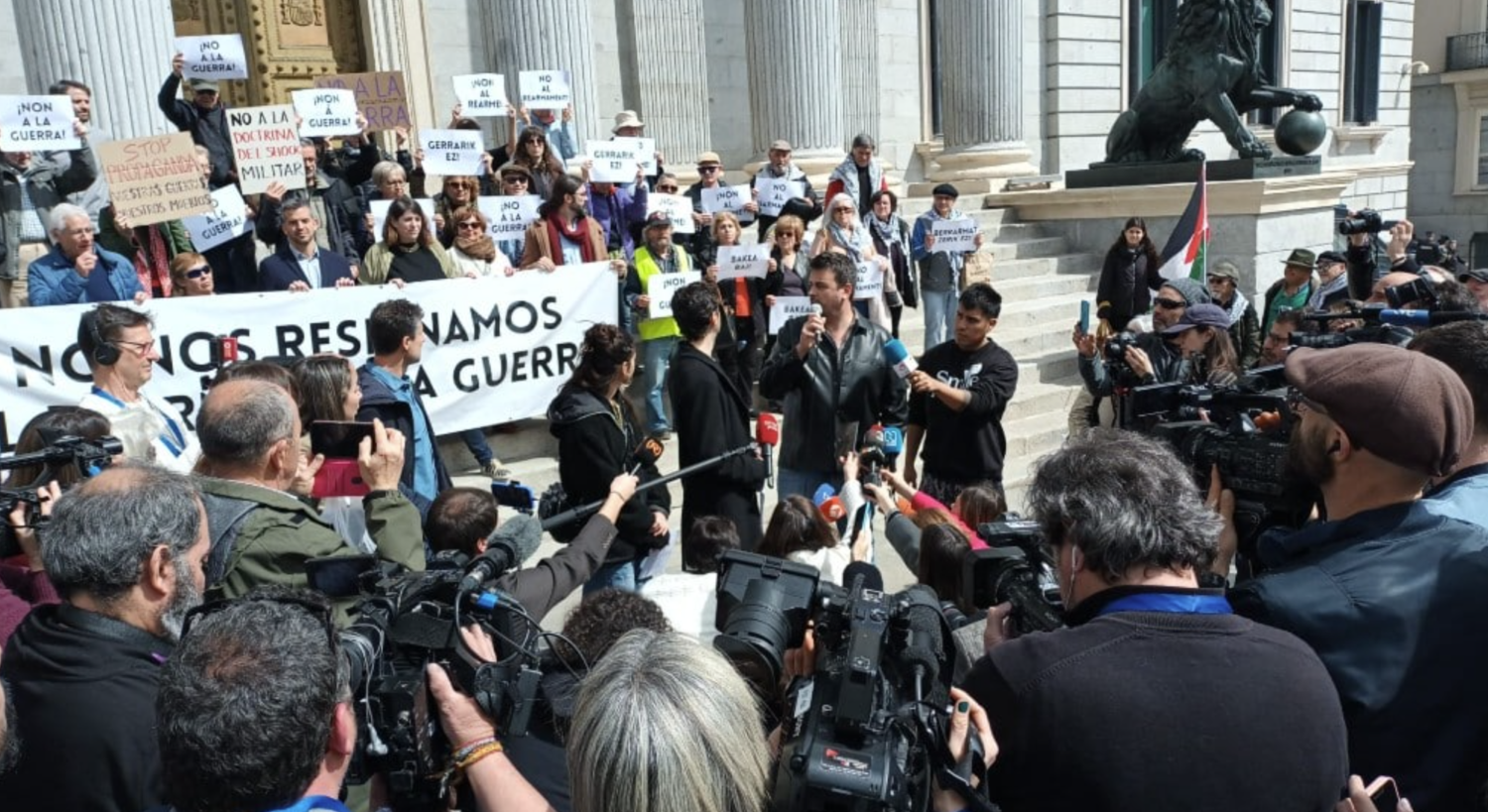
Photo from the Internationalist Assembly of Madrid.
Earlier this month, La Izquierda Diario reported: “The Internationalist Assembly of Madrid began last week after a large meeting in which more than 200 people participated and which concluded with the call for a demonstration against the war on March 21, under the slogan ‘No to war’.”
That article explains: “The initiative, promoted by various political, trade union and social organisations together with activists and individuals, seeks to promote internationalist solidarity and mobilisation against war, militarism and imperialism from a position independent of the Spanish government and all capitalist regimes.”
The Assembly now notes that more than 9,000 people took part in the march on March 21 to say no to war.
Publico.es reports: “In Madrid, the spokesman for the Internationalist Assembly has ‘demanded that the militarist escalation be stopped’ and has called for ‘the arms embargo on the State of Israel’, which he has described as ‘one of the main actors in this new arms escalation’, as he has expressed in statements to the media at the beginning of the protest. ‘We believe that it is an escalation that has to stop, that only leads us to more wars, to an escalation of destruction and death that makes no sense and that only reflects the interests of a militarist minority that wants to spend the war,’ said the spokesman of the organization.”
In February 2024, Peace Brigades International, a global human rights organization headquartered in Brussels, called on “the international community to suspend the supply of arms to Israel and the armed groups involved in the conflict.”
Canada and ReArm Europe
The lead banner in the march included the line “No al Rearme”.
Photo: The letter was announced on the steps of the Spanish Parliament in Madrid.
The letter asserts: “Militaristic contexts are also often accompanied by setbacks in rights, freedoms and social policies, causing fear and social alarm, an ideal scenario for normalising mechanisms of repression and authoritarianism.”
We also recall that the Government of Canada announced in June 2025 that it had signed a partnership with the European Union as “the intentional first step toward Canada’s participation in Security Action for Europe (SAFE), an instrument of the ReArm Europe Plan/Readiness 2030.”
On February 14, 2026, Defence Minister David McGuinty announced Canada had officially joined Europe’s (SAFE) program.
Canada at arms shows in Europe
On June 12, 2025, just after Mark Carney became the prime minister of Canada, Toronto Star national columnist Althia Raj highlighted: “Part of [their] vision [is] about a new economic plan, they want to grow the Canadian defence industry, that’s why they are joining ReArm, they want to help Canadian firms negotiate for deals in Europe, they view the economy, the way we are going to get the strongest economy in the G7 as natural resources, as critical minerals, and as the defence industry.”
Video still: Althia Raj comments on Carney’s economic strategy.
The Defence Industry Strategy proposes a new “team for export promotion” and the appointment of “new trade commissioners in the United Kingdom and key European markets” who will be at “major global defence and aerospace trade shows” so that the role of Canada’s embassies, consulates and international missions includes a prioritization of the safety and security of human rights defenders.
Photo by PBI-Canada of protest against DSEI, September 2025.
CADSI
This is likely to include continued government subsidies for the Canadian Association of Defence and Security Industries (CADSI). This past February 8-12, CADSI was “on the ground at World Defense Show in Riyadh, Saudi Arabia to support Canadian companies in accessing new opportunities in foreign markets.”
In its report on Saudia Arabia, Amnesty International has documented: “Human rights defenders and others exercising their rights to freedom of expression and association were subjected to arbitrary arrest and detention, unfair trials leading to lengthy prison terms, and travel bans.”
CADSI has also highlighted: “This year’s CANSEC will come at a defining moment for Canadian industry.”
In 2024, Canada exported $2.504 billion of “military goods and technology to non-U.S. destinations”. Beyond this, Canada exports another $1 billion of military goods to the United States on an annual basis.
On March 11, 2026, the Carney government along with Members of Parliament from other parties voted down Bill C-233, the proposed No More Loopholes Act, that sought to close the “loopholes in Canada’s arms export laws allow Canadian-made weapons and components to end up in the hands of governments accused of war crimes and human rights abuses.”
Human rights defenders
From PBI-Canada we are looking specifically at the implications of military exports to countries where State actors violate human rights and where these exports directly put at risk the safety and lives of human rights defenders, land and environmental defenders, lawyers, journalists, social leaders and communities.
Between 2012 and 2024, the Philippines was the third deadliest country for land and environmental defenders, according to data from Global Witness. They note that 306 defenders were killed in the Philippines during this period, with 413 killed in Brazil and 509 killed in Colombia during these years.
Global Witness has further noted about the situation in the Philippines: “The military has been linked to the highest number of killings and detentions of land and environmental defenders in the last decade… A Global Witness investigation published in December 2024 found that the government’s push to expand critical minerals mining in the country is putting frontline communities, especially Indigenous Peoples, at risk of militarisation and violence.”
Despite these concerns, The Defense Post reported last month that: “Canada and the Philippines are discussing a military intelligence-sharing framework that would allow broader exchanges of classified information.”
Photo: Filipino human rights groups held a rally outside the Embassy of the Philippines in Canada in Ottawa on March 14, 2025.
Accompaniment
As part of the protective accompaniment we provide to threatened human rights defenders around the world, we will be seeking answers to these concerns and measures to ensure that Canadian-made weapons, components and technologies do not put at further risk the lives of human rights defenders.
Video still: Land defender Shaylynn Sampson arrested on Wet’suwet’en territory in northern British Columbia by the RCMP C-IRG while resisting the construction of the Coastal GasLink fracked gas pipeline, November 19, 2021.
Peace Brigades International-Canada expresses concern that proposed major extractive projects brings an increased risk of violence against Indigenous women, girls, and 2SLGBTQQIA people in communities near these sites, and the threat of gender-based violence against Indigenous land and environmental defenders.
The threat of man camps
The Globe and Mail now reports: “The federal government’s chief adviser on human trafficking says Ottawa’s strategy to fast-track mining and energy projects must include measures to ensure that women and girls from local communities are safe from exploitation and predation by workers in nearby ‘man camps’.”
“In an interview, the adviser, Jennifer Richardson, said the sexual exploitation of young girls and women is an issue of particular concern to Indigenous communities located near sites that employ large numbers of transient male workers.”
The article further explains: “In a bid to boost Canada’s economy, Prime Minister Mark Carney set up a new Major Projects Office to cut approval times, including for new mines, to under two years. …Ms. Richardson said Indigenous communities she has spoken to are concerned that the new major and extraction and energy projects, could ‘release violence against Indigenous women’.”
The National Inquiry
In 2019, the final report of the National Inquiry into Missing and Murdered Indigenous Women and Girls (page 584) stated: “The National Inquiry heard testimony and examined evidence that suggested that resource extraction projects can exacerbate the problem of violence against Indigenous women and girls.”
“Reports submitted by witnesses substantiate their claims, as does a considerable body of literature identified by the National Inquiry. They all point to the same conclusion: federal, provincial, territorial, and Indigenous governments, as well as mining and oil and gas companies, should do a more thorough job of considering the safety of Indigenous women and children when making decisions about resource extraction on or near Indigenous territories.”
It further noted (on page 592): “The National Inquiry believes there is an urgent need to consider the safety of Indigenous women consistently in all stages of project planning, assessment, management, and monitoring of resource extraction projects.”
Among the report’s findings (on page 593): “There is substantial evidence of a serious problem demonstrated in the correlation between resource extraction and violence against Indigenous women, girls, and 2SLGBTQQIA people. Work camps, or ‘man camps,’ associated with the resource extraction industry are implicated in higher rates of violence against Indigenous women at the camps and in the neighbouring communities.”
Violence against women land defenders
In January 2020, The Guardian reported on a study by the International Union for the Conservation of Nature (IUCN) and noted: “There have been numerous examples of gender-based violence [GBV] directed against environmental defenders and activists, who try to stop the destruction or degradation of their land, natural resources and communities. Sexual violence is used to suppress them, undermine their status within the community and discourage others from coming forward.”
The IUCN report says: “The violence and intimidation employed to exert control over individuals’ and local communities’ territories and natural resources can also instigate, magnify and reinforce incidences of GBV.”
The report also notes: “The GBV experienced by WEHRDs [women environmental human rights defenders] can often be exacerbated when it intersects with racial and ethnic discrimination. In Guatemala, indigenous communities, which make up 60 per cent of the national population, often find themselves in defence of their territories against extractive interests. The country has also experienced a startling rise in GBV, particularly against indigenous women.”
Major Projects
On March 20, 2026, The Globe and Mail reported: “Prime Minister Mark Carney and Energy Minister Tim Hodgson are striving to spur development of LNG in Canada, believing that exporting 50 million tonnes a year is possible by 2030.”
That article adds: “They say that longer term, the country’s total LNG exports could reach up to 100 million tonnes annually by 2040.”
In August 2025, Carney launched a Major Projects Office (MPO) “to get nation-building projects built faster … by streamlining and accelerating regulatory approval processes [and] helping to structure and co-ordinate financing of these projects as needed.”
In September 2025, Carney referred a number of projects to the MPO including the LNG Canada Phase 2 expansion (that would involve the construction of two compressor stations on Wet’suwet’en territory to increase the flow of Coastal GasLink fracked gas pipeline).
In November 2025, Carney referred the Ksi Lisims LNG terminal (that would be fed by the Prince Rupert Gas Transmission pipeline on Gitanyow territory).
Final Investment Decisions
While the timelines have been subject to extension, The Globe and Mail reported in January: “Industry analysts expect LNG Canada to make a final investment decision by the end of 2026 on whether to proceed with Phase 2” and that “Ksi Lisims is expected to make a final investment decision in 2026.”
Concerns
PBI-Canada notes that there is no reference to the risks of associated violence in the prime minister’s announcement about the Major Projects Office.
We also note the unreleased systemic investigation into allegations of human rights violations by the Royal Canadian Mounted Police (RCMP) Community-Industry Response Group (C-IRG) against land defenders.
APTN has reported that almost a year before the systemic investigation was launched in March 2023: “An APTN News investigation of C-IRG in June of 2022 uncovered allegations against the unit that includes ‘intimidation, torture, brutality, harassment, racism, theft, destruction of property, arbitrary detention, inhumanity, lying and deceit.’ The investigation obtained evidence of vast spying — including casual surveillance of law-abiding groups engaged in the democratic process — collusion with private security, collaboration with industry lawyers and wilful violations of RCMP policy.”
That systemic investigation cannot be released because the position of the Chairperson of the federal Civilian Review and Complaints Commission for the RCMP has been left vacant since January 2025.
The Toronto-based United Steelworkers (USW) has expressed their “solidarity with the rubber worker’s union on strike at the Tornel tire company in Mexico, whose members suffered an armed attack on their picket line on March 18, resulting in four injuries from gunshot wounds.”
The USW has supported the union’s call for “a thorough investigation to ensure the company is held accountable under Mexican law and those responsible for the attack are prosecuted.”
The letter of solidarity from Marty Warren, the Canadian National Director of the United Steelworkers, can be read here.
Warren writes: “The USW demands security protections be provided for the more than one thousand striking workers.”
The USW’s international headquarters adds: “We also call upon the governments of the United States and Canada to demand stronger guarantees under the USMCA/CUSMA. Without respect for human rights and the right to genuine collective bargaining for Mexican workers—and as long as demands for better benefits continue to be met with gunfire—there can be no fair free trade agreement, nor will it be possible to guarantee fair competition for workers in North America.”
On March 18, La Jornada reported: “Three workers from the Hulera Tornel factory were shot and wounded by a group of armed men when they were on night duty at the Tultitlán plant, where they are on a labor strike…”
That article further notes: “The workers managed to capture two of the aggressors, who were wearing company uniforms and waited for the arrival of the authorities.”
In another article that day, La Jornada also reported: “Following the armed attack they suffered early this morning, striking workers at the Tornel tire factory in Tultitlán, in the State of Mexico, demanded justice and called for a full investigation into the incident and for the perpetrators—both those who carried out the attack and those who ordered it—to be brought to justice, ‘because someone must have ordered it’.”
The article also explains: “The four plants of this rubber company have been on strike since February 23. …Three weeks ago, 1,510 workers stopped work at facilities located in the boroughs of Azcapotzalco (two) and Miguel Hidalgo (one) in Mexico City, and in the municipality of Tultitlán (one) in the State of Mexico, resulting in a daily production shortfall of between 19,000 and 20,000 tires.”
Agencia NVM notes: “Roberto Gutiérrez Cortes, the union’s secretary for internal affairs, claimed that the company is in breach of the rubber sector’s ‘standard collective agreement’. This situation led to a labour complaint being lodged under the USMCA’s Rapid Response Labour Mechanism, following a request from the United States to investigate violations of workers’ rights.”
“Together with the international community, we stand in solidarity with the cultural resistance of young people who, in the face of the vandalism of the Casa Cultural de Potosí (Ciudad Bolívar), are affirming their commitment to peace through art and education with dignity.
In the early hours of 17 March 2026, intruders broke into this community centre and stole tools, equipment and materials essential to our work.
This incident comes amidst the escalating violence the country is experiencing and within an electoral context that puts community and organisational processes at risk.
La Casita is a space for gathering, culture and education for children, young people and the community. But it is also a movement that defends the Cerro Seco mountain, the land and life itself, in the face of mining interests, unchecked urban expansion and the dynamics of territorial control.
Let us be clear:
this is not just a theft; it is a blow to the community.
Even so, we remain standing.
They will not stop us.
We have launched a solidarity Vaki to recover what has been lost and strengthen this space:
“At the end of February, we accompanied the Inter-Church Commission for Justice and Peace to the 17th Memorial Meeting ‘For Life and Territorial Peace’, commemorating the 29th anniversary of Operation Genesis (24–27 February 1997).
The activities took place in Turbo—the place where the displaced communities arrived—and at the Community Council of the Cacarica River Basin in Bijao, where the attack began.
During these days, a moving tribute was paid to Marino López Mena, who was murdered on 27 February 1997. In his memory, a commemorative plaque was installed in the community.
Civil society organisations such as CAVIDA, CLAMORES and the Somos Génesis Network took part in the meeting, and representatives from various state bodies, including the Ministry of Foreign Affairs, the Ministry of the Interior and the Ombudsman’s Office, were in attendance.
The community and the organisations called for the implementation of the measures set out in the judgment of 20 November 2013 by the Inter-American Court of Human Rights (Series C, No. 270), to which the state has yet to respond.
We also accompanied the CIJyP on tours of the Curbaradó and Jiguamiandó Humanitarian and Biodiversity Zones.
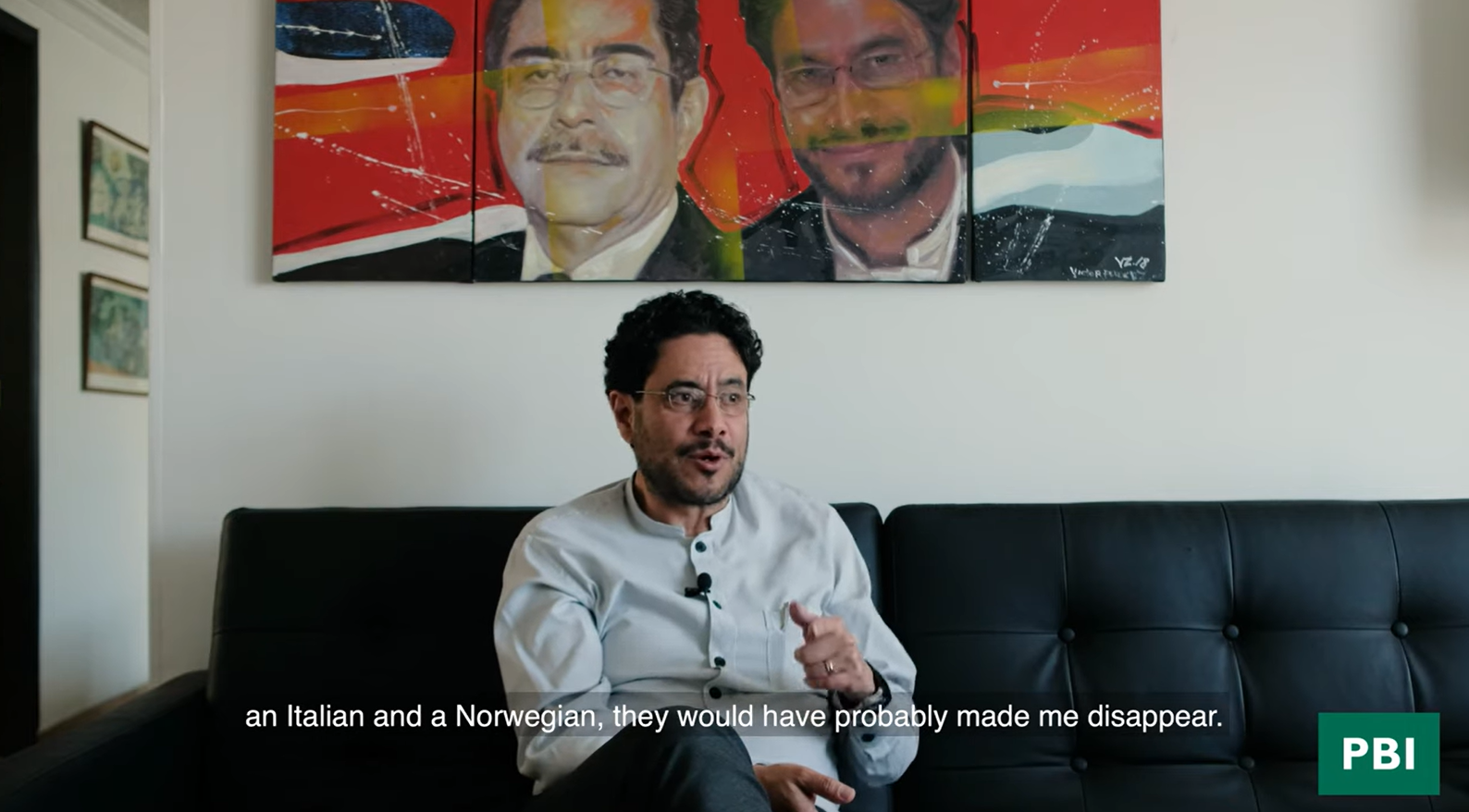
Video still: Iván Cepeda, who now leads in the polls, was accompanied by PBI from April 2004 to November 2009.
The presidential election in Colombia will take place on May 31, 2026, just a little over two months from now. In this election period there is a heightened risk of smears and attacks against human rights defenders and communities.
Election monitoring
ABC Colombia has noted the European Union is deploying an Election Observation Mission to Colombia to monitor Presidential elections with more than a hundred observers distributed across different regions of the country.
The Brussels Times has further reported: “Esteban González Pons, a Vice-president of the European Parliament, has been appointed as the mission’s Chief Observer by the EU’s High Representative for Foreign Affairs and Security Policy, Kaja Kallas, the European External Action Service (EEAS).”
And the San Francisco-based Global Exchange says it “is activating electoral monitoring tools to help document the process, support transparency, protect human rights, and amplify the voices that are building the nation from the ground up.”
Disinformation
Now, La Silla Vacía reports that a video clip is circulating on social media that implies presidential candidate Iván Cepeda demanding respect for the Revolutionary Armed Forces of Colombia (FARC).
La Silla Vacía notes Cepeda was instead defending the Peasant Association of the Cimitarra River Valley (ACVC).
Cepeda says: “These peasants live in very difficult situations, I ask you to please respect them.” Democratic Center Party Senator Maria Fernanda Cabal responds: “Don’t ask me to respect those who recruit children, such as the members of the ACVC.”
This was a debate in June 2017.
In that debate, Cabal also says the Peasant Association of Catatumbo (Ascamcat) has “a lot of relationship with illegal groups”.
Cepeda has now posted on social media: “As part of the various campaigns of lying communication being carried out by various far-right media outlets, a new dirty campaign against me is now unfolding on social media. It involves slanderous messages in which a fragment is taken from the debate I held years ago with Senator Cabal, in which she accused peasant associations and civil organizations of being guerrillas and child kidnappers. They decontextualize the video fragment and put it into circulation on social networks.”
Stigmatization, attacks against the ACVC
La Silla Vacía notes: “Since its inception, ACVC members have been stigmatized, according to Peace Brigades International. Between 1990 and 2010, the Truth Commission documented systematic persecution against the peasant movement with the aim of dismantling and displacing its social fabric. The last recorded murder of a member occurred in August 2023, along with the kidnapping of three other leaders. In the last year alone, at least 187 leaders were murdered in the country.”
The election, May 31 and June 21
On March 20, The Rio Times reported: “Cepeda leads Colombia’s presidential race at 35%, followed by nationalist lawyer Abelardo de la Espriella at 21% and center-right Paloma Valencia at 16%, according to the first major poll since March 8 primaries.”
Politichance notes: “Colombia’s presidential elections are scheduled for May 31, 2026, and a second round (if required) on June 21, 2026, in case no candidate secures more than 50% of the valid votes in the first round.”
PBI accompaniment of Cepeda
In this video clip produced by PBI-Colombia in 2019, Cepeda says: “Today I’m speaking here with you thanks to PBI. The paramilitary took me off a vehicle and there was a moment where if two PBI women hadn’t been with me, an Italian and a Norwegian, they would have probably made me disappear.”
PBI-Colombia has previously noted: “PBI has accompanied the Manuel Cepeda Vargas Foundation’s Executive Committee since April 2004, when Iván Cepeda and Claudia Girón returned to Colombia after four years of exile in France (resulting from the death threats they received in 2000).”
The Foundation was named after Cepeda’s father.
The Jacobin notes: “His father, Manuel Cepeda, a congressman for the Patriotic Union — a party that emerged from a peace process with the FARC — was assassinated in 1994 by paramilitaries in a campaign of extermination of the party’s leaders, for which the Inter-American Court of Human Rights condemned the Colombian state. After his father’s murder, Cepeda promoted the National Movement for Victims, with the aim of achieving justice for the people murdered by state agents and paramilitaries.”
PBI-Colombia also explains: “In November 2009, PBI suspended its accompaniment of Iván Cepeda when he announced he would run for congress in March 2010. Due to PBI’s mandate of non-partisanship, it does not accompany candidates for office or elected officials.”
Cepeda comments on Canadian companies
In a webinar in November 2020 alongside Canadian Member of Parliament Leah Gazan, Cepeda stated: “There is evidence of companies, I’m not saying just Canadians, but there is evidence of companies that have hired paramilitary groups. [There are also contracts between companies and the Colombian armed forces] in a sense the army becomes a privately hired company for security purposes for the multinational.”
It has been reported that 70 companies, mainly in the mining-energy sector, have 200 cooperation agreements with public institutions in Colombia, including the Ministry of Defence and even the Attorney General’s Office.
This includes agreements between the Canadian company Frontera Energy and the Colombian military that led to the criminalization and arrest of eight social leaders in San Luis de Palenque, Casanare who are accompanied by the PBI accompanied organizations the Committee for Solidarity with Political Prisoners (CSPP) and the Social Corporation for Community Advice and Training (COSPACC).
Will Trump interfere in the Colombian election?
Cepeda has been asked: “Do you fear a direct intervention by the United States in the upcoming elections?” His response: “Yes. When a foreign power issues opinions against a government during an electoral period, when it says that government has favorable attitudes toward criminal organizations, that it can have a harmful effect on the region — that has a purpose. Figures from President Trump’s circle, both congresspeople and administration officials, have spoken in this way.”
Cepeda has also been asked: “Beyond the statements, do you believe there could be a more direct intervention by the US government during the campaign and the presidential and legislative elections this year in Colombia?”
Cepeda has replied: “We will see. There is a real danger. There are precedents.”
“Join us on March 31 at 4:00pm PT/7:00 ET for the launch of LNG: Not in Our National Interest, a new cross-country campaign!”
The speakers include Chief Na’Moks, Hereditary Chief of the Wet’suwet’en Nation; Gwii Lok’im Gibuu (Jesse Stoeppler), Co-Executive Director of the Skeena Watershed Conservation Coalition; and Janelle Lapointe, Climate Justice and Indigenous Rights Organizer, among others.
We are particularly concerned about the safety and security implications for Indigenous land and environmental defenders opposed to major projects recommended to be fast-tracked on their territories.
In August 2025, Prime Minister Mark Carney’s government established a Major Projects Office (MPO) “to move major projects forward faster, responsibly, and sustainably.” The 15 projects that have been “deemed to be of national importance and significance” include LNG Canada Phase 2 (that would involve the construction of compressor stations on Wet’suwet’en territory) and Ksi Lisims LNG (that would be fed by the Prince Rupert Gas Transmission pipeline on Gitxsan and Gitanyow territories).
We situate this in the context of the unreleased Civilian Review and Complaints Commission (CRCC) systemic investigation of the Royal Canadian Mounted Police (RCMP) Community-Industry Response Group (C-IRG).
Photo from Mexico Solidarity Media, March 20, 2026.
Agence France-Presse reports: “Teachers from one of Mexico’s largest unions began three days of protests on Wednesday, March 18, to demand labor improvements, and warned that, if they are not heeded, they will demonstrate during the 2026 North American World Cup, which begins in June in the Mexican capital.”
“Thousands of workers from the National Coordination of Education Workers (CNTE) mobilized in the center of the capital to demand the repeal of laws on pensions, salary modifications and changes in education policy.”
That article adds: “The organizers reported that this Wednesday the teachers will also march to the embassies of the United States and Israel, in rejection of the conflict in Iran and the threats against Cuba, and to the embassy of Panama, in solidarity with teachers from that country.”
The Jacobin has previously explained: “The Mexican Teachers Union (SNTE) has 1.4 million members, with two hundred thousand or more active in the dissident National Coordinating Committee (CNTE).”
It adds: “Today’s dissident teacher movement began in the mid-1960s among mostly women, indigenous teachers in the state of Chiapas.”
It also highlights: “When on September 26, 2014 police and gang members in Iguala, Guerrero killed six people, wounded twenty-five, and kidnapped forty-three students from the Ayotzinapa Rural Normal School, the CNTE joined with their protests, which became national in scope.”
CNTE activists murdered, leaders arrested
The Jacobin article then concludes: “All of this makes the CNTE’s struggle even more remarkable. Despite the murder of several of its activists, the arrest of some of its leaders, and the violent attacks by the police on its demonstrations, the struggle continues.”
NEXT: Upcoming webinar prior to Mexico-Canada Dialogue
Look for a webinar this spring where we will continue to amplify this message in advance of the Mexico-Canada Dialogue on Human Rights and Multilateral Issues that will take place in Ottawa in the second half of May 2026.
Peace Brigades International-Canada recognizes trade union activists as human rights defenders and seeks increased protection for them.
This includes strengthening protections such as the Protection Mechanism for Human Rights Defenders and Journalists in Mexico, as well as the Rapid Response Mechanism within the Canada-U.S. Mexico Agreement.
“My name is Sleydo’ from the Gidimt’en clan of the Wet’suwet’en nation in so-called Canada. We’ve been reoccupying our territory and defending our land against the invasion of the state and industry that is destroying our land and waters. We want to call for the immediate release of Pablo Colhuan Nahuel who is a political prisoner in the Mapuche territories. They are defending a sacred site, one of their ceremonial sites. People have been criminalized for defending this site. People have been jailed and aren’t able to return home to their communities. We have to stop the criminalization of Indigenous people internationally for upholding our rights and our responsibilities to our homelands.”
Infoterritorial notes: “Colhuan Nahuel remains in Unit 6 of Rawson, a maximum security prison. …The Lawyers’ Guild, which legally represents him, reported that Colhuan Nahuel is at the disposal of the Federal Court of General Roca for this case of usurpation, linked to the property that National Parks had ceded to the State Gas Personnel Union.”
In November 2023, Al Jazeera reported: “[Betiana] Colhuan belongs to one of Argentina’s Indigenous peoples, the Mapuche. The land her community used to sit within falls under the administration of the Nahuel Huapi National Park, the country’s oldest national park and a popular outdoor destination.”
“In 2017, shortly after they moved in, members of the Albatross group, a special unit of Argentina’s naval police, tried to evict them based on complaints from the park administration that they were ‘usurping’ the land. The expulsion quickly turned violent. Colhuan’s cousin, 22-year-old Rafael Nahuel, was shot dead by police in the altercation.”
While it appears they were able to stay on their ancestral land after that attempted eviction, “Colhuan and her neighbours were forcibly expelled in 2022. Now, they fear government inertia and the outcome of Argentina’s presidential election on November 19 could permanently end their hopes of returning.”
Al Jazeera further explains: “Though often associated with the neighbouring country of Chile — where they constitute the largest Indigenous group — the Mapuche predate national borders. Their ancestral territory includes the southernmost reaches of Argentina, part of a region known as Patagonia.”
At this beginning of this year, Pablo Colhuan stated from prison: “If my trial does not begin in March, I will go on a dry hunger strike”
We continue to follow this.
Photo: Sleydo’ met with Peace Brigades International accompanied defender Jani Silva on Wet’suwet’en territory in June 2025. Silva has faced multiple threats and risks to her life for defending the Perla Amazónica Peasant Reserve Zone in the Putumayo region of Colombia from armed groups and industry.