Home Blog Page 38

Alternative Federal Budget 2026 notes importance of Canada supporting human rights defenders

Photo: Finance minister François-Philippe Champagne will table the next federal budget on November 4, 2025.

The Canadian Centre for Policy Alternatives (CCPA) has just released its Alternative federal budget 2026.

PBI-Canada notes the inclusion of human rights defenders in this AFB.

In the AFB chapter on International cooperation notes: “Demonstrating a commitment to democratic values through robust support for civil society, independent media, and human rights defenders will enhance Canada’s international standing and ensure that its global engagement reflects both its principles and strategic interests.”

It also says: “The AFB will invest in civilian protection by focusing on vulnerable populations in conflict zones, including women, children, and displaced persons, to ensure humanitarian assistance reaches those most in need.”

And it highlights: “The AFB will defend civic space and human rights by using its influence in global forums and providing dedicated funding as part of the IAE [international assistance envelope] to expand support for civil society and civic space. This funding will prioritize agile partnerships with local actors and support human rights defenders, civil society organizations and movements, independent media, and the legal and enabling environment for civil society, human rights, and democracy.”

The singular budget recommendation: “Maintain Canada’s Official Development Assistance at 2023-24 level ($10.2 billion) and adjust for inflation.”

Protection Mechanism in Mexico

On October 9, Stuart Trew, senior researcher at the Canadian Centre for Policy Alternatives (CCPA) and director of the CCPA’s Trade and Investment Research Project (TIRP), presented to the House of Commons Standing Committee on International Trade (CIIT).

Trew noted in his presentation:

“In light of the new Canada-Mexico Action Plan, I think it would be beneficial to strengthen cooperation with Mexico in areas like human rights as well by supporting the Protection Mechanism for human rights defenders and journalists which is under the jurisdiction of the Mexican government. This benefits Canadian businesses by giving them greater assurances that their Mexican operations are not going to be involved perhaps involuntarily in human rights violations.”

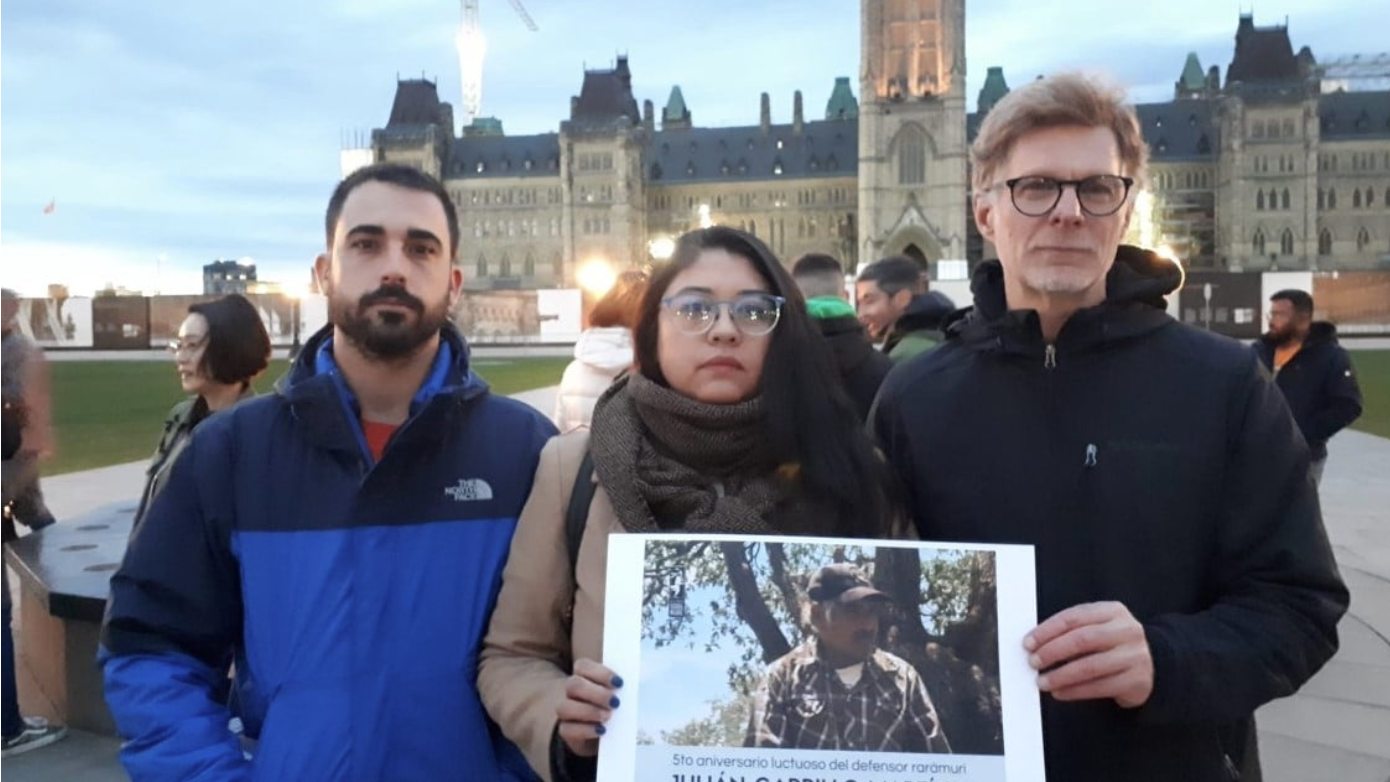
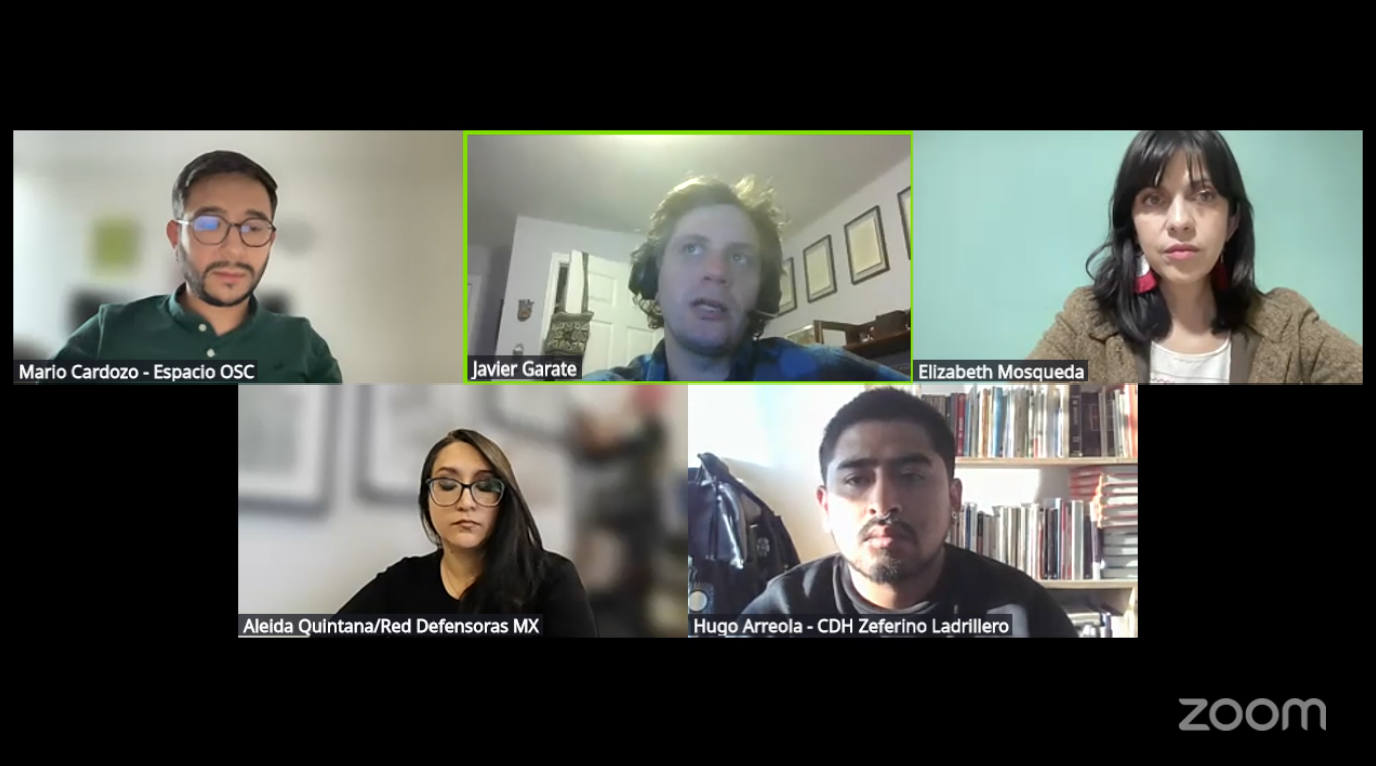
During a recent advocacy visit to Canada, two representatives of the Peace Brigades International accompanied Civil Society Organization Space / Espacio OSC noted that the Government of Canada had announced in the Canada-Mexico Action Plan $9.9 million in funding for projects in Mexico.

At meetings with Members of Parliament and Global Affairs Canada officials, Espacio OSC conveyed this message: “We believe that this could be supplemented by a similar amount allocated to strengthening the Mechanism over three years, focusing on the application of a gender, community, and Indigenous peoples and communities approach in risk assessments in multi-stakeholder spaces where civil society can participate alongside authorities and international organizations; to increase staffing levels; and to generate political awareness campaigns.”

We continue to follow this.

Further reading: Canadian Centre for Policy Alternatives notes the Protection Mechanism in Mexico at House of Commons committee presentation (PBI-Canada, October 10, 2025).

PBI-Canada notes language on trade unions and workers in UN talks on a Binding Treaty on business and human rights

Photo: United Nations Headquarters, Geneva. Photo by John Samuel.

The United Nations Human Rights Council open-ended intergovernmental working group on transnational corporations and other business enterprises with respect to human rights (OEIGWG) held its 11th negotiation session on a Binding Treaty on Business and Human Rights from October 20 to 24, 2025 in Geneva, Switzerland.

PBI-Canada recognizes trade union activists, who continue to be under attack for their work, as human rights defenders.

The version of the Draft Treaty that was negotiated last week makes two references to trade unions and workers:

6.2. State Parties shall adopt appropriate legislative, regulatory, and other measures to: (d)  promote the active and meaningful participation of individuals and groups, such as trade unions, civil society, non-governmental organizations, indigenous peoples, and community-based organizations, in the development and implementation of laws, policies and other measures to prevent the involvement of business enterprises in human rights abuse.

6.4. Measures to achieve the ends referred to in Article 6.2 shall include legally enforceable requirements for business enterprises to undertake human rights due diligence as well as such supporting or ancillary measures as may be needed to ensure that business enterprises while carrying out human rights due diligence: (e) protect the safety of human rights defenders, journalists, workers, members of indigenous peoples, among others, as well as those who may be subject to retaliation.

The negotiations

For updates from the Business and Human Rights Resource Centre (BHRRC), go to Day 1: Monday 20 OctoberDay 2: Tuesday 21 October, Day 3: Wednesday 22 October, Day 4: Thursday 23 October and Day 5: Friday 24 October.

The update from Day 4 notes: “After the discussion on the proposals, the Chairperson-Rapporteur presented the OEIGWG’s 2026 draft roadmap. It was approved following his responses to states and non-state stakeholders, including a clarification that no new draft of the instrument will be produced ahead of the 12th session.”

Next steps

That draft roadmap indicates that the 12th session of the open-ended intergovernmental working group on transnational corporations and other business enterprises with respect to human rights (OEIGWG) will be held on October 19 to 23, 2026.

Just prior to this round, ABC Colombia and Corporate Justice Coalition noted that the process intends to bring “forward a revised updated draft text in 2027.”

And in a press release issued on October 21, Dismantle Corporate Power highlighted the raised “expectations that the treaty could be finalised within the next two to five years”, which would suggest late 2027 to 2030.

We continue to follow this.

The COP30 climate conference starts in two weeks; will land and environmental defenders be on the agenda?

Photo: The Caravana for Climate and Life meets with COPINH while en route from Mexico to COP30 in Brazil.

The United Nations COP30 climate change conference will start two weeks from today on Monday November 10 in the city of Belém in northern Brazil. Will the protection needs of land and environmental defenders be on the agenda this year?

Land and environmental defenders continue to be killed

Berta Caceres, the co-founder of the Council of Popular and Indigenous Organizations of Honduras (COPINH), was murdered on March 2, 2016, just months after COP21 concluded on December 11, 2015, in Paris.

More than 1,729 land and environmental defenders have been killed in the 9 years since Caceres was murdered.

That’s an average of 192 defenders killed per year.

Defenders excluded at COPs

In March 2019, the UN Human Rights Council affirmed: “Environmental human rights defenders must be ensured a safe and enabling environment to undertake their work free from hindrance and insecurity, in recognition of their important role in supporting States to fulfil their obligations under the Paris Agreement.”

And yet this short sentence was not included in the final text of COP25 later that year or in any of the subsequent COP declarations.

Shauna Gillooly and Simón Escoffier from the Pontificia Universidad Católica de Chile have also noted: “Grassroots actors, Indigenous communities, labour unions, and environmental justice movements are not just consumers of climate information; they are frontline political actors, whose legitimacy in shaping climate policy should be recognised. Yet the UNFCCC [United Nations Framework Convention on Climate Change] and COP [these conferences of parties] do not provide them with the institutional leverage, financial resources, or direct access to decision-making processes that would allow them to act as true counterweights to government and corporate inertia.”

“Blatant attempts” to eliminate references to defenders

It appears that the dynamic is not just that defenders are neither meaningfully included nor mentioned in COP outcomes, but also that efforts to include defenders in the final text are removed by the “usual suspects”.

Commenting on COP29, Camilla Pollera of the Center for International Environmental Law stated: “The blatant attempts to eliminate reference to the protection of environmental human rights defenders and human rights is especially alarming.”

And Floridea Di Como of CambiaMO in Spain added: “To take out from the text reference to Land and Environmental Human Rights defenders is to make a deep injustice from the recognition, procedural and distributive points of view.”

The “usual suspects”

This echoes the comments made by Michel Forst, the UN Special Rapporteur on Environmental Defenders (Aarhus Convention), on a PBI-Canada organized webinar.

Forst told those at our webinar: “There are people who are willing to push for good results and at the same time we know that we also have people who are not our allies who are pushing also for counter-results and trying to delete paragraphs and good wording that some of us, some of them, would like to introduce.”

He added: “We have the same usual suspects who block the discussions.”

Forst did not name those “usual suspects”, but they are likely to include the United States, Japan, Canada and Australia.

“We can’t legitimize COP meetings”

Beyond this focused concern about COP conferences failing environmental defenders, there is also a broader critique of these annual gatherings.

Ahead of COP29, Greta Thunberg stated: “We can’t legitimize COP meetings in their current form. …Every time those in power get a chance to act, they choose not to and instead listen to industries that destroy the planet and violate human rights, rather than doing what’s right. …The only thing that will come out of it is loopholes, more negotiations, and symbolic decisions that look good on paper but are really just greenwashing.”

Calls for action

Within this challenging context that brings little expectation of progress, PBI-Canada supports the call that all State Parties at COP30 should “recognize the link between the climate crisis and growing violence and repression against land and environmental defenders and take meaningful steps to protect defenders and civic space (online and in person) to promote ambition and climate action.”

We further support the call “urging all Parties to commit to the enhanced protection of environmental human rights defenders, including reporting, investigating and seeking accountability and redress for reprisals against environmental human rights defenders, and public information about the actions taken to do so as well as public recognition of the importance of their work.”

Measuring violations

Global Witness has recommended: “To be effective, legislation and public policies to protect defenders need to be based on a deep understanding of the realities they face. The systematic documentation of attacks, and their motivations, would enable states to improve existing laws and mechanisms to protect defenders.”

We agree that Indicator 16.10.1 of the UN’s 17 Sustainable Development Goals (SDGs) should be incorporated into the COP process a meaningful way. That Indicator seeks to measure the “number of verified cases of killing, kidnapping, enforced disappearance, arbitrary detention and torture of journalists, associated media personnel, trade unionists and human rights advocates in the previous 12 months.”

The International Land Coalition says: “Countries are expected to report on the number of verified cases of killing, kidnapping, enforced disappearance, arbitrary detention and torture of human rights defenders (HRD).”

However, they further highlight, in the Voluntary National Reviews (VNRs) of 162 countries, only 3 countries reported that at least one HRD had been killed or attacked, 7 countries reported zero cases, and 152 countries did not report at all.

While Canada was one of the countries that did submit a report in 2024, it did not reference Indicator 16.10.1, specifically on the ongoing concerns about the abuse of process and arbitrary detention of Wet’suwet’en land defenders.

Canada and COP30

On September 8, 2025, the Canadian Press reported: “Prime Minister Mark Carney and his environment minister aren’t saying whether Canada is still committed to meeting its climate goals under the Paris agreement by 2030, as the government faces criticism over his emissions reduction plans.”

On October 25, 2025, CBC News reported: “The Prime Minister’s Office has yet to confirm if Carney will attend COP30.”

Meanwhile, Gitanyow land defenders are preparing to blockade the construction of the Prince Rupert Gas Transmission (PRGT) fracked gas pipeline on their territories as a final investment decision on that megaproject is expected within weeks.

Coming up

PBI-Canada is following the Mesoamerican Caravan for the Climate and Life that was formed with the assertion that: “Activism in defense of land, territory, water, and nature is dangerous, and many of our comrades face stigmatization, harassment, repression, criminalization, and even murder.”

The Caravan is expected to arrive in Belém by November 10.

And this coming Tuesday November 18, we plan to hold a webinar that comments on COP30 and the protection needs of land and environmental defenders. You can pre-register for this webinar by clicking here.

COP30 is scheduled to conclude on November 21.

Union activists continue to face death threats and physical attacks in Colombia, Guatemala, Honduras and Mexico

Photo: On April 28, 2025, PBI-Colombia accompanied Nomadesc at a commemorations of the National Strike of 2021 and the demand for a Truth Commission to address the 75 murders and 3,000 cases of physical violence.

The International Trade Union Confederation (ITUC) Global Rights Index 2025 reports: “Trade unionists paid the ultimate price for their activism in Cameroon, Colombia, Guatemala, Peru, and South Africa – killed for defending workers’ rights.”

The ITUC report further highlights: “The Americas remains the deadliest region for workers: five unionists were killed in Colombia, Guatemala, and Peru.”

It adds: “A culture of intimidation continues to threaten workers and trade union activists across much of the region, where death threats and physical attacks remain commonplace.”

Peace Brigades International, with teams in Colombia, Guatemala, Honduras and Mexico, remains attentive to this situation of attacks against union activists.

Colombia

ITUC notes: “In Colombia, Jhon Jarry Vargas Sarabia – the young father of three and a member of the Unión Sindical Obrera (USO) for oil workers – was shot dead in Tibú [on 23 September 2024].”

Guatemala

ITUC also documents:

Ronaldo Geovany Gómez Godoy, a member of the National Union of Health Workers of Guatemala (SNTSG), was killed on 23 September 2024 by hired assassins.

On 5 September, teacher René Sucup Morán, a union leader of Sindicato de Trabajadoras y Trabajadores de la Educación de Guatemala (STEG), was murdered by a hitman.

The union had documented a series of attacks and intimidation against STEG leaders since May 2024, when it organised a nationwide campaign to demand meaningful collective bargaining negotiations.

On 15 June 2024, Anastacio Tzib Caal, a leader in the network of textile maquila unions in Guatemala, was gunned down. At the time of writing, no arrests had been made.”

Honduras

In their report, ITUC further notes: “Companies operating in sectors known for their abusive work conditions engaged in widespread union-busting practices in El Salvador, Costa Rica, Honduras, and Panama.”

Worker-driven Social Responsibility (WSR) has noted that the US apparel brand Fruit of the Loom announced the closing two unionized factories in Honduras, Jerzees Nuevo Día and Confecciones Dos Caminos, impacting 3,000 workers. The Sourcing Journal adds: “Evangelina Argueta, a coordinator for CGT [Central General de Trabajadores/ General Workers’ Union] who led the fight at the former Jerzees de Honduras, said workers believe that the factory closures are a form of union-busting.”

Mexico

In more encouraging news, ITUC adds: “Mexico, by contrast, saw its rating climb to 3 [regular violations of rights] from 4 [systematic violations of rights], following positive reforms to its labour justice system.”

Colombia, Honduras and Guatemala are all rated as a 5: “no guarantee of rights”.

Peace Brigades International recognizes trade union activists as human rights defenders and seeks increased protections for them.

PBI-Canada attentive as Mesoamerican Caravan learns about the Canadian Aura Minerals “Era Dorada” mine in Jutiapa, Guatemala

Photo: “With the celebration of a mass with the Franciscan brothers of Asunción Mita Jutiapa concluded the Guatemala chapter of the Mesoamerican Caravan, with the route to El Salvador.” Photo by AGIMS Asociación Grupo Integral de Mujeres Sanjuaneras.

The Assembly of the Indigenous Peoples of the Isthmus in Defense of Land and Territory (APIIDTT) announced on October 12, that the Mesoamerican Caravan for Climate and Life began its journey from Mexico to Brazil for the United Nations COP30 climate summit that begins on November 10.

The APIIDTT further notes: “We call on civil society throughout the region and the world to remain attentive to the route of this caravan. …We call on human rights organizations to observe, denounce and document the abuses and violations we face at the border crossing and in every community criminalized for defending life.”

Peace Brigades International-Canada has responded to that call and is attentive to the Mesoamerican Caravan’s journey.

On October 19, Prensa Comunitaria reported: “After several days of touring the country, the Mesoamerican Caravan for Climate and Life concluded its passage through Guatemala with a symbolic act in Jutiapa, which brought together communities and organizations around a common agenda of territorial defense and climate justice.”

Aura Minerals Inc.

That article then highlights:

“The choice of Jutiapa as the final point of the Mesoamerican Caravan for Climate and Life was no coincidence. This department is home to Asunción Mita, the epicenter of one of the most emblematic socio-environmental struggles in the region: the resistance against the Cerro Blanco mining project, a gold mine located near the border with El Salvador.

The central concern is the threat it poses to the transboundary basin of the Lempa River, a vital source of water for more than 4 million people. The closing ceremony in this territory was both an expression of faith and a political statement in solidarity with the communities defending their right to water, health and to decide over their own territory.

At the beginning of 2025, the Canadian company Aura Minerals completed the purchase of Bluestone Resources, the previous owner of the deposit, and renamed the project ‘Era Dorada’ [Golden Era]. However, the change of hands has not implied an ethical or technical transformation: the project continues to be surrounded by serious legal, environmental and social questions, while seeking to advance its open-pit exploitation despite massive popular rejection.

Aura Minerals is no stranger to controversy. In Honduras, it has been singled out for acts of desecration and criminalization of communities. At the San Andrés mine, located between Copán and Chiquimula, the company reportedly exhumed bodies from a community cemetery to continue extracting gold from underground. Complaints for these events are still open and many people remain criminalized.”

That Prensa Comunitaria article also notes: “Before arriving in Jutiapa, the Mesoamerican Caravan for Climate and Life arrived on October 12 along the southern border from where it traveled through the west and the Guatemalan capital, articulating its passage around four central axes: militarization and megaprojects, forced migration, commodification of life and water crisis.”

We continue to follow the progress of the Caravana.

Photo of rally in Guatemala City by AGIMS Asociación Grupo Integral de Mujeres Sanjuaneras. The Peace Brigades International-Guatemala Project accompanies the Maya Ch’orti’ Indigenous Council of Olopa.

The Mesoamerican Caravan and defenders

The Mesoamerican Caravan was agreed to at the conclusion of the Global Meeting for Climate and Life: ANTICOP 2024. The final statement from that Global Meeting noted: “Activism in defense of land, territory, water, and nature is dangerous, and many of our comrades face stigmatization, harassment, repression, criminalization, and even murder. Since the signing of the Paris Climate Agreement, over 1,500 environmental defenders have been killed around the world—the vast majority in Global South countries. We demand safe spaces for activists, where they can heal and protect themselves physically, emotionally, and legally. We also propose creating networks and support mechanisms for legal, communication, technological, psychological, and physical and digital security for human rights defenders, land defenders, and environmental activists in the most vulnerable territories.”

Further reading

PBI-Canada remains attentive to the continuing journey of the Mesoamerican Caravan as it meets with COPINH on Lenca territory in Honduras (PBI-Canada, October 22, 2025)

PBI-Canada attentive to the journey of the Mesoamerican Caravan for Climate and Life from Mexico to Brazil (PBI-Canada, October 13, 2025)

Caravan for the Climate and Life set to travel from Mexico to Brazil for the UN COP30 climate conference (PBI-Canada, February 27, 2025).

PBI-Honduras visits National Union of Rural Workers (CNTC) community of 17 de Junio whose members are being criminalized for land “usurpation”

The Peace Brigades International-Honduras Project has posted on social media:

“Yesterday [October 23, 2025], we made a visit to the peasant base June 17 of the National Central of Field Workers – CNTC Progreso. On the same day, the judiciary in Villanueva (Cortés) canceled for the third time the initial hearing in the criminalization case against 23 people from the base accused of the crime of usurpation, two of them women. From PBI, we remind you that delays in court proceedings have a strong economic and emotional impact on peasant communities that face such criminalization processes. CNTC Tegucigalpa.”

The CNTC refers to the National Union of Rural Workers. Peace Brigades International has accompanied the union since May 2018.

The CNTC is affiliated with the Unified Confederation of Honduran Workers (CUTH) which in turn is affiliated with the International Trade Union Confederation (ITUC), along with 150+ labour organizations including the Canadian Labour Congress.

In their Global Rights Index 2024, the International Trade Union Confederation (ITUC) documented that 22 trade unionists and workers died because of violence or were killed in six countries including four union representatives in Honduras.

Reuters has reported: “Less than 5% of Honduras’ landowners, government figures show, control 60% of the fertile terrain, including many monocultures of palm and other export crops.” And anthropologist Andrés León has noted: “The Aguán is a region of rampant poverty and misery surrounded by a crop that makes millions in profits.”

“Usurpation” can be understood as a criminal charge that enables evictions of peasant-farmers by landowners.

Usurpation criminalizes the occupation/presence of campesinas on land in the context of land ownership inequalities and through the political prism of the prioritization of private property rights and the rights of large landowners and agribusiness.

We continue to follow this situation.

Further reading:

PBI-Honduras accompanies the CNTC rural workers union and 17 de junio community at trial date on land “usurpation” (PBI-Canada, April 1, 2025)

PBI-Honduras accompanies the National Union of Rural Workers (CNTC) as it helps reclaim land and food sovereignty (PBI-Canada, March 14, 2023).

Photo: PBI-Honduras with Franklin Almendares, General Secretary, National Union of Rural Workers (CNTC).

PBI-Canada congratulates the Amazon Pearl Campesina Reserve Zone on the 25th anniversary of its formation

Photo: Jani Silva receives a copy of the Global Witness “Roots of Resistance” report (that feature an article by Silva on pages 54 to 63) from Javier Garate (Senior US Policy Advisor – Land and Environmental Defenders at Global Witness; and member of the Peace Brigades International-Canada Board of Directors) at the 25th anniversary gathering, October 24, 2025.

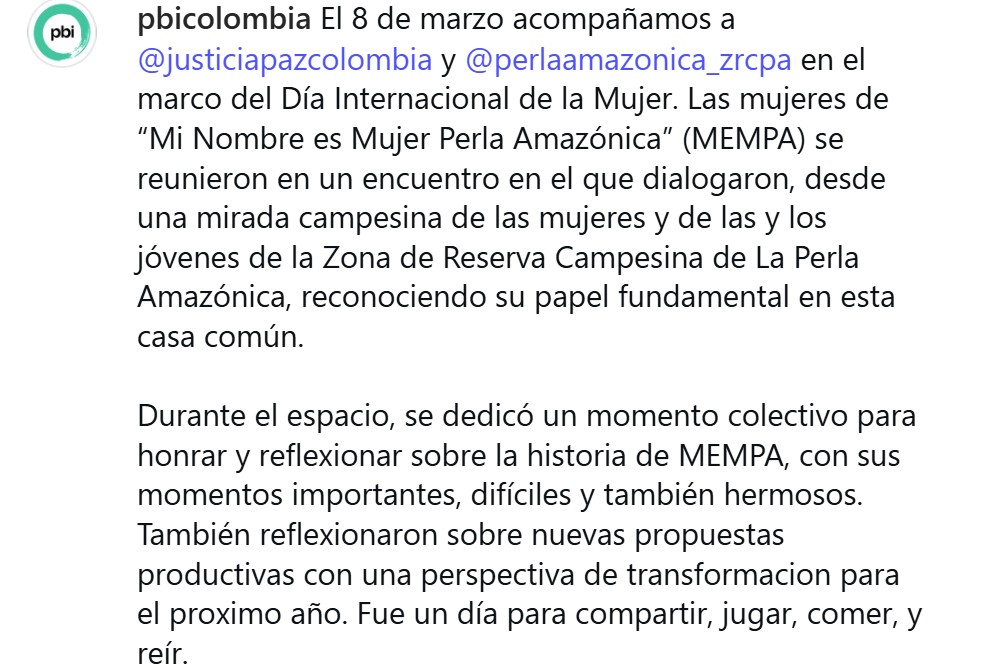
The Commission of Justice and Peace has posted on social media: “On October 24 and 25, in the commemoration of the 25 years of the Amazon Pearl Campesina Reserve Zone [ZRC]. 25 years defending life, peasant identity, and territory, protecting the Amazon and strengthening community organization.”

The Commission of Justice and Peace accompanies the Amazon Pearl Campesina Reserve Zone (ZRC). In turn, Peace Brigades International has accompanied the Commission of Justice and Peace for 31 years.

Instagram post.

The ZRC brings together 23 villages across 22,000 hectares more than 600 families from Bajo Putumayo in Colombia. There, it is the campesinas themselves who decide what is grown and where it is grown and how the land is cared for.

The ZRC faces threats from armed groups seeking territorial control and from oil and mining companies seeking to exploit the natural resources there.

The Peace Research Institute of Frankfurt (PRIF) recently highlighted: “The protection zone is under massive threat from paramilitary groups… In 2021, the human rights organization ‘Comisión Intereclesial de Justicia y Paz’ revealed that militias were planning to expel and even assassinate Jani Silva and other leading members of the ADISPA.”

Last month, Global Witness explained: “Jani Silva is a prominent social leader and central figure within Colombia’s peasant movement. In 2000, she helped create the Perla Amazónica Peasant Reserve Zone in Putumayo – one of Colombia’s first protected peasant reserves, with biodiversity preservation at its core.”

The Colombian magazine Voragine also recently described Silva as “the one who faces guerrillas, paramilitaries and oil multinationals alike, with no weapons other than words and a genuine concern for their territory.”

25 years of defending life, territory and biodiversity.

At this time, we also remember Silva’s visit this past June 2025 to Wet’suwet’en, Gitxsan and Gitanyow territories, and extend our warm wishes to the Amazon Pearl ZRC on its 25th anniversary.


PBI-Colombia accompanies the Justice and Peace Commission as armed conflict confines communities in Bajo Calima

On October 19, the Peace Brigades International-Colombia Project posted on social media:

“Last week, together with @justiciapazcolombia [the Inter-Church Justice and Peace Commission] and the Ombudsman’s Office, we visited the communities of Bajo Calima (Colonias, San Isidro, Nueva Esperanza, Ceibitos, La Trojita, Guadual, and the Santa Rosa de Guayacán biodiverse humanitarian reserve).

There, we observed the humanitarian emergency situation they are facing due to the resurgence of armed violence in their territory. More than 500 families are at imminent risk of displacement, which could become massive if they do not receive an urgent and sustained response to enable them to remain in dignified and safe conditions on the river and in the rural area of Buenaventura.”

This past February, the Justice and Peace Commission commented on the situation of the Indigenous Wounaan community of Santa Rosa de Guayacán: “Indigenous and black communities along the banks of the Calima River have been victims of increasingly aggressive territorial control by illegal armed structures, including the Gaitanista Self-Defense Forces of Colombia and the National Liberation Army, and most recently by the FARC’s Jaime Martínez column. In view of which they have declared themselves in confinement.”

On October 15, La FM reported: “The representative of Buenaventura, Jefferson Potes, denounced that more than 500 people remain in a situation of confinement due to the armed clashes that are registered in Bajo Calima, a rural area of the special district of Buenaventura, Valle del Cauca.”

That article further explains: “It should be noted that in this rural area of Buenaventura there have been multiple violent actions as a result of the territorial dispute between the ‘Jaime Martínez’ front of the FARC dissidents, the ELN and the Clan del Golfo, for the control of illegal economies in Bajo Calima.”

Diario Occidente adds: “According to the Ombudsman’s Office, at least 516 families – 1,419 people – remain confined to their homes, with extreme restrictions on accessing food, medical services and education. Among the reported human rights violations are targeted killings, enforced disappearances, sexual violence against women and girls, use of drones for attacks, and illegal occupation of homes.”

Last month, the Justice and Peace Commission stated: “The Colombian State is required to adopt real guarantees of protection for communities and the implementation of comprehensive measures that include an effective institutional presence, urgent social investment, and structural actions that address the causes of violence and exclusion. Official announcements or military operations are not enough, an effective policy with a focus on human security that prioritizes life and dignity is required.”

Context

The “Internal Armed Conflict” began in Colombia in 1964 as a struggle between the Colombian army and the left-wing insurgency led by the Revolutionary Armed Forces of Colombia – People’s Army (FARC-EP) and the National Liberation Army (ELN).

By the 1980s, paramilitary groups formed to protect the interests of large landholders and business leaders against the guerilla groups. With the support of the Colombian state, activists were targeted.

By November 2016, a peace agreement was reached between the government and the FARC. This peace agreement did not include the ELN and while there had been a ceasefire with the ELN in 2023 that expired in 2024.

Now, FARC dissidents, the ELN and the Clan de Golfo, also known as Gaitanist Self-Defense Forces of Colombia-AGC (seen as a successor group emerging out of the paramilitarism of the 1980s), battle for territorial control notably related to the illegal drug production and trafficking routes.

Accompaniment

Peace Brigades International has accompanied the Inter-Church Justice and Peace Commission since 1994.

PBI-Canada follows the UN talks on a Binding Treaty on business and human rights in Geneva, October 20-24

Photo from Rima Hassan. Dismantle Corporate Power notes that on October 19: “The day prior to the negotiations … activists and movements denounced the role of corporations like Chevron, BP, Microsoft, Amazon and Glencore in sustaining Israel’s occupation and genocide against the Palestinian people.”

The United Nations Human Rights Council is holding its 11th negotiation session from October 20 to 24, 2025 in Geneva, Switzerland to conclude three years of negotiations on a Draft Binding Treaty on business and human rights first presented in July 2023.

Peace Brigades International is a member of the Dismantle Corporate Power global campaign that backs the creation of an effective Binding Treaty.

HRDs in the Binding Treaty

The current version of the Draft Treaty makes two references to human rights defenders:

(PP13) Emphasizing that civil society actors, including human rights defenders, have an important and legitimate role in promoting the respect of human rights by business enterprises, and in preventing, mitigating and in seeking effective remedy for business related human rights abuses, and that States have the obligation to take all appropriate measures to ensure an enabling and safe environment for the exercise of such role;

6.2. State Parties shall adopt appropriate legislative, regulatory, and other measures to: (d)  promote the active and meaningful participation of individuals and groups, such as trade unions, civil society, non-governmental organizations, indigenous peoples, and community-based organizations, in the development and implementation of laws, policies and other measures to prevent the involvement of business enterprises in human rights abuse.

6.4. Measures to achieve the ends referred to in Article 6.2 shall include legally enforceable requirements for business enterprises to undertake human rights due diligence as well as such supporting or ancillary measures as may be needed to ensure that business enterprises while carrying out human rights due diligence: (e) protect the safety of human rights defenders, journalists, workers, members of indigenous peoples, among others, as well as those who may be subject to retaliation;

An updated Draft Treaty in 2027

In a statement endorsed by PBI-United Kingdom, ABC Colombia and Corporate Justice Coalition have noted: “The treaty process is now entering a crucial phase, with a clear Methodology and Programme of Work … and an ambitious Roadmap for 2026, including an increased number of engagements, with a view to bringing forward a revised updated draft text in 2027.”

A Binding Treaty within 2-5 years?

In a press release issued on October 21, Dismantle Corporate Power highlights: “The UN Binding Treaty focuses on obligations, not pledges. It is grounded in the principle that corporations must be held legally accountable for human rights violations and environmental destruction throughout their operations and value chains.”

That press release concludes: “In the last years the treaty process has gained new momentum with a strong participation of many countries from Africa, Latin America and Asia. For the first time, the UN organised intersessional consultations throughout 2024, expanding beyond the usual single annual negotiation week. This shift marks renewed institutional backing to the process and raises expectations that the treaty could be finalised within the next two to five years.”

Corporate lobbying against a Binding Treaty

However, Chris O’Connell from the Irish organization Trócaire and the Irish Coalition for Business and Human Rights also comments on the lobbying that is now undermining achieving an effective Binding Treaty: “We find ourselves back in a context where political and business leaders are talking blithely about ‘cutting red tape’ and ‘simplification’, like they are simple efficiencies, and will not come at a huge costs to workers, to indigenous peoples, to the planet. That is not credible policymaking. Deregulation profits the powerful at the cost of the vulnerable; it always has and always will.”

Canada and the Binding Treaty

Canada has been long seen as obstructionist in achieving a Binding Treaty.

In October 2023, Via Campesina noted: “The countries who have not engaged or directly reject and have tried to stop the process are the United States, Japan, Canada and Australia, as well as other highly industrialized countries with a high number of TNCs [transnational corporations] headquartered in their territories.”

Updates this week

For updates from the Business and Human Rights Resource Centre (BHRRC), go to Day 1: Monday 20 October and Day 2: Tuesday 21 October.

We continue to follow this.
Further reading

On October 24, 2024, PBI-Canada held a webinar that featured Yannick Wild, the Advocacy Coordinator for PBI-Switzerland, speaking about the Binding Treaty.

Wild explained: “The idea of the Binding Treaty was launched in 2014 with a Human Rights Council resolution with the idea to establish an Open Ended Intergovernmental Working Group to establish a legally-binding instrument to regulate the activities of transnational corporations.”

Wild also noted: “The idea was really to go beyond the voluntary basis of the Guiding Principles on business and human rights and to create this binding piece of international law because as we know business are guided by profit maximization and it’s asking a lot for them to voluntary do something to reduce those profits and some companies are actively violating human rights so definitely voluntary measures are not enough.”

He commented: “There are actually only two mentions of human rights defenders in the actual draft right now.”

“There is one in the preamble that provides the recognition of human rights defenders in preventing and seeking remedies for human rights violations committed by companies and it also formulates the obligations of states to ensure the safety of human rights defenders. Just a preamble but it establishes already the recognition that States must give to human rights defenders and this obligation to their safety.”

And then the most important article that says: “Measures by States to prevent involvement of business enterprises in human rights abuse shall include legally enforceable requirements for businesses while carrying out human rights due diligence to protect the safety of human rights defenders, journalists, workers, members of Indigenous peoples, among others, as well as those who may be subject to retaliation.”

Wild shared the link to the latest draft here.

Wild added: “There is opposition by some States that are skeptical about the role of human rights defenders. On the other hand, there have been also pushes to include more language about human rights defenders especially by Palestine in the last sessions.”

He further noted: “One of the bigger movements for the Binding Treaty is one that we are also part of as Peace Brigades International. The link to that movement is here. This is a coalition of 250 organizations and social movements that are affected by the activities of transnational corporations, groups that resist land grabs, mining activities, environmental destruction that are caused by transnational corporations globally. They are calling for a stronger Binding Treaty and they have also drafted their own draft treaty, the Peoples’ Treaty, where they are mentioning human rights defenders. One is that human rights lawyers and human rights defenders are allowed to act in litigation processes against transnational corporations. And the second part would be for human rights defenders to be recognized to respond to accusations against them in order to avoid criminalization and persecution.”


PBI-Canada remains attentive to the continuing journey of the Mesoamerican Caravan as it meets with COPINH on Lenca territory in Honduras

Photo by the Civic Council of Popular and Indigenous Organizations of Honduras (COPINH).

The Assembly of the Indigenous Peoples of the Isthmus in Defense of Land and Territory (APIIDTT) announced on October 12, that the Mesoamerican Caravan for Climate and Life began its journey from Mexico to Brazil for the United Nations COP30 climate summit that begins on November 10.

The APIIDTT further notes: “We call on civil society throughout the region and the world to remain attentive to the route of this caravan. …We call on human rights organizations to observe, denounce and document the abuses and violations we face at the border crossing and in every community criminalized for defending life.”

Peace Brigades International-Canada has responded to that call and is attentive to the Mesoamerican Caravan’s journey.

On October 18, the APIIDTT posted on social media a video highlighting: “Mesoamerican Caravan for Climate and Life in HONDURAS Utopia Center, Esperanza, Honduras Lenca Territory of COPINH Conversation of Resistance.”

And on October 20, COPINH posted on social media:

“Honduras Chapter | Mesoamerican Caravan for Climate and Life

The people of Lenca together with COPINH received the Mesoamerican Caravan for Climate and Life: the Caravan is a political and territorial process, driven by peoples, communities and organizations of Mesoamerica to visualize resistances, articulate struggles, build popular power and defend life in the face of the climate crisis, Extractivism and human rights violations threatening their territories and communities.

Share the voice of those who defend land, water and life.”

The coordinators of COPINH have been accompanied by Peace Brigades International team in Honduras since May 2016.