Home Blog Page 380

O’odham land and water protectors arrested at blockade against cultural and ecological destruction of U.S. border wall

Photo by Defend O’odham Jewed.

On Monday October 12, two O’odham groups, Defend O’odham Jewed and the O’odham Anti Border Collective, held an Indigenous Peoples’ Day blockade on Highway 85 on unceded Hia-Ced O’odham land in Arizona.

On October 13, Common Dreams reported: “Twelve people, including at least eight Native Americans, were arrested near an immigration checkpoint in Southern Arizona on Indigenous Peoples’ Day after United States Border Patrol agents and Arizona law enforcement officials violently repressed a peaceful action held Monday morning by roughly 30 land and water protectors.”

A 43-second video on Twitter of them being tear gassed and fired on with rubber bullets can be seen here.

The land and water protectors were released by 10 pm that evening.

That article adds: “The O’odham Anti Border Collective … organized an Indigenous prayer ceremony to voice opposition to the cultural and ecological destruction caused by the construction of President Donald Trump’s border wall.”

The Collective has highlighted: “The U.S / Mexico international border cuts through ancestral O’odham homelands. Trumps border wall is now desecrating those homelands by blasting grave sites, depleting scarce water resources for construction, posing threats to endangered species and committing colonial violence on indigenous lives.”

Among the demands being made by the O’odham Anti Border Collective are: End the checkpoints and remove all Customs and Border Protection agencies from O’odham lands; Immediate and indefinite discontinuation of border wall construction at Quitobaquito Springs and throughout O’odham territories; and Immediate demilitarization of O’odham lands.”

Their full list of demands can be read here.

For more, you can visit the Facebook page of the O’odham Anti Border Collective and the Instagram page of Defend O’odham Jewed.

The GoFundMe page for their legal fund can be found here.

Photo: Land and water protectors on their way to jail.

PBI-Guatemala accompanies Maya Ch’orti’ defender to file a complaint against the theft of documents from his home

Photo: PBI-Guatemala accompanying Nuevo Dia in April 2019.

On October 9, the Peace Brigades International-Guatemala Project posted an update about Nuevo Dia (CCCND), an Indigenous Maya Ch’orti’ campesino/peasant farmer organization, and the threats it experiences due to its work in defence of territory.

PBI-Guatemala reports:

“We continued to monitor the worrying security situation of the New Day Chorti Campesino Central Coordinator (CCCND) closely throughout the month as aggressions against its members have not ceased.

We are concerned about the security situation in the Olopa communities, whose members have been suffering threats, raids and robberies as a result of their involvement in the peaceful resistance to mining and other extractive projects.

On September 3, we accompanied one of their members to file a complaint with the Crimes Against Activists Unit from the Public Ministry (in the capital), for the raid and theft of documents perpetrated at his home in August.

Likewise, we continue to monitor community leaders Héctor Ovidio Vázquez, from the community of Lelá Chancó, and Pedro Esquivel, from the community of Lelá Obraje, in the municipality of Camotán, Chiquimula. They are suffering constant threats, defamations and surveillance as a result of their work as human rights defenders.

We maintain daily contact with both, in addition to meetings with national and international authorities to express concern about their situation.”

PBI-Guatemala has previously explained: “CCCND work in the four Ch’orti’ municipalities in the east of the country – Camotán, Jocotán, Olopa and La Unión – in the department of Chiquimula.”

It adds: “The work of CCCND revolves around the defence of the territory and its main concerns and actions focus on the impacts of projects and megaprojects on the environment and local economies.”

A key struggle Nuevo Dia is engaged in is its peaceful resistance and blockade of the ‘Cantera Los Manantiales’ antimony mine that lacks their free, prior and informed consent. For more on that, please click here.

PBI-Guatemala has accompanied Nuevo Dia since 2009.

To read the full PBI-Guatemala monthly information package for September, which includes the update on Nuevo Dia, please click here.

PBI-Kenya supports community discussions on teenage pregnancies in Nairobi’s informal settlements during the pandemic

The Peace Brigades International-Kenya Project has noted that there has been a sharp increase in teenage pregnancies in Kenya during the Covid-19 pandemic.

PBI-Kenya has highlighted: “Child pregnancies are closely linked to sexual and gender-based violence (SGBV) and put the health of girls at risk, have negative socio-economic effects and often block their access to education.”

Globally, pregnancy and childbirth complications are the leading cause of death among girls 15–19 years of age. In Kenya, a study into maternal deaths in 2017 found that 9 per cent of those who died in hospital were teenage girls. Another study done in 2019 found that 98 per cent of teenage girls in Kenya who survive childbirth drop out of school.

PBI-Kenya explains: “Measures that were put in place to curb the spread of Covid-19, such as the closure of schools and the curfew, combined with effects of the pandemic like job loss, are factors that have exacerbated the already critical problem of child pregnancies. The closure of schools also meant that school-based programmes that provide information on sexual and reproductive health and offer menstrual hygiene commodities, could not continue.”

PBI-Kenya developed the Women Human Rights Defenders Toolkit in 2016 to help address the specific challenges of grassroots WHRDs. Toolkit Organizers are community activists working for women’s and children’s rights in their communities.

This past August these organizers held community meetings in Kibera, Mukuru, Mathare, Kawangware, and Langata settlements about this situation.

Several recommendations came from these discussions.

PBI-Kenya highlights that one of the recommendations to empower girls “would be comprehensive sex education, which will support them with skills and knowledge and enable them to make informed choices regarding their sexual and reproductive health.”

Kenya’s parliament has been debating legislation mandating age-appropriate sex education in schools. Currently, when sex education is taught at all in schools, the courses focus largely on HIV prevention and abstinence.

Be sure to follow PBI-Kenya on Twitter, Facebook and Instagram.

PBI-Kenya holds trainings on the security situation for human rights defenders in Nairobi

In June, PBI-Kenya carried out a collaborative risk baseline assessment with sixteen Social Justice Centres that identified gaps that needed to be addressed to enhance the security of human rights defenders. Then in September, PBI-Kenya discussed digital security for HRDs, including safe communication platforms and social media presence.

In their most recent e-newsletter, the Peace Brigades International-Kenya Project notes:

“PBI-Kenya carried out trainings that explicitly took into account the changing security situation for human rights defenders (HRDs).

Between March and July 2020 Defenders Coalition Kenya recorded 82 arrests of HRDs, twice as much the number recorded in 2019.

The trainings, on digital security, organizational management and conflict resolution, were facilitated by human rights defenders that were either from the social justice centres (SJCs) or close to the movement and who know first-hand about the contexts of grass-roots HRDs.

These and the periodic follow-ups have helped the SJCs to come to shared agreements on security. It also allowed for the sharing of best practices between SJCs and for frank conversations about defenders’ security.

Faith Kasina, co-convenor of the Social Justice Centres Working Group (SJCWG) and co-founder of Kayole Social Justice Centre, commented that monitoring violations of human rights and providing protection to the victims can be a challenging task, however, the trainings have helped her realize that we should never forget our own safety and mental wellbeing in the course of protecting others in need.

PBI-Kenya also carried out visits to Social Justice Centres where they followed up on the specific security situation of the centre.

The sessions are meant to listen, accompany and advice the centres’ members. This increased engagement between PBI-Kenya and the members of the SJCWG coupled with their zeal in activism will hopefully see more justice centres flourish.“

Be sure to follow PBI-Kenya on Twitter, Facebook and Instagram.

Court orders Colombian Defence Minister to apologize for police violence against peaceful protests

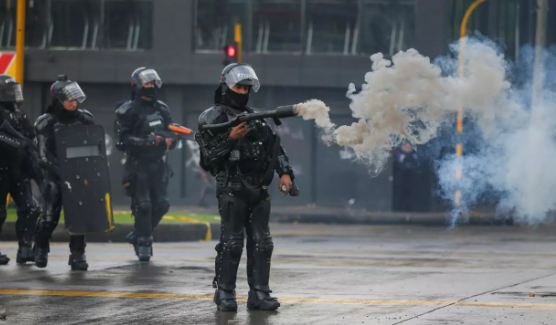
The BBC has reported: “[On September 22], in an unprecedented ruling, the Supreme Court of Justice ordered the national government to take administrative measures that guarantee peaceful protest, because the control forces are making a ‘systematic, violent and arbitrary intervention’ in against protesters.”

“The ruling also orders the Minister of Defense, Carlos Holmes Trujillo, to apologize for all the excesses of the State forces and to prohibit the use of 12-gauge shotguns by the Mobile Police Anti-Riot Squads (ESMAD), among other measures.”

In Colombia, the National Police are part of the Defence Ministry.

The Committee in Solidarity with Political Prisoners (CSPP), which is accompanied by the Peace Brigades International-Colombia Project, tweeted: “This [historic ruling] is thanks to the efforts of the victims of police violence, human rights organizations, professors and students from the Universidad de los Andes and Rosario.”

The Nation then reported: “President Duque’s government is appealing the decision.”

But on October 7, CSPP president Franklin Castañeda tweeted: “Minister @CarlosHolmesTru thought that he would deceive Justice, but the Superior Court of Bogotá has just let him know that his request for excuses did not comply with the order issued by the @CorteSupremaJ and therefore orders him to comply with the court order within one day.”

And Colombia Reports updates us: “Colombia’s defense minister on Wednesday [October 7] apologized for the violent crackdown of peaceful protests in November last year after a Bogota court gave him 24 hours to comply with a Supreme Court order.”

This is also happening in the context of the death of Javier Ordóñez on September 9. He had been stopped by the police, pinned down on the street, repeatedly shocked with a Taser, and then beaten at a police station before he died in police custody.

The Washington Post notes: “Thousands of protesters took to the streets of Bogotá in the aftermath of Ordóñez’s death last month, leading to clashes with security forces that left 13 people dead and more than 400 injured.”

“But instead of fizzling out, as protests here have tended to do, the incident has fueled a continuing string of demonstrations and social media agitation. Union members, student groups and human rights activists are now putting police brutality at the top of their list of grievances ahead of a national strike called for Oct. 21.”

That Washington Post article also quotes Castañeda of the CSPP who said: “We have noticed there is more citizen participation and more people becoming fed up over what they’re seeing in respect to the police.”

Temblores has reported almost 40,000 cases of police violence from 2017 to 2019, including 289 homicides. Last year, it reported that the ESMAD had killed 34 people since its inception in 1999. Most of those killed were activists within Indigenous, student, or peasant movements and none have resulted in a conviction.

A Peace Brigades International webinar on October 30 will be discussing the issue of police violence in Colombia, Kenya, Nicaragua, Guatemala and Canada. For more information on that and the details on how to register, please click here.

Canada Pension Plan should divest from BAE Systems and warplanes

Canada Pension Plan should divest from BAE Systems and warplanes

The Canada Pension Plan Investment Board (CPP Investments) increased its holdings in the United Kingdom-based BAE Systems from $9 million in 2015 to $33 million in 2017/18.

BAE Systems is the manufacturer of the Eurofighter Typhoon fighter jet.

The company delivered 72 of these warplanes to Saudi Arabia between 2009 and 2017.

Plans were also announced earlier this year for BAE Systems to manufacture another 48 of these warplanes for Saudi Arabia.

Since 2015, Saudi air strikes against Yemen have killed thousands of civilians and bombed over 100 medical facilities.

A former Royal Saudi Air Force officer has said that these air strikes would not be able to continue without the Typhoon fighter jet.

Please send this email to Chrystia Freeland, the Minister of Finance (the minister responsible for the Canada Pension Plan), and the Canada Pension Plan asking them to divest from BAE Systems.

[emailpetition id=”7″]

How $4 a month helps to defend the defenders…

A monthly online donation of just $4 a month to Peace Brigades International-Canada would help to continue our work in 8 crucial ways:

1- It would help us to continue to produce a weekly e-newsletter (sent to 3,600 people each week) and social media posts (that reach thousands more) to visibilize the struggles PBI accompanies.

2- It would help us to continue to outreach and find volunteers for our field projects, as we recently did at the request of our projects in Indonesia and Colombia.

3- It would help us to continue to organize informative webinars like the ‘police violence has no borders’ webinar scheduled for October 30.

4- It would help us to continue to visibilizes and contextualize in a global human rights framework Indigenous land defence struggles in this country, as we have been doing for Mi’kmaq land defenders and water protectors

5- It will help us continue to generate hundreds of emails of concern to the Prime Minister, like our recent Urgent Action calling on him to support the Escazu Agreement, a legally binding treaty that would help protect environmental defenders in Latin America.

6- It will help us continue to participate in the Canadian peace movement as we recently did with a massive ‘Defund Warplanes’ banner on Parliament Hill.

7- It will help us to continue to arrange meetings between defenders and Canadian officials as we did recently for Colombian human rights defenders who voiced concerns about the criminalization of local activists criminalized for speaking against a Toronto-based oil company causing social and environmental harms in a Colombian community.

8- It will help us continue to raise questions about Canadian arms exports and violations of human rights, as we recently did about whether riot control equipment manufactured in Canada has been used against Black Lives Matter protests in the US.

To Donate Monthly to PBI-Canada, please click here.

“PBI is an amplifier of the dedication and passion of human rights defenders”: Brandon McNally on his time with PBI in Kenya

As Peace Brigades International approaches its 40th anniversary in 2021, we are sharing the reflections of past volunteers from Canada who accompanied at-risk defenders in various PBI project countries over the years.

Brandon McNally, who is originally from Lethbridge, Alberta, accompanied defenders with the Peace Brigades International-Kenya Project in 2016-17.

Brandon tells us:

“Peace Brigades International is an amplifier of the dedication and passion of human rights defenders, standing in solidarity with the courageous individuals working to make our world a more just and peaceful place.”

A Rotary Club profile of Brandon highlights:

“Following his undergraduate [degree in political science at the University of Lethbridge], Brandon worked for Peace Brigades International in Kenya as a field officer. Brandon assisted in providing security assessments, accompaniments, advocacy, as well as recommending and fulfilling non-violent protection measures. During his master’s [degree studies in international relations at Leiden University in The Netherlands] Brandon was appointed to the organization’s Board of Directors.”

Please consider making an online donation to PBI-Canada to help us continue to support the work of human rights defenders. Accompaniment continues to be critically needed in helping to make space for peace.

“PBI taught me the value of solidarity”: field volunteer Scott Pearce reflects on his time with PBI in Colombia

As Peace Brigades International approaches its 40th anniversary in 2021, we are sharing the reflections of past volunteers from Canada who accompanied at-risk defenders in various PBI project countries over the years.

Scott Pearce, who now lives in Toronto, accompanied defenders through the Peace Brigades International-Colombia Project in 2000.

Scott tells us: “PBI taught me the value of solidarity. When political violence targets human rights defenders and anyone brave enough to speak out, building a strong network of solidarity–at the local level and the international level–is the most effective response. And on a personal level, this network of solidarity allows one to persevere against what seem like insurmountable odds.”

And in this older interview (likely from 2001) with PBI, Scott says: “I began being politically aware in high school, worked to save old growth forests in BC. I read some Chomsky, Turning the Tide, and started to think about and study the history of Latin America. I heard about [PBI] by word of mouth and it was the perfect fit for me.”

Soldiers capture two youth

In that PBI interview, Pearce recounts this story:

“We were walking up from the town center of San Jose up towards the outlying hamlet of La Union, which is also part of the peace community, and one of the local farmers came running towards us and told us that further up the trail there was a group of soldiers that had captured two youths and were questioning them, and he was worried that they might be disappeared.

We continued up the trail, and we came across the soldiers, we didn’t see the youths.

My PBI colleague was Eva Scarfe, one of the longest serving PBI members, she was in Guatemala for years, remarkable woman, she said in the middle of chatting that ‘We heard there was trouble in the area, a couple of youths, what can you tell us about this?’

The soldiers looked a little stunned and went to talk to their commander and came back, and we kept talking with them, but we weren’t going to leave until we found out how those youths were. Five minutes later, they just released these two boys, and we hadn’t made any demands at all.

We found out later that they’d had one of them tied to a tree blindfolded and were waving a machete in front of his face, threatening him. People said, if you hadn’t been there, something bad could have happened.”

Photo: Eva Scarfe remains an active member of PBI, currently supporting the work of PBI-Honduras and PBI-Nicaragua. 

Paramilitary raid on Peace Community

In the photo at the top of this article, Scott is standing beside Gildardo, a member of the Peace Community of San Jose de Apartado.

Scott shares: “The picture was taken the morning after paramilitary forces attacked San Jose de Apartado and set fire to many buildings. You can actually see the burn marks on the wall behind us and part of the burned roof top is lying on top of the pool table.”

Providing further context to this experience, Eva Scarfe says:

“I remember a time when Scott and a Swiss volunteer called Hans were in San José when the paramilitaries raided the town. On all previous raids, they had killed people, but this time no-one got killed. I attribute this to the excellent work of the two volunteers.

I was in the PBI house in Turbo when this happened. Scott’s role was to hide among the sacks of coffee and cocoa beans in the cooperative store, with PBI’s secret emergency telephone, and relay the information minute by minute to us in Turbo (a dangerous role, because if the paras had searched the store and found him, they would have been very angry).

I remember we were asking anxiously ‘can you hear shots being fired?’ because that would have meant people were being killed. And Scott was answering ‘I’m hearing a lot of noise, sounds like explosions, but I can’t be sure about shots.’

While we kept one line open for Scott, with the other we were calling our local emergency support network, and relaying the information to the office in Bogotá, from where it went out to the world. The result of the raid was that nearly half the houses in San José were burnt down, but no-one died.“

PBI-Colombia’s 25th anniversary in Toronto

On November 2, 2019, Scott joined a reflection/celebration in Toronto of the 25th anniversary of PBI-Colombia.

This was during a PBI-Canada organized advocacy tour with Ivan Madero from the Regional Corporation for the Defence of Human Rights (CREDHOS) and Julia Figueroa and Andrea Nocove from the Luis Carlos Perez Lawyers’ Collective (CCALCP). They were accompanied on that advocacy tour by Javier Garate from PBI-Colombia (now a member of the PBI-Canada Board of Directors).

The gathering was at the home of Luis van Isschot, another long time member of PBI. (A profile of his PBI experience can be read here).

Please consider making an online donation to PBI-Canada to help us with our continuing outreach efforts to find volunteers to accompany defenders. Accompaniment continues to be critically needed in helping to make space for peace.

PBI interview with Scott (likely from around 2001).

Faith Kasina to speak on Peace Brigades International webinar about police violence, October 30

Faith Kasina is the co-convener of the Social Justice Centres Working Group (Uhai Wetu), the co-founder and coordinator of the Kayole Community Justice Centre in Nairobi, Kenya, and is a field assistant with the Peace Brigades International-Kenya Project.

She will be speaking on the Peace Brigades International-organized webinar: Police violence has no borders: Human rights, land defence and police impunity on Friday October 30 at 10 am EDT (Ottawa), 5 pm EAT (Nairobi).

Earlier this month, The New Humanitarian reported: “Faith Kasina, 25, from Kayole, a rough neighbourhood plagued by gangs and drugs, was sexually assaulted by a policeman at last year’s Saba Saba demonstrations.”

Faith says: “[The police] came out to beat us and then I was like, ‘You can’t. You can’t touch me’. That’s when he touched my breast and told me, ‘You know what? We can do to you anything we want; we can do anything we want.’ And then he started abusing me, calling me names, and then now they took me in.”

The Saba Saba (7-7) protests are held annually on July 7 to commemorate Kenya’s pro-democracy movement that emerged in the 1990s.

Faith recently tweeted: “The Kenya police service is the most bribery prone institution. 75% of Kenyans believe that most police officers are corrupt and one in two who have interacted with the police report bribing them.”

She adds: “The police force engages in corruption but are rarely prosecuted.”

The New Humanitarian article notes: “Violence is emblematic of Kenyan policing. There has been a steady rise in killings and disappearances linked to the police over the past decade, with 2019 the most deadly year so far, with 144 alleged cases, according to Missing Voices, a nonprofit group of civil society organisations tracking police violence.”

And it highlights: “Excessive force and extrajudicial killings are routinely used to maintain law and order, especially in the poorest neighbourhoods, human rights groups told The New Humanitarian. At least eight people were killed over just two months at the beginning of the year in Kenya’s informal settlements.”

The Peace Brigades International-Kenya Project was established in December 2012. PBI-Kenya works with the Social Justice Centres Working Group. It is also part of the Missing Voices network and the Police Reforms Working Group network.

To register for the PBI webinar – that will also feature defenders from Guatemala, Nicaragua, Colombia and Canada sharing their experiences and analysis and shaping a global context to the problem of police violence – please click here.