Home Blog Page 379

Fracking contracts could be awarded to Canadian companies in Colombia in November

Photo: A protest against fracking in San Martin, Cesar, Colombia in April 2016 where Calgary-based Canacol Energy Ltd. could be awarded a contract this November-December to begin fracking in the first semester of 2021.

A new study by Harvard University published in the journal Nature Communications has found that fracking may result in an increase in the radioactivity of airborne particles and cause adverse health outcomes in nearby communities.

On October 13, the Guardian reported: “The radioactivity rose by 40% compared with the background level in the most affected sites. The increase will be higher for people living closer than 20 kilometres to the fracking sites, which was the closest distance that could be assessed with the available data.”

That article adds: “The Harvard scientists said this could damage the health of people living in nearby communities and that further research was needed to understand how to stop the release of the radioactive elements from under the ground.”

There have also been previously expressed concerns that fracking requires a large amount of water, that it puts groundwater at risk of being contaminated, and that the wastewater produced from fracking contains contaminants that are radioactive.

On October 6, RCN reported the Colombian Minister of Mines and Energy stating that six oil companies have expressed interest in the pilot projects, that the contracts for those pilot projects could be awarded between November and December, and that the pilot projects could start in the first semester of 2021.

Three Canadian companies are believed to seeking those contracts:

1- Toronto-based Sintana Energy and its subsidiary Patriot Energy Oil & Gas Inc. with Irving, Texas-based ExxonMobil in the VMM-37 bock near Puerto Wilches, Santander.

2- Calgary-based Canacol Energy Ltd. and its subsidiary CNE Oil and Gas in a consortium with Houston, Texas-based ConocoPhillips in the VMM-2 and VMM-3 blocks near Puerto Patiño and San Martin, Cesar.

3- Calgary-based Parex Resources in an unspecified location.

In November 2019, Peace Brigades International facilitated a cross-country advocacy tour in Canada with defenders from CCALCP and CREDHOS who raised concerns with Members of Parliament, government officials, the public and allies about the environmental risks and human rights implications of fracking in Colombia.

PBI-Honduras report for the UN’s review of human rights in Honduras, November 5

“We never wanted to go to the police, because it was the police who were chasing us.”

On October 14, the Peace Brigades International-Honduras Project posted this quote and further explained: “The National Network of Women Human Rights Defenders in Honduras explains that in Honduras 70% of the attacks against women defenders the aggressors are state security forces, especially police or the military.”

The “Third Cycle” of the United Nations Human Rights Council Universal Periodic Review (UPR) of Honduras is now scheduled for November 5. The UPR is a process that involves a review of the human rights records of all United Nations member states.

To read the PBI-Honduras report (that was published this past February) related to this UPR process, please see: Defending the Land Has a Woman’s Name.

It notes: “Through this report, PBI aims to bring increased visibility to the specific violence and risks that women defenders of land, territory and the environment face, in order to demonstrate the importance of a differentiated response on the part of the Honduran State.”

In the section “Towards a public security that complies with international standards: Militarization and excessive use of force”, PBI-Honduras highlights: “In the last 6 years there has been a 112% increase in the state budget for security and defence.”

“The PMOP [the Military Police for Public Order], created as a temporary measure, has become a normalized practice and the number of officers continues to increase. Civil society reports that this increase is accompanied by a rise in human rights violations, and more specifically an increase in sexual abuse.”

And it recommends: “In compliance with international human rights standards, abstain from using the Armed Forces for citizen security activities and commit to the definition of a clear timeline to eliminate the PMOP as police force responsible for public security.”

To read the Human Rights Council ‘Summary of Stakeholders’ submissions on Honduras’, which makes note of the recommendations by PBI, please click here.

The PBI-Honduras Project was established in 2013.

PBI-Canada calls on Deputy Prime Minister Freeland to support journalists at-risk in Mexico

Photo: Mexican journalist María Elena Ferral Hernández was shot to death on March 30, 2020. 133 journalists have been murdered in Mexico over the past 20 years.

Last year, in a major speech she gave in the United Kingdom, Deputy Prime Minister Chrystia Freeland stated: “The troubling reality is that journalists and other members of the media are increasingly the target of abuse and attack. This must stop. Journalists must be able to do their work safely and without fear of reprisal.”

In that speech, Freeland announced the launch of “a Media Freedom Coalition that will connect governments with civil society organizations and members of the press to save journalists and media workers at risk.”

The previous year, Prime Minister Justin Trudeau also highlighted that an international effort was needed to protect journalists.

Canada then signed the Global Pledge on Media Freedom that commits it to “harnessing the power of our diplomatic networks” to support “mechanisms to raise and respond to individual cases of violations and abuse.”

The situation for journalists in Mexico is perilous.

As of this past June, 19 journalists have been killed in Mexico since President Andrés Manuel López Obrador took office in December 2018.

And globally last year, Mexico was the country with the second highest number of journalists killed just behind war-torn Syria.

This past week, the Associated Press reported that the Chamber of Deputies, the 500-seat lower house of Mexico’s congress, had voted to eliminate 109 government trust funds, including the one that finances protection for threatened journalists.

This matter is now expected to go before the Senate, the 128-seat upper house, this coming Wednesday October 14.

The Centre for Research and Analysis (Fundar) has sounded the alarm on this and says: “There is no clarity in the process of eliminating [the trusts] – nor in where the money from their liquidation will be sent.”

The Mexican Federation of Public Human Rights Organizations (FMOPDH), the National Commission for Human Rights (CNDH) and the Office in Mexico of the UN High Commissioner for Human Rights (UN -DH) have also issued a statement calling for careful review of this decision along with a process of public participation and input.

And letters expressing concern and calling for a reconsideration of this decision have also been sent Mexican officials by Heike Hänsel (a member of the Bundestag in Germany) and ten members of the European Parliament.

PBI-Canada asks the Deputy Prime Minister to call on President López Obrador to take steps to strengthen Mexico’s protection mechanism for journalists, to adopt measures to address the violence against journalists, and to reconsider his government’s move to eliminate the trust fund that finances the protection of threatened journalists.

PBI-Mexico accompanied ProDESC files civil suit against transnational building wind farm without Indigenous consent

Photo: On February 26, 2020, PBI-Mexico accompanied ProDESC at a media conference relating to the Gunaa Sicarú wind farm megaproject.

On October 13, a media release from the European Center for Constitutional and Human Rights (ECCHR) highlights that ProDESC, Unión Hidalgo and the ECCHR have filed a civil suit in Paris urging the energy giant Electricité de France (EDF) to suspend the Gunaa Sicarú wind park megaproject until it complies with France’s duty of vigilance law.

ProDESC is a member of the Focal Group of Civil Society on Business and Human Rights (Focal Group) that PBI-Mexico has accompanied since 2015.

The media release further explains that EDF plans to build a wind farm on the land of the Indigenous community Unión Hidalgo which has not been appropriately consulted about the use of their land – a clear violation of their rights.

The megaproject would install 96 wind turbines over 4,400 hectares of the Isthmus of Tehuantepec region in the state of Oaxaca in southern Mexico.

ProDESC lawyer Guillermo Torres says: “It is important that the company stops negotiating land leasing contracts and requesting relevant licenses and permissions for its project without the community’s prior and informed consent.”

He adds: “By influencing the consultation and offering incentives to individual supporters of the project, EDF and its Mexican subsidiary caused violence to escalate in Unión Hidalgo. Consequently, threats against and attacks on human rights and land rights defenders are increasing. We urge EDF to take measures to prevent further attacks on Unión Hidalgo human rights defenders.”

The French corporate duty of vigilance law establishes a legally binding obligation for parent companies to identify and prevent adverse human rights and environmental impacts resulting from their own activities.

The Guardian has previously reported: “The situation for defenders [in Mexico has been] exacerbated by energy reforms in 2013, since when scores of renewable energy mega-projects have been imposed on rural and indigenous communities without adequate consultation or compensation. …The violence has been particularly marked in the biodiverse isthmus of Tehuantepec – a narrow land mass between the Gulf of Mexico and the Pacific Ocean where 28 mega wind farms now generate electricity.”

And the PBI-Mexico briefing paper Wind Farms and Concerns about Human Rights Violations in Oaxaca has highlighted that: “Throughout 2013, Peace Brigades International observed with concern an increase in the level of violence in the context of wind farms, particularly against [human rights defenders] and community leaders whose work involves the defence of those affected by these developments.”

The full ECCHR media release can be read here.

PBI-accompanied defenders in Guatemala and Mexico denounce neo-colonialism and the trampling of Indigenous rights

Photo: Assembly of a Mayan Q’eqchi’ community, affected by different megaprojects in the Alta Verapaz region of Guatemala.

On October 12, the Peace Brigades International-Guatemala Project posted this article from the Spanish daily newspaper Público on how neo-colonialism criminalizes human rights defenders and deprives Indigenous peoples of their rights and territories.

The article by Javier Sulé and Mara Saiz begins: “528 years after the arrival of Columbus, the new colonizers are big businessmen, they wear suits and ties and enter the indigenous territories with backhoes. As happened before, in the name of development, they continue to trample on the rights of indigenous peoples, this time with the complicity of supposedly democratic governments and states.”

The article quotes several defenders: María Josefina Caal Xol and Isabel Matzir of the Peaceful Resistance of Cahabón, Lesbia Artola of the Campesino Committee of the Highlands (CCDA), and Chaim and Telma Pérez of the TZK’AT Network of Ancestral Healers in Guatemala; as well as Neftalí Reyes of EDUCA Oaxaca and Yásnaya Elena Aguilar from the Ayutla women’s collective in Mexico.

All are accompanied (directly and indirectly) by Peace Brigades International. They assert Indigenous rights and oppose megaprojects.

For example, Maria Josefina is opposed to hydroelectric dams on the Cahabón River and Neftali draws attention to the exploitation of territory by mining projects, including Vancouver-based Fortuna Silver Mines.

Maria Josefina says of Florentino Pérez (one of the financiers of a dam on the Cahabón): “He is a river murderer who has violated the rights of indigenous peoples and imprisoned an innocent man [Bernardo Caal Xol]. What he has done to the original peoples is unforgivable.”

Isabel adds: “What for him are billions of euros, for indigenous peoples represent rivers, hills, life. I would tell Florentino Pérez to try to be human and consider himself as part of nature, not the owner of it.”

Lesbia says: “We fight for our historical rights, because without land there is no life and without water either. If we let them destroy the rivers and natural wealth, this is going to be a worldwide collapse. For us the land is sacred, the rivers they are sacred: they feel, they dry up and the great businessman does not understand that.”

Neftali says: “Along with a whole 500-year colonization process, then the mining, electric power, wind projects…, they are being driven with the logic that if we have many resources and we are impoverished, then let them come to invest and that is how development will come, which is a lie because what has happened is the opposite.”

Yásnaya says: ” “In Mexico the State has been built by the white Creole nationalist project. …More than half of the defenders of land and territory killed in Mexico are indigenous. Therefore, it is a question of life. This is how it is on this continent.”

Chaim says: “When a megaproject is implanted in a territory it is like when your body is penetrated in a sexual violation. By dimensioning it, if a river in which you go to wash clothes, bathe and drink water is co-opted, they are depriving you of something that sustains your life.”

And Telma says: “There are cases of people who must leave the country, people imprisoned … In the web of life there is love, joy, a whole relationship of life with the earth, but when these megaprojects arrive, everything is destroyed. However, the communities continue with that rebellion and that resistance. Facing it is a political act of going and healing together.”

The article then closes with a quote from Julio González of Madre Selva, an allied organization that PBI-Guatemala works with.

Julio says: “If in 500 years we have not been wise enough to understand that, if we do not respect nature or everything that produces life, we are going to become extinct; at a time where, perhaps, the only ones who will be saved will be billionaires.”

To read the full article, please click on “Florentino Pérez es un monstruo”: los nuevos conquistadores de América, 528 años después del 12 de octubre.

“It taught me so much about the meaning of justice and healing”: Marianna Tzabiras on her time with PBI-Guatemala

As Peace Brigades International approaches its 40th anniversary in 2021, we are sharing the reflections of past volunteers from Canada who accompanied at-risk defenders in various PBI project countries over the years.

Marianna Tzabiras, who now lives in Toronto, accompanied defenders through the Peace Brigades International-Guatemala Project in 1997-98

Marianna tells us: “What an honour to have accompanied Guatemalans as they were beginning to come to terms with the country’s painful past. It taught me so much about the meaning of justice and healing.”

Marianna also shared the photo below of the PBI accompaniment of the Guatemalan Forensic Anthropology team at the exhumation of a mass grave in Chel, Quiche in January 1998. Marianna notes: “People hadn’t gone to the site or spoken about the killing since it had happened in 1982 so this was incredibly healing.”

And this next photo is from the release of the Catholic Church’s ‘Nunca Mas’ (Never Again) report that PBI attended at the cathedral in Guatemala City in April 1998. That report detailed the human rights violations during Guatemala’s 36-year civil war.

Marianna notes: “Sadly the celebration was marred by the killing just two days later of Bishop Juan Gerardi, who had been instrumental in the release of the report.”

Marianna remains active with PBI as a member of the Board of Directors of Peace Brigades International-Canada.

Please consider making an online donation to PBI-Canada to help us with our continuing outreach efforts to find volunteers to accompany defenders. Accompaniment continues to be critically needed in helping to make space for peace.

Concerns deepen after violence against Mi’kmaq fishers in southwestern Nova Scotia

There are deepening concerns about violence against Mi’kmaq fishers on Sipekne’katik territory in Nova Scotia on the east coast of Canada as they assert their right to fish for a moderate livelihood affirmed by the Supreme Court 21 years ago.

On the morning of October 14, Agent NDN tweeted: “So I’ve just seen some live streams on FB showing what happened tonight. Settler fishermen raided the Mi’gmaw fishing compound. They cut the power; ransacked the buildings; poured chemicals on living lobsters; lit a van on fire; stole lobster traps; threw rocks; made threats.”

Two of those publicly posted videos on Facebook can be seen here and here. A short video of the van on fire can also be seen here on Twitter.

A few hours earlier on Facebook, Dorene Bernard posted: “Prayers for our Mi’kmaq fishermen/women down in Digby. There are hundreds of commercial fishermen surrounding them, trying to start a riot, burned my cousin’s van and broke into the pound, destroying property and cops won’t do anything. Trying to break into Jason Marr’s pound now, cops can’t or won’t do anything. WTF!! No law, no justice for Mi’kmaq in Mi’kmaki.”

This incident is now also being reported by Ku’ku’kwes News at Angry mob trap Mi’kmaw fishermen at a lobster pound in southwestern Nova Scotia.

That article highlights how the RCMP (police) responded to Jason Marr and Randy Sack who were inside the building being attacked.

It notes: “According to Marr, approximately 200 non-Indigenous fishermen were outside the lobster pound. He said RCMP officers arrived approximately two hours after he called 9-1-1. Marr said the RCMP told him and Sack that the non-Indigenous fishermen would let them leave the pound if they hand over the lobster.”

Nearly a month ago, Sipekne’katik Chief Michael Sack called on authorities “to uphold the rule of law amid ongoing violence, threats, human rights discrimination” and highlighted “our fisher people are facing harassment, vehicles have been damaged, boats have been damaged. Their fishing gear has been stolen, their lines have been cut. Boats have been burned.”

On October 6, PBI-Canada expressed concern about the arson attack against Robert Syliboy’s boat the previous day at the Comeauville Wharf.

In terms of background, the Supreme Court of Canada issued its decision on the case of Donald Marshall, Jr. on September 17, 1999. It ruled that Marshall’s fishing activities fell within the Peace and Friendship Treaties of 1760–61 and affirmed his right to sell the eel he was catching in limited quantities to earn a “moderate livelihood”.

The Sipekne’katik say: “Since Marshall was decided, [the federal Fisheries Department] has done nothing to recognize the treaty right to harvest and sell for a moderate livelihood. This breach of Mi’kmaq constitutional rights and can no longer continue.”

On the anniversary of that ruling, the Sipekne’katik First Nation issued 5 licences to Mi’kmaq fishers for 250 lobster traps. It has also been reported that the total capacity of the lobster traps is between 350 and 500 traps.

In comparison, the federal Department of Fisheries and Oceans has previously issued 979 licences permitting 375 to 400 traps per licence. This has also been reported as 925 licences for 367,125 lobster traps.

The Bay of Fundy Inshore Fishermen’s Association has responded against the Mi’kmaq lobster fishing by stating: “In the absence of law and order good people can be forced to take the law into their own hands…”

PBI-Canada is deeply concerned by the violence against the Mi’kmaq last night and the ongoing context of violence identified by the Sipekne’katik nearly a month ago.

For further updates on this situation, search #ModerateLivelihood on Twitter.

1492 Land Back Lane highlights the need to address land theft instead of criminalizing and judicializing land defenders

Indigenous land defenders and allies gathered on the steps of the Supreme Court of Canada on October 9 in solidarity with 1492 Land Back Lane and other Indigenous land defence struggles for sovereignty and justice.

Six Nations land defenders began an occupation on July 19 of the construction site of a housing development near the city of Caledonia, Ontario.

On October 9, CBC reported: “An Ontario Superior Court judge has given the 1492 Land Back Lane camp until Oct. 22 to vacate land slated to become a subdivision in Caledonia, Ont., before he rules on making an injunction against their presence permanent.”

That article adds: “Justice R.J. Harper said if the camp occupiers vacated he would hear constitutional arguments presented by [Six Nations land defender] Skyler Williams… Harper said if they remain on the site, he would exclude Williams from the scheduled hearing and hear arguments only from [the parties] seeking the permanent injunction.”

Williams comments: “Ideally, courts would recognize the long history of injustices that have been committed against the Haudenosaunee, but once again we face an ultimatum that leaves us with hard choices: enter into a colonial process and watch as our lands get developed or stay on our territory and face police violence.”

Gladue Principles

Williams adds: “Our legal argument highlights one key issue of injunctions: that because injunctions result in criminal charges, Gladue Principles have to be considered when Indigenous land rights are at stake.”

Gladue refers to a Supreme Court of Canada ruling in April 1999 that acknowledges systemic racism against Indigenous people in Canada and in the justice system and refers to the special consideration that judges must give an Indigenous person when setting bail or during sentencing.

The Supreme Court reaffirmed in March 2012 the importance of Gladue and noted that courts have displayed “an inadequate understanding of the devastating intergenerational effects of the collective experiences of Aboriginal peoples.”

The trouble with court injunctions

Kate Gunn, a Vancouver-based lawyer with First Peoples Law, has also pointed out that an injunction is not a determination of which party is right, rather it seeks, in principle, to preserve the status quo until the underlying dispute is resolved.

That means, for instance, that a land developer can more easily persuade the court that the economic harm is greater to them than communities seeking to protect their culture and traditions from centuries of land dispossession.

Williams has stated: “This development must be seen as being yet another instance in an ongoing history of colonial land theft and genocide, that it is people from Six Nations who are facing the greater harm if this matter is decided against their interests.”

The right to free, prior and informed consent

The Haudenosaunee Confederacy Chiefs Council has also not granted its free, prior and informed consent (FPIC) for the development. FPIC is a key principle in the United Nations Declaration on the Rights of Indigenous Peoples, an instrument that represents, in the words of the UN, “the dynamic development of international legal norms.”

Notably, the land being occupied is part of the Haldimand Tract that was granted in 1784 to the Six Nations of the Grand River. Six Nations launched a challenge in the Ontario Superior Court of Justice in 1995 for the unlawful dispossession of this land from them, but it is not scheduled to be heard until October 2022.

Similarly, Supreme Court of Canada recognition of Tsilhqot’in title over their traditional territory in British Columbia took more than two decades to win and illustrates the barriers faced implicitly and explicitly with the doctrine of discovery.

We will be watching to see what happens in court on October 22 in relation to this current land occupation. Some of the land defenders arrested in this struggle are also scheduled to appear in court on October 20.

1492 Land Back Lane has set up this Legal Fund to assist with their legal costs. For the latest updates, see #1492LandBackLane on Twitter.

Indigenous Minga march proceeds in Colombia amid concerns about repression against it

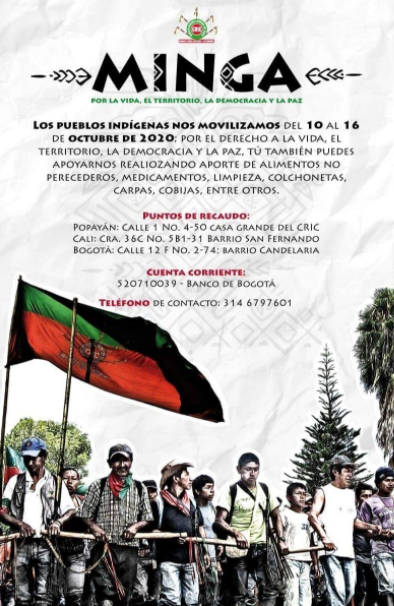
A Minga march for the protection of life, territory, democracy and peace is taking place in Colombia from October 10 to 16.

Minga is a word of Indigenous Quechua origin that refers to a collective effort for the common good and that in Colombia similarly refers to an organized protest for Indigenous rights. The first Minga mobilization was in 2004.

The Oidhaco network of 35 European and international organizations working for the defence of human rights and peace in Colombia has expressed its concern about the risk of violent repression by state security forces against this Minga.

Their statement notes: “The march is taking place after various attempts have been made to engage in dialogue with President Duque, dialogue which is urgent due to the needs of indigenous peoples and Afro-Colombian communities.”

It adds: “We would also like to recall that members of the state security forces and high-ranking Colombian government officials stigmatised the 2019 National Minga, which increased risks for the participants and, in particular, for social leaders belonging to the organisations that coordinated the protests.”

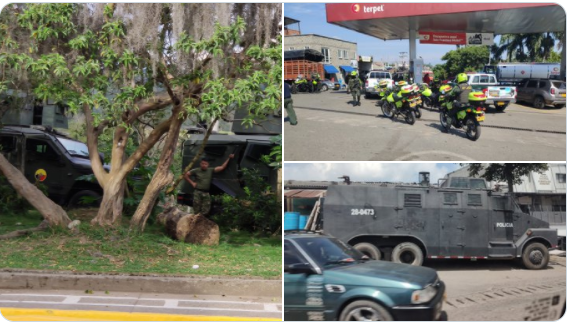
On October 10, Feliciano Valencia, a past leader of the Cauca Regional Indigenous Council (CRIC) and now a Senator, tweeted: “The President’s first response to the political debate raised by the Minga has been to militarize the roads.”

The photos Valencia posted (included above) lead us to recall that the Toronto-based firm INKAS sold 4 Huron armoured vehicles to the National Police of Colombia in 2014. They are similar in design to the one in the lower right hand corner of Valencia’s photos. In Colombia, the National Police are part of the Ministry of Defence.

In 2014, London-based General Dynamics Land Systems-Canada also delivered 24 light armoured vehicles (LAVs) to the Colombian Army.

The Canadian Commercial Corporation, a Government of Canada agency, has a Memorandum of Understanding with Colombia’s Ministry of Defence allowing Canadian suppliers to equip Colombian forces via government-to-government contracts.

We also recall that PBI-Colombia accompanies the Luis Carlos Perez Lawyers’ Collective (CCALCP) that has long sought the implementation of the historic T-880 court ruling on “the right to free prior and informed consent, and the rights related to demarcation of land, as well as exploitation of natural resources.”

PBI-Canada shares the concerns of Oidhaco and further notes the role Canadian exported military goods can play in the militarization of territory and repression against Indigenous peoples exercising their right to peaceful protest.

To read the full statement from Oidhaco, please click here.

For the latest updates on the Minga mobilization, search #Minga2020 on Twitter.

Global trade unions call for the United Nations Binding Treaty to recognize trade unionists as human rights defenders

A global trade union movement statement welcomes the second draft of the proposed United Nations Binding Treaty on transnational corporations and human rights – and recommends several needed improvements to the document.

The statement was issued by the International Trade Union Confederation (ITUC), UNI Global Union, IndustriaALL Global Union, Building and Wood Workers’ International (BWI), International Union of Food, Agricultural, Hotel, Restaurant, Catering, Tobacco and Allied Workers’ Associations (IUF), International Transport Workers’ Federation (ITF), Education International (EI) and Public Services International (PSI).

Their statement notes: “It is important that trade unionists are explicitly recognised as human rights defenders and that trade unions are acknowledged as being an integral part of human rights due diligence processes, among other things.”

It also notes: “It is our expectation that governments will make substantive contributions to the discussions during the 6th session of the OEIGWG in order to fulfil the mandate of HRC resolution 26/9 and to deliver the Legally Binding Instrument.”

And yet the Canadian government has been largely absent from the negotiating process for the Binding Treaty so far.

The next negotiating round on the Binding Treaty will take place October 26-30.

To send an email to the Prime Minister and Canada’s representatives at the United Nations calling on them to productively engage in this process and to support the Binding Treaty, please see our Urgent Action.

To read the global union statement, please click here.