Home Blog Page 345

Care of the forest has brought persecution: Lenca leader María Felícita López

“Care of the forest and opposition to extractive projects has brought persecution, criminalization, threats, militarization, poverty and forced emigration.”

Indigenous feminist leader María Felícita López is the women’s coordinator with the Lenca Indigenous Movement of La Paz, Honduras (MILPAH).

MILPAH was established in response to the irregular concessions of rivers and territories to mining companies and hydroelectric projects – and the Lenca demand for the right to free, prior and informed consent on their territories.

It is supported by the Honduran Centre for Communal Development (CEHPRODEC), which has been accompanied by PBI-Honduras since 2014.

In the department of La Paz, there are currently four hydroelectric concessions and at least 26 management plans and environmental permits for the exploitation of wood.

In these cases, López explains, the Forest Conservation Institute (ICF) grants permits without consulting communities and without finding out the environmental impact this will have on the community’s water sources.

She has commented: “You risk your life by challenging economic power here. It’s difficult, but we must do it.”

López says: “PBI helps us when there are difficulties with instances like the police or when communication no longer works. We are very grateful for this.”

#DíaInternacionalDeLosBosques #InternationalDayOfForests

“Care of the forest and opposition to extractive projects has brought persecution, criminalization, threats, militarization, poverty and forced emigration.”

PBI-Colombia accompanied CREDHOS notes community struggle against Canadian oil company on World Water Day

On March 19, CREDHOS tweeted: “For a healthy environment, CREDHOS accompanies and supports the processes in defence of water in the territory. We highlight the struggle of the Bajo Simacota community against contamination by oil spills, caused by Parex.”

Notably, Parex is a Calgary-based company.

The image above features Adolfo Salinas Coba who says: “We defend water, because water is life, and I would not exchange a glass of water for a glass of oil.”

Parex Resources Inc. operates the Aguas Blancas oil field in the municipality of Simacota, Santander in northeastern Colombia.

Numerous environmental concerns have been raised about this oil field.

Adolfo participated in a blockade of the oil field last March. By September, Parex had taken him and another social leader to court. By October, a municipal court had dismissed the company’s challenge against the social leaders.

On December 21, 2020, CREDHOS president Ivan Madero Vergel, CREDHOS lawyer Leidy Irreño, CRY-GEAM spokesperson Oscar Sampayo and environmental leader Raúl Barba. spoke about this case at this media conference.

Despite the environmental and community concerns, Export Development Canada provided financing and support to Parex including: $50-100 million (27-05-2019): $50-100 million (22-02-2019); and $25-50 million (07-05-2018).

#CredhosDefiendeElAgua

PBI-Colombia accompanies the Nydia Erika Bautista Foundation at meeting with UN Human Rights representative

On March 19, the Nydia Erika Bautista Foundation (FNEB) tweeted that it had met with Juliette de Rivero, Representative of the Office of the High Commissioner for Human Rights in Colombia, and leaders of Bolívar, Buenaventura, Madres por la Vida (Mothers for Life) and Mujer Sigue mis Pasos (Woman Follow My Steps).

The meeting was accompanied by Peace Brigades International.

PBI-Colombia has explained: “The Nydia Erika Bautista Foundation for Human Rights is an organization of relatives of the victims of forced disappearance from five regions around the country and an interdisciplinary group of lawyers, social workers and experts in social archives and communication, who accompany people who have suffered the disappearance of one or several loved ones.”

“A specific focus of the Foundation are cases of enforced disappearances of girls and women in the armed conflict and as a result of socio-political violence in the country, in which signs of gender violence have been identified.”

PBI-Colombia adds: “FNEB wants to draw attention to the differential impacts that enforced disappearances have left on the lives, bodies and rights of female victims and of the women who seek missing relatives. In its work with victims of enforced disappearance, the organization prioritizes meeting the specific needs of women.”

Yanette Bautista has been fighting against forced disappearances in Colombia since the disappearance of her 32-year-old sister Nydia Erika on August 30, 1987. Members of the Battalion of Intelligence and Counterintelligence of the Colombian National Army have been named as responsible for the disappearance of Nydia Erika.

Yanette established the Foundation in 1999 while in exile from Colombia.

With respect to the other organizations at the meeting:

Mujer Sigue mis Pasos is an “organization that aims to vindicate and defend the rights of victims of sexual violence.”

And Madres por la Vida “consists of women mothers, wives, daughters, relatives of people whose husbands, sons, relatives, have been direct victims of crimes of murder and those of humanity, enforced disappearance and displacement.”

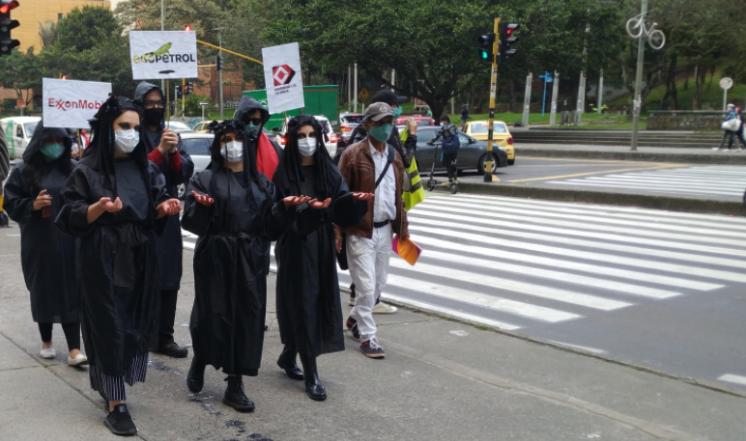
Little is known about the proposed Platero fracking pilot project in Colombia; what do we know about ExxonMobil?

A protest against fracking in Bogota on December 11, 2020.

On March 17, El Espectador reported: “The National Hydrocarbons Agency (ANH) reported that ExxonMobil submitted a proposal to carry out a research project called ‘Platero’, which would be developed in the sedimentary basin Valle Medio del Magdalena and consists of a pilot of the technique commonly known as ‘fracking’.”

Reuters adds: “ExxonMobil confirmed in an email it had submitted a proposal to the ANH, but did not elaborate.”

For now, we know little about ExxonMobil’s proposal other than the ANH has until March 29 to evaluate and qualify the proposal. The ANH has also stated that it will award a second round of contracts for fracking pilot projects on April 8.

ExxonMobil has highlighted that their “practices reflect the spirit and intent of the United Nations’ Universal Declaration of Human Rights and are guided by elements of the United Nations’ Guiding Principles on Business and Human Rights.”

But there are reasons for concern.

Five things to know about ExxonMobil

1- Last month, Oil Change International stated: “ExxonMobil is still searching for more oil and gas that can never be burned. It is still planning new extraction projects, and has no plans to decline production or develop at 1.5ºC-alignment long-term phase out plan.”

2- Last October, The Washington Post reported: “Leaked documents showed that the oil giant projected yearly direct emissions to increase by 17 percent by 2025.”

3- Reuters has reported: “Villagers sought to hold Exxon Mobil responsible for having retained soldiers from Indonesia’s military as guards for a natural gas facility in Aceh, despite knowing of past human rights abuses by Indonesia’s army and that the contract would lead to human rights violations against Aceh villagers.”

4- The Los Angeles Times has reported: “A coalition of state attorneys general and the Securities and Exchange Commission are investigating whether the company lied to the public and investors about what it knew about the dangers of climate change.”

5- Forbes has reported ExxonMobil spends about $41 million a year “to control, delay or block binding climate-motivated policy,” according to research by Influence Map.

Recently, the United Nations Special Rapporteur on human rights and the environment (David R. Boyd), the UN Special Rapporteur on toxics and human rights (Marcos A. Orellana), and the Special Rapporteur on Economic, Social, Cultural and Environmental Rights of the Inter-American Commission on Human Rights (Soledad García Muñoz) have called on the Colombian government to prohibit fracking.

Last month, an Oil Barometer poll found that 73 per cent of Colombians would not agree with fracking being carried out in their municipality and that 69 per cent of people in Puerto Wilches (in the Magdalena Medio) also disagree with fracking.

The Platero project

It is not known if the ExxonMobil ‘Platero’ project refers to the VMM-37 block it holds near Puerto Wilches, Santander. If it is, 30 per cent of that holding is held by Toronto-based Sintana Energy (and its Colombian subsidiary Patriot Energy).

We do know that Petroguia has reported: “Ecopetrol and the US company ExxonMobil signed a memorandum of understanding to work together on the development of one of the pilot fracking projects in the municipality of Puerto Wilches [that] will allow them to be ready for October 2020, the date on which the National Hydrocarbons Agency plans to open calls for pilot plans for the development of unconventional deposits.”

Peace Brigades International-Canada is following fracking in Colombia in relation to the threats being received by environmental defenders opposed to fracking (notably in the Magdalena Medio region); the impact of fracking on the human right to water; and in the broader context of climate breakdown as a violation of the right to a safe environment.

Image by Podion.

PBI-Mexico accompanied FPDTA-MPT mobilizing on World Water Day in defence of the Cuautla and Metlapanapa rivers

The Frente de Pueblos en Defensa de la Tierra y el Agua de Morelos, Puebla y Tlaxcala (Peoples’ Front in Defense of the Land and Earth of Morelos, Puebla and Tlaxcala) has posted on Facebook about protests on March 22, World Water Day.

They say: “WE CALL on everyone to demonstrate in the different ways, ways and safely on WORLD WATER DAY.”

The protests include in front of the National Water Commission (CONAGUA) in Cuernavaca, Morelos (starting at 10 am) and at the blockade by the Metlapanapa River, Santa María Zacatepec, Puebla (also at 10 am).

Latino Rebels recently reported that the newly constructed thermoelectric plant in Huexca, Morelos could soon begin operations. An aqueduct would draw 50 million litres of water a day from the Cuautla River to cool the turbines of that plant.

The Cuautla River sustains 32 ejidos (communal agricultural lands) and residents are concerned that the thermoelectric plant/aqueduct will deplete their already increasingly scarce water supplies and return to the river contaminated water.

They are also concerned that the Environmental Impact States for the thermoelectric plant did not account for the full impacts of the aqueduct on the Cuautla River or the rights of the Cuautla River Users Association.

This past November, the National Guard evicted the Apatlaco blockade in defence of the Cuautla River that had been blocking construction of the aqueduct.

The FPDTA-MPT has argued that aqueduct is illegal because the National Water Commission (CONAGUA) has not granted the necessary permits for the construction of the aqueduct and the diversion of water from the river.

Front Line Defenders has also noted that there has been an ongoing struggle in Santa María Zacatepec against the implementation of a sewage and storm drainage system that would mean the discharge of toxic waste into the Metlapanapa River.

The community of Zacatepec is part of the FPDTA-MPT.

The United Nations General Assembly adopted a resolution in 1992 that recognizes March 22 of each year as World Water Day.

PBI-Mexico has accompanied the FPDTA-MPT since 2020.

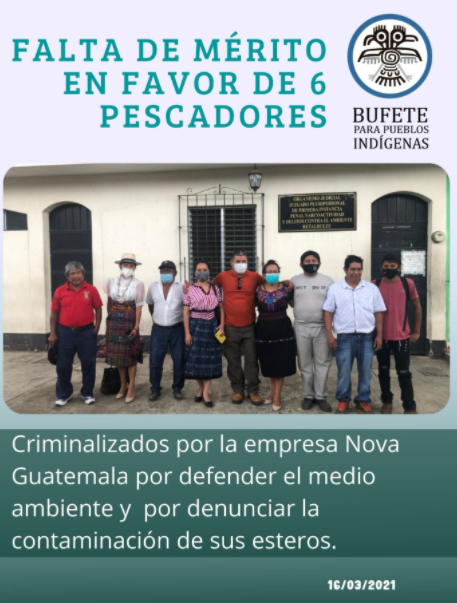
PBI-Guatemala congratulates fishers and lawyers defending the Champerico estuary from corporate shrimp farming

On March 16, the Peace Brigades International-Guatemala Project posted: “Congratulations to the fishermen and their team of lawyers and attorneys at the Law Firm for Indigenous Peoples [Bufete para Pueblos Indígenas].”

The Bufete para Pueblos Indígenas has posted on their Facebook page: “Retalhuleu criminal court judge declares lack of merit in favor of 6 fishermen who were criminalized since 2015 by the Nova Guatemala company.”

It adds: “This is due to their exercise in defence of a healthy environment and for having denounced the contamination that this shrimp company was doing in the estuaries from which the families were supplied. The judge considered that there are no presuppositions that constitute a crime.”

UDEFEGUA further explains: “We have accompanied the hearing of the first statement of 6 defenders who were denounced by the shrimp company Pesca Nova, S.A. after they demanded intervention from MAGA [the Ministry of Agriculture, Livestock and Food] and MARN [Ministry of Environment and Natural Resources] due to contamination and ecocide in the Champerico estuary by the company.”

In 2002, the World Rainforest Movement noted: “The community of Champerico –localized in Retalhuleu [on the Pacific Ocean] – has been fighting in defence of their livelihoods since 1995, when the shrimp farming firm Camarones S.A. (Camarsa) and its subsidiary Pesca S.A. built a fence to prevent public access to the wetlands.”

“Champerico is a port, being fish the main traditional diet of the local people.”

The article adds: “The fisherfolk have seen their traditional fishing grounds threatened by the intrusive moves of the company which has also polluted the estuaries, logged mangroves to build industrial shrimp ponds, provoked the death of hundreds of fish, and repressed and intimidated fisherfolk.”

In 2004, the BBC reported: “Growing consumer demand for shrimp is fuelling an environmental crisis in some of the world’s poorest nations, according to a new report. The [London-based] Environmental Justice Foundation [claims] shrimp farming is destroying wetlands, polluting the land and oceans and depleting wild fish stocks. Millions of people depend on the fish stocks for their food and livelihoods.”

While it does not appear that Canadian companies are involved in this in Guatemala, The Chronicle Herald reported in 2019: “[Saint John-based] Cooke Inc. says it has acquired Seajoy Seafood Corp., which farms shrimp in Honduras and Nicaragua.”


ExxonMobil applies for Platero fracking project in the Magdalena Medio region, few details publicly available

On March 17, El Espectador reported: “The National Hydrocarbons Agency (ANH) reported that ExxonMobil submitted a proposal to carry out a research project called ‘Platero’, which would be developed in the sedimentary basin Valle Medio del Magdalena and consists of a pilot of the technique commonly known as ‘fracking’.”

Reuters adds: “ExxonMobil confirmed in an email it had submitted a proposal to the ANH, but did not elaborate.”

As such, there is little information in the media about the proposal.

It’s not clear if ‘Platero’ refers to the VMM-37 block held by ExxonMobil near Puerto Wilches in the Magdalena Medio region. If so, 30 per cent of that holding is owned by Patriot Energy Sucursal Colombia, a subsidiary of Toronto-based Sintana Energy.

What we do know is that, according to a previously published schedule, the ANH will be awarding a second round of fracking pilot projects on Thursday April 8.

It also appears that the ExxonMobil Platero proposal is the only fracking pilot project now on the table other than the first round contract already awarded to Ecopetrol for its Kale project near Puerto Wilches. Infobae notes: “There they were also offering the multinationals Drummond, Tecpetrol and ConocoPhillips, which in the end gave up the process.”

This suggests that ExxonMobil is likely to be awarded a contract for its Platero project on April 8, but this cannot be confirmed from what is publicly available at this point.

This situation appears contrary to the principles of the Escazú Agreement which is intended to ensure greater community participation and access to information regarding projects that would have an environmental impact.

Colombia has signed the Escazú Agreement, but not ratified it.

Peace Brigades International-Canada is following fracking in Colombia in relation to the threats being received by environmental defenders opposed to fracking; the impact of fracking on the human right to water; and in the broader context of climate breakdown as a violation of the right to a safe environment.

We will be following the social media posts and commentary from social leaders in the Magdalena Medio region in response to the ExxonMobil project.

Guapinol water defender Jeremías Martinez acquitted of charges of usurpation and damages, but remains in prison

On March 17, Libertad para los defensores de Guapinol tweeted that Jeremías Martinez had been absolved of the crimes of usurpation and damages.

Following this, lawyer Edy Tabora tweeted: “Today we obtained an important achievement, an acquittal. 27 months later the judiciary agrees with us. Thanks to colleagues, nationals and foreigners who have invested thousands of hours of work in this case”

Proceso Digital reported: “The environmental defender has been deprived of his freedom since December 2018 for demonstrating and protesting against the concession of mining in the Guapinol sector by the company Inversiones Pinares.”

That article adds: “Environmental defenders argue that the mining project pollutes several rivers that originate from Carlos Escaleras Park.”

And Criterion.hn reported: “Although, Martínez was acquitted of these two offences he will not be released because he has another pending process of an indictment by the mining company Los Pinares, where he has been given pre-trial detention.”

This article also notes: “The trial was carried out with the allegations of the private indictment and not with those provided by the Public Prosecutor’s Office, which almost always makes accusations against the defenders of the territories and the environment with the private accusations and not with evidence provided by the prosecutors, recounted [Kenya Oliva, of Martinez’s lawyers].”

Libertad para los defensores de Guapinol also tweeted: “The acquittal of Jeremias Martínez of the crime of usurpation is a popular achievement that ratifies the community’s right to protest in defense of natural resources and common goods in Honduras. Camps for life and water are necessary and legitimate!”

Seven other Guapinol water defenders remain in prison along with Martinez

This despite the UN Working Group on Arbitrary Detentions earlier this month urging Honduras to “release the eight defenders immediately” and to grant them the effective right to compensation and reparation.

PBI-Honduras has been accompanying various processes in relation to the defenders of the Guapinol River for the past two years. On March 3, they observed the Guapinol Despierta media conference where the legal team and the Municipal Committee for the Defense of Common and Public Assets announced the finding by the UN Working Group.

PBI-Canada continues to follow this with great concern.

PBI-Honduras present as organizations file an appeal to the Supreme Court of Justice on the Pandora Case

On March 17, PBI-Honduras posted: “On March 11, the CNTC (the National Union of Rural Workers) and CODIMCA (the Council for the Integral Development of Peasant Women) presented an appeal for protection by the resolution of the Court of Appeals, which acquitted 22 of the 38 implicated in the Pandora Case.”

The Pandora Case involves the diversion of about CAD$14 million in public funds from the agricultural sector to the financing of political parties in Honduras.

PBI-Honduras adds: “The organizations that filed the complaint assure that they never received the resources destined to plant basic grains in the communities. They demand the revocation of the resolution [that acquitted 22 of the defendants] because the right to food and a dignified life of the peasantry was violated.”

PBI-Honduras also highlights that the CNTC and CODIMCA were accompanied by the Justice for the Peoples Law Firm (el Bufete Justicia Para Los Pueblos), the Anti-Corruption Coalition and CESPAD (the Centre for the Study of Democracy).

Criterio.hn reports: “The Pandora case involves looting more than 282 million Lempiras in the Ministry of Agriculture and Livestock (SAG) for the financing of political campaigns during the 2013 elections for the National, Liberal and Broad Front parties.”

“In August 2020, the Court of Appeals, appointed to hear the case, ruled on a final dismissal in favour of 22 defendants in the Pandora case and issued an order for formal prosecution against four of the defendants.”

That article further notes: “The court ruling demonstrated rampant impunity and threw away the investigation process and evidence presented by the defunct Anti-Corruption and Impunity Support Mission in Honduras (MACCIH) and the Special Tax Unit Against Impunity of Corruption (UFECIC).”

The appeal that was presented on March 11 is also noted in this El Pulso article.

PBI-Honduras has accompanied the CNTC since May 2018.

How to watch PBI-Guatemala Acércate videos with English subtitles in 4 easy steps

PBI-Guatemala has hosted six ACÉRCATE webinars over the last eight months with human rights defenders including Lesbia Artola (CCDA – Las Verapaces), Sandra Calel (UVOC) and Lorena Cabnal and Alex Vásquez (TZ’KAT).

Those videos are posted here.

While the videos are in Spanish, it is easy to watch them with English subtitles.

Follow these four steps:

1- Click on CC on the bottom right of your chosen video (this will activate auto-generated captions in Spanish).

2- Click on the Settings function next to the CC icon (it looks like a cog), that will bring up a menu that includes: Subtitles/CC Spanish (auto-generated).

3- Click on Subtitles/CC and scroll down in that menu to where it says Auto-translate.

4- Once you do that, you will find a list of languages that includes: English, French, German, Norwegian, and Dutch.

Acércate basically translates as come closer.

While the auto-generated translation isn’t always perfect, it will open up to you a good understanding of the issues being discussed in these conversations and allow us to “come closer” to these defenders.