Home Blog Page 318

Peace Brigades International accompanies lawyers and legal processes in Latin America

Photo: PBI-Guatemala accompanied BDH human rights lawyers at a hearing of ex-army officers accused of extrajudicial executions, June 7.

Peace Brigades International accompanies lawyers and legal processes in Colombia, Guatemala, Honduras and Mexico.

This includes the José Alvear Restrepo Lawyers’ Collective (CCAJAR) and Luis Carlos Pérez Lawyers’ Collective (CCALCP) in Colombia, the legal team at Honduran Centre for the Promotion of Community Development (CEHPRODEC), lawyer Edgar Pérez Archila and the Human Rights Law Firm (BDH) in Guatemala, and lawyers with the Paso del Norte Human Rights Centre and Juan Carlos Flores, the lawyer for the Peoples’ Front in Defence of Land and Water (fighting the PIM gas pipeline-plant-aqueduct megaproject) in Mexico.

The dangers these lawyers face are real. In Colombia alone, over 400 lawyers have been killed since 1991. Colombian lawyer Alirio Uribe of CCAJAR has stated: “The death sentences against each and every one of us have not been carried out because we are not alone, we have the accompaniment of PBI.”

This past week we amplified the concern that CCAJAR lawyer Yessika Hoyos received a death threat on her cellphone while representing the father of a university student who had been killed by the Colombian police during a Special Jurisdiction for Peace hearing.

Last week we noted PBI-Honduras accompanied the CEHPRODEC legal team at the trial of five Indigenous leaders criminalized for defending their territory.

And this month PBI-Guatemala accompanied BDH lawyers during the eight days of first statement hearings for six former military officers in which the defendants were indicted for crimes against humanity and now stand accused of murder, attempted murder, or both relating to the forced disappearance of 20 individuals from 1983 to 1985.

PBI has also been accompanying legal processes including the trial a former hydroelectric dam company executive charged in the murder of COPINH co-founder Berta Caceres in Honduras and a court hearing seeking the release from prison of Maya Q’eqchi’ land defender Bernardo Caal Xol in Guatemala.

Beyond this, PBI-Guatemala interviewed Law Firm for Indigenous Peoples director Wendy Lopez earlier this month about the criminalization of land defenders. That law firm works with 32 Indigenous communities in Guatemala.

Photo: Prior to the pandemic, PBI-Canada organized this meeting between Colombian lawyer Julia Figueroa of  the Luis Carlos Pérez Lawyers’ Collective and Kate Gunn of First Peoples Law in Vancouver, November 7, 2019.

PBI-Canada says a NATO climate security centre based in Canada will not help to build climate justice

Trudeau arriving in Brussels for the NATO summit.

On June 14, while at the North Atlantic Treaty Organization (NATO) summit in Brussels, Prime Minister Justin Trudeau confirmed “Canada’s interest in hosting a NATO Centre of Excellence (COE) on Climate and Security.”

It is not clear in what city this Centre of Excellence, defined by NATO as an “international military organization”, will be based, when it will open or how much it will cost.

“Security implications of climate change”

A statement from the Prime Minister’s Office notes: “The [Centre of Excellence] would play an important role in helping the Alliance to better understand, adapt to, and address the security implications of climate change.”

Another statement from the PMO explains: “It would provide Allies with a central location to pool their knowledge and develop effective preparedness and responses to the security impacts of climate change.”

“Threat multiplier”

The UN Under-Secretary-General for Political and Peacebuilding Affairs has commented: “Major armies and businesses have long recognized the need to prepare for climate-related risks, rightfully assessing climate change as a threat multiplier.”

There is the concern that rather than committing to address climate change, the rationale will be that climate change requires more spending on the military.

The U.S. Department of Defense, the world’s single largest consumer of oil and one of the world’s top carbon polluters, has described climate change as an “urgent and growing threat to our national security.” In 2020, the United States spent $778 billion on its military, an increase of 4.4 percent over the previous year.

That also appears to be the Canadian military’s perspective on the pandemic.

Last year, Department of National Defence deputy minister Jody Thomas stated: “In a post-COVID world, there is, I would say as the deputy minister of defence, a need for [the $553 billion ‘Strong, Secure, Engaged’ strategy paper] to in fact be done more quickly rather than slow it down or cut the budget.”

Greening the military?

There is also the concern that this “Centre of Excellence” could be spun as a commitment to somehow greening the NATO military alliance.

The Institute for Policy Studies has commented both on the immense challenges of making “the U.S. war machines more fuel efficient”, but also highlights that would “do nothing to make the U.S. military any less violent or oppressive.”

“Making peace with nature”

Those on the frontlines of the climate crisis are being killed. Four land and environmental defenders have been killed every week on average since the Paris climate agreement was reached at COP21 in Paris in December 2015.

Late last year, UN Secretary-General António Guterres stated: “Humanity is waging war on nature. …Making peace with nature is the defining task of the 21st century. It must be the top, top priority for everyone, everywhere.”

Front Line Defenders reports that 177 human rights defenders were killed in Colombia last year. Meanwhile, the NATO summit yesterday announced: “We are intensifying our interaction with Colombia, NATO’s partner in Latin America, on good governance, military training, interoperability, demining, and maritime security.”

A security strategy based on militarization can result in more human rights violations and attacks against climate defenders.

Military spending, fossil fuel subsidies

Massive amounts of money are poured annually into the drivers of climate change. G7 countries (all of which are NATO members except Japan) provide at least $87.7 billion a year in fossil fuel subsidies and spent $1.04 trillion on their militaries last year.

Until this spending is drastically reduced or eliminated, the prospects for climate justice are bleak. Thus, it is an urgent task for an intersectional movement committed to peace and climate justice (and by extension Indigenous rights and racial, economic and migrant justice) to call for the defunding of militarism and extractivism.

Murray Thomson, one of the co-founders of Peace Brigades International in 1981, called for Canada to withdraw from NATO. On March 30, 2019, he attended the ‘Say No to NATO’ demonstration in Ottawa during a blizzard. He passed away on May 2, 2019 at 96 years of age. Photo by Koozma J. Tarasoff.

PBI-Nicaragua accompanies human rights defenders living in exile in Costa Rica

Nicaraguan human rights defender Genesis.

The Peace Brigades International-Nicaragua Project accompanies Nicaraguan human rights defenders living in exile in Costa Rica.

Since the social crisis of April 2018 and the intensification of repression against Nicaraguan citizens, 108,000 people have fled the country, of which it is estimated that approximately 85,000 have sought protection in Costa Rica.

Many people who have played a key role in the defence of human rights in Nicaragua are now in Costa Rica continuing their active role in exile, making visible the continuous violations in search of guarantees for the full exercise and defence of human rights.

PBI-Nicaragua along with the Acceso Foundation have highlighted the testimonies of eight Nicaraguan human rights defenders now living in exile.

Genesis, one of these defenders, says:

“To continue defending human rights from exile is a great challenge, but for me it has meant breaking down that imaginary line that we call a border, because the defence of human rights goes beyond the place where we are, at the same time it has meant recognising me as a human being, defending my rights and my life, seeing myself from exile as a woman with rights. From this piece of land where I am, despite the kilometres, nothing stops me from continuing to work and making the Nicaraguan socio-political situation visible.”

To read all eight testimonies, please click here.

PBI accompaniment in Costa Rica

PBI launched this accompaniment project for Nicaraguans in exile in March 2020.

As noted above, this formation followed the protests against controversial changes to social security programs and police repression.

In 2019, the Inter-American Commission on Human Rights reported 20% of the Nicaraguans in exile were students who took part in protests, 23% are human rights defenders and 18% are people who helped demonstrators with food, medicine and safe houses. Others are doctors, journalists and former soldiers or police.

The Associated Press reports: “Some formerly middle-class citizens are having trouble putting food on the table and keeping a roof over their heads, while others from the working class are reduced to living in near-indigence.”

This year will be additionally challenging given the general elections to be held on November 7 to elect the President and National Assembly.

Earlier this month, four opposition candidates for President were arrested and other prominent critics, including Sandinista icon Dora María Téllez, have also been arrested.

The emigrants, now by Eduardo Galeano “Since always, butterflies and swallows and flamingos fly away from the cold, year after year, and whales swim in search of another sea and salmon and trout in search of their river. They travel thousands of leagues, on the free paths of air and water. On the other hand, the paths of human exodus are not free. In immense caravans, the fugitives from the impossible life march.”

PBI accompanies lawyers and legal processes, seeks to connect lawyers in Latin America and Canada

Photo: PBI-Guatemala accompanied BDH human rights lawyers at a hearing of ex-army officers accused of extrajudicial executions, June 7.

Peace Brigades International accompanies lawyers and legal processes in Colombia, Guatemala, Honduras and Mexico.

This includes the José Alvear Restrepo Lawyers’ Collective (CCAJAR) and Luis Carlos Pérez Lawyers’ Collective (CCALCP) in Colombia, the legal team at Honduran Centre for the Promotion of Community Development (CEHPRODEC), lawyer Edgar Pérez Archila and the Human Rights Law Firm (BDH) in Guatemala, and lawyers with the Paso del Norte Human Rights Centre and Juan Carlos Flores, the lawyer for the Peoples’ Front in Defence of Land and Water (fighting the PIM gas pipeline-plant-aqueduct megaproject) in Mexico.

The dangers these lawyers face are real. In Colombia alone, over 400 lawyers have been killed since 1991. Colombian lawyer Alirio Uribe of CCAJAR has stated: “The death sentences against each and every one of us have not been carried out because we are not alone, we have the accompaniment of PBI.”

This week we amplified the concern that CCAJAR lawyer Yessika Hoyos received a death threat on her cellphone while representing the father of a university student who had been killed by the Colombian police during a Special Jurisdiction for Peace hearing.

Last week we noted PBI-Honduras accompanied the CEHPRODEC legal team at the trial of five Indigenous leaders criminalized for defending their territory.

And this month PBI-Guatemala accompanied BDH lawyers during the eight days of first statement hearings for six former military officers in which the defendants were indicted for crimes against humanity and now stand accused of murder, attempted murder, or both relating to the forced disappearance of 20 individuals from 1983 to 1985.

PBI has also been accompanying legal processes including the trial a former hydroelectric dam company executive charged in the murder of COPINH co-founder Berta Caceres in Honduras and a court hearing seeking the release from prison of Maya Q’eqchi’ land defender Bernardo Caal Xol in Guatemala.

Beyond this, PBI-Guatemala interviewed Law Firm for Indigenous Peoples director Wendy Lopez earlier this month about the criminalization of land defenders. That law firm works with 32 Indigenous communities in Guatemala.

PBI-Canada seeks to connect lawyers across borders

Peace Brigades International in Canada is looking at ways to connect the lawyers PBI accompanies in Latin America with lawyers in this country.

We hope to do so through articles about at-risk lawyers in Canadian legal publications, webinars with lawyers (with simultaneous translation), and short interview video clips (with subtitles) with the lawyers we accompany.

The objectives of this initiative include moral support for lawyers in dangerous situations, increasing their profile to reduce the risks they face, and creating opportunities where Canadian lawyers may be able to provide strategic advice or even amicus curiae (friend of the court) statements during a court case or at a key moment in a legal process.

We hope to make these connections with specific bars within law societies, legal associations, public interest law firms, law unions and law students.

Photo: Prior to the pandemic, PBI-Canada organized this meeting between Colombian lawyer Julia Figueroa of  the Luis Carlos Pérez Lawyers’ Collective and Kate Gunn of First Peoples Law in Vancouver, November 7, 2019.

PBI-Colombia accompanied CCAJAR lawyer receives threat during hearing into police killing of university students

José Alvear Restrepo Lawyers’ Collective (CCAJAR) lawyer Yessika Hoyos and her client Alfonso Mora León have received threats.

Infobae reports that Alfonso Mora León is the father of Jenner Alfonso Mora Moncaleano, a university student who was killed in the Mondoñedo massacre committed by the Colombian police between September 6-7, 1996.

The threats were received via text messages on their cellphones during Special Jurisdiction for Peace (JEP) hearings on the massacre.

Infobae reports: “Jenner, along with Vladimir Zambrano, Archimedes Moreno, and Juan Carlos Palacio Gomez, were kidnapped, tortured, murdered, and cremated by members of the [police intelligence directorate] DIJIN between September 6 and 7, 1996.”

That article adds: “On that last date, the bodies of the young university students were found in a garbage dump at the ‘Fute’ Hacienda in the Mondoñedo sector, on the road that leads from Bogota to Mosquera.”

CCAJAR says: “Before the crime, a group of DIJIN men had identified, with the help of alleged witnesses, these six young men as members of the Antonio Nariño urban network of the FARC guerrillas, who in 1995 activated an explosive device at the police headquarters in the town of Kennedy in Bogota, which claimed the lives of three uniformed men.”

The lawyers’ collective adds: “The policemen acted by their own hand and executed the youths and cremated their bodies to avoid recognition.”

CCAJAR says this is a new episode of harassment and intimidation to which Alfonso Mora León has been subjected along the way in his search for truth about the crime committed against his son Jenner.

It further notes: “This type of attack is part of a systematic practice against members of the CCAJAR who have represented victims in this and other cases, and which has been known to the authorities and now to the Inter-American Court of Human Rights, where it is pursuing a case of persecution against this human rights organization.”

And it highlights: “This new episode of attacks against the victims and against the CCAJAR will be brought to the attention of the Inter-American Court of Human Rights in the framework of the case against the Colombian State for persecution of the José Alvear Restrepo Lawyers’ Collective.”

PBI-Colombia has accompanied CCAJAR since 1995.

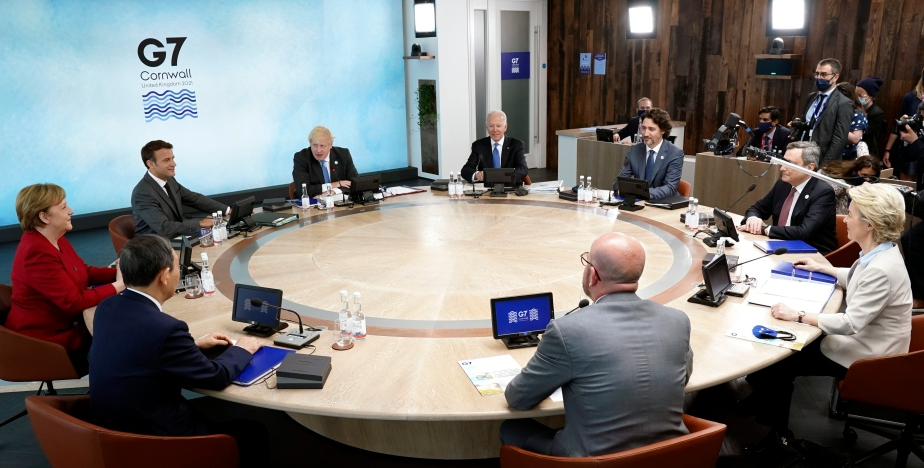
PBI-Canada asks: “How is the G7 summit responding to the threat of climate change to human rights?”

Photo by Kevin Lamarque/Pool via AP.

Speaking to the United Nations Human Rights Council about the impacts of climate change, High Commissioner for Human Rights Michelle Bachelet warned: “The world has never seen a threat to human rights of this scope.”

How has the G7 responded to this warning?

Promises made at the G7 summit in Cornwall, England included committing to halving their carbon emissions by 2030 relative to 2010, achieving net-zero carbon emissions by 2050, and increasing climate finance contributions to cut carbon emissions and cope with the existing impacts (extreme weather, rising sea levels) of climate change.

Let’s look more closely at each of these commitments:

1- Halving carbon emissions by 2030

G7 countries are responsible for about 25 per cent of global greenhouse gas emissions. That amounted to about 8.6 billion tonnes of CO2 in 2019. There is no clear plan yet from the G7 as to how they will reduce this by one-half.

2- Reaching net-zero emissions by 2050

The concept of “net zero” has been described by climate scientists as a dangerous trap. It does not strictly mean reducing emissions, but rather includes carbon offsets (for example, an oil company planting a forest) and employing technology that does not yet exist on a vast scale to capture carbon in the air.

3- Increasing climate financing

Current commitments from G7 countries amount to $36 billion by 2025. This despite their pledge in 2016 to provide $100 billion a year by 2020 to developing countries to help them cope with the impacts of climate change (such as rising sea levels) and to develop their economies within a net zero carbon framework.

Ending fossil fuel subsidies

G7 governments have also previously promised to phase out fossil fuel subsidies, a promise not highlighted in this G7 communique. G7 governments provide at least $87.7 billion a year in support for fossil fuels. This despite the pledge by G20 governments in 2009 and G7 governments in 2016 to eliminate “inefficient fossil fuel subsidies” by 2025.

We were also looking for bold statements on migration and military spending in the communique.

Migration

The UN says that weather emergencies have forced around 21.5 million people a year to move since 2010 and that roughly 90 per cent of refugees come from countries that are the most vulnerable and least ready to adapt to the impacts of climate change.

Military spending

In 2020, G7 countries spent $1.04 trillion on military expenditures. The US spent an estimated $778 billion, the UK $59.2 billion, Germany $52.8 billion, France $52.7 billion, Japan $49.1 billion, Italy $28.9 billion, and Canada $22.8 billion.

There are concerns that the world’s militaries, which themselves are responsible for an estimated 1.8 billion tonnes of carbon pollution each year, will be increasingly used against climate migrants at borders as they flee violence and disruption.

G7 on human rights defenders

The Open Societies Statement that accompanied the final communique from the G7 summit affirmed: “The importance of civic space and partnership with diverse, independent and pluralistic civil societies, including human rights defenders, in promoting human rights and fundamental freedoms.”

COP26 and human rights defenders

The UN COP26 climate summit is scheduled for November 1-12 in Glasgow, Scotland. Peace Brigades International continues to follow this with particular concern for the risks faced by human rights defenders challenging environmental breakdown.

Four land and environmental defenders have been killed every week on average since the Paris climate agreement was reached at COP21 in Paris in December 2015.

In the lead-up to COP26, PBI-Canada is highlighting this UN Human Rights Council resolution that affirms: “Human rights defenders, including environmental human rights defenders, must be ensured a safe and enabling environment to undertake their work free from hindrance and insecurity, in recognition of their important role in supporting States to fulfil their obligations under the Paris Agreement.”

Please follow us in the coming weeks and months for more on the relationship between climate change and human rights.

PBI-Mexico highlights Inter-American Court of Human Rights hearing for the Raramuri community in Choréachi, Chihuahua

Isela Gonzalez addresses the court.

On June 11, PBI-Mexico posted: “The public hearing has already begun before Inter-American Court of Human Rights. The Raramuri Community in Choréachi say their right to land is at risk of being violated and that they face persecution and discrimination.”

PBI-Mexico highlights: “We recognize the worthy struggle of the Sierra Tarahumara’s Indigenous communities for their ancestral territory.”

PBI-Mexico accompanies the Sierra Madre Alliance (ASMAC) that accompanies Indigenous communities such as Coloradas de la Virgen in the Sierra Tarahumara region in the northwestern state of Chihuahua. The threats against them including logging and mining concessions.

The Guardian has previously reported: “To defend the Tarahumara’s rights, [ASMAC director Isela] Gonzalez has organised protests, led occupations of government offices, filed lawsuits and compiled dossiers for the national government, the Inter-American Court for Human Rights and the United Nations.”

The Inter-American Court of Human Rights is an autonomous judicial institution based in the city of San José, Costa Rica that rules on whether a State has violated an individual’s human rights, rather than if individuals are guilty of human rights violations.

The Court has noted: “Matter of Members Choréachi Indigenous Community regarding Mexico. The public hearing will be held on June 11, 2021, starting at 8 a.m. (Costa Rican time). It will be transmitted by the Inter-American Court’s social networks.”

This relates to a request to the Court asking that it order the State of Mexico to protect the life and personal integrity of the members of the Choréachi community.

ASMAC has tweeted: “For more than 50 years, the Raramuri community of Choréachi has defended its territory, facing great risks. We demand safety conditions for those who defend the environment!”

And the Centre for Women’s Human Rights (CEDEHM) has tweeted: “We have nothing to guarantee that we are the owners of our territory. What we want is for Choréachi to be as before, for the community to be recognized for living without violence and persecution, for our human rights as indigenous people to be respected.”

The live broadcast of the Inter-American Court hearing can be seen here.

PBI-Mexico has previously noted: “PBI has accompanied ASMAC since 2018 due to the risks they face in their legitimate and recognized work in defense of human rights.”

Peace Brigades International and Amnesty International-Canada convened a webinar on March 11 with Isela Gonzalez to speak on issues impacting Indigenous peoples in Mexico.

PBI-Mexico seeking international observers, the deadline to apply is June 21

On June 2, the Peace Brigades International-Mexico Project tweeted: “We are looking for members for our team in the field!! Next week of training in September 2021. GET INVOLVED! Send your application before June 21, 2021.”

More information about the criteria, the selection and training process, and training expenses and scholarships can be found here.

For information on the organizations currently accompanied by PBI-Mexico, click here.

PBI-Mexico notes: “All travel and living expenses are covered by the project, including a stipend of €240 per month [about $350 Canadian] for personal expenses. Furthermore, a repatriation of €45.00 per month [about $65 Canadian] worked is paid upon successful completion of the annual volunteer contract. Medical insurance during the stay in the field.”

Key dates to keep in mind: June 21 (deadline to apply), September (training meeting near Lisbon, Portugal), October and February 2022 (dates in which new team members would enter the project).

If you have any questions not answered on this webpage, you can contact the Training Committee at formacion@pbi-mexico.org.

On February 28, Lucrezia Aresi from PBI-Mexico participated in a webinar organized by PBI-USA and PBI-Canada about what it is like to volunteer with PBI.

To watch that video, click here.

The Peace Brigades International-Guatemala Project is also currently seeking field volunteers. Their application deadline is August 1. More on that here.

Help PBI-Canada continue our work with a donation!

160+ people registered for our most recent webinar featuring Colombian human rights defenders facilitated by PBI-Canada Board member Ailish Morgan-Welden.

This past year we have worked to visibilize human rights defenders who have received death threats for their social, economic and environmental justice work, to help build an understanding in this country of the context of their struggles, and to generate advocacy opportunities to address the root causes of the threats they face.

Specifically, we have:

1- organized 6 webinars featuring accompanied human rights defenders with more than 120 people registering for each of those virtual gatherings

2- produced a weekly e-newsletter with updates on PBI accompaniments (and built a readership of about 750 people per week)

3- tweeted daily updates and built our following on Twitter to more than 5,000 people generating 36,000 profile visits this month alone

4- posted daily on Facebook to our 5,000 followers

5- organized 3 virtual meetings with Global Affairs Canada to enable our accompanied organizations CREDHOS, CSPP, COSPACC, ASMAC and Educa Oaxaca to raise issues of concern with government officials

6- organized 2 meetings with a Member of Parliament for the Colombian human rights organizations COSPACC, CSPP and CREDHOS

7- generated 1,166 advocacy emails to the Prime Minister through our urgent actions

8- engaged in innovative research, including most recently studying social media videos of police violence against Colombian human rights defenders during the national strike to determine if Canadian-made armoured vehicles sold to the Colombian national police have been involved in those violations

9- sent more than $25,000 to the PBI projects in Colombia and Mexico to help fund the protective accompaniment of at-risk defenders.

We want to do so much more than this!

To support this political accompaniment, social media amplification, and advocacy work, as well as strengthen our capacity to do more, you can:

1– make an online donation here (on our website) or here (via CanadaHelps.org)

2– donate by credit card or cheque to this mailing address: Peace Brigades International-Canada, 211 Bronson Avenue, Suite 220, Ottawa, Ontario, K1R 6H5

Your donation will fund our one staff person who is doing this work, our minimal overhead costs (we closed our office in 2019 to reduce these costs even more), the costs for the Zoom webinar platform and simultaneous translation, and our communication costs (including website, email and telephone).

Thank you for your support, it does make a difference!

250 water protectors arrested in protest against Canadian-owned pipeline being built on Indigenous territories in Minnesota

Photo by Nicholas Pfosi/Reuters.

Nearly 250 people were arrested in Minnesota on Monday June 7 protesting against a Canadian-owned tar sands pipeline being built on Indigenous lands.

The Associated Press reports: “Hubbard County Sheriff Cory Aukes said 179 people were arrested and charged with gross misdemeanor trespassing. An additional 68 people were cited for public nuisance and unlawful assembly. It was the largest show of resistance since protesters set their sights on the project.”

The Park Rapids Enterprise also reported: “Over 500 Indigenous people and allies shut down an active Line 3 pump station. Protesters linked arms and created blockades of debris at the site, including parking a boat across the roadway.”

That article adds: “According to Minnesota Public Radio, at one point, a U.S. Border Patrol helicopter flew in very low to try to flush out demonstrators from the site. It hovered about 20 feet off the ground, blowing up sand and dirt aggressively. A loudspeaker broadcast warned people they would be arrested if they didn’t leave the area.”

Canadian company pays for the police

This past March, Emily Atkin reported in Heated: “Enbridge established a financial relationship with Minnesota law enforcement in May 2020, when the state Public Utilities Commission approved Line 3’s route permit. That permit required the oil giant to set up a special fund that would reimburse police responding to anything pipeline-related.”

Atkin adds: “The permit said law enforcement could get reimbursed by Enbridge for any activity related to public safety and the pipeline.”

Notably, Atkin cites an article in The Intercept that reports a Minnesota Sheriff’s Office has requested Enbridge reimburse them for nearly $72,000 worth of riot gear and more than $10,000 in other costs including tear gas, pepper spray and batons.

The Line 3 pipeline financed by Canadian banks

The Calgary-based Enbridge Inc. 760,000 barrel per day Line 3 tar sands pipeline would run from Hardisty, Alberta to Superior, Wisconsin. It would be 1,659 kilometres in length, of which about 585 kilometres would be in the United States.

Prime Minister Justin Trudeau approved the construction of the Line 3 pipeline in Canada in November 2016. Enbridge has reported that the Canadian portion of the pipeline is complete and began commercial service in December 2019.

The Rainforest Action Network (RAN) has documented that the top five financiers of Enbridge are Canadian banks: TD Bank, Bank of Montreal, Scotiabank, RBC and CIBC. Collectively they have provided billions of dollars in financing to Enbridge.

Current status of pipeline

RAN has noted: “The [542 kilometre] Minnesota stretch of the pipeline is all that remains to be built. In November 2020, the Minnesota Pollution Control Agency approved the final permits for the pipeline.”

Work on the pipeline began in Minnesota on December 1, 2020 and was expected to take 6 to 9 months to complete.

Earlier this week, Winona LaDuke of Honor the Earth stated that the pipeline is “far from done” at this point with “35 or 40 percent” completed and that Enbridge still has many rivers to cross that they can’t begin to do until July.

Reuters has also noted: “Enbridge and opponents are waiting for a ruling from the Minnesota Court of Appeals, due by June 21, on whether there is sufficient evidence of crude oil demand to justify replacing Line 3.”