Home Blog Page 301

The #LandBack struggle and the 1974 Ojibway occupation of Anicinabe Park near Kenora, Ontario

Photo from ‘1974 Anicinabe Park Occupation 40 Yr Anniversary’ Facebook page.

Robert Jago, a member of the Kwantlen First Nation and Nooksack Indian Tribe, has asserted: “The modern fight to reclaim land began with the 1974 Ojibway occupation of Anicinabe Park near Kenora, Ontario.”

On the 40th anniversary of the occupation, Lorraine Major, one of the people who occupied the park, commented: “In the [Treaty 3] area, there are not very many people who even know about the occupation. It’s not something that’s talked about. It’s not in our history. There’s very little knowledge about what happened.”

What happened that summer?

It has been noted that occupation “began in mid-July and lasted until late August.” Another article specifies that it lasted 39 days. Linda Finlayson, who visited the park during the occupation, has written: “The police in Kenora gave the Native Youth in Anicinabe Park a deadline to evacuate the park. Several youth left before this deadline. These youth went to court August 17.”

On August 19, 1974, the New York Times reported: “For a month, armed Ojibway militants have occupied a 14‐acre park in the resort town of Kenora in northwestern Ontario to call attention to long‐standing grievances against the white authorities.”

“The embattled Ojibway in Kenora Park, led by 24‐year‐old Louis Cameron, the head of the militant Ojibway Warriors Society, marked the new phase of their campaign yesterday by destroying a collection of firebombs in a clearing. They then placed eight rifles and handguns on a blanket and turned them over to Mayor James Davidson of Kenora at the barricaded entrance to the park. In return, the 80 young Indians were given a city permit to spend 10 days more in the park, which they had occupied since [July 22].”

That article adds: “The Ojibway say the park was Indian land sold illegally to the city of Kenora by the Department of Indian Affairs in 1959. The militants also demand social reforms for some 7,000 Indians, most of them impoverished, in Kenora and nearby reserves.”

Years later, Jago interviewed seven members of the Warrior Society who took part in the occupation of the park. He spoke Lorraine Major (noted above), Tommy Keesick, Harry Greene, Rosabelle Major, Richard Greene, Lynn Skeen and Nancy Morrison.

Morrison said: “I went to residential school – the horror stories everybody knows. I was 17 years old, and I went back to my reserve. And when I came back, there was absolutely nothing [because everyone had been forcibly relocated]. No tents or anything left.”

Greene stated that the revelation in 1970 that the Reed Paper had been dumping mercury in the waters near the Ojibway community of Grassy Narrows 70 kilometres north of Kenora “really inspired us … to do more serious things to make our grievances known.”

And Major has highlighted the issues that drove the occupation included: “Lack of employment, poor housing, education, the high rates of Native peoples in the jails.”

Following the end of the occupation of the park, a demonstration took place on Parliament Hill on September 30, 1974.

In an interview from late 1974, Louis Cameron (noted in the New York Times article above) commented: “I think the way we planned it while we were in Anicinabe Park was to have a demonstration on Parliament Hill to illustrate the oppression and dictatorship against native people to the rest of the world. …I think our objective was to illustrate [that Canada] commits death on the native people.”

Cameron adds: “We did get approximately 800 to 900 native people on Parliament Hill that day. As we were going up Parliament Hill, we saw trucks passing by, big army trucks loaded with soldiers.” He describes pushing through a first line of RCMP police and then advancing against a second barricade of about 250 police by the steps He then notes: “And, while we were defeating two lines of those RCMP, the national guard with their bayonets started coming forward. There was about fifty or seventy-five of them.”

Cameron further noted: “They lowered their guns with the bayonets pointing towards us and started marching towards us. That was [when] the riot police advanced from the right of the demonstration and started hitting people with the clubs and their guns. They had tear-gas guns and they were hitting the people with that.”

Forty-seven years after the occupation of Anicinabe Park and the protest on Parliament Hill, the Land Back struggle continues.

Photo from ‘1974 Anicinabe Park Occupation 40 Yr Anniversary’ Facebook page.

PBI-Guatemala expresses concern following the murder of Q’eqchi Mayan land rights defender Regilson Choc Cac

On August 7, the Peace Brigades International-Guatemala Project posted: “Last month, the community leader Regilson Choc Coc of San Juan los Tres Rios was killed, the third murder in this community, following the violent deaths of Daniel Choc in 2016 and Matthew Chamán Pau in 2018. All were members of the CCDA.”

PBI-Guatemala adds: “We express our concern about the security situation of the members of the organization.”

Their Monthly Information Package provides this context:

“The community leader Regilson Choc Cac, from San Juan Los Tres Ríos, Cobán, Alta Verapaz, was murdered on July 20, at 10:30 pm. The community lives under permanent threat due to a dispute over the land they live on and for demanding land ownership from the Guatemalan State over the last ten years.

Regilson Choc Cac was a member of the Community Council of the Highlands (CCDA) – Las Verapaces and actively participated in the defense of the territory and human rights of his community. This murder comes following the murders of Daniel Choc in 2016 and Mateo Chamán Pau in 2018, who were also community leaders from San Juan los Tres Ríos. Neither case has been resolved by the Public Prosecutor’s Office (MP).

In condemning the death of Choc Cac, the CCDA recalled that the closure of the Secretariat of Agrarian Affairs, continues to violate the land rights of the population and is causing the criminalization of campesino leaders.”

The US-based Guatemalan Human Rights Commission (GHRC) also notes:

“The CCDA Committee in San Juan Tres Ríos has petitioned the Land Fund to grant them legal ownership of land disputed with the owner of the Rancho Alegre estate.  Choc Cac, although very young, was a community leader and had participated in dialogues related to the land dispute.”

And the InterReligious Task Force (IRTF) further explains:

“For more than ten years, the CCDA Committee in San Juan Tres Ríos has petitioned the government to grant them legal ownership of land which is being disputed with the owner of the Rancho Alegre estate. Regilson Choc Cac was a community leader who had participated in dialogues related to the land dispute. CCDA members are being unjustly criminalized for usurpation of land, while murders of their own CCDA members have not been resolved.  According to the CCDA, 962 warrants for the arrests of campesino leaders have been issued, and two CCDA members (Q’eqchi Mayan campesinos Jorge Coc Coc and Marcelino Xol Cucul) have been unjustly sentenced to 35 years in prison.”

The IRTF has also called on Guatemalan authorities to:

“guarantee that all human rights defenders, in particular Indigenous and environmental rights defenders, are able to carry out their legitimate human rights activities without fear of restrictions or reprisals in Guatemala.”

The CCDA

The CCDA accompanies 150 Maya Q’eqchi’ communities who have been repressed and stripped of their land or who are immersed in conflicts regarding land tenure. PBI-Guatemala has accompanied CCDA-Verapaz since July 2018.

PBI-Guatemala accompanies the Peaceful Resistance of La Puya at a monthly mass at mine protest

On August 8, PBI-Guatemala posted: “Last Sunday PBI accompanied the Peaceful Resistance of La Puya in the celebration of the monthly mass at their sit-in.”

In March 2012 residents from San José del Golfo and San Pedro Ayampuc – an area known as La Puya, just north of Guatemala City – set up a 24-hour a day blockade at the entrance of the Vancouver-based Radius Gold Inc. El Tambor mine.

By August 2012, the Canadian company sold El Tambor to US-based Kappes, Cassiday & Associates, but retained an economic interest in the mine (including quarterly royalty payments on the gold production from the mine).

On May 23, 2014, after two years of peaceful struggle, the communities in resistance to the mine were violently evicted by the police.

By February 2016, the Peaceful Resistance of La Puya won a Guatemalan Supreme Court ruling that provisionally suspended the mining licence because there had not been prior consultation with affected communities, as is required under Guatemalan and international law, in particular the International Labour Organization’s Convention 169.

Even after their eviction in 2014 and the court ruling in 2016, members of La Puya continued a 24-hour presence in opposition to the mine.

Then in December 2018, Kappes, Cassiday & Associates filed a $300 million claim with the International Centre for Settlement of Investment Disputes (ICSID), a World Bank arbitration mechanism, claiming its investor rights under the Dominican Republic–Central America Free Trade Agreement (CAFTA-DR) had been violated.

On May 21, 2021, the court suspension on the mine imposed in 2016 was lifted, but authorization for the mine to begin operation has not been granted. The police were present at the site to enforce the court ruling, while the Resistance reaffirmed its commitment to the peaceful fight for the defence of life, natural property and territory.

On June 21, 2021, according to the World Bank ICSID website, “The Tribunal [hearing the claim] issued Procedural Order No. 7 concerning confidentiality matters.” PBI-Guatemala has previously noted: “The Peaceful Resistance is forming legal alliances and solidarity across national and international organizations and groups [to] make their voices heard in this exclusionary procedure.”

On July 16, 2021, PBI-Guatemala accompanied the Resistance at the site of the blockade/sit-in for a dialogue with state institutions in the framework of international arbitration process driven by the company Kappes, Cassiday & Associates.

We continue to follow this situation closely.

The Peace Brigades International-Guatemala Project has accompanied the Peaceful Resistance of La Puya since November 2012.

PBI-Mexico accompanies commemorative gathering for slain Chihuahua-based journalist Miroslava Breach

On August 7, PBI-Mexico posted: “Four years after her murder, today we have been accompanying the commemorative act towards Miroslava Breach.”

PBI-Mexico adds: “We remember her work as a journalist and her commitment to human rights. A plaque was placed in her memory and in memory of the +20 journalists killed in the state of Chihuahua. The truth is not silenced by killing journalists.”

Infobae reports: “Several women’s groups gathered this Saturday afternoon outside the Government Palace of Chihuahua to remember the birth of journalist Miroslava Breach, who was murdered on March 23, 2017 due to her investigations into narco-politics in the state. Around 1:30 p.m. dozens of women arrived to begin the day of tributes. The first of these was to place a commemorative plaque on the sidewalk in front of the back door of the official compound, on Libertad Street, with the aim of keeping her legacy alive.”

Aljazeera has reported: “Breach, a 54-year-old veteran crime and politics reporter, was shot eight times in the head on March 23, 2017, as she left her home to take her son to school. Breach, who covered the country’s drug war, was one of 11 journalists murdered in 2017. More than 100 have been killed since 2000, but 90 percent of the murders remain unsolved. Breach’s murder was the rare media killing in Mexico to lead to a conviction.”

Last month, La Jornada reported: “Four years after the murder of Miroslava Breach Velducea, La Jornada’s correspondent in Chihuahua, the Special Prosecutor’s Office for Crimes Committed against Freedom of Expression (Feadle) has already obtained convictions for two of those involved in the attack that deprived her of her life and there are two arrest warrants to be executed.” The man suspected of the actual shooting, Ramon Zavala, was reportedly killed by unidentified assailants.

Notably, just days ago, on August 4, The Guardian reported: “The Mexican government has launched legal action against US gunmakers in an unprecedented attempt to halt the flow of guns across the border. The lawsuit alleges that gun companies openly pandered to Mexican criminals, citing Colt’s special edition .38 pistol. One such weapon was used in the 2017 murder of the Chihuahua journalist Miroslava Breach, who investigated links between politicians and organized crime and was shot dead while taking her son to school.”

In terms of a fuller context, Mondiaal Nieuws reports: “Violence in Mexico has escalated since then-President Calderón declared war on drug cartels in 2006. He had the army take out leaders, causing the big cartels to disintegrate into smaller, often even more violent networks. They gained more and more control over local politics. They put pressure on politicians or won a seat at municipal or regional level.”

In June 2021, a federal judge in the state of Chihuahua sentenced Hugo Amed Schultz Alcaraz, the former mayor of the Chihuahua city of Chínipas, to 8 years in prison for his role in providing information about Breach to the criminal gang that allegedly planned and carried out her murder.

“Blockades are necessary to confront illegal settler colonial invasion” of pipeline workers: Secwepemc land defender Kanahus Manuel

On August 7, Secwepemc land defender Kanahus Manuel tweeted: “#blockades are necessary to confront the illegal settler colonial invasion happening right now with canadian owned tarsands pipeline and #transmountain man camp.”

Human rights norms support her assertion.

Committee on the Elimination of Racial Discrimination

First, there is the context of free, prior and informed consent.

In December 2019, the United Nations Committee on the Elimination of Racial Discrimination issued this decision that called on Canada “to immediately cease construction of the Trans Mountain Pipeline Expansion project and cancel all permits, until free, prior and informed consent is obtained from all the Secwepemc people, following the full and adequate discharge of the duty to consult.”

The Committee monitors the implementation by states of the Convention on the Elimination of All Forms of Racial Discrimination that Canada ratified in 1970.

Inter-American Commission on Human Rights (IACHR) on blockades in Colombia

In June of this year, the Inter-American Commission on Human Rights (IACHR) conducted a visit to Colombia to report on possible human rights violations in relation to the ongoing national strike. It issued this report the following month.

Their report cautions that: “The Commission considers that the absolute prohibition of any blockade … could constitute a restriction disproportionate to freedom of expression, demonstration and assembly.”

“The IACHR considers that in the current context Colombian inter-American standards on the right to protest and freedom of expression can contribute to a better understanding of the scope of these rights and its possible restrictions.”

And the report further highlighted: “In the current Colombian context, it is noted that the generic official rating of the blockages as illegal behaviors can lose sight of the specificities of each particular roadblock, as well as affecting the possibility of reaching solutions negotiated through dialogue and mediation.”

The IACHR is an autonomous organ of the Organization of American States (OAS), which Canada joined in 1990.

IACHR on violence against Indigenous women in Canada

In June 2019, the IACHR called on Canada to “protect and guarantee the human rights of Indigenous women and girls, given the findings of the final report of the National Inquiry into Missing and Murdered Indigenous Women and Girls in Canada.”

That final report concluded that “work camps, or man camps, associated with the resource extraction industry are implicated in higher rates of violence against Indigenous women at the camps and in the neighbouring communities.”

The IACHR further urged “Canada to act with due diligence in the prevention, sanction and reparation of all acts of gender-based violence against Indigenous women and girls, and to take concrete actions, with the participation of Indigenous women, to implement the recommendations issued on the matter.”

UK Supreme Court

And in June 2021, The Guardian reported: “Four demonstrators who formed a blockade outside a London arms fair have had their convictions quashed by the supreme court, in what has been hailed as an affirmation of the right to protest.”

Two members of the court stated: “There should be a certain degree of tolerance to disruption to ordinary life, including disruption of traffic, caused by the exercise of the right to freedom of expression or freedom of peaceful assembly.”

PBI-Canada continues to follow the situation on Secwepemc territories.

Canada could buy a US $158 million warplane with a $44,000 per hour 8,000-hour lifespan

Economic justice, including a living wage, is fundamental to all human rights. This principle has informed the campaigns seeking a $15 per hour minimum wage.

Earlier this year, the Center for Defense Information highlighted: “It costs approximately $44,000 per hour to fly the F-35. Extrapolated out over the expected 8,000-hour lifespan of each F-35, the [US armed] services will spend $352 million to operate a single jet.”

Their article further notes that the lifespan of an F-35 could be as low as 2,100 flight hours, dramatically increasing its cost per hour.

Significantly, Canada could sign a $19 billion contract next year to purchase 88 of these warplanes. It has been estimated that the costs to operate and sustain these aircraft could total close to another $60 billion.

Economic choices

The Center has also reported: “Sold in 2001 as a cheap multi-role fighter at a promised $38 million per plane, the troubled F-35, now at an average $158.4 million per copy, continues to dramatically underperform in crucial areas including availability and reliability, cyber-vulnerability testing, and life-expectancy testing.”

Research by the Costs of War Project based at Brown University’s Watson Institute for International and Public Affairs found that while $1 million spent on “defence” creates 6.9 direct and indirect jobs, the same amount invested in solar power creates 9.5 jobs, in health care 14.3 jobs, and in elementary and secondary education 19.2 jobs.

A quick calculation suggests that the money needed to purchase one F-35 could generate 1,090 defence sector jobs, but if spent on education would create 3,033 jobs.

Since 1997, the Government has invested CAD $770 million in the development of the F-35. It argues that Canadian companies have secured more than US $2 billion in production and maintenance contracts related to this warplane. It does not offer comparative calculations if that money were spent on peaceful production.

$347 million war on Libya

The issue of cost and flying hours have been previously raised with respect to the bombing missions conducted by Canadian CF-18 fighter jets over Libya.

The Canadian Press has reported: “In terms of a jet’s airframe life, every hour spent on combat sorties equals three of regular mission use at home. The Libya campaign had the potential to add 9,000 flying hours to jets that were already well into middle age.”

The monetary cost of Canada’s intervention in Libya, including jet fuel and the salaries of pilots and support personnel, totalled $347 million.

Ten years later, Libya has gone from having one of the highest standards of living in Africa to having more than 200,000 people who are internally displaced and 1.3 million people in need of humanitarian assistance.

By the hour

Tamara Lorincz has pointed out: “The average hourly cost to operate an F-35 is sky-high at about $40,000, which is close to the yearly salary of an essential worker such as a paramedic, nurse and long-term care worker.”

An F-35 carrying 18,500 pounds of fuel can burn all of that in under an hour at full speed. By comparison, for a worker struggling to pay for a 40 litre tank of gas for their car, an F-35 can burn more than 10,000 litres of fuel in an hour.

The Government of Canada plans to spend an estimated $76.8 billion on a fleet of fighter jets. While weapons sales are profitable for the corporations that sell them, they represent a massive diversion of public dollars from the needs of people.

PBI-Guatemala accompanies the CCR to Comunidad 20 de octubre to discuss the right to water, respect for Indigenous identity

On August 6, PBI-Guatemala posted: “PBI accompanies the Retalhuleu Community Council (CCR) on a visit to Comunidad 20 de octubre where they discuss the problem of river pollution and lack of access to electricity.”

The Retalhuleu Community Council, made up of more than eighteen communities of Mam, K’iche’ and Ixil peoples, seeks “the transformation from an agricultural model of exportation to a model of food sovereignty, which would place respect and recognition for Indigenous identity at the center.”

On the issue of access to electricity, Prensa Comunitaria has reported that several communities around Champerico “have declared themselves in resistance, due to the high energy charges that the company Energuate.”

PBI-Guatemala has also reported on: “The adverse effects caused by the expansion of monoculture sugar cultivation and the use of large-scale agrochemicals and pesticides used by sugar mills in the region. In recent years there has been drought and contamination of wells, rivers and lagoons, as well as the destruction of livelihoods, causing lack of access to water and health problems such as malnutrition and respiratory and kidney ailments.”

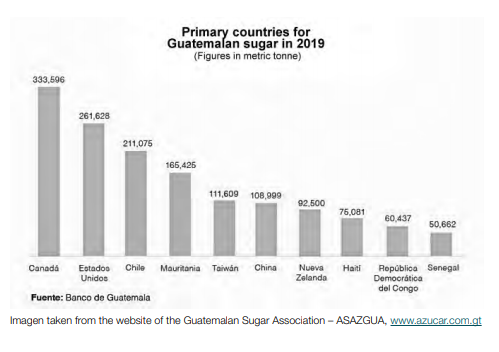
In the photo, the brigadista can be seen distributing copies of PBI-Guatemala’s Bulletin No. 44. That bulletin includes an article on pages 9-12 titled: The sugar business in Guatemala: Sweet profits for exporters, bitter impacts for communities.

Violations of the right to water

That article notes: “Sugarcane production uses large amounts of water. Studies have shown that the mills use any and every means to guarantee their water supply, including diverting rivers and drilling wells for which they have not carried out adequate environmental impact studies.”

“This intensive agriculture which, striving for maximum economic yield, makes use of polluting products (insecticides, herbicides and products that accelerate the process of sugar cane growth), often launched from small planes and which, therefore, also contaminate the population’s water reserves.”

“The scarcity of water due to the drying up of the wells forces women to travel farther (and more often) to collect water, exposing them to the risk of violence (of various types, including sexual violence), and damage to their physical health due to the weight of carrying the water. They are also more exposed to dermatological diseases caused by the toxic agro-chemicals which have polluted the water they use for laundry and daily cleaning.”

That article also highlights: “The State has allowed the appropriation of water, due to the in-existence of normative and legal frameworks (water law and/or public policies in this respect) that recognize the right to water as fundamental, and which penalize the pollution, diversion, appropriation and use of water to the detriment of human rights.”

Significantly, Canada is the largest importer of this export crop.

PBI-Guatemala has accompanied the Retalhuleu Community Council since April 2020.

PBI-Colombia welcomes two new brigadistas, seeks applications until September 12

On August 6, the Peace Brigades International-Colombia Project posted: “We welcome two new brigadistas, Mayara and Charlotte!”

In this article, they share some of their thoughts as they begin their placement with the field team in the city of Barrancabermeja.

Mayara: “I am Mayara, Brazilian. This opportunity to work with PBI seemed like what I had been looking for a long time. The principles applied in this organisation in pursuit of peace and non-violence are in line with my ethical and personal values. My expectation is that this work will be a continuous exchange of knowledge about human rights, as this organisation is multicultural with collaborators from different countries. So, I hope that during the 18 months I will be able to contribute to the project as a Latina.”

Charlotte: “I identify very much with PBI’s mandate to create spaces for peace and the protection of human rights. What convinced me to get involved with PBI Colombia is the protective role that foreigners (with non-Colombian citizenship) can play in enabling the local Colombian population to develop their own local ways of life, a role that in an ideal post-colonial world should not exist. The initial and ongoing training within the project in Colombia reassures me that I am not involved in voluntourism.”

PBI-Colombia has also just put out a call for new brigadistas.

As noted on this webpage, the deadline to apply is September 12, the training week would take place January 8-15 (to be confirmed) and new volunteers will be incorporated into the field teams at the end of February 2022 and at other dates.

All the information needed to apply can be found here.

The PBI-Colombia brigadistas that arrived in April 2021 and December 2020.

PBI-Guatemala accompanies CCR and Virginia Tech University researchers verifying water contamination

On August 6, the Peace Brigades International-Guatemala Project posted: “PBI accompanies the CCR and researchers from Virginia Tech University in the verification of water contamination in the rivers of the Champerico region.”

PBI-Guatemala explained: “The Retalhuleu Community Council (CCR) consists of more than 18 communities in the department of Retalhuleu (mainly the municipality of Champerico), belonging to the Mam, K’iche’ and Ixil peoples.”

It highlights: “The CCR began to organize in 2015 as a result of adverse effects caused by the expansion of the monoculture of sugar and the use of large-scale agrochemicals and pesticides used by the mills in the region. In recent years there has been drought and pollution of wells, rivers and lagoons, as well as the destruction of livelihoods, causing lack of access to water and health problems such as malnutrition and respiratory and renal ailments.”

Three years ago, Virginia Tech student Cristina Marcillo posted: “This July, I have been working in Guatemala conducting a drinking water monitoring study of San Rafael las Flores, home to the Escobal silver mine, and co-leading a water-monitoring workshop for citizen scientists from all over Guatemala in Chimaltenango.”

She added: “This project is funded by Virginia Tech’s Center for Peace Studies and Violence Prevention and is a collaboration between the Krometis lab group in Biological Systems Engineering (of which I am a part!) and Dr. Nicholas Copeland in Sociology, who received a Fulbright to work in Guatemala this year.”

PBI-Guatemala has accompanied the CCR since April 2020.

Canada enabled the bombing of Hiroshima and Nagasaki, we should work to end the scourge of nuclear militarism

Image by Thoughtco.

Seventy-six years ago, the United States Army Air Force dropped atomic bombs on the cities of Hiroshima (on August 6) and Nagasaki (on August 9). By the end of 1945, those bombings had killed more than 210,000 people.

Setsuko Thurlow, who survived the bombing of Hiroshima when she was 13-years-old, reminds us: “Each person had a name. Each person was loved by someone. Let us ensure that their deaths were not in vain.”

Canada’s role in the bombing of Hiroshima and Nagasaki

Matt Korda, a research associate for the Nuclear Information Project, has noted: “Canada played a critical role in the development of these horrific weapons: scientists at the Montréal Laboratory were an essential part of the Manhattan Project, and the first atomic bombs were made with uranium shipped from the Northwest Territories.”

And Gordon Edwards, who co-founded the Canadian Coalition for Nuclear Responsibility, has further explained that the uranium for the atomic bomb dropped on Hiroshima was refined in Port Hope, Ontario.

There were alternatives

Professor Benoît Pelopidas has written: “According to the US Air Force’s own review, finalized not long after the end of the war, Japan would likely have surrendered that same autumn even in the absence of atomic bombings or an invasion.”

Canada supplies uranium for nuclear weapons

Edwards has also highlighted: “For twenty years after World War II, Canada sold plutonium (from Chalk River) and uranium (from Ontario, Manitoba, Saskatchewan and the Mackenzie District) for use in the American and British nuclear weapons programs.”

Professor Jim Harding, the founder of the Regina Group for a Non-Nuclear Society, has further explained: “We now know that uranium out of Saskatchewan has been diverted through the depleted uranium (DU) system and has been fuelling the weapons stream.”

The Canadian Centre for Policy Alternatives has additionally noted: “Canada has long been the main source of uranium for the U.S. nuclear arsenal, globally the largest and deadliest at 10,000 warheads and bombs.”

A massive diversion into nuclear militarism

It has been estimated that the United States, between 1940 and 2005, spent more than $7.5 trillion on nuclear weapons.

The International Campaign Against Nuclear Weapons (ICAN) has stated: “In 2020, the report estimates that nine countries spent $72.6 billion on nuclear weapons, $27.7 billion of which went to a dozen defence contractors to build nuclear weapons.”

It further highlights: “Those contractors then spent $117 million lobbying policy makers and up to $10 million funding think tanks writing about nuclear weapons to ensure they can continue to line their pockets with nuclear weapon contracts for years to come.”

This represents a massive diversion of spending away from the public good and speaks to the need to defund nuclear war and divert that spending to alternatives.

Canada’s role today

Significantly, Canada has not signed the United Nations Treaty on the Prohibition of Nuclear Weapons, the first legally binding international agreement to comprehensively prohibit nuclear weapons with the goal of leading towards their total elimination.

In December 2019, the Canadian Press reported: “[The treaty] has no support among the countries that possess nuclear weapons — including the United States and its allies, including Canada. Canada doesn’t have nuclear weapons but its membership in NATO means it adheres to the 29-country military alliance’s nuclear-deterrent policy.”

And Korda has noted Canada “participates in NATO’s Nuclear Planning Group” and allows “American and British nuclear-capable vessels to visit our ports.”

As we commemorate the 76th anniversary of the death of more than 210,000 people in Hiroshima and Nagasaki, let us recommit ourselves to stopping this country’s role in supplying, facilitating, participating in and providing cover for nuclear militarism.