Home Blog Page 292

16 organizations sign statement on Nicaragua presented to UN Human Rights Council

On September 15, a statement supported by Peace Brigades International and 15 other organizations was presented to the UN Human Rights Council.

The statement was read by defender Amaru Ruiz of the Fundación del Río (River Foundation). Ruiz is a defender of the environment and the rights of Indigenous peoples in Nicaragua. He has lived in exile since 2018.

To watch his presentation in Spanish, click here. The video is also available with English translation at the 26 :32 mark here.

The full statement is as follows:

“On behalf of the undersigned organizations, we welcome the High Commissioner’s oral update on the situation in Nicaragua. We echo her concerns regarding the profound deterioration of the human rights situation in the country.

In recent months, we have seen arbitrary arrests, raids, criminal prosecutions, criminalization of protest, the cancellation of the legal status of 55 national and international organizations, as well as the implementation of restrictive laws undermining fundamental freedoms.

In particular, since the end of May, 37 people, including seven presidential hopefuls, opposition leaders, activists, human rights defenders, journalists, students and businessmen have been arbitrarily detained, bringing the number of political prisoners to more than 150.

We are alarmed by the State’s omission, negligence and impunity in the face of the recurrent attacks against indigenous and Afro-descendant peoples in the North Caribbean Coast Autonomous Region with the aim of widespread land-grab.

The most recent incident was a massacre of 23 August, in the Mayangna Sauni As Territory, within the core zone of the Bosawas Biosphere Reserve, in which at least nine people from the Miskitu and Mayangna indigenous peoples are known to have been killed.

Since 2015, these communities have repeatedly denounced the systematic increase in the invasion of their territories, the lack of protection of their collective rights and the environmental deterioration caused by extensive cattle ranching, logging and mining activities. Indeed, some have even had to leave their territories to safeguard their lives.

We call for the guarantee and protection of the right to life of these communities, their right to land and territory, as well as their right to defend human rights, through the restoration of indigenous and Afro-descendant territories, as well as investigation processes that allow for the clarification of the facts, identification of those responsible, access to justice and guarantees of non-repetition for the families of the victims.

Due to the continuous denunciation since 2020 by Amaru Ruíz, president of the Fundación del Río, of the situation of violation of indigenous and Afro-descendant communities, on 8 September 2021 the Nicaraguan Public Prosecutor’s Office presented the communiqué 075-2021 in which Mr. Ruíz is accused of infringing article 30 of Law 1042 or the Special Law on Cybercrime, yet another example of the persecution and criminalisation of human rights defenders in Nicaragua.”

Signatories:
1. Centre for Civil and Political Rights (CCPR)
2. Centro por la Justicia y el Derecho Internacional (CEJIL)
3. Colectivo de Derechos Humanos Nicaragua Nunca Más
4. Fundación del Río
5. Iniciativa Mesoamericana de Mujeres Defensoras de Derechos Humanos (IM-Defensoras)
6. International Fellowship of Reconciliation (IFOR)
7. International Service for Human Rights (ISHR)
8. Mesa de Articulación LGBTIQ+ en el Exilio Costa Rica (MESART)
9. Movimiento Campesino Anticanal
10. Organización Mundial Contra la Tortura (OMCT)
11. Peace Brigades International
12. Red Internacional de Derechos Humanos (RIDH)
13. Red Internacional de Derechos Humanos – Europa (RIDH-E)
14. The International Institute on Race, Equality and Human Rights
15. Unidad de Protección a Defensoras y Defensores de Derechos Humanos – Guatemala (UDEFEGUA)
16. Women’s Link Worldwide

Canada set to award contract for armed drones in 2022-23

Image from Democracy Now report.

The Canadian government will reportedly request bids this fall from two consortiums for a contract of up to $5 billion for armed drones.

The Calgary Herald reports: “The contract is expected to be awarded in 2022-23, with the first system delivery anticipated in 2024-25.”

The two bidders are expected to being General Atomics and its MQ-9B SkyGuardian drones (like the Reaper drone) and L3 Technologies and its Heron drone.

The Canadian Press adds: “The government and military say the unmanned aircraft will be used for surveillance and intelligence gathering as well as delivering pinpoint strikes from the air on enemy forces in places where the use of force has been approved.”

Vice has also noted that the Royal Canadian Air Force has developed a hypothetical mission in which a drone could scope out an insurgent base in Afghanistan and fire a Hellfire missile and two laser-guided bombs from the drone on a target.

It is in that context that we share this article from The Guardian that reports the US mistakenly killed an aid worker and nine others, including seven children, when a Reaper drone fired a Hellfire missile at his car on August 29 in Kabul, Afghanistan.

ABC News reports: “Days after the drone strike Gen. Mark Milley, the chairman of the Joint Chiefs of Staff, had labeled the strike as ‘righteous’ because it had followed protocols intended to prevent civilian casualties.”

While US military officials say their targets were plotting an attack on the Kabul airport, the New York Times reports that what was believed to be “explosives” in their car were actually water jugs the worker had taken home to his family.

The US Department of Defense is now investigating this drone strike.

Last month, World Beyond War released this fact sheet calling for a ban on armed drones.

That fact sheet notes: “Despite the U.S. government’s lack of transparency and frequent denials of civilian casualties, the Bureau of Investigative Journalism has documented an estimated 910 to 2,200 civilian deaths from U.S. drone strikes between 2010 and 2020, including attacks on entire families.”

It also highlights: “Drones violate human rights.”

With the Canadian government set to award a contract for armed drones as soon as next year, these are crucial concerns for the anti-war movement to amplify.

PBI-Colombia accompanies Justice and Peace Commission in humanitarian zones in Jiguamiandó Basin

On September 15, the Peace Brigades International-Colombia Project posted: “Today we accompany @Justiciaypazcol [Justice and Peace Commission] in pedagogical workshops on the topic of the global community agreement in the humanitarian zones of Nueva Esperanza and Pueblo Nuevo in the Jiguamiandó Basin.”

The World Council of Churches has previously explained:

“Since 1999, some of the displaced people in Curvaradó and neighbouring Jiguamiandó have tried to return to their homes with the support of non-governmental organizations, including the Inter-Church Justice and Peace Commission.

In 2001, a military and paramilitary attack caused new displacements. This exodus coincided with the introduction of African oil palm plantations on the evicted communities’ land.

In 2002 and again in 2003, the Inter-American Commission on Human Rights (IACHR) called for the right to life of the members of the Curvaradó and Jiguamiandó communities to be protected.

Starting in 2003, the humanitarian zones of Pueblo Nuevo (90 families), Nueva Esperanza (47 families) and Bella Flor (30 families) were created in Jiguamiandó.

The humanitarian zones are clearly demarcated areas inhabited by the civilian population where armed forces of any kind are not supposed to enter.

In the zones, groups of families help each other to protect themselves against militarization while at the same time defending their rights.

Since March 2005, these zones have the backing of the IACHR, which has required the Colombian government to grant them special protection.”

In September 2020, PBI-Colombia posted this article about their visit to the Nueva Esperanza Humanitarian Zone.

That article noted that in July 2020 the local indigenous government of the Uradá-Jiguamiandó Reserve decided to eradicate the coca leaf planted by people from outside their territory, people who ignored the Major Indigenous Council’s authority.

It highlighted: “In an action to heal their territory, the communities have eradicated close to 150 hectares of coca leaf, which has made things very risky for them.”

PBI-Colombia has accompanied the Justice and Peace Commission since 1994.

Also, on August 23, PBI-Colombia tweeted: “Last week we accompanied the Bajo Atrato team from @Justiciaypazcol in the indigenous communities of Jiguamiando.”

Five land defenders arrested on Secwepemc territory in opposition to Trans Mountain tar sands pipeline and man camp

On September 15, Kanahus Manuel tweeted: “#Secwepemc Land Defenders arrested at #TinyHouseWarriors where #TransMountain has been illegally clearcutting and constructing Trans Mountain Blue River industrial worker camp / Violating Secwepemc International Human Rights / Violence on frontlines by TMX workers #divestTMX.”

Kanahus also tweeted: “Mayuk Manuel @Weasel_Woman was just arrested at the Trans Mountain man camp yard under illegal construction!”

Along with Mayuk, four other land defenders have been arrested.

This took place at Blue River, which is located on unceded Secwepemc territory about 600 kilometres northwest of Vancouver.

The Tiny House Warriors are Indigenous Secwepemc land defenders protecting their unceded territory in British Columbia, Canada against the construction of the 890,000 barrel per day Trans Mountain tar sands pipeline megaproject that would cross 518 kilometres of their land without their free, prior and informed consent.

They are also challenging the construction of a man camp at this site for 500 workers who would be building this section of the pipeline.

A Secwepemc Women’s Declaration states: “Wherever man camps are set up, we face exponential increases in sexual violence.”

James Anaya, the former United Nations Special Rapporteur on the Rights of Indigenous Peoples, has noted: “Indigenous women have reported that the influx of workers into indigenous communities as a result of extractive projects also led to increased incidents of sexual harassment and violence, including rape and assault.”

In December 2019, the UN Committee on the Elimination of Racial Discrimination called on Canada “to immediately cease construction of the Trans Mountain Pipeline Expansion project and cancel all permits, until free, prior and informed consent is obtained from all the Secwepemc people, following the full and adequate discharge of the duty to consult.” That resolution can be read in full here.

The Committee raised the issue again in November 2020 and noted at that time that Canada’s periodic report on its compliance with the UN Convention on the Elimination of All Forms of Racial Discrimination is due on November 15, 2021.

For updates, you can find Kanahus Manuel on Facebook, Twitter and Instagram.

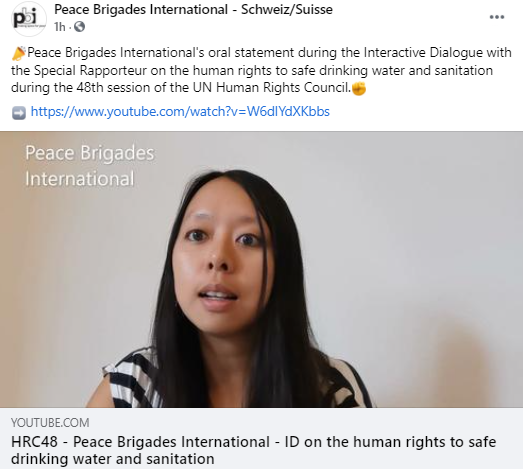
Peace Brigades International presents at the UN on the human right to water and sanitation

On September 15, Kim-Mai Vu of Peace Brigades International presented to the United Nations Human Rights Council during the Interactive Dialogue with the Special Rapporteur on the human rights to safe drinking water and sanitation.

To watch her presentation in Spanish, please click here. You can also click here and go to the 02:18:39 mark to watch with simultaneous English translation.

Her full intervention is as follows:

“We welcome the Rapporteur’s report that highlights the need to promote the effective participation of civil society in water management, particularly in communities affected by megaprojects. We are alarmed by the 227 murdered water and environmental defenders in 2020 as well as widespread impunity for their attackers.

In Mexico, the Peoples Front in Defense of Land and Water has received attacks for opposing to the PIM, a project that monopolizes large amounts of water from the Cuautla River to the detriment of farming communities. In the absence of indigenous consultation, appeals have been filed, achieving nine suspensions, still pending compliance.

In Putumayo, Magdalena Medio and Norte del Chocó, Colombia, there are threats and persecution against members of ADISPA, Justice and Peace Commission, AguaWil, FEDEPESAN and CREDHOS, who denounce corruption and pollution of rivers and swamps, opposing companies transnationals.

In Retahuleu, Guatemala, the activities of the sugar companies El Pilar, Pantaleón, Magdalena they have altered the course of the rivers. The construction of private mechanical wells causes a shortage of water sources that supply neighboring communities. The people who defend the right to water suffer multiple attacks and intimidation and are often criminalized.

It is urgent that Colombia and Guatemala ratify the Escazú Agreement to increase the guarantees of defenders of the environment.

In Honduras, the approval of two decrees aimed at prioritizing the identification of land, the design, construction and expansion of dams in areas with socio-environmental conflict, mostly indigenous territories and / or protected areas.

In Indonesia, defenders have denounced how megaprojects have reduced access to the water of rural and indigenous communities and caused further environmental degradation.

It is of the utmost importance that the international community urge States to develop policies for safeguarding water in collaboration with defenders as well as implementing policies comprehensive protection for them.”

PBI-Honduras accompanies press conference on LGTBI rights and the November 28 election

On September 14, PBI-Honduras tweeted: “More than 30 human rights organizations ask to prevent and sanction campaigns that promote hatred towards women and LGTB people. In the electoral framework, they ask the @MP_Honduras [Public Ministry] to act ex officio against any incitement to discrimination.”

The Arcoíris LGTB Association of Honduras also tweeted: “Press conference of organizations that defend human rights and public pronouncement against hate apology campaigns against LGBT + populations and women.”

The media statement issued by human rights organizations against hate can be read in Spanish here.

Paradigma reports: “Organizations that defend the rights of Lesbian, Gay, Bisexual, Transgender, Transsexual, Transvestite, Intersex (LGTBI) groups denounce hate campaign, after the presidential candidate of LIBRE Xiomara Castro spoke of equal marriage and the right to abortion in her government plan.”

Donny Reyes of the Arcoíris LGTB Association of Honduras and the Centre for Research and Promotion of Human Rights (CIPRODEH) says members of the National Party have orchestrated a campaign of rejection towards these groups, therefore, there must be protection from the National Electoral Council (CNE).

Reyes invited the CNE “to carry out the actions of appeal, because we cannot allow Fernando Anduray [a spokesman and executive secretary of the National Party’s political commission] to speak and call for rejection and discrimination.”

The article adds: “The human rights defender believes that the CNE must put into practice what the law mandates; avoid, punish and prevent any act of discrimination that threatens the criminality of these groups that have been forgotten by the government.”

The presidential candidates in the election on November 28 are Nasry Asfura (National Party), Xiomara Castro (Liberty and Refoundation/LIBRE Party), Salvador Nasralla (a coalition of parties) and Yani Rosenthal (Liberal Party). The current president Juan Orlando Hernández Alvarado is not seeking re-election

It was also recently reported that the Organization of American States (OAS) will send an electoral observation mission to Honduras for the election.

PBI-Honduras began accompanying Arcoíris in July 2015.

PBI-Mexico accompanies Indigenous Nahua river protector Miguel López Vega at court hearing

On September 13, the Peace Brigades International-Mexico Project posted: On Friday [September 10] in Puebla we accompanied Miguel López Vega, his defence and members of Pueblos Unidos. We are concerned about the risk that Miguel and other members of the @fpdtampt [Peoples’ Front in Defence of Land and Water] face for their legitimate work in defense of the territory and water.”

Angulo 7 has explained: López Vega, defender of the Metlapanapa River, was arrested after opposing the installation of the storm and sanitary sewer system in the Ciudad Textil Industrial Park, a project that could contaminate the tributary.”

And La Journal de Oriente further reports: “López Vega participated on the eve of his arrest, on January 24, 2020, in resistance actions together with residents of Zacatepec, belonging to the municipality of Juan C. Bonilla, to prevent the progress of the Wastewater Discharge Project of the Textile City from Huejotzingo on the Metlapanapa River. The project would include the installation of Audi and Volkswagen suppliers in that area.”

“It should be remembered that on October 30, 2019, locals of Zacatepec faced stones and sticks against state and municipal police, as well as agents of the National Guard who tried to open [the closure of the Mexico-Puebla highway] through force, to the machinery that would install the drainage pipes.”

That article adds: “In the crash, the neighbors were beaten and gassed by the police who were trying to set up a sit-in they had to prevent the completion of the work, because in August 2019 they held an open session of the Cabildo in which they confirmed their refusal to permit permits for the drainage passage that, they assured, would increase the degree of contamination of the tributary, on which its human consumption and agricultural activities depend.”

Prior to his hearing, López Vega stated: “Every day there are more polluted rivers, more waste of water from businessmen, but we do not know one, a predator, an environmental polluter who is in jail; but yes to environmentalists who defend water, land, life, who suffer unfair judicial processes and fierce judicial persecution. It is a danger to be a defender in this country. Some take their lives, others their freedom.”

Following the court appearance, La Journal de Oriente reported: “The Criminal Orality Court of the House of Justice of Tlaxcalancingo determined that it will review the suspension of the process against the environmentalist and defender of the Metlapanapa River, Miguel López Vega. As a condition, it imposed that the activist continue to sign in the San Miguel prison every Thursday, not change his address and do social service in the High School of the Santa María Zacatepec community.”

That article adds: “The judge summoned a second review of the evidence presented by López Vega’s legal defense, in order to determine the suspension of the case [anticipated to be on October 11 at 9 am].”

With concern, El Ciudadano comments: “Although it is expected that this time the suspension of the criminal process will be granted, the defense did not rule out that the process would continue to be delayed, including the risk that he would be detained again, given the criminalization process and the defamation campaign that exists against indigenous communicators and defenders in the region that now undertakes a new resistance against the dispossession of water in Juan C Bonilla.”

PBI-Mexico began accompanying the Peoples’ Front in Defence of Land and Water (@fpdtampt) in early 2020.

PBI-Honduras observes sit-in outside trial for Raúl Álvarez and Edwin Espinal

Photo via Committee of Political Prisoners in Honduras.

On September 13, the Peace Brigades International-Honduras Project tweeted: “PBI observes the sit-in in front of the Supreme Court of Justice to ‘demand the definitive freedom of the political prisoners” Raúl Álvarez and Edwin Espinal’.”

“Meanwhile, within the Court begins the oral and public trial of Edwin and Raúl, detained after the generalized protests that broke out in Honduras during the electoral crisis of 2017.”

The PBI-Honduras post highlights: “Amnesty International Americas has expressed concern about the improper use of judicial procedures, the lack of procedural guarantees and the inhumane conditions of his detention.”

CTV has reported: “Family and friends of 42-year-old Edwin Espinal gathered [on September 12] next to a Highway 92 sign in Springwater [Ontario, Canada] calling for his freedom in Honduras. ‘We want his complete release,’ says Janet Spring, Espinal’s mother-in-law. ‘He was arrested on trumped up charges for speaking against the Juan Orlando Hernandez government after the 2017 November election’. Espinal is married to Karen Spring, who is from Elmvale [Ontario, Canada]. Both are human rights activists and live in Honduras.”

That article adds: “Simcoe North MP [Member of Parliament] Bruce Stanton and Barrie-Springwater-Oro Medonte MP Doug Shipley have both been trying to have Espinal released. ‘We need to see Honduras step up and just make sure these judicial proceedings are fair and open,’ says Stanton. ‘That’s all we’re asking for here.’”

Honduras Now adds: “On Monday, September 13, 2021, political prisoners Edwin Espinal & Raúl Alvarez will stand trial on trumped up charges stemming from the 2017 electoral crisis. Both were released from pre-trial detention in August 2019 but are not fully in the clear. The trial next week will determine whether they will be sent back to prison for 15 to 30 years.”

A CTV News video posted by Karen Spring can be seen here.

For updates on Twitter, please see Free Edwin Espinal Libertad.

World Bank tribunal rules Colombia not liable to pay $736-million in damages to Vancouver-based Eco Oro Minerals

Photo: When Colombian human rights defenders from CCALCP and CREDHOS visited Canada in November 2019, they went to the Vancouver office of Eco Oro at 1055 West Hastings Street. More on that story here.

On September 13, the Luis Carlos Perez Lawyers’ Collective (CCALCP) tweeted: “In 2019, before Canadian authorities in dialogue on FTA, we exposed the co-responsibility in environmental impacts of extractive companies in Colombia; knowing how to use and insist on projects despite internal protection gaps.”

CCALCP also tweeted: “The Constitutional Court has ordered the protection of moors in Colombia. Meanwhile, companies and the State have weighed extractive interests on regulation based on detailed hydrogeological studies and current in process T-361 of 2017.”

T-361/17

In July 2019, civic leader Erwing Rodríguez-Salah wrote in Razón Publica, “The delimitation of the Santurbán páramo made by the Santos government in 2014 was the result of interest in facilitating mining activities, and not in protecting the water that the region needs for its life and development.” He highlights that Resolution 2090 of 2014 “delimited Santurbán with the purpose of legalizing mining companies in the area.”

He adds: “Under the leadership of the Luis Carlos Pérez Lawyers Collective, in July 2015 we filed a guardianship action against the Ministry of Environment. The guardianship was ruled by the Constitutional Court in judgment T-361 of 2017. The Court considered that Resolution 2090 violated our right to environmental participation and demanded from the Government a new delimitation of the Santurbán páramo.”

At the time of the ruling in February 2016, CCALCP lawyer Julia Adriana Figueroa Cortés told El Espectador that T-361 “becomes a precedent in favour of the claims set forth in the guardianship and strengthens the interventions that will be made before the Constitutional Court in our purpose that will generate legal, constitutional and material protection of our Páramo de Santurbán.”

The 317-page judgement can be read at Sentencia T-361/17.

World Bank tribunal decision

Mining Weekly reports: “Colombia’s government said on Friday [September 10] a World Bank tribunal has ruled it is currently not liable to pay $736-million in damages to Eco Oro Minerals after the Canadian mining company alleged that the Andean nation’s prohibition on mining in high-altitude wetlands constituted an indirect expropriation.”

Vanguardia adds: “According to the agency, the measure adopted by the country was not discriminatory against the investors of the mining company and also sought to protect a legitimate objective, such as the protection of the environment.”

However, Forbes reports: “The court also clarified that it is still necessary to specify whether Colombia did not apply the standard of fair and equitable treatment, included in the minimum level of treatment that is contemplated in the treaty signed between Colombia and Canada. …In turn, the Court enunciated certain findings regarding the damages, but has not determined the compensation that would be awarded to Eco Oro as a result of the violation of the Treaty, the information added.”

And Mining Weekly also notes: “In its own statement, Eco Oro celebrated that the tribunal found Colombia acted in violation of investment protection norms enshrined in the free trade agreement between Canada and Colombia, which means the case will continue.”

We continue to follow this.

For additional context, please see CCALCP opposed Vancouver-based Eco Oro mining in Colombia’s Santurbán wetland and Vancouver-based Eco Oro sues Colombia for $764 million through the Canada-Colombia Free Trade Agreement.

Global Witness ‘Last Line of Defence’ report notes death of Regan Russell in Canada

Since 2012, Global Witness has been documenting the deaths of land and environmental defenders around the world.

Their most recent report – Last Line of Defence – notes that at least 227 land and environmental defenders were killed in 2020, including Regan Russell who died in Burlington, Ontario, Canada on June 19, 2020.

The 65-year-old activist was run over and killed by a transport truck in front of Fearman’s Pork Plant as she attempted to give water and comfort to the pigs in the trailer of that truck before they were driven into the slaughterhouse.

Weeks after she was killed, the Halton Regional Police Service charged the driver of that truck with careless driving causing death. Toronto Pig Save and People for the Ethical Treatment of Animals (PETA) later protested outside the Halton police station in Oakville saying that the driver should instead face criminal charges.

Actor Joaquin Phoenix has stated: “While her tragic death has brought upon deep sorrow in the Animal Save community, we will honor her memory by vigorously confronting the cruelties she fought so hard to prevent by marching with Black Lives, protecting Indigenous rights, fighting for LGBTQ equality, and living a compassionate vegan life.”

On June 18 of this year, Global News reported that mourners gathered outside Fearman’s Pork Plant to mark the one-year anniversary of Russell’s death.

That article adds: “Russell was one of many who spoke out against the Food Supply Protection Act, which received royal assent in June 2020 and came into force in early September. The law is supposed to limit interactions between the public and any element of the food supply business including farm animals, truckers and farmers. Penalties under the law include a fine of up to $15,000 for a first offence and $25,000 for subsequent offences tied to trespassing or obstructing vehicles carrying farm animals.”

Global News further notes: “Animal rights groups, such as Toronto Pig Save, Animal Save Movement and Animal Rebellion, had been vocal about the bill, launching petitions and websites opposing the legislation in the past year.”

A 2019 report by the United Nations Intergovernmental Panel on Climate Change (IPCC) has stated that the West’s high consumption of meat and dairy is worsening the global climate crisis and described plant-based diets as a major opportunity for mitigating climate change. According to the UN’s Food and Agricultural Organization, farming livestock is responsible for 14.5 per cent of global greenhouse gas emissions.

Global Witness highlights: “Defenders are our last line of defence against climate breakdown. It has become clear that the unaccountable exploitation and greed driving the climate crisis is also driving violence against land and environmental defenders.”

To read the full Global Witness report, please click here.