Home Blog Page 279

Ahead of COP26, Michelle Bachelet says “those directly affected should have a seat at the table”

Photo: Michelle Bachelet meets with Kim-Mai Vu of PBI and others in Geneva. On November 6, PBI will be convening a panel of environmental defenders on the frontlines of the climate crisis. Register for that here.

Speaking on the COP26 climate summit starting this Sunday (October 31), the UN High Commissioner for Human Rights Michelle Bachelet comments: “Without a healthy planet to live on, there will be no human rights.”

Bachelet adds: “Let me be very clear: the triple threat of climate change, pollution and biodiversity loss constitutes the single greatest challenge to human rights in our era.”

She further highlights: “Those directly affected should have a seat at the table. Their meaningful participation is key to effective and equitable action.”

Bachelet made these comments on October 28, the following day, she met with Peace Brigades International and other human rights organizations based in Geneva to talk about the situation in Latin America and the Caribbean.

That situation includes that 137 land and environmental rights defenders were killed in Colombia, Guatemala, Honduras, Nicaragua and Mexico last year.

PBI webinar, November 6

Peace Brigades International will be holding a webinar on COP26 with some of those directly affected, but without a seat at the table.

The webinar will take place on Saturday November 6 at 1 pm EST (Ontario/Quebec) with simultaneous translation in English and Spanish.

It will feature Nelly Madegwa (Kenya), Sandra Calel (Guatemala), Danilo Rueda (Colombia), Juana Ramona Zuñiga (Honduras), Amaru Ruiz (Nicaragua) and Valeria Villalobos (Mexico). It will also include a special introduction by UN Special Rapporteur on human rights and the environment David R. Boyd.

To register for this webinar, please click here.

Export Development Canada’s financing of pipelines leads to the criminalization of Indigenous land defenders

In May of this year, following the revelation of Indigenous children buried in mass or unmarked graves at former residential schools, Prime Minister Justin Trudeau asked that flags at all federal buildings be flown at half-staff.

Export Development Canada (EDC), an Ottawa-based public financing/credit agency wholly-owned by the Government of Canada, lowered their Canadian flag.

At the same time, EDC finances Enbridge, Inc., the Calgary-based company that built the Line 3 tar sands pipeline that Ojibwe water protector Tara Houska has described as “a perpetuation of cultural genocide.”

Oil Change International has also noted: “EDC currently provides oil and gas companies with an average of over CAD 13 billion in support each year.”

The Toronto Star now reports: “EDC, the government’s export credit agency, says it provided financing and insurance that helped facilitate $62 billion in business for Canadian oil and gas companies from 2015 to 2020.”

Trans Mountain and Coastal GasLink pipelines

The article highlights: “EDC is funding the construction of the Trans Mountain pipeline expansion, which is estimated to cost at least $12.7 billion. The agency also made up to $500 million in loans available to the Coastal GasLink natural gas pipeline project.”

The Trans Mountain tar sands pipeline is being built on Secwepemc territory without free, prior and informed consent. The pipeline is being built just north of Kamloops where a residential school and mass grave is situated. The Coastal GasLink is being built on Wet’suwet’en territory also without free, prior and informed consent.

The United Nations Committee on the Elimination of Racial Discrimination has called on Canada to cease construction on both these pipelines.

The Committee has also indicated that it expects to provide an update on this resolution in its periodic review due on November 15, just days after COP26 concludes.

Line 3 pipeline

Above Ground has noted that EDC has also provided up to $5.78 billion to Enbridge between January 2010 and April 2020. It further notes: “The firm aims to increase volumes of oil sands crude piped to the U.S. through its Line 3 pipeline replacement project.” That replacement project was first announced in 2014.

Over the past year, more than 800 water protectors were arrested in Minnesota resisting the construction of the last stretch of this pipeline. Enbridge provided $2.4 million to the police who brutalized and arrested these protectors.

Subsidies must end

The issue of public financing for oil and gas companies is expected to be on the agenda of the UN COP26 climate summit starting this Sunday (October 31).

The Toronto Star notes: “For Julia Levin, senior program manager of climate and energy for the advocacy organization Environmental Defence, Canada must eliminate public financing of fossil fuel projects by the end of this year.”

Earlier this week, United Nations Human Rights High Commissioner Michelle Bachelet urged action at COP26: “This is a human rights obligation and a matter of survival. Without a healthy planet to live on, there will be no human rights. And if we continue on our current path, there may be no humans.”

By subsidizing the fossil fuel industry with billions of public dollars each year, the Canadian government is continuing on that “current path” that perpetuates the criminalization of Indigenous land defenders.

Canadian police framing of Wet’suwet’en land defenders as “protesters” trivializes Indigenous territorial rights

Canadian police arrest Gitxsan land defender Kolin Sutherland-Wilson. Photo by Kai Nagata.

On October 27, the Royal Canadian Mounted Police (RCMP) arrested two land defenders on Wet’suwet’en territory: Likhts’amisyu Clan Hereditary Chief Dsta’hyl and Kolin Sutherland-Wilson from the Gitxsan Nation.

The RCMP media release on this is headlined: Protesters arrested in Houston area.

The use of the term “protesters” trivializes an Indigenous land defence struggle, while “Houston area” erases recognition of Wet’suwet’en territory.

Land defenders is an internationally accepted term used by governments, organizations and the media to describe those who protect the land.

Even the Government of Canada says: “A land rights defender takes peaceful action to protect the land of a group of people.” Using a broader commonly accepted variant of the term, the United Nations says: “Many indigenous peoples are also human rights defenders, struggling to protect their lands, environment and rights.”

University of British Columbia School of Journalism Professor Candis Callison has previously commented:

“I think that by calling Indigenous people mere protesters, it really erases the long relationship that they’ve been in with lands and waters, but it also erases the long resistance they’ve had to all kinds of moves by governments and corporations to dispossess Indigenous people of their land, and to limit their ability to give consent.”

And writer and editor Hans Rollmann has noted:

“Not only does [the use of the term protester] minimize and trivialize the land defense actions, but it doesn’t adequately reflect what’s going on. Insofar as Indigenous rights are constitutionally protected and acknowledged by Treaties, …they’re people taking action to defend land that by rights belongs to them…”

Likhts’amisyu Chief Dsta’hyl and Gitxsan land defender Kolin Sutherland-Wilson are members of nations whose hereditary chiefs launched a legal challenge that concluded with the Supreme Court of Canada ruling that the provincial government of British Columbia had no right to extinguish the Indigenous peoples’ rights to their ancestral territories.

Lawyers Kate Gunn and Bruce McIvor further comment: “As with other Indigenous Nations, Wet’suwet’en Aboriginal title exists as a matter of law. It predates the colony of British Columbia and British Columbia’s entry into confederation in 1871.”

They add: “While Canadian courts have held that provincial governments may be able to infringe Aboriginal title, the requirements to justify infringement are very onerous. The provincial government has not attempted to justify [in its approval of the Coastal GasLink fracked gas pipeline] its infringement of Wet’suwet’en Aboriginal title.”

The RCMP framing of the hereditary chief and land defender as members of a “protest group” and that police were responding to a call from Coastal GasLink “to assist with keeping the peace” are deeply problematic narratives.

Writer Kazu Haga has commented:

“When we use nonviolence to confront violence and injustice, we are not disturbing the peace, we are disturbing complacency. We are disturbing the normalization of violence. When we engage in the hard work of nonviolence and social change, we are not disturbing peace. We are fighting for it.”

As the RCMP caution in their media release that “police will be proactively patrolling the forestry roads to ensure they remain open and unobstructed,” Wet’suwet’en land defenders and allies are committed to stopping the violence of Coastal GasLink drilling under the sacred Wedzin Kwa river without consent and, as Sleydo’ of the Gidimt’en Clan has stated, “the genocide on Indigenous people and lands.”

For more, please see the Gidimt’en Yintah Access call to Come to Camp. And for ongoing updates, you can follow Gidimt’en Checkpoint on Twitter.

Video of Kolin Sutherland-Wilson who says: “We’re doing everything in their power to stand up to injustice because we are doing what we know is right and we are following our truths … for the sake of peace, for the sake of the land.” Photo by Michael Toledano.

PBI-Honduras accompanies presentation on the right for transgender people to change their name

On October 28, PBI-Honduras tweeted: “PBI accompanies LGTB organizations in the presentation of proposals for reforms to the law and regulations of the @RnpHonduras [National Register of Persons] for the recognition of the name change of trans people in #Honduras.”

In November 2016, the Brussels-based International Lesbian, Gay, Bisexual, Trans and Intersex Association noted in its Trans Legal Mapping Report that in Honduras it’s “not possible” to change your name and that it’s “forbidden by law to make any modification of the sex assigned in the original birth certificate.”

On June 28 of this year, the Inter-American Court of Human Rights (IACHR) ruled that Honduras must make systemic changes to assure the rights of transgender people including allowing trans people to legally change their name and gender.

The Guardian reports: “[The IACHR] ruled that the state must allow people to alter their gender identity on identification documents and public records.”

Vice also reported: “The adoption of rules that allow name and gender changes could have an important effect on the inclusion of trans people, including in politics. The country’s only trans candidate for political office in the last election, Rihanna Ferrera, said that she lost votes because she appeared on the ballot under her birth name.”

Reuters has noted: “The government did not respond to a request for comment on the ruling, or what its next steps would be.” The BBC adds: “It is not clear how or when [the Honduran government] will enact the court order.”

The Guardian has also reported: “[Honduras] has the world’s highest rate of murders of trans people.”

The Peace Brigades International-Honduras Project has accompanied Arcoíris, the LGTB Association of Honduras, since July 2015.

PBI-Honduras accompanies COPINH on visit to Rio Blanco as the fight to defend Lenca ancestral territory continues

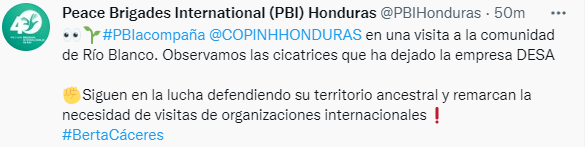
On October 28, PBI-Honduras tweeted: “PBI accompanies @COPINHHONDURAS on a visit to the Río Blanco community. We observe the scars left by the DESA company. They continue to fight defending their ancestral territory and highlight the need for visits from international organizations.”

On Facebook, PBI-Honduras adds: “The Lenca community expresses concern over the possible re-installation of the Agua Zarca hydroelectric project in its territory, since the company continues with the concession granted without prior consultation.”

In March 2019, Vice reported: “All three foreign investors—including Dutch [entrepreneurial development] bank FMO, Finnish finance company FinnFund, and the Central American Bank of Economic Integration (CABEI)—have withdrawn from the [Agua Zarca] project, putting the construction project on indefinite hold.”

However, it adds: “DESA owns the concession for 50 years, [COPINH general coordinator Bertha Zúñiga Cáceres] says, meaning the company has the exclusive right to work the land until 2059.”

She highlighted: “They have not given up and apparently have no intention of abandoning the project altogether.”

At this time, we also recall that less than a year before she was murdered, COPINH co-founder Berta received death threats related to her opposition to the construction of a dam on the Canjel River on Lenca territory by Montreal-based Hydrosys.

The Peace Brigades International-Honduras Project began accompanying the Civic Council of Popular and Indigenous Organizations of Honduras (COPINH) in May 2016, three months after the murder of Cáceres.


PBI-Honduras accompanies protest outside Supreme Court of Justice calling for liberation of the Guapinol defenders

On October 27, PBI-Honduras posted: “PBI accompanies the sit in against #ZEDEs and in favour of the liberation of the defenders of @guapinolre pending judicial resolution. The Office in Honduras of the United Nations High Commissioner for Human Rights recalls that there is no legal basis to maintain the preventive detention measure.”

Honduras Solidarity has also posted: “Still no ruling on bail for the Guapinol defenders. One of their lawyers explains that the authorities have violated the law already by keeping them so long in pre-trial detention in prison. The UN has called for their release also.”

When the court hearing began on October 26, Kathy Price of Amnesty International Canada tweeted: “Ongoing detention of Guapinol #waterdefenders is arbitrary, says the UN, & calls for their immediate release in #Honduras. @AmnestyNow joins calls on @PJdeHonduras [Supreme Court of Justice] to comply during bond hearing today. Many eyes in Canada are watching! #FreedomForGuapinol #WaterIsLife”

The eight water defenders who have been held for 26 months in arbitrary detention are: Ewer Alexander Cedillo Cruz, José Abelino Cedillo Cantarero, José Daniel Márquez Márquez, Kelvin Alejandro Romero Martínez, Porfirio Sorto Cedillo, Orbin Nahún Hernández, Arnold Javier Alemán and Jeremías Martínez Díaz.

These defenders are being criminally prosecuted for peacefully protesting the installation of an open-pit iron oxide mine in Carlos Escaleras National Park, after contamination of the Guapinol River and the San Pedro Sector appeared.

That trial for the Guapinol water defenders is scheduled to begin on December 1.

The Municipal Committee for the Defense of Common and Public Goods of Tocoa and other organizations are demanding that the Court allow the presence of national and international observers in the judicial process to guarantee transparency and compliance with other human rights obligations.

They also ask that the Supreme Court guarantee family members and other human rights defenders a simultaneous video and audio transmission to make transparent a judicial process typical of a member country of the United Nations Human Rights Council.

PBI-Canada continues to follow this closely.

On Saturday November 6, Honduran environmental rights defender Juana Ramona Zuñiga will be speaking on the PBI COP26 and land defenders webinar. To register to hear her speak, click here. Juana’s husband José Abelino Cedillo is one of the Guapinol 8 currently in prison for opposing the Los Pinares iron oxide mine.

1,010 land defenders have been killed since the Paris Agreement, hopes dim for action at COP26

CO

“Our Mother Earth – militarized, fenced-in, poisoned, a place where basic rights are systematically violated – demands that we take action.” Lenca land defender Berta Cáceres was killed in March 2016, just weeks after the Paris Agreement was signed.

The Guardian reports: “The world is squandering the opportunity to ‘build back better’ from the Covid-19 pandemic, and faces disastrous temperature rises of at least 2.7C if countries fail to strengthen their climate pledges, according to a report from the UN.”

That article adds: “Tuesday’s publication warns that countries’ current pledges would reduce carbon by only about 7.5% by 2030, far less than the 45% cut scientists say is needed to limit global temperature rises to 1.5C, the aim of the COP26 summit that opens in Glasgow this Sunday [October 31].”

Last month, The Guardian had also reported: “UN climate talks, billed as one of the last chances to stave off climate breakdown, will not produce the breakthrough needed to fulfil the aspiration of the Paris agreement, key players in the talks have conceded.”

The Paris Agreement reached at COP21 in December 2015 aimed to keep “a global temperature rise this century well below 2 degrees Celsius above pre-industrial levels and to pursue efforts to limit the temperature increase even further to 1.5 degrees Celsius.”

In March 2019, the UN Human Rights Council stated: “Human rights defenders, including environmental human rights defenders, must be ensured a safe and enabling environment to undertake their work free from hindrance and insecurity, in recognition of their important role in supporting States to fulfil their obligations under the Paris Agreement.”

And yet, Global Witness has documented that at least 1,010 land and environmental rights defenders have been killed since the Paris Agreement.

In the lead-up to COP26, the Global Women’s Assembly for Climate Justice, Fridays for Future, Global Witness, 166 organizations, 45 women human rights defenders, and 8 youth climate activists have drawn attention to this situation.

PBI webinar, November 6

Peace Brigades International will be holding a webinar on COP26 and land defenders that will take place on Saturday November 6 at 1 pm EST (Ontario/Quebec) with simultaneous translation in English and Spanish.

This webinar will feature Danilo Rueda (Colombia), Nelly Madegwa (Kenya), Valeria Villalobos (Mexico), Juana Ramona Zuñiga (Honduras), Amaru Ruiz (Nicaragua) and Sandra Calel (Guatemala). It will also include a special introduction by United Nations Special Rapporteur on human rights and the environment David R. Boyd.

To register for this webinar, please click here.

Likhts’amisyu Chief Dsta’hyl arrested by Canadian police for upholding Wet’suwet’en law in opposition to Coastal GasLink pipeline

Photo by Michael Toledano.

On October 27, Michael Toledano tweeted: “Chief Dsta’hyl of @Likhtsamisyu has been arrested & removed from his land, along with Kolin Sutherland-Wilson of the Gitxsan fireweed clan & at least one other person. Cops were deployed from all over northern BC for this. Fire blocked the road as prisoners were moved out.”

The Likhts’amisyu are one of the five clans of the Wet’suwet’en Nation that spans 22,000 square kilometres of territory in British Columbia (BC).

All five clans of the Wet’suwet’en have unanimously opposed all pipeline proposals and have not provided free, prior and informed consent to the construction of the TC Energy Coastal GasLink fracked gas pipeline on Wet’suwet’en lands.

At 11:41 pm yesterday evening, the Likhts’amisyu (Fireweed) Clan tweeted a short video noting: “It looks like an arrested just got to the Houston Detachment.”

There is also now this update:

The 18-member United Nations Committee on the Elimination of Racial Discrimination has previously stated:

“Concerned by the approval of new large-scale development projects on indigenous peoples traditional lands and territories without the free, prior and informed consent of affected indigenous peoples, such as the Coastal Gas Link pipeline in the territory of the Wet’suwet’en people;

Calls upon the State party to immediately halt the construction and suspend all permits and approvals for the construction of the Coastal Gas Link pipeline in the traditional and unceded lands and territories of the Wet’suwet’en people, until they grant their free, prior and informed consent, following the full and adequate discharge of the duty to consult;

Urges the State party to guarantee that no force will be used against Secwepemc and Wet’suwet’en peoples and that the Royal Canadian Mounted Police and associated security and policing services will be withdrawn from their traditional lands.”

This Committee is a body of experts that monitors the implementation of the Convention on the Elimination of All Forms of Racial Discrimination by its State parties. Canada ratified this United Nations Convention more than 50 years ago on October 14, 1970.

Canada’s report on its compliance with this Convention is due on November 15, just a little over two weeks from now.

In this video update following the arrests, Sleydo’ of the Gidimt’en Clan of the Wet’suwet’en stated: “We need everybody to get your boots on the ground. Please come to camp. We need support for Likhts’amisyu and the Wet’suwet’en struggle.”

Responding to this call, Brent Patterson of Peace Brigades International-Canada will be present on Wet’suwet’en territory in November to observe this land defence struggle, document and report on human rights violations, and help amplify Wet’suwet’en concerns to the international community, including to Mary Lawlor, the United Nations Special Rapporteur on the situation of human rights defenders.

For updates on this situation, please follow Gidimt’en Checkpoint and Likhts’amisyu (Fireweed) Clan on Twitter.

The formal call to “come to camp” from Gidimt’en Yintah Access is here.

For more on why World Beyond War is supporting their Canada Organizer Rachel Small to spend part of November at the Gidimt’en camp, please see Rachel’s article: Why I’m Going to the Frontlines of the Wet’suwet’en Resistance.

February 2020 map when the RCMP had set up an exclusion zone just prior to the arrest of 22 Wet’suwet’en land defenders.

PBI-Colombia accompanied Justice and Peace Commission amplifies concern about Vancouver-based MCC Mining Corporation

Facebook image.

On October 27, PBI-Colombia tweeted: “Eight organizations from #Asturias #Spain reject manipulation of mining companies of #Canadá and #Colombia in ethnic territories of the Jiguamiando, amid death threats and recent murders.”

Their tweet follows the Inter-Church Commission for Justice and Peace tweeting this Open Letter that is also posted on their website.

The letter from organizations based in Spain and Asturias (an autonomous community in northwest Spain) is addressed to the President of Minera Cobre SAS.

In the letter, the organizations “reject the mining projects of your company on the territories of the indigenous peoples and black communities of Chocó and Antioquia, the deceptions and terror unleashed to strip them of their rights.”

It further notes: “We know that the Minera Cobre SAS and by extension the Canadian MCC Mining Corporation, are heirs of the militarization and terror unleashed for the benefit of the Muriel Mining Corporation, with which they reached an agreement for the cession of the mining titles over territories of Carmen del Darién and Murindó.”

Given communities have rejected mining and not given their consent, the Open Letter concludes: “We demand that you suspend all the maneuvers deployed by Minera Cobre SAS and MCC Mining Corporation, to access by illegal means the ancestral territories of indigenous peoples and black communities.”

According to Gowling WLG, the MCC Mining Corporation, which has an office at Suite 206, 595 Howe Street in Vancouver, British Columbia, “is a private Canadian mineral exploration company with an extensive copper exploration portfolio in Colombia.”

We follow this with interest.

PBI-Colombia has accompanied the Justice and Peace Commission since 1994.

PBI COP26 webinar to feature Mexican environmental defender Valeria Villalobos

Mexican environmental defender Valeria Villalobos of Salvemos los cerros will be speaking on the PBI ‘COP26 and land defenders’ webinar on November 6.

To register to hear her speak, click here.

Salvemos los cerros says: “We are inhabitants of Chihuahua City, we want to save the hills that are the source of life, water, air, culture, identity.”

Their profile notes: “The protection of the environment and biodiversity with activities such as rescue of native fauna, mitigation of climate change, an approach in which the comrades of the National Network of Climate Resistance support us and the defense of the territory with a human rights perspective, especially with a focus on respect for the most vulnerable and marginalized social sectors,  the preservation of the cultural and archaeological heritage that exists in the territory, which we carry out together with the INAH [the National Institute of Anthropology and History] in Chihuahua.”

This past July, they also tweeted: “The hills help capture water and mitigate climate change. As the destruction of natural areas advances, so will ‘natural’ disasters.”

In July, Luis Rivera of Salvemos los cerros also spoke at this Facebook live event on the topic of Climate Crisis and Racism in the context of #500AñosdeResistencia.

And they have highlighted: “We all lose out with the terrible political and economic model that destroys the environment. A few make a lot of money, but money can’t be eaten, it can’t be taken, it can’t breathe, and it can’t heal.”

They add: “What do we prefer, to take care of Mother Earth, to respect the collective human rights of us and our children or that a few continue to earn a lot of money?”

Salvemos Los Cerros works with Extinction Rebellion and Fridays for Future among other climate justice groups.

PBI webinar, November 6

Peace Brigades International will be holding a webinar on COP26 and land defenders that will take place on Saturday November 6 at 1 pm EST (Ontario/Quebec) with simultaneous translation in English and Spanish.

It will feature Valeria along with land and environmental rights defenders from Colombia, Honduras, Guatemala, Nicaragua and Kenya.

To register for this webinar, please click here.

Our speakers for this webinar will be Nelly Madegwa (Kenya), Sandra Calel (Guatemala), Danilo Rueda (Colombia), Juana Ramona Zuñiga (Honduras), Amaru Ruiz (Nicaragua) and Valeria Villalobos (Mexico). It will also include a special introduction by UN Special Rapporteur on human rights and the environment David R. Boyd.