
Home Blog Page 269

PBI-Colombia accompanies CCALCP lawyers collective at community meeting in Caño Indio, Catatumbo on the Peace Agreement

On December 3, PBI-Colombia tweeted: “Today we met with @ccalcp before accompanying them to Caño Indio, Catatumbo, for a meeting with communities included in the guardianship actions to guarantee the #DDHH [human rights] within the framework of the implementation of points 1, 3 and 4 of the Agreement of peace.”

Those chapters in the Peace Agreement are:

1- Towards a New Colombian Countryside: Comprehensive Rural Reform (p. 10-33)

3- End of the Conflict (p. 57-103)

4- Solution to the Illicit Drugs Problem (p. 104-131).

Earlier this year CCALCP tweeted: “Breaches of the National Comprehensive Program for the Substitution of Illicit Crops (PNIS) in Catatumbo will be studied by the Constitutional Court in a guardianship review filed by CCALCP together with [other organizations].”

The PNIS is a crucial component of the Peace Agreement.

Under the program, farmers agreed to voluntarily uproot their coca fields. In exchange, the government would provide subsidies and training programs to help them swap illegal crops for alternative, legal ventures.

Instead, the Colombian government has pursued a controversial fumigation program to eradicate coca crops by spraying the herbicide glyphosate from airplanes.

Adam Isacson of the Washington Office on Latin America (WOLA) has cautioned that the resumption of fumigation could spur a wave of violent rural protests and blockades that could be as dramatic as the mass national strike protests this year.

Ten United Nations Special Rapporteurs have also told the Colombian government: “[Spraying poses] enormous risks for human rights and the environment, at the same time that it would not comply with the conditions established in the ruling T-236 of the Constitutional Court, nor with international obligations. in the matter.”

T-236 concluded there are elements to affirm, provisionally, that glyphosate is a toxic substance that, depending on the level of exposure, can cause cancer or have other health implications.

The Peace Brigades International-Colombia Project has accompanied the Luis Carlos Pérez Collective Lawyers Corporation (CCALCP) since 2006.

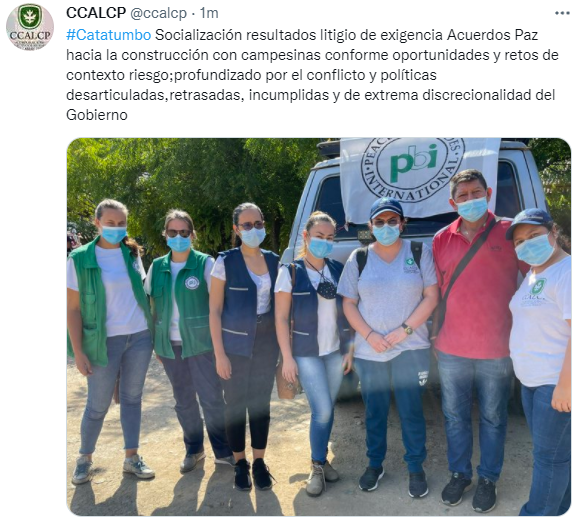
#Catatumbo Socialization results of the lawsuit demanding Peace Agreements towards construction with peasant women according to opportunities and challenges of risk context; deepened by the conflict and disarticulated, delayed, unfulfilled and extremely discretionary policies of the Government.
PBI-Colombia accompanied CCALCP featured in The Guardian, lawyers collective has challenged Canadian extractivist projects

Photo: PBI-Colombia visits with Julia Figueroa and CCALCP lawyers in Bucaramanga, November 13, 2021.

On December 2, The Guardian reported: “Julia Figueroa never leaves her house without security. She travels with two bodyguards and an armoured vehicle. Her home and office are watched around the clock. She carefully monitors any devices that might contain compromising information about her clients.”

That article adds: “As the director of the Luis Carlos Pérez Lawyers Collective Corporation (CCALCP), threats to her life are a daily occurrence. The all-female group of lawyers provides legal representation to small-scale farmers and indigenous communities affected by the armed conflict in Colombia.”

“Their work includes defending displaced peoples and victims of state crime, but also defending environmental rights, including fighting mining companies that seek to extract resources, often at the expense of the local water supply and the surrounding environment.”

“The CCALCP has its roots in Bucaramanga’s only public university, the Industrial University of Santander, where a group of law students graduating in 2001 bonded over a desire to address the conflict and displacement facing their province, says Figueroa.”

“As the team expanded to the surrounding Magdalena Medio region, they successfully defended displaced families from landowners, protected indigenous groups from oil companies and precious ecosystems from mining.”

CCALCP challenges Canadian extractivism

The Guardian article adds: “Since 1994, the Canadian mining company Eco Oro Minerals has sought to exploit the area’s gold and silver resources, and was granted a concession in the páramo. But in 2017, the CCALCP obtained a ruling in the country’s highest court declaring the licence unconstitutional.”

It also notes: “Another high-profile case involved fracking in the municipality of San Martín in the Magdalena Medio region. When Colombia announced its first fracking project in the area in 2015 there was a considerable backlash. The CCALCP helped to file the first ‘popular action’ – a legal mechanism to protect collective interests – in a fracking case, and the fracking was suspended in 2018.”

It was Calgary-based Canacol Energy Ltd. along with ConocoPhillips that sought to frack the VMM-2/Plata and VMM-3/Piranga sites near San Martin.

CCALCP also challenged the proposed Piedra del Sol hydroelectric project, which would have been situated south of Bucaramanga. That challenge was launched the same year that Toronto-based Brookfield Asset Management Inc. bought a majority share in the Colombian power generation company Isagen that would have built that dam.

The Peace Brigades International-Colombia Project has accompanied the Luis Carlos Pérez Collective Lawyers Corporation (CCALCP) since 2006.

Photo: Andrea Nocove and Julia Figueroa of CCALCP, Ivan Madero of CREDHOS , Kathy Price of Amnesty International Canada and Javier Garate of PBI-Colombia at the Amnesty International office in Ottawa during a cross-Canada advocacy tour focused on Canadian fracking in Colombia, November 2019. Photo by Brent Patterson.

Did the RCMP decide to raid Wet’suwet’en territory before the Hereditary Chiefs’ evacuation order was radioed to CGL workers?

Photo by Dan Loan, November 18, 2021.

The lack of transparency on the part of the British Columbia government and the RCMP, specifically on the timeline of their decision to raid Wet’suwet’en territory and arrest Indigenous land defenders and journalists, raises concerning questions.

Timing of the raid

On Wednesday November 17, Gidimt’en Checkpoint tweeted: “A charter plane full of RCMP has landed at the Smithers airport, with between 30 and 50 officers equipped with camo duffel bags.” The following days – Thursday November 18 and Friday November 19 – an RCMP raid arrested Wet’suwet’en land defenders, allies and journalists.

BC government authorizes raid, but when?

Prior to this, on Wednesday November 3, the provincial Minister of Public Safety and Solicitor General Mike Farnworth told the British Columbia Legislature: “Politicians — and in particular, the Minister of Solicitor General — do not direct police in terms of how they operationalize the issues that they are dealing with.”

But now, on December 2, Brett Forester of APTN News reports: “The British Columbia government authorized an RCMP request for increased police presence on Wet’suwet’en territory to crack down on pipeline resistance for the third straight year, according to the Mountie who planned the operation.”

He adds: “It isn’t clear when Farnworth greenlit the latest redeployment because his office declined to answer emailed questions from Nation to Nation.”

While the date of that authorization isn’t specified, the article continues: “The decision was made before the destructive extreme weather hit, according to Chief Supt. John Brewer [the gold commander for the Community-Industry Response Group].”

When did the extreme weather hit?

It was around Thursday November 11-Friday November 12 that meteorologists began warning that an extreme rainstorm was on its way.

The heavy rains in British Columbia began on Saturday November 13, so the suggestion is that the decision was made before that date.

Notably, it was not until Sunday November 14 that the Gidimt’en Clan radioed the Mandatory Evacuation Order for Coastal GasLink workers to leave Wet’suwet’en territory.

And it was on Monday November 15, that Gidimt’en Checkpoint tweeted: “The Morice River FSR has been disabled, blocking trespassers from our yintah!”

On Tuesday November 16, Marc Miller, the federal Minister of Crown-Indigenous Relations, said “it depends” when asked by a reporter if the situation will escalate as it did with the RCMP raid in 2020.

Timeline questions

As such, while the RCMP highlighted on Thursday November 18 that their raid was “an effort to rescue hundreds of workers who have been blocked in their camp by contemnors” as of Sunday November 14 or Monday November 15, Brewer’s comments that “the decision was made before the destructive extreme weather hit” on Saturday November 13 raises questions about the justification and the decision-making timeline.

While the RCMP could argue that the provincial state of emergency was declared on Wednesday November 17 thus marking the date of when “the destructive extreme weather hit”, that seems less logistically possible given that was also the day that the chartered aircraft with RCMP officers landed in Smithers in advance of the raid.

While Farnworth has not disclosed when he authorized the redeployment of the RCMP, some transparency from his office would be helpful in the public interest to better understand what transpired on Wet’suwet’en territory last month.

Photo: Chief Supt. John Brewer, gold commander for the RCMP’s resource extraction protection unit known as the Community-Industry Response Group.

Ontario NDP MPPs Sol Mamakwa and Joel Harden call for end to RCMP violence against Wet’suwet’en land defenders

Photo: Sol Mamakwa, Joel Harden

On December 1, Ontario NDP Member of Provincial Parliament (MPP) Joel Harden tweeted: “Reconciliation doesn’t happen at the barrel of a gun. The RCMP must leave Wet’suwet’en lands, nation-to-nation talks need to start, and construction of a pipeline on unceded territory without free, prior and informed consent must halt.”

In his speech to the Legislature, Harden also highlighted his concern that “millions of dollars can be found to send the RCMP into Wet’suwet’en lands with snipers and police dogs.”

And Harden noted: “As the member for Kiiwetinoong has said, the law is very clear: Wet’suwet’en hereditary chiefs are the title holders of their land. They have a right to refuse development on their lands despite agreements signed by other parties.”

In his intervention on November 24, Sol Mamakwa, the MPP for Kiiwetinoong, stated: “The violent dispossession of First Nations people from their land for the purpose of resource development is a foundation Canada was built upon.”

Two days later, Mamakwa released this statement on behalf of the Ontario NDP that notes: “The land defenders at Wet’suwet’en are not criminals and should not be treated as such. Their forceful detention must be denounced for what it is. It is time for respect, dialogue and a peaceful resolution in the homelands of the Wet’suwet’en peoples.”

Second eviction notice given to MLA Nathan Cullen

Harden’s intervention in the Ontario Legislature happened on the same day as a second eviction notice was presented to Nathan Cullen, the Minister of State for Lands and Resource Operations in British Columbia’s NDP government.

Git’luuhl’um’hetxwit Media has also highlighted on Facebook that Cullen was asked to: “denounce the use of injunctions and RCMP enforcement which violently inhibit Wet’suwet’en and Gitxsan peoples from exercising constitutionally protected title and rights in areas within the yintah and lax’yip [territories].”

The first eviction notice was posted at Cullen’s constituency office in Hazelton by Gitxsan Hereditary Chiefs on November 28.

Concerns have also been expressed about the comments made by Murray Rankin, the provincial Minister of Indigenous Relations and Reconciliation, that fail to adequately hold accountable the RCMP for violence against land defenders.

Lessons from the police killing of land defender Dudley George

The criminalization and use of police violence against Indigenous land defenders is a notable issue in Ontario.

On September 6, 1995, Indigenous land defender Dudley George was killed by an Ontario Provincial Police (OPP) sniper while occupying his traditional territory from which his peoples had been dispossessed for a military base.

A key recommendation of the Inquiry into his death was: “The provincial government should invite the federal government to participate in interministerial ‘blockade’ committees to inform and coordinate governmental responses to Aboriginal occupations and protests when a potential federal interest is engaged.”

This suggests political resolutions should be pursued, not an armed police response that can result in the death of a land defender.

And yet, on October 22, 2020, the OPP fired rubber bullets at Six Nations land defenders opposing a housing development on their lands.

The following day, Ontario Premier Doug Ford, rather than denouncing this police violence, shifted blame onto the Indigenous land defenders: “It’s unfortunate we have a couple bad apples causing problems.”

PBI-Canada expresses profound concern about the OPP violence against Haudenosaunee land defenders, all three RCMP militarized raids against the Wet’suwet’en and that the death of Dudley George has not resulted in systemic changes in how the state interacts with Indigenous land defence struggles.

On September 10, 2020, provincial MPPs Suze Morrison and Sol Mamakwa and federal MP Matthew Green visited Haudenosaunee land defender Skyler Williams at the 1492LandBackLane resistance to land theft in southern Ontario. Williams was arrested by the RCMP on Wet’suwet’en territory on November 18 of this year.

PBI-Colombia accompanies Justice and Peace Commission at meeting on police violence with Canadian Embassy representative

On December 1, the Peace Brigades International-Colombia Project tweeted: “During a visit to Cali from @CanadayColombia at an important meeting with @Justiciaypazcol [Inter-Church Commission Justice and Peace Commission] and victims of police violence they represent, great fear was expressed for their safety and the difficulties in accessing justice that can lead to impunity in these cases.”

Two weeks ago, Semana reported that the Ministry of Defense says 21 people died during the national strike, while the Prosecutor’s Office says 32 people died and some human rights organizations say 51 people died during the mobilizations.

Canacol also recently reported that Juliette de Rivero, the representative in Colombia of the United Nations High Commissioner for Human Rights, has announced her office will publish a document that includes a record of deaths caused by the excessive use of force during the national strike social protests.

She says: “It is very important that the State investigates such cases of abuse and that they do not go unpunished.”

Beyond these fatalities, Amnesty International has also received and verified hundreds of pieces of audiovisual material on the disproportionate and repressive actions of state security forces between April 28 and October 20, 2021.

Specifically, Temblores’ GRITA Platform recorded that between January and July 2021 there were at least 103 cases of eye injuries caused by the disproportionate use of force by security forces to repress the national strike protests.

While Infobae now reports that the Attorney’s General Office has charged a patrolman and two commanders in the deaths of six people in Cali during the national strike, it’s not clear how many more police officers have been charged in the 15-45 other deaths, the 100+ eye injuries and the many other acts of documented police violence.

There is reason for concern about this.

In May, the Colombian police said that they had launched disciplinary investigations against 117 officers for possible misconduct during the social protests.

But by June, Human Rights Watch noted: “Of those officers, five had been temporarily suspended including three who were under disciplinary investigation for homicide. The rest continued to perform their duties.”

Human Rights Watch has also reported that the Attorney General’s Office had launched 24 investigations into police conduct during the 2019 protests and another 5 into the protests that took place in 2020. But despite the passage of up to two years, the organization highlighted: “No police officers had been subject to disciplinary sanctions and most cases continued in the preliminary stages.”

And even with those concerns expressed, Canada has not pushed the Colombian government harder on the issue of police impunity.

By July 14 of this year, Canada’s Minister of Foreign Affairs Marc Garneau had only called on Colombia “to keep its commitment to fully investigate and hold anyone who has violated human rights to account for their actions.”

It is our hope that the testimony gathered by the Canadian Embassy from the meeting with the Justice and Peace Commission will prompt a stronger and more urgent statement of concern from Canada’s new Minister of Foreign Affairs Mélanie Joly.

Tweet: “Between this Friday and Saturday, young people from various cities of #Colombia and organizations such as @Justiciaypazcol participated in the National Meeting of victims of police violence.”

PBI-Colombia accompanies Nomadesc as it asks Canadian Embassy not to assist the Colombian police with equipment

On December 1, PBI-Colombia tweeted: “The Canadian embassy @CanadayColombia visits the office of @Nomadesc in Cali. To talk about the causes of the protests and learn first-hand about cases of police violence. Nomadesc requested guarantees that Canada will not assist the Colombian police with equipment.”

Police violence

Amnesty International has reported: “Since 28 April 2021, mass demonstrations have taken place in the city of Cali.”

Their report highlighted: “At least 28 people were killed between 28 April and 28 June 2021 as a result of the unlawful actions of the security forces. In addition, [human rights organizations] have documented at least 90 cases of eye injuries and 28 cases of sexual violence in the context of the demonstrations.”

Requests to stop exports to the police

This past May, the PBI-Colombia accompanied Regional Corporation for the Defence of Human Rights (CREDHOS) asked Global Affairs Canada to stop any technical assistance, aid, logistical or financial support to the Colombian army and police.

CREDHOS stated: “We are calling on the international community to ensure that logistical or financial support to the police and national army is stopped because right now they are attacking the people and we don’t want that to continue.”

The following month, Amnesty International Canada Secretary General Ketty Nivyabandi stated: “Canada must immediately cease the direct or indirect supply, sale or transfer of equipment that could be used against civilians.”

Canadian armoured vehicles sold to the Colombian police

The Toronto-based company INKAS sold four Huron tactical attack and defense vehicles to the Colombian police in 2014.

In April 2015, PLANT also reported: “The manufacturer is still building behemoth armoured personnel carriers (APCs). In fact, there’s a tendered order for 26 of its Huron vehicles, at about $450,000 a pop, for the National Police of Columbia.”

That article adds: “The Huron will be outfitted with a cannon to wrangle unruly rioters with foam, tear gas, dyes and water.”

Subsequently, Canada exported $458,318.87 in “military goods” to Colombia in 2020 that fall under category 2-6 of “Ground vehicles and components”.

While the Global Affairs Canada report doesn’t specify the end use of those components, it’s possible these parts are what keep the Canadian-manufactured Colombian police armoured vehicles operational.

On July 17 of this year, at least one of those Canadian-made armoured vehicles was used by the Colombian police to detain delegations travelling to Cali for a National People’s Assembly related to the national strike.

We continue to express concern about this situation.

The Peace Brigades International-Colombia Project has accompanied Nomadesc since 2011 and its president Berenice Celeita since 1999.

Canadian armoured vehicle stops delegations travelling to Cali on July 17, 2021.

Public Services and Procurement Canada says it will finalize the next steps in the fighter jet competition in the coming weeks

It is widely expected that the Canadian government will select the Lockheed Martin F-35 fighter jet in the coming weeks.

On December 1, the Canadian Press reported that Public Services and Procurement Canada has officially announced that the Boeing F/A-18 has been dropped from the fighter jet acquisition process. That leaves as the two remaining contenders in the competition the Saab Gripen and Lockheed Martin F-35.

That article adds: “While Public Services and Procurement Canada says it will finalize the next steps in the competition in the coming weeks, it insists it is still hoping to award a contract [in 2022] in time for the first new fighter jet to arrive by 2025.”

The Government media release further explains: “Over the coming weeks, Canada will finalize next steps for the process, which, based on further analysis of the 2 remaining bids, could involve proceeding to final negotiations with the top-ranked bidder or entering into a competitive dialogue, whereby the 2 remaining bidders would be provided with an opportunity to improve their proposals.”

The Canadian Press article also comments: “There have been long-standing concerns in some corners that the entire competition has been set up from the beginning to select the F-35, which is being purchased by many of Canada’s closest allies.”

The Harper government selected the F-35 in 2010 without a competition process. In 2015, the Liberals vowed they would not purchase the F-35.

Two weeks ago, we noted these questions for Filomena Tassi, the Minister of Public Services and Procurement, and Anita Anand, the Minister of National Defence:

1- When will the Parliamentary Budget Officer conduct a full-cost assessment of the lifespan costs of these fighter jets? While the purchase cost may be $19 billion, the full cost over 30-years has been estimated by community activists at $76.8 billion.

2- Will a calculation be made on the greenhouse gas emissions from this fleet of 88 fighter jets? A basic calculation would suggest the fleet could consume 3.94 billion litres of fuel. At the COP26 climate summit there was a call for transparency in military emissions.

3- The current fleet of CF-18s has conducted an estimated 1,598 offensive bombing missions over the past 30 years. Murray Brewster of CBC News has reported on the refusal by the Department of National Defence to disclose the casualty figures from its bombing missions in Iraq and Syria. Will a comprehensive report on casualties be released before billions are spent on new warplanes?

4- At what point and how will the United States grant its “ultimate certification” of the Canadian government’s choice of a fighter jet? Lee Berthiaume of The Canadian Press has reported: “American officials will need to certify the fighter jet Canada buys at the end of a multibillion-dollar procurement [process].”

5- Will there be a parliamentary debate on the lifespan costs, carbon pollution, offensive uses and ultimate certification process prior to the contract being signed?

We look forward to answers to these questions and a fulsome public and parliamentary debate based on the information provided in those responses as well as clarification on the expected date for the signing of the contract.

A protest on the opening day of Parliament, November 22, 2021.

Gidimt’en land defender Sleydo’ highlights RCMP/CIRG collusion with CGL in interview with Democracy Now!

On November 30, Gidimt’en land defender Sleydo’ was interviewed by Amy Goodman and Juan Gonzalez on Democracy Now!

Excerpts from that interview include Sleydo’ highlighting:

“The CIRG team of the police, the specialized group of RCMP to deal with specifically industry and Indigenous land defenders, surrounded our camp with tactical teams that they dropped in helis [helicopters].

They bulldozed the entire camp and CGL was present at the raid.

[The CIRG] is basically this rogue group of police that work for private industry. They are directed by private industry. The government has claimed no oversight or direction towards this particular group of police that [have raided our territory three times].”

They don’t have the same accountability as other police do and they take direction and were using CGL vehicles for the arrests, for the raid. They were staying at the man camps with CGL. They had put up an exclusion zone that they were letting only CGL through and blocking all Wet’suwet’en, even our house chiefs, from the territory, during the raids.”

The full interview with Sleydo’ can be seen here.

When Sleydo’ was released on November 23 from the Prince George Regional Correctional Centre she also stated: “CIRG and the RCMP need to be abolished.”

The video of her statement outside that jail can be seen here.

We were also told by Gitxsan land defenders in New Hazelton that the RCMP arrived in CGL-marked buses to break-up their rail blockade on November 19 that had been set up in solidarity with Wet’suwet’en land defenders.

For an overview of what we know about the CIRG, please see What do we know about the RCMP’s resource extraction protection unit?

For updates, please see Gidimt’en Checkpoint on Twitter.

PBI-Honduras comments on the crises and structural causes that continue to put human rights defenders at risk

As of Tuesday morning, Hondurans continue to wait for the final results of Sunday’s election.

On November 29, PBI-Honduras tweeted: “It is important to maintain national and international attention until the end of the electoral count, taking into account historical antecedents. Honduras arrives at these elections with increased poverty, food insecurity and distrust in institutions.”

PBI-Honduras then shares this article that highlights:

“As we await the final results of the elections in Honduras, one thing is clear: this moment is not only an electoral process, but also a convergence of the multiple crises that the country has faced since the coup d’état of 2009, and especially in the last four years since the post-electoral conflict of 2017.

According to the National Observatory of Violence, maintained by the National Autonomous University of Honduras, [political violence has resulted in] 68 deaths.

Political violence has a direct impact on human rights defenders.

From what was reported by the eight social organizations that have participated in preparatory workshops facilitated by PBI Honduras, in the week before the elections, all had seen an increase in the levels of violence against human rights defenders at key moments of the campaign.

Vulnerable communities, especially the LGTBI+ community, have seen a serious increase in their situation of risk, in the midst of a political campaign that questioned their fundamental rights.

Several sexual diversity organizations denounced a “hate speech” made by the outgoing president, Juan Orlando Hernández, on the occasion of the bicentennial of Honduran independence, in which he called “enemies of the homeland” to people who defend the rights of this community.

Just 10 days after the speech, Erika Tatiana, a trans woman from the department of Copán, in the mountainous west of the country, was stabbed to death in her apartment. CONADEH called for an investigation that “leads to the capture and prosecution of the material and intellectual authors of these hate crimes.”

Just three days before voting day, a women’s march in commemoration of the International Day for the Elimination of Violence against Women was heavily repressed by state forces, despite having been described as “peaceful” by the National Commissioner for Human Rights.

This distrust increased even more in October, when the National Congress approved a series of reforms to the penal code during a week of national holidays.

The penalties for the crime of usurpation, frequently cited in cases of criminalization of defenders of land and territory, were aggravated, in addition to extending its application to seizures of public spaces and enabling eviction orders even without judicial control, thus limiting the rights to peaceful protest, to freedom of association, and freedom of expression, among others.

On November 28, almost 70% of the Honduran population decided to vote. Several incidents were recorded during the day: from ASOPODEHU, for example, they reported at least 7 attacks against journalists, of which 3 were committed by the National Electoral Center (CNE), 2 by military police, 1 by activists of the National Party and another by activists of the Liberal Party.

Regardless of the results of the final count, these crises and their structural causes will require a comprehensive and lasting response that supports and does not hinder the work of human rights defenders who are constantly fighting for a better future.”

The full article by the Peace Brigades International-Honduras Project can be read in Spanish at Unas elecciones en medio de una crisis multiple.

Five reasons why Murray Rankin’s comments put Wet’suwet’en land defenders at risk of violence and criminalization

Photo: Murray Rankin with federal NDP leader Jagmeet Singh (who supports the Coastal GasLink pipeline, but who also criticized the recent RCMP raid against Wet’suwet’en land defenders: “That’s not reconciliation.”)

Murray Rankin, the Minister of Indigenous Relations and Reconciliation in the province of British Columbia, has highlighted following the RCMP raid against Wet’suwet’en land defenders, allies and journalists on November 18-19 that the provincial government does not and should not have any say over police operations.

There are at least five shortcomings in Rankin’s approach that put the lives of Wet’suwet’en land defenders at risk:

1- Rankin says: “In our democracy, it is not the government of the day that directs police to do their work.” But his reasoning should not be extended to suggest that the police are not ultimately accountable to the government.

Even the RCMP state that “the Commissioner of the RCMP is autonomous when it comes to the operational and investigative activities of the organization” but that the Minister of Public Safety is “accountable … for the actions and decisions” of the RCMP.

Impunity leads to further violence against land defenders.

2- Rankin’s colleague Mike Farnworth, the Minister of Public Safety and Solicitor General, has also stated he does direct “police operations”.

However, Farnworth did authorize on January 27, 2020 the “internal redeployment of resources within the Provincial Police Services” that enabled the second RCMP raid just a few days later against Wet’suwet’en land defenders.

The lack of transparency on the part of Farnworth, Rankin and other cabinet ministers creates a dangerous situation for land defenders.

3- Rankin also says: “There has been — it’s no secret — conflict between the elected and the hereditary system, but we continue to do this historic work [of sorting through that conflict].” His comment obscures the different jurisdictions of these bodies.

Vancouver-based lawyers Kate Gunn and Bruce McIvor have argued: “The [federal] Indian Act does not provide authority for a Chief and Council [band council] to make decisions about lands beyond the boundaries of the First Nation’s reserves.”

They add: “By contrast, the Hereditary Chiefs are responsible under Wet’suwet’en law and governance for making decisions relating to their ancestral lands.”

The failure to acknowledge land rights and then blur the jurisdictional roles of different governance bodies endangers land defenders.

4- To his credit, Rankin has stated: “The long-standing impacts of colonialism and systemic racism continue to affect Indigenous communities to this day.”

This report by the House of Commons Standing Committee on Public Safety and National Security acknowledges “the pervasive nature of systemic racism in policing in Canada”. And law professor Benjamin Perryman has noted in the Toronto Star: “Canada’s long history of using force to dispossess Indigenous people from their land.”

But Rankin’s failure to link colonialism and, as University of Birmingham lecturer Steve Hewitt notes, the historic role of the RCMP to move “Indigenous peoples onto reserves to free up land for European settlers”, puts present-day land defenders at risk.

5- Premier John Horgan has stated that “free and informed consent” does not apply to the Coastal GasLink project because it was already in the works prior to the passage of the provincial Declaration on the Rights of Indigenous Peoples Act (DRIPA). Horgan has also stated that cancelling the pipeline is “not an option for me.”

As such the cabinet of which Rankin is a member bears responsibility for entrenching a situation in which land defenders are being put at risk.

We continue to follow this with great concern.