Home Blog Page 259

PBI-Honduras congratulates the National Union of Rural Workers on its 37th anniversary

On January 21, PBI-Honduras tweeted: “From @PBIHonduras we congratulate @CntcTegucigalpa on its 37th anniversary. Almost four decades in defense of the rights of peasants and for an equitable distribution of the land.”

The CNTC has stated: “Since its founding in January 1985, the CNTC (National Union of Rural Workers) has worked for access to land and land titles, agricultural and forestry production, training for its members (at the Regional and National level), and including women and youth in the development of all activities.”

It adds: “The fight to achieve these goals has been difficult and complicated; we have even had to risk our lives for this cause as a consequence of the unequal system that does not have any political will for campesino families to have equal rights and to benefit from projects that could provide them with comprehensive development.”

And it further notes: “The arrival of the health emergency caused by the COVID-19 pandemic has created more unfavorable conditions for our defenders of the land and territory due to the creation of emergency decrees and the increased isolation of our communities from society. This, combined with police and military control of civic life, has increased the criminalization of the struggle for access to land and it violates the human rights of our campesino brothers and sisters.”

PBI-Honduras has previously explained: “Of the 404 communities that form the National Union of Rural Workers, just 20% have titles to their lands. Many others have worked and lived on their lands for three or four decades and have spent 15 years awaiting the official recognition of their rights that never seems to arrive.”

Overall, land distribution in Honduras is highly unequal.

Just 5% of large-scale farmers control almost two thirds of all cultivable land, while 71% of small-scale farmers have access to just 5% of it.

At this time, we recall that Canada abstained in the vote on the United Nations Declaration on the Rights of Peasants and other people working in rural areas that was adopted by the UN General Assembly in December 2018.

PBI-Honduras has noted that this UN Declaration recognizes key elements such as “the right to land, to natural resources and to food sovereignty, based on the principle of equality between men and women.”

Despite Canada’s abstention, the resolution in support of the Declaration passed.

PBI Honduras has been accompanying CNTC since May 2018.

Franklin Almendares, General Secretary of the CNTC.

Constitutional Court rules Colombian government failed to consult communities about aerial fumigation

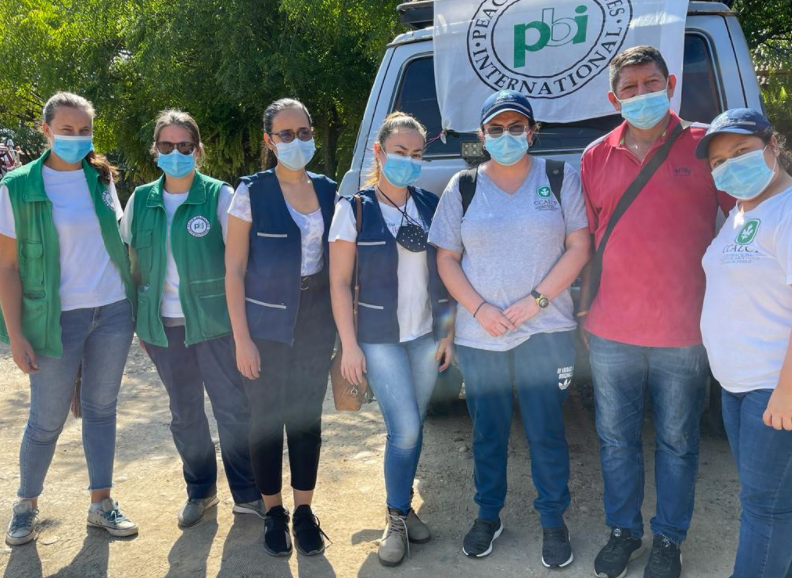
On December 3, 2021, PBI-Colombia accompanied CCALCP to Caño Indio, Catatumbo, for a meeting with communities included in the guardianship actions.

When Julia Figueroa and Andrea Nocove from the Luis Carlos Perez Lawyers’ Collective (CCALCP) took part in a PBI-organized advocacy tour in Canada in November 2019 they highlighted concerns about the forced eradication of coca crops in Colombia.

In March 2021, CCALCP tweeted: “Breaches of the National Comprehensive Program for the Substitution of Illicit Crops (PNIS) in Catatumbo will be studied by the Constitutional Court in a guardianship review filed by CCALCP together with [other organizations].”

Now, Aljazeera reports: “Rights groups and politicians in Colombia have welcomed a decision by the country’s Constitutional Court, which ruled this week that the government failed to consult local communities over its plan to restart aerial fumigation of coca crops.”

That article highlights: “In a decision on Wednesday [January 20], the court said the government of President Ivan Duque could not at this stage move forward with plans to carry out aerial spraying with herbicide glyphosate. It said Bogota must first adequately consult with communities that could be affected.”

Pedro Arenas, director of Viso Mutop, a think-tank that promotes drug policy reforms across Colombia, says: “The most significant thing about this [ruling] is that the court is protecting various rights that rural farmers, Indigenous and Black communities have.”

The article also notes: “The court’s order means Colombian authorities will have to carry out a consultation process with communities in six planned fumigation areas, which cover 104 municipalities across 14 departments. Government agencies will have one year, extendable by six months, to complete this process.”

The Peace Brigades International-Colombia Project has accompanied the Bucaramanga-based CCALCP since 2006.

Videos feature the work of Salvemos los Cerros in Chihuahua

Salvemos los Cerros says: “We are inhabitants of Chihuahua City, we want to save the hills that are the source of life, water, air, culture, identity.”

Their approach is: “The protection of the environment and biodiversity with activities such as rescue of native fauna, mitigation of climate change … with a human rights perspective, especially with a focus on respect for the most vulnerable and marginalized social sectors,  the preservation of the cultural and archaeological heritage that exists in the territory.”

They have also explained: “The hills help capture water and mitigate climate change. As the destruction of natural areas advances, so will ‘natural’ disasters.”

And they have highlighted: “We all lose out with the terrible political and economic model that destroys the environment. A few make a lot of money, but money can’t be eaten, it can’t be taken, it can’t breathe, and it can’t heal.”

Videos with Salvemos los Cerros

This past November, Valeria Villalobos of Salvemos los Cerros spoke on the PBI ‘COP26 and land defenders’ webinar. Her presentation can be seen here (starting at 47:47).

There is also now this video (2:34 in length) that answers the question: What is Salvemos los Cerros?

And there is this El Tema episode on water (11 minutes in length with subtitles) in which Luis Rivera of Salvemos los Cerros (starting at 6:29) talks about the role the hills play collecting water and providing air filtration.

Rivera says: “The key to facing the water crisis and the climate crisis is for political actors to commit to respecting water basins, meaning the hills, the streams, and all the riverbeds that filter and gather water underground and on the surface.”

“We want to save the hills because they are sacred to us. Politicians and business owners see them as merchandise, as barren lands, or as landfill. And to us, they are part of our Mother Earth. To us, without the hills environmental services, water, air, biodiversity, history itself and identity; basically, we wouldn’t exist.”

He further notes: “So, saving the hills also means saving our collective existence as the people of Chihuahua.”

You can find Salvemos los cerros de Chihuahua on Twitter, Facebook, and Instagram.

CANSEC arms show has included company that sold rifles implicated in the murder of the Ayotzinapa 43 in Mexico

A Canadian soldier holds a HK416 assault rifle manufactured by Heckler and Koch during the CANSEC arms show in Ottawa, April 2008. Photo by Chris Wattie.

Last March, Deutsche Welle reported: “Germany’s Federal Court of Justice (BGH) upheld a 2019 lower court decision, finding that employees at German arms manufacturer Heckler & Koch (H&K) knowingly falsified information as to the nature and destination of arms sold by the company in order to attain federal export licenses.”

That article adds: “German export licenses allowed H&K to sell large amounts of arms — mainly more than 4,200 model G36 machine guns — and component parts to Mexico’s central purchasing body, which then proceeded to sell the guns to police departments located in states with dubious human rights records.”

DW has also noted: “While selling weapons to the country, in general, was allowed, German authorities wanted to ban their use in specific Mexican states: Chihuahua, Chiapas, Guerrero, and Jalisco, where war with drug cartels, corrupt police forces, and the attendant human rights abuses, were believed to be particularly prevalent.”

That DW article highlighted: “Some of the rifles were almost certainly used in the murder of six Mexican students, and the probable murder of 43 others whose bodies have never been found, in [Guerrero] in September 2014.”

The Ayotzinapa 43 were students from a politically radical, poor, mostly Indigenous teachers’ college in the town of Ayotzinapa in Guerrero.

Heckler & Koch sold the G36 assault rifles to Mexico between 2006 and 2009. In 2008, a Heckler & Koch HK416 assault rifle was displayed at the CANSEC arms show in Ottawa (as seen in the Chris Wattie/Reuters photo above).

CANSEC bills itself as Canada’s largest global defence & security trade show as well as “North America’s largest tri-lateral defence event”.

Over the past ten years (2010 to 2020), Canada has exported $26.4 million in “military goods” to Mexico. We will be asking Global Affairs Canada whether it has similar restrictions as Germany on arms exports to Chihuahua, Chiapas, Guerrero, and Jalisco.

We are also planning to highlight issues of concern in relation to Canadian arms exports and human rights violations and militarization in Latin America when the next CANSEC arms show is scheduled to take place in Ottawa on June 1-2.

Photo: A protest in Stuttgart, Germany in May 2018 linking the Heckler & Koch assault rifle with the deaths of the Ayotzinapa 43.

IACHR says Mexican government committed serious errors in the investigation of the murder of lawyer Digna Ochoa

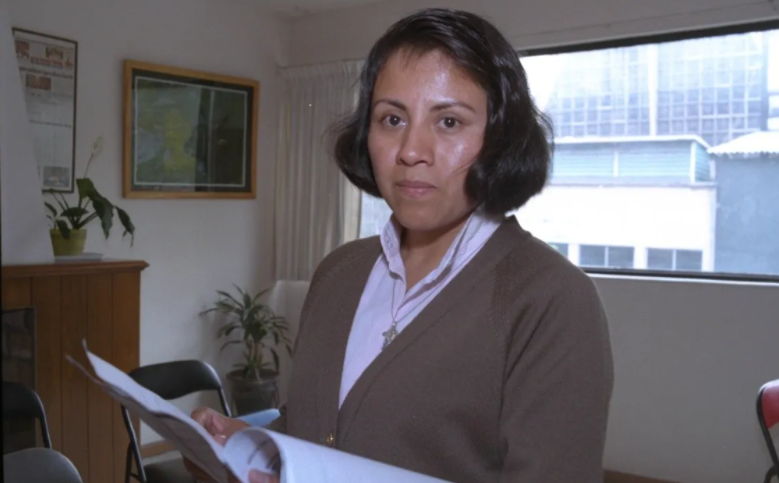
Lawyer Digna Ochoa was murdered on October 19, 2001. She worked at the Human Rights Center “Miguel Agustín Pro Juárez” (Centro Prodh).

In its 2001 annual review, Peace Brigades International noted: “The situation of human rights defenders [in Mexico] worsened significantly after the 19 October assassination of internationally known human rights defender Digna Ochoa and death threats against other human rights defenders.”

That PBI report further noted: “One of the cases that Digna Ochoa had been working on implicated the army in human rights abuses against environmental activists campaigning against logging in Guerrero.”

Ochoa is also mentioned in the PBI publication Dignas – Voices of Women.

In it, Emiliana Cerezo Contreras says: “In 2001 my brothers were accused of putting bombs in several offices of the National Bank of Mexico, Banamex. Through some friends, my brother Alejandro got in contact with Pilar Noriega and Digna Ochoa, two lawyers who took on their cases. That is how the Cerezo Committee was created.”

Democracy Now! has also reported: “Ochoa worked on behalf of peasant ecologists in the state of Guerrero, Zapatista guerrillas in Chiapas and indigenous peoples in her home state of Veracruz. At the time of her death, she was defending three men charged with bombing banks in Mexico City to protest against globalization.”

Lawyer’s Rights Watch Canada adds: “She represented many cases involving allegations of torture or murder by Mexico’s military and security forces, including the widows of the Aguas Blancas massacre and the campesino ecologists Rodolfo Montiel and Teodoro Cabrera. Montiel and Cabrera, who received the Goldman award for their work in forcing Boise Cascade to stop clear-cutting in the southern state of Guerrero, were sentenced to imprisonment on drug and weapons charges that Ochoa claimed were fabricated. Digna exposed the use of torture by the army to extract confessions from the environmentalists.”

IACHR ruling

Now, La Jornada reports: “The Inter-American Court of Human Rights [IACHR] found Mexico responsible for serious failures in the investigation into the death of human rights defender Digna Ochoa on 19 October 2001.”

That article adds: “Therefore, it ordered the Mexican state to reopen the investigations of the case in pertinent terms; investigate and eventually prosecute those possibly responsible for his death; carry out a public act of international responsibility and create a recognition in the defense of human rights that will bear the name ‘Digna Ochoa y Plácido’.”

Reuters also reports: “The Mexican government committed serious errors in the investigation of the death of the activist Digna Ochoa two decades ago and must continue with the probe, the Inter-American Court of Human Rights (IACHR) said on Wednesday [January 19].”

“Ochoa, who received death threats before her body was found with gunshot wounds in October 2001, was a lawyer who defended cases of human rights violations allegedly committed by civilian and military security forces.”

“Investigations into what became one of the country’s most high-profile cases initially pointed to a murder, but prosecutors later directed the investigation to a possible suicide. The case was considered closed.”

That article concludes: “Mexico must therefore continue to investigate and eventually prosecute those possibly responsible for her death, the court said, and take responsibility.”

This follows the admission by the Mexican State to the IACHR in April 2021 that it is partially responsible for the murder of Ochoa.

At that time, AL DÍA reported: “During the second hearing of the trial before the IACHR, the Foreign Ministry announced it will propose to the family to reopen the investigation after two decades to confirm that it was a homicide.”

The Peace Brigades International-Mexico Project began accompanying the Cerezo Committee in 2002 and has had a longstanding strategic alliance with the Miguel Agustín Pro Juarez Human Rights Center — Centro ProDH.

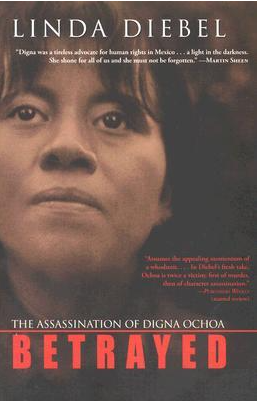
Toronto Star reporter Linda Diebel knew her and wrote the book “Betrayed: The Assassination of Digna Ochoa” that was published in 2005.

PBI-Mexico accompanies the National Meeting of Struggles against Gas Pipelines and Death Projects

On January 19, the Peace Brigades International-Mexico Project tweeted: “On January 15 and 16 in Puebla we accompanied the organizations and communities that gathered in Altepelmecalli —La Casa de los Pueblos— to participate in the National Meeting of Struggles against Gas Pipelines and Death Projects.”

PBI-Mexico adds: “We celebrate that this meeting has been an opportunity for defenders of the territory and the environment to share their words and experiences on the road to articulating a culture of peace, justice and respect for community rights.”

Resistance and upcoming actions

La Jornada reports: “Communities in resistance throughout the country, opponents of the so-called ‘Death Projects’, marched this Sunday [January 16] … to pronounce themselves against the Morelos Gas Pipeline, the Mining Law and the presidential decree that declares megaprojects as issues of ‘public interest’ and ‘national security’.”

Somos el Medio adds: “Under the slogans of uniting the struggles and turning them into solidarity, it was proposed to prepare the ‘Children’s and Youth Meeting for the Fight against Gas Pipelines and Death Projects’, as well as multiple joint actions that will later be published.”

And Pie de Pagina notes: “The final result of the Meeting was the announcement of the Caravan for Life that will depart from the Altepelmecalli on March 22. The caravan will advance through towns, communities and territories in resistance to megaprojects and will conclude a month later, on April 22, in the city of Juchitán, Oaxaca, on the Isthmus of Tehuantepec.”

Peoples’ Front

One of the organizations that took part in the National Meeting is the People’s Front in Defence of Land and Water – Morelos, Puebla and Tlaxcala (FPDTA-PMT).

They oppose the PIM megaproject that consists of the 171-kilometre gas pipeline across the states of Tlaxcala, Puebla and Morelos; a gas-fuelled thermoelectric plant in the town of Huexca, Morelos; and a 12-kilometre aqueduct to divert water from the Cuautla River near Huexca to cool the turbines at the thermoelectric plant.

PBI-Mexico has accompanied the Peoples’ Front since early 2020.

Regional Council of Indigenous Peoples

The Regional Council of Indigenous Peoples in Defence of the Territory of Puebla and Hidalgo was also present at the National Meeting.

They oppose the 287-kilometre Tuxpan-Tula gas pipeline being built across the states of Veracruz, Puebla and Hidalgo by the Calgary-based company TC Energy.

This report was recently published about Indigenous opposition to this pipeline.

When the report was presented to the Regional Council of Indigenous Peoples in Defense of the Territory of Puebla and Hidalgo, the council “accepted and celebrated the document, and pledged to continue their fight, and eventually to establish links with the Wet’suwet’en communities that resist TC-Energy in Canada.”

PBI-Canada was present on Wet’suwet’en territory in November 2021 to support their struggle against the TC Energy Coastal GasLink fracked gas pipeline being built on their territory without their free, prior and informed consent.

The National Meeting took place in the town of Cuanalá in the State of Puebla at the Bonafont bottled water plant (owned by Paris-based Danone) renamed Altepelmecalli, La Casa de los Pueblos (House of the People) when it was taken over by Indigenous and local communities on August 1, 2021.

Calgary-based Parex Resources secures 26 new oil exploration blocks in Colombia

PBI-Colombia tweet: “Heather Neun from @PBIcanada with the support of @Credhos_Paz seeing in person the environmental effects, including water sources, produced by the Canadian company Parex Resources in the village of El Diviso in Bajo Simacota.”

On January 18, La Republica reported that 30 new contracts valued at US$148.5 million have been awarded for the exploration and production of crude oil in Colombia.

Those 30 new agreements bring the total to 69 agreements.

Colombia’s Minister of Mines and Energy, Diego Mesa, says: “Before the Colombia 2021 Round, we had 39 contracts signed, with a committed investment of US$3.6 billion.”

La Republica adds: “Parex Resources will be the company with the most area allocations, with an investment of more than US$85 million.”

Parex Resources Inc. is a Calgary-based company.

Portafolio has also reported with 26 blocks to Parex, 5 blocks to Canacol Energy Ltd. (which operates as CNE Oil and Gas in Colombia), 4 to Gran Tierra Energy and 4 to Frontera Energy, 39 of the 69 blocks awarded between 2019 to 2021 went to four Canadian companies.

This is happening in the context of extreme danger for environmental and human rights defenders.

Deutsche Welle reports Colombia’s human rights ombudsman, Carlos Camargo, announced on January 17 that 145 civil society leaders were killed in the country in 2021. Those killed include human rights activists, community leaders and environmental activists.

That article adds: “The people killed — 120 men and 25 women — represented Indigenous peoples, led farming collectives or were union organizers.”

Despite this, Canada does not have due diligence legislation in place that recognizes and addresses (through enforcement mechanisms and meaningful consequences) the dangers faced by human rights defenders who challenge the impacts of Canadian transnational corporations and investment banks on their communities.

Canada has also refused to call on Colombia to ratify the Escazú Agreement, a legally-binding mechanism to protect environmental defenders.

Given the absence of legislative frameworks for protection and the dangers faced by environmental defenders challenging conventional and unconventional fossil fuel projects in Colombia, we continue to follow this situation with concern.

Chart from La Republica.

When “national interest” and “national security” militarize the response to an environmental struggle

Photo from El Tema episode with Sofía Castillo commenting on the water conflict related to the Boquilla dam in Chihuahua.

Some pipelines that have encountered Indigenous resistance have been declared to be in “the national interest” by the Government of Canada.

This framing can serve to criminalize Indigenous land defenders seeking to uphold their right to free, prior and informed consent and their sovereignty over unceded territories against megaprojects that can result in environmental harm to their lands.

For instance, a document from the Government Operations Centre, an office of the Department of Public Safety that identifies potential threats to “Canada’s national interest” references Unist’ot’en land defenders opposed to the Coastal GasLink fracked gas pipeline.

Similarly, Prime Minister Justin Trudeau has also framed the Trans Mountain tar sands pipeline being built on Secwepemc territory in this way.

Trudeau has stated: “This is a pipeline in the national interest and will get built.”

The language of “critical infrastructure” has also been used in the province of Alberta to criminalize opposition to megaprojects.

The Critical Infrastructure Defence Act sees pipelines, rail lines, hydroelectric dams and more as essential infrastructure. Those who block this infrastructure can be arrested without warrant and fined up to $10,000 and serve up to six months in jail for a first offence.

A similar use of language appears to be emerging in Mexico.

Now, President Andrés Manuel López Obrador has published a Presidential Agreement decree for the automatic approval of projects that employs the language of national security.

Educa Oaxaca has commented: “This agreement orders agencies to grant the necessary permits to start the projects or works that are considered a priority for the government declaring them of national security and public interest.”

It adds: “Among the projects benefiting from this Agreement would be the Felipe Angeles International Airport [that the Army is building at the military installation known as Santa Lucia Air Force Base near Mexico City], the Dos Bocas Refinery [where the military has intervened against a labour dispute that has stalled the construction of the refinery] and the Mayan Train [being built without Indigenous consent], which could be considered as of public interest and national security.”

It would also advance Isthmus of Tehuantepec corridor projects (that involve 200 kilometres of rail line, the modernization of ports, and 10 new industrial parks along the freight line).

Diego Álvarez Ampudia, a lawyer and specialist in infrastructure and energy project financing, says: “It’s very worrying that these projects are being classified as matters of national security.”

He adds: “There, what they want to do is restrict access to information on these projects, because there’s an exception under the federal law on transparency and freedom of information, which says information may be withheld on matters of national security.”

He also cautions: “The intention is clearly to make it impossible to legally reverse project authorizations.”

Numerous organizations, including the “Tlachinollan” Human Rights Centre, have also signed a letter that warns: “The Agreement aims to eliminate obligations to which the Mexican State has committed and must comply before granting any type of authorization for megaprojects, such as the realization of consultation procedures and prior, free and informed consent, or the realization of previous studies of social, environmental and rights impact. , which are indispensable for indigenous and comparable peoples to make an informed decision regarding such projects.”

And La Coperacha reports that Mixtec researcher Francisco López Bárcenas has “highlighted some risks that the agreement entails, such as the invasion of indigenous territories without consulting or passing over their own governments.”

Beyond this concern, there is already the militarization of land and water defence.

In this El Tema video, Sofía Castillo, a member of Wikipolítica Chihuahua, speaks about the conflict related to the Boquilla dam.

She says: “A decree was issued by the Mexican government, stipulating that the profits from our hydraulic resources our country’s water, was now a matter of national security. From there on, officially … the regional conflict was now militarized.”

We continue to follow these issues with concern.

Will Ottawa City Council welcome the CANSEC arms show this coming June 1-2?

Photo by Ben Welland.

In April 1989, Ottawa City Council voted to stop the ARMX arms show taking place at Lansdowne Park and other City owned properties. By June 2009, Councillors Eli El-Chantiry and Rick Chiarelli led a successful effort to overturn that prohibition.

Since then, Mayor Jim Watson has extended a “warm welcome” to the CANSEC arms show that now takes place annually at the EY Centre.

With a municipal election taking place on October 24 this year, we look back at the history of ARMX/CANSEC in the City of Ottawa.

The ARMX arms show first took place in Ottawa in 1985. It was held at the Uplands Air Force Base and organized by the Department of National Defence. Then in May 1989, the arms show, that had grown from 161 to 464 exhibitors and from an attendance of 5,000 to 15,000 military and civilian visitors, encountered its first public opposition.

On Saturday May 20, 1989, a “Public Inquiry into ARMX: Its Effects on Peace and Human Rights” was held. That event featured speakers from Project Ploughshares, Oxfam Canada, Lawyers for Social Responsibility, as well as a witness from El Salvador.

Then on Monday May 22, 1989, more than 2,000 people marched from Confederation Park up Bank Street to protest the arms fair at Lansdowne Park.

The following day, Tuesday May 23, the Alliance for Non-Violence Action organized a mass protest in which 160 people were arrested.

Significantly, the month prior to this, Ottawa City Council passed this resolution stating: “Whereas exports of Canadian military equipment and components end up in countries which persistently violate human rights … therefore be it resolved that Lansdowne Park and other city facilities not be leased to future ARMX exhibitions.”

ARMX did not return to Ottawa until March 1993 when it took place at the Ottawa Congress Centre under the rebranded name Peacekeeping ’93.

This was challenged by the DisARMX Coalition that organized a peace exhibition, a candlelight vigil and a march that began at the Ottawa-Carleton Centre, moved along Lisgar Street to Elgin, passed the Tribute to Human Rights and the War Memorial (where a wreath was laid), then on to the Ottawa Congress Centre on Colonel By Drive.

ARMX didn’t happen again until May 2009 when it appeared as the first CANSEC arms show, again held at Lansdowne Park.

At that time, Councillor Clive Doucet said that it was “a blight on our history” to allow weapons fairs in our cities.

And Councillor Alex Cullen stated that he wanted the City to maintain its ban on arms shows to “promote peace and respect for human rights, and seek to avoid associating with activities that promote and profit from the business of war.”

In October 2008, the Corporate Services and Economic Development Committee received an information report from staff that noted the prohibition adopted in 1989 by the old City of Ottawa was no longer applicable due to the sale of Lansdowne Park to the Regional Municipality of Ottawa-Carleton in 1999.

And, as noted above, in June 2009, this motion from Councillors El-Chantiry and Chiarelli effectively overturned the City’s ban on future arms shows at municipal properties.

Since then, CANSEC has been an annual arms show, interrupted only by the pandemic in 2020 and 2021.

On January 14, the organizer of CANSEC, the Canadian Association of Defence and Security Industries (CADSI), announced that it would be proceeding with the arms show this year. On that day, there were 5,479 known active cases of COVID in the city, a number that CBC reports may actually be three to 10 times higher.

This is happening despite the call from Secretary General of the United Nations, Antonio Guterres, who has stated: “The fury of the virus illustrates the folly of war. It is time to put armed conflict on lockdown and focus together on the true fight of our lives. To warring parties, I say: Silence the guns; stop the artillery; end the airstrikes.”

At the local level, with nominations opening on May 2, we ask candidates to reaffirm the City Council resolution from 1989 and to do their part to end the folly of war.

CANSEC arms show in Ottawa facilitates militarization, deepens risk for human rights defenders in Latin America

Photo by Justin Tang.

Over the past ten years (2010 to 2020), Canada has exported $48.9 million in “military goods” to Colombia and $26.4 million in “military goods” to Mexico. Smaller amounts have also been exported to Honduras and Guatemala during this period.

The report on Canada’s military exports in 2021 is expected in May.

Militarization puts human rights defenders at risk

In 2015, Peace Brigades International issued a joint statement that highlighted: “The increased militarization of public spaces and public security strategies has meant an increase in physical attacks on HRDs [human rights defenders].”

That statement further noted: “By reporting on human rights violations and working to fight impunity, HRDs directly face the causes and consequences of the governmental security strategies and are often attacked, criminalized and defamed by State actors, in particular judicial operators and members of the security forces.”

Last year, PBI commented in a statement to the United Nations Human Rights Council: “Instead of seeking solutions [to the murders of human rights defenders], the common response of these states to this situation of violence is the militarization of territories, which translates into an increase in socio-environmental conflict.”

Examples of militarization

A few examples of the militarization that PBI has cited over the years that is facilitated/enabled by arms exports include:

– the militarization of public security in Honduras and the normalization of the Military Police for Public Order (PMOP), created as a temporary measure, which has been linked with human rights violations and more specifically an increase in sexual abuse.

– the militarized police response to the national strike in Colombia in which security forces see those participating in social protests as an internal enemy and legitimate military targets.

– the militarized “war on drugs” in Mexico that has resulted in forced disappearances, including three members of the Alvarado family who were detained by the army and never seen again.

– the militarization of the Laguna del Tigre National Park in Guatemala where military detachments have been opened purportedly to combat drug trafficking and protect the environment (while an oil extraction contract has been extended and communities are evicted).

CANSEC arms show, June 1-2

Colombia and Mexico have sent delegations to CANSEC, Canada’s largest arms show that takes place in Ottawa on an annual basis.

In May 2014, the Canadian Commercial Corporation, a federal government owned Crown corporation, highlighted that it had toured the exhibition floor at CANSEC arms show in Ottawa with a delegation from Colombia and Mexico.

That year, Canada exported $44.8 million in “military goods” to Colombia and $1.2 million in “military goods” to Mexico.

Additionally, the Colombian Ministry of National Defence tweeted in 2017 about Colombia’s Vice-Minister of National Defence, Mariana Martínez Cuéllar, meeting with the Canadian delegation at Expodefensa, the arms show that takes place in Bogota.

That year, Canada exported an additional $114,688,85. in “military goods” to Colombia.

Calls for Canada to end its military exports

Following a meeting with the Canadian Embassy in Colombia this past December, PBI-Colombia tweeted: “Nomadesc requested guarantees that Canada will not assist the Colombian police with equipment.”

A few months earlier during a call with Global Affairs Canada, CREDHOS, another PBI accompanied organization in Colombia, stated: “We are calling on the international community to ensure that logistical or financial support to the police and national army is stopped because right now they are attacking the people and we don’t want that to continue.”

The International Observation Mission for the Guarantees of Social Protest and Against Impunity in Colombia also recommended: “To the United States, and to any country that provides military weapons or riot gear, you are required to suspend sales commercial or donations of such weapons to ESMAD [riot police].”

With the CANSEC arms show scheduled to take place this coming June 1-2 in Ottawa, PBI-Canada will be highlighting these issues of concern.

In June 2017, the Canadian armoured vehicle manufacturer INKAS exhibited at CANSEC. In July 2021, the Colombian National Police used an INKAS Huron armoured carrier to stop delegations travelling to Cali for a National Strike popular assembly.

Esprit de Corps, August 2017.