Home Blog Page 256

CGL expects to begin drilling under Wedzin Kwa over a 2-3 month period starting this spring

The path of the Coastal GasLink pipeline meets the Wedzin Kwa River. Photo by Amber Bracken.

On February 6, the Terrace Standard reported: “Coastal GasLink has resumed preparations to tunnel under the Morice River south of Houston as construction of its natural gas pipeline from northeastern B.C. to the LNG Canada liquefied natural gas facility now underway at Kitimat continues.”

A CGL spokesperson says: “There were limited activities over the holiday period, but preparation work has resumed over this past month. We expect that the micro-drilling will take place starting this spring.”

The article concludes: “In preparation, a drilling company is getting ready to install a starting shaft which is a deep circulation excavation acting as an entry point on the east side of the Morice. The active tunneling work is expected to take two and half to three months.”

Wet’suwet’en water protector Sleydo’ has previously stated: “It’s our sacred headwaters, our clean drinking water, and our salmon spawning river.”

She adds: “Our way of life is at risk. Wedzin Kwa is the river that feeds all of Wet’suwet’en territory and gives life to our nation.”

Journalist Brandi Morin has also written the pipeline underneath Wedzin Kwa could “potentially interrupting the salmon migration routes relied upon by the Wet’suwet’en and threatening the purity of the river’s drinking water.”

She has also noted: “For countless generations, Wet’suwet’en families have gathered at designated fishing grounds according to their clans at the start of the first run of salmon — the chinook — in mid-June.”

That occasion could coincide with CGL’s drilling schedule.

Coastal GasLink intends to use a method called “micro-tunneling” to lay the 48-inch (4-foot) diameter pipe 11 metres below the lowest point of the riverbed. CGL has further stated the length of the crossing will be 888 metres (.89 kilometres).

The image below includes a “mud management” structure.

It’s not clear if Coastal GasLink will be using bentonite, a clay-based drilling mud commonly used as a lubricant during trenchless drilling. Bentonite can also reduce oxygen in the water potentially threatening fish and other aquatic species.

If used, it’s not clear how many tons of bentonite would be needed, nor how many truckloads would be required to transport the bentonite to the site.

It’s also not clear what CGL’s contingency plans are if there is an inadvertent release into the river, the potential for a mechanical failure during the drilling, or if studies have been conducted on the impact the turbidity an accidental release of drilling mud would have at this crossing on salmon and other aquatic life.

While Coastal GasLink says micro-tunneling “minimizes risk and disposal volume” and results in “limited environmental disturbances”, Wet’suwet’en water protectors continue to defend their sacred river and to assert that the pipeline is a violation of their sovereignty and lacks their free, prior and informed consent.

PBI-Canada visited Wet’suwet’en territory this past November and continues to follow this situation closely.

PBI-Canada to watch ‘The Truth Behind the Guapinol Case’ conference, February 8

On Friday February 4, the concluding arguments were made in the case of the Guapinol River defenders in Honduras.

The verdict is now expected on Wednesday February 9.

The day prior, Tuesday February 8, there will be the conference titled: The Truth Behind the Guapinol Case: How the State fabricated a case to punish water defenders in Honduras.

The live transmission of the conference will begin at 9:30 am in Honduras (10:30 am EST) and there will be Spanish-English translation.

Freedom for Guapinol notes: “Join us for a conference where we will summarize the trial conclusions and hear from national and international human rights and legal experts the day before the Court emits its verdict. “

The link to register for the conference is here.

PBI-Honduras accompanies criminalized Guapinol River defenders as their trial concludes

On February 4, PBI-Honduras tweeted: “PBI accompanies for more than 3 years to defenders of @guapinolre who defend natural assets and good living for future generations. In the conclusions stage, we remain by your side and we trust that the liberation and integral reparation established by the United Nations will be fulfilled.”

The Canadian Embassy for Honduras (that is based in Costa Rica) has retweeted the PBI-Honduras tweet and commented: “Canada is closely following the Guapinol trial and advocates a trial with strict adherence to due process and considering the obligations of the state of Honduras with respect to the protection of human rights, including the ruling of the working group of the UN on arbitrary arrests.”

The concluding remarks in the trial of the Guapinol defenders began this morning at the courthouse in Tocoa, Colon.

Global Exchange has noted: “The concluding remarks lay out a summary of the case from the perspectives of the prosecutors, the ‘private accusers’ representing mining company Inversiones Los Pinares, and each of the defense attorneys. The water defenders are present as well.”

Yesterday (February 3), Mary Lawlor also tweeted: “All eyes on Honduras as a verdict is due early next week on the Guapinol defenders. UN Working Group ruled their detention to be arbitrary. One of [Honduran president] @XiomaraCastroZ’s priorities as newly elected president is to set them free. The court’s decision should be easy: release them.”

The struggle to defend the Guapinol River

The Unitarian Universalist Service Committee (UUSC) has explained: “In August 2018, when development of the mine began to contaminate the drinking water for 14 nearby communities, residents of Guapinol erected a ‘Camp in Defense of Water and Life’.”

The camp was in place for 90 days. The UUSC notes: “In October 2018, 1,500 Honduran military and police officers violently attacked and evicted the camp.”

One of the defenders has been imprisoned since December 8, 2018, while seven have been incarcerated since September 1, 2019.

This week Criterio also reported: “The Municipal Committee for the Defense of Common and Public Goods warned that, in these 29 months of illegal detention, the mining company Los Pinares, of the Emco Group, has continued its projects despite the wide rejection against it that was manifested in the open council of November 2019.”

We continue to watch with concern from Canada.

Reports document dangers faced by defenders in Colombia, Mexico and Honduras in 2022

On February 4, the Peace Brigades International-Colombia Project tweeted: “It is urgent, as requested by @WOLA_org, that the diplomatic community, political leaders from the US and the EU, and civil society give visibility to the humanitarian crisis and human rights in Colombia and that actions be taken to cease the violence.”

The Washington Office on Latin America (WOLA) article amplified by PBI-Colombia on social media further notes:

“The security situation in Colombia deteriorated alarmingly in January 2022. As of January 31, the Institute for Development and Peace Studies (INDEPAZ) has recorded a total of 13 social leaders murdered, 13 massacres, 3 ex-combatants killed, 214 selective homicides, 98 death threats, 58 homicide attempts, 25 episodes of harassment, 17 forced disappearances, and 16 mass internal displacements”

It then highlights:

“We strongly urge U.S. policymakers, the diplomatic community, and civil society to raise visibility on the human rights and humanitarian situation in Colombia. Also, we urge them to take actions denouncing the violence, calling for it to cease and for all the actors concerned to support humanitarian minimums and peace efforts.”

El Pais also now reports:

“Amnesty International on Wednesday presented a report in which it pointed to Colombia as the deadliest country for human rights defenders, with 13 murders. Just a day later the number had risen to 17 social leaders riddled so far in 2022. More than one every other day.”

That article adds the analysis that:

“The leaders killed in Colombia have a common struggle: they are dedicated to the defense of land, territory and the environment. Afro-descendants, women and indigenous people are the most vulnerable.”

Mexico

Another article in El Pais highlights:

“Colombia is followed in lethality by Mexico, where four journalists have been killed, which has generated a wave of indignation that has resulted in massive demonstrations in the main cities of the country. Although the authorities have warned that the crimes will not go unpunished, President Andrés Manuel López Obrador maintains an aggressive discourse against the press, denigrating the work of reporters and criticizing the media that oversee his administration.”

Amnesty International further notes that: “On 27 January, human rights defender Ana Luisa Garduño was killed in Temixco, Morelos. Ana Luisa was fighting for justice for the feminicide of her daughter. Amnesty International has shown that Mexico is a dangerous country for families seeking justice in cases of feminicide.”

Honduras

The El Pais article adds:

“Honduras, meanwhile, is the deadliest central American country for activists. Amnesty International’s report documents three killings in January.”

“These are the cases of Pablo Isabel Hernández, indigenous leader, social communicator and defender of human and environmental rights, …Thalía Rodríguez, a transgender human rights defender, [and] Melvin Geovany Mejía, a Tolupán indigenous and defender of the territory.”

Further reading

The Amnesty International report on the killings in Latin America can be read here. The Indepaz list of those killed in Colombia in January is here. The WOLA report documenting the violence in Colombia this past month can be read here.

The Global Witness report on the number of land and environmental defenders killed in 2021 is expected to be released in September (this is their report on 2020), while the Front Line Defenders report on human rights defenders killed in 2021 could be released in the next few days (their report on 2020 was released on February 9, 2021).

We continue to follow this with deep concern.

PBI-Honduras visits Colón, hears about land evictions that have benefitted agro-extractive companies

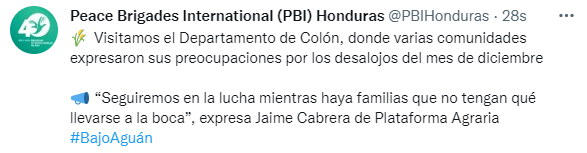
On February 3, PBI-Honduras tweeted: “We visited the Department of Colón, where several communities expressed their concerns about the evictions in December. ‘We will continue in the fight as long as there are families who do not have anything to put in their mouths,’ says Jaime Cabrera from the Agrarian Platform.”

On Facebook, PBI-Honduras further noted that the communities “shared that the judges abused their authority to benefit agro-extractive companies.”

On January 25, Real World Radio reported: “Last year, between December 16 and December 21, various social and peasant organizations denounced the violent evictions that thousands of peasants were suffering in Aguán, Honduras.”

That article adds: “The situation was repeated a week later against members of the Cooperativa Remolino cooperative, who were evicted by private security guards and the COBRA squad who shot them with firearms, leaving at least 7 people injured, two of them minors.”

Yoni Rivas of Plataforma Agraria told RWR that on December 27 some 200 families that are part of Cooperativa Remolino “entered to recover lands from the Agrarian Reform”; lands that “the corporations have been usurping for more than 27 years. Although several of the attackers carrying R15 weapons were arrested, they were released hours later.”

Rivas adds: “The evictions take place because we believe that there are judges and prosecutors who abuse their authority and issue eviction orders. This situation enables the police and security groups to obey these judges who are protecting the interests of landholding corporations of the Facusse, Morales and Canales families, who have monopolized almost 70% of the land in the Aguán Valley.”

He further noted: “This situation leaves the defenders of Aguán vulnerable, failing to comply with the 126 precautionary measures that the IACHR issued to protect them. …We hope that with the arrival of Xiomara Castro to power we will be finally heard.”

The Agrarian Platform

The Land Portal has explained: “The Agrarian Platform is a national network of more than 30 organizations, whose objective is to fulfill the mandate of the Constitution of the Republic that establishes an agrarian reform, and to achieve changes in public policies in favor of peasants and peasants through the Comprehensive Agrarian Transformation Law -TAI- presented to the Honduran National Congress in 2011.”

It adds: “The 2009 coup d’état created a new situation of impunity, motivating demands for justice followed by massive land repossessions, especially in the Bajo Aguán area.”

The Land Portal article then comments: “The response of the Honduran State strengthened the armed security of agricultural exporters and encouraged the distorted use of legal resources, the press and television, to turn the fair demands of the peasants into crimes. This ended up turning the courts, the police and the national army into accomplices of an obsolete land tenure system that can only be maintained through force.”

Land ownership in Honduras in deeply unequal.

Just 5% of large-scale farmers control almost two thirds of all cultivable land, while 71% of small-scale farmers have access to just 5% of it.

A January 27, 2022 statement from the Plataforma Agraria on this situation can be read here.


PBI-Mexico marks its 20th anniversary!

“20 years of weaving care”

We extend our warm congratulations and appreciation to our colleagues at PBI-Mexico as they mark their 20th anniversary.

In this article, PBI-Mexico notes:

“It is not easy to explain what 20 years of work mean for Peace Brigades International’s Project in Mexico.

Many metaphors came to mind when we tried: People crossing paths, stories, dialogues, jobs, will, heart and emotions which interlace between human rights defenders –the heart of this project– and the sea of volunteers who have given and continue to give life to the project. Words turn to threads which weave dialogue, dialogue which is threaded in accompaniment, an exchange which stretches vertically and horizontally to form a network.

’To weave is to devise, to fabricate, to conceive a function and beauty from the simplest of elements’, writes Virginia Postrel, making us think of the beautiful dignity that has been built between so many human rights defenders and volunteers through the decades.

Truth be told, this is a delayed celebration, one which had to wait because the world has been on pause for almost two years.

We learnt that the world only partially paused. In Mexico, the danger, the resource-depleting ‘megaprojects’ , the dispossession, the disappearances, the attacks on women, sexually diverse people or migrants and other rights violations continued.

We also wish to declare that radical tenderness is fundamental to offer support, that enormous amounts of resilience are needed to function, to walk despite adversity and distance.

With the many paths and spaces where we could and will continue to be present in such a complex country where we need to continue weaving with strategy, intelligence, constant work, care, commitment, radical tenderness, patience and much love. That is, perhaps, the first lesson after 20 years.”

We encourage you to read their full article at PBI Mexico, 20 years of weaving care.

You can also watch this 7-minute video they have produced for this anniversary. It is in Spanish, but there is a subtitles function (and it’s also just visually beautiful).

Journalists reporting on “Freedom Convoy” in Ottawa being threatened, harassed

Photo: A reporter is harassed by “Freedom Convoy” participants in Ottawa.

“Freedom Convoy” trucks began arriving in the city of Ottawa, unceded Algonquin territory, on Friday January 28.

CBC News reports: “Crowds [at the convoy protest] swelled to between 5,000 to 18,000 people on Saturday [January 29], according to police, with the city estimating another 3,000 came to the Hill on Sunday [January 30]. Police said Tuesday [February 1] night that 250 people remained, without offering a vehicle count.”

It is expected that this coming weekend there will be another large protest.

Journalist Brandi Morin receives threatening emails

Brandi Morin reporting on the land defence struggle of the Wet’suwet’en peoples against the CGL fracked gas pipeline, January 7, 2022.

On January 31, the Toronto Star, this country’s largest circulation newspaper, published ‘Freedom’ protests are white supremacy in all its glory by Brandi Morin.

Morin commented: “This country is rich from the innumerable resources of stolen Indian lands. And yet these protesters have been sitting in their comfortable lives for all these years, knowing the oppression of segregation via the reserve system and discrimination is a reality — but so far removed that it’s become acceptable.”

By February 2, she tweeted: “So many journalists are at the receiving end of violence lately. Literally I woke up to dozens more emails. I live w it though, people are reading my work I guess. Violence is never OK though, but I’m willing to take the hit for truth/justice.”

The Coalition For Women In Journalism (CFWIJ), a global organization of support for women journalists, has posted this statement: “CFWIJ was informed that she has received over 60 hateful and threatening emails in the past 24 hours. Not only is Brandi Morin uniquely positioned as an indigenous voice in the press fraternity, thus making her vulnerable to attacks from far-right groups, women journalists in the country have collectively experienced a spike in digital hostilities in the past few months.”

Journalists harassed, threatened

As Morin notes, there are other reports of journalists being harassed and receiving death threats.

On January 28, Vice reported: “Journalists who have reported on the convoy, particularly women, have received a deluge of hate and death threats. Global reporters Mercedes Stevenson and Rachel Gilmore have been inundated with vile and violent messages in recent days for doing their jobs and reporting on the movement.”

That same day, the Canadian Association of Journalists (CAJ) encouraged “newsroom leaders to take preemptive action to ensure that the safety of journalists is protected in the wake of increasing threats made against reporters covering the ongoing trucker’s convoy.”

The CAJ further noted: “Journalists have received death threats littered with racist epithets. Others have been spat on and verbally and physically harassed. In another case, the windows of a CBC/Radio-Canada news cruiser were broken.”

We express our profound concern about this ongoing situation and draw the parallels between the communities, defenders and journalists who PBI accompanies around the world (including in Mexico where four journalists have been killed so far this year).

Safe walks/rides organized in response to the “Freedom Convoy” in Ottawa

“Freedom Convoy” trucks began arriving in the city of Ottawa, unceded Algonquin territory, on Friday January 28.

CBC News reports: “Crowds [at the convoy protest] swelled to between 5,000 to 18,000 people on Saturday [January 29], according to police, with the city estimating another 3,000 came to the Hill on Sunday [January 30]. Police said Tuesday [February 1] night that 250 people remained, without offering a vehicle count.”

The convoy has also raised more than $10.1 million and there are indications that this will be an ongoing “occupation” with more trucks coming this weekend.

The CBC article adds: “The protest has seen [large tractor trailer] vehicles parked and honking on roads leading to Parliament Hill since Friday [January 28], with widespread reports of threats and harassment in the area.”

Those incidents include the assault of an unhoused person and a security guard at a homeless shelter, and a couple yelled at because of a Pride flag in their window. CBC has also reported: “The Cornerstone Housing for Women shelter in downtown Ottawa says the ongoing protest has re-triggered clients who have already experienced trauma — to the point that one woman has sought refuge at a hospital.”

One of the incidents is also told in this Twitter video.

More incidents are being posted here with names redacted for safety reasons.

While “F*ck Trudeau” and Canadian flags are most commonly seen, Nazi symbols and a Confederate flag have also been seen in the downtown area.

To date, three people have been arrested.

CBC reports: “On Sunday [January 30], police charged [a 37-year-old man from] Ottawa with carrying a weapon [a collapsible baton and non-folding six-inch knife] to a public meeting.” CTV has also reported: “A 48-year-old Quebec man for making threats and comments on social media while he was in Ottawa.”

Residents at risk

Ottawa City Councillor Catherine McKenney has tweeted: “I’ve heard from 100s of residents who are tired & frightened at what they are experiencing in their neighbourhoods.”

McKenney has also stated: “We have people who are exhibiting very dangerous behaviours — harassing people, threatening violence, driving erratically, driving on sidewalks.”

The Ottawa Citizen newspaper reports: “McKenney said they continue to talk to Centretown residents, some of whom are scared to leave their apartments — including a senior whose cat is hungry because she is afraid to leave to buy cat food.”

That article adds: “Others talk about being harassed because they wear masks and some women have reported being followed down Bank Street.”

Safe walks/rides being organized

Notably, Ottawa Convoy Report is also organizing a form of informal accompaniment for those who could be targeted by the convoy.

Their Instagram page notes: “If you need a safe walk/ride out of downtown Ottawa, DM [direct message] us to connect with a volunteer. All helpers have been vetted, provided photo ID, references, and are prominent figures in the community. If you are trapped and require food/groceries, we can connect you.”

City councillor Shawn Menard has also highlighted the creation of a Volunteer Urban Foot Patrol and this online form for  people “willing to help accompany someone during transit, or if you’d like someone to accompany you.”

We continue to follow this situation with concern.

Concluding remarks in the trial of the Guapinol River defenders to be delivered on February 4

Photo: On Tuesday February 1, PBI-Honduras was present at the solidarity gathering in Tegucigalpa marking 29 months of arbitrary detention for the Guapinol River defenders. On Friday February 4, the concluding remarks by the prosecution and defence will be delivered at their trial in Tocoa, Colon.

The trial of the eight Guapinol River defenders is nearing conclusion.

One of the defenders has been imprisoned since December 8, 2018, while seven have been incarcerated since September 1, 2019.

In February 2021, the United Nations Working Group on Arbitrary Detentions concluded that their imprisonment is arbitrary and urged the Honduran State to release them.

After a long delay, their 16-days of trial so far began on December 1, 2021. Day-by-day updates on the trial can be read here.

Freedom for Guapinol notes: “In a few days, the Trujillo court will hear the final conclusions in the trial of the defenders in which, it has been clearly demonstrated how the State has built a false case to punish those who dare to defend water and life.”

It further notes: “On the basis of the evidence, the Court has no choice but to acquit the defenders and order their immediate release, since it has been proven with the same proof from the State that the defenders are innocent and that it is the company that has acted outside the margins of the law.”

Global Exchange adds: “This week on Friday, February 4th at 9 am, the concluding remarks will be delivered in the courthouse in Tocoa, Colon (about a 6 to 8 hour drive from Tegucigalpa). The concluding remarks lay out a summary of the case from the perspectives of the prosecutors, the ‘private accusers’ representing mining company Inversiones Los Pinares, and each of the defense attorneys. The water defenders are present as well.”

It further highlights: “The presence of Embassies officials and international human rights observers is important to tell the judges and the corrupt judicial system that people are watching.”

This week Criterio also reported: “The Municipal Committee for the Defense of Common and Public Goods warned that, in these 29 months of illegal detention, the mining company Los Pinares, of the Emco Group, has continued its projects despite the wide rejection against it that was manifested in the open council of November 2019.”

The Unitarian Universalist Service Committee (UUSC) has explained: “In August 2018, when development of the mine began to contaminate the drinking water for 14 nearby communities, residents of Guapinol erected a ‘Camp in Defense of Water and Life’.”

Juana Zúñiga, who participated in a Peace Brigades International-organized webinar this past November, says: “They ruined our river … We couldn’t use water for anything, that’s why we organized, that’s our struggle.”

The camp was in place for 90 days. The UUSC notes: “In October 2018, 1,500 Honduran military and police officers violently attacked and evicted the camp.”

From that time to now, we watch from Canada with concern.

PBI-Honduras marks 29 months of arbitrary detention of the Guapinol River defenders

On February 1, the Peace Brigades International-Honduras Project tweeted: “When 29 months of arbitrary preventive detention of the defenders of @guapinolre, the doors of the Supreme Court remain closed before their demand for justice.”

Guapinol Resiste had issued this call to media and social organizations:

“29 months after the illegal detention of the defenders of the Guapinol River, the Municipal Committee for the Defense of Common and Public Goods, relatives of the defenders and allied organizations summon the media and social organizations: Meeting of solidarity and symbolic action in the Supreme Court of Justice of Tegucigalpa.”

Criminalization of water defenders

The Guardian has reported: “In March 2018, shortly after the company started widening a road within the national park, the tap water in Guapinol turned chocolate brown and thick with muddy sediment. Residents were forced to buy bottled water to drink, cook and even bathe after children began suffering from diarrhea, while some adults reported skin complaints.”

The Unitarian Universalist Service Committee (UUSC) adds: “In August 2018, when development of the mine began to contaminate the drinking water for 14 nearby communities, residents of Guapinol erected a ‘Camp in Defense of Water and Life’.”

Juana Zúñiga says: “They ruined our river … We couldn’t use water for anything, that’s why we organized, that’s our struggle.”

The camp was in place for 90 days. The UUSC notes: “In October 2018, 1,500 Honduran military and police officers violently attacked and evicted the camp.”

Eight water defenders are now on trial. One of them has been held since December 8, 2018, while seven have been incarcerated since September 1, 2019.

After a long delay, their trial began on December 1-2, 2021, resumed on December 9, but then adjourned without ruling on a habeas corpus application filed on December 14. The trial resumed on January 13, 2022.

On January 27, in her inaugural address, Honduran president Xiomara Castro said: “Freedom for the political prisoners of Guapinol.”

We continue to follow this situation.

COPINH photo: “Twenty-nine months after the arbitrary arrest of Guapinol’s comrades, social organizations demand their prompt release, the cessation of judicial persecution of those who fight for life, and the arrest of death projects.”