
Home Blog Page 243

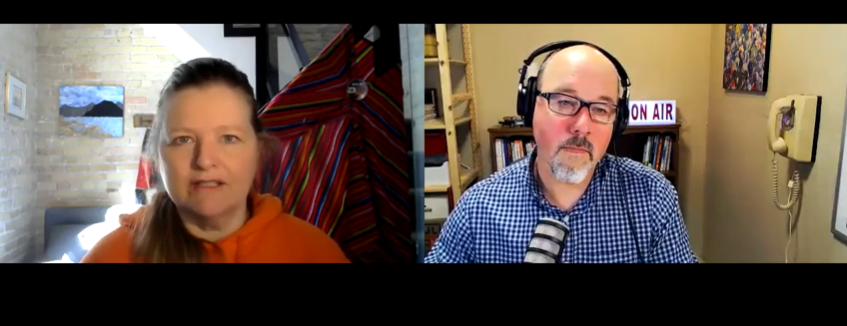
Former PBI field volunteer Karen Ridd to discuss nonviolent resistance in Ukraine, April 6

CBC has reported: “Since the start of the Russian invasion, Canada has pledged military aid to Ukraine valued in the tens of millions of dollars. The promised aid includes anti-tank systems, rockets, handguns, machine-guns and ammunition.”

It has also included up to 7,500 hand grenades.

The war has also been invoked with respect to the Canadian government’s decision to purchase 88 Lockheed Martin F-35 warplanes and the possibility of increasing its military budget by about $20 billion a year to 2 per cent of Canada’s GDP.

This past week, Karen Ridd wrote: “All-too-often, conflict leads to a renewed call for greater military spending, and more weaponry. It’s hard enough to be a peace activist in peace times; much harder to be so in times of war.”

On April 6 starting at 7:30 pm CDT, Karen along with David Balzer will host a Zoom conversation that will talk about “about nonviolent resistance we can take to support people facing war in Ukraine, and around the world.”

A video preview of that discussion can be seen here.
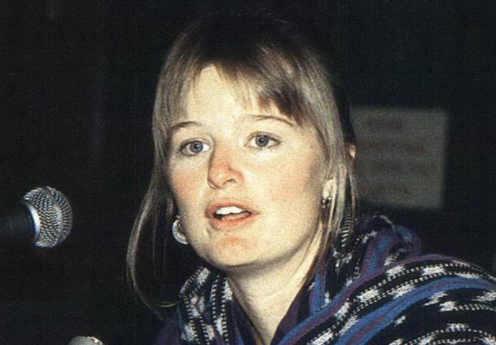
Karen, who now teaches conflict resolution studies at Menno Simons College in Winnipeg, was a PBI volunteer in Guatemala in 1988 and in El Salvador in 1989.

While in El Salvador, she was arrested by the National Guard along with four other PBI volunteers. Three Spanish PBI volunteers were handed over to their Embassy, but despite threats and intimidation, Karen refused to leave the jail until her Colombian PBI colleague was also released from captivity.

Karen has written: “At the time I was arrested, I was in a church refugee centre, trying to protect the safety of Salvadoran refugees and church workers who were inside. The Salvadoran military invaded the centre, scattered the refugees, detained the workers, and took me and four other PBI workers to the Treasury Police Jail. I was blindfolded, handcuffed, interrogated, kept standing without food and water, and threatened with rape and mutilation.”
In her article Nonviolent resistance: we need talk, Karen further reflects: “In my capacity as an ‘unarmed bodyguard’ for Peace Brigades International I watched as [people] led marches, strikes, ‘lightning’ actions, sit-ins, dance-ins, and so much more. I watched as their actions defeated their opponents, and simultaneously crumbled my former beliefs about ‘naïve’ nonviolent actions, or the ‘need for violence’.”

Waging Nonviolence

Additionally, Waging Nonviolence recently published the statement: Ukrainians could defeat a Russian occupation by scaling up unarmed resistance.

That statement says: “We would establish contact with international organizations such as Peace Brigades International or Nonviolent Peaceforce.”

It continues: “Over the past 40 years, organizations like these have learned how international observers can make a significant difference to local human rights activists living with threats to their lives. Their experience from countries such as Guatemala, Colombia, Sudan, Palestine and Sri Lanka can potentially be developed to fit the circumstances in Ukraine.”

Among the many people who signed this statement are Mary Girard (Quaker, Canada), David Swanson (World Beyond War, US), William Geimer (Greater Victoria Peace School, Canada) and George Lakey (a former PBI field volunteer and retired professor, US).

PBI statement on Ukraine

On March 18, Peace Brigades International issued this statement that highlights: “As an organization committed to peace, nonviolent conflict resolution and an end to militarization, we add our voice to those calling for an immediate end to this war.”

“PBI stands in solidarity with Ukrainian and Russian civil society initiatives providing mutual support and nonviolent alternatives in the midst of war, particularly women’s organizations and movements.”

It further notes: “The dominant security discourse associated with the militarization of societies is a setback. Billions more spent on weapons will not make the world safer.” 

To watch a video excerpt of this statement in Spanish, please click here.

PBI-Honduras accompanies ASODEBICOQ at presentation of declaration of Forest Protection Zone in Quimistán

On April 1, PBI-Honduras tweeted: “PBI accompanies ASODEBICOQ [the Association for the Defense of Common Goods of Quimistan] during the official presentation of declarations of Forest Protection Zone over 4 micro-watersheds in Quimistán. We celebrate these declarations and highlight the protection work of the communities as well as the defense work of ASODEBICOQ.”

Quimistán is a town and a municipality in the department of Santa Bárbara.

In February 2019, Radio Progreso reported that Santa Bárbara is “threatened by more than 15 hydroelectric projects and 23 concessions for mining.”

That article notes: “In the municipality of Quimistán, there is an imminent danger from the installation of the Santa Lucia hydroelectric dam, which is advanced by 90%. And, despite the fact that there is a strong rejection by the population, they currently intend to build a second hydroelectric dam also on the Cuyagual River.”

PBI-Honduras has previously highlighted: “Over the past two decades alone, Honduras has lost between 23,000 and 58,000 hectares of woodland per year.”

Between 1990 and 2005, Honduras lost 37 per cent of its forest cover, and between 2007 and 2011 the deforestation rate tripled in Honduras.

PBI-Honduras has accompanied ASODEBICOQ since May 2018.

PBI-Colombia accompanied CCAJAR lawyers collective files court action against Kalé and Platero fracking pilot projects

CCAJAR lawyer Rosa María Mateus: “We have filed this charge because … the Ministry of the Interior, the ANLA, and Ecopetrol … are illegally moving forward with the environmental licensing process without carrying out the prior consultation process.”

On March 31, PBI-Colombia tweeted: “@Ccajar, on behalf of Afrowilches, and other human rights organizations file tutelage against #fracking pilots in #PuertoWilches for lack of prior consultation with Afro-Colombian communities who, in the midst of threats, protect their #ancestral territory, water and ecosystem.”

Their tweet helped to amplify this statement from the PBI-Colombia accompanied José Alvear Restrepo Lawyers’ Collective (CCAJAR) that notes: “Human rights organizations together with the Colombia Free of Fracking Alliance, filed before a Circuit Court a charge against the Ministry of the Interior, the ANLA [National Environmental Licensing Authority] and Ecopetrol, for the violation of the right to prior, free and informed consultation of the Afro-Colombian Corporation of Puerto Wilches – Afrowilches.”

Their statement further explains: “The charge filed by [CCAJAR] and Corporación Podion, on behalf of Afrowilches, seeks to suspend both the environmental license granted last Friday [March 25] by ANLA for the Kalé fracking pilot project, as well as the licensing process underway for the Platero project, until the corresponding prior consultation process with Corporación Afrowilches is carried out in all its stages.”

And Lizeth Gómez, the lawyer for Podion and the Colombia Free of Fracking Alliance, says: “This action is a reflection of the arbitrary actions of the ANLA and Ecopetrol in their eagerness to obtain environmental licenses for the Kalé and Platero fracking pilots before the end of this government, so we seek to guarantee the rights of the Afro-Colombian communities that have opposed the development of these projects in Puerto Wilches.”

Canadian companies and fracking in Colombia

Toronto-based Sintana Energy Inc. has highlighted that it “holds an undivided 30% non-operated participation interest in a Contract for Exploration and Production for Block VMM-37” where the Platero project would be conducted.

Calgary-based Canacol Energy Ltd., which holds two nearby “unconventional shale oil blocks”, has previously commented that the Platero and Kalé projects are “positive steps towards realizing the commercial potential of the unconventional shale oil field in Colombia and specifically for the resources prospects that we have through our position in the Middle Magdalena Valley basin.”

Environmental defenders threatened

Afro-Colombian youth activist and Aguawil member Yuvelis Morales has denounced both of these fracking pilot projects. Due to the death threats against her, she has sought refuge in France. The French government has accepted her in a move they describe as “consistent with France’s feminist diplomacy.”

On a PBI-Canada organized webinar in April 2021, Morales stated: “When we became a problem for the oil companies, those interested in promoting fracking and its economic benefits, they started to threaten, stigmatize, and silence us.”

We continue to closely follow this situation.

PBI-Guatemala accompanies Q’eqchi’ river defender Bernardo Caal Xol at press conference

On March 31, the Peace Brigades International-Guatemala Project posted: “PBI accompanies the press conference of Bernardo Caal Xol.”

The video of the 45-minute press conference can be seen here.

Yesterday, Bernardo had posted: “National and international media, friends and friends, we wait for you tomorrow at the press conference where I will be present addressing the topic of my freedom and the situation of the rivers of Guatemala, also my lawyers will be there that. They are with the criminal proceedings.”

Caal Xol was released from prison in Cobán on Thursday March 24 at around 10 pm. On Saturday March 26, PBI-Guatemala accompanied him and the Peaceful Resistance of Cahabon as he left Cobán and returned to Santa María Cahabón.

EFE reports: “At a press conference on Thursday, [he] gave his first impressions to the media after leaving prison.”

That article adds: “The Oxec I and II hydroelectric plants are owned by the Energy Resources Corp. business group, registered in Panama, and were built in Alta Verapaz by the company Grupo Cobra-ACS, belonging to the businessman Florentino Pérez, president of the Spanish football club Real Madrid.”

Caal Xol says: “All the business chambers came together to criminalize me, they defamed me until they managed to imprison me.”

“The great crime I have committed is to have spoken out against the hydroelectric plants that were built on the Cahabón River, which are illegal. …It is embarrassing what these companies are doing. …I am innocent and I go out with my face raised.”

He added: “The Q’eqchi people’ will continue their struggle for the defense of the territory.”

Background

Bernardo was criminalized in January 2018 and spent 1,520 days in prison for his peaceful opposition to the hydroelectric company Oxec S.A. building dams on the Ox-eek’ and Cahabón Rivers on Mayan Q’eqchi’ territory without free, prior and informed consent.

The night he was released Bernardo said: “I was unjustly imprisoned for four years and two months, the people must not forget the persecution that we indigenous people live in Guatemala, just because voracious, murderous, discriminatory and racist capitalism wants the looting of natural resources.”

And he highlighted: “The struggle continues, the struggle continues. We do not stop because today the Q’eqchi’ people are at the epicenter of dispossession and looting. …The defense of the rivers, in this case the Cahabón River continues. Until I achieved the freedom of those rivers, just as I obtained my freedom.”

PBI-Guatemala has accompanied Bernardo and the Peaceful Resistance of Cahabon since August 2017.

PBI-Guatemala monitors the criminalization of 21 defenders of the Q’eqchi’ community of Chicoyogüito sent to trial

On March 30, PBI-Guatemala amplified this statement from CasoCreompaz:

“SENT TO TRIAL: 21 COMPANEROS FROM THE CHICOYOGUITO COMMUNITY CRIMINALIZED FOR DEFENDING THEIR TERRITORY

Today the judge of the First Criminal Court of First Instance of Coban sent to trial 21 of our companeros from the community of Chicoyoguito, who were criminalized when we began a peaceful demonstration.

This resolution evidences that it is a criminal proceeding that attacks defenders as usurpers of the territory where they exercised their right to demonstrate on June 9 of last year while we started a peaceful protest to demand that they return our land to us from the place that today is CREOMPAZ and from which we were evicted by the Guatemalan Army.

The community of Chicoyoguito since the violent eviction in 1968 has fought to recover the territory; from the grandmothers and grandfathers who lived through the eviction to the granddaughters and grandsons who today claim this legitimate demand and even if they want to criminalize our companeros, we will continue having struggle because we maintain long live the memory and the demand that our territory be returned to us.

We urge social organizations, human rights, the national and international community to be vigilant and support us.

WE CONITNUE TO BE THE CHICOYOGUITO COMMUNITY SEPARATED BY THE EVICTION, UNITED WITH OUR MEMORY OF THE CHICOYOGUITO COMMUNITY.”

Yesterday’s hearing

Concerns were raised about the transparency of the hearing yesterday.

Next trial date, April 21

Caso Creompaz has also posted: “The trial offering hearing will be on April 21.”

Background

The Indigenous Q’eqchi’ community of Chicoyogüito was violently displaced on July 28, 1968, from their ancestral lands so that an army base – then known as Military Zone 21 – could be established in the department of Alta Verapaz.

After the displacement of the community, the military base became a clandestine centre for illegal detention, torture, extrajudicial executions, enforced disappearance, and rape committed from 1978 to 1990.

At least 565 Indigenous people were disappeared at that base. The bodies identified are of Mayan Achí, Q’eqchi’, Pomochí, Ixil, and Kiché peoples.

The military base is considered the largest clandestine cemetery in Latin America.

The military base that displaced his community was rebranded in 2004 as Creompaz, a training base for UN peacekeepers funded by Canada and other countries.

Dawn Paley has written: “Regardless of the mass graves at the base, military and police training continues there, supported by countries like the US and Canada.” The support from Canada has included a CAD$250,000 grant in 2009 and the purchase of specialized equipment in 2014 for a training program at Creompaz.

On July 15, 2021, Olivia and Domingo,  members of AVECHAV, highlighted on a PBI-Canada webinar: “We know Canada has provided a lot of support for [the Creompaz peacekeeping base on our land]. But where is the peace that they say they are creating?”

On September 15, 2021, Domingo also presented to Seb Bonet’s 4th year students at the University of Victoria about the situation for this community.

We continue to follow this situation from Canada.

PBI-Guatemala has accompanied the Chicoyogüito Neighborhood Association of Alta Verapaz (AVECHAV) since 2015.

“This land is ours”

Ecopetrol waiting for ANLA approval of Platero fracking pilot project on land that Canadian company holds commercial interest

Video: This week PBI-Colombia accompanied CREDHOS environmental engineer Juna Camilo Delgado spoke about the fracking pilot projects.

Radio Nacional reports: “On Wednesday [March 30], the president of Ecopetrol, Felipe Bayón, confirmed that the company is currently waiting to receive the environmental license for a second comprehensive research pilot project in Colombia, also known as fracking.”

That article adds: “He pointed out that the application for the granting of an environmental license for the second pilot project called Platero was filed on February 15 with the National Environmental Licensing Authority (ANLA).”

The Platero fracking pilot project proposal was first submitted to the Colombian National Hydrocarbons Agency (ANH) on March 17, 2021.

The ANH gave its provisional approval of that proposal on March 31, 2021.

On April 16, 2021, Toronto-based Sintana Energy Inc. stated it was pleased to comment on the ANH acceptance of the ExxonMobil Comprehensive Research Pilot Project (CEPI) Platero project bid to be conducted in Block VMM-37.

The company confirmed: “Sintana, via wholly owned Patriot Energy Sucursal Colombia (Patriot), holds an undivided 30% non-operated participation interest in a Contract for Exploration and Production for Block VMM-37.”

“The Company’s support for Project Platero is made even though the Government’s process excluded an important segment of the petroleum industry by not allowing smaller companies, such as companies the size of Sintana, to participate in CEPI bids.”

And the company noted: “Sintana has been and continues to be in positive communications with both ExxonMobil and the ANH to ensure that the integrity of both the Company’s commercial arrangements with ExxonMobil and the Contract for VMM-37 with the ANH are honored.”

Sintana is not the only Canadian company to welcome the fracking pilot projects in Colombia.

On April 21, Charle Gamba, the CEO of Calgary-based Canacol Energy Ltd., commented that the two pilots are “positive steps towards realizing the commercial potential of the unconventional shale oil field in Colombia and specifically for the resources prospects that we have through our position in the Middle Magdalena Valley basin.”

At that time, Gamba also stated: “[Calgary-based Boury Global Energy Consultants] BGEC’s independent assessment of the prospective unconventional resources reaffirms the materiality and significant potential of Canacol’s unconventional shale oil blocks.”

If fracking is commercially approved in Colombia, Canacol would likely seek to explore and extract from the VMM-2/Plata and VMM-3/Piranga projects near San Martin, Cesar, in collaboration with the American transnational ConcoPhillips.

It’s also possible that Calgary-based Parex Resources Inc. is considering the commercial potential of fracking in Colombia.

As far back as March 2019, Colombia’s then-Mines and Energy Minister Maria Fernanda Suarez stated that Parex was among the companies “seeking to operate” a fracking block. Environmental defender Oscar Sampayo has further noted that Parex has had an interest in fracking Block VMM9 near Cimitarra, Santander since 2014.

Furthermore, Toronto-based Frontera Energy may also have an interest in the commercial potential of fracking in Colombia.

Frontera Energy is a minority owner in 236,000 barrel per day pipeline that runs from the Magdalena Medio region to Coveñas on the Caribbean coast.

Back in August 2019, Oleoducto de Colombia Chief Executive Officer Natalia De la Calle said it is ready to move increased crude output is fracking is approved. The Reuters article that reported this also highlighted that the Magdalena Medio region is home to geological formations that hold between 2 billion and 7 billion barrels of crude.

Drilling could begin this year

In November 2021, Natural Gas Intelligence reported: “Ecopetrol continues to advance two horizontal drilling pilot programs, Kalé and Platero, in conjunction with ExxonMobil.”

That article adds: “Executives expect the pilot projects to come online by 2023.”

By December 2021, Diario del Huila reported: “The president of [Ecopetrol], Felipe Bayón, said that although it is estimated that the extractions will begin in 2023, they could be advanced to 2022 if everything goes well.”

Environmental defenders at risk

This is happening despite the ongoing threats against environmental defenders who are speaking against fracking in Colombia.

Last month, Afro-Colombian activist Yuvelis Natalia Morales, the founder of the youth group Aguawil (the Committee for the Defence of Water, Life and Territory in Puerto Wilches) had to flee to France because of the threats against her.

The Government of France has stated its welcoming of Yuvelis and other women human rights defenders is “consistent with France’s feminist diplomacy.”

Last year, Yuvelis told PBI-Canada: “When we became a problem for the oil companies, those interested in promoting fracking and its economic benefits, they started to threaten, stigmatize, and silence us. More than eight of our youth have been threatened.”

PBI-Colombia accompanied CREDHOS president Ivan Madero also raised similar concerns at a meeting with Global Affairs Canada in November 2019.

Given this context, we continue to ask Canada to advocate for threatened environmental defenders and ensure that Canadian companies with an interest in fracking are not benefitting from the context of threats against land and water defenders.

CREDHOS president meets with Global Affairs Canada, November 5, 2019.

PBI-Honduras accompanies Somos-CDC and Arcoíris in their call on the International Transgender Day of Visibility

On March 30, PBI-Honduras tweeted:

“International Transgender Day of Visibility. PBI accompanies @somoscdc_hn [the Centre for LGTBI Development and Cooperation] and other organizations of sexual diversity in a call to the State to approve the Gender Identity Law and the reform of the @RnpHonduras [National Register of Persons] Law. It is essential to ensure recognition and participation.”

On Facebook PBI-Honduras also notes:

“We don’t want privileges, we want the #DDHH [human rights] to be respected.” Donny Reyes, #LGTB community rights advocate and member of Asociación LGTB Arcoiris de Honduras

In the face of the #DíaInternacionalVisibilidadTrans, PBI accompanies the Arcoiris LGTB Association of Honduras, Somos- CDC and other organizations of sexual diversity in Honduras in a public call to the State to implement laws that recognize the rights of this population

It is fundamental the approval of the Law on Gender Identity and the reform to the Law of the National Register of Persons to open new spaces of recognition and participation in the social, political and cultural sphere.

At the UN Universal Periodic Review of the human rights situation in Honduras on November 5, 2020, Canada recommended that Honduras “strengthen measures for the prevention, investigation, and punishment of all sexual and gender-based violence including most specifically domestic violence and violence against LGBTI persons.”

PBI-Honduras has accompanied Somos-CDC since January 2022 and Arcoiris since July 2015.

Canadian Network on Corporate Accountability calls for all-party support of two bills in the House of Commons

In this media release, the Canadian Network on Corporate Accountability calls for all-party support for two private members bills:

Bill C-262, An Act respecting the corporate responsibility to prevent, address and remedy adverse impacts on human rights occurring in relation to business activities conducted abroad, would require companies to review all their business activities, identify actual and potential risks to people and the planet, take steps to mitigate the risks, and ensure remedy for those harmed. This is called human rights and environmental due diligence.

Bill C-263, An Act to establish the Office of the Commissioner for Responsible Business Conduct Abroad and to make consequential amendments to other Acts, also tabled today, would invest the Canadian Ombudsperson for Responsible Enterprise (CORE) with the powers needed to do its job. Effectively, when the government created CORE, it was in name only. Without powers to order the production of documents and compel witness testimony under oath, the CORE is an ineffective office. Bill C-263 would change that.

“Respecting human rights and protecting the environment are non-partisan issues,” says Emily Dwyer, Policy Director for the Canadian Network on Corporate Accountability.

Peace Brigades International (PBI) accompanies human rights defenders impacted by Canadian oil and gas extractivism in Colombia, the sugar imported from Guatemala by two Canadian companies, the mines operated by Canadian companies in Honduras, and a pipeline constructed by a Canadian company on Indigenous territories in Mexico.

PBI supports both the implementation of effective and credible due diligence legislation as well as the passage of a UN Binding Treaty on transnational corporations and human rights.

Our recent statement on the war in Ukraine highlights: “PBI calls for binding legislation that requires companies to fully respect human rights throughout their supply chain and guarantee sustainable economic, social, and environmental investment.”

PBI-Canada is also concerned by the criminalization of Indigenous land defenders in this country, notably the Trans Mountain tar sands pipeline on Secwepemc territory and the Coastal GasLink fracked gas pipeline on Wet’suwet’en territory.

We have highlighted the call from the UN Committee on the Elimination of Racial Discrimination that construction of these pipelines be halted until consent is gained and that the RCMP and other security forces be removed from these territories.

We are following with interest Bill C-262 and Bill C-263.

What should be made public before Canada signs a contract with Lockheed Martin for F-35s this coming November?

Photo: About 88,420 people have signed a petition from the Stop F-35 campaign in Switzerland in opposition to their government’s planned CHF 25 billion (CAD $33.7 billion) purchase of 36 F-35s.

On Monday March 28, Defence Minister Anita Anand and Procurement Minister Filomena Tassi announced the Canadian government had chosen the Lockheed Martin F-35 as its preferred replacement for its current fleet of fighter jets and that it will open negotiations with the Maryland-based transnational corporation.

Tassi says that these contract negotiations could take as little as seven months. That means, arguably, that the contract could be signed by November 1.

What should happen before that date?

1- The Parliamentary Budget Officer should make public a full-cost analysis of the F-35 over the next 30 years. It could be $76.8 billion.

(The Swiss Federal Council says the procurement plus 30-year operating costs for its planned purchase of 36 F-35s amounts to CHF 15.5 billion.)

2- Anand should disclose how much the Department of National Defence has budgeted for missiles and bombs for the F-35 over the next 30 years.

(Finland says it will spend 824 million euros / CAD $1.2 billion on the “final optimized weapons package” for its new fleet of 64 F-35s.)

3- The casualty figures should be made public from the estimated 1,598 offensive bombing missions conducted by the current fleet of CF-18s over the last 30 years.

4- A calculation should be made public on the projected greenhouse gas emissions from 88 F-35s over the next 30 years. The fleet could consume 3.94 billion litres of fuel.

5- Anand should speak to the displacement of the Dene people from their ancestral lands for the Cold Lake base where the F-35s will be based.

6- Tassi should release the full list of scenarios of potential fighter jet uses that the procurement panel based their recommendation on.

7- Tassi should disclose when the United States granted its “ultimate certification” of Canada’s purchase of the F-35. Was it secured before Anand’s call with U.S. Secretary of Defense Lloyd Austin the day after the F-35 selection was made public?

David Pugliese, an Ottawa Citizen journalist writing on military issues since 1982, has commented: “The Russian invasion gives the Liberals the public-relations cover they need to proceed with the $19-billion purchase of the F-35 U.S. stealth fighter, an aircraft Prime Minister Justin Trudeau previously stated Canadians would not buy.”

In its statement on the war in Ukraine, Peace Brigades International highlighted: “The dominant security discourse associated with the militarization of societies is a setback. Billions more spent on weapons will not make the world safer.”

PBI-Colombia accompanies CAHUCOPANA on second day of gathering of peasant mining communities

On March 29, PBI-Colombia tweeted: “In #AcciónHumanitariaCarrizal [humanitarian action Carrizal] we accompany @CAHUCOPANA [the Humanitarian Action Corporation for Coexistence and Peace in Northeast Antioquia], who bring together peasant mining communities to discuss #crisishumanitaria [humanitarian crisis]: ‘Peasant protection and self-protection mechanisms are the only guaranteed tool to stay in the area’”

Carrizal is a village/hamlet in the municipality of Remedios in the department of Antioquia in the subregion of Northeastern Antioquia.

PBI-Colombia has previously explained: “The abundance of natural resources in these lands and the arrival of multinational companies, such as the Canadian Gran Colombia Gold, has provided the illegal armed groups who are present in the region with an extremely lucrative funding source in mining.”

And El Espectador has reported: “The presence of armed groups has been a constant. First came the guerrillas, such as the extinct FARC, during the eighties. Ten years later, with the emergence of the United Self-Defense Forces of Colombia (AUC), the municipality became a place of dispute over the richness of its gold-mined land.”

That article adds: “According to its inhabitants, this wealth has belonged to armed groups and multinationals that, according to trade unionists, committed crimes to keep most of the territory to exploit this mineral with titles in perpetuity.”

For more on PBI-Colombia’s accompaniment on CAHUCOPANA this week, please see: PBI-Colombia accompanies CAHUCOPANA at two-day humanitarian action in the village of Carrizal, Antioquia.