
Home Blog Page 235

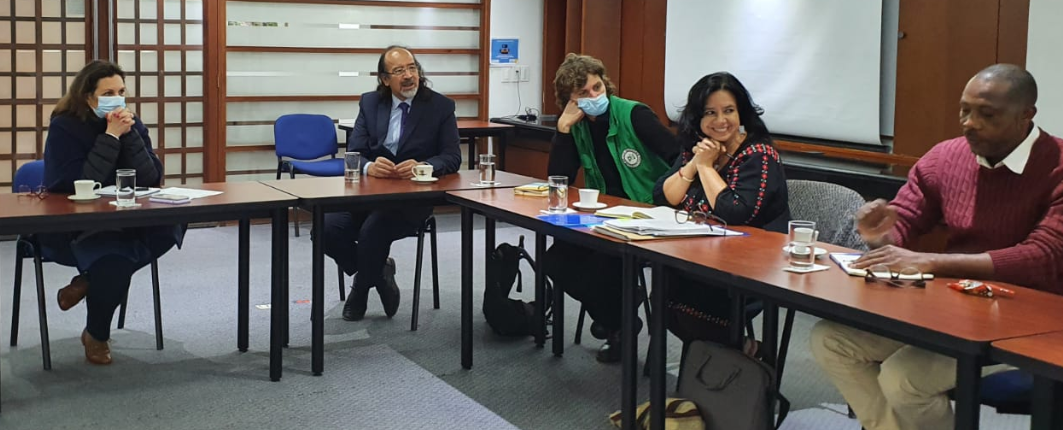
PBI-Colombia accompanies Nomadesc at meeting with UN representative and rural communities from Buenaventura

On April 29, ONU Derechos Humanos Colombia (the Office of the UN High Commissioner for Human Rights in Colombia) tweeted: “Representatives of rural communities from #Buenaventura meet with Juliette De Rivero, Representative of the UN High Commissioner for #human rights. #AtThisTime.”

Buenaventura is a coastal seaport city in the department of Valle del Cauca. The port accounts for about 60 per cent of all Colombian imports and exports by sea. The city’s population of 460,000 people is about 95 percent Afro-descendant and Indigenous.

In 2017, the port generated about USD $1.8 billion in revenue for the Colombian government. And yet in 2018, the Council on Hemispheric Affairs (COHA) reported: “91% of Buenaventura’s rural population and 64% of its urban population live under the poverty line.”

COHA has also reported: “Buenaventura’s water infrastructure is comparable to one of a low-income country; 71% of residents only have access to potable water eight hours a day and many fishermen are forced to fish in waters contaminated by the city’s sewage.”

In These Times has also noted: “In the early 2000s, water services were privatized, and they have deteriorated steadily since.”

5th anniversary of civic strike

This coming May 16th will mark the 5th anniversary of the start of the 22-day long civic strike in Buenaventura.

The mobilizations demanded access to sources of employment, housing, drinking water, education, and health, among other economic, social, and cultural rights.

Canadian organizations – including CUPE, PSAC, CUPW and the Steelworkers – worked in solidarity with the leaders of that strike.

The Inter-American Commission on Human Rights (IACHR) has reported: “On June 2, 2017, civil society organizations and communities reported that heavily armed ESMAD personnel carried out a repressive operation in Buenaventura which included the use of tanks among civilians. Information received by the IACHR also indicates that tear gas was used against peaceful demonstrators, including children, older people, and people with disabilities.”

Ongoing humanitarian crisis

There are ongoing concerns about how state neglect and structural racism are behind the crises of violence and poverty in the city.

On February 22, 2021, PBI-Colombia accompanied Nomadesc on a verification mission meeting on the humanitarian crisis in Buenaventura. The Office of the UN High Commissioner participated in that mission.

In April 2021, Foreign Policy also reported that “resentment simmers among Buenaventura residents over the fact that little money flowing through the port enriches the city.”

That article quotes Danelly Estupiñán with the Process of Black Communities who says: “The national government invests in Buenaventura through the port infrastructure. It does not make investments to the Buenaventura society, to the people of Buenaventura.”

Noting that 95 percent of the city’s residents are Afro-descendant and Indigenous, Estupiñán says: “From our judgment” the lack of investment is “precisely for that reason.”

The Peace Brigades International-Colombia Project has accompanied Nomadesc since 2011 and its president Berenice Celeita since 1999.

Berenice Celeita talks about the civic strike in this PBI video.

PBI-Colombia accompanies dhColombia at commemoration of three young men killed by the police at May Day protests

On May 1, PBI-Colombia tweeted:

“On #May 1 we accompanied @dhColombia in commemoration of the murder of Brayan Niño and Elvis Vivas [during the] #National Strike 2021. On May 1, 2005, Nicolás Neira was assassinated. 17 years later, an Esmad agent was sentenced. #Today research results are urgently needed to avoid #impunity and #repetition.”

Brayan Niño

Last year, Infobae reported:

“Brayan Niño, 24, who was a resident of the Cundinamarca municipality of Madrid, spoke with his sister, Marlin, in the morning hours of May 1, 2021, so that she could tell him which would be the concentration points of the marches that day, since she is a member of the strike committee and he wanted to be part of those demonstrations.

At night, people began to disperse to the so-called El Corzo toll and that was when everything turned into chaos.

The protesters began to confront the police officers of the El Sosiego station.

After a call for support by the police, an ESMAD tank arrived, launched some tear gas to which the protesters responded with stones and amid all the commotion the tragedy occurred. An impact rumbled in his ears and Brayan Niño fell to the ground, he was the one who received the impact in his right eye.

After the death of the young man, it was learned that Police Major Javier Arenas was in the tank.”

Elvis Vivas

Vice has also reported:

“Elvis Vivas was found stumbling and bloodied outside his local police station on the night of May 1, 2021, in Madrid, a satellite city of the Colombian capital Bogota. Passersby stopped to help him, calling out for water to wash the blood off his head.

Vivas was rushed to a hospital, where he told staff he’d been beaten by police.

He died a week later.

A 24-year-old factory worker and aspiring actor, Vivas was one of thousands of Colombians who went out to protest that day, early in a nearly three-month-long wave of massive demonstrations across the country.”

Nicolás Neira

On April 1 of this year, El Colombiano reported:

“The Superior Court of Bogotá confirmed this Friday the sentence to 17 years in prison against the former agent of the Mobile Anti-riot Squad (Esmad) Néstor Rodríguez Rúa for killing 14-year-old Nicolás Neira with a gas grenade , during the Labor Day mobilizations (May 1) 2005 in the capital of the country.

Nicolás Neira died after Rodríguez shot him in the head from six meters away, in the middle of a demonstration in Bogotá. This was due to severe head trauma.

However, the first hypothesis that was handled was that the minor, who at that time was in the ninth grade of the school, had tripped and fallen on a bollard. However, the justice managed to establish, 12 years later, that it had been a cover-up of the facts agreed and endorsed by the agents who were present that day and by his superiors.”

PBI-Colombia has accompanied the Association Network of Human Rights Defenders (dhColombia) since 2014.

dhColombia tweet: “In the demonstrations of #1deMayo of 2005 and the national strike of 2021 in commemoration of the #Day of the Worker 3 young people were murdered at the hands of ESMAD and the @Colombian Police.”

Honduran government repeals ZEDEs law amid warnings of free trade agreement rights and arbitration

The Associated Press reports: “A plan to create special self-governing zones for foreign investors in Honduras has been thrown into limbo with the new government’s repeal of a law many criticized as surrendering sovereignty.”

“[The zones for employment and economic development known as ZEDEs are] free from import and export taxes, but could set up their own internal forms of government, as well as courts, security forces, schools and even social security systems.”

The article adds: “On Monday [April 25], [President Xiomara Castro] signed a measure passed by Honduras’ Congress [on April 21] to repeal it — though the permission for the zones still remains in the constitution.”

Rodolfo Pastor, a member of Castro’s cabinet, says: “With those that already (exist) there is going to be dialogue because autonomous zones are not going to be allowed.”

The article refers to the zones already being developed, including Prospera (a 58-acre development on the island of Roatan) and Orquidea (an agro-industrial park near the city of Choluteca that produces peppers and tomatoes for export).

The Próspera Group says: “Honduras Próspera, Inc., the Promoter & Organizer of Prospera ZEDE, is a U.S. company with rights under the Central American Free Trade Agreement (CAFTA-DR) and the U.S.-HN Bilateral Investment Treaty, which extend to investments made in Próspera ZEDE the highest degree of legal protection in Honduras. Many other investors from other countries likewise enjoy powerful treaty rights.”

The Center for Strategic and International Studies also cautions: “If the Honduran government insists on moving forward with abolishing the ZEDE law, investors have a number of legal mechanisms at their disposal [including] Chapter 10 of the Dominican Republic-Central America Free Trade Agreement (CAFTA-DR) to seek interim injunctive relief to preserve the status quo, as well as damages for any lost investment and future profits.”

The Canadian ZEDE

PBI-Honduras has previously noted: “There are further ZEDEs, such as the Mariposa ZEDE.”

That ZEDE is being led by Canadian Daniel Morin and his wife Katerina.

The website for Mariposa says: “We believe this project is possible to realize in Honduras as part of the Honduran ZEDE Program.”

Their vision is “to create a startup city” that would “become a Health Sanctuary with clinics that use a combination of Holistic, Naturopathic, Functional, and Integrative Medical approaches” and that would “create an Ecstatic Birth culture by providing educational opportunities for future parents and birth practitioners.”

A “Little Canada” ZEDE in Trujillo?

In October 2015, Canadian activist Karen Spring also wrote: “In the Trujillo region, Garifuna communities are being evicted from their ancestral lands amid the possible construction of an Economic Development and Employment Zone (ZEDE) or Model City.”

Canadian journalist Sandra Cuffe also reported in December 2014 on this development and her article quotes [Canadian investor Randy] Jorgensen who says: “We sold 500 properties to Canadians. They’re starting to call it Little Canada.”

In terms of the cautions about investor rights and international arbitration, the Canada-Honduras Free Trade Agreement entered into force on October 1, 2014.

PBI accompaniment

The Peace Brigades International-Honduras Project was present at town hall meetings – including in La Ceiba, Trujillo, Arizona, Quimistán, Intibucá, Tela, Masica and San Francisco – that declared themselves free from ZEDEs.

Tlachinollan Human Rights Centre signs open letter on enforced disappearances and militarization of public security

Photo by Tlachinollan.

Numerous organizations – including the PBI-Mexico accompanied Tlachinollan Human Rights Centre, the CSO Space for the Protection of Human Rights Defenders and Journalists, and the Saltillo Migrant Shelter (Espacio OSC) – have signed an open letter to Mexican President Andrés Manuel López Obrador.

The letter states:

“From 15 to 26 November 2021, Mexico had the honour of receiving the visit of the United Nations Committee on Enforced Disappearances.

In its report, the Committee has argued that the public security approach adopted by the Mexican State three decades ago has been focused on militarization to combat crime, which has been insufficient and inadequate.

Human rights organizations have documented the involvement of the military, including the militarized National Guard, in cases of torture, repression, enforced disappearance, extrajudicial executions, sexual violence among other human rights violations.

[The Committee] again recommended that the federal government devise an “orderly, immediate and verifiable” withdrawal plan for military forces that are carrying out public security actions, urging them to abandon the militarized approach.

Amnesty International and the organizations, activists, independent experts and academics that make up the collective #SeguridadsinGuerra are convinced that public security policies should be carried out by civilian and not military institutions.”

The full letter can be read here.

Earlier this week, the National Guard killed 19-year-old student Angel Rangel in Guanajuato, which is about 360 kilometres north-west of Mexico City.

In response, Security Without War stated: “The militarization of the country’s public life has only brought an increase in atrocities under the indolence of those who promised to remove the Armed Forces from the streets and have only increased their power.”

El Pais further notes: “In its 2021 work report, presented in February, the National Guard reported that during that year it recorded ‘125 events where lethal force was used with firearms’, more than it had accumulated in previous years.”

In June 2018, PBI-UK commented in The Guardian:

“Last December Mexico enacted the interior security law, normalising the intervention of armed forces in public security activities and linked to a growing trend in Mexico towards the use of excessive force in situations of social protest. Peace Brigades International (PBI) has provided protection to at-risk human rights defenders in the country since 2000, an experience that has shown us that in the federal states where a security strategy based on militarisation has been implemented, attacks against activists have increased significantly.”

And in October 2021, The Guardian reported: “The national guard has built 165 barracks in Mexico since it was created only two years ago by President Andrés Manuel López Obrador… [The Indigenous Tzeltal ejido of San Sebastián Bachajón, Chiapas] is leading the first lawsuit against one of 500 or so barracks planned across the country.”

The article highlights that the community was not consulted about the base, nor did it give its free, prior and informed consent to it.

Further reading: National Guard barracks, militarization of territory a concern for Indigenous peoples, environmental defenders in Mexico (PBI-Canada article, October 2021).

Webinar, May 31

On Tuesday May 31, PBI-Canada will be hosting a webinar to discuss the issue of militarization of territory and Canadian arms exports.

Speakers will include Quetzalli Villanueva Vergara, a lawyer with Tlachinollan, World Beyond War organizer Rachel Small, and Dene land defender Little Wolf. It will be moderated by PBI-Canada Board member Seb Bonet.

A speaker from Colombia will be confirmed soon.

To register for the webinar, click here.

Peace Brigades International receives Gernika Award for Peace and Reconciliation

On April 26, PBI-Spanish State tweeted:

“Great emotion to finally collect the Gernika award for peace and reconciliation that the @AytGernika [Gernika town hall] granted us in the year 2020.”

They also tweeted:

“We sincerely appreciate the recognition of these 41 years of work accompanying human rights defenders. This award is especially dedicated to all of them.”

Pforzheim News has also reported: “On the occasion of the 85th anniversary of the bombing of the city of Gernika, Mayor Frank Fillbrunn visited Pforzheim’s Basque twin city and was impressed by the great hospitality and warmth of the hosts.”

That article adds: “Mayor Fillbrunn presented the 2020 Peace and Reconciliation Award to Miriam García Torres of Peace Brigades International. Due to the pandemic, the award could only now be handed over.”

The video of Miriam accepting the award can be seen here.

Peace Brigades International was chosen as a recipient of the Gernika Awards for Peace and Reconciliation for “facilitating the transformation of conflicts and for laying the foundations for future reconciliation processes.”

On April 26, 1937, the German Luftwaffe Condor Legion and the Italian Aviazione Legionaria conducted an aerial bombing of the Basque town of Gernika on behalf of Francisco Franco’s Nationalist forces during the Spanish Civil War.

The BBC explains: “General Franco wanted to terrorise the people in the Basque region, an area of strong resistance to his nationalist forces in the Civil War. For Nazi Germany and Fascist Italy, it was an opportunity to get some practice with a new form of warfare: strategic, aerial bombing of civilians. No strictly military objectives were touched. Factories and bridges were left alone – civilians were the only targets.”

More than 100,000 pounds of bombs were dropped on the town.

In 2005, the Gernika Awards were established by the Gernika-Lumo city council, Pforzheim’s city council, Gernika Gogoratuz (the peace research centre Remembering Gernika) and others, to recognize work done for peace, reconciliation, human rights and social justice.

Toronto-based Scotiabank criticized on climate change at annual shareholders meeting

Photo: Greenpeace mobilization campaigner Tara Seucharan at Scotiabank’s annual meeting in Toronto on April 5, 2022.

On Sunday May 8, PBI will hold a webinar that will explore the human rights and environmental implications of fracking in Colombia that will also take note of Scotiabank’s financing of Ecopetrol, Colombia’s national oil company.

To register for this webinar, click here.

Scotiabank held its annual meeting in Toronto early this month.

The Canadian Press reports: “Scotiabank faced criticism for not moving fast enough on climate change at the bank’s annual general meeting.”

At that meeting, Eric St. Pierre, executive director of the Trottier Family Foundation, stated: “Last year, Scotia’s financing of fossil fuels increased by 87 per cent or $14 billion in absolute numbers to a staggering $30 billion.”

Greenpeace mobilization campaigner Tara Seucharan also noted: “This AGM is the perfect moment to remind shareholders of Scotiabank’s dirty investments in destructive fossil fuels projects that are fueling the climate crisis and undermining Indigenous rights.”

And the National Observer reported: “’Clearly what they’re saying and what they’re doing is not aligned,’ Seucharan said of efforts by Scotiabank and other financial institutions to highlight their green credentials while still backing new projects incompatible with staving off climate catastrophe.”

Back in August 2014, Scotiabank president and CEO Brian Porter commented: “To drive the greatest growth, we remain focused on building scale in our highest priority markets of Mexico, Peru, Colombia and Chile.”

Now, the Banking on Climate Chaos website reveals Scotiabank’s recent investments in Ecopetrol, the Colombian state oil company that is set to operate two controversial fracking pilot projects in the community of Puerto Wilches, Santander.

Scotiabank provided USD $665 million to Ecopetrol in 2018, another $666.67 million in 2020, and $1.7 billion in 2021.

Banking on Climate Chaos further highlights that this means Scotiabank has provided $3,031.67 million ($3.0 billion) in financing to Ecopetrol since the Paris Climate Agreement was reached in December 2015.

This despite the UN Development Programme highlighting in 2020:

“Colombia is at high risk from climate change impacts. The majority of the population lives in the elevated Andes, where water shortages and land instability are already a reality, and on the coast, where the increase in sea level and floods can affect key human settlements and economic activities. Furthermore, the country has a high incidence of extreme events with growing emergencies associated with climate conditions.”

Webinar on fracking, May 8

On Sunday May 8, Peace Brigades International-Canada will be holding a webinar on the environmental and human rights implications of Ecopetrol’s Kale and Platero fracking pilot projects in Puerto Wilches.

Earlier this week, Reuters reported: “The attorney general’s office has received 33 reports of threats made to activists in Puerto Wilches and Barrancabermeja, a nearby city, of which 12 cases remain active, it told Reuters in a statement.”

That article also notes: “Campaigners accuse Ecopetrol of tarring protesters as hooligans, after the company decried what it said were ‘acts of vandalism’ during [a public hearing in February on fracking].”

The panel will feature Colombian environmental defenders Yuvelis Morales and Carolina Agón. Both are vocal anti-fracking activists who have had to leave their homes because of death threats directed against them.

The webinar will also feature Bronwen Tucker, the Edmonton-based Global Public Finance Co-Manager at Oil Change International, focusing on shifting public finance and subsidies towards a fair and 100% renewable future.

And the panel will be moderated by Luis van Isschot, the author of The Social Origins of Human Rights: Protesting Political Violence in Colombia’s Oil Capital, 1919–2010.

To register for the webinar, please click here.

PBI-Colombia accompanies the CSPP on 1st anniversary of national strike amid ongoing concerns about police violence

On April 28, PBI-Colombia tweeted:

“#Today #A28 anniversary of #National Strike 2021 we accompany one of the verification commissions of @CSPP_ [Committee in Solidarity with Political Prisoners]. The work of #human rights defense organizations is essential, which in the context of the protest ensure guarantees for their exercise and so that #police violence does not repeat itself.”

Earlier in the day, PBI-Colombia also tweeted:

“Today #A28 in Bogotá, one year after the start of the #National Strike 2021 the #Humanitarian Caravan that includes communities from multiple territories of Colombia and #human rights organizations, such as @Nomadesc [the Association for Social Research and Action], march for the #life and declare an #Humanitarian Emergency.”

The Associated Press reports:

“Hundreds returned to the streets on Thursday — in less crowded demonstrations than those of 2021 — in cities such as Bogota, Cali, Medellin and Villavicencio, where tributes to the victims and cultural activities were held. Meanwhile, the government deployed a security operation with more than 50,000 uniformed personnel.”

Vanguardia adds:

“The figures that reflect what actually happened in these two months of protests, are still very difficult to consolidate. While the Prosecutor’s Office indicates that during this time there were 29 homicides, of which 16 occurred in Cali, five in other municipalities of Valle del Cauca, three in Cundinamarca, three in Bogotá and one in Popayán and Ibagué, respectively, the UN Human Rights Office, indicated in its latest report that it received allegations of deaths of 63 people in the context of the protests and that it has verified 46 of them.

A similar situation arises in relation to the facts that have to do with gender-based violence, since the Prosecutor’s Office reports four victims for sexual acts and four more for violent carnal access. However, the latest UN report reported 60 cases of sexual violence allegedly committed by police, of which the Office was able to verify 16.”

PBI-Colombia provided physical accompaniment throughout the national strike last year. For more on that, please see Photo journal: PBI-Colombia accompanies human rights defenders during the national strike.

Reuters reports on the threats against environmental defenders opposed to fracking in Colombia

“These have been the worst days of my life, but ironically, also the best days, because I’m alive.” – Yuvelis Morales. To hear more from Yuvelis, register for our webinar on May 8 by clicking here.

On April 28, Reuters reported: “Colombia’s anti-fracking activists are facing increased threats and violence as two investigative pilot projects to extract oil and gas from unconventional fields move forward, five campaigners said, with some forced to flee in fear for their lives.”

The article further notes:

“The anti-fracking activists told Reuters that threats, intimidation and attacks from unknown assailants have spiked since February, after a public hearing on the Kale project’s environmental license.

Campaigners accuse Ecopetrol of tarring protesters as hooligans, after the company decried what it said were “acts of vandalism” during the February hearing.

Contractors who stand to lose out if the projects do not go ahead are behind the threats, two of the activists alleged, as did another who was attacked in 2021.

Threats pushed two of the campaigners to leave the town this year, including Yuvelis Natalia Morales, 21, who fled to France after she and her bodyguards were chased through Puerto Wilches by men on a motorbike.

Prior to that February incident, Morales – a member of the Aguawil committee, a group seeking to protect water sources – received various threats from people who approached her at home, she said.

Then one day, just after leaving home with two bodyguards provided by an anti-fracking coalition, she got a terrifying message.

“My mom wrote to me two minutes after saying ‘sweetie, there are two armed men looking for you here, they’re on a high-powered motorcycle,'” Morales said by telephone. “That’s when everything started to feel like a movie.”

Morales and her bodyguards drove around the municipality to try to escape the pursuers, she said. They could not go far because the leftist National Liberation Army rebels, who are active locally, had forbidden citizens to leave that weekend.

Local police took more than an hour to arrive at a hotel where they sought refuge, Morales said.

They did not take her statement, she added, but asked her to sign a document confirming they had spoken to her.

The Magdalena Medio regional police confirmed officers found Morales and the bodyguards at a hotel, adding they responded to the reports “immediately” and arranged protection measures.

The attorney general’s office has received 33 reports of threats made to activists in Puerto Wilches and Barrancabermeja, a nearby city, of which 12 cases remain active, it told Reuters in a statement.

Three cases have been shelved and 17 are considered inactive, because there is evidence they are connected to other crimes, the office said. In one other case, the victim withdrew their complaint.

Leonardo Gutierrez, 66, a palm oil producer and anti-fracking member of the committee evaluating the pilot projects, told Reuters that a recent call left him shaking with fear.

“They told me that if I keep messing around, if I keep getting involved, they are going to kill me.”

The attorney general’s office requested protection for Guttierez following the threats.

The government unit which provides security to activists would not comment in detail but Gutierrez said the request was denied.

Other activists also reported threatening phone calls, text messages, intimidation and attacks.”

The full article can be read at Violence against activists grows as Colombia’s pilot fracking projects progress.

Webinar, May 8

Please join us on Sunday May 8 when we will hear about the popular resistance to fracking in Colombia, the threats being experienced by environmental defenders opposed to fracking, and the role of Canadian corporations (including Toronto-based Scotiabank) in fracking and oil and gas generally in Colombia.

Our panel will feature Yuvelis, environmental defender Carolina Agón and Edmonton-based Oil Change International researcher Bronwen Tucker.

The webinar will be moderated by PBI-Canada Board member Luis van Isschot. He is a professor of history at the University of Toronto and the author of The Social Origins of Human Rights: Protesting Political Violence in Colombia’s Oil Capital, 1919–2010.

The webinar will be available with simultaneous translation in English and Spanish.

To register, please click here.

Colombian Petroleum Association comments on court ruling suspending fracking pilot projects

Photo: Francisco Jose Lloreda Mera, President of the Colombian Petroleum Association (Asociación Colombiana del Petróleo/ACP).

To register for the PBI webinar on May 8 on the human rights and environmental implications of fracking in Colombia, please click here.

Earlier this month, El Espectador reported: “The first oral administrative court of the judicial circuit of Barrancabermeja ruled this April 21 on a guardianship in which it orders to protect the fundamental right to prior consultation of the Afro-Colombian Corporation of Puerto Wilches [Afrowilches].”

“[The court] orders the suspension of the environmental license of the pilot projects of fracking known as Kalé, granted at the end of last March through resolution No. 00648 of the National Environmental Licensing Authority (ANLA), and Platero, until the process of prior consultation with the aforementioned corporation is developed in all its stages.”

That article adds: “The protection was filed by the Afrowilches Corporation, represented by the Podion Corporation, the José Alvear Restrepo Collective [CCAJAR] and the Alliance for a Colombia Free of Fracking.”

The ACP responds

In this interview, Portafolio asks Francisco José Lloreda Mera, “How do you analyze the tutelage that suspended the ‘fracking’ pilots?” He says:

“What happened is very serious for the legal security of the country. It is up to the Ministry of the Interior and the National Authority for Environmental Licenses (ANLA) to verify, ascertain and assess the presence or absence of indigenous or Afro communities in the area of ​​influence of the pilot projects. Beforehand they conceptualized that these communities are not here. And a judge, to whom this competence does not correspond, without further support, and abusing the instrument of guardianship, ordered the initiatives to be suspended.”

In 2018, Colombia produced about 865,205 barrels of oil per day.

In December 2018, Lloreda stated: “We are a long way from a million barrels, although it could be achieved with fracking.”

Ecopetrol to appeal court ruling

On April 21, Infobae reported: “After the Barrancabermeja First Court notified Ecopetrol of the suspension of the Kalé and Platero fracking pilot projects, which were to be developed in Puerto Wilches, Santander, the company said it would appeal the ruling. According to the Colombian oil company, it has met all the requirements to implement the process and, in addition, it has verified that it does not affect communities and the environment.”

Ecopetrol is the state oil company that would operate both pilot projects.

Webinar, May 8

Please join us on Sunday May 8 when we will hear about the popular resistance to fracking in Colombia, the threats being experienced by environmental defenders opposed to fracking, and the role of Canadian corporations (including Toronto-based Scotiabank) in fracking and oil and gas generally in Colombia.

Our panel will feature environmental defender Carolina Agón, Aguawil activist Yuvelis Morales and Oil Change International researcher Bronwen Tucker.

The webinar will be moderated by PBI-Canada Board member Luis van Isschot. He is a professor of history at the University of Toronto and the author of The Social Origins of Human Rights: Protesting Political Violence in Colombia’s Oil Capital, 1919–2010.

The webinar will be available with simultaneous translation in English and Spanish.

To register, please click here.

Wet’suwet’en water protectors call for legal observers as Coastal GasLink prepares to drill under the Wedzin Kwa river

Photo: This 6-minute video shows how horizontal directional drilling (HDD) would begin with the drilling of a pilot hole.

Drilling under the Wedzin Kwa (Morice River) appears to be imminent.

The Tyee reports that Royal Canadian Mounted Police (RCMP) Chief Superintendent John Brewer sent an internal email on January 3, 2022, that stated: “CGL has drilling equipment en route from Edmonton to the Marten FSR [forest service road].”

That email also noted that a police action was “anticipated to occur around Jan. 10.”

That “police action” was called off when land defenders moved from the drill pad area. It would have been the fourth such action within three years to facilitate the construction of the Coastal GasLink (CGL) fracked gas pipeline on Wet’suwet’en territory in northern British Columbia without free, prior and informed consent.

The Tyee article published on April 28 concludes: “Coastal GasLink responded to an email from The Tyee asking about when it plans to begin drilling under Wedzin Kwa by saying that preparation for microtunnelling is currently underway.”

Drilling imminent

APTN has also reported that Brewer wrote in December 2021 (after land defenders returned to the area after the November 2021 police raid) that: “This area has been undergoing preparation work for drilling under the river to start in February.”

Brewer added in that email: “CIRG [the RCMP’s so-called Community-Industry Response Group] will begin planning to remove any protestors at the site as soon as practicable.”

On February 6, 2022, the Terrace Standard also reported: “Coastal GasLink has resumed preparations to tunnel under the Morice River [Wedzin Kwa] south of Houston as construction of its natural gas pipeline from northeastern B.C. to the LNG Canada liquefied natural gas facility now underway at Kitimat continues.”

At that time, a CGL spokesperson stated: “There were limited activities over the holiday period, but preparation work has resumed over this past month. We expect that the micro-drilling will take place starting this spring.”

That article adds: “In preparation, a drilling company is getting ready to install a starting shaft which is a deep circulation excavation acting as an entry point on the east side of the Morice.”

The article also notes: “The active tunneling work is expected to take two and half to three months.”

It’s not clear if Coastal GasLink will be using bentonite, a clay-based drilling mud commonly used as a lubricant during trenchless drilling. If used, it’s also not clear how many tons of bentonite would be needed, nor how many truckloads would be required to transport the bentonite to the site.

The call for legal observers

Two weeks ago, Gidimt’en Checkpoint tweeted: “Since March, RCMP have sent 6-8 officers into our village site, between 4-8 times each day, in order to harass & intimidate our elders, relatives & supporters.”

They have also tweeted: “Come to the yintah and be a legal observer! RCMP continue to harass our elders and supporters daily. They are now bringing in dog teams to intimidate and need to be held accountable.”

They further explain: “We require a rotating team of upwards of a dozen legal observers. Your time and ethical commitment are the most useful assets; necessary supplies and training will be provided by experienced movement members & legal support organizers.”

The application form is here.

We continue to follow this situation.