Home Blog Page 214

PBI-Canada Board member Heather Neun meets with CCALCP during VII International Caravan of Jurists in Colombia

PBI-Canada Board member Heather Neun is participating in the VII International Caravan of Jurists in Colombia.

As noted in this statement from the José Alvear Restrepo Lawyers’ Collective (CCAJAR): “From August 20 to 28, 2022, 18 international jurists, human rights experts from eleven countries will be in Colombia for an intense week to undertake a fact-finding mission and advocate for the protection of lawyers, human rights defenders and their communities, to guarantee access to justice and truth.”

On August 22, CCAJAR tweeted:

“In Cúcuta, Norte de Santander, the Caravan met with @ccalcp [the Luis Carlos Pérez Lawyers Collective Corporation] to find out about the risk situation in the territory, with @Asonal_Judicial [the National Association of Officials and Employees of the Judicial Branch] about the victims of the judicial branch, and with @DefensoriaCol [Institution of the Colombian State responsible for promoting human rights] to find out the balance of human rights in the dept. and institutional response.”

Then on August 23, CCALCP tweeted:

“In #Cúcuta, international jurists are aware of the litigation filed by @ccalcp demanding the implementation of the public policy established in the Peace Agreement; as well as the risks that the continuity of the conflict represents for the protection of the rights of the population

With the VII International Caravan of Jurists, @ccalcp [makes] visible deficiencies of the authorities in the protection of aquifer recharge zones; and sustainable substitution activities for coca crops and mining in territories in conflict, and for environmental protection.

In Cúcuta, international jurists met with the @DefensoriaCol and learned of acts of gender-based violence, human trafficking, sexual exploitation and recruitment of minors that occurred in Norte de Santander and the Catatumbo region.

From Asonal, with the participation of Prosecutors and CTI [the Technical Investigation Unit], the Caravan of Jurists was exposed: lack of security guarantees and resources for the exercise of their work, and the complaint by the population; what worries them in the face of the continuity of impunity and violence.”

And on August 24, CCALCP tweeted:

“The legal area of the @AscamcatOficia [organization defending the territory, human rights, promoter of peace with social justice and the peasant reserve zones of Catatumbo] exposed before international jurists the demands of the peasantry in the implementation of the Peace Agreement in the Catatumbo region and the risk for the population, defenders and social leaders in the face of the continuity of the conflict.

VII International Caravan of Jurists met with the territorial liaison of the @JEP_Colombia [Special Jurisdiction for Peace] in Norte de Santander and learned about the challenges facing the implementation of its own sanctions in this territory in a context of continuing conflict and the presence of armed groups.”

To follow the Caravan, please also follow the Twitter account: Colombian Caravana.

Further reading: VII caravana internacional de juristas de Norte de Santander llega a la UFPS.

PBI-Mexico speaks at media conference on human rights violations over the past year

Photo: The coordinator of the Mexico office of Peace Brigades International, Sandra G. de Garmendia; Mexican journalist Jade Ramírez Cuevas; the coordinator of the Cerezo Mexico Committee, Francisco Cerezo; and the deputy representative in Mexico of the Office of the High Commissioner of the United Nations for human rights, Jesús Peña at a press conference in Mexico City. Photo by EFE/Jose Mendez.

On August 24, EFE reports: “In the last year there were a total of 118 events that violated the human rights of defenders, according to the report ‘Defending human rights in Mexico: between omission and simulation’, presented on Tuesday [August 23] by several non-governmental organizations in the Mexican capital.”

The article adds: “For her part, Sandra G. de Garmendia, coordinator of the Mexico office of the organization Peace Brigades International, considered that although, sustained over time, ‘there may have been a decline,’ this does not imply the elimination of human rights violations. ‘In addition to non-commission, omission is not enough. We need proactivity from the authorities,’ she shared.”

The article also notes:

“The report, presented by the organizations Comité Cerezo and Acción Urgente para Defensores de Derechos Humanos (ACUDDEH), covers from June 2021 to May 2022, details that 39 organizations, 28 communities, 48 people and three family members were affected in these events.

In addition, it was pointed out that ‘it is evident that the main perpetrators of these acts are the police of the federal entities that maintain a preference for the same classes and types of aggressions, harassment and threats that characterized the repressive strategy of the previous six-year terms.’ On the other hand, in the same period there were 307 acts of arbitrary detention, whose main objective was to dismantle the exercise and defense of the human right to protest.

Also 28 people were victims of extrajudicial execution and 19 of enforced disappearance.

‘The use of extrajudicial execution and forced disappearance is used as a repressive strategy of disarticulation and annihilation against defenders of the human right to protest, to a dignified life and to territory,’ they added.

They also explained in the report that the perpetrators of these two human rights violations are police from federal and municipal entities and paramilitary groups linked to the governments of the states, the Mexican Army and the National Guard.

For the rapporteurs of the presentation of the report, enough time has passed since López Obrador’s inauguration on December 1, 2018, to conclude that they are not fulfilling the promise of protection for human rights defenders.

Nor to journalists, since so far this year fifteen reporters were killed and the president continues to disqualify them in his daily press conferences.”

The full EFE article can be read at En 2021 en México hubo 118 violaciones de derechos de defensores.

For the full report on the ACUDDEH website, please see: Informe. Defender los derechos humanos en México: entre la omisión y la simulación – Junio de 2021 a mayo de 2022.

Photo by ACCUDEH.

Photo by ACCUDEH.

PBI-Canada Board member Heather Neun participates in VII International Caravan of Jurists in Colombia

On August 21, the José Alvear Restrepo Lawyers’ Collective (CCAJAR) posted:

“From August 20 to 28, 2022, 18 international jurists, human rights experts from eleven countries will be in Colombia for an intense week to undertake a fact-finding mission and advocate for the protection of lawyers, human rights defenders and their communities, to guarantee access to justice and truth.

Colombian Caravana, a British non-profit civil organization, has been organizing these Caravans biannually since 2008 together with groups of lawyers from Colombia and international organizations such as the Observatoire Internationale des Avocats en Danger OIAD … Lawyers Rights Watch and Peace Brigades International Canada and Human Rights Committee of the Law Society of England and Wales.

This will be the VII International Caravan of Jurists. Previous visits have made it possible to make visible the risks of the work of lawyers and defenders in Colombia, in the defense and accompaniment of communities that fight for social, environmental, racial, gender justice and for peace.

In addition, as a result of the International Caravans of Jurists, a Report is prepared with the documented facts and recommendations to the Colombian State and the international community. You can find the reports of previous Caravans here.

The delegation is taking place in the midst of a situation marked by breaches of the Final Peace Agreement that have left as a legacy a humanitarian crisis reflected in hundreds of murders against social leaders and ex-combatants since the signing of the Agreement in November 2016, the intensification of massacres and forced displacement in indigenous territories, Afro-Colombians and rural people, with the persistence of the armed conflict, as well as the criminalization of the right to protest during and after the social outbreak of 2021.

It also coincides with the fourth year of operation of the Special Justice for Peace, JEP – where human rights lawyers face risks in their work representing victims – and the recent presentation of the report of the Truth Commission that includes recommendations for the justice system that will be a frame of reference for the Caravan.

The VII International Caravan of Jurists will travel to four regions (Bolívar, Norte de Santander, Santander, Valle del Cauca) to meet with victims, lawyers, judges and many others to learn first-hand about the current situation, particularly in relation to the rule of law and justice.

The delegation will also hold meetings with regional and national authorities with representatives of the new government to discuss challenges and share concerns regarding the safety of human rights lawyers.

In addition, the group will seek dialogue with the diplomatic community to understand international strategies and initiatives for peace, justice and the protection of human rights lawyers.

To present the preliminary report of the Caravan, a press conference will be held in downtown Bogotá at 10am, on Friday, August 26 to present the initial findings.”

The full media release can be read at Juristas internacionales verifican situación de la abogacía y la defensa de derechos humanos en Colombia.

PBI-Colombia accompanies CREDHOS at Municipal Human Rights Committee assembly in Cantagallo

CREDHOS has tweeted:

“Today August 20, 2022, the Informative Assembly of the Municipal Human Rights Committee of #Credhos in #Cantagallo is held. “Today like yesterday, persisting for life and dignity”.”

On Instagram, CREDHOS also posted:

#Credhos, In Cantagallo, South Bolivar is held the Informative Assembly of the Municipal Committee of Human Rights of #today space for collective dialogue with the social, environmental leaders and defenders of human rights advocates of the region from the Magdalena Medio. “Today as yesterday, persisting for life and dignity.”

The Peace Brigades International-Colombia Project has accompanied the Regional Corporation for the Defence of Human Rights (CREDHOS) since 1994.

For more on the work of CREDHOS, please see the PBI-Colombia overview here.

Agencia de Prensa IPC reports on new death threat against CAHUCOPANA leader Carlos Arturo Morales

Agencia de Prensa IPC reports:

“The inhabitants of the Carrizal corregimiento warned about this in early August, when they made the humanitarian camp in the village of El Carmen, in the Carrizal corregimiento in Remedios, and denounced that they were in the middle of a confrontation between members of the AGC or Clan del Golfo, the ELN and the FARC dissidents.

This morning [August 19] they found murdered the miner Elmer Lenin Guerra, who, since yesterday, August 18, was held by members of the AGC on the outskirts of the municipality of Segovia in the El Aporriado sector, when he was returning from Medellín with his partner Yuliana Liceth Galeano.

Photo: Lenin Guerra, Yuliana Galeano.

El Aporriado is one of the places where members of the AGC are concentrated, as denounced by the communities in the early warning of July 17.

Elmer and Yuliana were the parents of a baby girl. Yuliana appeared alive today, but she is beside herself, pained by the loss of her partner. She, as secretary of the community action board of the village of El Carmen, was one of the leaders who met with officials of the Government of Antioquia and with members of several embassies in Bogotá to denounce what they were living in their territory.

Just the day she returned to her municipality, after several weeks of raising her voice to make visible the threats and the resurgence of the armed conflict, she was held with her companion and today mourns his death.

Photo: Yuliana (third from the left) and Carlos Morales (fifth from the left) meet with the Canadian Embassy in Bogota, August 11, 2022.

Carlos Arturo Morales, legal representative of Cahucopana (Humanitarian Action Corporation for Coexistence and Peace of Northeast Antioquia), was with Yuliana denouncing the humanitarian crisis they are experiencing due to the abandonment of the State and the intensification of the armed conflict.

“Before they were captured, I was on the tour with my companera Yuliana, and they just informed me that they also have a plan to murder me,” says Carlos.

Carlos learned yesterday of the threat of the AGC against him and in the afternoon they informed him that they had held his two companions.

“I have denounced the violations of human rights in the territory, on February 27 they made an attack on me, they wounded my rib and my wife in the arm. We were going with my five-year-old son. I learned, from a reliable source, that there is an order to kill me,” he says. The message he received said that he will be killed “because we gave him a warning and I did not heed.”

The warning said to remain silent and not to denounce more about what was happening in the Northeast of Antioquia. And they are persecuting him, four years ago he had to flee his territory and today he lives in another area of the country, where they attacked him and his family.

Photo: Carlos Morales

Since 2018, Carlos and other members of Cahucopana have had precautionary measures from the Inter-American Commission on Human Rights (IACHR). At the time of the attack he was not accompanied by his security scheme.

Cahucopana has been a human rights organization for 17 years and brings together 50 community action boards in Segovia and Remedios, which impacts more than 14,000 people in the region.

“We continue to bet on the defense of the permanence of the communities in the territories in a peaceful and organized way, it is where the new government has to enter to listen in front of the communities and generate contacts to expedite the dialogues where communities, institutions and actors feel to think about how peace is going to be built with territoriality.”

In addition to Carlos, there are other members of Cahucopana threatened, victims of WhatsApp messages in which they warn them to shut up, not to denounce the presence of illegal armed actors.

Now, the communities of Carrizal and the members of Cahucopana mourn the death of one of their members. They denounced the risk they were running at the beginning of August and now, three weeks later, they mourn the death of one of their own.””

The full article can be read at Las AGC asesinaron a un campesino de Carrizal y amenazaron de nuevo a un líder de Cahucopana.

The Peace Brigades International-Colombia Project has accompanied the Humanitarian Action for Coexistence and Peace in Northeastern Antioquia (CAHUCOPANA) since 2013.

PBI-Colombia accompanies Justice and Peace in the search for victims in the San Antonio Estuary in Buenaventura

On August 19, PBI-Colombia tweeted:

“#Forced Disappearances in #Buenaventura: PBI accompanies @Justiciaypazcol [Inter-Church Commission on Justice and Peace] together with @UBPDcolombia [Unit for the Search of Disappeared Persons] in search of victims in the framework of Precautionary Measures of @JEP_Colombia [Special Jurisdiction for Peace] in the San Antonio Estuary.”

Justice and Peace also tweeted:

#The picture today. Day of characterization of the San Antonio estuary before the forced disappearance in Buenaventura within the framework of the precautionary measure presented by @Justiciaypazcol other organizations and awarded by the @JEP_Colombia.”

The City Paper has reported: “The San Antonio estuary is believed to be the final resting place for hundreds of disappeared persons killed by drug-traffickers vying for control of routes, that like the San Antonio estuary, meander through overcrowded shanties.”

In April 2021, El Tiempo reported that the Special Jurisdiction for Peace (JEP) tribunal had agreed to study a request from 16 organizations, including the Inter-Church Commission for Justice and Peace and the Nydia Erika Bautista Foundation for Human Rights, to order the protection of the wetlands in the south of the city so that residents would have the right to search for their missing relatives.

The Nydia Erika Bautista Foundation for Human Rights (FNEB) has opposed expansion of the port because it destroys areas where they report graves.

In September 2021, Peace Brigades International made this intervention at the Interactive Dialogue with the Working Group on Enforced or Involuntary Disappearances.

That intervention noted: “Expansion works port in Buenaventura would irreversibly affect the location of the remains of people disappeared, as in the case of Estero San Antonio, on which the Special Jurisdiction for Peace is studying the approval of precautionary measures.”

PBI-Colombia has accompanied the Justice and Peace Commission since 1994.

PBI-Honduras accompanies communities protesting mining in Montaña de Botaderos Carlos Escaleras Mejía National Park

On August 19, PBI-Honduras tweeted:

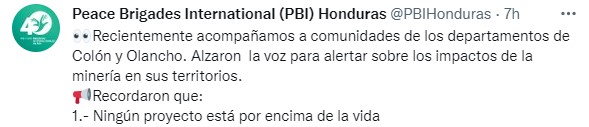
“[We] recently accompanied communities in the departments of Colón and Olancho. They raised their voices to warn about the impacts of mining in their territories. They remembered that: 1.- No project is above life.”

On Facebook they added:

“Among other things, people from the communities remembered that:

  1. – No project is above life and no project should be driven without the approval of those inhabiting the territories
  2. – Botaderos National Park depend on basic water sources for life
  3. – No licences should be granted to projects involving environmental destruction

“34 sources of water that feed several municipalities depend on the Botaderos National Park, affecting more than 45 thousand inhabitants of our communities… ”

PBI-Honduras further notes: “The first rally occurred on the outside of Miamiente [the Secretariat of Natural Resources and Environment] and subsequently on the lower floor of Congress.”

On August 16, Criterio.hn reported:

““For water and for life, not mining!”, was the demand of the leaders of five municipalities in northeastern Honduras who arrived at the Secretariat of Natural Resources, Environment and Mines (Serna) in Tegucigalpa, to demand a stop to open-pit mining and the protection of the Montaña de Botaderos National Park, Carlos Escaleras.

They traveled between 243 and 374 kilometers from the municipalities of Sabá, Bonito Oriental and Tocoa in the department of Colón; and Gualaco and San Estebán in Olancho, to tell the central government that their municipalities are united by the defense of the Montaña de Botaderos National Park.

Orbin Hernández, one of the eight defenders of Guapinol released after an arbitrary imprisonment of 914 days, told Criterio.hn that the union of the five municipalities for the defense of the national park is an encouraging action because it shows that they never invented, never lied and are right to claim the protection of the protected area.

The water defender remarked that the visit to the Serna and the National Congress is precisely because the socio-environmental problem in Guapinol was generated by politicians in Tegucigalpa, so they demand a review of the concession that is damaging the San Pedro and Guapinol Rivers, as well as reviewing the illegalities committed during the presidency of Porfirio Lobo Sosa in the Executive Branch and Juan Orlando Hernández in the Legislative Power.

The secretary of the Municipal Committee in Defense of common and public goods of Tocoa, Dalila Santiago [said] “We are here in Serna demanding the immediate cancellation of the mega project Inversiones Los Pinares and Ecotek, which has been located in the core area of the Montaña de Botaderos National Park, Carlos Escaleras, and the iron oxide pelletizing plant is located approximately one hundred meters from the Guapinol River and this causes a great impact on the lives of the population. The most affected communities are Guapinol, Ceibita, Cayo Campo and Nueva Lempira.”

After finishing the meeting in Serna, the inhabitants of the municipalities of Sabá, Bonito Oriental and Tocoa in the department of Colón; and Gualaco and San Estebán in Olancho, moved to the basement of the National Congress to demand an answer to why the buffer zone of the national park was expanded at the expense of the core area through legislative decree 252-2013, opening the doors to mining in the protected area.

In addition to Inversiones Los Pinares and Inversiones Ecotek in Tocoa, the residents denounced environmental destruction, water pollution and violence by the mining companies JAMART in Gualaco, San Esteban and Bonito Oriental, as well as Canteras y Más in Sabá, which exposed “they develop an illegal extractive activity, with vices of nullity due to corruption in the core area and buffer zone of the Montaña de Botaderos National Park, Carlos Escaleras Mejía”.”

The full article can be read at: Defensores del Parque Nacional Carlos Escaleras llegan a la SERNA a exigir su Protección.

CAHUCOPANA denounces attack against social leaders Lenin Guerra and Yuliana Galeano

BluRadio photo: Lenin Guerra and Yuliana Galeano.

On August 19, the Humanitarian Action Corporation for Coexistence and Peace in Northeastern Antioquia (CAHUCOPANA) tweeted: “We report that unfortunately the lifeless body of the farmer, Elmer Lenin Guerra, a recognized inhabitant of the village of El Carmen #Remedios and sentimental partner of Yuliana Liceth Galeano, was found. …We continue in the search for Yuliana Liceth Galeano, held by armed men, together with her partner yesterday, August 18, in the place known as ‘El Aporreado’.”

Following that, PBI-Colombia tweeted: “#SOS The lifeless body of Elmer Lenin Guerra is found in the village of El Carmen #Remedios and the search continues for his partner, the leader Yuliana Liceth Galeano. Guarantees are required for life in Northeast Antioquia.”

Then about two hours later, PBI-Colombia tweeted: “The leader of the #nordeste Yuliana Galeano was found alive.”

Earlier, Semana had reported:

“Added to the security crisis in the department of Antioquia is the retention of two social leaders in the village of El Carmen in the municipality of Remedios by armed men, as reported by the Humanitarian Action Corporation for Coexistence and Peace of the Northeast Antioquia [CAHUCOPANA].

Three illegal groups commit crimes in that area.

They are Yuliana Liceth Galeano and Elmer Lenin Guerra, both led the humanitarian refuge that was carried out in this town to encourage the authorities to mediate between the crossfire between the illegal Clan del Golfo and the National Liberation Army (ELN) for the control of criminal income.

According to the story of the community organization, at 5:00 p.m. m. on August 18, the married couple was gagged in the sector known as El Aporreado. One of these organizations that hope to advance a peace process with the government of Gustavo Petro would have set up an illegal checkpoint in that place.

One of the spokespersons for the Humanitarian Action Corporation for Coexistence and Peace in Northeast Antioquia, who asked that her name be omitted for security reasons, explained that the spouses had an active voice within the territory in favor of peace.

Precisely, Yuliana Liceth Galeano had been on a tour in the country’s capital denouncing the conflict suffered by the inhabitants of this subregion of Antioquia.

While Elmer Lenin Guerra is carrying out mining work and also showed rejection of the terrorist actions that are being committed in the municipalities of Segovia and Remedios. In the list of the authorities there are selective homicides, forced displacement, extortion and recruitment of peasants.”

The full article in Semana can be read at Atención: grupo armado secuestró a dos líderes sociales en Remedios, Antioquia.

CAHUCOPANA has also noted that just last week, on August 11, Yuliana Galeano was part of a PBI-Colombia accompanied delegation that met with the Canadian Embassy in Bogota.

PBI-Colombia has accompanied the Humanitarian Action Corporation for Coexistence and Peace in Northeast Antioquia (CAHUCOPANA) since 2013.

Is Canada importing “conflict oil” from the Cubiro Block in San Luis de Palenque, Colombia?

Photo: Gabriel de Alba, Chairman of the Board of Frontera Energy. He is also the Co-Chairman of Cirque du Soleil Entertainment Group Board of Directors.

In 2021, Canada imported 10,872 barrels of oil per day from Colombia.

That is an annual total of about 3.97 million barrels, up from 2.89 million in 2020 and 2.53 million in 2018. The 2021 figure has also been reported as 3.19 million barrels.

Notably, all of the Colombian oil exported to Canada in 2021 was imported into the province of New Brunswick.

Colombia has seven major oil pipelines, five of which connect production fields to the Caribbean export terminal at Coveñas. One of those pipelines – the 120,000 bpd Bicentenario pipeline – connects with the Llanos basin in the department of Casanare.

In January 2019, the U.S. Energy Information Administration reported that one of the operators of the pipeline was Pacific Rubiales Energy.

Toronto-based Frontera Energy operates the Cubiro oil block in the Llanos basin. Prior to June 2017, Frontera Energy operated as Pacific Exploration & Production Corporation (and was also known as Pacific Rubiales).

The Cubiro block produces an average of 3,600 barrels of oil per day (while the company says the block produced 2,410 barrels per day of light and medium crude oil in 2021).

Colombia Informa has further specified: “Frontera Energy has had a license to extract oil in the territory of San Luis de Palenque, Cubiro Block, since 2005. It has installed some 20 platforms in the six districts of the municipality. These extract oil 8,000 feet deep. Only its most active platform (Copa 1) takes out 22 trucks with between 220 and 240 barrels of crude oil each day for an approximate value of 600 million pesos [about CAD $182,000].”

BNAmericas has also reported the Cubiro block “accounts for ‘important royalties’ for the company that have totaled some $30 million USD since 2015.”

PBI-Colombia accompanies the Committee of Solidarity with Political Prisoners (CSPP) and the Social Corporation for Community Advice and Training (COSPACC) who in turn accompany social leaders in San Luis de Palenque who have protested Frontera.

In February 2018, Frontera temporarily closed Cubiro block operations.

At that time, they said: “Unfortunately, the excessive demands on the part of a minority group of people from San Luis de Palenque — a group that does not represent the leaders or the community of the municipality — has led the company to make this decision.”

By November 16 and 19, 2018, Frontera had signed two protection agreements with the Ministry of Defence for USD $1.34 million to secure army protection.

Just days after those contracts were signed, a police and military operation arrested eight social leaders in San Luis de Palenque on November 27.

The community members who were arrested and criminalized are: Ferney Salcedo, Yulivel Leal, Jesús Leal Salcedo, Carmen Iraida Salcedo, Miguel Ángel Rincón, Josué Eliecer Rincón, María Teresa Rincón and Salcedo Betancourt.

Video: A Black Hawk helicopter was used in the arrest of the social leaders.

A still from this video of the social leaders being taken into custody after their arrest.

On September 16, 2019, the CSPP and COSPACC raised this situation with the United Nations Working Group on Arbitrary Detention in Geneva.

Michel Forst, the UN Special Rapporteur on the situation of human rights defenders, also raised concerns about the criminalization of these leaders in his February-March 2020 report to the UN Human Rights Council.

It was not until August-September 2020, that a judge ordered the release of the leaders from prison and house arrest.

Photo: Miguel Ángel Rincón and Carmen Iraida Salcedo receiving the news they would be released from house arrest, August 2020.

El Nuevo Oriente reports: “The release decision was appealed by the Prosecutor’s Office and by Frontera Energy’s lawyers.”

In May 2022, the company reported a first-quarter net income of $102.2 million.

That same month Frontera Energy also released its Sustainability Report that noted its goals for 2022 (to be reported on in May 2023) include “community engagement” and to “Increase local goods and services purchases to $41 million through direct contracting and subcontracting processes.”

PBI-Canada met with the criminalized social leaders this past July 1.

They are now expected to be in court this October to face the criminal charges dating back to November 2018. Their lawyer has cautioned the legal process could take two more years and even may need to be followed by an appeals process.

The company’s annual shareholders meeting is expected to take place in May 2023.

We continue to follow this situation.

Community meeting at La Venturosa, July 1, 2022.

RCMP uses excessive force against three land defenders on Wet’suwet’en territory

On August 16, Gidimt’en Checkpoint tweeted:

“RCMP Pepper Spray Three Land Defenders in a Show of Excessive Force. On Friday August 12 around 4pm, land defenders were followed and harassed by police while enroute to their private residence on Gidimt’en yintah.”

Their media release adds:

“The police proceeded to use excessive force by arresting 2 land defenders and pepper spraying each arrestee and one other. One of the victims of this violent assault had already been placed in hand cuffs behind their back before being pepper sprayed. This police escalation happened outside the residence of one of the victims who is a young Indigenous Land Defender, and far from any Coastal GasLink worksite. This is a blatant example of the targeted harassment that the RCMP and the CIRG has inflicted on the Wet’suwet’en and their supporters.”

It further notes:

“On July 13, 2022, the Gidimt’en Checkpoint launched a civil suit against the RCMP, CIRG, the Minister of Justice for BC, Coastal Gaslink Pipeline and private security contractor Forsythe for hundreds of instances of trespass, harassment, and intimidation tactics. The Department of Justice is asking for more time to respond, but while they stall, the RCMP are now escalating their violence against unarmed land defenders.”

Wet’suwet’en land defender Molly Wickham says: “This police attack targeting Indigenous people who live on the Wet’suwet’en yintah comes as people are preparing for a big cultural gathering with elders and children on the territory in August, and is clearly meant to intimidate and prevent Indigenous people from conducting our ceremonies on the land. We remain part of the Wedzin Kwa, the sacred river, that we are protecting from colonial invaders. This won’t deter us from doing what is right, upholding our own laws that have been in place for thousands of years, protecting our land and standing up for future generations.”

UN Committee calls for RCMP to leave the yintah

The United Nations Committee on the Elimination of Racial Discrimination (CERD) has repeatedly urged Canada to stop construction on the Coastal GasLink pipeline on Wet’suwet’en territory.

This fracked gas pipeline is being built on unceded Wet’suwet’en territory without free, prior and informed consent.

The UN committee’s third letter – dated April 29, 2022 – called on Canada to provide a response to several concerns by July 15, 2022, including measures to: “Prevent and duly investigate the allegations of surveillance measures, practices of arbitrary detention, instances of excessive use of force against protesters, in particular those belonging to the Secwepemc and Wet’suwet’en peoples, by the RCMP, CIRG, and private security firms.”

It’s not clear if Canada met that deadline.

Ongoing criminalization of land defenders

The Narwhal has also reported: “On July 7, the province’s legal team told B.C. Supreme Court Justice Marguerite Church it would prosecute Sleydo’ Molly Wickham, Shaylynn Sampson (Gitxsan Lax Gibuu Wilp Spookxw), Teka’tsihasere Corey ‘Jayohcee’ Jocko and Hannah Hall. The decision brings the total to 19 individuals arrested during the raid that B.C. Prosecution Service will pursue criminal charges against in the coming months.”

Wedzin Kwa river at risk

Earlier this year, the Terrace Standard reported: “The active tunneling work [under Wedzin Kwa] is expected to take two and half to three months.”

On August 8, Wickham posted: “I don’t know if people understand the severity of the time we are in right now.”

“The Wedzin Kwa is about to be destroyed. Our sacred life giver where our salmon spawn, the cleanest drinking water in the whole yintah, the place out ancestors walked and drank from, where all the animals and beings drink and use to survive.”

She adds: “It is about to be destroyed and we need you to come. Aug 20th for a week of Ceremony. Organize solidarity actions if you can’t make it. Nothing is more important than this, right now. This is our family, our future, our livelihood. It is life. Be as relentless as the systems in place meant to destroy us all.”

PBI-Canada visited the yintah in November 2021 and continues to follow this land defence struggle.

For more, please see the Gidimt’en Checkpoint Twitter feed.