Home Blog Page 194

PBI-Honduras accompanies ARCAH as it files complaint with the Public Ministry in the framework of the ZEDEs

On November 24, PBI-Honduras tweeted: “PBI accompanies @Arcah_hn [the Honduran Alternative for Community and Environmental Vindication] in filing a complaint with the Public Ministry in the framework of the ZEDE [Economic Development and Employment Zones]. We are concerned about the constant pressure and risk situations that the organization is going through due to its advocacy work.”

Radio Zapatista has reported:

“Christopher Castillo, general coordinator of ARCAH, has denounced threats against him made by the police, as well as by members of the directors and executives of different ZEDES projects.

According to a statement from the Peoples’ Human Rights Observatory, the attacks occur in the context of the fight against the ZEDES, particularly those known as Ciudad Morazán and Próspera, which “ignore the popular decision to repeal the law, which it was achieved by the popular struggle of communities and organizations. Therefore, the ZEDES do not want to recognize it, instead they threaten with violent actions seeking to settle in the territories”.

One of the recent attacks occurred at the end of October when ARCAH members were peacefully protesting against Ciudad Morazán, since it is one of the ZEDES projects that have remained in operation despite the repeal of the law that supported them. Added to this are the threats against the ARCAH coordinator by the founder of Ciudad Morazán, Massimo Mazzone, and other members Jorge Colindres and Carlos Fortín.

Given these facts, Christopher Castillo demanded that the Honduran authorities effectively repeal the ZEDES and, before local media, stated that “we cannot allow these businessmen to come only to impose projects that are not development, that are alien to the will of the people and that They also come to threaten people.””

The Prospera and Morazán ZEDEs

The Prospera’s website says: “Prospera’s first hub is on the island of Roatan, Honduras. We’ve partnered with the Honduran government under the 2014 ZEDE act to create an innovative economic jurisdiction that is already creating transformative change for Honduran workers, technology entrepreneurs and international investors.”

Last week Miriam Miranda from the Black Fraternal Organization of Honduras (OFRANEH) commented on the Próspera ZEDE that is still being constructed on Garífuna territory. She stated: “They’re building their famous towers there and they already have a tower that I think is twelve stories high, in an area where there is supposed to be no construction of that kind, because it’s an island. But they’re still constructing them. And they’ve stated on social media that they’re going to sue Honduras for billions of dollars.”

And the Ciudad Morazán website notes: “Ciudad Morazán is a complete community located at the outskirts of Choloma, Honduras, the third largest city and the center of its vibrant manufacturing region. It offers residential solutions, an industrial area, commercial spaces, parks, churches, schools and all the other civic meeting points and infrastructure works. The community is a “Zona de Empleo y Desarrollo Económico”, enjoying a certain degree of fiscal and regulatory autonomy. It develops over 24 enclosed hectares and when completed it will house up to 10,000 residents. All the buildings are offered for rent to any Honduran or foreigner legally residing in the country.”

Background and timeline

Last month, the American Prospect reported:

“Honduran President Xiomara Castro, who took office in January [2022], promised on the campaign trail to abolish special economic zones known as ZEDEs (“Economic Development and Employment Zones” in English), where private investors have outsized power to shape labor laws, judicial systems, and local governance.

In April, she achieved a major win when the Congress of Honduras unanimously voted to repeal the law that allows for ZEDEs, and to abolish the current ones, though the latter has to be ratified next year.

In July, the [US] State Department issued its own condemnation of Castro’s move to eliminate ZEDEs, and intimated that the government could be violating two trade agreements, the Dominican Republic–Central America Free Trade Agreement (CAFTA-DR) and a U.S.-Honduras bilateral investment treaty (BIT).

On September 29, the U.S. embassy in Honduras tweeted that its deputy chief of mission, Roy Perrin, “met today with Honduras Próspera to talk about the climate for investment in Honduras, the legal guarantees that will permit those businesses to create jobs, and how sustainable development can create economic opportunities for all Hondurans.””

Global Arbitration Review further notes: “A US investor has formally notified Honduras of its intent to bring a treaty claim potentially worth nearly US$11 billion over plans to repeal special economic zones… Delaware-registered company Honduras Próspera and two subsidiaries served a notice of intent on 16 September under the Dominican Republic-Central America free trade agreement, triggering a 90-day cooling-off period.”

Canadian ZEDEs?

There may be two other ZEDEs – Mariposa (health sanctuary) and “Little Canada” (a 500-unit housing development) – that involve Canadian capital. It has been previously reported that the Mariposa ZEDE is being led by Daniel and Katerina Morin, while “Little Canada” in the Trujillo region is being developed by Randy Jorgensen.

PBI-Honduras has been accompanying the Honduran Alternative for Community and Environmental Vindication (ARCAH) since September 2022.

We continue to follow this situation.

Bank of Montreal calls for due diligence legislation, but funds pipeline companies that criminalize Indigenous water protectors

Greenpeace photo.

The Bank of Montreal (BMO) recently signed a letter that states:

“The process of continuously conducting robust human rights and environmental due diligence (HREDD) is a core requirement for businesses and investors in fulfilling that responsibility, as framed in the recognized international standards of the UN Guiding Principles on Business and Human Rights (UNGPs) and the OECD Guidelines for Multinational Enterprises.”

It also highlights:

“The European Commission is developing a new law, as part of the Corporate Sustainability Due Diligence Directive, mandating HREDD. The UK now has an opportunity to retain its leading role in business and human rights by bringing forward its own legislation.”

And it concludes:

“We renew our call on all governments to develop, implement, and enforce mandatory human rights and environmental due diligence requirements for businesses headquartered or operating within their own jurisdictions or, where appropriate, to further strengthen these regulatory regimes where they already exist.”

BMO and Coastal GasLink, Line 3 pipelines

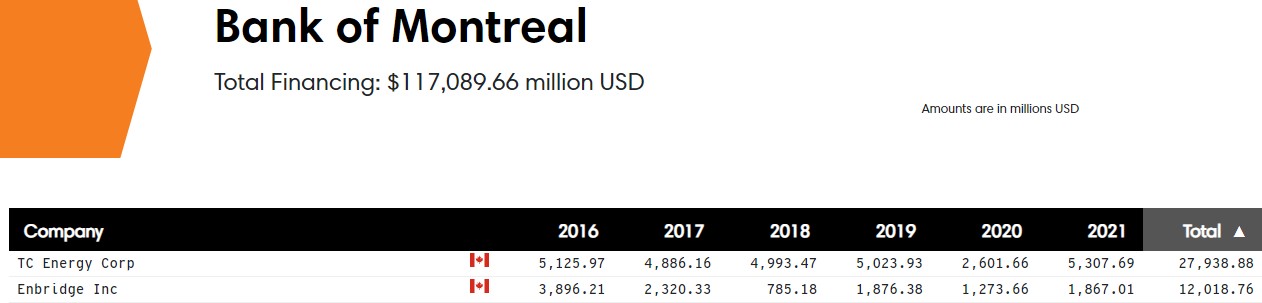
And yet, as noted in the Banking on Climate Chaos: Fossil Fuel Finance Report 2022, BMO has provided millions of dollars in financing to companies that are building pipelines that have criminalized Indigenous land defenders.

Just two of those companies include the Calgary-based TC Energy Corp and Enbridge Inc.

In 2012, TC Energy Corp was selected by LNG Canada to design, build, own and operate the Coastal GasLink fracked gas pipeline.

That pipeline is currently being built on Wet’suwet’en territory in northern British Columbia without free, prior and informed consent. The UN Committee on the Elimination of Racial Discrimination has repeatedly called on Canada to stop this megaproject.

The Narwhal recently reported: “To date, RCMP have spent more than $25 million maintaining a constant presence on Wet’suwet’en territory. Most of that supports the force’s Community-Industry Response Group, commonly called C-IRG, a special unit set up in 2017 to police opposition to industrial projects.”

According to the RCMP, 90 arrests have been made involving 80 different people and there are 20 people currently facing charges.

Photo: RCMP raid on Wet’suwet’en territory, November 2021.

And Enbridge Inc recently completed the constructed of the Line 3 tar sands pipeline that crosses Ojibwe territory in Minnesota.

More than 800 water protectors have been arrested or cited in Minnesota for their opposition to Line 3 since November 2020.

Land defender Tara Houska recently tweeted: “I’m facing a year in jail for defending my people’s territory, courtesy of this Enbridge-backed sheriff [Daniel Guida]. Enbridge paid MN law enforcement/DNR $8.5M. Over 1000 of us were arrested. Some were tortured. Many were surveilled, brutalized. For defending the rivers & wild rice.”

Photo: Tara Houska.

Next steps on due diligence            

In May 2021, PBI-Guatemala highlighted at the European Parliament that due diligence legislation must include “strong provisions for the protection of human rights defenders, mainly environmental defenders, as well as very clear mechanisms for meaningful participation prior to investment and environmental impact assessments of major development projects.”

PBI has also recommended that due diligence legislation must ensure that “companies adopt a zero-tolerance approach on reprisals and attacks on defenders not only in their own operations but also when they are linked to such attacks through their value chain, business relationships and private security contractors.”

We have further stated that due diligence legislation should include “effective mechanisms for victims and communities to hold companies to account and access remedy in the context of human rights violations and attacks on human rights defenders.”

Rigorous due diligence?

It should not be possible then, as Export Development Canada (EDC) did, to claim that it carried out “rigorous due diligence” before granting up to $500 million in financing to Coastal GasLink.

EDC says: “[The pipeline] continues to be opposed by a group of hereditary chiefs from the Wet’suwet’en First Nation, who claim to be the legitimate decision-makers of this nation, not to have been duly consulted and not to have consented to the project. [However, EDC believes TC Energy] has demonstrated a great ability to manage environmental and social risks.”

In May 2021, the Canadian Network on Corporate Accountability launched model legislation for due diligence and corporate accountability in Canada.

The model legislation for Canada can be read here.

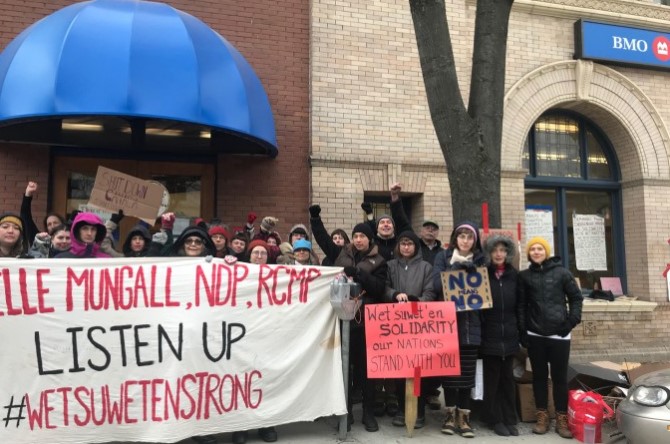
Photo: Land and indigenous rights defenders continue occupation of BMO in Nelson, British Columbia; February 2020.

Protest rejects police violence and encampment evictions, calls for affordable housing and accessible washrooms

About 500 metres east of Parliament Hill in Ottawa there is an air grate that the houseless have used to keep warm as it gets colder outside.

The Hope Encampment says: “We set camp here for about a month and a half because there is heat coming from the grate and we have nowhere else to go.”

Then on November 20, “the City sent police officers and city workers to throw away our belongings, which are essential to our daily survival. After throwing our stuff in the garbage during the sweep, the police parked their car on the grate for hours to prevent us from being warm without presenting us with a viable alternative.”

Following that, a protest took place on November 22, National Housing Day, at that grate in front of the Hudson’s Bay store.

The Hope Encampment said: “We call on those who support our struggle to show up in-person and send a message to the City, the police, and the ByWard Business Improvement Area and other businesses that we are not alone and that encampment evictions and street sweeps are immoral and a practice that must stop, immediately!”

In their statement, the Hope Encampment demands: “The City of Ottawa and the Ottawa Police must stop displacing, harassing, surveilling, and targeting us, immediately!”

They also highlight that: “The City of Ottawa must build affordable housing for all: we see empty buildings, condo towers, and hotels going up, but nothing is being built for poor people.” And they further note: “We need accessible washrooms: at night, there are no accessible washrooms. We need access to washrooms at all times of the day.”

To read their full statement, click here.

For a CTV News report on the protest, click here.

City Councillor Shawn Menard, who was present at the protest, later tweeted: “The needs in the market and across our city have been growing. This is not an enforcement solution, these people need mental health support, social workers, and most of all housing with supports. Our priorities must evolve and change to help one another or this will get worse.”

And local activist Sam Hersh also tweeted: “It’s blatantly obvious strategies prioritizing enforcement and lining the pockets of developers instead of the lived experience of people actually living on the street has led us here.”

Housing is a human right

The right to housing is an internationally recognized human right.

PBI-Canada affirms that human right and rejects the structural violence of houselessness, poverty and exclusion, carceral violence against the poor, and are mindful of the risks faced by defenders who challenge police violence and uphold the human right to housing.

For updates on the Hope Encampment, please see Justice For Anthony Aust on Twitter.

PBI-Honduras calls for fair and transparent trial for Garifuna defenders arbitrarily detained at illegal eviction in Punta Gorda

On November 22, PBI-Honduras tweeted:

“We stress the importance of a fair and transparent trial for defenders of the Garífuna community in Punta Gorda, Roatán, so we hope that it will be broadcast live.”

The Mesoamerican Initiative of Women Human Rights Defenders (IM-Defensoras) has also tweeted:

“Tomorrow, November 23 at 9 am, the hearing against Melissa Martínez, coordinator of the @ofraneh [the Black Fraternal Organization of Honduras] in Punta Gorda and defenders Dorotea Arzú, Keyden Tishany Gonzales, Richard Armando Martínez, Abot Efrahin Sánchez and Augusto Moisés Dolmo.

On November 7, after a violent and illegal eviction from the community of Punta Gorda, Roatán, six defenders were arbitrarily detained and criminalized, charging them with the crimes of aggravated usurpation, and in one of the cases, assault.

The hearing that will take place in the Departmental Court of First Instance, Roatán, Bay Islands, will be presided over by Judge Allan Joel Urbina García, who also ordered the eviction.

Together with the @RedDefensoras [the National Network of Women Human Rights Defenders in Honduras] we keep abreast of this situation and stand in solidarity with the Garífuna community in the face of capitalist and racist dispossession that threatens their survival.”

News report

On November 7, the Spanish news agency EFE reported:

“The Garifuna (black) community of Honduras denounced on Monday a “forced eviction” of dozens of people in the community of Punta Gorda, on the island of Roatan, in the Caribbean of the country, a fact that also left six detainees.

The Honduran Black Fraternal Organization (Ofraneh) said on Twitter that six defenders of ancestral territory were detained by security forces who “demonstrated in addition to their racism, the inclination for violence.”

The Office of the United Nations High Commissioner for Human Rights (OHCHR) condemned “the aggressions and detention” of the six members of the Garifuna community in Punta Gorda in the context of “forced eviction executed by police and military forces in contravention of human rights obligations.”

Amnesty International’s Americas director, Erika Guevara-Rosas, also condemned the violent eviction, demanded the release of the detainees and that “their human rights be respected.””

The full article can be read at Comunidad negra de Honduras denuncia “desalojo forzado” en comunidad caribeña.

We are watching this situation from Canada as well.

PBI-Honduras accompanies Indigenous Lenca community seeking to stop the threat of dispossession and eviction from their lands

On November 22, PBI-Honduras tweeted:

“Last week we accompanied the Lenca Indigenous Community Tierras del Padre to present an appeal for amparo before the Supreme Court of Justice. Although it has been suspended, at PBI we show our concern that the eviction will take place later.”

Criterio.hn has reported:

“A little downcast, waiting to be evicted on November 23.

This is how Marina Corina Díaz, a woman over 60 years old, from the Tierras del Padre community, presented herself. Corina, like 120 other families, faces this sad story that is summed up in a territorial conflict like many in Honduras.

Precisely to avoid this eviction ordered by the Criminal Court of Francisco Morazán, the Justice for the Peoples Law Firm filed an appeal on Thursday [November 17] before the Court of Criminal Appeals, denouncing violation of the right to due process, the right to defense and the right to indigenous land. For this reason, the application of a precautionary measure was requested to suspend the eviction.

The inhabitants of the community in conflict have lived under constant threats of being dispossessed of the lands they occupy by court decisions. That is why, on the afternoon of Wednesday, November 16, they filed a complaint with the Public Ministry against Judge Gladis Alejandra Ochoa Sierra, of the criminal court of Francisco Morazán for the crime of judicial malfeasance.”

Proceso Digital adds:

“The Criminal Court of the Judicial Section of Tegucigalpa, Francisco Morazán, ordered, since last July 26, the execution of an eviction, in the Lenca indigenous community of “Tierras del Padre”, Municipality of the Central District, scheduled for November 23, at 6:00 in the morning.

The Court in question orders that the National Police be notified and demand the presence of no less than 1,000 police officers and the Military Police of Public Order, so that they can order the corresponding person to provide all the cooperation required by the Executing Judge.”

Agence France-Presse has explained: “According to the court decision, the families occupy this land called ‘Tierras del Padre’ of about 200 hectares, owned by a businessman carrying a real estate project to build 10,000 homes. But community representatives say they have a deed of ownership registered in the national archives dating back to 1739.”

Conexihon has also noted: “For some years, the families that inhabit the place, approximately 200, have been living in anxiety since Mario Facusse, a businessman, landowner known in the country, through his legal representatives threatens to evict them claiming to be the owner of the land on which they live.”

And IM-Defensoras further explains: “The Facussé family has been linked to business activities that violate the rights and common and public goods of the Honduran population, highlighting among them that derived from extractivist activity and illegal contracts with state institutions for more than 40 years.”

Past accompaniments of Tierras del Padre

On February 8, PBI-Honduras had also tweeted: “PBI accompanies the Lenca indigenous community Tierras del Padre before the eviction ordered for today. @OACNUDHHN [the Office in Honduras of the United Nations High Commissioner for Human Rights] urge the State to suspend its execution since guarantees and conditions for the effective protection of human rights are not observed.”

And on November 11, they tweeted:

“PBI accompanies to the Tierras del Padre Lenca Indigenous Community to file an amparo appeal to stop the eviction order filed. The community requests that ILO Convention 169, which establishes their property rights over ancestral lands, be respected.”


We continue to follow this.

PBI-Guatemala accompanies Peaceful Resistance of La Puya at ceremony with ancestors

On November 21, PBI-Guatemala posted:

“PBI accompanies the Bufete Jurídico de Derechos Humanos [Human Rights Law Firm] and the Peaceful Resistance of La Puya at a ceremony to present the representatives for consultation to their ancestors.”

On March 2, 2012, residents from San José del Golfo and San Pedro Ayampuc – an area known as La Puya, just north of Guatemala City – set up a 24-hour a day blockade at the entrance of the Vancouver-based Radius Gold Inc. El Tambor mine.

By August 2012, the Canadian company sold El Tambor to US-based Kappes, Cassiday & Associates, but retained an economic interest in the mine (including quarterly royalty payments on the gold production from the mine).

On May 23, 2014, the communities in resistance to the mine were violently evicted by the police. Just prior to the eviction, Peaceful Resistance member Yolanda Oquelí appealed to the police as a PBI-Guatemala volunteer observed the exchange.

In February 2016, the Peaceful Resistance of La Puya won a Guatemalan Supreme Court ruling that provisionally suspended the mining license because there had not been prior consultation with affected communities, as is required under Guatemalan and international law, in particular the International Labour Organization’s Convention 169.

In December 2018, Kappes, Cassiday & Associates filed a $300 million claim with the International Centre for Settlement of Investment Disputes (ICSID), a World Bank arbitration mechanism, claiming its investor rights under the Dominican Republic–Central America Free Trade Agreement (CAFTA-DR) had been violated.

On May 21, 2021, the court suspension on the mine imposed in 2016 was lifted, but authorization for the mine to begin operation has not been granted.

Current situation

In June 2022, Prensa Latina reported: “The Minister of Energy and Mines, Alberto Pimentel … stated that the Government will soon issue regulations for carrying out community consultations stipulated in Convention 169 of the International Labor Organization (ILO) on indigenous and tribal peoples.”

“In addition, the pre-consultation stage is being prepared for the Progreso VII Derivada Mining project, also known as El Tambor or La Puya.”

The article also noted: “[Pimentel] also announced that the National Mining Policy is being prepared [and] would be finished in 2023, since he wants to finish it before the change of government.”

PBI-Guatemala has accompanied the Peaceful Resistance of La Puya since November 2012 and the Human Rights Law Firm since 2013.

PBI-Honduras accompanies the National Union of Rural Workers on anniversary of the murder of Celenia Bonilla and Nelson García

On November 21, PBI-Honduras tweeted:

“PBI accompanies the @CntcTegucigalpa in the inspection of the bases “Hombres y Mujeres de Fe“ [Men and Women of Faith] and “Unidos al Campo” [United to the Field]. Today marks one year since the murder of Celenia Bonilla and Nelson García. We extend our condolences and reiterate the importance of clarifying the facts.”

On Facebook, PBI-Honduras adds: “From PBI we express concern about the levels of risk, violence and criminalization faced by people defending land, territory and environment as a result of their advocacy work.”

Last year, the National Network of Women Human Rights Defenders in Honduras posted:

“Once again the Honduran land is stained with peasant blood. Defender Celenia Bonilla and her husband Nelson García were murdered in her territory this Sunday, November 21, in the community of Cañada de Flores, municipality of Guaimaca, Francisco Morazán.

Both were leaders of the “Men and Women of Faith” Peasant Company, part of the National Central of Farm Workers (CNTC), who together with their companions and companions have fought for more than ten years in that land where they received all kinds of harassment and persecution, until this murder.

According to the CNTC, the so-called owner of the land, named Maximiliano Elvir, had threatened the members of the group, for which they consider his possible authorship should be investigated immediately.

The National Network of Human Rights Defenders in Honduras joins the outrage for one more crime of those who fight for the land for life. We demand justice for Celenia Bonilla and denounce the null importance that the State of Honduras gives to the agrarian conflict in the country, especially when it comes to attacks on the peasantry. The struggle for life cannot end the existence of our peasant companions.”

Earlier this year, EFE reported:

“A total of 11 human rights defenders were killed in Honduras in 2021, a year in which 332 attacks on activists were also registered, according to a report released Tuesday in Tegucigalpa. The document details that the last defender killed in Honduras was Celenia Bonilla, who was attacked by three men on November 21, 2021 in the municipality of Guaimaca, central department of Francisco Morazán. Bonilla was a defender of land and food for the peasant organization Hombres y Mujeres de Fe.”

The Peace Brigades International-Honduras Project has accompanied the National Union of Rural Workers (CNTC) since May 2018.

The CNTC is affiliated with the Unified Confederation of Honduran Workers (CUTH) which in turn is affiliated with the International Trade Union Confederation (ITUC), along with 150+ labour organizations including the Canadian Labour Congress.

PBI-Mexico accompanies Indigenous community as it blockades highway to airport to demand recognition of their ancestral rights

On November 21, PBI-Mexico tweeted:

“PBI accompanies the Bosque de San Elías Repechique community in the #SierraTarahumara supported by @CONTECAC in their protest demanding the legal recognition of their territory and the definitive filing of the investigation folder against their members.”

Raichali reports:

“The Rarámuri community of Bosques de San Elías Repechique held a sit-in to demand legal recognition of their territory. In 2014, a judge recognized their ancestral right, but the property titles remain in the hands of mestizo individuals.

On Saturday, November 19 and Sunday, November 20, the Rarámuri community of Bosques de San Elías Repechique held a sit-in on the road between Creel and San Rafael, through which hundreds of tourists pass daily, to demand that the Mexican authorities titling their ancestral territory and respect their way of life.”

El Heraldo de Chihuahua also reports:

“The Ralámuli indigenous community blocked the road that is located in front of the Barrancas del Cobre Regional Airport demanding the approval of projects that were proposed for the benefit of residents before the Technical Committee of the Forest Trust of San Elías Repechique, in the municipality of Bocoyna, among which a community house, housing improvement and purchase of agricultural equipment stand out.

The members of the community of Bosques de San Elías Repechique demanded recognition of their territory and an end to criminalization by individuals, from whom they constantly receive threats.

Despite the fact that there is a ruling in favor of the community, their rights are violated due to people from outside the community who cut down trees, make use of their territory for the passage of an electric power line, the installation of the airport, the gas pipeline and tourism projects. All without the consent of the community, resistance that leads them to suffer threats and aggression.

It is worth mentioning that in the sewing project for women called Bowe Najativo (following the path) located on the dirt road between Sánchez and Cerro de la Virgen, it was approved in 2019, and in 2020 the execution process began but the FGE stopped the construction for more than a year, even members of the community were taken into custody. Two investigation folders were derived from this against Teresa González and Nicolás Sánchez, for which the closure of these investigations was demanded.”

And El Diario reports: “Indigenous take Creel-San Rafael highway. They affirm that they will not withdraw until they are heard by the government.”

That article quotes Repechique residents who say: “We demand an end to the intimidation of individuals to the members of our community; every time our right is violated by people, by the imposition of projects such as felling trees, passing the electric light line, installing the airport, gas pipeline and tourist projects without our consent.”

CONTEC also accompanied the San Elías Repechique Forests community in 2014-15 when it opposed Calgary-based TransCanada Corp. (now TC Energy) building the Encino-Topolobampo gas pipeline on its ancestral territories without free, prior and informed consent.

PBI-Mexico has been providing punctual accompaniment to the Community Technical Consultancy, A.C. (CONTEC) since 2015. In February 2022, PBI-Mexico formalized this accompaniment due to the increase in the level of risk faced by the organization.

Photo by Raichali.

Photo by El Diario.

Photo by PBI-Mexico.

Second draft of COP27 final declaration fails to mention safety for frontline environmental human rights defenders

Ministers discuss the text at COP27. Photo by Etienne Leblanc.

A second draft of the COP27 final declaration text has been released. The Guardian reports: “At 10 pages, this second draft of the Cop27 cover text is just half the length of the previous version [and] some key points have been weakened or left out.”

Language recognizing environmental human rights defenders was neither noted in the first draft or this second draft.

In sharp contrast, the first point in the COP27 Peoples’ Declaration for Climate Justice states: “We recognise that there can be no climate justice without human rights and Indigenous Peoples’ Rights. We call on all governments to stop the shrinking of civic space, to respect the rights and dignity of Indigenous Peoples, workers, climate activists, human rights activists and environmental defenders.”

Prior to COP27, EarthRights International, Global Witness, Natural Justice, Sociedad Peruana de Derecho Ambiental (SPDA), CIVICUS, and the International Land Coalition released a set of recommendations calling on those at COP27 to take meaningful steps to protect those on the frontlines of the climate crisis.

Silvana Baldovino of SPDA said: “A higher recognition and incorporation by the UNFCCC and COP27 of the role of defenders in facing the climate crisis is crucial to move States towards stronger protection schemes.”

Amnesty International also called on all parties at COP27 to: “Ensure the action plan recognizes the role of environmental human rights defenders in promoting effective and ambitious climate action and includes concrete measures to protect them in line with the UN Declaration on Human Rights Defenders.”

And UN Special Rapporteur Ian Fry recommended “establishing an international tribunal for the prosecution of perpetrators of violence against and the killing of environmental and indigenous human rights defenders and enhanced participatory processes at future COP conferences as well as the General Assembly.”

Several years ago, in March 2019, the UN Human Rights Council affirmed that “human rights defenders, including environmental human rights defenders, must be ensured a safe and enabling environment to undertake their work free from hindrance and insecurity, in recognition of their important role in supporting States to fulfil their obligations under the Paris Agreement” to limit global average temperature increases to 1.5 degrees Celsius.

And yet this language continues to be missing from COP declarations.

On November 15, Peace Brigades International convened a webinar with environmental defenders from Colombia, Guatemala, Honduras, Mexico, Nicaragua and Kenya. To hear their concerns about COP27, click here.

Peace Brigades International in solidarity with the labour movement and the struggle for workers rights and social justice

PBI-Honduras accompanying Franklin Almendares, the General Secretary of the National Union of Rural Workers (CNTC).

Peace Brigades International physically accompanies human rights struggles in Honduras, Guatemala, Colombia and Mexico.

These countries have been dangerous for trade union activists.

The International Trade Union Confederation (ITUC) has documented that at least 13 trade unionists were murdered in Colombia between April 2021 and March 2022. There were also 6 attempted murders, 99 death threats and 8 arbitrary arrests in the country.

This has been a longstanding problem.

ITUC has also documented that of the 101 trade unionists murdered in 2009, 48 were killed in Colombia, 16 in Guatemala, 12 in Honduras and 6 in Mexico.

Now, PBI-Guatemala is accompanying the ongoing Military Diary Case court hearings in which several military and police officers are on trial for the disappearance, torture and murder of 183 people, including trade union activists, from 1983 to 1985.

PBI-Guatemala accompanies a Caso Militar Diario hearing, July 2021.

PBI-Honduras also accompanies the National Union of Rural Workers (CNTC). The CNTC is affiliated with the Unified Confederation of Honduran Workers (CUTH) which in turn is affiliated with the International Trade Union Confederation (ITUC).

PBI-Colombia accompanies the José Alvear Restrepo Lawyers Collective Corporation (CCAJAR), notably lawyer Yessika Hoyos. Her father Jorge Darío Hoyos Franco was assassinated for his union activism on March 3, 2001 (when Yessika was 17 years old). Yessika now leads CCAJAR’s trade union work seeking accountability and reparations for crimes committed against the trade union movement.

PBI-Colombia also accompanies the Association for Research and Social Action (NOMADESC), a Canadian Union of Public Employees (CUPE) partner. NOMADESC president Berenice Celeita was targeted in an assassination plot in 2004 for her work with the SintraEmcali union and their opposition to the privatization of Emcali, a state-owned company providing water, telecommunications, and electricity services in the city of Cali.

PBI-Colombia with Berenice Celeita during the national strike, 2021.

And notably, PBI-Colombia accompanied social movements almost on a daily basis during the historic National Strike that took place between April 28 and June 30, 2021. Indepaz has documented that 44 people were killed by security forces during this time for protesting the national government’s austerity policies. This police violence was condemned by many unions, including IndustriALL.

And PBI-Mexico accompanies the Cerezo Committee that works with the Popular Union of Street Vendors (UPVA) “28 de octubre” in Mercado de Hidalgo. The Cerezo Committee has also supported the Committee of Human Rights of the Tehuacan Valley that promotes labour rights in the make-up shops in Tehuacan.

PBI-Mexico has also accompanied the Focal Group on Business and Human Rights since 2015. The Focal Group works to ensure the UN Guiding Principles on Business and Human Rights are respected, including the “fundamental rights set out in the International Labour Organization’s Declaration on Fundamental Principles and Rights at Work.

PBI-Mexico accompanying the Economic, Social, and Cultural Rights Project (ProDESC), a member of the Focal Group, February 2020.

PBI has supported multiple other initiatives, meetings and processes related to the advancement of labour rights and social justice. For example, PBI-Honduras attended the forum focused on the Impact of the Coup D’état on Human Rights, with an emphasis on the violation of labour rights and the LGTBI community.

PBI-Canada also spent two days this past summer with a Canadian labour movement delegation in Colombia that included representatives from the Public Service Alliance of Canada (PSAC), the Canadian Union of Public Employees (CUPE), the National Union of Public and General Employees (NUPGE), the Canadian Union of Postal Workers (CUPW) and the Canadian Labour Congress (CLC).

With the Canadian labour movement delegation meeting with the Black Communities Process (PCN) in Buenaventura, where a 22-day civic strike took place in May 2017.

PBI-Canada also observed two CUPE picket lines in Ottawa on November 4 when 55,000 unionized Ontario school support workers went on strike after the provincial government imposed a contract on them and overrode the Canadian Charter of Rights and Freedoms, notably the right to collective bargaining.

Peace Brigades International recognizes that the struggle for human rights is indivisible from the struggle for the rights of workers.

Unifor visits with PBI-Colombia in Bogota.