Home Blog Page 171

UN Special Rapporteurs call on Mélanie Joly to answer concerns about criminalization of Wet’suwet’en land defenders

Photo: RCMP C-IRG raid on Wet’suwet’en territory, November 2021. Photo by Dan Loan.

United Nations Special Rapporteurs – including David R. Boyd, Mary Lawlor and José Francisco Cali Tzay – have written Canada’s Minister of Foreign Affairs Mélanie Joly to express their concern about the criminalization of Wet’suwet’en land defenders resisting the Coastal GasLink fracked gas pipeline.

Excerpts from their 21-page letter include:

“We would like to bring to the attention of your Excellency’s Government information we have received concerning serious risks posed to Indigenous Peoples’ rights in the context of oil and gas projects in British Columbia, Canada.

Of particular concern are allegations of ongoing violations and abuses against Wet’suwet’en Indigenous Peoples and communities related to the development of the Coastal GasLink pipeline project, as well as the human rights violations of land rights defenders peacefully demonstrating against the Coastal GasLink (CGL) pipeline under construction that was approved in 2018 without the consent of the impacted Indigenous Peoples represented by the Wet’suwet’en Hereditary Chiefs.

The use of injunctions and Royal Canadian Mounted Police (RCMP) exclusion zones around CGL worksites have led to the criminalization of indigenous opposition to the pipeline. In Wet’suwet’en territory, injunctions are allegedly being used by public and private corporations to obtain police control over indigenous territory, effectively removing Indigenous Peoples from their homelands to make way for pipeline construction and criminalising Wet’suwet’en hereditary leadership.

Reportedly, the CGL obtained a series of injunctions against the Wet’suwet’en people in 2018 and 2019. Despite the Committee on the Elimination of Racial Discrimination’s (CERD) decision urging Canada to cease forced evictions of Wet’suwet’en people from their lands, in early February 2020, the RCMP conducted a series of raids on Wet’suwet’en encampments, deploying over 100 tactical officers armed with semi-automatic rifles and police dogs. Unarmed Wet’suwet’en land rights defenders and peaceful supporters were forcibly removed from the territory and jailed. During the raid, the RCMP created an “exclusion zone” 17 kms away from the injunction area, blocking public access. Hereditary Chiefs, journalists, and a Member of Parliament were prohibited from entering the area to witness the arrests, while non-indigenous people were allowed to pass through the blockade without showing identification.

In September 2021, the RCMP and the Community-Industry Response Group (C-IRG) established a new police checkpoint and exclusion zone within Wet’suwet’en territory. It is alleged that officers have continued to raid Wet’suwet’en encampments, dumping drinking water and violating COVID safety measures by not wearing masks or observing safe social distancing practices.”

Video: RCMP raid on Wet’suwet’en territory, November 2021.

The Special Rapporteurs then list 13 areas of concern with requests, such as: “Please provide information on efforts to address the vulnerability of indigenous women to violence from work camps and to reprisal due to their significant role as land defenders, and any measures taken to prevent such occurrences and attempts made to provide essential resources and services for indigenous women.”

The letter dated January 13 highlights: “We would appreciate receiving a response within 60 days. Past this delay, this communication and any response received from your Excellency’s Government will be made public via the communications reporting website. They will also subsequently be made available in the usual report to be presented to the Human Rights Council.”

60 days from the date of the letter would be about March 13, yesterday.

We continue to follow this with concern.

At the United Nations in Geneva

On September 28, 2022, Kim-Mai Vu of Peace Brigades International presented to the United Nations Human Rights Council in Geneva during the Interactive Dialogue with the Expert Mechanism on the Rights of Indigenous Peoples.

She stated: “The Committee on the Elimination of Racial Discrimination has called on Canada to stop construction of the Coastal GasLink pipeline on Wet’suwet’en territory. Canada ratified this International Convention in 1970 and said in 2016 that it supported the Declaration on the Rights of Indigenous Peoples, however, the construction of this gas pipeline without consent continues as does the criminalization of land defenders.”

The video of this presentation (made in Spanish, with English translation) can be seen here (starting at 28:55).

Autopsy shows that U.S. environmental defender Tortuguita was killed while sitting with their hands raised

Photo: Belkis Terán, the mother of Tortuguita, sits in the position that it is believed police killed the young environmental defender.

An independent autopsy shows that environmental defender Manuel Esteban Terán, known as Tortuguita, was shot by Georgia State Patrol police while sitting cross-legged with his hands raised on January 18 in the Weelaunee Forest in opposition to Cop City.

Tortuguita wase 26 years old, Indigenous Venezuelan, nonbinary, “a trained medic, a loving partner, a dear friend, a brave soul, and so much more.”

NBC News: “The autopsy, conducted by a former state medical examiner, Dr. Kris Sperry, showed the fatal wound was a shot through Tortuguita’s right eye, along with other wounds to the left upper chest, abdomen, arms and leg, lawyers said.”

NBC News reports: “An environmental activist died after raising hands and being shot from head to toe by police nearly two months ago near Atlanta, the person’s family and attorneys said Monday [March 13].”

That article adds: “The activist known as Tortuguita, whose full name is Manuel Esteban Páez Terán, suffered 14 gunshot wounds on Jan. 18, family attorneys said.”

Citing an autopsy commissioned by the family, attorney Brian Spears says: “Manuel was shot so many times and by different firearms that the tracks of the bullets running through the body converge and intersect. The autopsy identified 14 separate gunshot injuries.”

Spears adds: “The gunshot to the head would have killed them instantly but probably … not before they were able to raise their hands and arms in front of their body.”

Jeff Filipovits, another family attorney, says: “The police went to the forest that morning planning for violence.”

The video of the 35-minute media conference where the autopsy results were released to reporters can be seen here.

#StopCopCity

Kamau Franklin, the founder of the Atlanta-based organization Community Movement Builders, has explained: “The Atlanta Police Foundation, the Atlanta Police Department and the City of Atlanta plan to destroy nearly 100 acres of forest to erect a domestic version of a military base in the heart of a working-class Black community.”

“The plans for this ‘Cop City’ include military-grade training facilities, a mock city to practice urban warfare, explosives testing areas, dozens of shooting ranges and a Black Hawk helicopter landing pad. This police training facility for the Atlanta police is a prototype of militarized police centers in the country.”

He further notes: “The idea of ‘Cop City’ came after the uprisings in 2020 when the police-perpetrated murders of George Floyd, Breonna Taylor, and here in Atlanta, Rashad Brooks, began a new call for defunding and/or abolishing the police.”

For more, please see our articles: Weelaunee Forest defender Manuel “Tortuguita” Teran opposed to “Cop City” shot dead by Georgia police (January 20); Organizations denounce police killing of forest defender Tortuguita in Georgia, USA (January 27); Killing of land defender Tortuguita in the United States could draw attention to the role of police foundations in Canada (January 30); and “I never thought taking care of a park would be a dangerous thing” – Belkis Terán (February 12).

PBI-Honduras accompanies the National Union of Rural Workers (CNTC) as it helps reclaim land and food sovereignty

On March 13, PBI-Honduras tweeted:

“#PBI accompanies CNTC [National Union of Rural Workers] Progreso on a visit to the 17 de Junio peasant base, which is in the process of recovering land and developing community projects. We highlight the work of the CNTC in defence of land and food sovereignty.”

On Facebook, PBI-Honduras adds:

“For 2 years, the base has been in the process of reclaiming land and is developing community projects, which include the expansion and recovery of crops, collective gardens, fish farms and irrigation systems, among others.”

It’s possible the community was named after a key date.

Rebelion has noted: “On 17 June 2009, at a meeting with a thousand peasants from Bajo Aguán in the town of Tocoa, [Honduran president Manuel] Zelaya dropped a bombshell on the country’s political business sector: he promised to remediate the lands of landowners and hand over any surpluses that were outside the law, along with other idle land, to some 100,000 peasants claiming arable land.”

Significantly, the article adds: “Eleven days after that promise, on Sunday 28 June of the same year, the army, after conspiring with the country’s economic elite and the majority in Congress, dragged Zelaya out of his house in the middle of the night and put him on a plane to Costa Rica. There the ousted president arrived in exile.”

Land inequality in Honduras

PBI-Honduras has stated: “Despite being one of the richest countries in the world in terms of natural resources, Honduras has high levels of inequality in land ownership and there has been a considerable increase in extractive projects in the country.”

In May 2000,  FIAN reported: “According to the official 1993 statistics on agriculture more than 126,000 peasant families have neither access to land nor a secure place of employment. This figure represents 27% of the rural population. If we add to this group the 80,000 peasant families (at least), who own less than 1 hectare of land, we are confronted with the disturbing figure of more than 200,000 families, or 44% of the rural population who have either no or very limited access to land. These families live in extreme conditions and form the core of that group of the rural community who suffer from extreme poverty.”

And last year, Reuters provided this overview of the inequality in land ownership: “Less than 5% of Honduras’ landowners, government figures show, control 60% of the fertile terrain, including many monocultures of palm and other export crops.”

Andrés León, an anthropologist at the University of Costa Rica, says: “The Aguán is a region of rampant poverty and misery surrounded by a crop that makes millions in profits.”

 The Peace Brigades International-Honduras Project has accompanied the National Union of Rural Workers (CNTC) since May 2018.

The CNTC is affiliated with the Unified Confederation of Honduran Workers (CUTH) which in turn is affiliated with the International Trade Union Confederation (ITUC), along with 150+ labour organizations including the Canadian Labour Congress.

Jon Stewart interviews retired US Army General David Petraeus with links to KKR, investors in the Coastal GasLink pipeline

Video: David Petraeus on The Problem with Jon Stewart.

The Hill reports: “Comedian and political commentator Jon Stewart pushed back against the U.S. military-industrial complex while speaking with former CIA director and retired Gen. David Petraeus in an interview for Stewart’s Apple TV+ show.”

A 6-minute portion of this show featuring Petraeus can be seen here.

While Stewart later quips about Petraeus wearing a short-sleeve fleece vest, it’s also notable that the vest has the KKR logo on it.

KKR and Coastal GasLink

In December 2019, a TC Energy media release stated: “TC Energy Corporation … announced today that it has entered into an agreement to sell a 65 per cent equity interest in the Coastal GasLink Pipeline Project … to KKR and Alberta Investment Management Corporation (AIMCo) on behalf of certain AIMCo clients.”

The following year, The Narwhal reported: “KKR is an American private equity firm and one of the largest in the world with assets of US$207 billion. Its Coastal GasLink purchase was made in partnership with South Korea’s state-run National Pension Service — the third-largest pension in the world with over US$600 billion in assets.”

That article adds: “In their responsible investment policies, AIMCo and KKR do not indicate whether they consider Indigenous Rights in their investment decisions.”

Since 2017-18, the Royal Canadian Mounted Police (RCMP) “community-industry response group” (C-IRG) has spent more than $27.6 million on their ongoing presence on Wet’suwet’en territory in northern British Columbia, Canada to enable the construction of the Coastal GasLink fracked gas pipeline and have arrested more than 74 land defenders, legal observers and members of the media in three militarized raids.

Photo: The militarized RCMP C-IRG raid on Wet’suwet’en territory, February 2020. Photo by Amber Bracken/The Narwhal.

Petraeus and KKR

KKR notes: “General David H. Petraeus (US Army, Ret.) (New York) is a Partner at KKR and Chairman of the KKR Global Institute, which he established in May 2013.”

KKR adds: “The KKR Global Institute (KGI) is an integral part of the KKR investment process — working in partnership with KKR deal teams, portfolio companies, and limited partners to help enable smarter investing through a better understanding of the world.”

It also notes: “To accomplish its mission, KGI integrates expertise and analysis about emerging developments and long-term trends in geopolitics, macroeconomics, demographics, energy and natural resource markets, technology, and trade policy, as well as environmental, social, and governance (ESG) considerations.”

Petraeus and torture in Iraq

Petraeus served for 37 years in the United States Army, including as the commander of US Forces in Iraq from February 2007 to September 2008 and then in Afghanistan from July 2010 to July 2011. 

The Guardian has reported: “The Pentagon sent [Colonel James Steele] a U.S. veteran of the ‘dirty wars’ in Central America [notably El Salvador] to oversee sectarian police commando units in Iraq that set up secret detention and torture centres to get information from insurgents. These units conducted some of the worst acts of torture during the US occupation and accelerated the country’s descent into full-scale civil war.”

The article adds: “A second special adviser, retired Colonel James H Coffman, worked alongside Steele in detention centres that were set up with millions of dollars of US funding.” It then notes: “Coffman reported directly to General David Petraeus, sent to Iraq in June 2004 to organise and train the new Iraqi security forces.”

After the US Army, Petraeus served as the Director of the Central Intelligence Agency (CIA) from September 2011 to November 2012.

For more: Revealed: Pentagon’s link to Iraqi torture centres. Exclusive: General David Petraeus and ‘dirty wars’ veteran behind commando units implicated in detainee abuse.

You can also watch INVASION, a “film about the Unist’ot’en Camp, Gidimt’en checkpoint and the larger Wet’suwet’en Nation standing up to the Canadian government and corporations who continue colonial violence against Indigenous people.”

Wet’suwet’en hereditary chiefs and land defenders continue to call for RBC and other banks and pension funds to divest from the CGL pipeline.

#DefundCGL

Colt Canada, the company that arms the RCMP C-IRG unit, will be at CANSEC in Ottawa

Photo: Gidimt’en Checkpoint.

It appears that Colt Canada is a major supplier of weapons to the RCMP, including its controversial “community-industry response group” (C-IRG) currently under investigation by the Civilian Review and Complaints Commission (CRCC).

As CBC has explained: “[The CRCC] will assess whether the unit’s operations are consistent with the Charter [of Rights and Freedoms], legislation on the United Nations Declaration on the Rights of Indigenous Peoples [UNDRIP], and the findings of the national inquiry into missing and murdered Indigenous women and girls [MMIWG].”

In August 2017, TheGunBlog.ca reported: “Colt Canada Corp. was the RCMP’s biggest supplier of guns last year, as Canada’s national police equipped officers with AR-15 rifles.”

Their article further notes: “The federal police purchased $2.7 million in firearms from Kitchener, Ontario-based Colt Canada and $1.8 million in guns from Victoria, British Columbia-based M.D. Charlton, out of 21 weapons suppliers listed in the reports.”

It adds: “RCMP bought $7.9 million of munitions and ammunition, almost all of which was supplied by the Canadian subsidiary of General Dynamics Corp. of the U.S.”

Photo: RCMP guns.

Weapons deployed on C-IRG raids on Wet’suwet’en territory

We are in the process of trying to identify the weapons that the RCMP C-IRG has deployed against land defenders in the militarized raids on Wet’suwet’en territory in January 2019, February 2020 and November 2021 to enable the continued construction of the Coastal GasLink fracked gas pipeline.

While we are not certain, the rifles appear to be Colt Canada C8 carbines. Various news articles – including from CBC Daybreak North, CBC News, Vancouver Is Awesome, and Burnaby Now suggest a match. 

According to a Government of Canada website, the specifications for the C8A3 Carbine Automatic Rifle include: “Sustained rate of fire: 15 rounds per minute; Maximum rate of fire (semi-automatic): 65 rounds per minute.”

Furthermore, from the following photo compared with the illustrative photo immediately below it, it’s also possible – given the appearance of the large circular barrel – that the RCMP officer pointing his rifle into a small cabin with land defenders and journalists may have been equipped with an AG-C grenade launcher.

Photo by Amber Bracken.

The AG-C/EGLM (enhanced grenade launching module), manufactured by the German gun company Heckler and Koch, is “a single shot 40 mm grenade launcher that attaches to any AR-15 type rifle” (which includes the C8 carbine) and “can fire high-explosive, smoke, illuminating, buckshot direct fire, CS gas, and training grenades.”

According to the German company Rheinmetall, their 40 mm ammunition includes: “practice cartridges, impulse/less-than-lethal, sound & flash, and irritant cartridges for peacekeeping and peace enforcement, as well as high explosive, illumination and smoke/obscurant ammunition for high intensity warfare.”

Wet’suwet’en land defender Sleydo’ says: “I did not take my eyes off of that gun and that man who was holding that gun and pointing it at me. I was thinking, what’s going to happen if the dog comes in, or if somebody makes the wrong move.”

Sleydo’: “Get your gun off me!” Video still from Yintah Film.

“Lethal overwatch”

After the first RCMP C-IRG raid on Wet’suwet’en territory in January 2019, The Guardian reported: “Canadian police were prepared to shoot Indigenous land defenders blockading construction of a natural gas pipeline in northern British Columbia, according to documents seen by the Guardian.”

That article adds: “Notes from a strategy session for a militarized raid on ancestral lands of the Wet’suwet’en nation show that commanders of Canada’s national police force, the Royal Canadian Mounted Police (RCMP), argued that ‘lethal overwatch is req’d’ – a term for deploying an officer who is prepared to use lethal force.”

“One document noted that the Wet’suwet’en possessed ‘firearms for hunting/sustenance’ but police intelligence indicated that there was ‘no single threat indicating that [land defenders] will use firearms.'”

It further notes: “Police established a ‘media exclusion zone’, blocking reporters from accessing the area. They took care to hide their carbine rifles on the approach to the roadblock because the ‘optics’ of the weapons were ‘not good’, according to one of the documents.”

CANSEC

We are attentive to the CANSEC weapons show that will take place May 31-June 1 at the EY Centre in Ottawa. Colt Canada (Booth 1429), M.D. Charlton (Booth 1933), General Dynamics (Booths 1203, 1301, 1601/3042) and Rheinmetall (Booth 1121/3021) are all listed as exhibitors at this annual convention.


BC government to provide an additional $36 million to controversial RCMP C-IRG unit starting on April 1

Photo by Gidimt’en Checkpoint, November 2021.

The Tyee reports: “A portion of the $230 million promised last fall by the BC NDP to bolster rural police detachments and make communities safer is earmarked for a controversial RCMP unit tasked with policing resource industry protests.”

“[Ministry of Public Safety] documents provided to The Tyee through freedom of information laws show the promised $230 million was divided into two streams, with $36 million — roughly 15 per cent — designated for ‘police response to unlawful protests’.”

Tyee image of an internal BC government briefing note.

“When asked this week to confirm the $36 million would go to C-IRG and provide more details about where remaining funds would be spent, an RCMP spokesperson said it was too soon to comment.”

The Tyee further notes: “The Public Safety Ministry did not immediately respond to The Tyee’s questions about whether the $36 million would go exclusively to C-IRG and if they would be provided up front or administered over three years, like the rest of the funding.”

The article adds funds would begin flowing to the RCMP on April 1.

Additional funding to the C-IRG

In early January, Ottawa-based CBC journalist Brett Forester reported: “An RCMP squad charged with policing resistance to resource extraction in British Columbia spent nearly $50 million enforcing injunctions obtained by the petroleum and forestry sectors in its first five years, an internal accounting shows.”

CBC has previously reported: “Provinces and territories pay 70 per cent of the cost of the RCMP’s operations in their jurisdictions, with the federal government contributing the remaining 30 per cent.”

This suggests the BC government could have spent about $35 million on the C-IRG since 2017-18 (while the  Canadian government may have provided $15 million).

C-IRG under investigation

On March 9, APTN reported: “The Civilian Review and Complaints Commission (CRCC) for the RCMP says it is launching a ‘systemic investigation’ into the activities and operations of the Community-Industry Response Group or C-IRG as it’s known.”

This follows the CRCC receiving nearly 500 formal complaints about the C-IRG.

An APTN investigation of the C-IRG last year “uncovered allegations against the unit that includes ‘intimidation, torture, brutality, harassment, racism, theft, destruction of property, arbitrary detention, inhumanity, lying and deceit.’”

It further found evidence of “vast spying — including casual surveillance of law-abiding groups engaged in the democratic process — collusion with private security, collaboration with industry lawyers and wilful violations of RCMP policy.”

Will the BC government begin to provide an additional $36 million to the C-IRG while it is under investigation?

For more, please see Documents Reveal ‘Rural Policing’ Money Is Going to the C-IRG (by Amanda Follett Hosgood, The Tyee, March 10, 2023).

PBI-Guatemala accompanies Human Rights Law Firm at hearing on the extrajudicial killing of three Q’eqchi’ community members

On March 10, PBI-Guatemala posted:

#PBI accompanies the Human Rights Law Firm at the continuation of the hearing of the oral and public debate of the #SamocochCase. Today the visual and audio-visual evidence was presented in relation to the facts, analyzed by a forensic specialist from the National Civil Police.”

PBI-Guatemala has previously explained: “More than 20 PNC officers are accused of extrajudicial execution, non-compliance with duties and abuse of authority for having caused the death of three Q’eqchi’ community members from Samococh village in Chisec, Alta Verapaz, during a demonstration [on August 15, 2014].”

La Hora has reported: “Two of the fatalities were left at the scene and were identified as Sebastian Rax and Luciano Cal. The other death corresponded to Óscar Chin, who died in the hospital of Cobán, after having been wounded by a bullet.” Prensa Comunitaria adds: “The result of the police raid was the death of Sebastian Rax Caal, 29; Luciano Can Cujub, 40; and Oscar Chen Quej, 22.”

That article also notes: “Elena Beb Atzing, Cristina Quej Quej de Chen and Zoila Caal Chun are the co-plaintiffs in this case against PNC agents. Two of the three Q’eqchi’ women lost their husbands and one their son to police bullets.”

The Santa Rita dam

The demonstration appears to have been against the Santa Rita hydroelectric dam on the Dolores River in Alta Verapaz.

Truthout explains: “In Monte Olivo, the state used its full force against the community. On August 14, 2014, 600 police units were deployed to evict a community of a few hundred families along the River Dolores. …In the following days, two other communities, 9 de Febrero and Samococh, both faced similar violent evictions to make way for the dam. These communities were driven out by 1,600 police units, and 22 community leaders were detained.”

That article also notes: “The Guatemalan-based company Hydro Electrical Santa Rita S.A., owned by the elite López-Roesch family, first proposed the Santa Rita hydro project in 2009. The powerful and influential cement company Cementos Progreso, owned by the Guatemalan Novella family, is reported to also have interests in the project.”

Prensa Libre further notes: “The confrontation occurred when dozens of police tried to evict peasants who had blocked the road from Chisec to Raxruhá, Alta Verapaz, to prevent the transfer of two leaders of the Peasant Development Committee [CODECA].”

“The PNC agents who arrived came from Cobán, where the Public Ministry successfully evicted some 160 families who were occupying the Santa Rita and Santa Rita Xalahá Canguini farms. In the first community [Santa Rita], families lived to avoid the construction of a hydroelectric plant [that lacked their free, prior and informed consent].”

That article adds: “The PNC tried to capture local leaders Rafael Chub and María del Carmen del Cid, which generated discontent among the residents and the confrontation.”

For more on the raid, please see the Witness Media Lab article/videos at: Community reporters document deadly raid on Indigenous villages in Guatemala.

Financing of this dam

In 2017, Carbon Market Watch reported: “In October, the private sector lending arm of the World Bank Group (International Finance Corporation, IFC) confirmed the cancellation of a controversial Santa Rita hydroelectric project in Guatemala, approved under the UN’s carbon offsetting scheme Clean Development Mechanism (CDM).”

That article further highlights: “[The dam was going to be built with] financial support of a private equity fund backed by bilateral and multilateral institutions such as the German and Dutch development banks (DEG and FMO), the World Bank’s International Finance Corporation (IFC) and the Spanish Agency for International Cooperation (AECID).”

We continue to follow this.

UN Special Rapporteur expresses concern about criminalization of Indigenous human rights defenders in Canada

Photo: UN Special Rapporteur José Francisco Calí Tzay

The United Nations Special Rapporteur on the rights of Indigenous Peoples, José Francisco Calí Tzay, has concluded his official March 1-10 visit to Canada.

He presented his preliminary findings in Ottawa today and will present his final report to the UN Human Rights Council in September.

His preliminary report notes:

“During my visit, I was informed that a large number of megaprojects in Indigenous territories proceed without good faith consultation and in the absence of obtaining Indigenous Peoples’ free, prior and informed consent as, in the case of Trans Mountain Pipeline. I am also concerned about the ongoing militarization of Indigenous lands and the criminalization of Indigenous human rights defenders resisting the Trans Mountain and Coastal GasLink pipelines in British Columbia. I urge the Government of Canada to end these violations and to adopt adequate measures to guarantee Indigenous Peoples’ right to consultation and free, prior and informed consent, and their rights to lands, territories and resources.”

His full 10-page statement can be read here.

UN Committee on Coastal GasLink, Trans Mountain and Site C

Notably, Cali Tzay was previously the President of the Committee for the Elimination of all forms of Racial Discrimination. It appears that he was a member of that Committee in December 2019.

That Committee has repeatedly called on Canada to halt construction on three megaprojects in British Columbia: the Coastal GasLink fracked gas pipeline on Wet’suwet’en territory, the Trans Mountain tar sands pipeline on Secwepemc territory, and the Site C hydroelectric dam on the Peace River on Treaty 8 territory.

The first resolution from the UN Committee, dated December 13, 2019, urged Canada to: guarantee that no force will be used against Secwepemc and Wet’suwet’en peoples and that the Royal Canadian Mounted Police and associated security and policing services will be withdrawn from their traditional lands; [and] to prohibit the use of lethal weapons, notably by the Royal Canadian Mounted Police, against indigenous peoples.”

RCMP raid on Wet’suwet’en territory, November 19, 2021. Photo by Amber Bracken.

The Committee’s most recent letter, dated April 29, 2022, to Leslie Norton, Permanent Representative of Canada to the United Nations in Geneva, requested Canada “to provide information on the measures taken to … prevent and duly investigate the allegations of surveillance measures, practices of arbitrary detention, instances of excessive use of force against protesters, in particular those belonging to the Secwepemc and Wet’suwet’en peoples, by the RCMP, CIRG, and private security firms.”

On September 28, 2022, Kim-Mai Vu of Peace Brigades International presented to the United Nations Human Rights Council in Geneva during the Interactive Dialogue with the Expert Mechanism on the Rights of Indigenous Peoples.

She stated: “The Committee on the Elimination of Racial Discrimination has called on Canada to stop construction of the Coastal GasLink pipeline on Wet’suwet’en territory. Canada ratified this International Convention in 1970 and said in 2016 that it supported the Declaration on the Rights of Indigenous Peoples, however, the construction of this gas pipeline without consent continues as does the criminalization of land defenders.”

We continue to follow this and will share news when the UN Special Rapporteur presents his report to the Human Rights Council this September.

Gitxsan hereditary chiefs ban the RCMP’s “community-industry response group” (CIRG) from their territories

Photo: Gitxsan hereditary chiefs, matriarchs and elders, November 2021.

The Terrace Standard reports: “Gitxsan hereditary chiefs issued a notice this week prohibiting the RCMP’s ‘militarized squadron’ called the Community-Industry Response Group (C-IRG) from Gitxsan lands centered on the Hazelton area, effective immediately.”

Their notice reads: “While we embrace safety measures for our community, the militarized squadron of the RCMP [the C-IRG] funded to the tune of $50M, have been sent to terrorize our people at the barrel of a gun during peaceful protests and blockades.”

Gitxsan Hereditary Chief Brian Williams says: “We’re a peaceful people and we’re not trying to hurt anyone on our lands and the C-IRG, they’re usually in full fatigues, carry lethal weapons and have dogs. …We need to maintain safety in our community. We don’t want to see a dead Indian because a militarized squadron is trying to break up peaceful protests or blockades.”

Williams adds: “We don’t want the C-IRG army back on our territory again.”

The C-IRG on Gitxsan territory

On November 21, 2021, the RCMP entered the village of New Hazelton, as Vuntut Gwitchin citizen Kris Statnyk has tweeted “to put down a peaceful protest led by Gitxsan families with a show of force, including tactical officers authorized for lethal oversight and traumatizing Gitxsan children.”

Video: CBC has reported 24 year old Gitxsan land defender Denzel Sutherland-Wilson shouted “I can’t breathe!” as RCMP officers tackled him at an encampment in solidarity with the Wet’suwet’en struggle against the Coastal GasLink pipeline.

Photo: Heavily-armed RCMP on the streets of New Hazelton, November 2021.

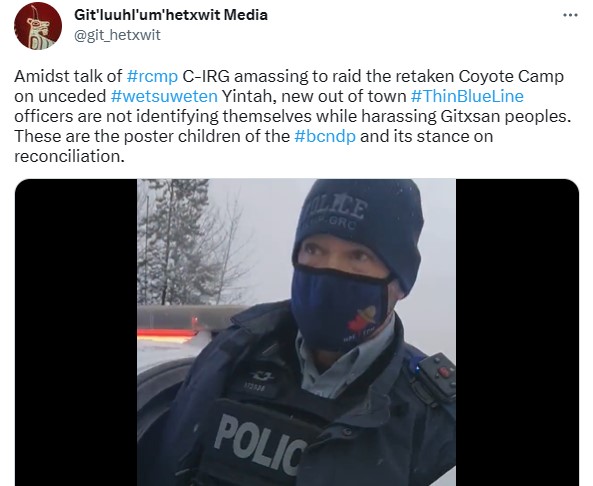
On January 1, 2022, Git’luuhl’um’hetxwit Media also tweeted:

Pipelines to be built on Gitxsan territory

Both Calgary-based Enbridge and TC Energy also have permits from British Columbia to build pipelines across Gitxsan land, adjacent to Wet’suwet’en territory.

Wilps Gwininitxw member Ankhla Jennifer Zyp says: “We’re worried, for sure, that we’re going to be met with the same violence [as seen against the Wet’suwet’en], with the same push from the government. We’re concerned about how these pipelines crossing all these rivers are going to affect the salmon returning back to our territory.”

CRCC review of C-IRG

Yesterday, APTN reported: “The Civilian Review and Complaints Commission (CRCC) for the RCMP says it is launching a “systemic investigation” into the activities and operations of the Community-Industry Response Group or C-IRG as it’s known.”

That article adds: “An APTN News investigation of C-IRG in June of 2022 uncovered allegations against the unit that includes ‘intimidation, torture, brutality, harassment, racism, theft, destruction of property, arbitrary detention, inhumanity, lying and deceit.’”

It further highlighted: “The investigation obtained evidence of vast spying — including casual surveillance of law-abiding groups engaged in the democratic process — collusion with private security, collaboration with industry lawyers and wilful violations of RCMP policy.”

#AbolishCIRG

On February 21 of this year, PBI-Canada organized a webinar titled “Dismantle the C-IRG, end violence against land defenders” featuring Wet’suwet’en Hereditary Chief Na’moks, international human rights lawyer Shivangi Misra, activist-academic Keith Cherry and PBI-Canada Board member Seb Bonet.

To watch the video of that webinar, please click here.

Now, we are part of an informal network of activists, academics, lawyers and organizations who are also calling for the abolition of C-IRG.

For an in-depth read, please also see The C-IRG: the resource extraction industry’s best ally by Molly Murphy and Research for the Front Lines (January 5, 2022).

PBI-Colombia accompanies CREDHOS and FEDEPESAN on verification visit to the caño San Silvestre

On March 9, CREDHOS tweeted:

“#CREDHOS accompanied #FEDEPESAN [the Federation of Artisanal Fishermen of Santander] on a visit to verify the events that occurred in the San Silvestre caño [channel/spout], in which the death of fauna species and the burning of the water round were identified. Added to this is the death of fish that had occurred on March 3 in the La Represa sector.”

On Facebook, CREDHOS also reported:

“In a visit made by #CREDHOS accompanying #FEDEPESAN in a verification visit on 7 March, observing the latest events that have occurred in the San Silvestre channel and its surroundings, in which the death of species of fauna and the indiscriminate burning of the water roundabout were identified. In addition to this, the death of fish occurred on 3 March 2023 in the La Represa sector.”

We also recall that on August 26, 2022, PBI-Colombia also accompanied CREDHOS and Fedepesan as they denounced “an unknown oily liquid spill in Caño Rosario, which flows into Ciénaga San Silvestre, where there is death of fish and contamination”.

On the morning of June 30, 2022, PBI-Canada visited the San Silvestre wetland ecosystem in Barrancabermeja with CREDHOS, FEDEPESAN and PBI-Colombia and witnessed the impacts of Ecopetrol and large-scale agribusiness (buffalos and palm) on the water, wildlife and livelihoods of artisanal fishers.

On December 7, 2022, we hosted this webinar with CREDHOS and FEDEPESAN to further amplify their concerns about the San Silvestre wetlands.

PBI-Colombia has accompanied the Regional Corporation in the Defence of Human Rights (CREDHOS) since 1994.