Home Blog Page 169

PBI-Canada to co-host PBI field volunteer outreach webinar, April 2

On Sunday April 2 at 1 pm ET, PBI-Canada will be co-hosting a webinar to encourage applications for field volunteers.

The webinar will feature Romina (Argentina) and Valentina (Italy) from PBI-Honduras and Maria (Chile) and Laura (Spain) from PBI-Guatemala.

The webinar will have Spanish-English translation.

People are already registering from the United States, the United Kingdom, Germany, Switzerland, Honduras and Colombia.

This webinar will also support the call-out from PBI-Guatemala for field volunteers that has a deadline of April 9.

It will also support future calls from the PBI field projects in Honduras, Colombia and Mexico.

To join this webinar, register now here.

PBI-Colombia accompanies Justice and Peace as Vice-President Francia Marquez visits Cacarica to acknowledge Operation Genesis

On March 22, PBI-Colombia tweeted:

“#26 years after #OperationGenesis and 10 years after the sentence of the @CorteIDH [the Inter-American Court of Human Rights], the State carries out an act of forgiveness in #Cacarica before ethnic communities, victims #Cavida [the Community of Self-Determination, Life, and Dignity of Cacarica] and #Clamores accompanied by @Justiciaypazcol [the Inter-Church Commission for Justice and Peace]. Important support from @IrelandColombia @SwedeninCOL [embassies] for peace in Colombia.”

On March 22, Vice-President Francia Marque tweeted:

“Yesterday I was accompanying the act of acknowledgment of responsibility of the Colombian State regarding the violation of #human rights against the communities of the river basin #Cacarica, Chocó, in the case ‘Operation Genesis vs. Colombia’. We took a step towards reparation and justice.”

PBI-Colombia has explained: “Operation Genesis included the participation of the Army, Navy, Airforce and National Police, in coordination with paramilitaries from the Cordoba and Uraba Self Defence Forces (AUC). The military and paramilitary operation resulted in over 70 crimes, including murders and enforced disappearances. As a result, around 3,500 people from the 23 communities of the Cacarica river basin were forcibly displaced.”

According to a 2003 ruling by the Inter-American Court of Human Rights (IACHR), the armed forces used bombs and machine guns against the inhabitants of the Cacarica river basin during a weeklong offensive.

That ruling found Colombia responsible for not preventing the 1997 displacement of thousands of Afro-Colombians and the brutal murder of Afro-Colombian campesino Marino Lopez Mena. During the incursion, paramilitaries killed Marino accusing him of being a guerrilla before capturing and beheading him.

WOLA has noted: “Operation Genesis formed part of a larger paramilitary political effort to displace Afro-Colombians from their territories to facilitate the entry and expansion of oil palm plantations throughout the department of Choco.”

Two years after their displacement, the communities of Cacarica obtained collective ownership of their lands, to which they returned in 2000. There, they established the Community of Self-Determination, Life, and Dignity of Cacarica (CAVIDA).

PBI has accompanied the Inter-Church Justice and Peace Commission since 1994.

Ontario Superior Court Justice calls respected Haudenosaunee land defender Skyler Williams a “busybody”

Photo by Steve Mongeau/APTN.

On March 20, Justice Paul Sweeny released his ruling on the costs associated with the 1492 Land Back Lane occupation and ordered Mohawk land defender Skyler Williams to pay Haldimand $13,000 and Foxgate Developments Inc. $60,000.

Justice Sweeny ruled: “The unsuccessful litigant must have a bona fide belief that the litigation is in the pubic interest. However, as Ducharme J. noted at para. 19 ‘the test for a costs exemption must be more than mere sincerity as even the most misguided and quixotic litigant might genuine believe in her cause and in its importance for the public at large.’ While Mr. Williams might justify his actions using genuinely held beliefs surrounding land defence and the rights of Indigenous peoples, in my view, he appears at best to be a misguided litigant.”

Significantly though, the Haudenosaunee Confederacy Chiefs Council, the traditional government of the Six Nations of the Grand River, has stated that no development can proceed on their lands without the consent of the Haudenosaunee.

In April 2021, Cayuga Snipe Chief Deyohowe:to (Roger Silversmith) stated: “It is time to end the injustice. We want the land that is ours. We are not interested in approving fraudulent dispossessions of the past. We are not interested in selling land.”

Despite this, Justice Sweeny comments: “[Mr. Williams] was acting on his own throughout the occupation and did not have the support of Indigenous groups such as the Six Nations Elected Council or the Haudenosaunee Development Institute. …In my view, this lends support for characterizing Mr. Williams as a busybody or interloper.”

For clarity, a “busybody” is defined as “a meddling or prying person”, while an “interloper” is “a person who becomes involved in a place or situation where they are not wanted or are considered not to belong.”

Sweeny was appointed a regional senior judge of the Superior Court of Justice of Ontario for the Central South Region in 2020. At the time of his appointment, federal justice minister David Lametti wrote: “I am confident he will continue to serve Ontarians well…”

On January 25 of this year, Williams and Darryl Porter were in court to hear Justice Gethin Edward’s decision on sentencing for mischief and other charges related to the 1492 Land Back Lane occupation. At that time, Two Row Times reported: “Williams, who is a brand-new father to a one-month-old baby, says there is one silver lining: he has been informed there will be no custodial sentence, meaning no jail time.”

For more on this, please see the Turtle Island News article: 1492 Landback Lane’s Skyler Williams appealing court decision ordering him to pay $70,000 in damages.

Background

On July 19, 2020, Haudenosaunee land defenders began a reoccupation of a 25-acre area of land about near the city of Caledonia, located about an hour southwest of Toronto.

Foxgate Developments planned to build at least 218 houses on this land. That was reportedly the first phase of a 1,000 unit housing development.

The Haudenosaunee asserted it was their territory through the Haldimand Treaty of 1784 that granted them an area of 950,000 acres in southern Ontario.

On July 31, 2020, the Ontario Provincial Police (OPP) escorted a court sheriff who delivered a first court injunction against the reoccupation.

Kate Gunn, a Vancouver-based lawyer with First Peoples Law, has also pointed out that an injunction is not a determination of which party is right, rather it seeks, in principle, to preserve the status quo until the underlying dispute is resolved.

That means, for instance, that a land developer can more easily persuade the court that the economic harm is greater to them than communities seeking to protect their culture and traditions from centuries of land dispossession.

Williams has stated: “This development must be seen as being yet another instance in an ongoing history of colonial land theft and genocide, that it is people from Six Nations who are facing the greater harm if this matter is decided against their interests.”

On July 2, 2021, the developer backed down, temporarily at least.

On December 15, 2022, an Ontario judge granted a permanent injunction to Foxgate Developments that bars land defenders from the site.

At that time, CBC reported: “Haudenosaunee land defenders, who have built structures and planted trees on the property known as 1492 Land Back Lane over the past two years, say they will continue to occupy the land and will appeal the decision.”

We continue to follow this.

PBI-Mexico accompanies the People’s Front in Defence of Land and Water at March against the Dispossession of Water

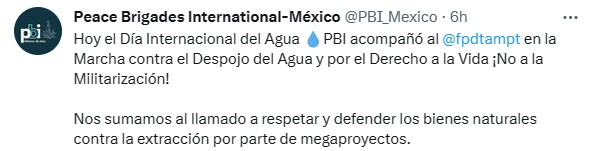
On March 22, PBI-Mexico tweeted:

“Today, International Water Day PBI accompanied the @fpdtampt [the People’s Front in Defence of Land and Water] in the March against the Dispossession of Water and for the Right to Life, No to Militarization! We join the call to respect and defend natural resources against extraction by megaprojects.”

The People’s Front has resisted the dispossession of water by the Morelos Integral Project (PIM) that would draw 50 million litres of water per day from the Cuautla River to cool the turbines of a thermoelectric plant, and the Bonafont bottled water plant in the city of Juan C. Bonilla has taken more than 1,400,000 litres of water per day over the past 25 years.

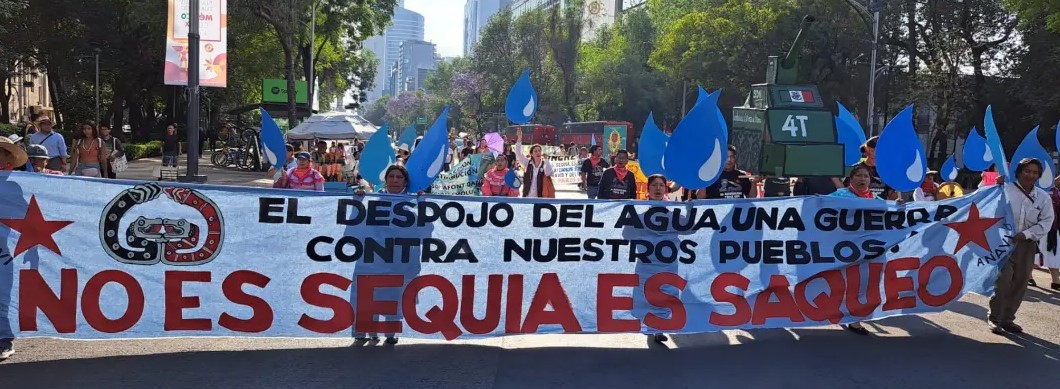
Photo: The banner says: “The dispossession of water, a war against our peoples. It’s not drought it’s plunder”

On March 22, the Spanish news agency EFE reported:

“About a hundred members of indigenous communities marched on Wednesday in the Mexican capital to protest against the dispossession of water at the hands of multinational companies and government institutions.

Organized by the National Assembly for Water and Life of the National Indigenous Congress, the demonstrators marched from the Angel of Independence to the central square of the Zocalo taking advantage of the celebration of World Water Day.

The protester denounced the collusion of the government of President Andrés Manuel López Obrador with large multinational companies such as Bonafont, Heineken or Coca-Cola when granting concessions to privatize water with impunity.

Among the different harangues that were launched along the route, reference was made to the manufacturing plant that the electric car company Tesla will build in the northern state of Nuevo León, criticizing that international companies are prioritized in a region where water is a scarce commodity.

The march, in which a variety of demands were demonstrated, was led by a dozen children dressed in fish costumes and a banner that read: “The dispossession of water, a war against our peoples. It’s not drought, it’s looting.””

La Izquierda Diario México adds:

“[Social organizations and defenders of territory and nature] spoke out against the militarization that the government of Andrés Manuel López Obrador has promoted and which has been responsible for the increase in violence in the communities, as well as responsible for the intimidation and threats to the peoples who oppose megaprojects.

At the same time, they denounce that soft drink and real estate companies maintain a constant hoarding of water, despite the drought conditions that have been experienced in recent years in the country, a situation that exacerbates violence and the criminalization of defenders of the territory.”

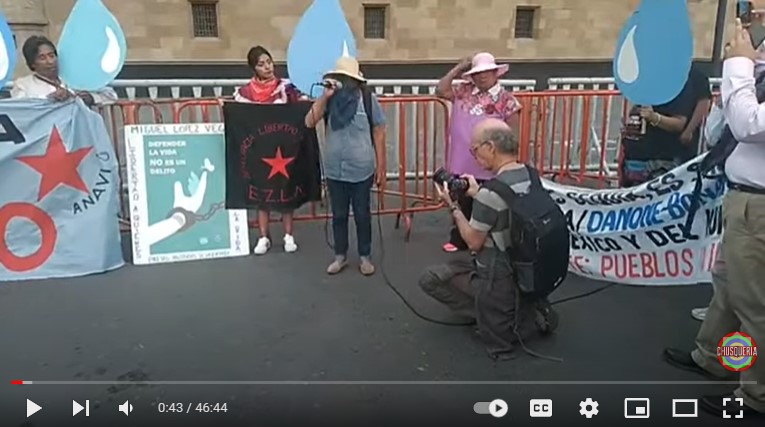
A video of the speeches at the march can be seen here.

PBI-Mexico has accompanied the People’s Front in Defense of Land and Water Morelos, Puebla, Tlaxcala since early 2020.

PBI-Honduras accompanies CEHPRODEC in Sazagua, a community affected by hydroelectric dams

On March 22, PBI-Honduras tweeted:

“Today is International Water Day, yesterday we accompanied @Cehprodechn [the Honduran Centre for the Promotion of Community Development] in the community of Sazagua, La Paz, affected by the construction of two hydroelectric dams. We highlight the work of communities in defense of the environment and access to water.”

On Facebook, PBI-Honduras also posted:

“Today, March 22, we celebrate the International Water Day! The origin of this day is at the United Nations Conference on Environment and Development, in 1992, Rio de Janeiro, Brazil. Water, common and vital for all humanity, is today in a state of particular risk because of climate change and the exploitation of resources, aggravated by the action of the human being.

During yesterday March 21, we accompanied CEHPRODEC in their visit to the community of Sazagua in Santiago de Puringla, La Paz, which years ago has been affected by the construction of two hydroelectric dams, regretted the difficulty of being able to have regular access to water.

We highlight the constant advocacy work of the CEHPRODEC organization and environmental activists to support communities in their fight to defend land and natural resources, for a dignified life!”

Anti-dam activist killed in Santiago de Puringla in December 2020

In March 2021, NBC News reported on the murder of an anti-dam activist and added that in December 2020: “Félix Vásquez, a longtime environmental activist from the Lenca Indigenous group, was shot by masked men in front of relatives at his home in Santiago de Puringla.”

The Guardian reported at that time: “Vásquez had been involved in the defence of indigenous land rights since the 1980s and was well-known nationally for organizing opposition to environmentally destructive megaprojects such as mines, hydroelectric dams, wind farms and logging, as well as for helping dispossessed communities recover ancestral land titles.”

Aurora-1, Corral de Piedras and Sazagua dams

Margarita Pineda of the Independent Lenca Indigenous Movement of La Paz (MILPAH) has stated: “Our region has been handed over to transnational companies. Just around our territory there are three hydroelectric dams, Aurora-1, Corral de Piedras and Sazagua, that, since 2009, have caused drought-related deaths in our communities.”

Speaking about Aurora-1, Pineda adds: “The water levels in our rivers and streams have lowered, which has resulted in some communities no longer having access to water. They have also built many roads which have killed  our flora and fauna.”

Shado magazine also provides the context:

“In the midst of the post-coup crisis and after the right-wing National Party of Honduras took power in 2010, the Honduran National Congress approved a General Water Law which allowed for the country’s water resources to be concessioned to third parties. Around the same time, the government named much of Lenca territory as a “productive water zone” and Honduras’ government-owned National Electric Power Company began approving hydroelectric projects like Aurora-1.”

PBI-Honduras has accompanied CEHPRODEC since May 2014.

Open letter from coalition calls for the suspension of the RCMP C-IRG during CRCC systemic review

Photo: C-IRG deployment on Wet’suwet’en territory, November 2021.

An open letter to the Civilian Review and Complaints Commission (CRCC) is calling for a suspension of Community-Industry Response Group (C-IRG) deployments during the CRCC’s systemic review of the controversial RCMP unit.

The letter comes from a coalition of impacted communities, lawyers, researchers, and non-profits, including Peace Brigades International-Canada.

We delivered the letter to the CRCC office in Ottawa.

The letter states: “The CRCC reviews can take years to complete, and it is irresponsible to have this unit continue operations during that time, enabling the continuation of unlawful use of force, arrests, detentions, and assaults that have sparked such an investigation.”

It also expresses concern that the “review fails to exercise the full investigative powers of the CRCC and its Terms of Reference weaken opportunities for accountability.”

It adds: “We note that the communities whose collective complaints informed the CRCC’s decision have all advocated for a public process that includes public hearings in affected communities.”

“The CRCC’s TOR [terms of reference] does not include any opportunity for affected communities to inform the process directly by giving evidence or commenting on the accuracy of the RCMP’s evidence or practices. The current TOR also does not explicitly reference the Commission’s powers to compel witnesses or to deal directly with the unlawful conduct of specific officers.”

And it notes: “This letter also comes in the wake of the news that the C-IRG could be receiving $36 million in funding in just a few weeks.”

The full letter can be read here.

 To help amplify on social media, click here.

To learn more about the C-IRG from front line defenders, you can register for our webinar on Sunday April 16 at 4 pm ET by clicking here.

PBI-Colombia accompanies NOMADESC and CSPP as they seek justice for the victims of police violence during the national strike

Photo: PBI-Colombia accompanied NOMADESC in its work of monitoring and verifying human rights violations during the National Strike, May 19, 2021.

PBI-Colombia accompanied organizations including the Association for Research and Social Action (NOMADESC) and Committee for Solidarity with Political Prisoners (CSPP) are seeking an end to the impunity for human rights violations committed by state security forces during the National Strike in 2021.

At the same time, PBI-Canada takes a look at Canada’s statements on state violence during the National Strike in 2021.

We also look at the helicopters and armoured vehicles that Canada has sold to the Colombian police (and our concern about the weakness of verification measures to clarify if these vehicles and helicopters were used against participants in the National Strike).

And we express concern about Canada’s export of “riot control agents”, “pyrotechnic devices” and “components” to the United States in the context of calls that the US stop exporting Venom rocket launchers and tear gas to the Colombian police.

 NOMADESC, CSPP seeking accountability

PBI-Colombia writes:

“Almost two years after the 2021 National Strike, the high-ranking members of state security forces investigated for serious human rights violations committed during the repression of protests remain in total impunity.

Of the 3,169 criminal acts reported, the Prosecutor General’s Office only attributed 65 cases to the state security forces, of which 11 were archived and, to date, there have been no convictions. Meanwhile, 230 young people are being prosecuted for leading the protest.

In December 2022, several leaders who denounced human rights violations committed by state security forces in the context of the protests were declared military targets, allegedly by the Gaitain Self-defense Forces of Colombia (AGC)—a group that arose out of the paramilitary structure.

These individuals include the director of NOMADESC, Berenice Celeita, the organization’s lawyer, Lina Pelaez, and Walter Agredo, a member of the Committee in Solidarity with Political Prisoners (CSPP). No progress has been made to clarify these events to date.

According to Óscar Ramírez, CSPP president, impunity is a direct consequence of the lack of external control of the institution, due to the military nature of the National Police.

The recent report from the Inter-American Commission on Human Rights (IACHR) as follow up to the 41 recommendations made to the Colombian state after the repression of 2021 protests highlights concerns over the generalized impunity and reports only a “partial compliance” with just three of the recommendations.”

The full PBI-Colombia article can be read at: Impunity on police violence during the 2021 national strike (March 21, 2023).

Global Affairs Canada statements on accountability

On May 9, 2021, Canada’s then Foreign Affairs Minister Marc Garneau stated: “We welcome the Government of Colombia’s commitment to fully investigate and hold accountable those who may be guilty of violating human rights during these events.”

A July 14, 2021 readout of Minister Garneau’s meeting with Colombia’s then vice-president Marta Lucía Ramírez notes: “[The Minister] called on Colombia to keep its commitment to fully investigate and hold anyone who has violated human rights to account for their actions.”

Almost two years after these statements, state security forces have not been held accountable for their violence during the national strike.

The current Minister of Foreign Affairs Melanie Joly has not made public statements subsequent to Minister Garneau’s comments.

Canadian export of “military goods” to Colombia

Canada has exported more than $46.4 million in “military goods” to Colombia over the past 8 years: $88,403.11 in 2021, $460,338.87 in 2020, $310,576.25 in 2018, $114,688.85 in 2017, $215,066.11 in 2016, $522,203. in 2015 and $44,754,393. in 2014.

The 2014 chart shows $988,347. exported in a category 2-4 (“bombs, torpedoes, rockets, missiles, other explosive devices and charges, and related equipment and accessories specially designed for military use; and specially designed components”) and $44 million in category 2-6 (“ground vehicles and components”).

In 2020, there was also a significant export of category 2-6 (ground vehicles and components) to Colombia.

And in the Government of Canada’s most recent report 2021 Exports of Military Goods (released in May 2022), it is noted that Canada exported $88,403.11 in “military goods” to Colombia in 2021. Those exports mostly fall again under category 2-6 “Ground vehicles and components”, with small amounts attributed to 2-21 “software” and 2-22 “technology”.

Canadian ground vehicles with “cannon to wrangle unruly rioters”

The Toronto-based company INKAS sold four Huron tactical attack and defense vehicles to the Colombian police in 2014.

In April 2015, PLANT also reported: “The manufacturer is still building behemoth armoured personnel carriers (APCs). In fact, there’s a tendered order for 26 of its Huron vehicles, at about $450,000 a pop, for the National Police of Columbia.”

That article adds: “The Huron will be outfitted with a cannon to wrangle unruly rioters with foam, tear gas, dyes and water.”

Canadian-made ground vehicle stops activists travelling to Cali during the National Strike

It seems that a Huron armoured vehicle was used against National Strike participants.

On July 17, 2021, Alejandra Wilches tweeted: “The police detained different delegations heading to the National People’s Assembly in Cali!”

Digital media Kienyke also reported: “Caravans of cars and buses with dozens of people were stopped on different roads in the country because the National Police prevented entry to the department of Valle del Cauca.”

This tweet (with the armoured vehicle visible) further noted: “Several delegations from each city (Popayan, Bucaramanga, Bogota …) going to the Asemblea Nacional del Paro are detained by the police who prevent them from going there to Cali.”

And this 2-minute video (in Spanish) with the armoured vehicle visible in the background also helps to understand what happened.

Helicopters over Siloé during National Strike

Colombian security forces assaulted peaceful protesters in the Siloé neighbourhood in Cali on May 3, 2021. Notably, Amnesty International’s Digital Verification Corps has confirmed the presence of two helicopters in the area during Operation Siloé.

It is in this context that we note Canada has sold forty CH-135 (between September 1998 and February 2000), twelve 212 (between 1994 and 1996) and four 407 helicopters (in 2013-14) to the Colombian police and military.

In November 2019, when the national strike mobilizations first began, Webinfomil.com reported that the Colombian National Police would “deploy its entire fleet of Bell 407 Halcón surveillance helicopters in the main cities of the country, where the most important concentrations are expected to occur.”

Semana also noted: “The aircraft, normally, carries four policemen (two pilots) and sends the images it takes to the police command, in real time, so that they are implemented in chases, padlock operations and all kinds of operations.”

We remain concerned that it is possible that the helicopters deployed by the National Police in Operation Siloé could have been helicopters made in Canada.

Canada exports “riot control agents”

In 2021, Canada also continued to export “controlled goods and technology” to the United States. Those exports totaled $123.8 million in category 2-4 that lists bombs, torpedoes, grenades (including smoke grenades), smoke canisters, pyrotechnic devices and missile rocket nozzles.

Canada also appears to have exported category 2-7 items “chemical or biological toxic agents, riot control agents, radioactive materials, and related equipment, components and materials” in 2021 through General Brokering Permits (GBP).

While the UK and US banned the export of tear gas to Hong Kong in response to misuse by that police force in 2019, no such ban appears to have been put in place by Canada in 2021 to prohibit the sale of tear gas to the Colombian police.

Further research is required to know if Canadian-produced “riot control agents” sold to the United States might have subsequently been exported to Colombia as US sales or aid. Greater transparency on supply chains would help to clarify if there are any Canadian links to the Venom rocket launchers or tear gas sold/provided by the US to Colombia.

We continue to closely follow this situation.

Join us on May 30 when we make the links between the CANSEC arms show in Ottawa (May 31-June 1), the export of Canadian military goods to Colombia, the export of Canadian military parts and components to the US, and accountability for state violence against participants in the National Strike in Colombia. More details on this coming soon!

PBI-Guatemala accompanies Human Rights Law Firm at 11th hearing in “Maestro case” for Cahabón River defender Bernardo Caal Xol

On March 20, PBI-Guatemala posted:

“#PBI accompanies to the Human Rights Law Firm at the trial of oral and public debate, in the conclusion phase, of the case of the defender of the Cahabón River Bernardo Caal Xol.

In their conclusions, the Public Ministry MP and the Prosecutor’s Office requested a maximum sentence of 4 years in prison and Q3,000 [about CAD $525] for the defender for an accusation of withholding and improper appropriation of salaries in the MINEDUC [Ministry of Education] that began in 2017.

Hereby, the Teacher case reaches the 11th audience, a process that the defender has expressed has caused him a lot of fatigue and weariness.

The next hearing will take place on March 31 at 8.30 a.m. in Court 2 of Cobán, Alta Verapaz, and replications of the findings presented today will be carried out.”

Prensa Comunitaria has previously explained:

“Caal regained his freedom on March 24 [2022], after spending more than four years in prison, for a sentence of seven years and four months in prison, issued by the Sentencing Court of Cobán for defending the rivers in Santa María Cahabón.

Caal is [now] accused of the crime of improper retention.

The events of which the Mayan Q’eqchi’ professor … is accused, occurred in 2013. In the accusation against him … they point out that between January 2012 and August 2013 he did not show up for work.

Caal served as a teacher and in 2012 was Deputy General Secretary of the Union of Education Workers of Guatemala (STEG). …The law empowers trade union leaders to have eight working days a month to do the work that corresponds to them; in the collective agreement of 2008 this situation was changed and the days were increased.

Caal is surprised by the accusation, because the law says that, if a worker is absent three days in a row, the fourth his salary should be suspended, so when he [first] voluntarily appeared before the judge on June 21, he said that at no time had he defrauded the State.

[Caal says STEG leader] Joviel Acevedo and the former Minister of Education Cynthia del Águila, were the ones who initiated the conditions for his criminalization from his union work that coincided with the defense of the Cahabón River.

[PBI has also noted: “Caal maintains his innocence in the matter. An administrative procedure by the Ministry of Education, in any case, should have preceded any criminal complaint. Caal and his attorneys argue that the charges were lodged against him in reprisal for his work to defend land, territory, and the environment.”]

In this process, until the intermediate stage, MINEDUC and the Attorney General’s Office (PGN) participated as complainants in the case; at the beginning of the trial on September 7 [2022], only the PGN and the MP [Public Ministry] were present. Although [Caal] is clear about what can happen in the trial, he does not lose hope of the resistance and mobilizations at the national level for the defense of natural assets and justice.”

PBI-Guatemala has accompanied Bernardo Caal and the Peaceful Resistance of Cahabón since August 2017.

“There have been no physical injuries as a result of any enforcement actions” by the C-IRG: RCMP Sgt. Kris Clark

Photo: “RCMP arresting old-growth activists [in May 2021] at the Caycuse blockade [in the Fairy Creek watershed] demonstrated a higher level of force than earlier in the week. Screen grab courtesy of the Rainforest Flying Squad video.”

The Canadian Press reports: “The B.C. RCMP will not respect a ban from the Gitxsan hereditary chiefs which prohibits the police force’s Community-Industry Response Group (C-IRG) from entering their traditional territories.”

That article highlights that RCMP Sgt. Kris Clark says: “While [the Gitxsan hereditary chiefs’] perception of C-IRG must be respected, it is also important to understand that there have been no physical injuries as a result of any enforcement actions to date.”

Clark is the Senior Media Relations Officer with the RCMP’s “E” Division headquarters in Surrey. It was “E” Division that created the C-IRG in 2017.

CRCC review of the C-IRG following 500 complaints against the unit

On March 9, the Ottawa-based Civilian Review and Complaints Commission (CRCC) announced that it would be conducting a systemic investigation of the C-IRG.

In January, the CBC had reported: “The RCMP’s federal watchdog agency is weighing its options after receiving nearly 500 formal complaints about a unit tasked with policing resistance to major resource extraction projects in British Columbia.”

APTN News reports on allegations of “torture, brutality” by the C-IRG

In June 2022, Brett Forester reported: “APTN News spent months investigating the C-IRG, obtaining more than 4,000 pages of court files and releases from more than two dozen federal and provincial freedom of information requests. APTN uncovered a broad suite of allegations against the unit that include intimidation, torture, brutality, harassment, racism, theft, destruction of property, arbitrary detention, inhumanity, lying and deceit.”

“Tortured somebody for an hour”

In this video in which you can hear a young man screaming in pain, Wet’suwet’en land defender Sleydo’ says: “[The RCMP] came in and tortured somebody for an hour” who had locked themselves to the underside of a bus blocking a road.

Secwepemc land defender alleges broken wrist

The APTN News article also notes: “[Tiny House Warriors] spokesperson Kanahus Manuel is suing a Mountie named Cpl. Todd Bowden, who she alleges broke her wrist when applying a wrist-lock technique during an October 2019 arrest, according to the provincial court registry. The allegation has not been proven in court.”

Gouging eyes

APTN also reports it “has confirmed C-IRG used so-called ‘pain compliance techniques,’ which included gouging a protester’s eyes with a face hold, at Fairy Creek.”

APTN News: “Levi Rowan filed several pictures of a Mountie gouging his eyes during an aerial extraction. Police use of this tactic was reported at Fairy Creek, but hard evidence like this was scarce. Photo: court file.”

“I can’t breathe!”

CBC has also reported: “Video shared on Facebook of an arrest at [a Wet’suwet’en solidarity] encampment [on Gitxsan territory] on Nov. 21 [2021] shows four officers on top of a man near the rail line. The man is heard shouting, “I can’t breathe!” while the person taking the video screams at the officers to let him go. A second person who tries to intervene is seen being put in a headlock by another officer.”

Video: Denzel Sutherland-Wilson shouts “I can’t breathe!” as C-IRG officers tackle him at the Gitxsan railroad blockade in New Hazelton.

CANADALAND reports on pepper spray in mouth, genital area

In September 2021, CANADALAND reported: “Video taken on August 21 showed an RCMP officer ripping the Covid face masks off of two women, seconds before police unleashed pepper spray onto a crowd at close range.”

That article also quotes Kristy Grear, a producer and videographer with an independent film studio, who says: “I watched [the RCMP] pick up a girl by her hair and make her open her mouth and deploy the pepper spray into her mouth.”

She also says: “I saw one officer spread the legs of a young woman and spray the pepper spray up her pants and into her genital area. I watched people be [dragged] out and choked and beaten and stepped on and kicked and punched.”

Witness account of hair being ripped out

In August 2021, Sii-am Hamilton posted: “The RCMP ripped hair out of [T’Sou-ke land defender Kati George-Jim] head when they dragged her body across the pavement.”

She adds: “This police officer proceeded to climb on top of her body and bang her head against the pavement. Without question the most brutal arrest I’ve witnessed to date at the blockade. Her hair was literally on the road after her body was dragged away.”

Land defender punched in the ear, braids pulled

In February 2022, APTN reported: “[Mohawk land defender Logan] Staats was arrested on Nov. 18 [2021] during an RCMP raid on the Gidimt’en checkpoint. An arrest he says was violent. “About 80 to 100 RCMP approached us. I’m talking, not just RCMP but green guys with sniper rifles. They had dogs. And they advanced on us and they violently took us out,” says Staats, who adds he was punched in the ear and had his braids pulled.”

Accusation of sexual assault

In August 2021, Victoria Buzz reported: “Protestors [at Fairy Creek] have taken to social media to accuse the RCMP of misconduct using excessive force and sexual assault; the RCMP, however, have denied such claims. …Victoria Buzz received an anonymous tip linking to multiple videos posted to social media which depict incidents of RCMP intimidation and a victim’s account of an alleged sexual assault.”

Video: “This officer who is standing in the right corner there he thought it was appropriate to try to twist my nipple to get me to release from the block, he then proceeded to grab my boob and use his elbow to choke me…”

Psychological trauma

And while Sgt. Clark says “there have been no physical injuries as a result of any enforcement actions to date”, this doesn’t take into account psychological trauma.

In January 2020, Sleydo’ talked with Al Jazeera about the RCMP C-IRG raid the year before. She stated: “Knowing that they were watching every move and that they had these huge weapons to use on our people – it was traumatic.”

Other incidents

In this interview with Brandi Morin, Sleydo’ also describes how police forcibly cut a cedar bracelet and medicine bag from her at an RCMP detachment in November 2021. Sleydo’ says four or five RCMP officers physically restrained her and cut the medicine bag off her body as about ten officers watched.

Mohawk land defender Layla Staats has also spoken about the “humiliation and degradation” that she felt when an RCMP C-IRG officer winked at her as she was handcuffed in the back of his police cruiser after she was arrested on Wet’suwet’en territory for resisting the CGL pipeline on November 18, 2021.

$36 million in funding to the C-IRG starting on April 1

Despite these allegations of violence and the CRCC investigation, the C-IRG could soon receive a significant amount of funding from the provincial government of BC.

Amanda Follett Hosgood reports: “Documents obtained by The Tyee that $36 million [will be] going to the RCMP’s Community-Industry Response Group. …The funding begins April 1 and will be spread over three years.”

Significantly, Follett Hosgood adds in her article that the Public Safety Ministry says the RCMP requested the funds to enforce injunctions and “standardize C-IRG within the BC RCMP, support deployment operations and response requirements, and put in place permanent funding for dedicated officers.”

#AbolishCIRG

Peace Brigades International-Canada is organizing a webinar for Sunday April 16 that will hear from people who have experienced or witnessed C-IRG violence.

To register for that webinar, please click here.

On February 21 of this year, PBI-Canada organized a webinar titled “Dismantle the C-IRG, end violence against land defenders” featuring Wet’suwet’en Hereditary Chief Na’moks, international human rights lawyer Shivangi Misra, activist-academic Keith Cherry and PBI-Canada Board member Seb Bonet.

To watch the video of that webinar, click here.

We continue to follow this situation.

Biden and Trudeau should commit this week to the rights of environmental human rights defenders

Photo: Protest against Line 3 pipeline. Photo by Joshua Partlow/The Washington Post.

When US President Joe Biden visits Ottawa on Thursday March 23 and Friday March 24 to meet with Canadian Prime Minister Justin Trudeau, a commitment to environmental human rights defenders should be on their agenda.

The Global Witness Decade of Defiance report concludes that governments should “create a safe environment for defenders and civic space to thrive.”

The report specifies on page 36:

“Existing laws that protect defenders must be enforced. Where such laws do not exist, new frameworks must be established. And efforts to use any legislation to criminalise defenders should be declared null and void. Governments must protect defender rights, including rights to free, prior and informed consent, Indigenous peoples’ rights to their livelihood and culture, the right to life, liberty and freedom of expression, and the right to a safe, healthy and sustainable environment.”

But when Biden addresses Parliament on Friday, it’s unlikely he will acknowledge the 800+ water protectors arrested in Minnesota for their peaceful opposition to the Line 3 pipeline built by Calgary-based Enbridge Inc.

Nor is Trudeau likely to note the 74+ people arrested on Wet’suwet’en territory in British Columbia for their resistance to the Coastal GasLink fracked gas pipeline now owned in part by the New York City-based investment firm KKR & Co. Inc.

Frontline defenders are not mentioned in this White House statement about the upcoming visit that notes “taking bold action to combat climate change” without referencing the crucial role environmental defenders play in addressing this crisis.

Line 3 tar sands pipeline

In November 2016, Trudeau approved the 760,000 barrel per day Line 3 tar sands pipeline from Alberta to Wisconsin.

Tara Houska of the Giniw Collective has highlighted: “Rubber-bullet welts spread purple down my arms and back, courtesy of Minnesota police, who have reportedly billed nearly $2 million in security-related costs to a fund set up by Canadian pipeline giant Enbridge.”

She has also noted: “Enbridge is dumping millions of dollars to incentivize and encourage police officers to repress, suppress and surveil, harass Indigenous people and our allies that are helping us try to stop this pipeline from happening in our treaty territory.”

More than 800 water protectors were arrested since construction of the pipeline began in Minnesota in December 2020

Coastal GasLink fracked gas pipeline

Meanwhile, the Coastal GasLink fracked gas pipeline continues to be built on Wet’suwet’en territory in northern British Columbia without consent.

In December 2019, a TC Energy media release stated: “TC Energy Corporation … announced today that it has entered into an agreement to sell a 65 per cent equity interest in the Coastal GasLink Pipeline Project … to KKR and Alberta Investment Management Corporation (AIMCo) on behalf of certain AIMCo clients.”

The following year, The Narwhal reported: “KKR is an American private equity firm and one of the largest in the world with assets of US$207 billion. Its Coastal GasLink purchase was made in partnership with South Korea’s state-run National Pension Service — the third-largest pension in the world with over US$600 billion in assets.”

More than 74 people, including land defenders, allies and journalists, have been arrested since the first RCMP Community-Industry Response Group (C-IRG) raid on Wet’suwet’en territory in January 2019. Three letters from the United Nations Committee on the Elimination of Racial Discrimination calling for construction of the pipeline to stop and the RCMP to leave the territory have gone unheeded.

Mainstream media coverage

The pre-visit coverage by CTV News, the Canadian Press and CBC News has highlighted issues such as the modernization of NORAD (that includes Canada’s $76 billion purchase of Lockheed Martin F-35 warplanes) and the mining of critical minerals (needed for military production including 920 pounds of rare-earth minerals for each F-35 produced) without also noting the historic displacement of Indigenous peoples for military bases or the Indigenous communities that will seek to protect their lands and waters from mining.

Chief Wayne Moonias of the Neskantaga First Nation has stated: “There is going to be opposition [to mining in the Ring of Fire], if this continues the way it is and the [Ontario premier Doug] Ford government or any future government doesn’t recognize the rights of our people, it’s going to be a strong stance.”

We will be watching this visit with these concerns in mind.

Photo: Biden visits Ottawa, December 2016. Photo by Justin Tang/Canadian Press.