Home Blog Page 157

Canada, the CANSEC weapons show in Ottawa and the arming of repression against the LGBTQI+ community in Honduras

Photo: A truck donated to/purchased by the Honduran Ministry of Health from Canada is used to transport soldiers in June 2019.

What is the relationship between Canada, the CANSEC weapons show in Ottawa and the arming of state repression against the LGBTQI+ community in Honduras? The lack of transparency and public information makes it hard to precisely answer this question, but we can piece together enough to paint a troubling picture.

The murder of Vicky Hernández

On June 29, 2021, The Guardian reported: “In a landmark ruling [by the Inter-American Court of Human Rights] for transgender rights, the Honduras government has been found responsible for the 2009 murder of the trans woman and activist Vicky Hernández.”

Photo: Vicky Hernández.

The article in The Guardian continues: “Hernández was killed on the first night of the June 2009 coup d’état, in which the Honduran military ousted President Manuel Zelaya and enforced night-time curfews across the country. The curfews were brought in to contain demonstrations against the coup, but were part of wider crackdown in which journalists, teachers, students and LGBTQ+ people were targeted.”

And it notes: “Lawyers working on Hernández’s case argued that state agents actually committed the murder.” Lawyer Angelita Baeyens says: “She was murdered during a curfew, on the first night of the coup d’etat, when only security forces were on the streets.”

Canada trains the Honduran army

As noted above, Hernández was murdered on June 28, 2009, the first night of the coup. On July 30, 2009, about a month after the coup, The Globe and Mail reported: “Canada is still providing training to members of the Honduran army.”

Canadian financing of surveillance

By February 17, 2015, Sandra Cuffe reported in Ricochet: “Militarization, impunity, and human rights abuses have dominated Honduras since the coup. Joining the regular national police force on the streets are soldiers, military police, and new militarized elite special police forces with U.S. and Colombian training. Canadian aid to security forces and investigative units has picked up, but some of it has produced more concerns than results.”

She adds: “Since 2011, Canada has provided the Northern Triangle (Honduras, Guatemala and El Salvador) with $5 million in surveillance and criminal investigation equipment and training to investigate homicides and violent crimes, wrote Department of Foreign Affairs, Trade and Development spokesperson John Babcock in an email to Ricochet.”

Significantly, Cuffe further notes in the article: “Given the alarming frequency of threats and attacks against human rights activists, farmworker movement participants, Indigenous leaders, journalists and others in Honduras, training in surveillance raises concerns. Bertha Oliva, coordinator of the Committee of Relatives of the Detained-Disappeared [COFADEH] in Honduras takes it for granted that human rights activists and social movement organizations are under heavy surveillance.”

Photo: Bertha Oliva, COFADEH.

“Biggest problem is state security forces”: Arcoíris (Rainbow) Association

The Arcoíris LGTB Association of Honduras was founded six years prior to the coup with the aim of empowering the LGTBI community in Honduras.

Coordinator Donny Reyes has stated: “The biggest problem that we face is the violence of the state security forces towards the LGBT+ community: the armed forces, the police, the criminal investigation police, military police, municipal police.”

Photo: Donny Reyes, Arcoiris.

Reyes adds: “The research studies that Arcoiris and other organizations have done reflect the same pattern — more than 60 per cent of hate crimes have been committed against us by those forces who should be guaranteeing our safety.”

Canadian arms sales to Honduras

Canada does not appear to export a large amount of “military goods” to Honduras. The official reports produced by Global Affairs Canada dating back to 2007 only show a sale of $4,548.00 of category 2-11 in 2016. This refers to “electronic equipment, military spacecraft and components not controlled elsewhere”, but the report does not further specify what that “electronic equipment” might have been.

We do not know if Canada still provides training to the Honduran army (as the Globe and Mail reported in July 2009) or if there is continued funding similar to the Canada Initiative for Security in Central America (that Ricochet reported on in February 2015).

We do know that Canada exports approximately $1 billion in “military goods” to the United States each year. And we know that the United States has provided well over $114 million in security assistance to Honduras between 2008 and 2014. In 2017, Global Witness documented that at least $18 million in U.S. aid was sent to Honduran police and military “in spite of their abuse against activists.” Given export permits are not required for most arms sales from Canada to the United States, it is unknown what Canadian-produced “military goods” could be going to Honduras in this way.

The Berta Cáceres Human Rights in Honduras Act

The Berta Cáceres Act, first introduced in 2016, states: “The Honduran police are widely established to be deeply corrupt and to commit human rights abuses, including torture, rape, illegal detention, and murder, with impunity.”

Video still from La Lucha Sigue.

It then calls on the United States to suspend all “security assistance to Honduran military and police until such time as human rights violations by Honduran state security forces cease and their perpetrators are brought to justice.”

There does not appear to be similar legislation in Canada to ensure that Canadian-produced “military goods” are not sold directly or indirectly to Honduras.

The CANSEC arms show in Ottawa

The CANSEC arms show in Ottawa boasts that it attracts “280+ defence and security exhibitors” and “50+ International delegations”. It further highlights that “74% of attendees have purchasing power”.

Research would be needed to know how many of the 280+ exhibitors at CANSEC sell “military goods” to Honduras. CANSEC does not make publicly available the list of countries at CANSEC, so we do not know if Honduras sends military officials to the arms show.

Photo: Protest against the CANSEC arms show.

We will continue to follow this, work to overcome the lack of transparency and information available to the public and support the mobilization against the CANSEC arms show in Ottawa in May-June (specific date to be confirmed) next year.

Bertha Zúñiga Cáceres: “We have an army in a country where there’s no armed conflict with any other country. The only conflict in Honduras is a conflict of interests of the richest people with the most historically impoverished people.”

Peace Brigades International accompanies Bertha Zúñiga Cáceres and the Civic Council of Grassroots and Indigenous Organizations in Honduras (COPINH), Donny Reyes and the Arcoíris LGTB Association of Honduras, and has provided periodic accompaniment to the Committee of Relatives of the Detained-Disappeared (COFADEH).

PBI-Colombia accompanied organizations comment on the ESMAD riot police now being called the UNDMO

Photo: The ESMAD riot police.

The government of President Gustavo Petro has changed the name of the controversial ESMAD police unit to UNDMO. The Mobile Anti-Riot Squadron (ESMAD) is now the Dialogue and Order Maintenance Unit (UNDMO).

Three PBI-Colombia accompanied organizations – the Committee of Solidarity with Political Prisoners (CSPP), the José Alvear Restrepo Lawyers Collective (CCAJAR), and the Corporation for Judicial Liberty (CJL) – say this is insufficient.

They released this open letter on June 13 that expresses their “deep concern about the process of internal transformation” which they describe as “cosmetic” and one that “does not favour comprehensive transformations.”

For context, the ESMAD was formed in February 1999 as a specialized police unit to deal with protests and crowds. Between its inception and November 2019, the ESMAD killed 34 people. Among the dead: 10 students, 9 campesinos, 9 Indigenous people, 2 children, 1 homeless man, a worker, a street vendor, and one other person.

According to the non-governmental organization (NGO) Temblores, there were also 3,789 cases of police violence including 45 killings between April 28 and May 31, 2021, against protesters challenging the neoliberal policies of the government headed by Iván Duque.

By November 2021, the ESMAD had also been implicated in 12 cases of irreversible eye trauma during the National Strike of 2020 and 2021. They are accused of intentionally firing less-than-lethal weapons at the eyes of people at protests.

Photo: “I regret to inform the ESMAD that with my left eye I still see a better future for my country.”

During the National Strike, the Canadian Labour Congress (CLC), the Public Service Alliance of Canada (PSAC) and the National Union of Public and General Employees (NUPGE) supported the popular call for the dismantling of the ESMAD.

Notably, Petro, as a candidate in 2022, had promised to do just that.

Specifically, his program stated: “Our priority will be to recover, at the institutional and operational level, the civilian character of the police force and, accordingly, to redefine its functions and priorities, which include the dismantling of the ESMAD and the transition to a force oriented to the peaceful and intelligent resolution of conflicts.”

Petro was sworn in as President of Colombia on August 7, 2022.

Photo: Petro, a former M-19 guerilla, is Colombia’s first left-wing president. Before his election, five presidential candidates had been assassinated: liberal Jorge Eliecer Gaitan (1948), communist Jaime Pardo Leal (1987), liberal Luis Carlos Galan (1989), and leftists Bernardo Jaramillo and Carlos Pizarro (1990).

The recently announced UNDMO will be divided into two groups: one focused on dialogue (who will wear blue vests and a white helmet), the other on controlling public order (who will wear the current uniform of black armour, helmets and shields). Portafolio reports: “[The UNDMO] will continue to have the well-known tankettes [armoured vehicles], but inside it will have a mobile dialogue unit equipped for the subject.”

Photo: The new dialogue group with the public order group behind them.

The three PBI-Colombia accompanied organizations along with other organizations, including the National Movement of Victims of State Crimes (MOVICE) and the Movement in Resistance Against Eye Aggressions of the ESMAD (MOCAO), now say: “The new UNDMO, although it replaces the ESMAD, does not dismantle the old structure and seeks to legitimize abusive practices and human rights violations in other scenarios.”

They further highlight in their statement: “The opportunity to confront and put an end to [ESMAD] practices of discrimination against women, people with diverse sexual orientation and gender identity and structural racism against the Afro-descendant population and ethnic communities is missed.”

The organizations also note that the “military doctrine” of the police continues to see protesters as an “internal enemy”. They comment: “The intention to leave behind this conception has not gone beyond the discourse and, therefore, the current attempts to change practices of systemic violence within the National Police are insufficient.”

We will continue to follow this and help to amplify the concerns of organizations in Colombia accompanied by Peace Brigades International.

Photos: An old and new ESMAD tankette.

“We don’t need your RCMP!”: Indigenous leader George Manuel honoured with Canada Post commemorative stamp

Video by Russ Diabo.

Canada Post has honoured Indigenous leader George Manuel (1921-1989) with a commemorative postage stamp.

Canada Post Magazine explains: “A strong-willed political leader and a champion of his people, George Manuel worked tirelessly to improve the social, economic and political conditions of First Nations people in Canada. He is credited by many with inspiring the modern Indigenous movement in Canada.”

And Canada Post highlights: “His steadfast commitment to fighting the Canadian government’s policies of assimilation led to perhaps his most important contribution: organizing the Constitution Express. The movement brought supporters from the west to Ottawa and the United Nations headquarters in New York by train in 1980 – and to Europe in 1981 – to lobby for the inclusion of Indigenous rights in the patriated Canadian Constitution. His efforts contributed to the recognition and affirmation of existing Indigenous and treaty rights in the Constitution Act, 1982.”

RCMP bomb threat against the Constitution Express

Indigenous Foundations adds: “A group of activists led by George Manuel, then president of the Union of BC Indian Chiefs [UBCIC] chartered two trains from Vancouver that eventually carried approximately one thousand people to Ottawa to publicize concerns that Aboriginal rights would be abolished in the proposed Canadian Constitution.”

Their article also notes: “Arthur Manuel recalls a bomb threat made against it while in Winnipeg. Dr Winona Wheeler, on board as a representative of the UBCIC, recalls that the bomb threat was in fact staged by undercover RCMP officers posing as train employees in order to delay the train and to intimidate the activists. The train was stopped in remote, rural Ontario, and the passengers’ belongings were searched.”

In Unsettling Canada, Arthur Manuel also writes: “In Ottawa, the RCMP began to fortify Parliament Hill with riot gates.”

Photo: Union of BC Indian Chiefs. (How the Constitution Express transformed Canada, by Emma Feltes and Glen Coulthard).

George Manuel Jr. and Doreen Manuel

The Canadian Press article about the commemorative stamp reports: “The stamp depicting Manuel, a member of the Sk’atsin (Neskonlith) First Nation, part of the Secwépemc Nation, was unveiled Monday [June 12] in North Vancouver, at a ceremony attended by his children George Manuel Jr., and Doreen Manuel.”

Photo: Manuel Jr. was arrested by the RCMP on his traditional territory in September 2004. He was resisting the $70 million expansion of the Sun Peaks Resort.

Doreen Manuel, an award-winning filmmaker, has also been critical of the RCMP.

She has commented (in a social media post about the 890,000 barrel per day Trans Mountain tar sands pipeline being built on Secwepemc territory without consent): “RCMP act as military to terrorize Indigenous land stewards on their Unceded traditional territory. Canadian government enacts genocide on Indigenous people.”

Kanahus Manuel

Secwepemc land defender Kanahus Manuel was also present at the ceremony. George Manuel is her paternal grandfather.

Photo: Kanahus Manuel and Russ Diabo at the ceremony for the commemorative stamp.

Kanahus Manuel has been criminalized for her struggle against the Trans Mountain pipeline. She is part of the Tiny House Warriors movement.

Earlier this year, the Tiny House Warriors signed this open letter that calls for the abolition of the controversial RCMP unit, the Community-Industry Response Group (C-IRG), that is used to repress Indigenous land defence struggles.

The C-IRG has spent at least $3.5 million in “enforcement” actions in support of the Trans Mountain pipeline since 2017-18.

The letter states: “Given the serious nature of allegations against C-IRG, we call on Canada, BC, and the RCMP E-Division command to suspend all C-IRG duties and deployment. This suspension and disbandment would align BC with its stated commitments to the Declaration on the Rights of Indigenous Peoples Act (DRIPA).”

Along with the video shared by Russ Diabo on Twitter, there is also this video where you can hear “We don’t need your RCMP!” sung at the ceremony.

We congratulate the Manuel family on the occasion of this commemorative stamp and for their continued defence of Secwepemc lands.

The stamp will be released on June 21.

Guatemalan appeals court orders release of military officers convicted of crimes against humanity in the Molina Theissen case

PBI-Guatemala photo (April 18, 2016): “We observe the press conference convened by the Molina Theissen family seeking justice for the forced disappearance of Marco Antonio Molina Theissen and the illegal detention, torture and rape suffered by his sister Emma at the hands of the Guatemalan army.”

The Associated Press reports: “A Guatemalan appeals court on Friday [June 9] disobeyed a ruling from the Inter-American Court of Human Rights by ordering the release of three former high-ranking military officers convicted of crimes against humanity.”

“It’s not the first time that Guatemala authorities have disregarded rulings by the court – they’ve been condemned for it 14 times before. …But it’s the first case Guatemala authorities have done so in a situation that involves releasing prisoners already convicted of serious crimes.”

The article continues: “In 2018, the men were sentenced to between 33 and 58 years in prison for crimes against humanity, the forced disappearance of a 14-year-old boy and the violent rape of his sister.”

Benedicto Lucas García and Manuel Antonio Callejas had been sentenced to 58 years in prison for crimes against the duties of humanity (25 years); enforced disappearance (25 years) and aggravated rape (8 years). Francisco Gordillo Martínez was sentenced to 33 years of imprisonment for crimes against the duties of humanity and rape with aggravated penalty. Hugo Ramiro Zaldaña, sentenced to 58 years in prison could also benefit from the appeals court ruling. Edilberto Letona Linares was acquitted of all charges.

Photo: Francisco Gordillo Martinez, Hugo Ramiro Zaldana, Manuel Antonio Callejas and Edilberto Letona Linares.

Further reading: Molina Theissen Case: Chamber Fails to Comply with Inter-American Court Ruling and Releases Convicted Military Personnel (Prensa Comunitaria, June 9, 2023)

In August 2020, PBI-Guatemala posted: “PBI accompanies the family in the Molina Theissen case looking for justice.”

The Guardian has provided the context: “[On September 27, 1981, 21-year-old social and political activist Emma Guadalupe Molina Theissen] was taken for interrogation to a military base in Quetzaltenango, western Guatemala, but refused to collaborate.”

“She was given electric shocks to the eyelids, was raped by her captors, and deprived of food and water to create sensory disorientation. Emma escaped by slipping through the cell railings because she had lost so much weight.”

“She fled to Mexico a few weeks later, unaware that her little brother [14-year-old Marco Antonio Molina Theissen] had been taken [on October 6, 1981], most likely in retaliation for her audacious escape.”

Photo: Emma Guadalupe Molina Theissen (left) and her mother Emma Theissen Álvarez de Molina hold a photo of Marco Antonio.

In April 2016, PBI-Guatemala noted: “This month we observed the Molina Thiessen family press conference.” And in October 2017, PBI-Guatemala further noted: “The Molina Thiessen trial will begin on March 1, 2018.”

On May 23, 2018, four soldiers were convicted of crimes against humanity and aggravated sexual abuse against Emma. Three of them were also found guilty of the forced disappearance of Marco Antonio. The three received a sentence of 58 years in prison, while one was sentenced to 33 years.

The body of Marco Antonio has not been found.

Commenting on the appeals court decision last week to release the three military officers, Jovita Tzul, lawyer for the Molina Thiessen family, stated that it was “a regrettable resolution, which generates serious setbacks in terms of human rights”.

Excerpt from April 2016 PBI-Guatemala monthly information pack.

Pacheedaht Elder calls for land defenders to return to Fairy Creek watershed; will the CRU/C-IRG be deployed again?

Photo: Pacheedaht Elder Bill Jones and land defenders at the Ada’itsx / Fairy Creek Blockade. Photo from the Fairy Creek Blockade Facebook page.

On June 2, the Government of British Columbia announced that it had “approved a legal order to extend the deferral of old-growth harvesting in the Fairy Creek watershed until Feb. 1, 2025.” That appeared to be good news, but there is reason for concern.

On June 5, fairycreekblockade posted on Instagram: “LOGGING IS CONTINUING – The extension of the deferral at Fairy Creek has by no means stopped the slaughter of our ancient forests. …Elder Bill has requested that land defenders return to his territory, we are currently sorting out the logistics of doing so in a manner that will keep us ALL safe (-The trees included!).”

It was Pacheedaht Elder Bill Jones who first invited allies to the territory near Port Renfrew to stop Teal Jones from logging old-growth forest.

Late last month, he commented: “Enforcement is there to defend the logging companies and are given free rein over their actions and create any law they want to further defend the logging companies who are supported by our biased government policies.”

The RCMP reportedly made a total of 1,188 arrests at Fairy Creek between May and December 2021. That enforcement cost $18,716,968.

It also resulted in nearly 500 formal complaints about the RCMP to the Civilian Review and Complaints Commission (CRCC).

The CBC reports: “More than 100 grievances accepted for investigation contain allegations of excessive force, illegal tactics, unprofessional behaviour, racism, discrimination and charter violations by the force’s Community-Industry Response Group (C-IRG).”

Citing “unjustifiable” police actions at Fairy Creek, an RCMP officer resigned from the C-IRG. The National Observer reports: “The resignation from the RCMP’s controversial Community-Industry Response Group (C-IRG) came in an email dated Sept. 5, 2021, after the officer, with 13 years of experience, was sent to the long-running protest in the Port Renfrew area on southeastern Vancouver Island.”

By March 8, 2023, the CRCC launched a systemic investigation into the C-IRG which is focusing on “the C-IRG’s governance, command and control, and operational planning, as well as its activities and enforcement operations with respect to at least three sites [including] the Teal Cedar Products Ltd injunction in the Fairy Creek watershed.”

Despite this, the British Columbia government still allocated $36 million over a three-year period to the C-IRG. Public Safety minister Mike Farnworth says that number is “based on an average that we have spent in this province over the last number of years in terms of dealing with the enforcement of court ordered injunctions.”

Meanwhile, the Abolish C-IRG coalition has called for the C-IRG to be suspended during the period of the CRCC investigation, which is expected to take 12-18 months.

The call for land defenders to return to Fairy Creek and the likely return of the C-IRG (now rebranded the Critical Response Unit, CRU) is cause for concern.

We will continue to follow this closely.

Canada has exported $19.86 million in “military goods” to Colombia and Mexico over the past five years

Photo: In 2015-16, Montreal-based Bell Helicopter sold 15 407GXP helicopters to the Mexican Air Force. They are stationed in Zapopan, Jalisco. In 2020, Canada exported $12,295,751.38 of category 2-10 aircraft-related “military goods” to Mexico.

Over the last five years (2018 to 2022), Canada has exported at least $19.86 million in military goods to Colombia and Mexico.

These are countries where Peace Brigades International accompanies at-risk human rights defenders, many of whom experience repression at the hands of state security forces, namely the police and army.

The exports appear to have included: small calibre weapons, ammunition, ground vehicles, aircraft, electronic equipment, imaging equipment, equipment for the production of munitions, software, and technology.

In 2022:

Colombia – $21,111.10 (2-21, 2-22)*

Mexico – $625,160.28 (2-10, 2-11, 2-15, 2-18, 2-21, 2-22)

Total: $646,271.38

In 2021:

Colombia – $88,403.11 (2-6, 2-21, 2-22)

Mexico – $1,084,963.51 (2-10, 2-15, 2-22)

Total: $1,173,366.62

In 2020:

Colombia – $460,338.87 (2-6, 2-21, 2-22)

Mexico – $13,103,875.79 (2-3, 2-10, 2-15, 2-22)

Total: $13,564,214.66

In 2019:

Mexico – $1,517,790.57 (2-1, 2-10, 2-11, 2-15, 2-22)

Total: $1,517,790.57

And in 2018:

Colombia – $310,576.25 (2-5, 2-11, 2-15)

Mexico – $2,657,463.84 (2-10, 2-15, 2-18, 2-22)

Total: $2,968,040.09

Arms sales to Guatemala and Honduras

If we go back five more years – to 2017, 2016, 2015, 2014 and 2012-2013 – we find more sales to Colombia and Mexico, as well as Honduras ($4,548.00 of 2-11 in 2016) and Guatemala ($6,000.00 of 2-1 in 2015 and $8,731.00 of 2-13 in 2013).

And if we go back another five years – to 2011-2010, 2009-2007 – we also find more sales of “military goods” to Colombia and Mexico, as well as to Guatemala ($89,708.00 of 2-1 in 2007, $75,310.00 of 2-1 in 2008).

As noted in the chart below, the $171,018.00 in sales to Guatemala in 2015, 2008 and 2007 were small calibre weapons, including automatic weapons.

Militarization of territory in Mexico

In June 2018, PBI-United Kingdom commented in The Guardian:

“Your article about Mexico’s security crisis in the run-up to the July elections obscures the fact that strategies purported to tackle criminal violence are often themselves responsible for human rights violations.

Last December Mexico enacted the interior security law, normalising the intervention of armed forces in public security activities and linked to a growing trend in Mexico towards the use of excessive force in situations of social protest. Peace Brigades International (PBI) has provided protection to at-risk human rights defenders in the country since 2000, an experience that has shown us that in the federal states where a security strategy based on militarisation has been implemented, attacks against activists have increased significantly.

The violence linked to the elections is particularly affecting human rights defenders and journalists. While electoral debate focuses on criminal violence and militarised responses, it is concerning that civil society initiatives to tackle human rights issues – such as Chihuahua’s early warning system and contingency plan to address the structural causes of violence against defenders – are being put on hold for electoral reasons. Encouragement of such civil society processes should be the first step in strengthening the rule of law in the country.“

It was in this context of militarization and human rights violations that Canada exported to Mexico $4.157 million of military goods in 2018-2019.

Our concerns

PBI-Canada continues to be concerned about the lack of transparency in what is specifically exported, what companies are involved in these exports, the lack of accountability/follow-up by Canadian officials on how these “military goods” may be used against organizations, defenders and communities.

In June 2021, Global Affairs Canada stated: “Canada is monitoring developments in Colombia and will take appropriate action if credible evidence of the inappropriate use of any controlled Canadian product or technology is identified, including to perpetrate or facilitate serious violations of international human rights law.”

And yet Global Affairs Canada does not appear to proactively initiate independent and credible investigations, publicly report on concerns it might have, or publicly comment on the dissonance between human rights violations documented by Amnesty International, Human Rights Watch and other groups and the continued sale of military goods to countries implicated in these violations.

Journalist David Pugliese has reported in the National Post: “The Ottawa-based CCC [Canadian Commercial Corporation, a federal Crown corporation], which helps Canadian exporters get contracts with foreign governments acknowledges it conducts no follow-up to ensure exported Canadian-built equipment isn’t being used to abuse human rights.”

We are also concerned by the role that the CANSEC arms show in Ottawa plays in the facilitation of these exports/sales.

Photo: Canada will also be present at DSEI, the world’s largest arms show that attracts 40+ international delegations, this coming September 12-15 in London, UK.

And we remain concerned that beyond the figures reported by Global Affairs Canada, that some of the $1 billion in military goods exported by Canada to the United States every year may be re-exported as “security assistance” by the U.S. to Colombia, Guatemala, Honduras, and Mexico where it may be used against organizations, defenders and communities.

While transparency has somewhat improved in recent years, Project Ploughshares has previously highlighted this concern in Transfer of Military Equipment to Colombia Exposes Loopholes in Export Controls (March 2001).

Their briefing highlighted the sale of 40 surplus Bell CH-135 Huey II military helicopters to Colombia via the United States between September 1998 and February 2000 did not require a Canadian permit because they were refurbished in the U.S. before being sent to Colombia.

They add: “This loophole is a major one, since significant levels of Canadian military exports are of components and subsystems used in the importing country for the manufacture of weapons systems which are in turn sold to third countries.”

Video: On May 2, 2021, Colombian security forces used helicopters to assault a peaceful protest in the Siloé neighbourhood of the city of Cali. We remain concerned that Canada sold forty CH-135 helicopters (between 1998 and 2000), twelve 212 (between 1994 and 1996) and four 407 helicopters (in 2013-14) to the Colombian police and military.

Bell CH-135 (CUH-1N) helicopter. Photo by Santiago Rivas.

We continue to follow this situation and to ask for both greater transparency/accountability with respect to Canada’s arming of security forces that violate human rights and repress organizations, defenders and communities.

—

*Global Affairs Canada categories of “military goods”:

2-1: Smooth-bore weapons with a calibre of less than 20 mm, other arms and automatic weapons with a calibre of 12.7 mm or less and accessories.

2-3: Ammunition and fuse-setting devices, and specially designed components.

2-6: Ground vehicles and components.

2-10: Aircraft, lighter-than-air vehicles, unmanned airborne vehicles, aero-engines and aircraft equipment, related equipment and components, specially designed or modified for military use.

2-11: Electronic equipment, military spacecraft and components not controlled elsewhere.

2-13: Armoured or protective equipment and constructions and components.

2-15: Imaging or countermeasure equipment, specially designed for military use, and specially designed components and accessories.

2-18: Equipment for the production of products referred to in the Munitions List.

2-21: Software.

2-22: Technology.


PBI-Guatemala accompanies criminalized CCR water defenders as they receive a complete acquittal at court hearing

On May 30, PBI-Guatemala posted on their Facebook page: “PBI accompanies the 4 people criminalized from the Council of Communities of Retalhuleu for defending the right to water. Today a sentence of complete acquittal was issued for the 4 defenders in the absence of elements that can first establish a crime and then the participation of all in a demonstration for the right to defend water.”

Just four weeks earlier, on May 2-4, PBI-Canada visited with the Council of Communities of Retalhuleu (CCR) on the South Coast of Guatemala.

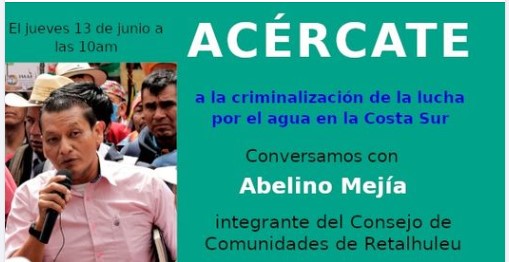
While there, Abelino Mejia Cancino, one of the criminalized defenders, introduced us to communities experiencing water shortages related to the water-intensive sugar industry and showed us drained and polluted rivers, as well as water being taken from this river.

The CCR began to organize in 2015 because of the adverse effects of the expansion of sugar crops and sugar mills on water and the environment.

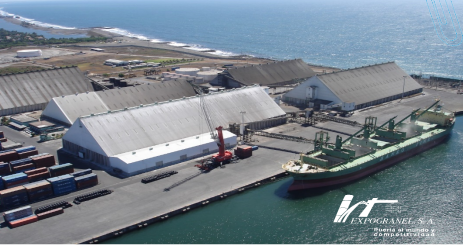
Canada is one of the largest importers of sugar from Guatemala. Since 2015, the time the CCR began to organize, Canada has imported 1.46 million tonnes of sugar from Guatemala. That sugar is shipped from Puerto Quetzal on the South Coast of Guatemala to the Lantic/Rogers refinery in Vancouver and the Redpath refinery in Toronto.

Photo: The Expogranel port in Puerto Quetzal.

Photo: Lantic/Rogers Vancouver Cane Refinery.

Photo: Redpath Sugar Refinery in Toronto.

The four members of the CCR have been criminalized since November 2019 due to their advocacy.

Panorama Noticias has reported: “Allegations of violations of the right to water, food and environmental pollution by the communities of the South Coast led to four defenders being criminalized by the mills of El Pilar and Magdalena. The Court of First Instance of Retalhuleu terminated a case in which they were accused, however, the case was appealed by sugar mills and the defenders were linked to the process.”

Photo: The entrance to the El Pilar sugar mill.

We welcome the news of the acquittal of Abelino and his CCR colleagues.

On March 13, 2022, a year before we met him in person, Abelino also participated in this PBI-Canada webinar.

Video of webinar.

At that time, he said: “There is a year-by-year certification process for the sugar mills. They need to visit not just the sugar mills, but the communities, that they come to see the rivers, they need to see the reality of the poverty the sugar cane industry is leaving here in our country.”

From the websites of Lantic/Rogers and Redpath, the companies that import Guatemalan sugar to the ports of Vancouver and Toronto, it appears that the companies conduct their own assessments/certification.

Redpath highlights: “’Sustainably Sourced’ and ‘Ethically Grown’ for Redpath means that our raw cane sugar comes from suppliers who: respect and work towards the highest environmental, social, and governance standards; uphold human rights; have been verified through our rigorous Ethical Sourcing Program.” They add their “Corporate Social Responsibility Program is an ongoing commitment to continuous assessment of our supply chain.”

And Lantic/Rogers also produced this ESG Report in June 2021 that says: “Rogers’ raw material sourcing is responsible.”

Abelino has also commented: “We need people to realize that when they consume sugar, it has an impact on the life of the communities and on the right to water for all. We call for the consumption of what is healthy and good produced by the campesinos and not products made by the big companies.”

PBI-Canada is currently in the early stages of planning an advocacy tour with Abelino and other members of the CCR to Vancouver and Toronto in 2024.

Stay tuned for more on this.

And for more (in Spanish), PBI-Guatemala will be interviewing Abelino this coming Tuesday June 13 at 10 am (in Guatemala) / 12 pm (Eastern Time).

CRCC Chair Michelaine Lahaie comments on the systemic investigation of the RCMP Community-Industry Response Group (C-IRG)

On Friday June 9, Michelaine Lahaie, the chair of the Civilian Review and Complaints Commission (CRCC), presented to the House of Commons Standing Committee on Public Safety and National Security (SECU) on Bill C-20.

In short, Bill C-20 proposes to replace the existing CRCC that reviews complaints against the Royal Canadian Mounted Police (RCMP) with a Public Complaints and Review Commission (PCRC) that would be a review body for both the RCMP but also now in addition the Canada Border Services Agency (CBSA).

In a response to a question from Member of Parliament Peter Julian during the committee hearing, Lahaie commented: “We are now looking at the Community-Industry Response Group in British Columbia. That’s a big investigation. It’s taking up a lot of my resources but it’s absolutely critical that we do it. But we had to wait for additional program integrity funding to come in before I could actually launch that investigation.”

That’s at the 9:19:02 mark in this video of her testimony.

On January 23 of this year, the CBC reported: “The RCMP’s federal watchdog agency is weighing its options after receiving nearly 500 formal complaints about a unit tasked with policing resistance to major resource extraction projects in British Columbia. More than 100 grievances accepted for investigation contain allegations of excessive force, illegal tactics, unprofessional behaviour, racism, discrimination and charter violations by the force’s Community-Industry Response Group (C-IRG).”

From Ms. Lahaie’s testimony, it’s possible that the weighing of options included waiting for the additional program integrity funding.

The investigation into the C-IRG was launched on March 8, 2023.

This past week, three months into this systemic investigation, PBI-Canada asked the CRCC about the status of this work.

While the CRCC Communications and Media Relations Team told us they “will not be providing interviews at this stage of the ongoing investigation”, they did note:

“At the launch of our systemic investigation on March 8, 2023, the CRCC submitted a request for extensive information to the RCMP.  We have received some of that information so far, and are awaiting confirmation on when the RCMP will be able to compile and provide the remainder.  At this time, we are also procuring independent counsel and other experts to support the investigation.

The CRCC strives to complete its systemic investigations within 12-18 months; however, the timely provision of requested information and access to RCMP personnel will largely determine when the CRCC’s report will be available. All systemic investigation reports are made available on the CRCC website. This includes the RCMP Commissioner’s response to our findings and recommendations and the final report.”

The Abolish C-IRG coalition has called on the CRCC “to expand the current Terms of Reference (TOR) to include a broader public inquiry with more robust investigatory powers, as was done during the Commission’s investigation at Elsipogtog (aka Kent County, NB), via a parallel Chair-initiated investigation under s. 45.66(1) of the RCMP Act.”

The letter further highlights: “The CRCC’s TOR does not include any opportunity for affected communities to inform the process directly by giving evidence or commenting on the accuracy of the RCMP’s evidence or practices. The current TOR also does not explicitly reference the Commission’s powers to compel witnesses or to deal directly with the unlawful conduct of specific officers.”

We continue to follow the CRCC systemic investigation of C-IRG actions against land defenders and reaffirm the call from the Abolish C-IRG coalition for the C-IRG to be suspended during the period of this investigation.

Video: The C-IRG on Wet’suwet’en territory, November 2021.

Video: INVESTIGATION: RCMP misled the public about pepper spray incident at Fairy Creek (Capital Daily)

Article: I watched my mom get arrested at a logging blockade (Louis Bockner, The Narwhal)

Canadian agency waits for information from the RCMP three months into its systemic investigation of the C-IRG

Video: The C-IRG on Wet’suwet’en territory, November 2021.

On March 9, the Civilian Review and Complaints Commission (CRCC) issued a media release that stated it had “initiated a systemic investigation into the activities and operations of the RCMP “E” Division Community-Industry Response Group (C-IRG).”

The CRCC is an independent agency of the Canadian government. It was established by Parliament with a series of responsibilities, including to “initiate complaints and investigations into RCMP conduct when it is in the public interest to do so.”

The terms of reference for its C-IRG investigation noted: “The review will include a detailed examination of relevant RCMP policies, procedures, guidelines and training to assess their adequacy, appropriateness, sufficiency and clarity, in accordance with section 45.34(1) of the Royal Canadian Mounted Police Act. …The systemic investigation will also include a comprehensive file review to assess whether or to what extent the activities and operations of the C-IRG are carried out in accordance with legal standards, policy requirements, and leading practices.”

What is the status of the investigation?

While the CRCC Communications and Media Relations Team tells us they “will not be providing interviews at this stage of the ongoing investigation”, they did respond by e-mail earlier this week to our inquiry about the investigation stating:

“At the launch of our systemic investigation on March 8, 2023, the CRCC submitted a request for extensive information to the RCMP.  We have received some of that information so far, and are awaiting confirmation on when the RCMP will be able to compile and provide the remainder.  At this time, we are also procuring independent counsel and other experts to support the investigation.

The CRCC strives to complete its systemic investigations within 12-18 months; however, the timely provision of requested information and access to RCMP personnel will largely determine when the CRCC’s report will be available. All systemic investigation reports are made available on the CRCC website. This includes the RCMP Commissioner’s response to our findings and recommendations and the final report.”

On March 22, the Abolish C-IRG coalition wrote to the CRCC. That letter was hand-delivered by PBI-Canada to the CRCC office in Ottawa.

The letter highlights:

“The CRCC’s announcement is the result of long, multifaceted grassroots and Indigenous-led efforts to call attention to the C-IRG unit and its role in violently facilitating resource extraction without Indigenous consent. We note that the communities whose collective complaints informed the CRCC’s decision have all advocated for a public process that includes public hearings in affected communities.

While we welcome the CRCC’s investigation, the current Terms of Reference (TOR) for this process fails to create a meaningful forum for accountability. Given the nature of the complaints and substantial evidence supporting them, we argue for the suspension of all C-IRG deployment in BC pending investigation and resolution of all complaints currently before the CRCC. The CRCC reviews can take years to complete, and it is irresponsible to have this unit continue operations during that time, enabling the continuation of unlawful use of force, arrests, detentions, and assaults that have sparked such an investigation.

We encourage the Commissioner to expand the current Terms of Reference (TOR) to include a broader public inquiry with more robust investigatory powers, as was done during the Commission’s investigation at Elsipogtog (aka Kent County, NB), via a parallel Chair-initiated investigation under s. 45.66(1) of the RCMP Act.

The CRCC’s TOR does not include any opportunity for affected communities to inform the process directly by giving evidence or commenting on the accuracy of the RCMP’s evidence or practices. The current TOR also does not explicitly reference the Commission’s powers to compel witnesses or to deal directly with the unlawful conduct of specific officers.”

The three-month anniversary of the launch of the systemic investigation into the C-IRG coincides with reports that the RCMP appears to have rebranded the C-IRG as the Critical Response Unit (CRU).

Abolish C-IRG has tweeted:

We continue to follow this. We will provide another update on September 8, the six-month anniversary of the launch of the CRCC investigation.

Innu and Atikamekw blockades seek to defend ancestral territories in Quebec from logging

Photo from Collectif Mashk Assi Facebook page.

Indigenous land defenders are expected to continue blockades this summer on Innu Nitassinan territory (south of Lake Kénogami) and Atikamekw Nitaskinan territory (near La Tuque and Manawan). This area is located about 465 kilometres north-east of Ottawa.

The independent news source Pivot reports (in French): “Since Tuesday [May 30], after issuing an eviction notice to seven [logging companies], the Mashk Assi Collective and Atikamekw and non-Atikamekw allies have been blocking a logging road south of Lake Kénogami to prevent the passage of machinery.”

The article adds: “Mashk Assi is an independent group dedicated to the protection of territory and the implementation of ancestral sovereignty over unceded territories.”

“On Monday [May 29], the collective sent an eviction letter signed by 35 land guards to seven logging companies operating on Nitassinan (Innu territory). This letter argues that logging activities are illegal, as they are carried out on unceded territory and without the consent of the custodian families of the territory.”

“While agreements between band councils and foresters sometimes govern logging, Mashk Assi points out that the cutting areas concerned are outside reserve territories. Thus, since they target areas outside the jurisdiction of band councils, the agreements are void, according to the collective.”

And the article notes: “Members of Ekoni Aci (“enough is enough”), which brings together defenders of the Atikamekw territory of Manawan and Wemotaci, went to the blockade site to lend a hand to the Mashk Assi collective in its fight. …The Association for the Protection of Lake Kénogami, which brings together residents and non-native vacationers, has also expressed its support for the blockade.”

Radio-Canada has also reported (in French): “The Mashk Assi Collective and guardians of the Innu ancestral territory want to force a stop to logging north of the Laurentian Wildlife Reserve and in the Lake Kénogami watershed in Saguenay.”

That article further notes: “Since early March, Atikamekw from Wemotaci have been blocking a logging road north of La Tuque to protest logging on their ancestral territory. This blockage is in addition to the one that has existed for more than a year in Manawan, the other Atikamekw community in Haute-Mauricie.”

Photo by Matawinie Mobilization.

It’s Going Down further explains: “On May 19th, a hard blockade was set up on the road ahead of the year-old camp, but after conflict between land defenders and Atikamekw forestry employees, the blockade at KM 16 was dismantled.”

It adds: “Logging on Atikamekw territory has come to a halt in the first week of June due to forest fires, but it is likely blockading will resume and multiply once the fires are put out.”

For more, please see Collectif Mashk Assi and Mobilisation Matawinie on Facebook.

We continue to follow this.

Video.