Home Blog Page 152

PBI-Mexico meets with Secretary of Public Security in Chihuahua to raise concerns about insecurity experienced by communities

La Opción de Chihuahua reports:

“The Secretary of Public Security of the State (SSPE), Gilberto Loya Chávez, held a meeting on Monday [August 26] with authorities of the International Peace Brigade (Peace Brigades International or PBI) Mexico project, with the aim of reviewing data on the incidence of crime in the municipality of Guadalupe y Calvo. This, as a follow-up to the information issued by the PBI, where they highlighted their concern of the international community regarding the insecurity faced by the inhabitants of nearby communities, such as Baborigame, Santa Tulita, Puerto de Animas and La Sierrita.”

In November 2021, El Diario had reported: “Loya Chávez, reported that they are waiting for the diagnoses made by national and international observers of the Undersecretariat of Human Rights of the Federal Government and the Inter-American Court of Human Rights, on the review and evolution that has had the protection of communities that at some point were displaced by crime in the Sierra Tarahumara.”

That article added: “Communities such as Choreachi, Santa Rita and San Jerónimo de Guadalupe y Calvo, El Manzano in Uruachi and Monterde in the municipality of Guazapares, have presented problems of forced displacement in recent years.”

Internally displaced persons

As of December 2020, there were approximately 357,000 internally displaced persons in Mexico, up from 8,000 people in 2009.

While some have been displaced by climate change and natural disasters, the majority have been displaced by organized crime groups fighting for control of territory rich in natural resources, including timber.

Social movements have called on the López Obrador administration to implement the necessary protection frameworks in this regard.

PBI-Mexico has also noted that the Mexican Commission for the Defense and Promotion of Human Rights has highlighted that Chihuahua is one of the states with most episodes of internal forced displacement in the country.

PBI-Canada webinars on Chihuahua

The issue of internal displacement in the state of Chihuahua has been raised on PBI-Canada-organized webinars by Diana Villalobos Diaz of the Community Technical Consulting (CONTEC) in April 2022, and by Isela Gonzalez of the Sierra Madre Alliance (ASMAC) in March 2021.

PBI accompaniment in Chihuahua

As noted on the PBI-Mexico website here, PBI-Mexico accompanies the Community Technical Consultancy, A.C. (CONTEC) and the Paso del Norte Human Rights Centre in the state of Chihuahua in the northwestern part of Mexico.

The full article about the meeting between PBI-Mexico and the Secretary can be read at Sostiene reunión Seguridad Estatal con representantes del PBI México.

Union of Indigenous Communities from the North of the Isthmus (UCIZONI) opposes TC Energy gas pipeline in Mexico

Photo: Carlos Beas Torres of UCIZONI.

The Union of Indigenous Communities from the North of the Isthmus (UCIZONI) is opposed to the of the Interoceanic Corridor of the Isthmus of Tehuantepec (CIIT) and the TC Energy Southeast Gateway Pipeline, an offshore gas pipeline whose landfall endpoint is Coatzacoalcos, Veracruz, which is situated in the Isthmus of Tehuantepec.

The CIIT

Carlos Beas Torres of UCIZONI says: “This [CIIT] megaproject, which includes the construction of more than ten industrial parks, will create an intense strain on our rivers, streams, and water sources. They are also building high speed railway lines to transport goods, as well as expanding ports, destroying many trees, and destroying mountains.”

Mexico News Daily has also explained: “The so-called Interoceanic Corridor will include 10 new industrial parks across the Isthmus of Tehuantepec — the narrow ‘waist’ of southern Mexico between Salina Cruz, Oaxaca and Coatzacoalcos, Veracruz.”

That article adds: “The ports of Coatzacoalcos and Salina Cruz would be expanded, and a new gas pipeline would be constructed in the oil-rich region.”

And El Universal has reported the pipeline would serve the needs of companies in the south of the country, “especially those established in the industrial parks promoted by the Interoceanic Corridor of the Isthmus of Tehuantepec (CIIT).”

The Jaltipán-Salina Cruz/Chinameca-Oaxaca pipeline

That pipeline appears to be the Jaltipán-Salina Cruz pipeline. In August 2022, Bnamericas reported on the Jaltipán-Salina Cruz pipeline, which is expected to cross the Tehuantepec isthmus. Mexico Daily Post has also noted: “The pipeline will support the development of the Tehuantepec interoceanic corridor (CIIT).”

This pipeline may now be known as the Chinameca-Oaxaca gas pipeline. It would span from Chinameca, Veracruz to Salina Cruz, Oaxaca.

The Sur de Texas-Tuxpan and Southeast Gateway pipeline

In an article about the CIIT, Beas says: “Two gas pipelines are currently being considered, one involving a Canadian company, TransCanada [TC Energy Corporation], seeking to transport gas from the state of Texas to southeastern Mexico [this most likely refers to the Sur de Texas – Tuxpan Pipeline], where the construction of another gas pipeline [we think the Chinameca-Oaxaca pipeline] is being proposed by two North American companies, Mirage Energy and Hemisphere Northern Logistics.”

He adds: “We also want to inform you that they announced this week [the week of May 15] that they started the construction of [the Southeast Gateway] pipeline from Tuxpan [Veracruz] to Coatzacoalcos [Veracruz] without an environmental impact assessment. This project is also being built by TransCanada [TC Energy]. So, we are witnessing this Canadian company threaten the Laguna del Ostion estuary, in the south of the state of Veracruz.”

Photo: The Laguna del Ostion estuary.

The PBI-Mexico accompanied People’s Front in Defense of Land and Water of Morelos, Puebla and Tlaxcala signed this letter against the Southeast Gateway pipeline.

Pieced together, the Sur de Texas-Tuxpan Pipeline would go from Brownsville, Texas to Tuxpan. The Southeast Gateway pipeline would go from Tuxpan to Coatzacoalcos. And the start of the Chinameca-Oaxaca pipeline (that would cross the Isthmus of Tehuantepec) would be situated 36 kilometres from the end point of the Southeast Gateway pipeline.

Southeast Gateway pipeline connects with Trans-Isthmus pipeline

Expansion reports: “The 715-kilometer [Southeast Gateway] pipeline will originate in Tuxpan – where the first stretch [the Sur de Texas – Tuxpan Pipeline] that runs under the sea from South Texas concludes – will continue offshore and make landfall in Coatzacoalcos, Veracruz, where it will carry fuel to the Salina Cruz liquefaction plant, and in Dos Bocas, Tabasco the project will also transport gas to the Olmeca refinery [also protected by the Mexican Navy] and connect with the Trans-Isthmus pipeline, which has been projected by the federal government to connect the port of Salina Cruz, in Oaxaca, with Jáltipan, Veracruz.”

TC Energy in Mexico

Overall, TC Energy has five fully owned pipelines currently operating in Mexico.

Encino-Topolobampo pipeline

One of those pipelines is the Encino-Topolobampo pipeline that was successfully resisted by the San Elías Repechique Forest community who fought for the pipeline to be rerouted away from the ancestral territory of the Rarámuri in Chihuahua.

Tuxpan-Tula pipeline

TC Energy is also building the Tuxpan-Tula pipeline resisted that is being resisted by Otomi, Nahua and Tepehua communities grouped together as the Regional Council of Indigenous Peoples in Defense of the Territory of Puebla and Hidalgo.

In January 2020 Mexican president Andrés Manuel López Obrador announced that the pipeline would be rerouted away from areas in Puebla state that are held sacred by local indigenous groups. In April 2023, the Federal Electricity Commission (CFE) confirmed the intention to complete the pipeline. As of June 2023, efforts to complete the construction of the pipeline appeared to be moving ahead despite continued opposition.

PBI-Mexico participates in observation mission on the CIIT

Proceso has reported: “During its three-day tour [July 25-27], the Civilian Observation Mission recorded human rights violations, framed in the Interoceanic Corridor of the Isthmus megaproject, against members of indigenous peoples and communities, most of which involve the Navy and the National Guard.”

Video: A representative of PBI-Mexico (in green vest) speaks (starting at 35:26) at the observation mission media conference, July 27.

La Jornada has further reported: “The most worrying thing, [the civilian observation mission] said, is that there has been an increase in attacks this year and the integrity of defenders who resist this mega-project is at risk.”

The joint statement from the observation mission can be read here.

It highlights: “Among the authorities responsible for the human rights violations identified during the mission are the National Guard, the Navy, the Sedena [the Mexican Secretariat of National Defense], [and] the State Police…”

‘We are also protesting against TC Energy’

Beas has also commented on what needs to be done: “Spreading the word is very important because we are being isolated, the information regarding what is happening here, silenced. In many places, no one is aware of what is currently happening: the escalating situation of criminalization, the repercussions of the Interoceanic Corridor and the interests of TransCanada, building gas pipelines. The original peoples of Canada and the United States have also had intense struggles against the impacts of these projects. It is important to know that in Mexico we are also protesting against this company.”

The Wet’suwet’en oppose the TC Energy Coastal GasLink fracked gas pipeline on their territory in northern British Columbia, Canada.

We continue to follow this with concern.

Further reading: Extension of The National Dream railway has implications for Indigenous land defenders opposing megaproject in Mexico (July 30, 2023).

PBI-Honduras accompanies LGBTQI+ defenders at Pride March in Tegucigalpa where car hit transgender activist Megan Kerr

On July 31, PBI-Honduras posted:

“To end this #PrideMonth, we accompanied the organizations Asociación LGTB Arcoiris de Honduras and Somoscdc Hn during the closing march through the streets of Tegucigalpa. At PBI we highlight the work of all the organizations that work to defend LGTBI+ rights and we remember the importance of protecting the people of the collective, who every day suffer situations of violence and oppression. Also, we remember that tomorrow August 1 will be the anniversary of the Asociación LGTB Arcoiris de Honduras and we congratulate you on the great achievements and perseverance demonstrated in these years!”

Notably, Reportar sin Miedo has reported:

“”Watch out!” they shouted. Attendees at the 2023 LGBTIQ+ Pride March in Tegucigalpa, central Honduras, [on the evening of Saturday July 29] watched as a silver Honda sped over the wet street and raised a curtain of rainwater. They kept screaming when the car knocked Megan Kerr down and braked a few feet ahead. For a few seconds they believed that the violent blow had ended in tragedy.”

Megan says: “By God’s miracle he didn’t touch my feet or the car passed over me. People started moving the car backwards and they managed to get me out. It hit my knee and hip. I’ve been with hip and knee pain. I was inches away from that car running over me and leaving my legs broken.”

Photo: Megan Kerr.

PBI-Honduras has commented:

“We stand in solidarity with transgender defender Megan Kerr of the Honduran LGTB Rainbow Association after the outrage that occurred during the Pride March in Tegucigalpa. We recognize the important work that Megan does in favor of LGTBI+ rights in the country. We are concerned about the hate speech and transphobia that prevail in Honduran society and that constitute a risk for people from the LGTBI+ collective. We remember that the Inter-American Court of Human Rights, through the sentence of Vicky Hernández and others vs. State of Honduras, made several recommendations to guarantee the rights of trans people in Honduras, some of which are still pending.”

IACHR ruling

In June 2021, The Guardian reported: “In a landmark ruling for transgender rights, the Honduras government has been found responsible for the 2009 murder of the trans woman and activist Vicky Hernández.”

“Hernández was killed on the first night of the June 2009 coup d’état, in which the Honduran military ousted President Manuel Zelaya.”

“Lawyers working on Hernández’s case argued that state agents actually committed the murder. …The court ruling, which ordered Honduras to restart its investigation into Hernández’s death, found ‘several indications of the participation of state agents.’”

“The court [also] ordered Honduras, which has the world’s highest rate of murders of trans people, to pay reparations to Hernández’s family and implement a sweeping range of measures designed to protect trans people, including anti-discrimination training for security forces and state collection of data on violence against LGBTQ+ people.”

“[And the IACHR] ruled that the state must allow people to alter their gender identity on identification documents and public records.”

The Trans Legal Mapping Report notes that in Honduras it’s “not possible” to change your name and that it’s “forbidden by law to make any modification of the sex assigned in the original birth certificate.”

Ongoing PBI accompaniment

Most recently, PBI-Honduras tweeted:

“Yesterday we visited @arcoirisghn as a follow-up to our accompaniment. The association shows concern for the increase in violence against the group. We remember the importance of protecting LGTBI+ people and investigating cases of violence they have suffered.”

The PBI-Honduras Project has accompanied the Centre for LGTBI Development and Cooperation (Somos-CDC) since January 2022 and the LGTB Rainbow Association of Honduras (Arcoiris) since July 2015.

Calgary-based CPKC railway pursues the Corredor Interoceánico megaproject in Mexico

Photo: CPKC executives, President Andrés Manuel López Obrador, US officials and the Mexican military discuss the rail corridor, May 2023.

The Canadian Pacific Railway (CPR) company, rebranded as CPKC this past April, is involved in a megaproject variously called the Interoceanic Corridor of the Isthmus of Tehuantepec, the Trans-Isthmus Corridor, and the Tehuantepec isthmus rail corridor.

In Spanish it is known as Corredor Interoceánico del Istmo de Tehuantepec (CIIT).

Railway Age reports:

“Under the supervision of Mexico’s Secretariat of the Navy, the 188-mile (303 km) CIIT is being built to connect the Pacific and Atlantic Oceans with a mixed-used (freight and passenger) railroad crossing the Isthmus of Tehuantepec from Coatzacoalcos, Veracruz to Salina Cruz, Oaxaca on mostly long-neglected right-of-way. The project also includes modernization and growth of the ports at Coatzacoalcos and Salina Cruz, and of the Minatitlán and Salina Cruz oil refineries in southern Mexico. It also plans to attract private investment through creation of 10 industrial parks in the Isthmus area.”

Mexico Business News also adds:

“Canadian Pacific Kansas City (CPKC) started the feasibility study for a passenger train to connect Mexico City and Queretaro, two important industrial and business poles in the Central-Bajio region. During a conference, Oscar del Cueto, President, CPKC, reported that the company will start the economic feasibility study, which is expected to be delivered in 1H24 [the first quarter of 2024]. Currently, CPKC holds the track concession for cargo operations, but not for passenger transport.”

And El Economista notes:

“Canadian Pacific Kansas City, he added, committed to deliver the study to the current federal government (2018-2024), in order to deliver a portfolio of projects to the new administration (2024-2030). The document will also study the feasibility of it being a public, private or shared investment.”

Test run on September 17

The CIIT is expected to undergo a “supervised test run” on September 17.

According to PasantesDF: “This locomotive with 10 hoppers with cement and two tanks with dangerous material (hydrofluoric acid), is the first machine that travels the tracks from Veracruz to Oaxaca.”

Human rights concerns

Last month, the Peace Brigades International-Mexico Project participated in a Civilian Observation Mission on the CIIT.

Video: A representative of PBI-Mexico (in green vest) speaks (starting at 35:26) at the observation mission media conference, July 27.

Significantly, Proceso reported: “During its three-day tour [July 25-27], the Civilian Observation Mission recorded human rights violations, framed in the Interoceanic Corridor of the Isthmus megaproject, against members of indigenous peoples and communities, most of which involve the Navy and the National Guard.”

La Jornada has further reported: “The most worrying thing, [the civilian observation mission] said, is that there has been an increase in attacks this year and the integrity of defenders who resist this mega-project is at risk.”

The joint statement from the observation mission can be read here.

It notes: “Among the authorities responsible for the human rights violations identified during the mission are the National Guard, the Navy, the Sedena [the Mexican Secretariat of National Defense], [and] the State Police…”

The Canadian government

On May 20, Mexican Secretary of Economy Raquel Buenrostro met with Canadian Minister of International Trade Mary Ng and Industry Minister François-Philippe Champagne, along with US Secretary of Commerce Gina Raimondo, in Washington, DC to promote the Interoceanic Corridor of the Isthmus of Tehuantepec.

Photo:  Buenrostro, Champagne, Ng, Raimondo.

We continue to follow this with concern.

Further reading: Extension of The National Dream railway has implications for Indigenous land defenders opposing megaproject in Mexico (July 30, 2023).
UN Special Rapporteur says Canada should cease construction of Coastal GasLink pipeline, halt the criminalization of Indigenous human rights defenders

Video still: Cali Tzay visited Canada from March 1-10 this year.

The United Nations Special Rapporteur on the rights of Indigenous Peoples, José Francisco Calí Tzay, has released his report on his Visit to Canada.

On page 13 of that report, he writes:

  1. In Canada, Indigenous Peoples are taking up the fight for climate justice by opposing the construction of TC Energy’s Coastal GasLink pipeline and the Federal Government-run Trans Mountain pipeline, projects approved without the consent of all affected Indigenous Peoples. TC Energy signed benefit agreements with band councils along the pipeline route but did not obtain the consent of hereditary chiefs who assert jurisdiction off reserve. The use of injunctions and exclusion zones around worksites have led to the criminalization of Indigenous opposition to the pipeline. Despite letters from the Committee on the Elimination of Racial Discrimination, in which the Committee urged Canada to cease forced evictions of Wet’suwet’en people from their lands, the federal police (under contract with the government of British Columbia) conducted a series of raids using tactical officers, helicopters, assault rifles and police dogs to arrest 74 Wet’suwet’en land rights defenders. Nineteen Indigenous defenders were charged with criminal contempt for violating an injunction prohibiting entry to the pipeline construction site on the community’s unceded, ancestral territory. Five pleaded guilty, the remaining land defenders will face trial later this year and could be sentenced to prison.

On page 20, he says Canada should:

(i) Suspend large-scale mining and other business activities in the Ring of Fire region and cease construction or operation of the Coastal GasLink, Trans Mountain and Line 5 pipelines, until the free, prior and informed consent of the Indigenous Peoples affected is secured;

(k) Halt the criminalization of Indigenous human rights defenders peacefully defending their lands and resources from extractive industries and other business actors.

In his End of Mission Statement, released on March 10 of this year when he was in Ottawa, Cali Tzay also wrote (on page 9):

“During my visit, I was informed that a large number of megaprojects in Indigenous territories proceed without good faith consultation and in the absence of obtaining Indigenous Peoples’ free, prior and informed consent as, in the case of Trans Mountain Pipeline. I am also concerned about the ongoing militarization of Indigenous lands and the criminalization of Indigenous human rights defenders resisting the Trans Mountain and Coastal GasLink pipelines in British Columbia. I urge the Government of Canada to end these violations and to adopt adequate measures to guarantee Indigenous Peoples’ right to consultation and free, prior and informed consent, and their rights to lands, territories and resources.”

Cali Tzay will be at the 54th Session of the UN Human Rights Council in Geneva, Switzerland on September 28.

Mylene Vialard faces 5-years in prison for peacefully resisting the Canadian Line 3 pipeline in the United States

Photo: Mylene Vialard (on a 25-bamboo tower) says: “Enbridge Corporation is the one destroying the land, is the one destroying the traditional way of life of Indigenous people, is the one altering the ecology and the environment, is the one denying the right to ceremony to the Indigenous people. All I did was say, ‘No.’”

Nina Lakhani reports in The Guardian that 54-year-old Boulder, Colorado-based activist Mylene Vialard is facing up to five years in prison for her role in resisting the construction of the 760,000 barrel per day Line 3 tar sands pipeline in Minnesota.

The Calgary-based Enbridge Inc. tar sands pipeline runs from Hardisty, Alberta to Superior, Wisconsin. It is 1,659 kilometres in length, the majority of which is in Canada with the remaining 585 kilometres in the United States.

In Canada, Prime Minister Justin Trudeau approved the construction of the pipeline on November 29, 2016, the same day that he also approved the Trans Mountain pipeline now being built on Secwepemc territory without consent.

Photo: Trudeau government announces its approval of the Line 3 pipeline.

The Rainforest Action Network (RAN) has documented that the top five financiers of Enbridge are Canadian banks: TD Bank, Bank of Montreal, Scotiabank, RBC and CIBC. Collectively they have provided billions of dollars in financing to Enbridge.

Export Development Canada, Canada’s export credit agency, also provided up to $5.78 billion to Enbridge between January 2010 and April 2020.

Photo: Mylene Vialard.

Vialard faces a felony obstruction charge after attaching herself in August 2021 to a 25-foot bamboo tower erected to block a pumping station in Aitkin county. She refused to take a plea deal and her week-long trial begins on Monday August 28.

Vialard says: “I couldn’t sign a piece of paper saying I was guilty because I’m not the guilty party here. Enbridge is guilty, the violation of treaty rights, the pollution, the risk to water, that is what’s wrong. I’m just using my voice to point out something that’s wrong.”

Lakhani notes: “Minnesota environmental regulators have confirmed four groundwater aquifer breaches along the new pipeline – including one last month in Aitkin county, not far from where Vialard was arrested, at a wild rice lake in an area with complex wetlands and peat bogs. Enbridge, which reported gross profits of $16.55bn for the year ending June 2023, has so far been fined $11m to address the breaches, which a spokesperson said, ‘Enbridge reported transparently and corrected them consistent with plans approved by the agencies.’”

Lakhani further explains: “Minnesota law enforcement – which along with other agencies received at least $8.6m in payments from the Canadian pipeline company Enbridge – made more than 1,000 arrests between December 2020 and September 2021.”

“Vialard is only the second felony case to reach the trial phase, but several other Line 3 cases remain open and next month three Anishinaabe women elders – Winona LaDuke, Tania Aubid and Dawn Goodwin – will go on trial together on gross misdemeanour critical infrastructure charges related to a January 2021 protest.”

Photo: Winona LaDuke, Tania Aubid, Dawn Goodwin.

Lakhani adds: “The mass arrests and criminalization of Line 3 activists is part of a nationwide – and global – trend of suppressing legitimate protests about climate and environmental harms, according to Marla Marcum, director of the Climate Disobedience Centre, which supports climate activists engaged in civil disobedience in the US.”

Marcum says: “The pattern of heavier and heavier criminalization is undeniable. It’s a tactic which aims to divide and distract activists, suppress dissent and stop ordinary folks getting involved as more and more people wake-up to the urgency of the situation … tying people up for years is a huge emotional and energy drag.”

The full article by Nina Lakhani can be read at: ‘I’m not the guilty one’: the water protector facing jail time for trying to stop a pipeline (The Guardian, August 27, 2023).

Further reading: Colorado-Based Water Protector Faces Trial for Involvement in Line 3 Pipeline Protest: ‘I Don’t Feel Guilty. Enbridge Should Feel Guilty.’ (Ms. Magazine, August 3, 2023).

Canadian banks have provided USD $3.8 billion to the companies behind the Mountain Valley fracked gas pipeline

Photo: “Appalachians Against Pipelines: After preventing MVP construction at the site for 7 hours, around 1:15 PM [on Saturday August 26], the person locked to equipment was extracted and arrested.”

If completed, the $6.6 billion Mountain Valley Pipeline (MVP) would carry fracked gas about 300 miles (482 kilometres) from West Virginia to Virginia, cross nearly 1,000 streams and wetlands (construction to date has resulted in more than 300 violations of water quality protections) and could lead to annual emissions of more than 89 million metric tons of carbon dioxide equivalent — the same as adding 26 coal plants.

Appalachian Voices has also reported: “In MVP’s 2017 Final Environmental Impact Statement, the company identified 50 Indigenous cultural sites. Out of these, the company only classified one as a burial mound, located in Nicholas, West Virginia. [Monacan climate justice organizer] Desiree Shelley states that this is inaccurate, and that there are several burial mounds and other Indigenous cultural sites either in the pipeline’s path in Southwest Virginia or close enough to be affected by construction.”

Banking on Climate Chaos and others have collaboratively noted that American banks are financing the pipeline and ask: Will US banks become the next target for activists fighting the Mountain Valley Pipeline? (August 24, 2023).

We further note that Canadian banks are also financing the companies behind the pipeline, a joint venture of EQT Midstream Partners (45.5%); NextEra Energy Resources (31%); Con Edison Transmission (12.5%); WGL Midstream (10%) and RGC Midstream (1%).

According to figures from Banking on Climate Chaos, Canadian banks have provided USD $3.827 billion in financing since 2016 to these companies:

Amounts are in millions USD.

– The Royal Bank of Canada (RBC): $1,280.06 to EQT Corp., $303.48 to NextEra Energy Capital Holdings Inc., $9.29 to NextEra Energy Operating Partners LP, and $88.27 to WGL Holdings Inc. for a total of $1,681.1.

– The Toronto-Dominion Bank (TD): $589.26 to EQT Corp., $46.22 to NextEra Energy Capital Holdings Inc., $9.10 to NextEra Energy Operating Partners LP, and $238.32 to WGL Holdings Inc., for a total of $882.9.

– Bank of Montreal: $517.10 to EQT Corp., and $116.74 to NextEra Energy Capital Holdings Inc. for a total of $633.84.

– Scotiabank: $170.51 to EQT Corp., $331.16 to NextEra Energy Capital Holdings Inc., and $23.59 to NextEra Energy Operating Partners LP for a total of $525.26.

– The Canadian Imperial Bank of Commerce (CIBC): $104.65 to NextEra Energy Capital Holdings Inc.

Image from Banking on Climate Chaos.

On August 25, Roanoke, Virginia-based writer, artist and organizer Denali Sai Nalamalapu highlighted in Truthout magazine:

“This weekend, only a few hundred activists will come to Appalachia to support the people directly impacted by the still unfinished 303-mile fracked gas Mountain Valley Pipeline (MVP) through their participation in trainings, anti-pipeline actions and a music festival. But in a month, thousands and thousands will descend on New York City to demand that President Joe Biden declare a climate emergency and end all new fossil fuel projects.

From the front lines of a massive, ongoing fossil fuel buildout in Appalachia, I wonder: Where are the thousands flocking to help us put a direct stop to this project? What would our movement look like if we centered it around the front lines?”

We continue to follow this situation.

For more see Appalachians Against Pipelines on Facebook and on X/Twitter.

Nagata links RCMP C-IRG, Coastal GasLink, former CIA Director David Petraeus and US military counter-insurgency manual

Video still of David Petraeus with KKR corporate logo on his vest in 2023; photo of Petraeus in Iraq in 2007.

Ricochet reports: “The RCMP’s Community-Industry Response Group (C-IRG), a special unit that polices Indigenous resistance against resource extraction in British Columbia, has adopted the playbook from former CIA director David Petraeus, according to a presentation at a summit held on Wet’suwet’en territory this week.”

Here’s how they report on Kai Nagata, communications director at Dogwood BC, connecting the dots between the C-IRG unit and Petraeus:

– “In [December] 2019, the global investment firm Kohlberg, Kravis, Roberts & Co (KKR) purchased a 65 per cent equity interest in the Coastal GasLink Pipeline project from TC Energy Corporation through a separately managed infrastructure account in partnership with the National Pension Service of Korea.”

– “On its website, KKR states that when you partner with them “you benefit from the breadth and expertise of the entire firm.” Some of that “expertise” comes from chairman and founder David Petraeus, the former director of the CIA, and former commander of U.S. forces in Iraq and Afghanistan. Petraeus is also the author of U.S. army publication FM-3-24 MCWP 3-33.5 Insurgencies and Countering Insurgencies, a four-step playbook on how to quash insurgents.”

Excerpt from the foreword for FM 3-24.

– “The RCMP’s chief superintendent John Brewer is the C-IRG’s gold commander. In 2010, he served as NATO’s senior police advisor to Afghanistan under Petraeus. It was under his leadership that C-IRG raided Gidimt’en territory in 2021.”

Photo of Brewer in Afghanistan in 2010; photo of Brewer on Wet’suwet’en territory.

– “Since those dramatic raids [of January 2019, February 2020 and November 2021], land defenders living on Gidimt’en territory have had to contend with constant video and photo surveillance, stress-inducing traffic stops, harassment and intimidation, walk-throughs at every hour of the night and day, sometimes blasting loud music from an RCMP truck, as well as physical searches and restraints with zip ties. These tactics are designed to wear an insurgent opponent down.”

Video still: C-IRG on Wet’suwet’en territory, May 2022.

– “The arrests and intimidation have kept many allies away. Land defenders and their families are exhausted by ongoing surveillance and intimidation and some balk at returning to the sites of trauma on their own land.”

To read the full article in Ricochet by Sidney Coles, please see: Playbook for RCMP’s Wet’suwet’en raids provided by former U.S. commander in Iraq and Afghanistan (August 17, 2023).

You can also read our article: Jon Stewart interviews retired US Army General David Petraeus with links to KKR, investors in the Coastal GasLink pipeline (March 12, 2023).

It notes: “Petraeus served for 37 years in the United States Army, including as the commander of US Forces in Iraq from February 2007 to September 2008 and then in Afghanistan from July 2010 to July 2011. After the US Army, Petraeus served as the Director of the Central Intelligence Agency (CIA) from September 2011 to November 2012.”

Petraeus is now a Partner at KKR as well as the Chairman of the KKR Global Institute, which he established in May 2013.

This article cites The Guardian that has reported that the US Pentagon sent Colonel James Steele, a “counterinsurgency specialist” and veteran of the “dirty wars” in Central America, specifically El Salvador and Nicaragua, to oversee the police commando units in Iraq that set up torture centres to get information from insurgents.

The Guardian highlights: “Retired Colonel James H Coffman, worked alongside Steele in detention centres that were set up with millions of dollars of US funding. Coffman reported directly to General David Petraeus.”

Video still: Coffman and Steele.

The article in The Guardian can be read at: Revealed: Pentagon’s link to Iraqi torture centres. Exclusive: General David Petraeus and ‘dirty wars’ veteran behind commando units implicated in detainee abuse (March 6, 2013).

PBI-Canada conversation with Maya Q’eqchi’ frontline journalist Carlos Ernesto Choc

On August 18, Maya Q’eqchi’ journalist Carlos Ernesto Choc spoke with PBI-Canada coordinator Brent Patterson about the criminalization he is experiencing, his commitment to frontline journalism, and the current political situation in Guatemala.

Ninety-nine people from around the world registered for this webinar, with viewers in the United States, the United Kingdom, Germany, Portugal, Switzerland, Morocco, Guatemala and Canada listening to the conversation.

Carlos told us:

– “I never imagined that I would be criminalized. I never imagined it would reach the point where I would have two criminal cases against myself because of my journalistic work.”

– “When I saw my name and the order from the judge and the judge’s signature and stamp, I thought this is a dream, this is a nightmare. I went home and I cried silently without anyone seeing me. I am a journalist, not a criminal.”

– “There were five charges were pressed against me and others for illicit actions, threats, instigating criminal action, illegal protests and meetings, damage and illegal detentions.”

– “My life has taken a radical term because of these charges, but I feel strong. I will continue investigating and doing my work as a journalist. Something woke up inside me.”

– “The objective of the Guatemalan state in complicity with the mine was to censure the press, alternative journalism, and to put them in prison.”

– “I have suffered assassination attempts, people who were shooting in front of my home, there were also unidentified people who went into my home and took my journalistic equipment, my cameras, my lenses, everything you use as a journalist.”

– “My lawyers have just written me, they are obviously watching very closely everything in the electoral era that we are experiencing right now, that the hearing [that had been scheduled for Monday August 21] has been suspended.”

– “The Public Ministry for years now has been a tool, used by the government, as an instrument by the transnational foreign companies, they criminalize innocent people.”

– “We have achieved international pressure with the government through human rights organizations like PBI and lawyers’ collective, with my colleagues, frontline journalists.”

– “The mine is not operating currently. Its operations have been suspended. But there are some rumours that there is interest from other countries such as Canada and from the United States that want to get involved. The Swiss mine has said it wants to continue operations.”

– “I am afraid for my life, I am afraid for my security, my well-being, and I hope that the criminal prosecution will end.”

– “The international community has an important role to play.”

– “I remember in Ireland there was a festival where they had scholarships and awards but when civil society heard about the human rights violations and they realized that the nickel is not clean and all the impacts of extracting nickel, one of these festivals that was carried out by the nickel companies, civil society said no, you are murderers. So I think these types of actions, as well as making public statements, statements from individuals and organizations, as well as accompaniment from these organizations are very important to make advances.”

– “My next hearing may be in November.”

We continue to follow this situation, and we will watch to see particularly if this process continues against Carlos later this year.

For additional background: Maya Q’eqchi’ journalist Carlos Choc to appear in court on August 21 for his reporting on the Fenix mine in Guatemala (August 3, 2023)

PBI-Colombia accompanies CREDHOS and FEDEPESAN at meetings with Canadian Embassy in Barrancabermeja

On August 16, PBI-Colombia posted:

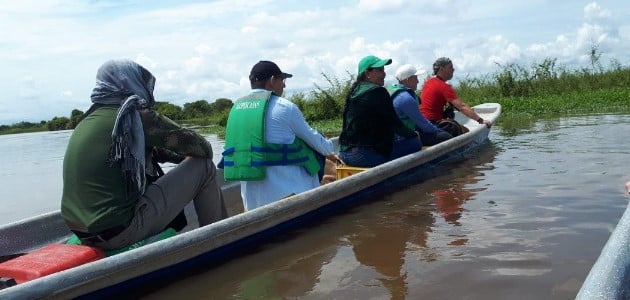
“In the village of Campo Gala #Barrancabermeja accompanying @Credhos_Paz [the Regional Corporation for the Defence of Human Rights] and @CanadayColombia [the Canadian Embassy in Colombia] at a meeting with #Fedepesan [the Federation of Artisanal Fishermen of Santander] and #LosCogollos to talk about the effects that those who are dedicated to artisanal fishing are experiencing in #MagdalenaMedio and find focused environmental measures.”

CREDHOS also posted:

“Begins visit of the embassy of @CanadayColombia in #Barrancabermeja meeting with #MesaHumanitaria [humanitarian table] of #MagdalenaMedio analysis of the human rights situation and environmental effects in the region.”

“Today we toured the San Silvestre Swamp telling the @CanadayColombia embassy from the voice of the fishermen and environmental leaders of @Fedepesan about the various effects on water and fauna by individuals and @EcopetrolMag.”

Canadian financing impacts the San Silvestre wetlands

The Banking on Climate Chaos website reveals Toronto-based Scotiabank’s investments in Ecopetrol. Scotiabank provided USD $665 million to Ecopetrol in 2018, another $666.67 million in 2020, and $1.7 billion in 2021 for a total of $3.0 billion in financing.

Bronwen Tucker of Oil Change International also shared on a PBI-Canada organized webinar this slide of the top recipients of Export Development Canada (EDC) financing in Colombia between 2012 and 2020.

In January 2016, Toronto-based Brookfield bought a majority share (57.6 per cent) in the Colombian power generation and distribution company Isagen. One of the dams Brookfield bought through its majority share in Isagen is the Sogamoso Hydroelectric Dam which is located 30 kilometres west of Bucaramanga.

In March 2020, El Espectador published this article titled Community denounces fish and bird deaths in Barrancabermeja.

That article notes: “The fishermen of the San Silvestre spout, in Santander, denounce that since the middle of February there is a fish mortality in the place. According to them, this emergency is due to the fact that Isagen, a company in charge of the Sogamoso dam, opened the floodgates to feed the river that bears the same name.”

PBI-Canada visit to the San Silvestre wetlands, June 2022

On June 30, 2022, CREDHOS and FEDEPESAN took PBI-Colombia and PBI-Canada on a tour of the San Silvestre wetlands.

PBI-Canada webinar with CREDHOS and FEDEPESAN, December 2022

On December 7, 2022, we hosted this webinar with CREDHOS and FEDEPESAN to further amplify their concerns about the San Silvestre wetlands.

PBI-Colombia has accompanied the Regional Corporation in the Defence of Human Rights (CREDHOS) since 1994.