Home Blog Page 125

PBI-Colombia accompanies the Nydia Erika Bautista Foundation as Comprehensive Law on the Rights of Women Searchers receives Senate approval

On April 4 (at 12:05 pm ET), PBI-Colombia posted: “#Rights For Women Seekers At this moment accompanying the @nydia_erika Foundation in the last Senate debate on the draft Law for the Protection of Women Searchers of the #Disappeared.”

Later (at 4:14 pm ET), PBI-Colombia posted: “We celebrate the approval of the Comprehensive Law for the Protection of the Rights of Women Searchers. And we congratulate @nydia_erika for all the efforts, the tireless commitment, and the daily defense of the rights of the disappeared.”

This follows the post from the Foundation that said: “#Approved Comprehensive Law for the Protection of the Rights of Search Women, now it is the Law of the Republic, the fight for its implementation continues, Thank you Women from all territories. We made history!”

Comprehensive Law approved!

El Tiempo further explains: “In the plenary session of the Senate, the bill that establishes protections for the rights of women searching for victims of forced disappearance was approved in its last debate. Bill No. 242 of 2022 grants recognition as peacebuilders and subjects of special protection to women and people looking for victims of enforced disappearance.”

“The initiative was promoted by the Nydia Erika Bautista Foundation for Human Rights. The organization is dedicated to protecting the rights of women and family members who are victims of enforced disappearance. Its founder, Yanette Bautista, created the foundation in exile after her sister, Nydia Erika Bautista, was forcibly disappeared in 1987.”

Why was the Law needed?

El Espectador notes: “The Nydia Erika Foundation [says] that 95% of those who are looking for a missing person are women: grandmothers, mothers, daughters, wives or girlfriends. …The Foundation said that while they are searching for their disappeared, they have suffered sexual violence, arbitrary detentions, kidnappings, threats and sometimes, they have seen how another of their loved ones is submerged in the universe of war. That is without leaving behind the psychological effects of not knowing the fate and whereabouts of their relatives for years.”

National Day, October 23

El Tiempo adds: “The law also establishes October 23 as the National Day of Recognition for Women and Persons Searching for Victims of Enforced Disappearance. In addition, the initiative provides for the offer of subsidies and social housing and housing improvement programs to families of women and people seeking victims of enforced disappearance. Other special guarantees of access to social security and health are also introduced.”

The legislative process began in October 2022

El Espectador also notes: “The initiative was filed in October 2022 and; Despite the fact that groups and congressmen denounced at the end of 2023 that the project was being postponed and silenced, after more than 15 months, the victims finally see a glimmer of hope in the approval of the law.”

PBI-Colombia accompanied the Foundation at key points during the process of achieving this law, including:

On October 19, 2022, PBI-Colombia tweeted: “#Today the first Bill of Law in #LatinAmerica was filed in #Colombia that protects the rights of women seekers.”

Instagram photo of the day the Bill was filed.

On March 15, 2023, PBI-Colombia tweeted: “We are accompanying the Meeting with the @FirstCommission to promote the Bill on #WomenSearchers of #EnforcedDisappearance in Colombia @nydia_erika”

On Instagram they noted: “We accompanied the Meeting with the First Commission of the House of Representatives to push for the prioritization of the dialogue of the Bill on #WomenSearchers of victims of #EnforcedDisappearance in Colombia as @fundacionnydiaerikabautista”

The First Commission (Comisión Primera) is the “Permanent Constitutional Commission of the Congress of the Republic of Colombia that processes in first debate the Bills and Legislative Act.”

And on May 16, 2023, PBI-Colombia accompanied the Foundation at the First Debate on the Comprehensive Law.

Instagram photo of First Debate.

On June 27, 2023, PBI-Colombia posted: “The Commissioner of the @CIDH [Inter-American Commission on Human Rights] @JulissaMantill6 visits the office of @nydia_erika in support of the risk situation that the Foundation faces in its fight against forced disappearance and in support of the Women Searchers bill.”

On July 27, 2023, PBI-Colombia posted: “Today vice minister @liliasolanor [Lilia Solano] facilitated an important push for law 242, protection for #WomenSearchers promoted by @nydia_erika. There was the participation of @ONU [United Nations] Women, @OACNUDH [the Office of the United Nations High Commissioner for Human Rights-Central America and the Caribbean], and the Ministry of Interior, Ministry of Justice and Ministry of Defence.”

On October 27, 2023, PBI-Colombia posted: “We were with @nydia_erika at the meeting with @ONUMujeresCol [the United Nations agency in Colombia for gender equality and the empowerment of women] and @ONUHumanRights [UN Human Rights Colombia] to follow up on the draft Law for the Comprehensive Protection of #WomenSearchers of Victims of #MissingPersons.”

On February 27, 2024, PBI-Colombia posted: “Talking at the headquarters of the @nydia_erika Foundation about the importance of advancing and making a reality the Law Project on Guarantees for Women Seekers, a pioneering initiative presented last week to the UN Committee against Enforced Disappearances.”

April 4, 2024!

PBI-Colombia began accompanying the Nydia Erika Bautista Foundation occasionally in 2007 and fully since 2016.

#DerechosParaLasBuscadoras

Instagram video.

Eleven Zapotec communities in Mexico win injunction against Canadian mining company, say court order should be respected and the mine closed

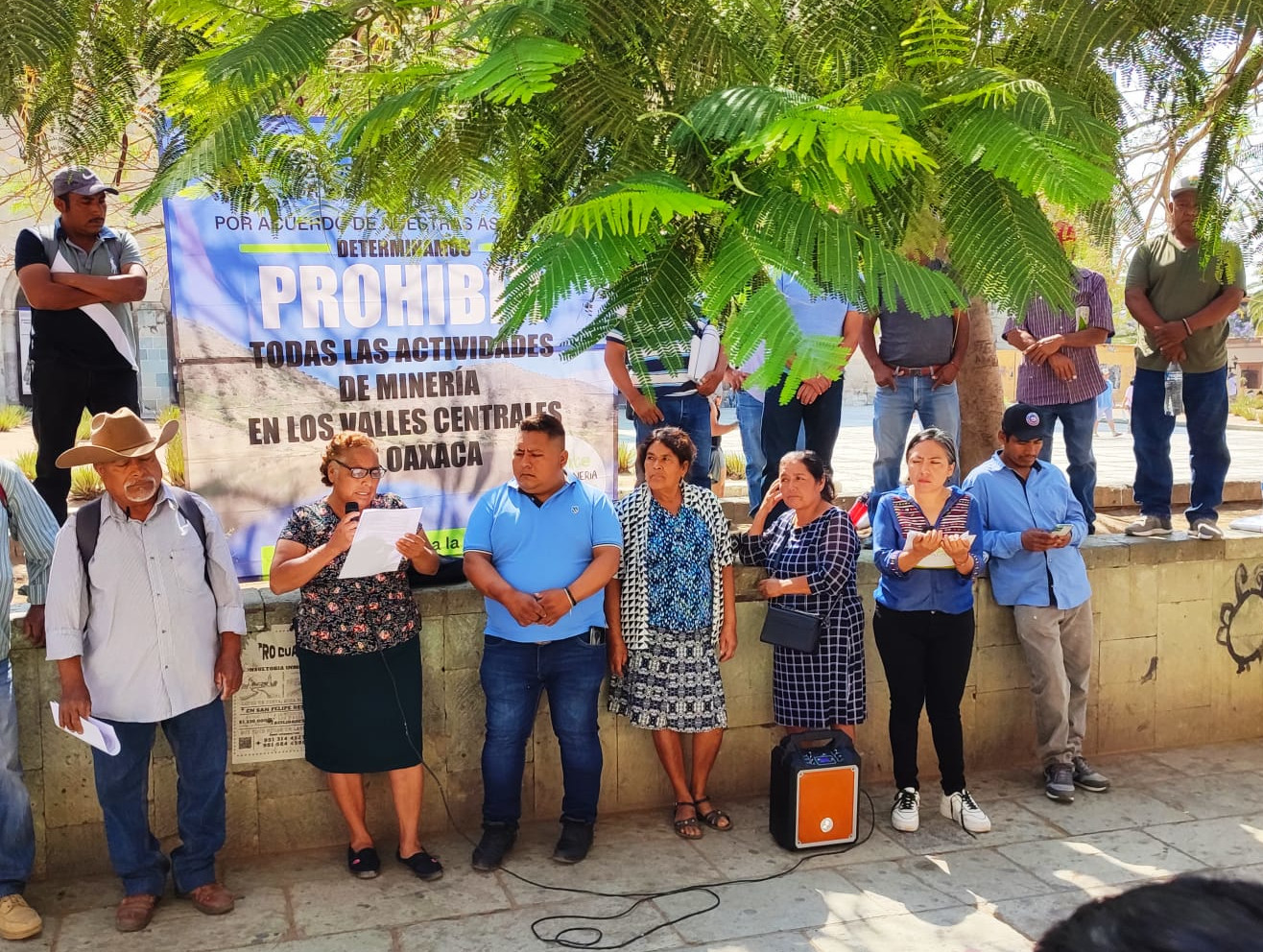
Photo: The No to Mining Front for a Future of All media conference; April 3, 2024.

An injunction/court order granted by a Mexican judge should protect eleven Zapotec communities in the Ocotlán Valley of Oaxaca state from Vancouver-based Fortuna Silver and its subsidiary the Cuzcatlán mining company.

A statement from the communities says: “Faced with the negligence and omission of the federal government, we decided to appeal to the justice system through an amparo on December 5, 2023, to request the cancellation of the mining concessions granted in our territories without our consent.”

La Jornada further explains: “Judge Emmanuel Hernández Alba, head of the First District Court in the state of Oaxaca, granted 11 communities an injunction by which it is ordered ‘to refrain from depriving totally or partially, temporarily or permanently, of the ownership and possession of the lands of the agrarian regime, the populations of merit,’ that is, that they are prohibited from applying any project. including the miners, which is an achievement of these communities.”

Fortuna/Cuzcatlán has been extracting gold and silver concentrates in San José del Progreso since 2011 through mining concessions granted by the federal government without prior consultation with its residents.

El Universal adds: “In a press conference [on April 3], [the communities] reported that they achieved the suspension of mining concessions in their territories, affected by the ‘San José’ mining project of Fortuna Silver Mines (FSM) in San José del Progreso. They added that since 2011, in the community assemblies, they decided not to allow the territorial expansion of the ‘San José’ mining company, a decision for which they sought the support of the municipal and state orders; however, they say, governments promoted mining activities in their territories, instead of supporting the communities’ decision.”

And Pagina 3 notes: “The No to Mining Front demanded that the federal and state governments respect and abide by the suspension and establish measures for the definitive closure of the mining project and the operation of the mining company in the Central Valleys of Oaxaca.” As for the length of the suspension, the article notes that “this suspension would last for the duration of the legal process.”

For more on this and a video of the media conference by the communities, please go to the Educa Oaxaca post: Communities of the Oaxaca Valley Seek Protection Against Mining Concessions (April 3, 2024).

Additional coverage can also be found in Estado 20, Zona Roja Oaxaca, Chiapas Paralello, ONEA Mexico, Municipios Digitales and Desinformémonos

PBI-Mexico’s relationship with Educa Oaxaca dates back to 2001. Formal accompaniment began in May 2013.

We continue to follow this from Canada.

PBI-Mexico accompanies Educa Oaxaca and the “Mision Civil de Observacion Justicia para San Jose del Progreso”; November 2012.

Three former UK Supreme Court Justices call for a suspension of arms sales to Israel

Photo: Former UK Supreme Court justices Lady Hale, Lord Wilson and Lord Sumption have signed a letter calling for the suspension of arms sales to Israel.

The Guardian reports: “Three former supreme court justices, including the court’s former president Lady [Brenda] Hale [and Lord Nicholas Wilson and Lord Jonathan Sumption], are among more than 600 lawyers, academics and retired senior judges warning that the UK government is breaching international law by continuing to arm Israel.”

The article continues: “The 17-page letter, which also amounts to a legal opinion, was sent on Wednesday evening and says: ‘…the sale of weapons and weapons systems to Israel… falls significantly short of your government’s obligations under international law.’”

On arming Israel, the letter further says: “The ICJ’s conclusion that there exists a plausible risk of genocide in Gaza has placed your government on notice that weapons might be used in its commission and that the suspension of their provision is thus a ‘means likely to deter’ and/or ‘a measure to prevent’ genocide.”

Notably, The Guardian also reports: “The findings of a YouGov poll, conducted before the [Israeli air] strike [that killed seven international humanitarian aid workers], suggested that the government and Labour are out of step with public sentiment, with a majority of voters – by 56% to 17% – in favour of an arms ban.”

Canadian government

While the Canadian government has now pledged to “cease the further authorization and transfer of arms exports to Israel to ensure compliance with Canada’s arms export regime and increase efforts to stop the illegal trade of arms, including to Hamas”, it has also stated that, “Given the nature of the supply chain, suspending all open permits [arms exports approved prior to January 8] would have important implications for both Canada and its allies” and will therefore proceed.

Canadian unions

On April 2, the Canadian Union of Public Employees (CUPE), the Canadian Union of Postal Workers (CUPW), the National Union of Public and General Employees (NUPGE) and the Public Service Alliance of Canada (PSAC) issued a statement that says: “We urge the Canadian government to immediately suspend trade in arms and military equipment with Israel, in accordance with Canada’s legal obligations. Canada must impose an arms embargo to help end the horrors in Gaza.”

They also highlight: “Canada exports military equipment to Israel, including via the United States. This means that Canada is at risk of being complicit in the violence and human rights violations Israel is perpetrating in Gaza. Canada also imports military equipment from Israel, which anti-war groups argue supports Israel’s military industry and operations.”

Peace Brigades International continues to follow this situation and to “call on the international community to suspend the supply of arms to Israel.”

Excerpt from letter signed by more than 600 lawyers, academics and retired senior judges in the United Kingdom:

Suspend the provision of weapons/weapons systems to Israel

Rationale: The ICJ’s conclusion that there exists a plausible risk of genocide in Gaza has placed your Government on notice that weapons might be used in its commission and that the suspension of their provision is thus a “means likely to deter” and/or “a measure to prevent” genocide.

The provision of military assistance and material to Israel may render the UK complicit in genocide as well as serious breaches of IHL. Customary international law recognises the concept of ‘aiding and assisting’ an international wrongful act.

A State is complicit in the commission of genocide if: “its organs were aware that genocide was about to be committed or was under way, and if the aid and assistance supplied, from the moment they became so aware onwards, to the perpetrators of the criminal acts or to those who were on the point of committing them, enabled or facilitated the commission of the acts.”

On 23 February 2024, 34 UN experts called for the immediate cessation of weapons exports to Israel, including export licences and military aid, observing as follows:

“Such transfers are prohibited even if the exporting State does not intend the arms to be used in violation of the law – or does not know with certainty that they would be used in such a way – as long as there is a clear risk.”

“The need for an arms embargo on Israel is heightened by the International Court of Justice’s ruling on 26 January 2024 that there is a plausible risk of genocide in Gaza and the continuing serious harm to civilians since then”, the experts said. The Genocide Convention of 1948 requires States parties to employ all means reasonably available to them to prevent genocide in another state as far as possible. “This necessitates halting arms exports in the present circumstances”.

Continued arms exports to Israel moreover give rise to concerns regarding the United Kingdom’s compliance with its obligation under The Arms Trade Treaty.

Mechanism: The UK Government should suspend licensing arms for export to the Government of Israel. The UK’s Strategic Export Licencing Criteria (“SELC”) require the UK government to refuse to licence military equipment for export where there “is a clear risk that the items might be used to commit or facilitate a serious violation of international humanitarian law”. The same principles apply where arms or military equipment might be used to commit or facilitate acts which constitute genocide.


OXEC dams on Maya Q’eqchi’ territory in Guatemala linked to Spanish, French and Canadian companies

On April 3, during a webinar organized by PBI-UK and Amnesty International, Maya Q’eqchi’ defender Bernardo Caal Xol spoke about a march by the Peaceful Resistance of Cahabón to the Spanish Embassy in Guatemala City.

That march took place on May 10, 2023. PBI-Canada was there and compiled Bernardo’s tweets that day to help share the story of what happened.

You can read that here.

The Spanish company – Grupo Cobra

The construction of dams on Bernardo’s territory without the free, prior and informed consent of the Maya Q’eqchi’ people is associated with a Spanish company (this was the reason behind the march to the Spanish Embassy).

The Business and Human Rights Resource Centre has noted: “The Guatemala-based company Oxec S.A. owns the hydroelectric dams Oxec and Oxec II…and is being built by the Spanish company Grupo Cobra, which is owned by Florentino Pérez, the president of Spanish soccer giant Real Madrid.”

Upside Down World has also noted: “The company, Hidro Oxec S.A., which is owned by the Bosch Gutiérrez family, received a 50 years permit for the river. The Spanish company Cobra Group, owned by Florentino Pérez, the president of Spanish soccer team, Real Madrid, is constructing several of the projects along the river.”

The Peace Brigades International-Guatemala Project has noted that “the hydroelectric project installed on the Cahabón river basin, operated by OXEC SA, [belongs] to the Energy Resources Capital Corp group (ERCC).”

In November 2016, Jeff Abbott, a freelance journalist based in Guatemala, also reported in Waging Nonviolence: “The Guatemala-based company Oxec S.A. owns the hydroelectric dams Oxec and Oxec II, with investments from Energy Resources Capital Corp, which is based in Panama. Oxec S.A. is owned by the powerful Bosch Gutiérrez family and is being built by the Spanish company Grupo Cobra, which is owned by Florentino Pérez, the president of Spanish soccer giant Real Madrid.”

With respect to ERCC registered in Panama, Transparency.org has generally noted: “Once companies are successfully incorporated, authorities usually do not collect any information on the real owners of companies. In case of suspicions or investigations against a particular company, law enforcement or tax authorities would have to request information from the corporate service provider.”

A French company?

On the PBI-UK and Amnesty International webinar, Bernardo shared that when the Spanish Ambassador in Guatemala City met with them in May 2023, they stated that it was no longer a Spanish company but a French company that is responsible for the dams.

At this point we cannot verify the accuracy of the Ambassador’s statement or identify the name of the French company.

A Canadian company

We have, however, compiled information linking a Canadian company. Hatch Ltd., a company founded in Toronto and now based in nearby Mississauga, has been involved in both the OXEC II and OXEC III projects.

NS Energy has reported: “Hatch would be engaged to deliver the conceptual design and detailed design-build-engineering for the Oxec II Hydroelectric Project, recipient of a 2019 Award of Excellence from the Association of Consulting Engineering Companies-Canada (ACEC).”

Design-Build combines all aspects of design services, construction services, and project management into one team that works together to complete a project.

That article also notes: “Hatch’s design of the cellular cofferdam [for the first stage diversion of the river] was recognised by the Consulting Engineers of Ontario (CEO) in 2017 with an award of merit in the Industry, Energy, and Resources category.”

Commenting on OXEC II, Ian Ainslie, a Hatch project manager based in Niagara Falls, Ontario, noted: “Hatch has been active in developing hydroelectric sites in Guatemala for over 20 years.” And Hatch’s managing director of power, Jim Sarvinis, says: “Projects like Oxec II are exactly why we do the type of work we do at Hatch.”

And just as PBI-Guatemala and Jeff Abbott reference Energy Resources Capital, the NS Energy article links Hatch to them: “What began as a discussion with stakeholders in 2014 would later become Hatch’s formal engagement by Energy Resources Capital (ERC), the developer, and Solel Boneh Guatemala (SBG), the general contractor.”

OXEC III

Power Technology notes “construction is likely to commence in 2025 and is expected to enter into commercial operation in 2027.”

Breakbulk Magazine has reported that the Oxec II dam was “designed by Hatch Ltd., the Toronto, Canada-based engineering firm”, then notes that Hooman Ghassemi, Hatch’s project manager for Oxec II, “has been working on Oxec II since 2015 and has just finished the conceptual design for Oxec III.”

At that march in Guatemala City on May 10, 2023, PBI-Canada took this photo of a banner that says: “We demand that the Oxec 3 licence be cancelled.”

We continue to follow this.

The Peace Brigades International-Guatemala Project has accompanied the Peaceful Resistance of Cahabón since July 2017.

Thank you to PBI-UK and Amnesty International for organizing an informative and inspiring webinar.

CRCC review of RCMP C-IRG actions at logging protest near Argenta continues more than a year after it began

Photo: “RCMP arrest and remove the protester’s designated police liaison representative shortly after arriving to enforce the injunction and break up the camp on the Salisbury Forest Service Road at the north end of Kootenay Lake.” Photo by Louis Bockner.

The Trail Times reports: “An independent review of RCMP actions in shutting down a 2022 logging protest near Argenta is still underway [more than] a year after it began, and the lawyer representing the people who were arrested says the delay is predictable.”

“Noah Ross, a Denman Island-based lawyer representing the arrested protesters, said the delays are an indication that as Canadians we do not value ‘timely, impactful police accountability’ as much as we value ‘getting people off the road so industry can happen’.”

Photo: Noah Ross.

The article continues: “Ross thinks the investigation should be about ‘officer misconduct’, not just about policies and systemic issues. ‘It’s not about what the complainants were most interested in, which was having an independent investigator look at RCMP conduct,’ Ross said.”

C-IRG operations should be stopped

A year ago, on March 17, 2023, the Kimberly Bulletin had reported: “Noah Ross, a lawyer who represents [Last Stand West Kootenay], told the Nelson Star that he thinks the CIRG should be disbanded, or at least its operations should be stopped, while the investigation is underway, because the unit committed a number of human rights violations while making its Argenta arrests.”

That article adds: “He said the CIRG created a large exclusion zone that blocked local residents from accessing their homes and travelling on a public road. The officers sealed the whole area off, he said, and aggressively arrested many people who were not actually blocking the road. ‘It seems a lot of these human rights violations or charter rights violations were planned into their operations,’ Ross said.”

Systemic investigation launched on March 9, 2023

The terms of reference for the CRCC systemic investigation launched on March 9, 2023, notes: “The file review will focus on the C-IRG’s governance, command and control, and operational planning, as well as its activities and enforcement operations with respect to at least three sites [including] the Cooper Creek Cedar Ltd injunction on Salisbury Creek Forestry Road.”

C-IRG arrests on Argenta forest service road

In May 2022, the C-IRG arrested 17 people positioned near the bottom of a forest service road at the north end of Kootenay Lake, near Kaslo.

As Louis Bockner has reported in The Narwhal: “[The road] was being occupied in an effort to protect a 6,200-hectare strip of forest surrounded by a provincial wilderness conservancy. Parts of the area, known as the Argenta-Johnsons Landing face, were set to be logged by Cooper Creek Cedar Ltd. in April [2022]. Due to the occupation, three weeks had passed without a chainsaw or feller buncher roaring to life.”

That article adds: “’It’s brutal that people got arrested that had no intention to’, says Noah Ross, a lawyer who is representing many of those arrested. ‘It’s scary and [there’s] a lot of stress and expenses.’”

“According to Ross, who is also representing land defenders arrested at Fairy Creek, the RCMP’s approach to land defenders has changed in the last decade. He’s observed an increase in the use of exclusion zones — areas where members of the press and legal observers are denied access in the name of creating safe work areas for officers.”

“Ross sees this as an escalation in tactics by the Community-Industry Response Group and believes that the arrests of people wishing to peacefully protest were unlawful. ‘It sounds like there were a couple of arrests of people in hardblocks, which were reasonable,’ Ross says. ‘But I don’t know that any of the other [people] were properly arrestable under the injunction.’”

The article further notes: “Ross says the same troubling approach was taken in November [2021] on Wet’suwet’en territory. ‘It seems like there’s a culture of non-accountability to civil liberties within [the Community-Industry Response Group], where they’re willing to kind of go beyond the injunction in order to try and break a camp,’ adding that extending that to a small blockade in the Kootenays just seems ‘completely out of historical tradition in relation to rural forests.’”

Webinar on C-IRG violence

To watch our 1-hour webinar from April 16, 2023, that features Bockner speaking about the situation at Argenta, click here.

That webinar also features powerful presentations from Wet’suwet’en land defender Jocey Alec, Professor Tia Dafnos, and frontline activist Molly Murphy. The panel was moderated by PBI-Canada Board member Phil Henderson.

We continue to follow this.

Treatment of Mi’kmaw fishers by federal DFO officers compared to Starlight Tour violence by Saskatoon police

Photo: Mi’kmaw protest at the federal Department of Fisheries and Oceans in Dartmouth, Nova Scotia; April 2, 2024.

CBC reports: “Two Mi’kmaw elver fishermen say they were forced to walk in sock feet for hours along a rural Nova Scotia highway in the middle of the night last week after they were detained by federal [Department of Fisheries and Oceans/DFO] officers who took their boots and phones before releasing them [at 1 a.m. at a gas station].”

That article adds: “Blaise Sylliboy [of the Eskasoni First Nation] and Kevin Hartling [Membertou First Nation], who assert they have a treaty right to fish for the lucrative baby eels despite this year’s season being cancelled, were joined Tuesday [April 2] morning by dozens of protesters outside the Department of Fisheries and Oceans [DFO] building in Dartmouth, Nova Scotia.”

Photo: Sylliboy and Hartling.

The DFO says: “Fishery officers engaged the RCMP to provide assistance to track down a vehicle suspected to be associated with the individuals. It is standard practice for fishery officers to seize fishing gear related to the commission of alleged infractions, including hip waders, fyke nets and dip nets.”

But Chief Wilbert Marshall of the Assembly of Nova Scotia Mi’kmaw Chiefs says: “Canada speaks of reconciliation and then employs people [at the Department of Fisheries and Oceans] who treat our people like this. Keeping quiet on these situations only leads to officers like this feeling like they can get away with their actions. We need to put a spotlight on these disgusting behaviours, so they stop.”

The full statement by the Assembly of Nova Scotia Mi’kmaw Chiefs about this incident can be read here.

Starlight Tours

Hayley Ward adds: “[The DFO] were doing starlight tours essentially.”

A “starlight tour” refers to the situation that may have first come to public attention when the Saskatoon Police Service took a 17-year-old Cree man, Neil Stonechild, to the outskirts of the city in -30 Celsius weather on November 25, 1990, and left him there to walk home. Stonechild froze to death.

Photo: Neil Stonechild.

Mi’kmaq Treaty Rights

As to the treaty right to fish referenced in the CBC article, Ku’ku’kwes News has explained: “The Supreme Court of Canada ruled in the [September 17] 1999 Marshall decision that Mi’kmaq, Wolastoq and Peskotomuhkati have a treaty right to earn a moderate livelihood from catching and selling fish. That treaty right was guaranteed under the Peace and Friendship Treaties of 1760-61 which was signed between the three Indigenous nations and the British Crown. In a second ruling in November 1999, the Supreme Court of Canada issued a clarification stating that the federal government can regulate the treaty right. However, the ruling stated that the federal government has to justify any limit or infringement on the treaty right as well as consult with the affected Indigenous groups on any plans to infringe or limit the right.”

Photo: Donald Marshall, Jr.

The Supreme Court of Canada decisions in September-November 1999 stemmed from the prosecution of Donald Marshall Jr., a Mi’kmaq member of the Membertou First Nation in Nova Scotia. In August 1993, he was charged by DFO officers for catching and selling eel without a licence during the fishery’s off-season.

Angela D’Elia Decembrini, a lawyer at First Peoples Law, has commented: “In the 1999 Marshall decision, the Supreme Court of Canada recognized that the Mi’kmaq have a constitutionally protected right to fish for a moderate livelihood. This means that, in addition to their right to catch fish, the Mi’kmaq have a constitutionally protected right to sell the fish they catch in order to support themselves.”

Burnt Church

The “Burnt Church Crisis” refers to the period of October 1999 to August 2002 when Mi’kmaq fishers of Esgenoopetitj (the Burnt Church First Nation in New Brunswick) asserted the Treaty rights recognized by the Supreme Court of Canada and experienced violence by non-Native fishermen who destroyed their traps and fishing equipment as well as arrests and seizures of equipment by DFO officers.

The 2002 documentary Is the Crown at War with Us? by filmmaker Alanis Obomsawin tells the story of this conflict.

The National Film Board of Canada description says: “In this feature-length documentary by Alanis Obomsawin, it’s the summer of 2000 and the country watches in disbelief as federal fisheries wage war on the Mi’kmaq fishermen of Burnt Church, New Brunswick. Why would officials of the Canadian government attack citizens for exercising rights that had been affirmed by the highest court in the land? Casting her cinematic and intellectual nets into history to provide context, Obomsawin delineates the complex roots of the conflict with passion and clarity, building a persuasive defence of the Mi’kmaq position.”

To watch the film, click here.

Peace Brigades International

Indigenous fishing rights and the situation at Burnt Church were issues of concern for the Peace Brigades International-North America Project that opened in April 1992 and closed on March 7, 2000.

Today, PBI-Canada continues to follow this with concern.

Is Canada exporting already-authorized military goods to Israel to uphold “the supply chain” over human rights conventions?

Photo: Canadian Foreign Affairs Minister Melanie Joly.

Is Canada choosing to export “military goods” to Israel approved prior to January 8, 2024, based on commercial “implications” while disregarding human rights commitments in the Genocide Convention and the Arms Trade Treaty?

On March 19, the House of Commons passed a motion — in a 204 to 118 vote — stating Canada will “cease the further authorization and transfer of arms exports to Israel to ensure compliance with Canada’s arms export regime and increase efforts to stop the illegal trade of arms, including to Hamas.”

The Trudeau government weakened the original wording of the motion that had called on Canada to “suspend all trade in military goods and technology with Israel and increase efforts to stop the illegal trade of arms, including to Hamas.”

The Globe and Mail has reported: “By mid-day on March 18, one source said, more than 70 Liberal MPs had told the whip’s office that they would vote with the original version of the motion. Several sources said the government expected that number to keep rising to between 80 and 90. Others believed it could climb even higher, opening the possibility that the motion would pass.” This prompted the government to “scramble to convince New Democrats to accept amendments and avoid exposing deep divisions in the governing party.”

According to NDP Member of Parliament Heather McPherson, Foreign Affairs Minister Melanie Joly approached her before the vote and pushed for the softer language on arms exports because: “They didn’t want the liability of cancelling arms contracts.”

The following day, the Canadian Press reported this statement from Global Affairs Canada: “Since Jan. 8, the government has not approved new arms export permits to Israel and this will continue until we can ensure full compliance with our export regime. …Given the nature of the supply chain, suspending all open permits would have important implications for both Canada and its allies.”

As such, export permits issued before January 8 are still in effect.

This is significant because The Maple has reported: “The Trudeau government authorized at least $28.5 million of new permits for military exports to Israel during the first two months of the state’s brutal war on Gaza… The information provided by GAC does not indicate the time period for which the newly authorized permits are valid for, meaning not all the goods may have been exported in 2023.”

The case of LAV exports to Saudi Arabia

Back in April 2016, then-Foreign Affairs Stephane Dion, defending the controversial decision to export Light Armoured Vehicles (LAVs) to Saudi Arabia, told the House of Commons: “It was to honour the signature of a contract.”

He then added: “I have the power to allow the export permit or revoke them according to the behaviour of the country regarding human rights on the use of the equipment. The equipment has not been misused since 1993.”

Then in February 2018, speaking on the same issue of LAV exports to Saudi Arabia in the context of C-47, legislation that would bring Canada in accord with the Arms Trade Treaty, then-Foreign Affairs Minister Chrystia Freeland highlighted: “Canada will honour, to the greatest extent possible, pre-existing contracts.”

The Canadian Press added: “Freeland said Canada’s word as a ‘trusted partner’ in international negotiations has to be protected.”

At that time, then Amnesty International Secretary-General Alex Neve rightly commented: “Honouring contracts is no defence to or justification for action that may lead to serious human rights violations.”

Brief suspension of arms sales to Saudi Arabia

In August 2018, in response to a Foreign Affairs Department tweet expressing concern about human rights in Saudi Arabia, their government responded by implementing a freeze on “all new trade and investment transactions”.

Then in November 2018, Canada announced it would review all Saudi arms sales and freeze new export permits.

But by September 2019, a Global Affairs Canada briefing note to Freeland stated it had found no credible evidence linking Canadian exports of military equipment to human rights violations by Saudi Arabia.

And the ban on new export permits was lifted by April 2020.

In March 2023, The Breach reported on the likely reasons Canada upheld its contract to sell LAVs to Saudi Arabia: “Cheap reliable oil, new markets for Canadian corporations, and a heavily-armed proxy for Western countries. According to a document obtained by The Breach, these are among the reasons Justin Trudeau’s government continues to send massive amounts of weapons to Saudi Arabia.”

The Arms Trade Treaty

It is also notable Dion and Freeland made their arguments before Canada formally became a State Party to the Arms Trade Treaty (ATT) on September 17, 2019.

Now, Kelsey Gallagher of Project Ploughshares comments: “Under Article 7(7) of the ATT, States Parties are encouraged to reassess previously approved arms exports when new information emerges after the initial authorization of an export permit.”

That new information could include the January 26th ruling by the International Court of Justice that found it plausible that Israel’s actions amount to genocide.

It could also include the statement on March 26 by UN Special Rapporteur Francesca Albanese who found: “There are reasonable grounds to believe that the threshold indicating the commission of the crime of genocide…has been met.”

Albanese further specified: “Israel has committed three acts of genocide with the requisite intent: causing seriously serious bodily or mental harm to members of the group, deliberately inflicting on the group conditions of life calculated to bring about its physical destruction in whole or in part, and imposing measures intended to prevent birth within the group.”

As such, according to Albanese, Israel meets three of the five criteria for committing a genocide defined by the Convention on the Prevention and Punishment of the Crime of Genocide (that Canada ratified in 1952).

A question

As such, the question appears to be: Is Canada, in choosing to export already approved military goods to Israel, valuing “the nature of the supply chain”, and validating past justifications about “the signature of a contract” and its role as a “trusted partner” in international negotiations, above its human rights obligations?

World Beyond War Canada tweet.

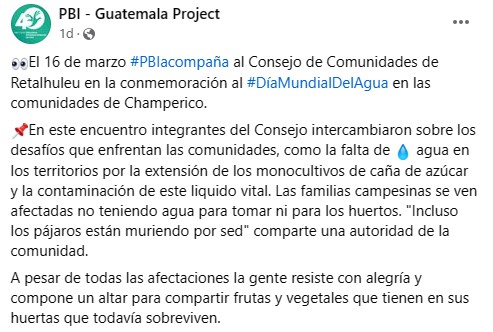
PBI-Guatemala accompanies the Council of Communities of Retalhuleu at World Water Day commemoration

PBI-Guatemala has posted:

“On March 16 #PBI accompanies the Council of Communities of Retalhuleu in the commemoration of #WorldWaterDay in the communities of Champerico.

In this meeting, members of the Council exchanged on the challenges faced by the communities, such as the lack of water in the territories due to the extension of sugar cane monocultures and the contamination of this vital liquid. Peasant families are affected by not having water to drink or for the orchards. ‘Even the birds are dying of thirst,’ shares a community authority.

In spite of all the effects, the people resist with joy and make an altar to share fruits and vegetables that they have in their orchards that still survive.”

The virtual water trade

Between 2015 and 2022, Canada imported 1.46 million metric tons of sugar from Guatemala.

Figures for 2023 should become available in the coming weeks.

In last year’s annual report from the United States Department of Agriculture on sugar production in Guatemala, they note that the sugarcane crop system requires 100 cubic meters of water per ton.

That would suggest that the sugar exported to Canada since 2015 has required 146 million cubic meters of water.

Criminalization and acquittal

PBI-Guatemala has noted: “The CCR began to organize in 2015 as a result of adverse effects caused by the expansion of the monoculture of sugar and the use of large-scale agrochemicals and pesticides used by the mills in the region.”

Four members of the CCR have been criminalized since November 2019 due to their advocacy.

It was not until May 30, 2023, that they were fully acquitted.

PBI-Canada visit to Guatemala

Just four weeks earlier, on May 2-4, 2023, PBI-Canada visited with the CCR on the South Coast of Guatemala.

These are lands from which the Indigenous Mam, K’iche’ and Ixil peoples have been displaced through Spanish colonization that began in 1524.

While there, Abelino Mejia Cancino, one of the members of the CCR criminalized for his defence of water, introduced us to communities experiencing water shortages related to the water-intensive sugar industry and showed us drained and polluted rivers, as well as water being taken from this river.

We hope to facilitate a visit by the CCR to Vancouver and Victoria this coming October. More details on this coming soon.

The Peace Brigades International-Guatemala Project has accompanied the Retalhuleu Community Council (CCR) since April 2020.

U.S. authorizes the transfer to Israel of bombs and fighter jets made by companies financed by the Royal Bank of Canada

Photo: An Israeli F-35I with four GBU-31 bombs in the foreground. The Boeing-developed Joint Direct Attack Munition (JDAM) guidance tail kit converts an unguided MK-84 bomb into a “smart” guided bomb unit (GBU).

Today, on the 176th day of the Israeli assault on Gaza in which 82 people were killed over the last 24 hours, and in which an attack on Rafah continues to appear imminent, news is breaking of new weapons transfers to Israel.

The Washington Post reports: “The Biden administration in recent days quietly authorized the transfer of billions of dollars in bombs and fighter jets to Israel despite Washington’s concerns about an anticipated military offensive in southern Gaza that could threaten the lives of hundreds of thousands of Palestinian civilians.”

It then explains: “The new arms packages include more than 1,800 MK84 2,000-pound bombs and 500 MK82 500-pound bombs, according to Pentagon and State Department officials familiar with the matter. [And] last week, the State Department authorized the transfer of 25 F-35A fighter jets and engines worth roughly $2.5 billion, U.S. officials said. The case was approved by Congress in 2008, so the department was not required to provide a new notification to lawmakers.”

The MK84 and MK82 bombs are manufactured by General Dynamics Ordinance and Tactical Systems (GDOTS), while the F-35 fighter jets are built by Lockheed Martin. General Dynamics also produces the F-16 fighter jet for the Israeli air force. Both the F-35 and F-16 are capable of carrying the MK84 and MK82 bombs.

Photo: An Israeli F-16 armed with GBU-31 bombs (2,000 pound MK84 equipped with a JDAM guidance system).

Shareholders

Among the top Canadian shareholders in General Dynamics (as of December 31, 2023) are the Royal Bank of Canada ($808,850,000.), Bank of Montreal ($370,538,000.), and the Canada Pension Plan Investment Board ($38,747,000.)

Defense World has also noted: “Royal Bank of Canada reissued an ‘outperform’ rating and set a $300.00 price target on shares of General Dynamics in a research report on Thursday, January 25th.” General Dynamics has posted that RBC Capital Markets analyst following them is Ken Herbert at (415) 633-8583.

Defense World has also reported: “[General Dynamics] recently declared a quarterly dividend, which will be paid on Friday, May 10th. Shareholders of record on Friday, April 12th will be paid a dividend of $1.42 per share.”

Fintel notes that RBC owns 3,114,908 shares in General Dynamics.

Along with the $809M that the Royal Bank of Canada holds in General Dynamics, it also holds $934M ($933,605,000) in Lockheed Martin.

Components

Project Ploughshares has highlighted: “The United States is not only the largest provider of military aid to Israel but is also typically the largest consumer of Canadian-made military goods in any given year. Project Ploughshares conservatively estimates that the value of annual Canadian military exports to the United States is well over C$1-billion. Some Canadian-made components transferred to the United States, including components integrated in the F-35 aircraft, are eventually supplied to the IDF.”

“Canadian suppliers have manufactured segments of the F-35’s airframe and a host of internal components, including engine monitoring sensors, printed circuit boards, segments of the landing gear, inserts of the weapons bay door, and the horizontal tail of the aircraft.”

They add: “Critical aspects of the aircraft apparently unaltered on the [Israeli Air Force] F-35I variant include the F135 engine, elements of the landing gear, and parts of the fuselage, all of which contain Canadian components.”

Oil exports from Canada

The Guardian has also reported: “Israeli jets and tanks bombarding Palestinians are being fueled by some of the world’s most profitable fossil fuel companies [according to research by Data Desk commissioned by Oil Change International]. Israel relies on crude oil and refined products from overseas to run its large fleet of fighter jets, tanks and other military vehicles.”

The article notes that one ship with JP8 jet fuel left the US for Israel on December 6, 2023, and another departed on February 9, 2024.

The U.S. Energy Information Administration (EIA) adds: “Canada is now the largest single source of U.S. total petroleum and crude oil imports. …Some of the crude oil that the U.S. imports is refined by U.S. refineries into petroleum products—such as gasoline, heating oil, diesel fuel, and jet fuel—that the U.S. later exports.”

It is not known how much of the 4.36 million barrels of crude oil per day that Canada exports to the U.S. could be then shipped by the U.S. to Israel to fuel its fighter jets, tanks and other military equipment.

In April 2023, CBC reported: “A report from a coalition of environmental groups shows that Royal Bank of Canada was the biggest fossil fuel financier in the world last year after providing over $42 billion US in funding.”

ICJ ruling

The International Court of Justice (ICJ) in The Hague ruled this past January 26th that “there is a real and imminent risk that irreparable prejudice” will be caused to the rights of Palestinians in Gaza under the Genocide Convention (paragraph 74) and that “at least some” of South Africa’s claims that Palestinian rights needing protection under the Genocide Convention were “plausible” (paragraph 54).

Toronto-based law professors Heidi Matthews (Osgoode Hall Law School), Faisal A. Bhabha (York University) and Mohammad Fadel (University of Toronto) have commented: “The Export and Import Permits Act forbids arms permits to be issued if there’s a ‘substantial risk’ that the goods could be used to commit or facilitate serious violations of international humanitarian or human rights law. Because the ICJ found a serious risk of genocide in Gaza, continuing to export arms to Israel would be illegal. It would also be flagrantly inconsistent with Canada’s obligation to prevent genocide, and could expose Canada and Canadian officials to liability for participation in genocide.”

UN Guiding Principles

The Guiding Principles on Business and Human Rights, adopted by the United Nations in 2011, cautions: “The responsibility to respect human rights is a global standard of expected conduct for all business enterprises wherever they operate. It exists independently of States’ abilities and/or willingness to fulfil their own human rights obligations, and does not diminish those obligations. And it exists over and above compliance with national laws and regulations protecting human rights.”

This responsibility extends to companies that build fighter jets and bombs, those that provide the components, those that fuel these machines, and to those that finance them.

Actions challenging RBC, April 6

RBC will hold its annual meeting in Toronto on April 11. Just prior to that there will be 25+ actions in multiple cities on April 6. The action taking place in Ottawa is noted here.

Shut down CANSEC, May 29-30

A mobilization is also being planned during the CANSEC arms show in Ottawa where General Dynamics, Lockheed Martin and multiple other transnational weapons companies, including Elbit Systems, will be present.

We continue to follow this.

Peace Brigades International calls on the international community to “show its strong support for such important institutions for global justice as the International Court of Justice and to “suspend the supply of arms to Israel”.

Ontario companies export armoured vehicles to police forces implicated in human rights violations

Photo: Roshel Inc., an Ontario-based company trying to export its armoured vehicles to Israel, will be an exhibitor at the CANSEC arms show in Ottawa, May 29-30.

There are human rights concerns about how some armoured vehicles manufactured in Ontario are used by security forces around the world.

The human rights considerations can also include the sale of these vehicles despite concerns about the countries they are being sold to, the active promotion by Canadian officials of armoured vehicle sales, and the absence of monitoring of how they are being used/misused.

This can be further complicated by the general lack of transparency and accountability with the sale of “military goods”.

While a fuller study is needed, we look at a few examples related to the sale of Canadian-manufactured armoured vehicles to police forces (while acknowledging concerns about armoured vehicles sold to militaries).

Brampton-based Roshel Inc. and Israel

The CBC has reported that Roshel Inc. is seeking a permit to sell armoured vehicles to Israel.

The company has told the CBC: “It is our understanding that these vehicles are not to be used for military purposes, but solely for domestic police operations. This has been communicated to the government of Canada.”

While Roshel is seeking to reassure with their statement, Amnesty International highlighted in June 2021: “Israeli police have committed a catalogue of violations against Palestinians in Israel and occupied East Jerusalem, carrying out a discriminatory repressive campaign including sweeping mass arrests, using unlawful force against peaceful protesters, and subjecting detainees to torture and other ill-treatment, during and after the armed hostilities in Israel and Gaza.”

Newmarket-based Terradyne Armored Vehicles Inc. and Mexico

Still from Vanguardia video of Terradyne armoured vehicle used by the Saltillo Operational Reaction Group (GROMS).

Terradyne has highlighted that it had sold its vehicles to the Nuevo Leon police in Mexico. It has also sold its Gurkha RPV vehicles to the Veracruz Fuerza Civil (civil force) and its MPV to the Ministry of Public Security in Ciudad Guadalupe, Nuevo.

Amnesty International reported in 2016 that “Mexican police and armed forces routinely torture and ill-treat women, and that sexual violence is routine during arrest and interrogation.”

In 2020, Human Rights Watch also noted: “The abusive behavior of Mexico’s police forces is the result of multiple factors, including systematic impunity, lack of clarity and enforcement around regulations limiting police use of force, widespread corruption and intimidation by organized crime, and decades of institutional abandonment.”

Midland-based Streit Manufacturing Inc. and Mexico

Photo by Voices in Movement and Infobae photo of Streit Group-manufactured Spartan armoured vehicle.

On February 3, 2023, La Jornada reported: “Riot police evicted with tear gas about 100 students from the Mactumactzá rural normal school, who demonstrated in the center of Tuxtla Gutiérrez to demand the hiring of 33 workers for that school.”

A student told La Jornada: “First the municipal police harassed us and then the grenadiers arrived. Then came one of the tankettes from which they launch tear gas. …We condemned the eviction because we were not doing anything, we were peaceful.”

While it needs to be verified, an examination of the news photo shows similarities between the “tankette” and the Streit-manufactured Spartan.

Toronto-based INKAS and Haiti

Photo: Inkas armoured vehicles in Haiti.

The CBC has reported: “Toronto-based INKAS signed a contract to deliver 18 armoured vehicles to Haiti [in 2022]. The contracted delivery date was subsequently extended to the last day of 2022. But by that date, only six of the MRAPs had been delivered. Since then, three more have been transported to the island by the Canadian Air Force. Half of the contract remains unfulfilled.”

While the focus of the CBC article is on how “Haitian police will have to wait even longer for the vehicles they desperately need to protect their dwindling force from Haiti’s ruthless and well-armed gangs”, even the US State Department has noted concerns about the Haitian National Police (HNP) beating and abusing detainees and suspects, poor training, lack of professionalism, rogue elements with alleged gang connections, instances of police brutality and widespread impunity.

INKAS and Colombia

Photo: Colombian police use what appears to be a Toronto-based INKAS-manufactured armoured vehicle to stop buses of delegates travelling to Cali for a popular assembly related to the national strike on July 17, 2021.

In 2014, the Ottawa Citizen published an INKAS media release about the sale of four Huron tactical attack and defense vehicles to the Colombian police.

In April 2015, PLANT also reported: “The manufacturer is still building behemoth armoured personnel carriers (APCs). In fact, there’s a tendered order for 26 of its Huron vehicles, at about $450,000 a pop, for the National Police of Columbia.”

That article adds: “The Huron will be outfitted with a cannon to wrangle unruly rioters with foam, tear gas, dyes and water.”

During the National Strike in 2021, Amnesty International and other human rights organizations documented numerous instances of violence and repression by the Colombian police and the ESMAD riot police.

PBI-Canada has asked if Canadian-made armoured vehicles were involved in this police repression.

Our Access to Information Request revealed an October 14, 2021, email stating: “Officials from BGOTA [the Embassy of Canada in Colombia] asked the Colombian National Police (CNP) whether these armoured vehicles were being used in response to the social protests that began in late April. [Police] officials responded that no Canadian armoured vehicle was being used for such a purpose.”

This is not a credible verification process.

Then following an estimated 9-line redacted paragraph, the email says: “The vehicles are not being used by ESMAD” followed by another redacted line.

Armoured vehicles and Sudan, Azerbaijan, Saudi Arabia, Peru, Uganda

There are also media reports noting concerns about Streit-manufactured armoured vehicles sold to the “Sudan Police” (The Globe and Mail, September 2016), INKAS sales to Azerbaijan (Radio Canada International, July 2017), the Terradyne-manufactured Gurkha armoured vehicle that killed civilians during a “security operation” in Saudi Arabia (The Canadian Press, July 2018), the sale of London, Ontario-based General Dynamics Land Systems armoured vehicles in the context of repression by security forces against Indigenous-led protests in Peru (The Maple, December 2023), as well as a Streit manufacturing plant in Uganda that would sell to their security forces (The Globe and Mail, November 2022).

An unknown Ontario company and Israel

Most recently, The Maple reported: “In January, $680,312 worth of goods were exported from Ontario to Israel under the ‘armoured fighting’ vehicle category… Stat Can’s export data does not reveal the identity of the end user or users in Israel, or precise details about the goods being sold, including the quantity of units.”

Other armoured vehicle companies

Photo: A Honduran National Police operation in Comayagua with Black Mamba Sandcat vehicles.

This is not to suggest that only Ontario-based companies manufacture armoured vehicles exported to police forces with records of human rights violations.

Last month, The Rio Times reported: “Honduras recently added two Black Mamba APC SandCat armored vehicles to its National Police. These form the first part of a fleet of ten, aiming to increase police safety and efficiency.”

Its functions are to include “riot control”, “demonstrations”, and “internal security operations”.

While it has been reported that the armoured vehicles were manufactured by TPS Armouring in Mexico, SandCat is also an armoured vehicle associated with the Israeli company Plasan.

Armoured vehicles and CANSEC, May 29-30

Roshel Defence Solution will be at Booth 1321 at the CANSEC arms show this spring at the EY Centre in Ottawa. General Dynamic will also be there (in various booths, including 1301). Terradyne and INKAS have also previously displayed their armoured vehicles at CANSEC.

We continue to follow this.