Home Blog Page 117

PBI-Guatemala and PBI-Honduras now seeking field volunteers

PBI-Guatemala has now posted: “We extend the call to January 28 to select volunteers who want to accompany human rights organizations!”

More information on this here.

And PBI-Honduras has posted: “Want to know more about volunteering at PBI Honduras? Read the call on our website and learn about the world behind volunteering at PBI here.”

Their application deadline is January 31.

We remain attentive to upcoming calls from PBI-Mexico (more at Become a Field Volunteer) and PBI-Colombia for field volunteers.

Last May, PBI-Colombia welcomed these three new field volunteers.

And when these PBI-Colombia field volunteers joined in late 2022, they stated: “We consider it an exceptional opportunity to accompany different farmer, indigenous and Afro-descendant organizations in their struggles with land rights issues, their pursuits of justice for victims of the conflict, and their work with families of forcibly disappeared persons. Parting from our own experiences, we connect with each other through our motivation to contribute to the construction of a fairer world and our desire to learn about the organizations that have been working towards the consolidation of a more just society for so many decades.”

Apply today! Help spread the word!

Indigenous land defenders found guilty of criminal contempt; court will now focus on Charter violations by RCMP C-IRG unit

Video: RCMP C-IRG officers arrest land defenders Sleydo’ and Shaylynn Sampson at gunpoint on November 19, 2021.

We are monitoring news reports and social media posts on the trial of three Indigenous land defenders – Sleydo’ (Wet’suwet’en), Shaylynn Sampson (Gitxsan), and Corey Jocko (Mohawk) – charged with criminal contempt for their opposition to the construction of the Coastal GasLink fracked gas pipeline on Wet’suwet’en territory without consent.

They were arrested on November 19, 2021, during a Royal Canadian Mounted Police (RCMP) Community-Industry Response Group (C-IRG) raid on Wet’suwet’en territory.

CBC now reports: “A prominent Wet’suwet’en leader and two pipeline opponents were found guilty of criminal contempt of court for breaking an injunction against impeding work on the Coastal GasLink pipeline. B.C. Supreme Court Justice Michael Tammen read his decision to the court in Smithers on Friday [January 12].”

“Tammen found the accused guilty of one charge each of criminal contempt of court for blocking access to Coastal GasLink pipeline construction in defiance of a court order. In December 2019, the B.C. Supreme Court granted Coastal GasLink an injunction barring protesters from impeding the construction.”

The Tyee adds: “While civil contempt requires proof that an accused was aware of and deliberately defied a court order, criminal contempt is distinguished from civil contempt when it is carried out in a public way ‘that would tend to depreciate the court’s authority,’ Crown prosecutor Kurtas Welch said.”

That article then explains: “Criminal contempt penalties can include fines or imprisonment.”

Further reading: “Canada’s legal landscape continues to be heavily in favour of corporations when it comes to court injunctions during conflicts with First Nations over resource development, according to a report released Tuesday by an Indigenous-led think-tank.” (CBC, October 29, 2019).

Abuse of process application

The CBC article adds: “Sleydo’, Sampson, and Jocko have filed abuse of process applications with the court on these charges, alleging the RCMP used excessive force when they were arrested and that they were treated unfairly while in custody.”

In this interview with Brandi Morin, Sleydo’ describes how police forcibly cut a cedar bracelet and medicine bag from her at an RCMP detachment after she was arrested. Sleydo’ says four or five RCMP officers physically restrained her and cut the medicine bag off her body as about ten officers watched.

The CBC also notes: “Tammen will hear the applications before sentencing and the proceedings started after Tammen issued his decision.”

The court filing on Charter violations related to C-IRG violence

A Gidimt’en Checkpoint media release in February 2023 highlighted: “The RCMP/CIRG’s enforcement tactics impaired the Applicant’s individual Charter rights, but the police misconduct also displays a systemic disregard for Indigenous rights and sovereignty and the Charter more generally.”

At the time of the filing, Sleydo’ commented: “Society is rightly concerned with how a special unit of RCMP (C-IRG) acts with impunity, using racist language and violence against unarmed indigenous women. Now it’s in the courts hands to decide if this is acceptable.”

On March 2, 2023, just after the filing, The Tyee reported: “RCMP did not immediately respond to The Tyee’s request for comment about the application to have charges stayed.”

Further reading: Wet’suwet’en land defenders apply for charges to be stayed, alleging Charter violations (Global News, March 2, 2023).

RCMP used “overwatch” in November 2021 raid

On January 12, The Tyee reporter Amanda Follett Hosgood tweeted:

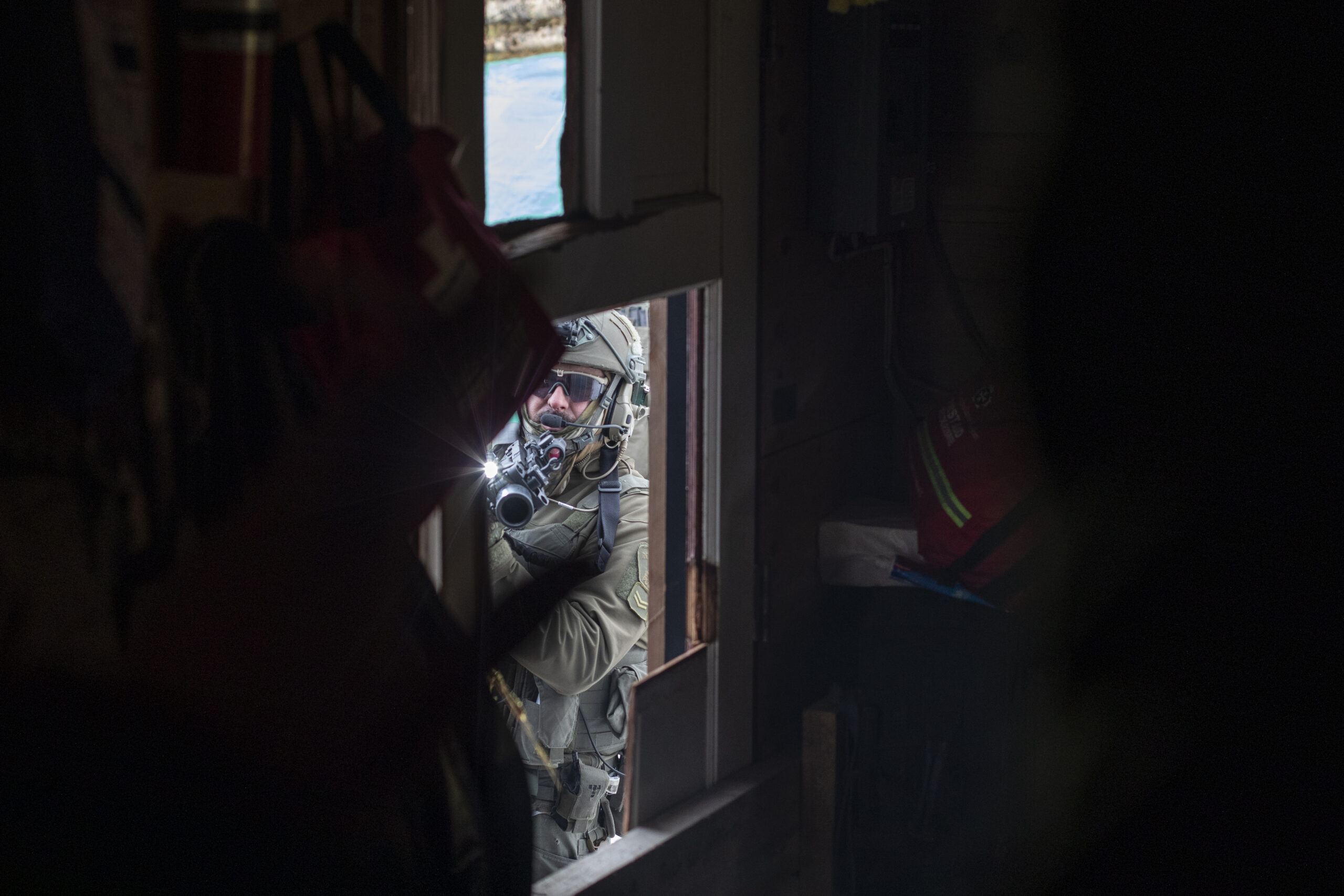
Photo: An RCMP C-IRG officer points what appears to be a C8A3 Carbine Automatic Rifle at Sleydo’, Sampson, other land defenders and journalists inside a cabin on November 19, 2021. The weapon is capable of firing 65 bullets per minute. Photo by Amber Bracken.

Video.

Reporting on the RCMP C-IRG raid in January 2019, The Guardian noted: “Canadian police were prepared to shoot Indigenous land defenders blockading construction of a natural gas pipeline in northern British Columbia, according to documents seen by the Guardian.”

That article explains that lethal overwatch is “a term for deploying an officer who is prepared to use lethal force.” It also notes that an RCMP planning document for the raid seen by The Guardian revealed “police intelligence indicated that there was ‘no single threat indicating that [land defenders] will use firearms’.”

Following that raid, the United Nations Committee on the Elimination of Racial Discrimination, under its Early Warning and Urgent Action Procedure issued this decision that:

The hearing that began on Monday January 8 is expected to continue until Friday January 19. We continue to follow this.

PBI-Colombia calls for quick and effective investigations following attacks against CAJAR lawyers

On January 12, PBI-Colombia posted:

“Attacks and defamations persist against @Ccajar. Urgent #guarantees and quick and effective investigations on material and intellectual authorship [are needed].”

The Peace Brigades International-Colombia Project has accompanied the José Alvear Restrepo Lawyers’ Collective (CAJAR) since 1995.

El Espectador reports:

Despite the fact that there are currently protection measures from the Inter-American Court of Human Rights on the Lawyers’ Collective, the attacks against their lawyers, defenders of serious human rights cases, continue.

On Monday 8 January, Santiago Salinas reported having been the victim of a physical attack against him and his wife, Erika Isabel Prieto Jaime, also a human rights defender.

Photo: CAJAR lawyer Santiago Salinas.

The incident took place in a supermarket on 26th Street in Bogotá at 3:10 p.m. The couple noticed the presence of two women talking about them and pointing at them. Prieto’s reaction was to record with his cell phone to record the situation, because they have not already suffered multiple aggressions and threats against their lives.

The lawyer says that he immediately recognized the women and recalled that they had been present in different institutional spaces of the Cajar, generating scandals and sabotage. But this time, as seen in a video, they did much more than verbal aggression.

When the couple began to record the two women, the lawyer details, “they reacted violently and began to shout that they knew who I was, they mentioned the place where my wife worked and precise information about other members of the Cajar.”

In addition, they say that they were later accused of having hacked their cell phones and assured that they all have a complaint in the Prosecutor’s Office.

Likewise, Salinas says: “They yelled at those present and the security people to call the police. I started recording after that and the older lady takes a coffee that she had in her hand that is quite hot and throws it at me.” As a result, the lawyer suffered burns to his chest.

Video.

The organization notes that the affected people are part of the team that monitors the interference practices and impacts of some companies in the ultra-processed and sweetened beverages industry, as well as processes of socio-environmental impacts in territories by transnational companies. This, within the framework of the campaign “Sweet Poison – the antidote is the truth”.

After the incidents, the defenders explain that the two women tried to escape, but the supermarket’s security prevented them from doing so, following the instructions of Erika Prieto, who asked to wait for the police presence.

The police squad took the aggressors to the CAI [Immediate Attention Commands of the Colombian National Police] of Teusaquillo to collect their data and later to the URI [Immediate Reaction Unit of the Attorney General’s Office] of Puente Aranda. There, Cajar’s lawyer denounced the incident and informed the authorities that he had previously seen his aggressor during a public hearing in the Congress of the Republic on business and human rights.

Background

Cajar also indicates other acts allegedly carried out by the two women.

The first, in March 2023, during an event on human rights and business, two women harassed members of Cajar, including lawyer Yessika Hoyos and Diana Marcela Otavo.

The second, at the same event, is said to have followed other human rights defenders such as Diana Otavo and Paz Gaviria, interrupted a public hearing in Congress and harassed the press coordinator of Cajar in La Vega (Cundinamarca). Later, the women allegedly chased Diana Otavo from a television station to the headquarters of former congressman Gustavo Bolívar.

In view of these incidents, the human rights organization asks the Colombian State to take measures to guarantee the safety of those affected and demands that the Prosecutor’s Office carry out a comprehensive investigation to clarify the facts and apply sanctions, underlining the importance of protecting human rights defenders in the country.

The full article can be read at Defensor de derechos humanos del Cajar denuncia ser víctima de ataque físico (El Espectador, January 10, 2024).

Further reading: Ataque físico a abogado defensor de derechos humanos (Agencia Prensa Rural) and Ataques y hostigamiento contra el abogado del CAJAR Santiago Salinas Miranda y Erika Isabel Prieto Jaime (International Federation for Human Rights/FIDH).

PBI-Honduras accompanied COPINH backs South Africa’s case against Israel for genocide in Gaza

Photo: COPINH general coordinator Bertha Zúñiga Cáceres holds the letter.

On January 8, the Civic Council of Popular and Indigenous Organizations of Honduras (COPINH) posted on X/Twitter:

“We support the initiative of #South Africa by bringing Israel before the [International Court of Justice] for violations of agreements on genocide in the #Gaza Strip. International solidarity is essential to fight for peace and the restoration of all violated rights. #FreePalestine”

Then on January 11, it also posted:

#Attention #Honduran social organizations present letter of request to President Xiomara Castro to support South Africa’s case against Israel for genocide in Gaza.

Israel has bombed hospitals, homes, UN refugee centers, temples, churches and mosques, and escape routes, killing thousands of Palestinians, including thousands of children.

South Africa is right to charge that, under the Convention on the Prevention and Punishment of the Crime of Genocide, Israel’s actions “are genocidal in character, as they are committed with the requisite and specific intent (…) to destroy the Palestinians in Gaza…”

We the #Lenca people raise our voice against oppression and injustice. We urge the State of #Honduras to accompany the case of South Africa and let’s put a Stop to Israel’s genocide against the Palestinian people!

Full letter |

The co-founder of COPINH Berta Caceres was murdered on March 3, 2016.

Front Line Defenders has documented the attacks and harassment of COPINH members, including the killing of Nelson García on March 15, 2016.

Global Witness has reported that 14 land and environmental defenders were killed in Honduras in 2022. This is the context in which COPINH works.

COPINH’s coordinators have been accompanied by the Peace Brigades International-Honduras Project since May 2016.

News reports on the first three days of court proceedings against Indigenous land defenders charged with criminal contempt

The Tyee Photo: Corey Jocko, Shay Lynn Sampson and Sleydo’ Molly Wickham stand outside the courthouse in Smithers, British Columbia on Monday January 8. Photo for The Tyee by Amanda Follett Hosgood. The Tyee article can be read at Trial Begins for Land Defenders Arrested at CGL Drill Site (January 9, 2023).

PBI-Canada is monitoring news reports and social media posts on the trial of three Indigenous land defenders – Sleydo’ (Wet’suwet’en), Shaylynn Sampson (Gitxsan), and Corey Jocko (Mohawk) – now on trial for their opposition to the construction of the Coastal GasLink fracked gas pipeline then being built on Wet’suwet’en territory in British Columbia.

They were arrested on November 19, 2021, during a Royal Canadian Mounted Police (RCMP) Community-Industry Response Group (C-IRG) raid on Wet’suwet’en territory.

CBC has previously reported: “In April [2022], Justice Marguerite Church invited the B.C. Prosecution Service to consider bringing criminal charges against” the land defenders for breaching “a court injunction to stay away from the pipeline construction zone”.

On July 7, 2022, Crown prosecutors decided to pursue criminal charges against land defenders including Sleydo’, Sampson and Jocko.

This is happening despite this call from the United Nations Committee on the Elimination of Racial Discrimination on December 13, 2019, for Canada to halt construction on the pipeline and for the RCMP to be withdrawn from Wet’suwet’en territory. On April 29, 2022, the UN Committee issued its third rebuke calling for the “the Community-Industry Response Group (C-IRG)” to leave the territory.

The Northern View now reports:

“The Crown’s case over the first two days focussed on testimony from and cross-examination of Julie Jones, a private investigator tasked by RCMP with collecting video evidence from social media; James Lank, a security advisor with Forsythe Security, Coastal GasLink’s security contractor; and RCMP corporal Kelly Grant, an officer who provided his own video of the arrest. Other Crown witnesses include Clint Colwell, a construction manager with Coastal GasLink and TC Energy (CGL parent company) officials Jesse Erickson and Tom Munro.”

Photo: “People gather outside the courthouse before the Supreme Court hearing against pipeline opponents Sleydo’ (Molly Wickham), Shaylynn Sampson, and Corey Jocko.” Photo by Morgan Powell/The Interior News.

BNN also notes:

“The trial, which opened its proceedings on Monday in Smithers, B.C., featured the testimony of RCMP Cpl. Kelly Grant alongside video evidence from a two-day raid leading to several arrests at a resistance camp stationed at a pipeline worksite. The video, recorded by Grant, captures RCMP officers reading an injunction and attempting to arrest individuals inside a small house and a cabin. A striking moment in the footage is the use of a chainsaw by the RCMP to break down the door of the small house, resulting in several arrests, including those identified as members of the media.”

And CBC News highlights:

Video footage captured by RCMP during a two-day police raid to enforce an injunction on the Coastal GasLink pipeline was shown in court Wednesday during the trial of three people accused of taking part in a blockade on Wet’suwet’en territory.

The Crown called RCMP Cpl. Kelly Grant to the stand Wednesday.

Video shot by Grant on the day of the arrests was shown in court on Wednesday.

In the video, one of at least three RCMP officers at the scene identified himself as Ken Floyd, who at the time was the RCMP bronze police of jurisdiction commander for North District stationed in Prince George.

Floyd testified Wednesday that he was the one in the video who knocked on the door of the tiny house and read from a script to inform the occupants of an injunction granted by the B.C. Supreme Court in December 2019 that bars anyone from impeding work on the pipeline.

In the next clip filmed by Grant, several RCMP officers are seen back outside the tiny house. 

The video shows one of the officers in tactical gear holding a barking police dog and another officer using a chainsaw to cut the door of the tiny house. Grant said in court he was unsure if the officer brought the chainsaw or was using one found at the location.

The Crown concluded its case Wednesday. On Tuesday, the Crown called several Coastal GasLink workers to testify about their role during the two days of police raids.

Court will resume at 10 a.m. Thursday in Smithers, B.C.

Photo: “RCMP officers on the Morice River Forest Service Road on Friday, Nov. 19, 2021.” Photo submitted by Dan Loan.

We continue to follow this.

The trial is expected to conclude on January 19.

Further reading: Land defenders charged with criminal contempt for defending Wet’suwet’en territory now in Canadian court (PBI-Canada, January 9, 2023)

PBI-Guatemala accompanies the Indigenous Community of San Francisco Quezaltepeque at its annual assembly

On January 8, PBI-Guatemala posted:

“On Sunday [January 7], #PBI accompanied the Indigenous Community of San Francisco Quezaltepeque at its annual assembly to elect the board of directors for the 2024 term.”

On Facebook, the community posted:

“GENERAL ASSEMBLY OF THE INDIGENOUS COMMUNITY

Quezaltepeque held its ordinary assembly to elect the board of directors for the period 2024, until January 6, 2025 in which there was re-election of president Humberto de la Cruz Lopez, and other members were integrated for the integration of the board of directors, was accompanied by the indigenous council of Olopa, and the ancestral authorities of Quezaltepeque and international peace brigades PBI, the population is encouraged dra accompaniment wings actions to take this year, the indigenous community moves forward

The delivery of the rod of authority is scheduled on January 21 in the central park of Quezaltepeque

A united people will never be defeated and we will defend our territory.”

PBI-Guatemala has previously explained:

“The Indigenous Community of San Francisco Quezaltepeque is located in the municipality of the same name, in the department of Chiquimula. It belongs to the Maya Ch’orti’ people and is represented by a board of directors composed of 30 ancestral authorities elected annually by the 23 communities and 96 hamlets that make up the community.”

They add:

“Their struggle is for the land, 243 caballerías [1 caballeria = 78.58 hectares] bought between 1710 and 1805, in the name of the common people and natives of San Francisco Quezaltepeque. However, the majority of these lands are not recognised by the municipality, which is why their struggle revolves around the recovery of this ancestral land. They also defend their territory against the entry of extractive projects, especially mining.”

PBI-Guatemala has also highlighted that the Indigenous community “is resisting a mining company working in the municipality: Minerales Sierra Pacifico S.A. [that] has five exploration licenses for gold, silver, copper, lead and zinc.”

This September 2023 media release notes that the “local company Minerales Sierra del Pacifico S.A., [is] a wholly-owned subsidiary of Radius…”

Radius Gold Inc. is based in Vancouver, Canada.

Notably, PBI-Guatemala also accompanies the Peaceful Resistance of La Puya that set up a 24-hour a day blockade in March 2012 in opposition to the Radius Gold Inc. owned El Tambor mine also known as the Progreso VII Derivada mine.

While Radius Gold sold this mine to US-based Kappes, Cassiday & Associates in August 2012, Radius retains an economic interest in the mine. Radius Gold has noted: “Upon commercial production, KCA agreed to make quarterly payments to the Company [Radius] based on the then price of gold and the number of ounces produced from the property.”

Photo: PBI-Canada met with the Peaceful Resistance of La Puya in May 2023.

We continue to follow this.

Land defenders charged with criminal contempt for defending Wet’suwet’en territory now in Canadian court

For updates go to yintah_access on Instagram, @Gidimten on X, Gidimt’en Checkpoint on Facebook and the Yintah Access website.

PBI-Canada continues to follow the criminalization of Indigenous land defenders who sought to protect Wet’suwet’en territory against the construction – without free, prior and informed consent – of the TC Energy Coastal GasLink fracked gas pipeline on unceded lands in northern British Columbia, Canada.

The land defenders were arrested on November 19, 2021. Prior to that, in December 2019, the United Nations Committee on the Elimination of Racial Discrimination had called on Canada to stop the construction of the pipeline and withdraw the Royal Canadian Mounted Police (RCMP) from Wet’suwet’en territory.

On January 8, CBC News reported:

The trial is underway for three people charged with criminal contempt for breaking a court order forbidding them from blocking access to the Coastal GasLink pipeline.

Among the accused is Sleydo’, also known as Molly Wickham, who has been the public face of a high-profile Indigenous land rights movement. She is a Wing Chief of Cas Yikh, a house group of the Gidimt’en Clan of the Wet’suwet’en Nation.

Sleydo’ stands trial alongside Shaylynn Sampson, a Gitxsan woman with Wet’suwet’en family ties; and Corey Jocko, a Mohawk member of the Six Nations Haudenosaunee Confederacy from Ontario.

Photo: Sleydo’, Shaylynn Sampson, Corey Jocko.

The three appeared in B.C. Supreme Court in Smithers, B.C., on Monday to face one charge each of criminal contempt of court related to arrests made during a police raid to enforce the pipeline injunction in November 2021. They each pleaded not guilty. Justice Michael Tammen is hearing the case.

The Crown called two witnesses on the first day of the trial.

The first witness was Julie Jones, a private investigator who was hired by the RCMP to collect and preserve videos posted on social media accounts run by Wet’suwet’en land defender groups, including the Gidimt’en Checkpoint, Wet’suwet’en Strong and Sovereign Likhts’amisyu.

Five of the videos saved by Jones were played at trial. Many of the videos still appear publicly on the Gidimt’en Checkpoint Facebook page and feature Sleydo’.

The second witness called to the stand was James Lank, a former RCMP officer who was a security adviser for Coastal GasLink at the time of the raids. The Crown played two videos recorded by Lank while he was on the stand.

In the first video, recorded on Sept. 25, 2021, Lank and other Coastal GasLink workers confronted land defenders at a blockade along the Morice Forest Service Road. (CBC heard audio of these videos but was unable to view them as there is no video feed for the trial, only a phone-in conference line.)

In response to questioning by the Crown, Lank points out that Sleydo’ and Sampson appear in the video.

The second video, recorded on Nov. 14, 2021, shows a confrontation between Coastal GasLink workers and land defenders at a blockade.

Lank points out that Jocko can be seen in this video.

The Crown is expected to call seven witnesses over the course of the trial, scheduled to take place over two weeks.

Court will resume at 10 a.m. Tuesday, with the defence set to cross-examine Lank.

The full CBC article can be read at Trial of prominent Wet’suwet’en leader and land defenders begins.

On social media

PBI-Guatemala posts that Guatemalan human rights lawyer Virginia Laparra is free after almost two years in military prison

Photo: Virginia Laparra released from prison. Photo by @EmmanuelPixab.

PBI-Guatemala has posted that Virginia Laparra has finally been freed:

For a short video of Laparra’s comments upon her release, click here.

Laparra was arrested on February 23, 2022, in Quetzaltenango and transferred 200 kilometres away to be held in preventive detention in Matamoros military prison in Guatemala City, where she remained until last night.

In September 2022, The Guardian reported: “A Guatemalan anti-corruption prosecutor has been locked up for six months in conditions ‘bordering on torture’, as the country’s ruling elite pursues a strategy to purge the justice system and derail corruption investigations against their allies.”

That article adds: “The current pattern of persecution has parallels to the situation after Guatemala’s 36-year civil war, which led to 200,000 mostly Indigenous civilians deaths between 1960 and 1996, and left the country’s economic, political and military institutions under the control of criminal networks and parallel security structures.”

It also quotes lawyer Juan Francisco Sandoval who said: “[The prosecution of Laparra is] a clear message from the political and economic power brokers that never again should corruption cases be investigated – or the consequences will be prison or exile.”

La Hora has also explained: “On December 16 [2022], a court sentenced Laparra to 4 years in prison, commutable at the rate of Q10 per day, after being found guilty of the crime of continuous abuse of authority. Laparra was prosecuted after former judge Lesther Castellanos denounced her, because when he was a prosecutor, she wanted to investigate him on four occasions for allegedly leaking confidential information.”

Yesterday, with the news of her release, Ana Piquer, Americas director at Amnesty International, commented: “Virginia Laparra should never have spent a day in jail. It’s great news that she can be reunited with her loved ones after nearly two years as a prisoner of conscience. Her release is a first step towards ending the terrible human rights violations she has faced in retaliation for her outstanding work as an anti-corruption prosecutor.”

Piquer added: “Amnesty International reiterates its call for the Guatemalan authorities to put an immediate end to the misuse of the criminal justice system to harass, intimidate and punish judges, prosecutors, human rights defenders and journalists.”

Amnesty International declared Laparra a prisoner of conscience on November 28, 2022 following a review of the criminal case against her that found serious shortcomings and multiple irregularities in the handling of the case.

We continue to follow this.

Thirty-three organizations call on Canada to better regulate the conduct of Canadian companies in the Amazon region

Photo: PBI-Colombia meets with Martín Ayala of COSPACC.

The Globe and Mail reports: “As Canada vies for a seat on the United Nations human rights council, Indigenous leaders and environmental advocates have launched a co-ordinated campaign drawing attention to Canadian companies operating in the Amazon region and raising questions about their environmental and human rights track record.”

The article by journalist Tavia Grant continues: “A joint submission to the United Nations from 33 non-governmental organizations and advocacy groups, including California-based Amazon Watch, said Canada’s failure to take adequate measures to regulate the conduct of Canadian companies abroad ‘has contributed to the systematic violation of human and environmental rights in the Amazon.’ Canadian mining and oil companies, according to a 2021 study by the Washington-based Inter-American Dialogue, had a larger share of foreign ownership in the rain forest than any other country.”

The 62-page joint submission can be read in full here.

Among the 33 NGOs that endorsed this submission is the PBI-Colombia accompanied Social Corporation for Community Advice and Training (Corporación Social para la Asesoría y Capacitación Comunitaria) COSPACC.

The twelve recommendations listed in the report (on pages 12-13) include a call on the Canadian state to “adopt policies to eliminate and prevent the criminalization of defenders and protests, considering that Canadian extractive companies operating in the Amazon have encouraged this treatment.”

The newspaper article notes that the submission names 11 Canadian-led projects in Colombia, Peru, Ecuador and Brazil, including Toronto-based Belo Sun Mining Corp.’s proposed Volta Grande open-pit gold mine and Brazil Potash Corp’s proposed fertilizer mine. Reuters has previously reported that Brazil Potash Corp is partially owned by the Toronto-based merchant bank Forbes & Manhattan Group that began the project.

The two projects in Colombia are the Calgary-based Gran Tierra APE-La Cabaña oil exploration project in Putumayo (that the submission says “operated from 2012 to 2022, leaving behind a severely impacted ecosystem and Indigenous communities seeking justice and reparations after the project’s closure”) and the Vancouver-based Libero Copper & Gold Corp. Mocoa copper and molybdenum mine (that is “in the exploration phase”).

Photo: This protest against the Gran Tierra APE-La Cabaña project in Villagarzón, Colombia was part of a national strike on June 17, 2021. Photo by Joaquín Jansasoy.

The Globe and Mail also notes that the submission names: “[Calgary-based] Frontera Energy Corp. in northern Peru, which, The Globe has reported, incurred 33 environmental fines related to oil spills in the time it operated there. In response to questions, Frontera said it is honouring its contractual commitments and will continue to comply with its outstanding social and environmental obligations.”

Photo: In August 2023, PBI-Colombia accompanied COSPACC and the Information Center on Business and Human Rights (BHRRC) to document testimonies from those who have experienced the impacts caused by oil companies, including Frontera Energy.

The article adds: “A draft of the universal periodic review report on Canada, issued by a UN working group [in November 2023], made more than half a dozen recommendations on business and human rights – among them, that the [Ottawa-based] CORE [Canadian Ombudsperson for Responsible Enterprise] be strengthened, and that the federal government ensure access to remedies for victims of human rights abuses committed abroad by Canadian corporations.”

Photo: Sheri Meyerhoffer, Ombudsperson for Responsible Enterprise.

“A Globe and Mail investigation this year showed that the office has yet to complete a single probe, and that it was never given the powers to compel testimony and documents for thorough investigations, despite a federal government pledge to do so. To date, Canada has introduced mostly voluntary measures related to corporate conduct, through adherence to guidelines and standards.”

Photo: UN Special Rapporteur Mary Lawlor.

The UN special rapporteur on human-rights defenders Mary Lawlor told The Globe that non-binding guidance and self-regulation “have proven insufficient to bring around real change for people in communities affected by industries such as mining.” She says: “If governments are serious about promoting respect for human rights, they must ensure business activities do not infringe upon them, undermine or threaten them.”

The vote on Canada’s bid for a seat on the 47-member United Nations Human Rights Council will take place in 2027.

Prior to this vote, the UN COP16 Biodiversity Conference will be held in Colombia (October 21 to November 1, 2024) in a city yet to be determined and the UN COP30 Climate Change Conference will be held in Belém, Brazil (November 10 to 21, 2025). Both may be occasions to highlight the role of Canadian corporations in the Amazon region and their impact on the environment and human rights defenders.

The article by Tavia Grant can be read in full at As Canada vies for UN Human Rights Council seat, some Indigenous leaders from the Amazon raise red flags (The Globe and Mail, Saturday December 30, 2023).

PBI-Mexico accompanies 39th Assembly for the Defense of Territory opposed to the construction of the Atexcaco II dam

PBI-Mexico has posted:

“Last Sunday, December 17, PBI accompanied the 39 Assembly in the municipality of Hueyapan, Sierra Norte de Puebla, in the framework of the Defense of the Territory and Construction of Life Plans. Representatives of the Masewal, Tutunakú and Mestizo villages raised their voices against the Atextaco [Atexcaco] Hydroelectric Project which would use more than 12 million cubic meters of water for the operation of 3 mines.

From PBI, we recognize the work of communities in defense of the territory and their right to self-determination understanding that mining concessions generate serious environmental and social impacts.”

Twitter photo of 39th Assembly by Amnesty International Mexico.

Background

In terms of the “3 mines”, this article in La Jornada de Oriente tells us the mining concessions are Atexcaco I, Atexcaco II and Macuilquila, located in the municipalities of Tlatlauquitepec, Yaonáhuac, Hueyapan and Cuetzalan.

The Mexican Center for Environmental Law (CEMDA) notes that the concessions were granted to Autlán, a subsidiary and controlled by Grupo Ferrominero, S.A. de C.V. (Grupo Ferrominero).

The La Jornada de Oriente article also explains that “39 Assembly” refers to the 39th Assembly for the Defense of the Territory and Construction of Life Plans, a gathering opposed to this megaproject.

And La Tinta Oaxaca has explained: “The Assembly’s decision was recognized, respected, and judicially guaranteed, because based on it, on May 9, 2023, the Fifth District Judge in Matters of Civil, Administrative and Labor Amparo and Federal Trials in the state of Puebla, ordered the Ministry of Economy to issue a resolution determining the inadmissibility of a new issuance of the mining concessions that were rendered ineffective by virtue of the amparo.”

While the mining concessions appear to have been stopped, news reports suggest there are concerns about the Atexcaco II dam.

In October 2020, Diario Enfoque reported: “Five groups defending the natural resources of Hueyapan, led by the ‘Majsewal Timosenyolchikawa Council’ demand that the construction work of the hydroelectric plant ‘Atexcaco II’ carried out by the Autlán Mining Company to generate electricity be stopped, since it is drying up and polluting the rivers of this municipality, so they demand that the ecological damage they have caused so far be repaired.”

For more, there are short videos on the 39th Assembly on the Facebook page for the Consejo Majsewal Timosenyolchikawa.

We continue to follow this.