Home Blog Page 109

PBI-Guatemala accompanies walk by Q’eqchi’ communities who demand OXEC be removed as member of COMUDE

PBI-Guatemala has posted:

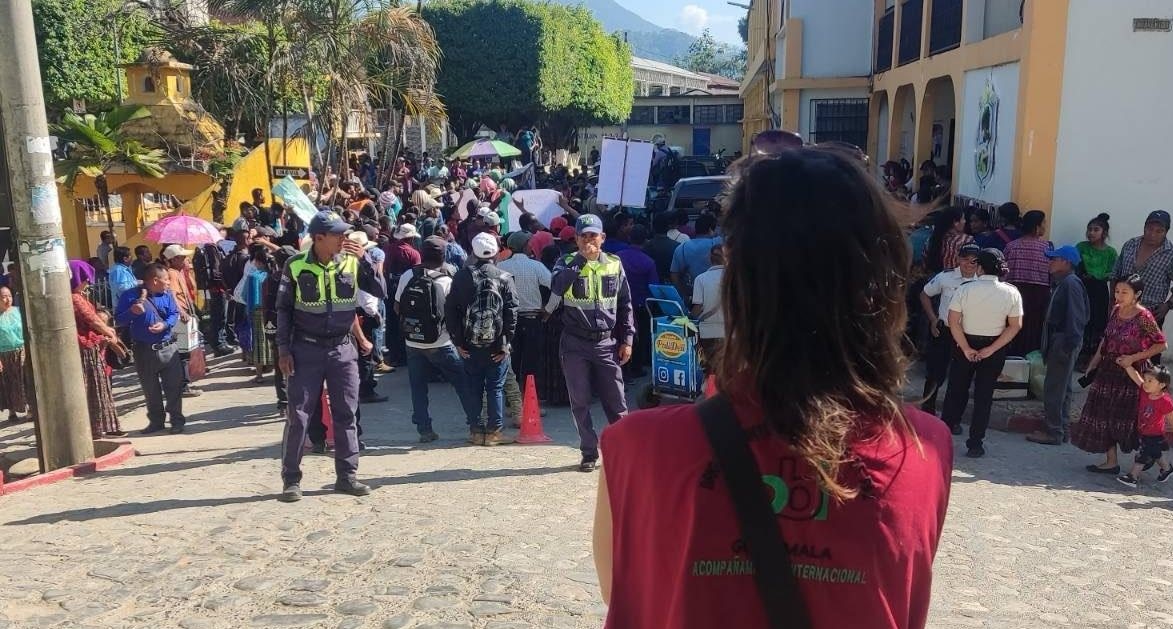
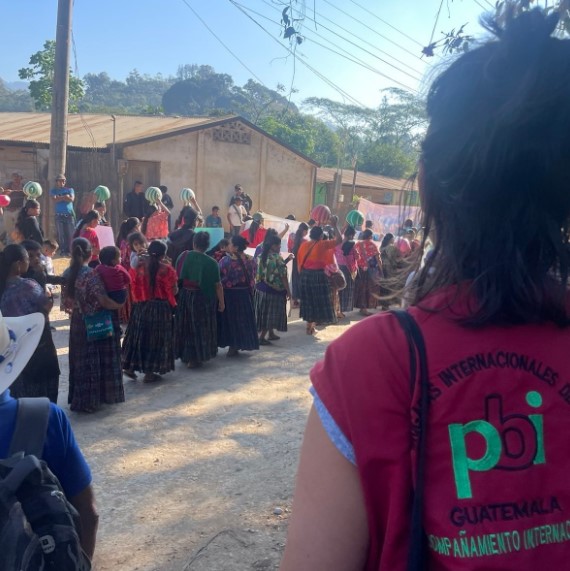
“[On February 26], #PBI accompanies the peaceful walk carried out by the Q’eqchi’ communities of Santa María Cahabón.

Around 300 people mobilized towards the municipality to demand the removal of the accreditation of the hydroelectric company OXEC as a member of the Municipal Development Council (COMUDE), and that no more licenses continue to be granted to hydroelectric companies.

The mayor received them to listen to their demands, to which he pledged to respond over the next month.

“Respect the good faith consultation in which 25,000 people participated” and “No more hydroelectric plants in Cahabón”, were some of the demands that could be read on the banners of the demonstrators.

It should be recalled that the region continues to suffer the effects of the hydroelectric company that has restricted the Cahabón river,”

Maya Q’eqchi’ journalist Carlos Ernesto Choc also tweeted:

“#Alta Verapaz Peaceful Walk in the municipality of Cahabón, Alta Verapaz, Maya Q’eqchi’ communities, hold a peaceful demonstration against Oxec hydroelectric projects.

They demand from the municipal mayor Abraham Chiquin, who won for the VAMOS party the cancellation of the Oxec 3 project and that the representatives of the COMUDE hydroelectric company resign.”

The Peace Brigades International-Guatemala Project has previously explained: “The Peaceful Resistance of Cahabón is made of more than 190 Q’eqchi’ communities who live in the Cahabón River basin. Since 2015 they have organized around defense of territory and against the launch of the OXEC I and OXEC II hydroelectric projects installed on the Oxec River, a tributary of the Cahabón River.”

PBI-Guatemala has accompanied the Peaceful Resistance Cahabón since July 2017.

Hatch and OXEC II

NS Energy has reported: “Hatch would be engaged to deliver the conceptual design and detailed design-build-engineering for the Oxec II Hydroelectric Project.”

Hatch was founded in Toronto, Canada, by W.S. Atkins as W.S. Atkins & Associates in 1955. It has offices around the world with its headquarters in Mississauga, Ontario.

From list of Hatch Ltd. office locations in Canada.

Commenting on OXEC II, Ian Ainslie, a Hatch project manager based in Niagara Falls, Ontario, noted: “Hatch has been active in developing hydroelectric sites in Guatemala for over 20 years.” And Hatch’s managing director of power, Jim Sarvinis, says: “Projects like Oxec II are exactly why we do the type of work we do at Hatch.”

OXEC II became operational in September 2018.

OXEC III

In April 2023, Power Technology noted: “Oxec III is a 75MW hydro power project. It is planned on Cahabon river/basin in Alta Verapaz. The project construction is likely to commence in 2025 and is expected to enter into commercial operation in 2027.”

On May 10, 2023, PBI-Canada observed a march by the Peaceful Resistance of Cahabón in Guatemala City that included a banner that read: “We demand that the Oxec 3 licence be cancelled.”

Breakbulk Magazine has previously reported Hatch’s project manager for Oxec II Hooman Ghassemi “has been working on Oxec II since 2015 and finished the conceptual design for Oxec III [in 2017].”

We continue to follow the Q’eqchi’ resistance to dams on the Cahabon River.

Photo: Maya Q’eqchi environmental defender Bernardo Caal Xol spent four years in prison for his peaceful resistance to dams being built on ancestral territory without consent. He was released from prison in March 2022. PBI-Canada met with him on May 5, 2023, in Cobán, Alta Verapaz, Guatemala.

PBI-Guatemala accompanies the Maya Ch’orti’ Indigenous Council of Olopa Chiquimula as it peacefully resists Canadian mining company

The PBI-Guatemala Project has posted: “Yesterday [February 25], #PBI accompanies the Maya Ch’orti’ Indigenous Council of Olopa Chiquimula in its eighth anniversary, which took place in a natural water birth. During the act, claims were made in defense of water and land through indigenous authorities and through their spirituality.”

Poster: Consejo Indígena Maya Ch’orti’ de Olopa Chiquimula.

In April 2023, the Regional Business and Human Rights Platform noted in their report Fourth Cycle of the United Nations Universal Periodic Review of Canada:

The Gold and Silver Extraction Project of the corporate structure of [the Vancouver, Canada-based] Gold Group Management Inc; that in Guatemala operate in a joint venture between Radius Gold Inc. and Volcanic Gold Mines Inc. through Minerales Sierra Pacífico S.A., did not comply with the consultation and prior consent procedures of the communities of the Maya Ch’orti’ territory of Olopa. In the face of opposition to the project, the defenders of the territory have suffered threats, criminalization, and processes of community division. Furthermore, the company, with the support of the Municipality of Olopa, has hindered the recognition of ancestral authorities to favor community authorities elected by the municipal council and try to limit the historical forms of Organization of the Ch’orti’ Mayan people.

Sierra Pacífico S.A. mineral project

Summary case information: Project name: Minerales Sierra Pacífico S.A (part of the Holly Banderas project)

Location: Olopá, Chiquimula, Guatemala

Companies involved: Gold Group is founder of Volcanic Gold Mines Inc. and Radius Gold Inc., all Canadian companies that they operate in Guatemala through the subsidiary Minerales Sierra Pacífico S.A. (Exploration company).

Financial entity: The Volcanic Gold Mines company is financed by shareholders; the main internal shareholder is Simon Ridgway and the external shareholder is True Independence LLC. In the case of Radius, the main external shareholder is the U.S. Global Investors Fund-World Precious Minerals Fund and the main internal shareholder is Simon Ridgway. They are looking for more financiers and shareholders for the development of the project.

Sector: Mining

Project Status: 4 exploration licenses requested (Arely, Ava, María Elena for which the Ministry of Energy and Mines -MEM- requests an extension of the Work Plan and Karen, in the cadastral opinion phase; the company has waived 6 applications in the 14 communities organized in the Ch’orti’ Mayan Indigenous Council of Olopa

Population or groups affected: The population of the Mayan Ch’orti’ indigenous people of the municipality of Olopa, Chiquimula.

Impacted natural environment: Cerros La Bandera, Cerro de Tituque and La Montañita; The water sources are: the Cayur ravine, the Lempa river and the Jupilingo river, in addition to the Espíritu Santo Natural Reserve.

Main human rights abuses: Right to information, consultation, right to freedom of expression and movement; rights at risk: to water, to life, to food; economic, social and cultural rights.

Organization responsible for documenting the case: Ch’orti’ Mayan Indigenous Council of Olopa/Extractive Industries Observatory

Organizations that subscribe to the report: Mayan Ch’orti’ Indigenous Council of Olopa.

Brief description of the relevance of the project:

Olopa is located in a border region of Guatemala with Honduras and El Salvador. There is a regional organization called “Plan Trifinio”, but it does not integrate the care of Mother Earth from the worldview of the indigenous communities, but rather from the extractivist vision of the authorities of the 3 countries involved.

Following the OIE investigation into another mining project that operates and impacts Chiquimula, more exploration licenses appeared from the Canadian company Minerales Sierra Pacífico S.A. They had to go to the Ministry of Energy and Mines to obtain information about the companies and their activities, because no information was disclosed in the territory impacted by these licenses. The company – from Gold Group – has already carried out exploration activities on private land, without informing, under deception and with the support of the municipality, saying that soil studies were being carried out for access to community water and the construction of tanks. distribution.

Due to the impacts already suffered with the imposition of other mining projects in Olopa, the Ch’ortí Mayan communities began to organize to inform themselves, formulate their demands to demand compliance with their rights and the rights of nature213. These communities are concerned about the number of licenses, and the impacts that all these metal mineral exploitations could generate if they are carried out, in addition to the acts of corruption that preceded the licenses.

Main human rights abuses:

The mining legal framework has not been built from the territories, nor consulted, and does not take into account the environmental, social and cultural impacts of mining exploitation. Decisions to grant environmental and mining licenses are made within ministries (such as the Ministry of Energy and Mines) without notifying the affected populations of the interests that exist over their territories. Reliable information is not shared about the impacts, benefits and reparations that exploration and exploitation activities could generate.

The Mining Law and environmental regulations favor the exploitation of territories by multinationals. In Guatemala, the right to consultation of indigenous peoples is systematically denied.

Right of access to information; right to consultation; right to free expression and peaceful mobilization

In the Ch’orti’ Mayan territory of Olopa, we have an antimony mining operation, the Cantera Los Manantiales mining company215. Faced with the actions of the Mayan Ch’orti’ Council to denounce all the illegalities and impacts generated by this mining activity (mainly on the water and health of the surrounding communities), the State and the company have responded with the criminalization and judicialization of the Mayan Ch’ortí’ authorities, events that break community harmony, increase violence and persecution. For this reason, the defense of the territory is strengthened to prevent further impacts on the ways of life of the communities and it is hoped that action will be taken legal against the company’s exploration licenses.

Actions of cooptation and community division are already being suffered. For example, the municipality prevents the recognition of ancestral authorities to favor community authorities elected by the municipal council and try to limit the historical forms of organization of the Ch’orti’ Mayan people.

Right to a clean environment

Right to water: The communities of the department of Chiquimula are seeing the loss of water resources due to the presence of numerous mining concessions, most of them in the exploration stage, but which are being exploited illegally, without an environmental license. This puts other human rights of the Ch’orti indigenous people at risk.

Right to life and a healthy environment: Linked to the right to water and the possibility of enjoying a healthy environment, the community of Olapa views with concern the mining advance that is articulated with negative impacts already visible in neighboring communities, due to the contamination of the air, soil and water.

Right to health: Exposure to heavy metals and other toxic substances, a product of mining activity, puts the population’s health at high risk, already precarious due to the little or no presence of state services, with differential effects on girls and boys. , women and older adults from the Ch’orti’ ethnic community.

Right to food: The communities have preserved their food traditions, based on agroecology, thanks to their ancestral knowledge, the conservation and exchange of native seeds and the use of medicinal plants, which have become an alternative for survival in the face of advance of the mining companies, stripping the forests and biodiversity of this Guatemalan region.

Cultural rights: As established in the international human rights instruments that Canada is obliged to protect and respect, in the territory where its mining projects are located, the indigenous right to identity is denied, their cultural integrity is affected , its spirituality, its practices based on reciprocity and the community and peasant economies of the region.

Methodology

The documentation of the cases responds to a systematic follow-up of the case by the Ch’orti’ Mayan Indigenous Council of Olopa and the investigation by the Extractive Industries Observatory. Additionally, an investigation of secondary sources has been carried out on official pages such as those of the Ministry of Energy and Mines, the Ministry of Environment and Natural Resources, and the Ministry of Public Health and Social Assistance. In addition, information on judicial processes has been obtained from indigenous jurisprudence. In the Las Pomas community, meetings were organized with the Ch’orti’ Mayan Indigenous Council of Olopa to expose the risks of mining and the community began a process of electing its representatives. The 14 communities of Olopa that are organized in the Ch’orti’ Mayan Indigenous Council of Olopa are in peaceful resistance against mining exploitation and defend their cultures, values, spirituality, physical territory, the community and its forests, hills, rivers, mountains. They protect the territory from development models that exploit Mother Earth and allow progress towards climate justice. They carry out social actions (such as community organization and the election of their authorities and representatives), political, legal (such as community acts for the rejection of mining activities in their territories) and communication. It is expected to be able to file a legal action for the exploration licenses in process in the Maya Ch’orti’ communities.

The full report in Spanish can be read at Cuarto Ciclo del Examen Periódico Universal de las Nacionales Unidas República de Canadá (Plataforma Regional de Empresas y Derechos Humanos, Abril de 2023).

PBI-Guatemala has accompanied the Maya Ch’orti’ Indigenous Council of Olopa in June 2021, following their request, which is based on the serious increase in security incidents, defamation and criminalization processes they are experiencing.

MLA Olsen asks the BC Minister of Public Safety if he still has confidence in the controversial RCMP C-IRG unit

On Thursday February 22, there was this exchange in the Legislative Assembly of British Columbia in Victoria between Green Party MLA Adam Olsen and Mike Farnworth, the Minister of Public Safety.

Olsen refers to testimony that emerged last month at an ongoing abuse of process court hearing in Smithers, BC that highlighted C-IRG officers could be heard in an audio recording from November 19, 2021, saying: “They all had the fuckin’ paint like, are you an orc?”, and the previous day saying: “That big fuckin’ ogre-looking dude, he’s actually like, autistic.” and “Apparently the sergeant grabbed his balls and twisted.”

ADAM OLSEN

Last fall I drew a comparison between the amount of money that the Minister of Public Safety and Solicitor General has invested in the RCMP’s controversial community-industry response group, the C-IRG, and the implementation of the calls for justice in the missing and murdered Indigenous women and girls report.

The minister was furious with this line of questioning, yet transcripts released during court proceedings illustrate perfectly how the RCMP’s C-IRG unit has dehumanized Indigenous people. Much of the language used in the recordings is inappropriate for this House, Mr. Speaker.

Basically, the C-IRG officers were calling Indigenous people ogres and orcs. They made fun of a neurodiverse person and openly described a high-ranking member of that unit sexually assaulting somebody.

Human rights violations, excessive force, illegal tactics, unprofessional behaviour, racism, discrimination. A shame on the RCMP. A shame on this minister. A shame on this House.

To the Minister of Public Safety, is there an ongoing investigation of the alleged sexual assault described by the C-IRG members?

MIKE FARNWORTH

What I can tell the member is that the kinds of comments the member references are absolutely, obviously, and completely unacceptable. I think all members in this House would agree with that.

At the same time, there are processes and protocols in place for complaint procedures and to deal with this kind of thing, some of which are underway — as you acknowledge, a court case.

I can also tell the member that part of the work that has been underway in terms of the reform of the Police Act is to deal with these kinds of things and to extend accountability and oversight on our police forces in this province.

ADAM OLSEN

 I would imagine that when the police forces in this province are made aware of a potential sexual assault…. Perhaps an investigation would be necessary and not the requirement of the person who was involved in that to have to file a complaint. It seems like the conversation between the members of these units was quite open about what was going on there.

The C-IRG has vastly exceeded their projected budget, year over year. In their first year, in 2019-2020, they were budgeted $920,000, yet they spent $10 million. Each year this unit continues to receive funding and then blow past their budgets.

The RCMP’s Civilian Review and Complaints Commission is currently undertaking a systemic investigation of the C-IRG unit, an investigation that has experienced significant delays because the RCMP is not giving them information.

The B.C. Civil Liberties Association and the Union of B.C. Indian Chiefs have called for the C-IRG to be disbanded due to the ongoing human rights violations and harm to Indigenous communities.

To the Minister of Public Safety and Solicitor General. If the allegations that we heard on tape, the racist and demeaning comments on the record, the picking on neurodiverse people, laughing about an incident that basically amounts to sexual assault…. Does the C-IRG still have the confidence of this minister?

MIKE FARNWORTH

I appreciate the question. As I said a moment ago, we expect police to conduct themselves in line with the standards that are in place for policing. If they are not, then they should be held accountable for that. Again, I’d say that every member of this House agrees with that.

At the same time, the member talks about the budget for the C-IRG. Well, the C-IRG was established to assist those communities that have been dealing with some of the challenges that we’ve been facing in terms of protests and in terms of enforcing court-ordered injunctions in this province. The result of….

The budget is based on the amount that has actually had to have been spent in order for police to be able to do that job. The amount is based on a rolling average over the last three years. It started off, as the member said, at $900,000. What we have seen in some different parts of the province, particularly on some of the LNG pipelines, is a significant amount of resources required in order to deal with some often extremely violent protests.

Our expectation is that those engaged in law enforcement are obeying the laws and the standards in the province of British Columbia and Canada and, at the same time, recognize that they have an important job to do in enforcing sometimes court-ordered injunctions to ensure that legal, lawful activity is allowed to take place in our province.

We continue to follow this and support the calls for the abolition of this RCMP unit.

Notably, March 9 will mark the one-year anniversary of the Civilian Review and Complaints Commission (CRCC) systemic investigation of the RCMP (with no indication of when this investigation will be completed and a report released) and the abuse of process hearing will resume June 17-21 in Smithers.

Further reading: Twelve concerning things we learned about the RCMP C-IRG during the first week of the abuse of process hearing (January 20, 2024).

REGISTER NOW

Gitxsan and Gitanyow Resistance to Colonial Mega Projects webinar

Tuesday March 5 at 5:30 pm PT

featuring Tara Marsden, Kai Nagata, Kolin Sutherland-Wilson and Maryam Adrangi

PBI-Canada co-organizes webinar encouraging applications to be a PBI-Colombia field volunteer

On February 27, PBI-Colombia, PBI-UK and PBI-Canada collaborated on a webinar to help encourage people to be a field volunteer with PBI-Colombia.

They are currently seeking new volunteers with an application deadline of March 2.

For more about that, click here.

This webinar featured former PBI-Colombia field volunteers Marie Zeller (there from 2019 to 2023) and Sophia Kerridge (2012 to 2013) along with PBI-Colombia accompanied Associated Network of Human Rights Defenders (dhColombia) lawyer Germán Romero.

Key excerpts from that webinar include:

Sophia Kerridge: “What PBI really offers is an international presence. And that can be in the form of physical accompaniment or observation in the field, or it can be through our huge support network that spans a number of different levels in various different countries. And what that provides, it essentially shines a light on the threats that those human rights defenders face in order to dissuade the people who are behind those threats from continuing with those threats or from taking things further. And the way that it works is essentially by PBI drawing attention to those security problems it puts pressure on governments and international authorities to take responsibility for the safety of those human rights defenders.”

Germán Romero: “I feel something really deep in my heart for PBI and so does my whole team, we always have you in mind.”

“My work as a lawyer [includes] working with campesino or peasant and Indigenous communities and Afro-Colombian communities to be able to stay in their territory, to defend their territory and to have access to land and to guarantee the protection of natural resources from the threat of megaprojects. …With the Rios Vivos movement in Antioquia which is working to save a river that has been messed up by a hydroelectric project [financed in part by Export Development Canada]. …There is nothing more important to me than being able to be in the field and being able to be directly with the families, with the communities and be able to bring forward strategic litigation.”

“[Before I was with dhColombia] PBI accompanied us directly in the communities in which I was working doing popular education, judicial, legal, political formation, and strategic litigation in the field and that was the only way that I was able to move about in the territory. There was one situation where I wasn’t able to be accompanied by PBI and I was attacked. They had me detained. They had me against the ground. They were going to assassinate me.”

“If PBI wasn’t accompanying us [now with dhColombia] in certain areas of the country we couldn’t go in, we couldn’t work there, and we couldn’t carry out our work, it’s that easy to understand. If PBI didn’t come along with us and accompany us at different hearings that happen in Bogota, it would be impossible for us to have enough safety and security to be able to work as lawyers in those spaces.”

Marie Zeller: “It was wonderful to find an organization that was doing what was just necessary with the principle of not getting involved in the decisions of the organizations that operate there who are really the experts, the ones who had the experience and the pain. That’s what I really liked about PBI, that’s why I applied. …I accompanied German, like he was saying, we are part of a movement, always as outsiders, but we get included. …[Within PBI] there isn’t a boss, there isn’t a decision coming from above, you listen to all of the parties from within to reach a consensus and to reach the best solution. …Horizontality is the most beautiful way of working, it just needs patience. …There’s also a lot of looking after internally, internal support to carry on because we can be emotionally affected [by the situations we accompany]. It’s very important to look after each other. …There are many things you can’t be prepared for, and I think knowing that is a good way to prepare because the situation in Colombia is very volatile, and there are many things you won’t be able to plan.”

During the question-and-answer session, Romero was asked: “For those who can’t work with PBI in the field, what can they do to support your work?”

Romero replied: “I think there are several options. The first is to learn more about the situation that is of the greatest importance. Not just the situation in Colombia, but the human rights situation in general. I think we have some very serious problems in the Western hemisphere in terms of human rights, follow PBI on social media that’s really important. To be totally honest nowadays with the crises we are seeing across the world, for example the genocide being committed against the Palestinian people, the very serious crisis of human rights violations that we are seeing against immigrants and migrants who are coming up to the EU and UK and US border, and now we can add Australia, it can be really important going in on a political and economic support campaign, that’s of great importance.”

In total, 78 people registered for this webinar with participants joining from the United Kingdom, Canada, Colombia, Mexico, the Netherlands, Australia, USA, Germany, Italy, Belgium, Switzerland, Kenya and Cameroon.

The webinar also included the short film In the Company of Hope. To watch that, click here.

To apply to be a PBI-Colombia field volunteer, click here.

CEHPRODEC executive director Donald Hernández: “We go to the territories accompanied by organizations such as PBI”

PBI-Honduras has accompanied the Honduran Center for the Promotion of Community Development (CEHPRODEC) since May 2014.

Spanish RTVE radio-television recently interviewed Donald Hernández, the executive director of CEHPRODEC.

Below is an excerpt from that full interview.

QUESTION: Have you ever suffered threats?

ANSWER: Yes, many. The activism in which we develop leads us to be permanently threatened. They are direct threats from powerful groups that see their economic interests affected by the actions we develop with activists in the field.

Q: Do you take any measures to protect yourselves?

A: Institutionally we are careful and we follow protocols. We go to the territories accompanied by organizations such as Peace Brigades International. Their vests and visibility allow us to be under their umbrella. Imagine how we have lost our dignity. Because I am Honduran, my life does not deserve respect, I am only respected when I am with someone whose ambassador is watching over me. We have also learned to have very direct relations with the UN High Commissioner’s Office. And when they are dangerous places, we have officials accompany us or we request the visit of ambassadors so that there is more visibility of the vulnerable people who are day by day facing these groups of power.

Q: When you talk about indigenous peoples and native peoples, which ones are you referring to?

A: CEHPRODEC works with the Lenca population in the department of La Paz, with the Tolupanes in the municipality of Yoro and with the Pech population in Olancho.

Q: What are the main demands of these native peoples and of the peasants that you also defend from your organization?

A: There are three important things. One is information. This is understood because in Honduras information is vetoed, we do not have access to public information. The government, so far, refuses to sign the Escazú Agreement, which would oblige us to provide public information, mainly on environmental issues. If we do not have information, then there is a lot of speculation. People ask us for information.

Q: There were three important things you were asked for. Information is the first one, and the other two?

A: Once we had the information with the number of hectares granted in the concession – whether for mining, hydroelectric or other projects – we began to provide training. And then we start organizing. We must have the capacity to accompany the leaders with lawyers, because they are going to need them. We must have the capacity to move them within 24 hours the day they are threatened with death and have to be taken out of the country.

Besides, we study the environmental regulations to be able to contribute in the presentation of unconstitutionality appeals on the Mining Law, the Forestry Law… on all those contributions that we make with the peasants and indigenous people to ensure that their rights are respected.

To read the full interview, go to Entrevista – Donald Hernández, abogado de indígenas y campesinos: “Nadie quiere ser líder porque te persiguen y te matan” (RTVE, February 26, 2024).

Further reading: CEHPRODEC lawyer Donald Hernández: “For those whose lands are stolen and poisoned by mining companies, Canada is synonymous with mining” (October 19, 2022).

PBI-Colombia accompanies the Peace Community of San José de Apartadó at the commemoration of the Massacre of Mulatos and La Resbalosa

PBI-Colombia has posted: “PBI Colombia accompanied the Peace Community of San José de Apartadó in the community work and the commemoration of the Massacre of Mulatos and La Resbalosa, perpetrated on February 21, 2005, by the Army. Hearings on this event are currently underway at the JEP with case 04.”

The Massacre

PBI-Colombia has previously explained: “On February 21, 2005, the villages of Mulatos and La Resbalosa (Antioquia), located five hours from La Holandita, the main settlement of the Peace Community, were the scene of a heinous crime that, once again, hit its inhabitants.”

“Among the 8 victims of this massacre, 7 were members of the Peace Community: Luis Eduardo Guerra, historical leader and founder of the Community, Bellanira Areiza, his companion and Deiner Andrés Guerra, his 11-year-old son; Alfonso Bolívar Tuberquia Graciano, the coordinator of the Humanitarian Zone of La Resbalosa, Sandra Milena Muñoz Posso, his wife, Natalia and Santiago, their two children aged 5 years and 20 months.”

“The massacre was perpetrated by a commando of around 60 paramilitaries from the Heroes of Tolová Bloc of the United Self-Defense Forces of Colombia (AUC) along with troops attached to the Army’s 17th Brigade.”

That article adds: “In the months following the massacre, the XVII Brigade and the Ministry of Defense stated that, given the modus operandi employed, there was no doubt that the massacre had been perpetrated by the FARC-EP guerrilla group.”

The Peace Community

For Peace Presence explains: “In the middle of the 1990s, as violence escalated and peasant farmers suffered from extrajudicial deaths at the hands of armed actors as well as forced displacements, the people began to organize themselves in order to return to their land and to escape from the spiral of violence.”

It adds: “Conscientiously objecting to the war and demanding their rights as civilians not to be involved in a conflict, the community denounced the use of arms within their territories and committed to a variety of principles in the process (including cooperative communal work, prohibition of alcohol, the non-use of illicit drugs, the no-entry of armed actors, non-use of weapons and the refusal to provide information to armed actors).”

JEP Case 04

The Special Jurisdiction for Peace (JEP) has noted: “The JEP opened case 04, through Order 040, on September 11, 2018.”

“This case prioritizes the territorial situation based on the facts of the conflict occurred in the Urabá region between 1986 and 2016. This is one of the three territorial cases that the JEP has opened along with that of the Norte del Cauca, the south of Valle del Cauca, and the municipalities of Barbacoas, Ricaurte and Tumaco in Nariño.”

It adds: “To date, members of the 5th, 34th and 57th Fronts of the Jose Maria Cordoba Bloc of the FARC-EP and their respective Fronts have appeared in Case 04 mobile units, as well as members of the XVII Brigade of the National Army.”

PBI-Colombia has previously noted: “In an appeal to the JEP, [the Peace Community] asked that the case be returned to the ordinary courts. The Peace Community does not agree that the massacre is treated as a fact of the armed conflict, since it considers that it occurred in the context of the persecution against the community for having declared itself neutral in the face of the armed conflict.”

Accompaniment

The Peace Brigades International-Colombia Project has accompanied the Peace Community of San José de Apartadó since 1999.

PBI-Guatemala accompanies Conavigua at commemoration of Indigenous Maya victims of the internal armed conflict

On February 24, PBI-Guatemala posted:

“PBI accompanies in the framework of the Day of the Dignification of the Victims of the IAC [internal armed conflict] commemorated every February 25 by the delivery of the Report of the Commission for Historical Clarification (CEH) in the year 1999, Conavigua Guatemala invited to a forum and presentation of a documentary.

The forum was dedicated to the CEH Guatemala Memory of Silence Report, presented 25 years ago, which collects testimonies about more than 7,500 cases of human rights violations during the conflict. The commission was created by one of the Peace Agreements with the purposes of “clarifying human rights violations and acts of violence that have caused suffering to the Guatemalan people”; investigate the causes of the conflict and make recommendations “for peace and national accord in Guatemala”. One of the commissioners, Otilia Lux de Cotí, shared a summary and key moments of the report’s preparation and insisted on using her recommendations “to build a democratic and inclusive Guatemala.”

Following the Collective Divergence and the Community of Mayan Studies Ixb’alamkyej Junajpu Wunaq (CEMIJW) presented a documentary that was dedicated to a discussion between Mayan scholars Aura Cumes, Edgar Esquit and Kaypa’ Tz’iken on Maya Memory and Resistance 500 years from the invasion.

The event closed with a music concert from the Tujaal Rock group.”

CONAVIGUA

CONAVIGUA is a women’s organization that fights for the individual and collective rights of Mayan women and indigenous peoples.

Ottawa-based InterPares further explains: “Since 1988, CONAVIGUA (Coordinadora Nacional de Viudas de Guatemala, National Coordination of Widows of Guatemala) has been working with local groups of widows to obtain justice and reparations for their family members killed or disappeared during the armed conflict. Present in seven departments of Guatemala, CONAVIGUA has been actively promoting the implementation of the peace accords in Guatemala by denouncing militarization and by promoting gender equality and human rights. In response to the evolution of their member’s reality, CONAVIGUA is increasingly working around the defense of indigenous land against transnational development projects.”

Historical background

The International Center for Transitional Justice provides this overview:

“From 1960–1996, the nation of Guatemala was ravaged by a bloody civil war. The primary parties to the conflict were the authoritarian government and the rebel, leftist Guatemalan National Revolutionary Unit (URNG), led by the ethnic minority Mayan indigenous people and Ladino peasants.

The worst violence occurred in the 1980s under the governments of General Romeo Lucas Garcia from 1978–1982, General Efraín Ríos Montt from 1982–1983, and General Mejía Victores from 1983–1986. This period of intensive counter-insurgency saw massacres and “scorched-earth” tactics executed throughout the nation.

On June 23, 1994, the Guatemalan government and the URNG signed an agreement to create the Commission to Clarify Past Human Rights Violations and Acts of Violence that Caused the Guatemalan Population to Suffer.

Guatemala’s Commission for Historical Clarification (CEH) was established during the peace process as a conduit for truth seeking and reconciliation across the nation. Like most truth commissions, the CEH began with the signing of a peace agreement and from there embarked on an obstacle-ridden path to the truth.

On February 25, 1999, after two six-month extensions, the CEH released its final report.”

The CEH report

The United Nations-backed Commission for Historical Clarification determined that the Guatemalan military was responsible for 93 per cent of the atrocities – including forced disappearances, massacres and torture – and that 83 per cent of the victims were Indigenous Maya peoples.

The Commission concluded that acts of genocide occurred during the war.

The internal armed conflict killed an estimated 200,000 people and displaced more than one million people between 1960 and 1996.

45,000 people are still unaccounted, including 5,000 children.

Israel’s role in the genocide

NACLA has highlighted: “Israeli press reported that 300 Israeli advisors helped execute the [March 1982 military coup that brought General Efraín Ríos Montt to power]… Through the height of la violencia (“the violence”) or desencarnacíon (“loss of flesh, loss of being”), between the late 1970s to early 1980s, Israel assisted every facet of attack on the Guatemalan people. Largely taking over for the United States on the ground in Guatemala (with Washington retaining its role as paymaster, while also maintaining a crucial presence in the country), Israel had become the successive governments’ main provider of counterinsurgency training, light and heavy arsenals of weaponry, aircraft, state-of-the-art intelligence technology and infrastructure, and other vital assistance.”

Rosa De Ferrari has also noted in the University of Pittsburgh publication Panoramas: “Five years before Rios Montt’s coup, in 1977, the U.S. cut off military aid to Guatemala based on human rights violations committed by the military. In a move that many saw as becoming a proxy for the U.S., Israel began arm sales to the Guatemalan government. By the 1980s Israel had become the largest supplier of weapons, military training, and surveillance technology to Guatemala.”

PBI-Guatemala has also posted this poster of a “march for dignity” happening today.

Meet German Romero on Monday!

German Romero Sánchez is a Bogotá-based lawyer with the Associated Network of Human Rights Defenders (dhColombia) that PBI-Colombia has accompanied since 2016. To meet him this Monday February 26, register here.

His organization is made up of an interdisciplinary group of professionals, who assume the defence of victims of human rights violations, either individually or collectively. Its work focuses on litigation actions and legal defence in cases of attacks on unions, campesino leaders, political opponents, and Indigenous communities.

German represents victims of serious human rights violations and emblematic crimes against humanity perpetrated mainly by state security forces.

As a result of his work, he has experienced threats, theft of sensitive information, attacks, surveillance against him and his family, defamation and stigmatization statements by the highest representatives of previous governments.

You can meet him on Monday February 26 at 2 pm ET as he speaks about the importance of accompaniment and the need for PBI field volunteers to accompany him and other threatened organizations, defenders and communities.

Marie Zeller, a former PBI-Colombia field volunteer, will further highlight the crucial role of PBI’s accompaniment. The webinar will be moderated by Sophie Kerridge, also a former PBI-Colombia field volunteer, now a lawyer in London, UK.

Register now here.

Global Affairs Canada provides $450,352.00 to CADSI, UN Special Rapporteurs note arms companies have human rights obligations

Photo: Protest outside the CADSI office in Ottawa on February 13, 2024.

The website of the Office of the Commissioner of Lobbying of Canada shows that the Canadian Association of Defence and Security Industries (CADSI) has received $450,352.00 from Global Affairs Canada (GAC) over the past two years.

That same Lobbying Commissioner website notes that the role of CADSI is “to convince government officials to maintain and/or improve global market access for Canadian firms in a way that respects Canada’s export controls.”

Citing those export controls, namely the Export and Import Permits Act, three Toronto-based legal scholars argue that “because the ICJ [International Court of Justice] found a serious risk of genocide in Gaza, continuing to export arms to Israel would be illegal.”

CADSI, as “the national voice” representing arms companies in Canada has not publicly commented on the calls for a ceasefire, the International Court of Justice ruling that it is “plausible that Israel’s acts could amount to genocide” in Gaza, or the obligations of companies vis-à-vis the Genocide Convention and the Arms Trade Treaty.

Who does CADSI represent?

CADSI describes itself as “the bridge between government and industry.” Among the companies CADSI represents: BAE Systems, Bell Textron, Boeing, Colt, Elbit Systems, General Dynamics, L3 Harris, Leonardo, Lockheed Martin, Raytheon, and Rheinmetall among others.

Photo: Protest at Lockheed Martin plant in Ottawa, November 10, 2023.

The Oakland, California-based American Friends Service Committee (AFSC) Action Center on Corporate Accountability has noted that these same companies that CADSI represents are profiting from Israel’s 2023-2024 attacks on Gaza.

These companies are among the most profitable weapons companies in the world.

For example, Lockheed Martin’s gross profit for the twelve months ending September 30, 2023, was $8.486 billion. General Dynamics’ gross profit for that same period was $6.580 billion.

CADSI membership for companies with 500+ employees is $10,600. a year. The fee for “small” companies with 5-99 employees is $2,650. a year.

It’s unclear why a lobby group that represents “700+” companies, including billion-dollar transnational corporations, needs a public subsidy to undertake its work.

“No follow-up” by the CCC

The Canadian Commercial Corporation (CCC) is also a member of CADSI. The CCC says as “the only Canadian agency that offers international contracting expertise, we have facilitated the delivery of billions in Canadian products and services to national, state, and municipal governments around the world using G2G contracts.”

Photo: Canadian Commercial Corporation​, 350 Albert Street, Suite 700, Ottawa.

Notably, journalist David Pugliese has previously reported in the National Post: “The Canadian Commercial Corporation acknowledges it conducts no follow-up to ensure exported Canadian-built equipment isn’t being used to abuse human rights.”

The CCC is listed as an exhibitor at CANSEC 2024 at Booths 225/M18/M17.

The CANSEC weapons show

CADSI organizes CANSEC, “Canada’s leading defence, security & emerging technology event”.

CADSI further notes: “CANSEC has always been a great success, and CANSEC 2024 will once again showcase leading-edge technologies, products and services for land-based, naval, aerospace and joint forces military units.”

Video: “Made in Israel, tested in Palestine.” The Israeli weapons company Elbit Systems, which is a CADSI member, will be an exhibitor at CANSEC this year (Booth 1421).

This year’s CANSEC will take place on May 29-30 at the EY Centre in Ottawa.

Notably, while Global Affairs Canada: Trade Commissioner Service was listed last month as an exhibitor at CANSEC, at Booth 225-S, they can no longer be found on the current listing.

The Global Affairs Canada logo, however, still remains on the CADSI website as a “partner” for its presence at the Eurosatory arms show in Paris (happening in June 2024) and the DSEI UK arms show in London (September 2025).

Arms companies have obligations

A recent statement on the need to stop weapons exports to Israel signed by United Nations Special Rapporteurs, Independent Experts and working group members highlights: “Arms companies contributing to the production and transfer of arms to Israel and businesses investing in those companies bear their own responsibility to respect human rights, international humanitarian law and international criminal law. They have not publicly demonstrated the heightened human rights due diligence required of them and accordingly risk complicity in violations.”

The Guiding Principles on Business and Human Rights includes: “The responsibility to respect human rights is a global standard of expected conduct for all business enterprises wherever they operate. It exists independently of States’ abilities and/or willingness to fulfil their own human rights obligations, and does not diminish those obligations. And it exists over and above compliance with national laws and regulations protecting human rights.”

Amnesty International explains: “In relation to the defence sector, this means companies must assess and address human rights risks and abuses arising in all aspects of their business, including how clients such as national armies and police forces use their weaponry and related services. …Major industry players including Airbus, BAE Systems and Raytheon [all CADSI members] are not undertaking adequate human rights due diligence which could prevent their products from being used in potential human rights violations and war crimes.”

Significantly for CADSI, the CANSEC list of exhibitors still includes “Israel Representatives” at Booth M7 and Elbit Systems at Booth 1421 at the EY Centre where there will be “600+ VIPS, generals, top military & government officials”, “50+ international delegations”, and “74% of [the 12,000+] attendees have purchasing power”.

We continue to follow this.

For more on the planned mobilization against the CANSEC arms show on May 29-30 this year, see this World Beyond War Canada webpage.

Photo: Protest at CANSEC 2023.

UN Special Rapporteurs say any transfer of weapons to Israel is likely to violate international humanitarian law

Photo: Francesca Albanese, Special Rapporteur on the situation of human rights in the Palestinian territories occupied since 1967.

Thirteen United Nations Special Rapporteurs, including Francesca Albanese, along with several Independent Experts and Working Group members, have stated that “any transfer of weapons or ammunition to Israel that would be used in Gaza is likely to violate international humanitarian law and must cease immediately.”

Their statement has also been endorsed by Mary Lawlor, the Special Rapporteur on the situation of human rights defenders, and David R. Boyd, the Special Rapporteur on human rights and the environment.

The Special Rapporteurs highlight: “The United States and Germany are by far the largest arms exporters and shipments have increased since 7 October 2023. Other military exporters include France, the United Kingdom, Canada and Australia.”

$28.5 million in new permits

Two weeks ago, Alex Cosh of The Maple reported: “The Trudeau government authorized at least $28.5 million of new permits for military exports to Israel during the first two months of the state’s brutal war on Gaza, data supplied to The Maple by Global Affairs Canada (GAC) shows. The total value of the new permits authorized over a two-month period exceeds the 30-year annual record high of $26 million in Canadian military exports to Israel in 2021.”

That article adds: “The permits appear to have been authorized quickly, with one processed within four days of the application being submitted. In its 2022 report on military exports, GAC said that its target processing time was 10 days for ‘low-risk’ destinations, and 40 days for other destinations.”

Is Canada still exporting “military goods” to Israel?

Yesterday, the National Post reported: “Canada has stopped issuing export permits to companies looking to sell military equipment to Israel, according to one person familiar with the matter. The source says that Mélanie Joly’s office has issued instructions to staff at Global Affairs Canada to delay issuing permits that are required for weapons, firearms and components that could have a military use.”

It then notes: “Joly may be starting to feel the heat from her own lawyers. Earlier this month, Nicaragua said that it will take Canada, the U.K., Germany and the Netherlands (which only recently stopped supplying arms) to the International Court of Justice over the Gaza war, claiming that the four countries have violated the Genocide Convention by supplying ammunition and technology to Israel.”

World Beyond War Canada has commented: “Good news if true, but frankly we’re not convinced. And if it is, let’s still be clear that a temporary, secretive, unconfirmed pause on new permits is NOT an arms embargo. We expect the 100s of existing permits to be canceled, including the record breaking amount issued Oct-Dec.”

Tweet by Alex Cosh, News Editor, The Maple (February 23).

The Netherlands and F-35 parts

The Special Rapporteurs also “welcomed the decision of a Dutch appeals court on 12 February 2024 ordering the Netherlands to halt the export of F-35 fighter jet parts to Israel.”

Canada has not taken similar action.

A study commissioned by Lockheed Martin in 2018 said there are US$2.3-million worth of Canadian components in every F-35 fighter jet.

Arms companies have human rights obligations

The UN Special Rapporteurs also say: “Arms companies contributing to the production and transfer of arms to Israel and businesses investing in those companies bear their own responsibility to respect human rights, international humanitarian law and international criminal law. They have not publicly demonstrated the heightened human rights due diligence required of them and accordingly risk complicity in violations.”

CADSI

Most of the biggest arms companies – including Lockheed Martin, General Dynamics and Boeing – that do export weapons to Israel are represented in Canada by the Canadian Association of Defence and Security Industries (CADSI) located at 251 Laurier Avenue West in Ottawa.

Photo: Protest at CADSI, February 13, 2024.

It does not appear that CADSI has publicly commented on the calls for a ceasefire or for an arms embargo on Israel, nor has not noted the International Court of Justice ruling on the plausibility of a genocide happening in Gaza, or highlighted the necessity of all states (and corporations) adhering to the Genocide Convention.

Last year CADSI received $208,600. from Global Affairs Canada. In 2022 it received another $241,752. with the likelihood of more this year.

Photo: Office of the Commissioner of Lobbying of Canada.

Trade Commissioner Service not at CANSEC?

CADSI is also organizing the annual CANSEC arms show that will take place this coming May 29-30 at the EY Centre in Ottawa.

Along with Lockheed Martin, Boeing and General Dynamics, other exhibitors include Elbit Systems (a CADSI member that provides up to 85 percent of the land-based equipment procured by the Israeli military and about 85 percent of its drones), “Israel Representatives”, and the Canadian Commercial Corporation, a Crown corporation that helps “forge commercial contracts between Canadian businesses and foreign governments”.

CANSEC list of exhibitors, January 18, 2024.

Significantly, the Global Affairs Canada Trade Commissioner Service (that “helps Canadian companies and organizations of all sizes grow and operate internationally”) had been listed as a CANSEC exhibitor this year, but is no longer there.

We continue to follow this.