Home Blog Page 102

Indigenous communities present to UN Special Rapporteur on the right to water about the threat of Ring of Fire mining

Last night we heard powerful testimony from Indigenous communities who would be affected by the Ring of Fire mining development.

Representatives from the Neskantaga and Attawapiskat nations made presentations to Pedro Arrojo-Agudo, the UN Special Rapporteur on the right to water, at a gathering at Carleton University in Ottawa.

Neskantaga is just south-west of the Ring of Fire zone, while Attawapiskat is downstream of this area.

Map by Canadian Geographic.

In November 2021, CBC reported: “Premier Doug Ford’s government [wants] to lure the big automakers to produce electric vehicles in southern Ontario. A key part of that strategy involves opening up the so-called Ring of Fire mineral deposit, located more than 500 kilometres north of Thunder Bay in an area home to Indigenous people.”

The area has an abundance of the rare-earth/critical minerals touted as part of the “green energy transition” used in electric vehicle batteries and energy storage systems, including cobalt, lithium, manganese, nickel, graphite and copper.

Photo: On March 29, 2023, then-Chief-elect Chris Moonias from Neskantaga First Nation shouted “no consent” at Premier Doug Ford from the Queen’s Park provincial legislature gallery before walking out.

By December 7, 2023, CBC reported: “Mining claims staked in northern Ontario’s Ring of Fire area have risen by 30 per cent since last year, according to provincial data analyzed by the Wildlands League.”

No free, prior and informed consent

That CBC article from last year highlighted: “Surrounding First Nations say there hasn’t been proper consultation about mining projects on their territories. A number of rallies have been held at Queen’s Park in Toronto this year by members of the First Nations Land Defence Alliance, calling out the province’s free entry mining system and demanding a meeting with Premier Doug Ford.”

Significantly, the UN Special Rapporteur on the rights of Indigenous Peoples, José Francisco Calí Tzay, has already stated: “[Canada should] suspend large-scale mining and other business activities in the Ring of Fire region … until the free, prior and informed consent of the Indigenous Peoples affected is secured.”

“They’re going to have to run me over”

CBC has also reported: “Outgoing Chief Wayne Moonias of Neskantaga First Nation said his people are willing to risk their lives to protect their river system. But when pushed further about what this resistance may actually look like – be it lawsuits, blockades or even violence, he didn’t specify what their future action might entail.”

Moonias has also stated: “If Premier Ford wants to get on a bulldozer, if the CEO of Ring of Fire Metals wants to get on a bulldozer, they’re going to have to run me over.”

Peace Brigades International (PBI) and 100+ organizations have signed an open letter on just energy transition concerns that notes: “Mining always comes with risks of human rights and environmental abuses. …The extractive industry is the most dangerous sector for those voicing concerns… We call on world leaders to commit [to] clear protection mechanisms for human rights and environmental defenders.”

Risk of OPP violence

With the Royal Canadian Mounted Police (RCMP) Community-Industry Response Group (C-IRG, now rebranded as CRU-BC) adopted as a “national best practice”, we express our concern about potential actions by the Ontario Provincial Police (OPP) in response to peaceful Indigenous resistance to the Ring of Fire.

We recall that it was an Ontario Provincial Police sniper who shot and killed Ojibwa land defender Dudley George during a peaceful reoccupation of Ipperwash Provincial Park on September 6-7, 1990.

We continue to follow this.

International Court of Justice to make provisional ruling on arms exports to Israel within weeks

Video still: The ICJ hears case on weapons exports to Israel.

Foreign Policy reports: “Nicaragua asked the International Court of Justice (ICJ) on Monday [April 8] to order Germany to stop all arms exports to Israel. …Germany is Israel’s second-largest arms provider after Washington, with the former having sent $353.7 million in military equipment to Israel in 2023.”

“[This case] raises new questions about the liability of other countries that have supplied weapons to Israel.”

The article adds: “A preliminary decision will likely take weeks to deliver, and the case, if accepted, could last for years.”

The specific provisional measures sought would call on Germany to “immediately suspend its aid to Israel, in particular its military assistance” and to “immediately ensure that military equipment or weapons or other equipment used for military purposes already delivered by Germany and German entities to Israel are not used to commit or to facilitate serious violations of the Genocide Convention or international humanitarian law.”

The BBC also notes: “The allegations build on a separate case taken by South Africa in January, where judges in the Hague ordered Israel to take ‘every possible measure’ to avoid genocidal acts.”

Carlos Arguello Gomez, Nicaragua’s Ambassador to the Netherlands, says: “Germany cannot but be aware that the arms and munitions it supplies to Israel are supporting attacks in Gaza, even if they’re not being immediately used for that purpose. It doesn’t matter whether an artillery shell is delivered straight from Germany to a tank shelling a hospital or whether it goes to replenish Israel’s stockpile. The fact is that security of supply is crucial to Israel’s prosecution of its campaign in Gaza.”

France 24 further notes: “Argüello Gómez urged the court to include U.S. supplies in its preliminary orders, known as provisional measures.”

But that article cautions: “According to the Stockholm International Peace Research Institute, Germany is second only to the U.S. in supplying arms to Israel – but it would be harder, if not impossible, for the U.S. to be brought before the court because Washington does not recognize the ICJ’s power to compel countries to appear before it. The U.S. also has not signed a protocol to the Genocide Convention that allows countries to bring disputes to the court.”

German lawyers and civil servants also call for an end to arms exports

The Guardian adds: “German lawyers have [also] brought a case calling for Germany to end its arms sales to Israel. Britain and other governments are facing the same pressures, while a Dutch court found a ‘clear risk’ that exported F-35 jet parts could be used in breaches of international humanitarian law.”

Additionally, Aljazeera has reported: “A group of German civil servants have written to Chancellor Olaf Scholz and other senior ministers calling on the government to ‘cease arm deliveries to the Israeli government with immediate effect’.”

Their letter says: “Israel is committing crimes in Gaza that are in clear contradiction to international law and thus to the Constitution, which we are bound to as federal civil servants and public employees.”

Implications for Canada

Raymond Murphy, a human rights lawyer and professor of law at the University of Galway in Ireland, says: “The case has great relevance not just for Gaza but also for all the states that manufacture weapons and supply states and other parties with weapons that are ultimately used to commit violations of international law, of humanitarian law, the convention against genocide and a whole host of other international measures that seek to protect civilian and other vulnerable groups.”

The Government of Canada is likely to be attentive to the provisional ruling of the ICJ on arms sales.

While Canada has pledged “cease the further authorization and transfer of arms exports to Israel” it has also said that arms transfers approved prior to January 8 will go ahead. That could still mean millions of dollars of military goods.

Peace Brigades International has called on the international community to suspend the supply of arms to Israel and to show its strong support for institutions of global justice, including the International Court of Justice.

We continue to follow this.

PBI-Guatemala accompanies the Indigenous Community of San Francisco Quezaltepeque as it protects Cerro del Quetzal ancestral lands

PBI-Guatemala has posted:

The day before yesterday [on April 6] #PBI accompanied the indigenous community of San Francisco Quezaltepeque in an investigation carried out by the Public Prosecutor’s Office in the Quezaltepeque volcano. Last month the Maya Ch’orti’ authorities and neighbours of the community filed a complaint about attempts by private individuals to appropriate communal lands and thus privatise the ancestral lands of Cerro del Quetzal. 

The tour was accompanied by inhabitants of other communities of the Maya Ch’orti’ region, as well as PNC [National Civil Police] agents and officials from the municipality.

Prensa Comunitaria explains:

Mayan Ch’orti’ authorities from the indigenous community of San Francisco Quezaltepeque and representatives of other communities in the municipality accompanied an assistant prosecutor from the Public Ministry (MP) to a proceeding in the village of Chiramay, where the Quezaltepeque Volcano, better known as Cerro del Quetzal, is located, after filing a complaint against a community member.

The community members consider that most of the land is virgin forest, however they indicate that a neighbor, Fernando Gregorio, seeks to appropriate a part and sell it to people who are not from the municipality.

This would lead to the privatization of a part of the Cerro del Quetzal, ancestral lands that belong to the cachaceros (the nickname by which the natives of Quezaltepeque are known because of the cachaça they get from the sugar cane mills).

As a follow-up to the complaint filed on March 11, 2024, at the departmental delegation of the Human Rights Ombudsman’s Office (PDH) in Chiquimula, by indigenous authorities and residents of different villages in the municipality of Quezaltepeque, a visual inspection of the place was carried out.

According to Assistant Prosecutor Osvaldo Sagastume Ramírez, it was reported that a neighbor is marking the land. Now it is up to other witnesses to testify and then pass the process to the jurisdictional court to determine whether or not there is a crime to prosecute, he said.

When the investigation was about to begin, the accused, Fernando Gregorio, along with family members who did not identify themselves, began to make inappropriate conversations with the aim of provoking violence. However, members of the indigenous community called for calm and not to be provoked, but to exhaust the dialogue.

When the parties involved in the diligence arrived at the places to inspect again, tempers were upset since members of the community claim to have documents of possession and that they are community lands, while Gregorio claimed to be the owner.

The prosecutor told the community member that he has to present himself to the Municipal Prosecutor’s Office of the MP of Quezaltepeque with the documents he has to confront him in the investigation that is being carried out, to solve this process.

At the end of the proceedings, Humberto de la Cruz López, president of the Maya Ch’orti’ Indigenous Community of San Francisco Quezaltepeque, announced that people outside the community seek to privatize the Cerro del Quetzal, a heritage of ancestral communal lands, which they have cared for and preserved for decades.

This is the reason why we made the complaint at the Office of the PDH of Chiquimula and we have ratified it at the Municipal Prosecutor’s Office of the MP, said López, who hopes that the complaint will bear fruit and that these lands whose title dates back to colonial times will not be privatized, “that is what we defend in the present case.”

However, Marvin Arnoldo Nájera López, from the Ch’orti’ Mayan indigenous communities of Quezaltepeque who accompanied the process, opposed it, arguing that once it becomes a protected area, they will no longer allow community members to enter.

They unanimously told the councilman that at no time would they allow this, except that it is a protected area under the protection and care of the communities and ancestral indigenous authorities of the municipality.

The full Prensa Comunitaria article can be read at Autoridades maya Ch’orti’ y MP realizan diligencia en Volcán Quezaltepeque.

PBI-Guatemala has also highlighted that the Indigenous community “is resisting a mining company working in the municipality: Minerales Sierra Pacifico S.A. [that] has five exploration licenses for gold, silver, copper, lead and zinc.” This September 2023 media release notes that the “local company Minerales Sierra del Pacifico S.A., [is] a wholly-owned subsidiary of Radius…” Radius Gold Inc. is based in Vancouver, Canada.

PBI-Guatemala accompanies the Indigenous Community of San Francisco Quezaltepeque.

General Dynamics has “no comment” on Canadian House of Commons vote to cease arms exports to Israel

Photo: A protest outside the General Dynamics arms factory in Hastings, United Kingdom; March 13, 2024.

Despite the International Court of Justice (ICJ) ruling on January 26th that Israel’s acts in Gaza could amount to genocide, General Dynamics in Canada has “no comment to provide” on the motion passed in the House of Commons to “cease the further authorization and transfer of arms exports to Israel”.

The American Friends Service Committee (AFSC) Action Center on Corporate Accountability has documented: “General Dynamics is the only company in the U.S. that makes the metal bodies of the MK-80 bomb series, the primary weapon type Israel uses to bomb Gaza. …It is also the only company in the U.S. that makes 155mm caliber artillery shells, which have been used extensively to attack Gaza.”

While the company has “no comment” on the House of Commons vote on March 18th, Jason Aiken, chief financial officer and executive vice president at General Dynamics, did comment in late-October 2023 on “the incremental demand potential” on “the artillery side” after Israel launched its attack on Gaza.

While noting General Dynamics has increased its production of artillery rounds for Ukraine, Aiken added: “I think the Israel situation is only going to put upward pressure on that demand.” This past January, General Dynamics reported its highest quarterly earnings per share (EPS) in company history with “fourth-quarter net earnings of $1 billion”.

Photo: General Dynamics vice-president Jason Aiken.

Photo: XM133 155mm artillery shell produced by General Dynamics. Photo by General Dynamics Ordnance and Tactical Systems.

Furthermore, despite the ICJ ruling and the staggering loss of life in Gaza, the Canadian Association of Defence and Securities Industries (CADSI) is only seeking clarification from the Canadian government on the ability of its members, including General Dynamics, to continue to export weapons to Israel.

Defense News reports: “The association representing Canadian defense firms says it is in the dark about the status of equipment exports to Israel after the House of Commons voted to end military sales to that nation.”

That article then quotes Christyn Cianfarani, the president of CADSI.

She says: “For companies to be able to comply with changes to those rules, they need to know what the changes are. The government has a responsibility to quickly publish the exact details of any changes to its policy surrounding exports, and that hasn’t happened yet.”

Photo: CADSI president Christyn Cianfarani.

CADSI’s “code of ethics” says that CADSI members will: “Ensure compliance with relevant Government of Canada legislation, regulations and policies when contemplating and completing any Canadian or international sale.”

It says: “This includes but is not limited to the Corruption of Foreign Public Officials Act, the Export and Import Permits Act, the Automatic Firearms Country Control List, the Controlled Goods Program, as well as Government of Canada established anti-boycott, sanctions, special economic measures, and embargo requirements.”

Weapons companies also have responsibilities under the United Nations Guiding Principles on Business and Human Rights. The Government of Canada says it has adopted these internationally respected guidelines and that it expects Canadian companies operating abroad to abide by them.

On February 23, UN Special Rapporteurs, Independent Experts and working group members highlighted: “Arms companies contributing to the production and transfer of arms to Israel and businesses investing in those companies bear their own responsibility to respect human rights, international humanitarian law and international criminal law. They have not publicly demonstrated the heightened human rights due diligence required of them and accordingly risk complicity in violations.”

The UN Guiding Principles on Business and Human Rights also notes: “The responsibility to respect human rights is a global standard of expected conduct for all business enterprises wherever they operate. It exists independently of States’ abilities and/or willingness to fulfil their own human rights obligations, and does not diminish those obligations. And it exists over and above compliance with national laws and regulations protecting human rights.”

Amnesty International has previously commented: “In relation to the defence sector, this means companies must assess and address human rights risks and abuses arising in all aspects of their business, including how clients such as national armies and police forces use their weaponry and related services.”

It adds: “Major industry players including Airbus, BAE Systems and Raytheon [all CADSI members] are not undertaking adequate human rights due diligence which could prevent their products from being used in potential human rights violations and war crimes.”

Numerous CADSI members, including General Dynamics, are listed in the American Friends Service Committee (AFSC) Action Center for Corporate Responsibility article The Companies Profiting from Israel’s 2023-2024 Attacks on Gaza. These companies will also be present at the CANSEC arms show this coming May 29-30 at the EY Centre in Ottawa.

Peace Brigades International has called on the international community to suspend the supply of arms to Israel and to show its strong support for institutions of global justice, including the International Court of Justice.

We continue to follow this.

Amnesty Canada’s 2023 Human Rights Agenda (April 8, 2024) includes this recommendation:

World Beyond War tweet.

Canadian banks continue to hold shares in the weapons companies profiting from Israel’s ongoing assault against Gaza

Photo: Sarah Abdul-Karim, a member of the Palestinian Youth Movement, spoke about RBC investments in weapons companies at this rally in Ottawa on April 6.

Six months after Israel’s assault on Palestine began, Canadian banks continue to invest in the weapons companies arming the Israeli military.

The numbers are staggering: 33,137 Palestinians have been killed and more than 75,815 injured. More than 13,800 children have been killed and 17,000 are currently unaccompanied or separated from their parents. 1,000 children have lost one or both of their legs. 1.9 million Palestinians have been internally displaced and nearly the whole population of 2.3  million face starvation. Furthermore, 62 per cent of all homes in Gaza have been damaged or destroyed, there has been $18.5 billion in damage to public infrastructure, and 26 million tonnes of debris have been left by the destruction.

The American Friends Service Committee (AFSC) has highlighted that weapons companies are profiting from this death and destruction.

This is the situation three months after the International Court of Justice recognized (on January 26) that Israel’s acts could amount to genocide, weeks after UN Special Rapporteur Francesca Albanese concluded (on March 26) there are reasonable grounds genocide is being committed, and days after the UN Human Rights Council voted (on April 5) to cease the sale, transfer and diversion of arms, munitions and other military equipment to Israel.

Notably, the Royal Bank of Canada holds $809 million in stock in General Dynamics, the company that manufactured F-16 fighter jets for the Israeli air force and the MK84 and MK82 bombs those planes continue to drop on Gaza.

Furthermore, other Canadian banks that hold General Dynamics stock include the Bank of Montreal (at $370 million), the Toronto Dominion Bank ($170 million), the National Bank of Canada ($95 million), TD Waterhouse Canada ($84 million), TD Asset Management Inc. ($80 million), Bank of Nova Scotia ($72 million), CIBC Asset Management Inc. ($51 million), and CIBC World Markets Inc. ($48 million).

It has also been highlighted that the Bank of Nova Scotia has held up to $500 million in stock in Elbit Systems, one of the primary suppliers of weapons systems to the Israeli military, including the Skylark and Hermes military drones used extensively in Gaza.

The Bank of Montreal, TD, the Royal Bank of Canada, and the National Bank of Canada are also implicated in holding millions of dollars in shares in the company.

The United Nations Guiding Principles on Business and Human Rights states: “The responsibility to respect human rights is a global standard of expected conduct for all business enterprises wherever they operate.”

The UN Guiding Principles on Business and Human Rights also highlight: “[This responsibility] exists independently of States’ abilities and/or willingness to fulfil their own human rights obligations and does not diminish those obligations. And it exists over and above compliance with national laws and regulations protecting human rights.”

Peace Brigades International has called on the international community to suspend the supply of arms to Israel and to show its strong support for institutions of global justice, including the International Court of Justice.

We continue to follow this.

PBI-Mexico accompanies Cerezo Committee and families in the call to find Edmundo Reyes and Gabriel Cruz

4-minute read.

PBI-Mexico has posted: “Yesterday [April 4], we accompanied the families of Edmundo Reyes and Gabriel Cruz together with the @comitecerezo [Cerezo Committee]. We are also working with the Special Search Commission ruled by the SCJN [Supreme Court of Justice of the Nation] in 2022. #PBIaccompanies #Until We Find Them”

Video: A member of the Cerezo Committee speaks at the rally on April 4 outside the Ministry of the Interior (Segob).

Edmundo Reyes Amaya and Gabriel Alberto Cruz Sánchez

The Cerezo Committee has previously explained: “On May 25, 2007, in the city of Oaxaca, Edmundo Reyes Amaya and Gabriel Alberto Cruz Sánchez, members of the Popular Democratic Revolutionary Party-Popular Revolutionary Army (PDR) were arrested and disappeared by various police and military groups.”

Popular Revolutionary Army

NACLA has noted: “Mexico’s ‘other’ armed movement, the Popular Revolutionary Army (EPR), made its first public appearance [on] June 28 [1996], at a memorial service in the state of Guerrero commemorating the massacre of 17 campesinos by state police the year before. Dozens of masked men and women dressed in military uniforms and brandishing high-caliber weapons suddenly appeared at the service in the village of Aguas Blancas. After reading a manifesto in Spanish and Nahuatl in which they described their origins – ‘we come from the sadness of widows and orphans, from the absence created by our disappeared loved ones’ – the armed group called for the overthrow of the ‘unjust and illegitimate’ government. As quickly and mysteriously as they had appeared, they melted back into the mountains.”

The Popular Revolutionary Army (EPR) also formed a political party, the Popular Revolutionary Democratic Party (PDPR).

While founded in Guerrero, the Los Angeles Times reported in 2007: “[The EPR] now appears to be rooted in the adjacent state of Oaxaca, whose social inequities and heavy-handed governing style have fed several militant movements. Oaxaca remains one of the poorest states of Mexico: 68% of its residents live below the government’s poverty line, with monthly income less than $90. And more than one-third of the population is living in ‘extreme poverty’, according to government statistics.”

The first communique from the Popular Revolutionary Army back in 1996 had read: “Individual rights are violated every day, and the people are left out of the economic and political decisions of the country.”

The Cerezo Committee

In September 2007, the Los Angeles Times also reported: “Two of [33-year-old Francisco] Cerezo Contreras’ brothers, Hector, 27, and Antonio, 30, are in prison, [unjustly] convicted of bombing a Mexico City bank building in 2001.”

Photo: Francisco Cerezo.

Photo: Antonio, Hector and their sister Emiliana.

That article adds: “Cerezo Contreras says the charges were fabricated to make his family a ‘scapegoat’ for the EPR’s actions. Cerezo Contreras says he has never met Gabriel Alberto Cruz Sanchez, the EPR leader who is said to be his uncle. EPR communiques say that Cruz disappeared, along with Reyes, in May [2007].”

The newspaper suggests that the parents of the Cerezo brothers, Tiburcio Cruz Sanchez, also known as Francisco Cerezo, and his wife, Emiliana Contreras, are said to be members of the Popular Revolutionary Army.

Supreme Court decision

Proceso has reported: “On May 6, 2019, the Fourth District Court of Amparo in Criminal Matters in Mexico City issued a sentence that recognized ‘the serious violation of human rights’ against Popular Revolutionary Army members ‘by agents of the Mexican State’.” That decision was appealed by the Attorney General’s Office (FGR) and the Secretariat of National Defence (Sedena).

The Committee of Relatives of the Detained and Disappeared notes: “On August 10, 2022, the First Chamber of the Supreme Court of Justice of the Nation issued the ruling in favor of the victims, Gabriel Alberto Cruz Sánchez and Edmundo Reyes Amaya, detained and disappeared on May 25, 2007.”

Special Search Commission (Comisión especial de Búsqueda – CEB)

A Special Search Commission was established on November 3, 2022. A first objective was to develop a comprehensive search plan.

Update

In September 2023, La Jornada reported that relatives of Edmundo and Gabriel went to the Attorney General’s Office (Fiscalía General de la República – FGR) and demanded that the Federal Public Prosecutor’s Office (Fiscalía General de Justicia – FGJ) comply with the decision of the Supreme Court of Justice of the Nation (Suprema Corte de Justicia de la Nación – SCJN) and draw up a comprehensive plan that includes the review of all military installations where Edmundo and Gabriel are presumed to have been illegally detained and then deprived of their lives.

The rally on April 4 took place during the 10th meeting of the Special Search Commission (CEB).

On April 5, NVI Noticias reported: “The Committee of Relatives of Detainees Who Disappeared Until They Are Found denounced that the inspection scheduled by the Special Search Commission (CEB) in the City of Oaxaca de Juarez in the case of guerillas Gabriel Alberto Cruz Sanchez and Edmundo Reyes Amaya was carried out with delay, lack of coordination and lack of assistance from institutional personnel.”

Accompaniment

Francisco and his sister Emiliana Cerezo founded the Comité Cerezo when their brothers Alejandro, Hector and Antonio along with Pablo Alvarado Flores were arrested on August 13, 2001. The brothers and Pablo were accused of putting bombs in three offices of the National Bank of Mexico, Banamex.

Their lawyer Digna Ochoa was murdered on October 19, 2001. Mexico City prosecutors declared her death a suicide. (Almost twenty years later, in April 2021, the Mexican State admitted before the Inter-American Commission on Human Rights its “partial responsibility” for her murder).

Photo: Digna Ochoa was 37 years old when she was murdered in October 2001. Then-Toronto Star journalist Linda Diebel, who knew Digna, wrote Betrayed: The Assassination Of Digna Ochoa (published September 2005).

PBI-Mexico began to accompany the Cerezo Committee in 2002.

Alejandro (who was 19 years old when he was arrested in 2001) was exonerated of all charges and released on February 28, 2005. 

Photo: Alejandro Cerezo.

Pablo completed his sentence on August 13, 2006. Antonio and Héctor were freed on February 16, 2009.

Outside the jail. Antonio yelled to those waiting for him: “Now we will keep fighting to release all the political prisoners in Mexico, and for all the disappeared from the past and the present.”

Photo: PBI-Mexico with the Cerezo Committee, February 27, 2024.

Photo: Former PBI-Canada Board member Paul Bocking along with then-PBI-Mexico advocacy representative Virry Schaafsma (who is now with PBI-Kenya) met with Antonio Cerezo in Mexico City on June 28, 2019.

PBI-Mexico interview with Elga Aguilar Guttierrez and Antonio Cerezo, August 2011.

We continue to follow this.

PBI-Colombia accompanies the Nydia Erika Bautista Foundation as Comprehensive Law on the Rights of Women Searchers receives Senate approval

On April 4 (at 12:05 pm ET), PBI-Colombia posted: “#Rights For Women Seekers At this moment accompanying the @nydia_erika Foundation in the last Senate debate on the draft Law for the Protection of Women Searchers of the #Disappeared.”

Later (at 4:14 pm ET), PBI-Colombia posted: “We celebrate the approval of the Comprehensive Law for the Protection of the Rights of Women Searchers. And we congratulate @nydia_erika for all the efforts, the tireless commitment, and the daily defense of the rights of the disappeared.”

This follows the post from the Foundation that said: “#Approved Comprehensive Law for the Protection of the Rights of Search Women, now it is the Law of the Republic, the fight for its implementation continues, Thank you Women from all territories. We made history!”

Comprehensive Law approved!

El Tiempo further explains: “In the plenary session of the Senate, the bill that establishes protections for the rights of women searching for victims of forced disappearance was approved in its last debate. Bill No. 242 of 2022 grants recognition as peacebuilders and subjects of special protection to women and people looking for victims of enforced disappearance.”

“The initiative was promoted by the Nydia Erika Bautista Foundation for Human Rights. The organization is dedicated to protecting the rights of women and family members who are victims of enforced disappearance. Its founder, Yanette Bautista, created the foundation in exile after her sister, Nydia Erika Bautista, was forcibly disappeared in 1987.”

Why was the Law needed?

El Espectador notes: “The Nydia Erika Foundation [says] that 95% of those who are looking for a missing person are women: grandmothers, mothers, daughters, wives or girlfriends. …The Foundation said that while they are searching for their disappeared, they have suffered sexual violence, arbitrary detentions, kidnappings, threats and sometimes, they have seen how another of their loved ones is submerged in the universe of war. That is without leaving behind the psychological effects of not knowing the fate and whereabouts of their relatives for years.”

National Day, October 23

El Tiempo adds: “The law also establishes October 23 as the National Day of Recognition for Women and Persons Searching for Victims of Enforced Disappearance. In addition, the initiative provides for the offer of subsidies and social housing and housing improvement programs to families of women and people seeking victims of enforced disappearance. Other special guarantees of access to social security and health are also introduced.”

The legislative process began in October 2022

El Espectador also notes: “The initiative was filed in October 2022 and; Despite the fact that groups and congressmen denounced at the end of 2023 that the project was being postponed and silenced, after more than 15 months, the victims finally see a glimmer of hope in the approval of the law.”

PBI-Colombia accompanied the Foundation at key points during the process of achieving this law, including:

On October 19, 2022, PBI-Colombia tweeted: “#Today the first Bill of Law in #LatinAmerica was filed in #Colombia that protects the rights of women seekers.”

Instagram photo of the day the Bill was filed.

On March 15, 2023, PBI-Colombia tweeted: “We are accompanying the Meeting with the @FirstCommission to promote the Bill on #WomenSearchers of #EnforcedDisappearance in Colombia @nydia_erika”

On Instagram they noted: “We accompanied the Meeting with the First Commission of the House of Representatives to push for the prioritization of the dialogue of the Bill on #WomenSearchers of victims of #EnforcedDisappearance in Colombia as @fundacionnydiaerikabautista”

The First Commission (Comisión Primera) is the “Permanent Constitutional Commission of the Congress of the Republic of Colombia that processes in first debate the Bills and Legislative Act.”

And on May 16, 2023, PBI-Colombia accompanied the Foundation at the First Debate on the Comprehensive Law.

Instagram photo of First Debate.

On June 27, 2023, PBI-Colombia posted: “The Commissioner of the @CIDH [Inter-American Commission on Human Rights] @JulissaMantill6 visits the office of @nydia_erika in support of the risk situation that the Foundation faces in its fight against forced disappearance and in support of the Women Searchers bill.”

On July 27, 2023, PBI-Colombia posted: “Today vice minister @liliasolanor [Lilia Solano] facilitated an important push for law 242, protection for #WomenSearchers promoted by @nydia_erika. There was the participation of @ONU [United Nations] Women, @OACNUDH [the Office of the United Nations High Commissioner for Human Rights-Central America and the Caribbean], and the Ministry of Interior, Ministry of Justice and Ministry of Defence.”

On October 27, 2023, PBI-Colombia posted: “We were with @nydia_erika at the meeting with @ONUMujeresCol [the United Nations agency in Colombia for gender equality and the empowerment of women] and @ONUHumanRights [UN Human Rights Colombia] to follow up on the draft Law for the Comprehensive Protection of #WomenSearchers of Victims of #MissingPersons.”

On February 27, 2024, PBI-Colombia posted: “Talking at the headquarters of the @nydia_erika Foundation about the importance of advancing and making a reality the Law Project on Guarantees for Women Seekers, a pioneering initiative presented last week to the UN Committee against Enforced Disappearances.”

April 4, 2024!

PBI-Colombia began accompanying the Nydia Erika Bautista Foundation occasionally in 2007 and fully since 2016.

#DerechosParaLasBuscadoras

Instagram video.

Eleven Zapotec communities in Mexico win injunction against Canadian mining company, say court order should be respected and the mine closed

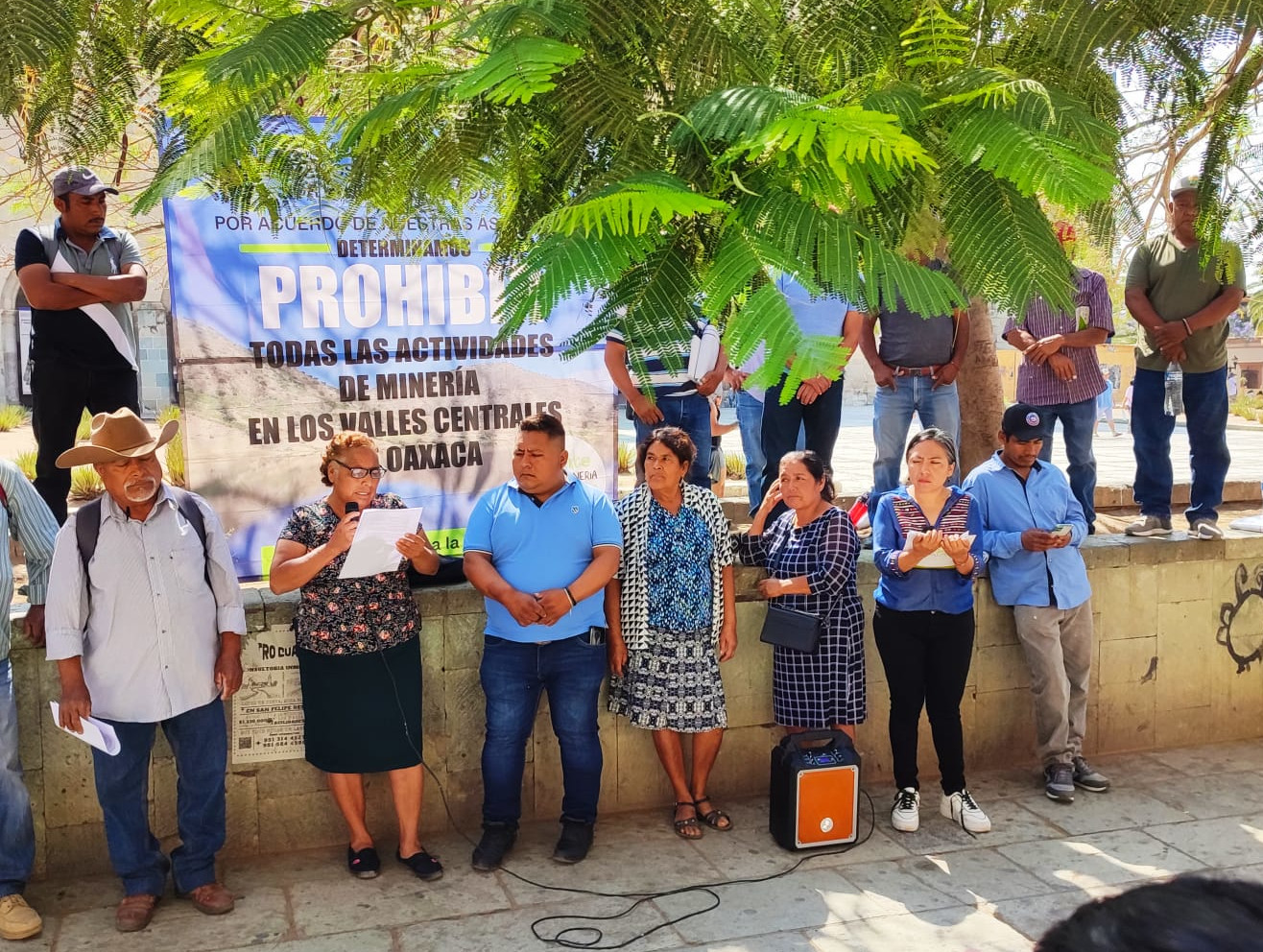
Photo: The No to Mining Front for a Future of All media conference; April 3, 2024.

An injunction/court order granted by a Mexican judge should protect eleven Zapotec communities in the Ocotlán Valley of Oaxaca state from Vancouver-based Fortuna Silver and its subsidiary the Cuzcatlán mining company.

A statement from the communities says: “Faced with the negligence and omission of the federal government, we decided to appeal to the justice system through an amparo on December 5, 2023, to request the cancellation of the mining concessions granted in our territories without our consent.”

La Jornada further explains: “Judge Emmanuel Hernández Alba, head of the First District Court in the state of Oaxaca, granted 11 communities an injunction by which it is ordered ‘to refrain from depriving totally or partially, temporarily or permanently, of the ownership and possession of the lands of the agrarian regime, the populations of merit,’ that is, that they are prohibited from applying any project. including the miners, which is an achievement of these communities.”

Fortuna/Cuzcatlán has been extracting gold and silver concentrates in San José del Progreso since 2011 through mining concessions granted by the federal government without prior consultation with its residents.

El Universal adds: “In a press conference [on April 3], [the communities] reported that they achieved the suspension of mining concessions in their territories, affected by the ‘San José’ mining project of Fortuna Silver Mines (FSM) in San José del Progreso. They added that since 2011, in the community assemblies, they decided not to allow the territorial expansion of the ‘San José’ mining company, a decision for which they sought the support of the municipal and state orders; however, they say, governments promoted mining activities in their territories, instead of supporting the communities’ decision.”

And Pagina 3 notes: “The No to Mining Front demanded that the federal and state governments respect and abide by the suspension and establish measures for the definitive closure of the mining project and the operation of the mining company in the Central Valleys of Oaxaca.” As for the length of the suspension, the article notes that “this suspension would last for the duration of the legal process.”

For more on this and a video of the media conference by the communities, please go to the Educa Oaxaca post: Communities of the Oaxaca Valley Seek Protection Against Mining Concessions (April 3, 2024).

Additional coverage can also be found in Estado 20, Zona Roja Oaxaca, Chiapas Paralello, ONEA Mexico, Municipios Digitales and Desinformémonos

PBI-Mexico’s relationship with Educa Oaxaca dates back to 2001. Formal accompaniment began in May 2013.

We continue to follow this from Canada.

PBI-Mexico accompanies Educa Oaxaca and the “Mision Civil de Observacion Justicia para San Jose del Progreso”; November 2012.

Three former UK Supreme Court Justices call for a suspension of arms sales to Israel

Photo: Former UK Supreme Court justices Lady Hale, Lord Wilson and Lord Sumption have signed a letter calling for the suspension of arms sales to Israel.

The Guardian reports: “Three former supreme court justices, including the court’s former president Lady [Brenda] Hale [and Lord Nicholas Wilson and Lord Jonathan Sumption], are among more than 600 lawyers, academics and retired senior judges warning that the UK government is breaching international law by continuing to arm Israel.”

The article continues: “The 17-page letter, which also amounts to a legal opinion, was sent on Wednesday evening and says: ‘…the sale of weapons and weapons systems to Israel… falls significantly short of your government’s obligations under international law.’”

On arming Israel, the letter further says: “The ICJ’s conclusion that there exists a plausible risk of genocide in Gaza has placed your government on notice that weapons might be used in its commission and that the suspension of their provision is thus a ‘means likely to deter’ and/or ‘a measure to prevent’ genocide.”

Notably, The Guardian also reports: “The findings of a YouGov poll, conducted before the [Israeli air] strike [that killed seven international humanitarian aid workers], suggested that the government and Labour are out of step with public sentiment, with a majority of voters – by 56% to 17% – in favour of an arms ban.”

Canadian government

While the Canadian government has now pledged to “cease the further authorization and transfer of arms exports to Israel to ensure compliance with Canada’s arms export regime and increase efforts to stop the illegal trade of arms, including to Hamas”, it has also stated that, “Given the nature of the supply chain, suspending all open permits [arms exports approved prior to January 8] would have important implications for both Canada and its allies” and will therefore proceed.

Canadian unions

On April 2, the Canadian Union of Public Employees (CUPE), the Canadian Union of Postal Workers (CUPW), the National Union of Public and General Employees (NUPGE) and the Public Service Alliance of Canada (PSAC) issued a statement that says: “We urge the Canadian government to immediately suspend trade in arms and military equipment with Israel, in accordance with Canada’s legal obligations. Canada must impose an arms embargo to help end the horrors in Gaza.”

They also highlight: “Canada exports military equipment to Israel, including via the United States. This means that Canada is at risk of being complicit in the violence and human rights violations Israel is perpetrating in Gaza. Canada also imports military equipment from Israel, which anti-war groups argue supports Israel’s military industry and operations.”

Peace Brigades International continues to follow this situation and to “call on the international community to suspend the supply of arms to Israel.”

Excerpt from letter signed by more than 600 lawyers, academics and retired senior judges in the United Kingdom:

Suspend the provision of weapons/weapons systems to Israel

Rationale: The ICJ’s conclusion that there exists a plausible risk of genocide in Gaza has placed your Government on notice that weapons might be used in its commission and that the suspension of their provision is thus a “means likely to deter” and/or “a measure to prevent” genocide.

The provision of military assistance and material to Israel may render the UK complicit in genocide as well as serious breaches of IHL. Customary international law recognises the concept of ‘aiding and assisting’ an international wrongful act.

A State is complicit in the commission of genocide if: “its organs were aware that genocide was about to be committed or was under way, and if the aid and assistance supplied, from the moment they became so aware onwards, to the perpetrators of the criminal acts or to those who were on the point of committing them, enabled or facilitated the commission of the acts.”

On 23 February 2024, 34 UN experts called for the immediate cessation of weapons exports to Israel, including export licences and military aid, observing as follows:

“Such transfers are prohibited even if the exporting State does not intend the arms to be used in violation of the law – or does not know with certainty that they would be used in such a way – as long as there is a clear risk.”

“The need for an arms embargo on Israel is heightened by the International Court of Justice’s ruling on 26 January 2024 that there is a plausible risk of genocide in Gaza and the continuing serious harm to civilians since then”, the experts said. The Genocide Convention of 1948 requires States parties to employ all means reasonably available to them to prevent genocide in another state as far as possible. “This necessitates halting arms exports in the present circumstances”.

Continued arms exports to Israel moreover give rise to concerns regarding the United Kingdom’s compliance with its obligation under The Arms Trade Treaty.

Mechanism: The UK Government should suspend licensing arms for export to the Government of Israel. The UK’s Strategic Export Licencing Criteria (“SELC”) require the UK government to refuse to licence military equipment for export where there “is a clear risk that the items might be used to commit or facilitate a serious violation of international humanitarian law”. The same principles apply where arms or military equipment might be used to commit or facilitate acts which constitute genocide.


OXEC dams on Maya Q’eqchi’ territory in Guatemala linked to Spanish, French and Canadian companies

On April 3, during a webinar organized by PBI-UK and Amnesty International, Maya Q’eqchi’ defender Bernardo Caal Xol spoke about a march by the Peaceful Resistance of Cahabón to the Spanish Embassy in Guatemala City.

That march took place on May 10, 2023. PBI-Canada was there and compiled Bernardo’s tweets that day to help share the story of what happened.

You can read that here.

The Spanish company – Grupo Cobra

The construction of dams on Bernardo’s territory without the free, prior and informed consent of the Maya Q’eqchi’ people is associated with a Spanish company (this was the reason behind the march to the Spanish Embassy).

The Business and Human Rights Resource Centre has noted: “The Guatemala-based company Oxec S.A. owns the hydroelectric dams Oxec and Oxec II…and is being built by the Spanish company Grupo Cobra, which is owned by Florentino Pérez, the president of Spanish soccer giant Real Madrid.”

Upside Down World has also noted: “The company, Hidro Oxec S.A., which is owned by the Bosch Gutiérrez family, received a 50 years permit for the river. The Spanish company Cobra Group, owned by Florentino Pérez, the president of Spanish soccer team, Real Madrid, is constructing several of the projects along the river.”

The Peace Brigades International-Guatemala Project has noted that “the hydroelectric project installed on the Cahabón river basin, operated by OXEC SA, [belongs] to the Energy Resources Capital Corp group (ERCC).”

In November 2016, Jeff Abbott, a freelance journalist based in Guatemala, also reported in Waging Nonviolence: “The Guatemala-based company Oxec S.A. owns the hydroelectric dams Oxec and Oxec II, with investments from Energy Resources Capital Corp, which is based in Panama. Oxec S.A. is owned by the powerful Bosch Gutiérrez family and is being built by the Spanish company Grupo Cobra, which is owned by Florentino Pérez, the president of Spanish soccer giant Real Madrid.”

With respect to ERCC registered in Panama, Transparency.org has generally noted: “Once companies are successfully incorporated, authorities usually do not collect any information on the real owners of companies. In case of suspicions or investigations against a particular company, law enforcement or tax authorities would have to request information from the corporate service provider.”

A French company?

On the PBI-UK and Amnesty International webinar, Bernardo shared that when the Spanish Ambassador in Guatemala City met with them in May 2023, they stated that it was no longer a Spanish company but a French company that is responsible for the dams.

At this point we cannot verify the accuracy of the Ambassador’s statement or identify the name of the French company.

A Canadian company

We have, however, compiled information linking a Canadian company. Hatch Ltd., a company founded in Toronto and now based in nearby Mississauga, has been involved in both the OXEC II and OXEC III projects.

NS Energy has reported: “Hatch would be engaged to deliver the conceptual design and detailed design-build-engineering for the Oxec II Hydroelectric Project, recipient of a 2019 Award of Excellence from the Association of Consulting Engineering Companies-Canada (ACEC).”

Design-Build combines all aspects of design services, construction services, and project management into one team that works together to complete a project.

That article also notes: “Hatch’s design of the cellular cofferdam [for the first stage diversion of the river] was recognised by the Consulting Engineers of Ontario (CEO) in 2017 with an award of merit in the Industry, Energy, and Resources category.”

Commenting on OXEC II, Ian Ainslie, a Hatch project manager based in Niagara Falls, Ontario, noted: “Hatch has been active in developing hydroelectric sites in Guatemala for over 20 years.” And Hatch’s managing director of power, Jim Sarvinis, says: “Projects like Oxec II are exactly why we do the type of work we do at Hatch.”

And just as PBI-Guatemala and Jeff Abbott reference Energy Resources Capital, the NS Energy article links Hatch to them: “What began as a discussion with stakeholders in 2014 would later become Hatch’s formal engagement by Energy Resources Capital (ERC), the developer, and Solel Boneh Guatemala (SBG), the general contractor.”

OXEC III

Power Technology notes “construction is likely to commence in 2025 and is expected to enter into commercial operation in 2027.”

Breakbulk Magazine has reported that the Oxec II dam was “designed by Hatch Ltd., the Toronto, Canada-based engineering firm”, then notes that Hooman Ghassemi, Hatch’s project manager for Oxec II, “has been working on Oxec II since 2015 and has just finished the conceptual design for Oxec III.”

At that march in Guatemala City on May 10, 2023, PBI-Canada took this photo of a banner that says: “We demand that the Oxec 3 licence be cancelled.”

We continue to follow this.

The Peace Brigades International-Guatemala Project has accompanied the Peaceful Resistance of Cahabón since July 2017.

Thank you to PBI-UK and Amnesty International for organizing an informative and inspiring webinar.