

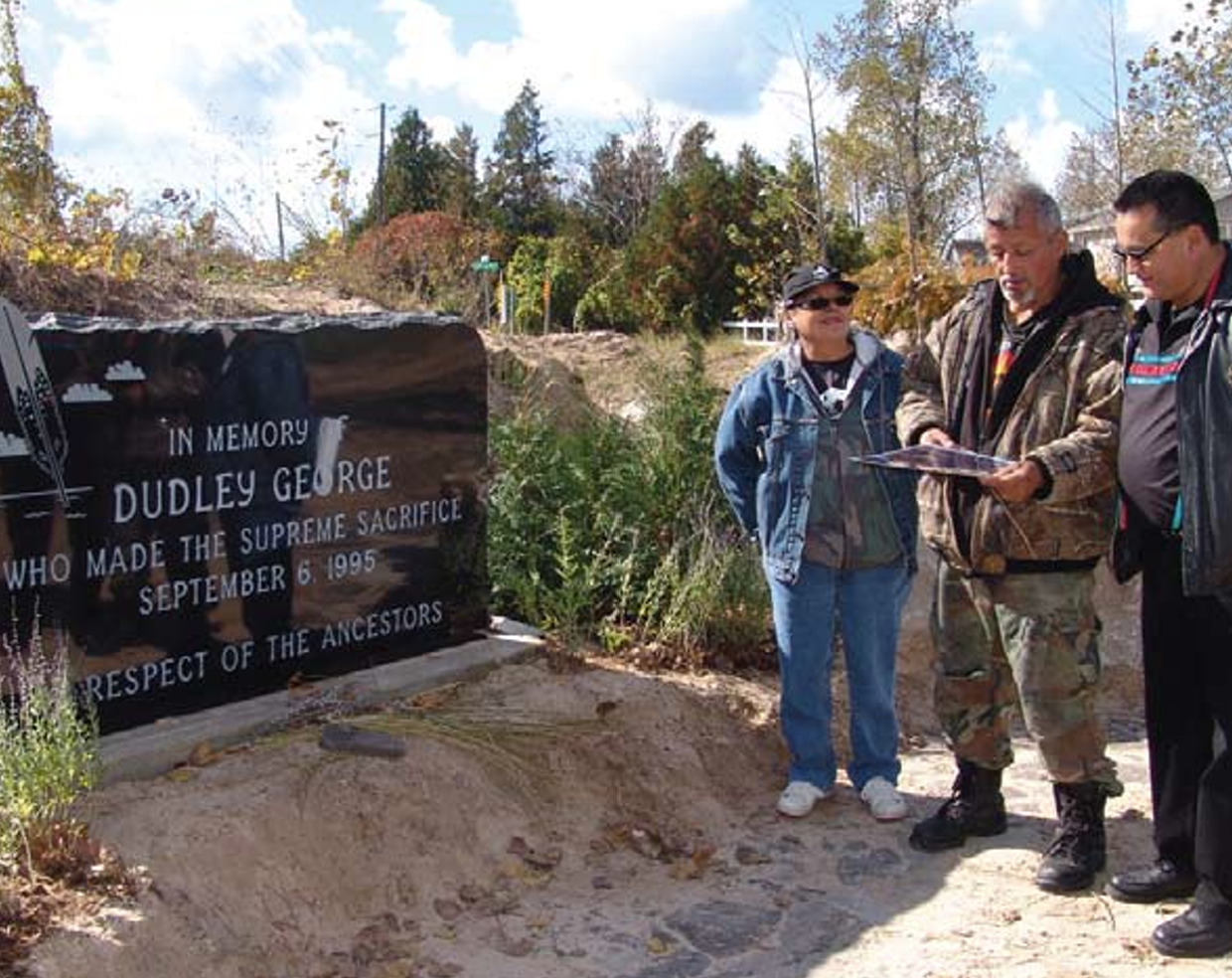
Photo: “Aazhoodena residents and Dudley George’s siblings Caroline (Cully) George and Pierre George with Grand Council Chief Patrick Madahbee at the unveiling of the Dudley George monument in the former Ipperwash Provincial Park. Photo by Nicole Latulippe.” Text from Treaties Matter: Understanding Ipperwash.
Journalist Tanya Talaga has written a column about “emergency measures” legislation for major projects published by The Globe and Mail titled Canada’s efforts to fast-track development could launch a new Oka or Ipperwash crisis.
She writes about Bill 140, the Building Ontario Faster Act, that “looks set to move to third reading by month’s end, when it is expected to receive a rubber stamp from a PC majority government and then royal assent to become law”.
Talaga also highlights “Bill 5 [in Ontario], which creates special economic zones where consultation and environmental assessments are not needed” and likens it to the federal government’s Bill C-5 for major projects.
Oka, Ipperwash and PBI
Talaga highlights in her column Grand Chief Joel Abram referring to the Oka and Ipperwash crises saying that the legislation being passed by the provincial and federal governments could cause deep unrest and ignite movements.
Peace Brigades International began reflecting on the possibility of building on its experience in Latin America and elsewhere with a PBI-North America Project in September 1990 after the 78-day July-September 1990 the Siege on Kanien’kéha:ka territory. Commonly referred to as the Oka Crisis, this was a confrontation between the Canadian army and Mohawk land defenders who opposed the expansion of a golf course onto Indigenous burial grounds.
Toronto-based author-activist Len Desroches has written: “The summer after the ‘Oka crisis,’ some members of Peace Brigades International and myself spent an intense week in Kanesatake and Kahnawake [and] explored the possibilities of active nonviolence with members of the Mohawk community.”
A PBI Annual Report explains: “Part of the training was held in The Pines, site of the armed confrontation between the Sûreté du Québec and Mohawk Warriors a year before. PBI’s internationalism was especially valued, above all because one of the trainers was himself an Indigenous person from Central America.”
Five years later, Indigenous land defender Dudley George was killed by an Ontario Provincial Police (OPP) sniper on September 6, 1995. George had been part of a land reoccupation action at a provincial park.
Four days after George was killed by the police sniper, the PBI-North America was invited to “be observers for First Nations people if needed [and] do accompaniment for anyone fearing further violence on the part of the police.” By the following year, PBI-North America had made at least four visits to the area.
Were Ipperwash Inquiry recommendations implemented?
On November 12, 2003, a public inquiry was launched by the Ontario government under then-premier Dalton McGuinty. It produced a four volume 1,533-page Ipperwash Inquiry Report released on May 30, 2007, that contained 100 recommendations.
The Report of the Ipperwash Inquiry – Volume 2, released in May 2007, contains 18 recommendations “POLICING ABORIGINAL OCCUPATIONS” (pages 237 to 241) that includes: “38. Police services in Ontario should promote peacekeeping by adopting the following objectives when policing Aboriginal occupations and protests: a. Minimize the risk of violence at occupations and protests.”
Recommendation 41 also notes: “The OPP should post all significant OPP and provincial government documents and policies regarding the policing of Aboriginal occupations and protests on the OPP website. The OPP should also prepare and distribute an annual report on the Framework for Police Preparedness for Aboriginal Critical Incidents.”
Recommendation 45 stated: “The provincial government should develop a provincial peacekeeping policy to govern its response to Aboriginal occupations and protests”, while Recommendation 47 noted: “The provincial government should develop a policy governing the use of injunctions at Aboriginal occupations and protests.”
It is unclear how fully, for what length of time, or if these recommendations are presently being fully implemented by the OPP.
“On the ground and in the courts”
In her column, Talaga quotes Cree defender Ramon Kataquapit who is defending Attawapiskat territory from Ring of Fire mining. He says: “We will be present in every fashion possible. You’ll see us on the ground and in the courts.”
Jeronimo Kataquapit has also previously warned: “Ontario is considering new measures that raise serious concerns about freedom of expression, peaceful assembly, expanded police powers, and the protection of Indigenous and Treaty rights. These proposals could have consequences for Indigenous land defenders working to protect their lands, waters, and rights. Particularly within the Ring of Fire, Doug Ford’s government is looking to change the law to target Indigenous ‘protesters’ in the Ring of Fire. Those who protest on the road, development— and more will be open to immediate arrest.”
And we recall Attawapiskat land defender Cedar Iahtail from the Assembly of Seven Generations (A7G) stating last month: “Despite being systematically targeted by governments, Indigenous youth remain on the front lines, always standing up for their communities, the land, and future generations. From Oka to Fairy Creek to Wet’suwet’en to here right now, Indigenous youth have always been the ones defending our lands, our cultures, and our futures.”
PBI-Turtle Island
PBI-Canada is now in the process of drawing lessons from the experience of the PBI-North America Project to form a new PBI-Turtle Island accompaniment initiative. The PBI International Office in Brussels has commented: “This transformative proposition would mark a move away from traditional models and start to recognise and address the human rights abuses that threaten us all.”
Further reading
–Indigenous land protector Ramon Kataquapit speaks against “national interest” designation for Ring of Fire at Senate hearing (PBI-Canada, November 18, 2026)
–UBCIC Grand Chief warns of “boots on the ground” if Pacific Link bitumen pipeline ignores Indigenous rights (PBI-Canada, October 7, 2026)
–Annual review: PBI-Canada’s “transformative proposition” of extending PBI’s protective accompaniment into a “Northern” territory (PBI-Canada, October 29, 2025).

