


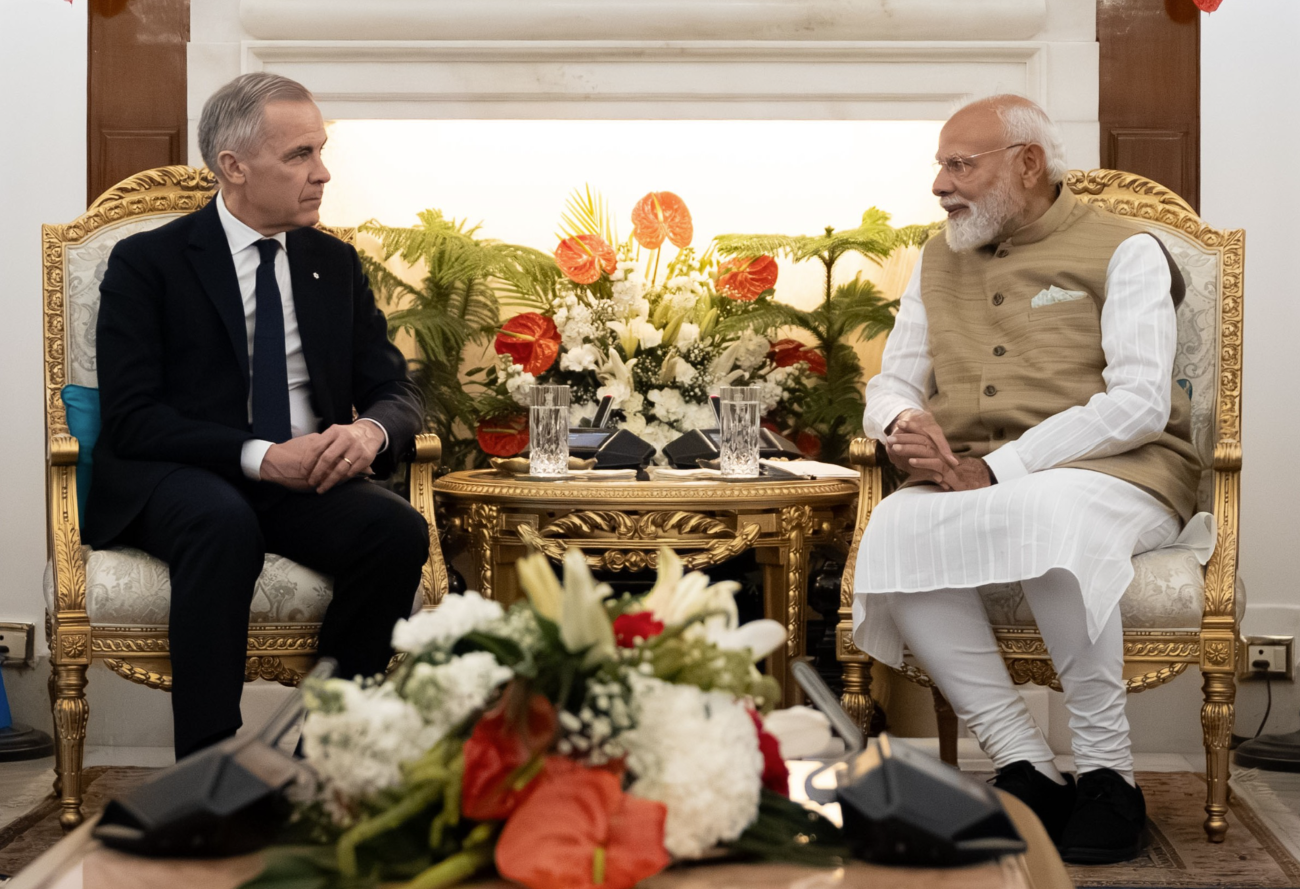
Photo: Prime Minister Carney meets with Prime Minister Modi, March 2026.
Indian Prime Minister Narendra Modi is expected to visit Toronto on Friday December 11 and Ottawa on Saturday December 12.
Following the meeting between Carney and Modi in New Delhi on March 2, 2026, the Office of the Prime Minister of Canada posted: “To increase cooperation in defence and security, Prime Minister Carney and Prime Minister Modi will launch a new Defence Dialogue. This will support maritime security cooperation and stability in the Indo-Pacific, as well as training, education, and joint exercises. The leaders agreed to negotiate a General Security of Information Agreement to facilitate greater defence cooperation.”
After a conversation on October 13, 2026, the Prime Minister’s Office also noted: “The prime ministers welcomed the bilateral security dialogue that took place in India last week as part of ongoing security and law enforcement engagement at the National Security Advisor level.”
Now, the Canadian Press reports: “Speaking at an event held by the Centre for Strategic Statecraft and the Canadian International Council in Ottawa on Tuesday [November 17, 2026], Dinesh Patnaik, the Indian high commissioner to Canada, said it’s likely a defence agreement will be signed during the trip.”
ETDefence.com also reports: “According to the Hindu, India’s High Commissioner to Canada, Dinesh K. Patnaik, said the two sides are close to announcing a defence understanding while also moving towards a broader economic pact.”
And Wisevoter has reported: “India and Canada held their first Defence Dialogue virtually on November 3, 2026, co-chaired by senior defence officials from both countries. The two sides are discussing a defence understanding that could be unveiled when Modi visits Canada, expected on December 11 and 12. The Defence Dialogue identified defence-industry cooperation, military-technical collaboration and defence research and development as areas for further work.”
Arms exports
In the last five years, Global Affairs Canada figures indicate that Canada has exported more than $116.5 million in military goods to India (2021 to 2025 inclusive).
This includes $23,547,120.45 in military goods in 2024 even after Sikh human rights activist Hardeep Singh Nijjar was shot dead in Canada in June 2023 despite Canada’s national security apparatus having reason to believe the killing was carried out by “agents of the Indian government”.
In February 2026, the Canadian government launched its “Defence Industrial Strategy to strengthen security, create prosperity, and reinforce strategic autonomy” with the pledge to “increase our defence exports by 50%” and to “ramp up Canada’s presence at major global defence and aerospace trade shows”.
A “Defence understanding” would likely give momentum to Canadian participation at the Aero India 2027 arms show in Bengaluru (February 8–12, 2027) and an Indian delegation attending the CANSEC arms show in Ottawa (June 2-3, 2027).
Human rights concerns
PBI-Canada recalls the “Concluding observations on the fourth periodic report of India” by the United Nations Human Rights Committee in July 2024:
“The Committee is concerned that the requirement of mandatory prior authorization by the Government for the prosecution of members of the security and armed forces in the context of counter-terrorism and security and military operations creates a climate of widespread impunity regarding allegations of human rights violations.”
“The Committee is also concerned by information regarding the transnational repression of political opponents and human rights defenders and about the frequent disruption of demonstrations and cases of excessive use of force, such as during the protests in Tamil Nadu in 2018, which resulted in 13 deaths, and the use of pellet guns for crowd control, which has caused numerous injuries since 2010, in particular in Kashmir.”
The Committee called on India to: “Ensure that all allegations of harassment, intimidation and violence against journalists, human rights defenders and protestors and of excessive use of force by State agents are promptly, thoroughly, independently and impartially investigated, perpetrators are prosecuted and, if convicted, punished with sanctions commensurate with the gravity of the crime and victims are provided with effective remedy.”
The situation does not appear to have improved.
In their report on the situation in India in 2025, Amnesty International documented: “The human rights situation sharply deteriorated as authorities continued their assault on dissent. …Authorities curtailed peaceful assembly through administrative detentions, denying permission for protests and violently dispersing gatherings calling for justice and accountability. …Authorities continued to misuse counterterrorism and other draconian laws to keep human rights defenders in detention.”
We continue to follow this.

