


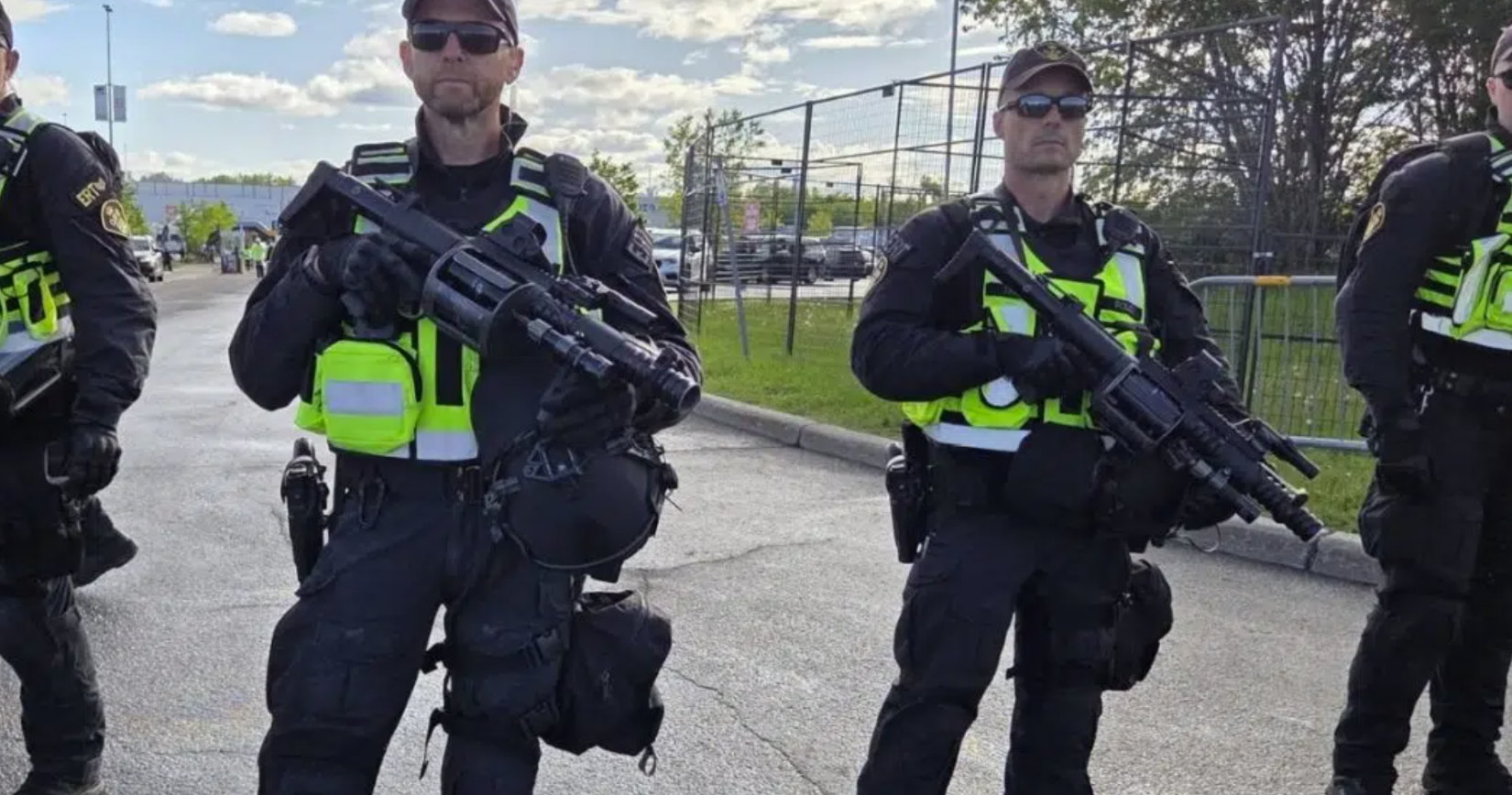
Photo: Ontario Provincial Police deployed at the Shut Down CANSEC-organized protest in Ottawa, May 28, 2026. Photo by Brent Patterson.
Massive weekly protests began across France on Saturday October 17, 2026. Thousands of people, including youth and members of the trade union movement, are on the streets again today, the seventh consecutive weekend of mobilizations across the country, according to a France 24 news report.
Now, The Guardian reports: “French police fired about 22,000 teargas grenades at protesters on 17 October at the height of the protests – equivalent to two grenades every three seconds (over 10 hours of maintaining order).”
MPR News specifies: “Tear gas grenades used by French police contain CS, a chemical irritant that affects the eyes, skin and respiratory tract. CS is a crystalline powder dispersed into the air as fine particles.
The Guardian highlights: “Activists and health researchers now fear tens of thousands of women and young girls may have suffered immediate and long-term damage to their reproductive health from being heavily exposed to the teargas.”
That article documents: “Following the protests in France this autumn, Lacrymos de Sang, a feminist collective founded to investigate the possible reproductive effects of teargas, gathered the testimonies of more than 9,200 women and girls… Of those, 94% reported gynaecological symptoms. …The complaints ranged from severe uterine cramps and unusually heavy bleeding to missed periods. …Of 47 pregnant respondents who said they had been exposed to teargas, 15 reported losing their pregnancies.”
Canada and the export of “riot control agents”
According to A Guide to Canada’s Export Control List – 2026 published by the Government of Canada earlier this year, Canada allows for the export of “Riot Control Agents” under Category 2-7. These are defined as: “Substances which, under the expected conditions of use for riot control purposes, produce rapidly in humans sensory irritation or disabling physical effects which disappear within a short time following termination of exposure. (Tear gases are a subset of ‘riot control agents’.)”
Cross-referenced with the 2025 Annual Report on Strategic Goods and Technologies Pursuant to Section 27 of the Export and Import Permits Act published by the Government of Canada in June 2026, Canada exported $33,094,749.29 ($33 million) under Category 2-7 in 2025. Annex G of that report notes that Australia, Croatia, France, Germany, Italy, Japan, New Zealand, Poland, Saudi Arabia, Slovakia, Slovenia, Switzerland, Taiwan, the United States, and Uruguay received exports under 2-7 in 2025.
That report documents France received $44,964.17 of exports from Canada under Category 2-7 defined in the earlier report as “riot control agents”.
Misuse of tear gas in 31 countries
Amnesty International has previously verified over 500 videos of tear gas misuse in 31 countries and territories, including France, Colombia, Ecuador, Guatemala, Honduras, Indonesia, Kenya, and on the US/Mexico border.
A paper published by International Human Rights Program at the University of Toronto Faculty of Law in September 2020 has argued: “Tear gas is already illegal in warfare under the Chemical Weapons Convention and should be banned under international human rights law. …Tear gas canisters themselves are also a threat and have caused deaths when launched directly at protestors.”
The three authors of that International Human Rights Program report also highlighted: “Under international law, the use of any force by law enforcement must be necessary and proportionate to the situation. However, as a recent Amnesty International investigation shows, tear gas is seldom used in accordance with these principles. Instead, it has become the weapon of choice for policing assemblies and demonstrations, and is often used to disperse largely peaceful crowds, preventing people from exercising their fundamental freedoms of assembly, association and expression.”
Calls to control the trade in tear gas
In “Tear Gas: An Investigation”, Amnesty International has commented: “International law imposes specific obligations on States to prevent torture and other ill-treatment, to investigate its occurrences, criminalise complicity in such activities and to provide reparations to the victims. There is a growing recognition that this includes prohibiting the trade in equipment, such as tear gas, where there is a high risk that it would be used to carry out torture and other ill-treatment. …One potential route for the creation of a legally binding international instrument which would control the trade in tear gas is through the recently created Alliance for Torture Free Trade.”
Police use of CS gas in Canada
The Royal Canadian Mounted Police (RCMP) refers to the use of chemical munitions, such as CS gas, also commonly known as tear gas, as a “specialty munition”.
In their most recent report, the RCMP indicates that it used specialty munitions 155 times in 2024. In February 2023, the Canadian Press reported: “Public disclosures show that the RCMP used CS gas 102 times in 2021.”
That Canadian Press article further noted: “The public order units of major municipal police forces, including in Vancouver and Toronto, confirmed to The Canadian Press that they also have access to the tools.”
In November 2023, CBC News reported that the Ottawa Police Service is equipped with the Anti-riot Weapon Enfield (ARWEN) that “can launch a variety of projectiles including plastic bullets, tear gas and less-lethal batons”.
The Ontario Provincial Police (OPP) has also confirmed that CS gas/tear gas “may only be used by a member of a tactical unit, hostage rescue team or public order unit”.
The Canadian Press has reported that Montreal police used tear gas on May 31, 2020, against an anti-racism protest after projectiles were thrown following the police murder of George Floyd in Minneapolis, Minnesota.
Berta Caceres tear-gassed in Quebec City
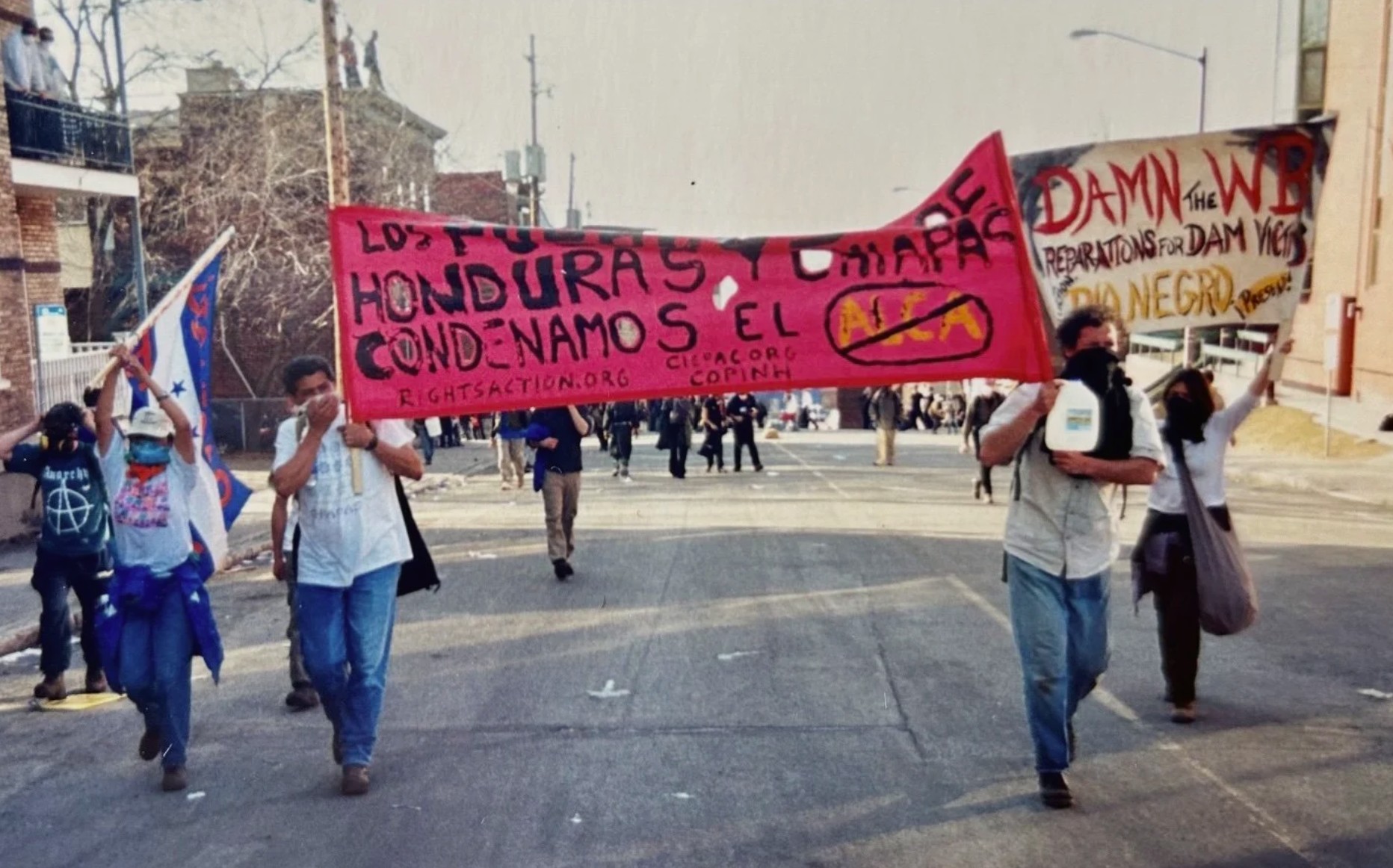
CBC News has also reported that riot police used tear gas and water cannon against the protest of the Summit of the Americas in Quebec City in April 2001.
Nina Lakhani, author of Who Killed Berta Cáceres? Dams, Death Squads, and an Indigenous Defender’s Battle for the Planet (Verso Books) has recounted how Berta Caceres and Gustavo Castro were forced back by “blinding tear gas” at this protest. And Daniel Fireside recalls: “After one too many of these smoking cans was shot in our direction, I was moved to kick it away. I succeeded, but the winds changed and I was enveloped in a cloud of gas. …Berta squirted my eyes with a cleansing solution and gave me an approving smile for my foolhardy action.”
Photo: (L-R) Berta Caceres, Gustavo Castro, Grahame Russell, Annie Bird. Quebec City, April 2001. Photo by Rights Action.
E-petition 2656
In November 2020, in response to e-petition e-2656 (Public safety), the Minister of Public Safety and Emergency Preparedness stated: “RCMP use of chemical munitions is limited to trained resources within the RCMP Public Order Units and Emergency Response Teams only. Use of chemical munitions is also subject to multiple officer and Critical Incident Commander risk assessments.”
At that time, the Minister of National Defence added in their response to e-petition e-2656: “Under the Chemical Weapons Convention (CWC), Canada has agreed to never use or facilitate the use of chemical weapons as a method of warfare. The Convention, however, allows countries the right to use tear gas for law enforcement, training and defensive research purposes.”
In their most recent report, the 2024 Police Intervention Options Report, the RCMP says: “Specialty munitions are limited to specialized groups such as Emergency Response Teams and Tactical Support Groups… Since 2010, the RCMP has only deployed CS gas during two public order events – the 2011 Stanley Cup riots, and in February 2022, during the Trucker Convoy occupation of Ottawa.”
Accompaniment
The Peace Brigades International-Canada Research Unit conducts periodic open-source research investigations on issues related to the safety and security of human rights defenders, including land and environmental defenders, journalists, and members of trade unions and worker movements.
We also examine the intersection between the export of “military goods” and their impacts on human rights defenders.
We continue to follow this.

