


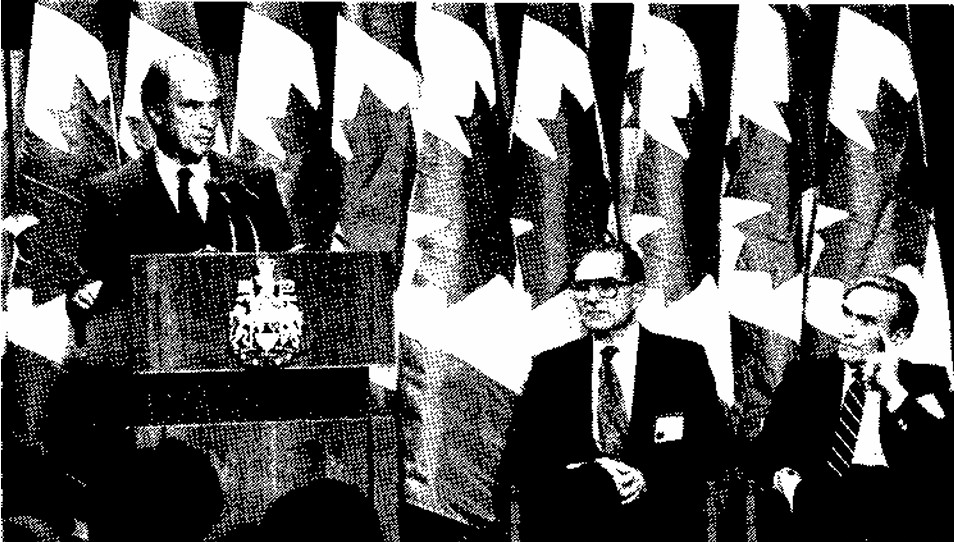
Photo: “Prime Minister Trudeau outlines personal plans for peace. Prof. Wiseman, centre, and Prof. Boehnert.” Photo by Guelph University News Bulletin, 1983.
This week PBI-Canada coordinator Brent Patterson met with Daniel N. Clark, one of the eleven co-founders of Peace Brigades International. PBI was founded at a meeting that took place from August 31 to September 4, 1981, on Grindstone Island, situated 120 kilometres southwest of Ottawa, Canada.
Wiseman: “We must!”
Clark recounted that on the Greyhound bus ride from Ottawa to Grindstone Island that Henry Wiseman, who would have been 58 years old at the time, said: “I don’t expect much to come of this.” Clark then shared in our conversation that at one of the sessions he, then 38, read a quote from Leo Tolstoy and paraphrased: “You may wonder whether you have any authority to start a world organization without any resources at your disposal, given the overwhelming nature of the problem.”
Clark then noted that a couple sessions later Wiseman said we need to discuss: “Do we really have the resources to go ahead with this?” Clark continued: “The skeptic now converted answered strongly in the affirmative. ‘We must!’”
Henry Wiseman
Henry Wiseman completed his BA in 1947 at Queen’s University in Kingston, Ontario. After working in Montreal, Quebec, he completed the first academic study of United Nations Peacekeeping while earning his PhD in 1967 at Queen’s.
From there, Wiseman taught undergraduates as a Professor of Political Studies at the University of Guelph while monitoring the first elections as Rhodesia became Zimbabwe (in March 1980), was with the Lester B Pearson International Peacekeeping Training Centre (Cornwallis, Nova Scotia), and taught military and non-military personnel the principles and practice of peacekeeping under the auspices of the United Nations, the International Peace Academy (New York)
Photo: Guelph University News Bulletin, January 17, 1980.

When PBI was formed on Grindstone Island at the historic meeting that took place from August 31 to September 4, 1981, the peace movement was arguably in its ascendancy and the need for it was intense.
In January 1981, Ronald Reagan had become the President of the United States; on September 5, 1981, the Greenham Common Women’s Peace Camp in the United Kingdom was established; on June 12, 1982, one million people marched in New York City’s Central Park against nuclear weapons and for an end to the cold war arms race; by March 1983, Petra Kelly was one of 27 members of the newly formed Green Party elected to the Bundestag, the West German federal parliament; and by October 1983, more than 400,000 people would march in Bonn, West Germany in opposition to the NATO decision to deploy 572 nuclear missiles in Western Europe.
It is notable that Petra Kelly wrote just a few years later: “We spend billions on weapons research and millions training our young people at military academies. Why not invest in peace studies and peace actions? We need training centers, public campaigns, and educational materials. We need to support groups like Peace Brigades International that intervene nonviolently in situations of conflict. We need to work concretely to realize peace and nonviolence in our time.”
Notable seminars
In November 1981, Wiseman co-directed a seminar on “Peacekeeping: Latin America and the United Nations” in Caracas, hosted by the Ministry of Foreign Relations and the Institute of Higher Studies of National Defense, Venezuela. And in 1984, Wiseman presented a paper “The Parameter of The Process of Conflict Resolution in Central America” at a diplomatic workshop sponsored by the International Peace Academy at Ixtapa, Mexico.
Guelph peace conference
In November 1983, the University of Guelph News Bulletin reported on a conference at the university where then Canadian prime minister Pierre Trudeau spoke at the opening about the “Strategies for Peace and Security in a Nuclear Age”.
The conference was attended by more than 1,000 people and brought together a range of speakers including Dr. Galina Savelyeva, of the Soviet Committee of Physicians for Prevention of Nuclear War, as well as General Brent Scowcroft, chairman of then US president Ronald Reagan’s MX (intercontinental ballistic missile) Commission in Washington, and Roland Vogt, the first member of the German Green Party to be elected to the Bundestag from Rhineland-Palatinate in 1983.
The News Bulletin highlighted: “The work of Guelph’s Liberal Education Committee and the eminence of Professors Henry Wiseman, Political Studies, and Gunnar Bohnert, History, affirmed the University’s leadership in the academic search for peace and created an irresistible pressure for the University to convene just such a conference.”
The Guelph Mercury Tribune also reported after the conference: “With a focus on disarmament, Gunnar and colleague Henry Wiseman hosted the Strategies for Peace and Security in a Nuclear Age conference in 1983 at the University of Guelph, where Pierre Trudeau gave a keynote speech.”
Photo: “Left to right: History professor Gunnar Boehnert, Political Studies professor Henry Wiseman, Dr. Clark, and Economics professor Gustaaf van Beers” with a report on the 1983 conference. Photo from Guelph University News Bulletin, May 1985.

Photo: “Dr. William Winegard, MP, left, receives a copy of Selected Bibliography of Contemporary Strategic Issues from Prof. Henry Wiseman, Political Studies.” Photo by Herb Rauscher, Illustration Services, At Guelph, June 1986.

By 1990, McMaster University in Hamilton, Ontario, had a Peace Studies Centre, described by Peace Magazine as “a lively committee that organizes lectures, and a popular course on peace” taught by Wiseman.
Remembering Henry Wiseman
Born in 1923, Wiseman passed away on December 29, 2016, at the age of 93.

“The moral disparity of wanton human degradation and butchery occurring in so many bloody conflicts throughout the world challenges the very meaning of civilization. Who are we, the human race, that not only dominates and plunders the world, but also feeds on itself?” – Henry Wiseman, Conflict Quarterly, 1994.
We remember the living legacy of Henry Wiseman through his affirmation at the formation Peace Brigades International and his longtime commitment to peacekeeping, conflict resolution and nuclear disarmament.
Additional reading: THE DYNAMICS OF ARMS CONTROL NEGOTIATIONS by Henry Wiseman; Peace Research Vol. 17, No. 2 (May 1985), pp. 39-49 (11 pages) Published By: Canadian Mennonite University.

