


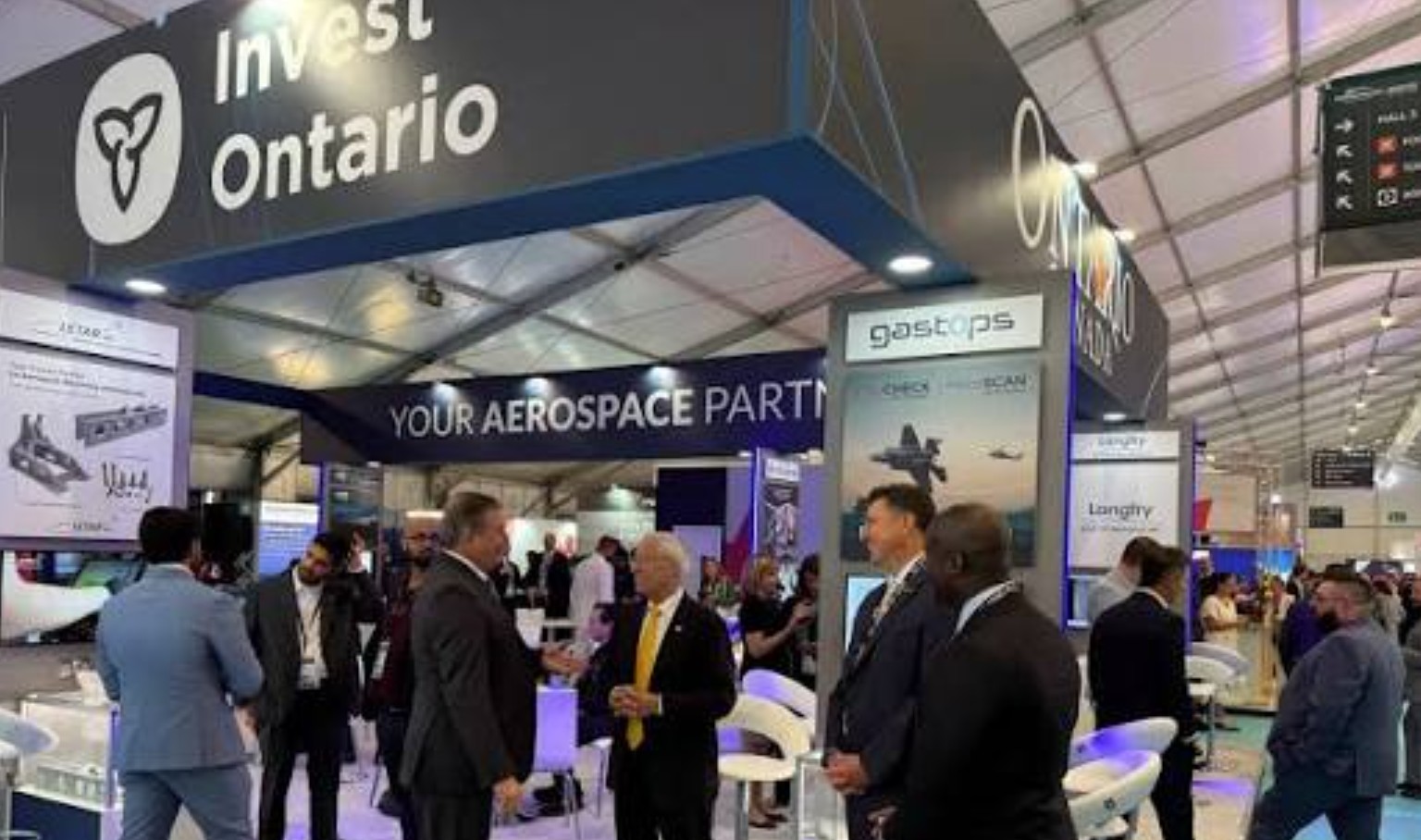
Photo: The Invest Ontario pavilion at the Farnborough International Airshow in the United Kingdom featured a promotional poster for Gastops (“Ottawa-based company is key to keeping Israeli warplanes bombing Gaza”, The Breach, September 2024). The Campaign Against Arms Trade (CAAT) says of Farnborough: “Among past attendees are countries with dismal human rights records of systematic war crimes and internal repression. They include Bahrain, Egypt, Saudi Arabia and Turkey.”
The Government of Ontario has developed a 14-page framework for a 10-year Ontario Defence Industrial Strategy (ODIS) that the province says could “contribute over $6 billion to the province’s GDP”, support “NATO rearmament”, “expand export reach”, “secure export opportunities” and “diversify its exports to new strategic markets”.
The framework highlights that presently 50 per cent of Ontario’s defence sector revenue is generated by exports (presumably about $2.5 billion given overall the sector generates “more than $5 billion in annual revenue”).
It also notes that “Ontario’s Defence Advantage” includes “Ontario companies supply systems and components for military aircraft programs (e.g., F-35 fighters…)” and produce “critical munitions for Canadian and allied militaries”.
The framework for the ODIS also references advancing “opportunities in critical minerals extraction and processing to supply allied nations with key defence inputs (e.g., class 1 nickel)” and “using Special Economic Zones, permitting reforms and municipal collaboration on potential incentives and local investment hubs to fast-track large scale defence projects of strategic importance”.
It also notes: “Ontario leads trade and export missions, which are increasingly prioritizing defence. This includes a record 11 missions planned for 2026.” These provincial missions have included the Eurosatory arms fair in France (June 2026), the Farnborough International Airshow in the United Kingdom (July 2026), and in the latter half of this year the AEDEX + Airport Expo in India (September 2026), and the Defense Expo Korea (K-DEX Korea) in South Korea (December 2026).
Just prior to the launch of this ODIS framework, the Ontario government appointed “the province’s first-ever Ontario Military Defence Representative (OMDR)” to “promote Ontario’s defence industry in global markets” and highlight Ontario’s “responsible development of resources like nickel, cobalt, and platinum-group elements that are essential to the advanced technologies and hardware”.
ODIS by year-end
The launch of the full Ontario Defence Industrial Strategy is expected by the end of 2026 following “consultations with municipalities, academia and industry stakeholders over the coming weeks and months”.
Questions
Some of the questions that relate to human rights, peace and the safety and security of human rights defenders around the world include:
1-What portion of the $6 billion contribution to the province’s GDP envisioned by the Ontario Defence Industrial Strategy (ODIS) is to be generated through exports?
2-Will the full ODIS include language in compliance with the United Nations Guiding Principles on Business and Human Rights that articulates both “the State duty to protect human rights” and ”the corporate responsibility to respect human rights”?
3-Will the ODIS have human rights due diligence provisions that recognize State and corporate responsibilities before, during and after arms transfers that exist over and above national laws and regulations? Would this include obligations and considerations under the UN Declaration on human rights defenders?
4-How would the ODIS, or perhaps specifically the Ontario Military Defence Representative (OMDR), respond to calls from UN experts, including Mary Lawlor, the then-Special Rapporteur on the situation of human rights defenders, for companies including BAE Systems (with an office in Ottawa), Boeing (Ottawa, Petawawa, Trenton), Caterpillar (Mississauga), General Dynamics (London, Ottawa), Lockheed Martin (Ottawa), Northrop Grumman (Hamilton), Oshkosh (Ottawa, London), Rheinmetall AG (Ottawa), Rolls-Royce Power Systems (Peterborough, Mississauga, Ottawa), RTX (Midland, Ottawa), and ThyssenKrupp (Ottawa), to stop transferring arms, munitions and other military equipment to the Israeli military given those transfers “may constitute serious violations of human rights and international humanitarian laws and risk State complicity in international crimes, possibly including genocide”?
5-How would the ODIS commitment to “expand export reach” formally relate to the federal jurisdiction on the export of military goods? In response to the criticism of the contract Brampton, Ontario-based Roshel had with US Immigration and Customs Enforcement to produce armoured vehicles, the Ontario Premier stated in January 2026: “I don’t direct companies to go sell military vehicles down south or around the world… We don’t have anything to do with what crosses the border.”
6-Given the ODIS highlights that “Ontario companies supply systems and components for military aircraft programs (e.g., F-35 fighters…)”, does it have a position on the legal challenges in the Netherlands and the United Kingdom, backed by 230 organizations, to stop the transfer of F-35 fighter jet parts to Israel given “Israel’s use of the F-35 fighter jets in Gaza constitutes a likely violation of international humanitarian law and risks contributing to genocide”?
We continue to follow this.
Additional reading: Responsible business conduct in the arms sector: Ensuring business practice in line with the UN Guiding Principles on Business and Human Rights (Information Note by the UN Working Group on Business and Human Rights, August 2022).

