


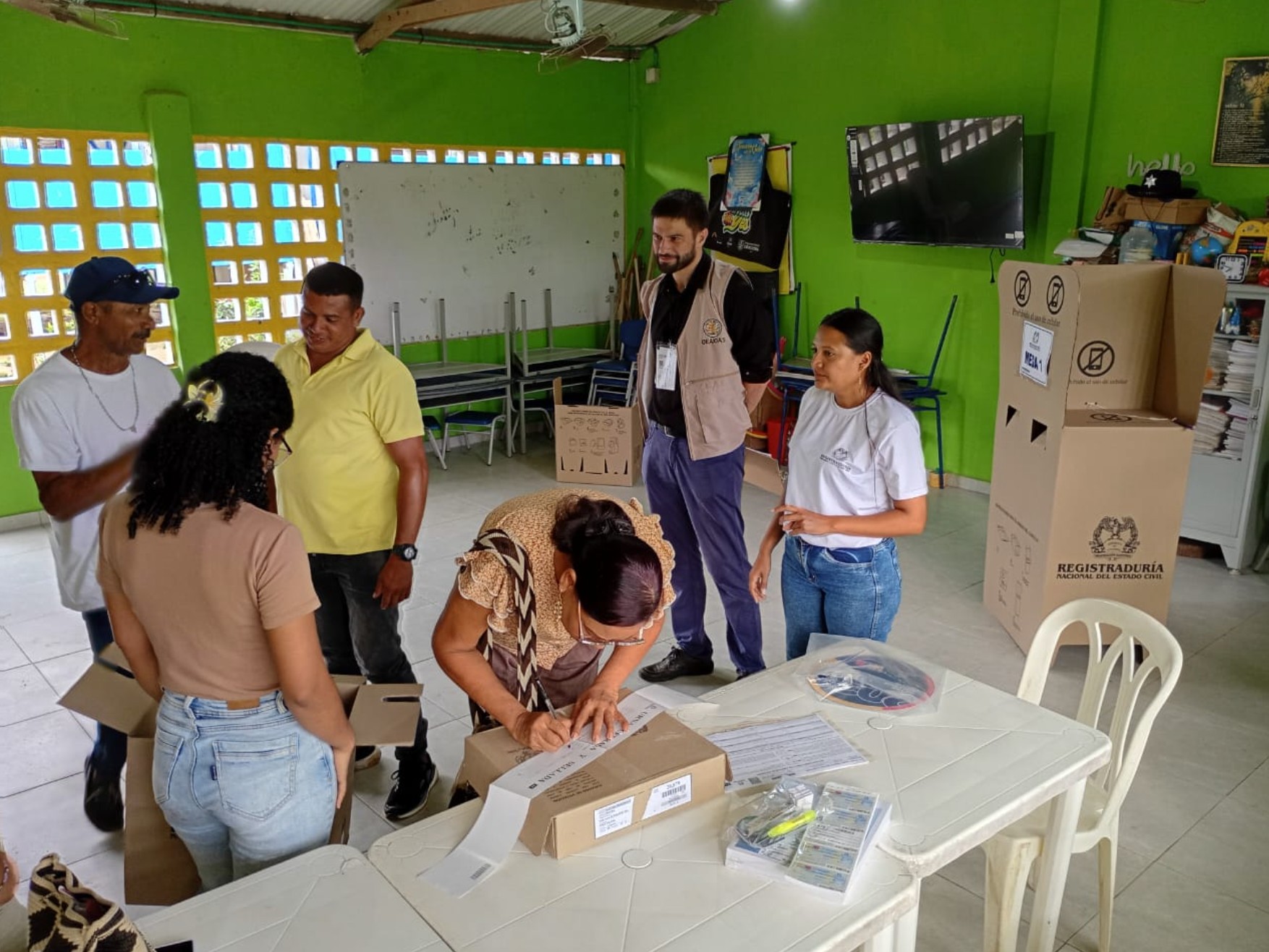
Photo: The Organization of American States (OAS-OEA) observes the opening of polling stations in Colombia, May 31, 2026.
The first round of the presidential election took place in Colombia on Sunday May 31, 2026, with a second round about to take place on Sunday June 21, 2026.
The security situation
While Peace Brigades International is a non-partisan organization, we are attentive to the security situation for human rights defenders and communities in the context of escalated violence at the time of elections.
Latin America Reports notes: “According to the Electoral Observation Mission (MOE), 386 municipalities across 31 departments have been identified as having some level of electoral risk linked to violence and the presence of armed groups.”
Just ahead of the first round vote, Lina Mejía, coordinator at the humanitarian organization Vivamos Humanos, told Latin America Reports: “It’s not just a question of whether armed groups will respect the elections themselves, but also whether there will be mobility restrictions, whether electoral materials will be protected from attacks after the vote, and whether communities will be free from intimidation.”
And The Guardian cautioned: “During the election period, there has been a surge in guerrilla attacks, homicides, kidnappings, forced displacement and massacres; and last year, the rightwing senator and presidential hopeful Miguel Uribe Turbay was shot during a campaign event and later died. The violence is widely seen as a reminder that although the landmark 2016 peace deal between the government and most of Farc dramatically reduced violence for years, it did not end it for good.”
First round results
The Guardian reports: “A far-right lawyer and Donald Trump admirer will go head-to-head against leftwing senator Iván Cepeda in the race to be Colombia’s next president after he won a surprise victory in the first round of voting. With 100% of ballots counted, the outsider Abelardo de la Espriella secured 43.7% of the vote – just over 10.3m votes – compared with 40.9% (about 9.6m votes) for Cepeda, a philosopher and human rights activist who has served as a senator since 2014 and is backed by the current leftwing president, Gustavo Petro.”
Differing visions
Assessing the situation the day prior to the first round vote, Gimena Sanchez, a Colombia expert at the Washington Office on Latin America (WOLA), a human rights nonprofit, told Al Jazeera: “The leading candidates fall into two camps: continuity with the leftist government of Petro and an approach to security that focuses on negotiations with armed groups, and right-wing candidates who very much want to go back to a hardline security model that Colombia had in the past. You have polar opposite visions for the country.”
Thomson Reuters has reported: “Portraying himself as an outsider free from political baggage, de la Espriella has proposed a tough offensive against illegal armed groups, the construction of 10 mega-prisons, and poverty reduction through better education, health care and housing for the poorest. Cepeda, a 63-year-old lawmaker and son of a murdered communist leader, …has promised to pursue peace with illegal armed groups through negotiations, an approach that has brought little progress under Petro. Cepeda also plans to deepen reforms meant to reduce inequality and poverty, including by raising taxes on high-income earners, granting one million hectares to victims of the country’s six-decade internal conflict and expanding health-care coverage.”
Americas Quarterly comments: “One half of the electorate supports a more inclusive, egalitarian, and sustainable socioeconomic model alongside peace negotiations to end organized violence, while the other half favors a hardline crackdown on illegal groups, socially conservative values, and minimal state intervention in the economy.”
Caldwell Manners of Community Peacemaker Teams (CPT) also comments: “For communities that have spent generations demanding land, rights, recognition, and peace, the outcome of this election will shape not only public policy but also the prospects for a more just and democratic Colombia.”
June 21 vote
With the second route vote less than three weeks away, we keep in mind the concern expressed by the Inter-American Commission on Human Rights (IACHR) “about political violence in the ongoing electoral process in Colombia.”
The IACHR, an autonomous body of the Organization of American States (OAS), has called on the State “to take all measures necessary to ensure that the presidential election process can be completed, in particular by preserving the safety of all presidential candidates.” It has also reminded the State “of its obligation to ensure that citizens may fully exercise their political rights safely and on an equal footing.”
At PBI-Canada we are monitoring news reports about the security situation in Colombia during this election period, following the social media posts from PBI accompanied organizations, defenders and communities, and staying in communication with our colleagues at PBI-Colombia.

