

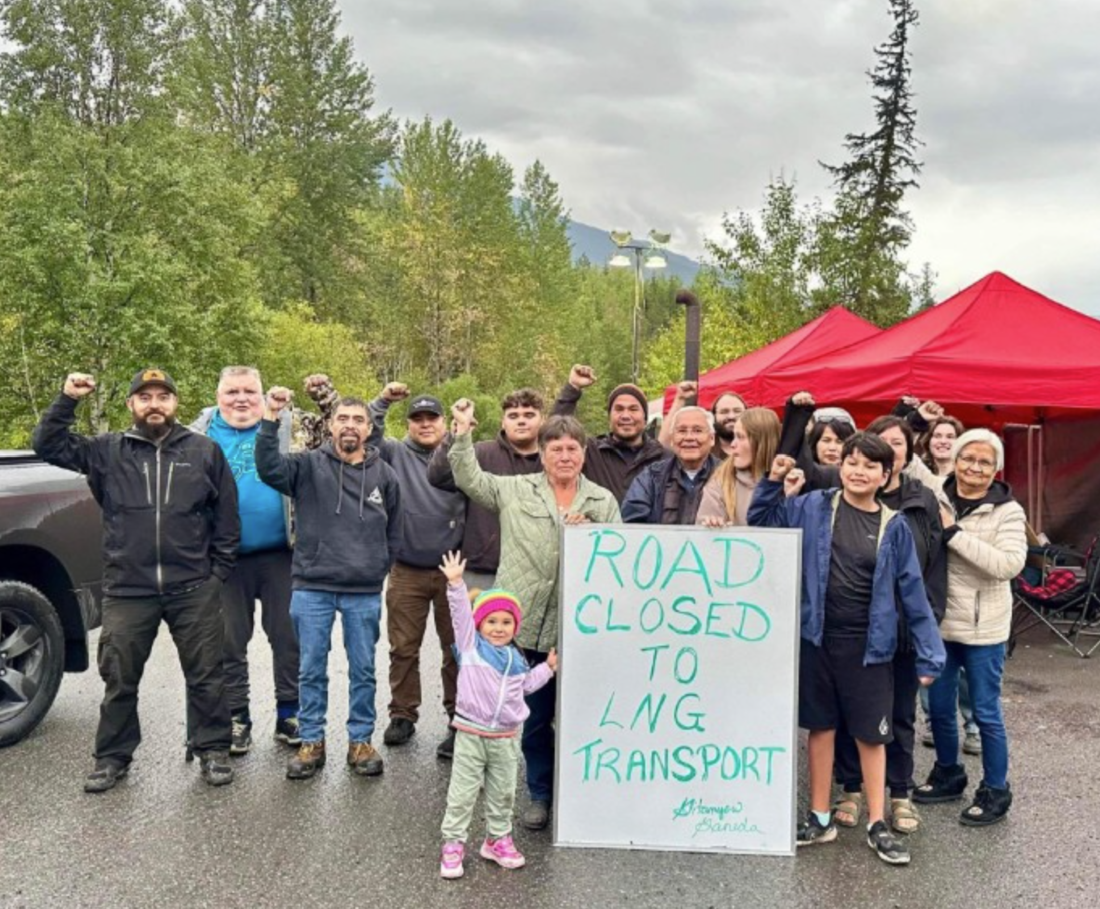
Photo: On August 22, 2024, the Gitanyow closed a road on their territory to stop the construction of the PRGT pipeline.
Wet’suwet’en, Gitanyow and Gitxsan land and environmental defenders on unceded territories in northern British Columbia, Canada, oppose the proposed Phase 2 expansion of LNG Canada that would require new compressor stations for the Coastal GasLink fracked gas pipeline on Wet’suwet’en territory, as well as the Ksi Lisims LNG megaproject that would see the construction of the Prince Rupert Gas Transmission (PRGT) pipeline on Gitanyow and Gitxsan territories.
The Globe and Mail now reports: “Shell and four other LNG Canada co-owners are expected to make a final investment decision by the end of this year on whether to forge ahead with Phase 2 expansion plans, which would require increased capacity from the 670-kilometre Coastal GasLink pipeline.”
In early-January, the Vancouver Sun had reported: “Rebecca Scott, a spokesperson for Western LNG] said Ksi Lisims is in advanced discussions with lenders as part of considerations for the all-important final decision. The partners had hoped to hit that milestone by the end of 2025. They won’t, but it will be close. …Scott said they expect final pieces to fall in place by the end of March, but ‘everything is positive’ for a final investment decision over the winter.”
By mid-February, The Globe and Mail echoed that a decision could be close. It reported: “Ksi Lisims is expected to make a final investment decision in 2026 whether to forge ahead with Pearse Island development.”
Major Projects
The Globe and Mail further reports: “Prime Minister Mark Carney, as part of his quest to make Canada an energy superpower, announced last September that LNG Canada’s Phase 2 expansion plan to double its capacity made the list of major projects of national interest to be considered for fast-tracking. Mr. Carney subsequently said Ksi Lisims near Pearse Island has been added by Ottawa to the growing roster of plans submitted to the Major Projects Office, which was announced in August to expedite a wide range of developments.”
It is not clear what this recommended fast-tracking means in terms of specific timelines, if approval by the Major Projects Office would precede the final investment decision, or how this will all unfold.
Injunctions, surveillance, violence
There is reasonable clarity, however, that resistance by Indigenous land and environmental defenders against these extractive megaprojects on their territories is likely to be met with court injunctions (prohibiting “obstruction” of construction), surveillance and harassment by private security, the Royal Canadian Mounted Police (RCMP) Critical Response Unit-British Columbia (CRU-BC) and perhaps even by the Canadian Security Intelligence Service (CSIS), as well as militarized raids.
All of this has been seen before.
It also seems evident so far that no meaningful measures have been implemented to address the RCMP violence seen against land and environmental defenders in raids on Wet’suwet’en territory in 2019, 2020 and 2021.
More than three years after it was launched, the Civilian Review and Complaints Commission (CRCC) systemic investigation into the RCMP Community-Industry Response Group (C-IRG) – the previous name of the CRU-BC – appears stalled.
In January, the CRCC told PBI-Canada: “We anticipate providing an update on the status of the systemic investigation in March.”
PBI-Canada continues to follow news reports about the final investment decisions of the Phase 2 and Ksi Lisims megaprojects, the CRCC investigation of the RCMP C-IRG, and is attentive to the safety, security and holistic protective accompaniment needs of Indigenous land and environmental defenders.

