Home Blog Page 63

PBI-Honduras observes court hearing of three accused Los Pinares/Ecotek defendants

PBI-Honduras has posted on social media:

“Yesterday [March 11], we observed the initial hearing against three defendants from the company Inversiones Los Pinares/Ecotek accused of #environmental damages to the Montaña de Botaderos Carlos Escaleras National Park. The Municipal Committee in Defense of Common and Public Goods demands #justice and highlights the alleged existence of a criminal structure that would be behind the installation of the company in the national park and the murder of community leaders, such as #defender Juan López.”

The Los Pinares megaproject

The Pinares-Ecotek megaproject has seven components including: the ASP and ASP2 concessions to dig for iron oxide, a thermoelectric plant that would burn petroleum coke (pet coke) to power the operations, an iron oxide pelletizing plant that could produce 800,000 tons of iron oxide pellets in its first year of operation, generating US$190 million in foreign exchange, and the Guapinol River and Ceibita stream concessions that would extract one hundred gallons of water per minute for the pelletizing plant.

Accompaniment

PBI-Canada coordinator Brent Patterson visited Tocoa and Guapinol, Honduras on October 29-30, 2024, to learn more about this case.

A poster of Juan Lopez in Tocoa, the city where he was killed.

The entrance to the village of Guapinol.

The Peace Brigades International-Honduras Project has accompanied the Municipal Committee for the Defence of Common and Public Goods of Tocoa (CMDBCPT) processes and Guapinol River defenders since January 2019.

PBI-Mexico accompanies International Women’s Day marches in Cuernavaca and Mexico City

Video still from NotiFactor4 on X.

La Jornada reports: “Members of Peace Brigades International said that they observed the marches in Mexico City, and the one in the capital of the state of Morelos.”

Punto Medio reports: “A10,000 women, mostly dressed in black and purple, marched in the main streets of [Cuernavaca] to commemorate March 8, and demand that the authorities of the three levels of government cease femicides in Morelos, and seek justice for the thousands of disappeared women and for the thousands of victims of femicide.”

That article further notes: “The contingent included observers from Peace Brigades International.”

El Sol de Cuernavaca has also reported: “In Morelos, 584 women disappeared in the period from 1973 to February of this year. …The municipality of Cuernavaca, being the most populous in Morelos, is where the highest number of disappearances of women has been reported, with 157 cases.”

We continue to follow this.

PBI-Colombia accompanies “Defender La Libertad” verification mission at International Women’s Day march in Bogotá

PBI-Colombia has posted on Instagram:

“This past March 8, in the framework of International Women’s Day and the protest marches that took place in the capital [city of Bogota], we accompanied one of the Verification Commissions. Its objective is to guarantee the free exercise of the legitimate right to protest and demonstration, in the context of the ‘Defend Freedom’ campaign, of which the accompanied organization Committee of Solidarity with Political Prisoners/CSPP is part of. #humanrights #march8”

Defender La Libertad has explained: “The Defend Freedom: A Matter of All Campaign is a network of organizations that works to denounce arbitrary detentions, judicial persecution, and the criminalization of social protest in Colombia. …The Defend Freedom Campaign promotes the formation of a National Network of Verification and Intervention Commissions of Civil Society in scenarios of social mobilization.”

And the Spanish news agency EFE reported: “In front of the mural of ‘The cuchas are right’, a symbol of the struggle of mothers of victims of forced disappearance, hundreds of women met this Saturday [March 8] in the streets of Bogotá to raise their voices collectively, demand their rights, talk about resistance and paint the city purple and green during the feminist demonstration of 8M.”

The “cuchas” can be translated as “old ladies” and refers to the women who for decades have stated that a garbage dump in the city of Medellin has been used as a clandestine burial ground for some of the thousands of people who have been disappeared by gangs, paramilitaries and Colombian security forces.

More on this: PBI-Colombia accompanies NOMADESC in Cali as mural painters highlight paramilitary and state violence in Medellín (January 29, 2025).

The EFE article adds: “According to the Femicide Observatory Colombia, 886 women were victims of femicide between January and December 2024.”

That article also notes: “That figure [on femicides in Colombia] shakes the hearts of the participants in the mobilization, which also became the stage for tributes such as the one made by Nury Rojas, who wore a T-shirt with the face of Angie Paola Baquero Rojas, her daughter, killed during the September 2020 protests in Colombia against police brutality.”

On September 9, 2020, Angie Paola Baquero Rojas was shot by a police officer after she attended a vigil for law student Javier Ordóñez who was killed by police after being repeatedly tasered by police, an incident that evoked for Colombians the killing of George Floyd in the United States.

Peace Brigades International has accompanied the Committee for Solidarity with Political Prisoners (CSSP) since 1998.

ICC arrest of Duterte raises questions about CANSEC and the export of “military goods” to the Philippines

Photo: A delegation from the Philippines, led by Defense Assistant Secretary for Plans and Programs Teodoro Cirlo Torralba III, at the CANSEC arms show in Ottawa on June 1, 2017. The sale of Bell-manufactured helicopters was finalized in December 2017. That sale was suspended in February 2018 after media coverage drew attention to the human rights implications of this sale.

ABC News reports: “Former Philippines President Rodrigo Duterte was detained on Tuesday [March 11, 2025] under an International Criminal Court arrest warrant, which accused him of crimes against humanity in connection with the brutal ‘war on drugs’ he led while in office… Members of the Philippine National Police met the former president as he arrived in Manila, the capital, on a flight from Hong Kong.”

The ICC investigation of Duterte began on February 8, 2018.

Following the arrest of Duterte, the Ottawa-based Ontario Committee for Human Rights in the Philippines (OCHRP) highlighted: “Duterte’s Drug War (2016-2022) resulted in approximately 30,000 deaths, and hundreds more were killed in his counterinsurgency campaign – as documented by human rights groups – with many victims being extrajudicially executed in what amounted to state-sanctioned murder.”

Canada exports “military goods” to the Philippines

Duterte was the president of the Philippines from June 30, 2016, to June 30, 2022.

During that period, Canada exported about $7 million in military goods to the Philippines ($6,050,640.67 in 2016, $3,219.78 in 2017, $175,497.00 in 2018, $458.00 in 2019, $18,100.00 in 2020, $399.95 in 2021, and $385,000.00 in 2022).

Human rights defenders targeted in the Philippines

Yesterday, OCHRP further noted: “Duterte’s military and police forces (the same as those commanded by current President Marcos Jr.) have participated in red-tagging union organizers, peasant leaders, faith workers, and indigenous land defenders.”

Global Witness has also documented that 17 land and environmental defenders were killed in the Philippines in 2023 and that 298 were killed between 2012 to 2023.

Despite these ongoing human rights violations in the Philippines, Canada exported $514,604.48 of military goods to the Philippines in 2023.

The figures for 2024 will be made public by Global Affairs Canada around the time of the CANSEC arms show in Ottawa this coming May 28-29.

Has Canada raised concerns?

On November 11, 2017, Canadian prime minister Justin Trudeau was asked if he would raise human rights concerns with Duterte during the ASEAN summit in Manila on November 10-14, 2017. Trudeau replied: “There are a range of issues that I could bring up with him, that I may bring up with him, if we have an opportunity. There’s always human rights concerns to bring up with a wide range of leaders.”

On November 12, 2017, then-Foreign Affairs Minister Chrystia Freeland also commented: “[Canada has] some serious concerns about human rights violations and violations of due process in the Philippines. If we get the opportunity, we will talk about these issues.”

Trudeau reportedly did raise his concerns with Duterte and later claimed that Duterte “was receptive to my comments [about extrajudicial killings] and it was throughout a very cordial and positive exchange”.

Photo: Trudeau meets with Duterte and his partner Honeylet Avancena on November 12, 2017. Photo by Adrian Wyld/Canadian Press.

Canada planned to sell Bell helicopters to the Philippines

On February 8, 2018, The Guardian reported: “This week it was revealed that – despite Trudeau’s concerns – Canada has brokered the sale of 16 combat utility helicopters worth $185m to the Philippine air force.”

That article adds: “The sale of the Bell helicopters – designed by an American company but manufactured in Canada [at the Bell plant in Mirabel, Quebec] – was facilitated by the Canadian Commercial Corporation, an umbrella organization that sells arms to other countries on behalf of the Canadian government.”

The following day, February 9, 2018, the CBC reported: “Earlier this week, Reuters reported the Philippines inked a $233-million deal to buy Montreal-built Bell helicopters. Other reports said the deal was worth up to $300 million. The Canadian Commercial Corporation, which facilitated the deal, wouldn’t confirm the cost.”

Review of the deal

That CBC article adds that following this media attention about the sale of these helicopters: “International Trade Minister Francois-Philippe Champagne announced [on February 6, 2018] he had ordered a review of the deal, which was finalized [on December 29, 2017], after a senior member of the Philippines military said the aircraft would also be used in ‘internal security operations’.”

And yet at that time, Armed Forces of the Philippines (AFP) deputy chief of staff for plans Major Gen. Restituto Padilla countered: “The AFP deal for the acquisition of the Canadian Bell 412 as a combat utility helicopter is a very transparent one. From the very onset, the contract has specified that we are acquiring a CUH.”

“Disingenuous” position of Canadian government

On February 25, 2018, McMaster University professor Netina Tan and graduate student Marvin Mercado commented in The Conversation: “The timing of Trudeau’s public criticism of Duterte’s extra-juridical killings in November 2017 at a Manila summit and the re-signing of the helicopter deal with the Philippines in December 2017 shows a clear disjuncture in public speech and arms trade policy.”

Tan and Mercado further note: “It doesn’t take a security expert to point out that in the Philippines under Duterte’s leadership, the helicopters were likely to be used for combat purposes. There has been major news coverage of the Philippines’ bloody internal conflicts and extra-judicial killings. It would be naïve, if not disingenuous, for the Liberal government to defend its position by arguing that the helicopters would be used only for search-and-rescue and disaster relief.”

Duterte had also publicly threatened to throw officials out of a helicopter

On December 27, 2016, then-president Duterte commented: “If you are corrupt I will fetch you using a helicopter to Manila and I will throw you out. I have done this before, why would I not do it again?”

Signing ceremony

On April 30, 2018, National Post journalist David Pugliese reported: “The Philippine government never hid its intention to use the Canadian-built helicopters in military operations, even going as far as displaying the first batch of those choppers armed with machine guns during an official ceremony in 2015 attended by Canada’s ambassador.”

Photo: Canadian Ambassador to the Philippines, H.E. Neil Reeder (third from the left) at ceremony, August 2015.

Bell tried again to sell the helicopters

On April 30, 2018, the National Post reported: “Just months after a contract to sell military helicopters to the Philippines was cancelled, a Canadian firm is hoping it can revive the controversial deal. … Bell says it is now back in discussions with the Philippines as a potential client for the same helicopters.”

On May 18, 2018, Pugliese further reported: “The Canadian Commercial Corporation acknowledges it conducts no follow-up to ensure exported Canadian-built equipment isn’t being used to abuse human rights. …The CCC confirmed this in its email, saying it ‘merely provides contracting assistance to Canadian exporters’ and that it is those companies [in this instance, Bell] who are legally bound by the terms of the export permit issued by the Canadian government.”

The CCC office is at 350 Albert Street, Suite 1100, in Ottawa.

CANSEC, May 28-29

The Canadian Commercial Corporation (CCC), that facilitated the helicopter sale, and Bell Textron, the manufacturers of the helicopter, are both members of the Canadian Association of Defence and Security Industries (CADSI).

Image: CADSI is funded by Global Affairs Canada.

CADSI is the Ottawa-based lobby group that organizes the annual CANSEC arms show at the EY Centre in Ottawa.

The Ontario Committee for Human Rights in the Philippines (OCHRP) is one of the organizers of the upcoming Shut Down CANSEC protest. Look for updates about this mobilization on Instagram here.

United Nations Special Rapporteur closely following the upcoming sentencing of Wet’suwet’en land defenders

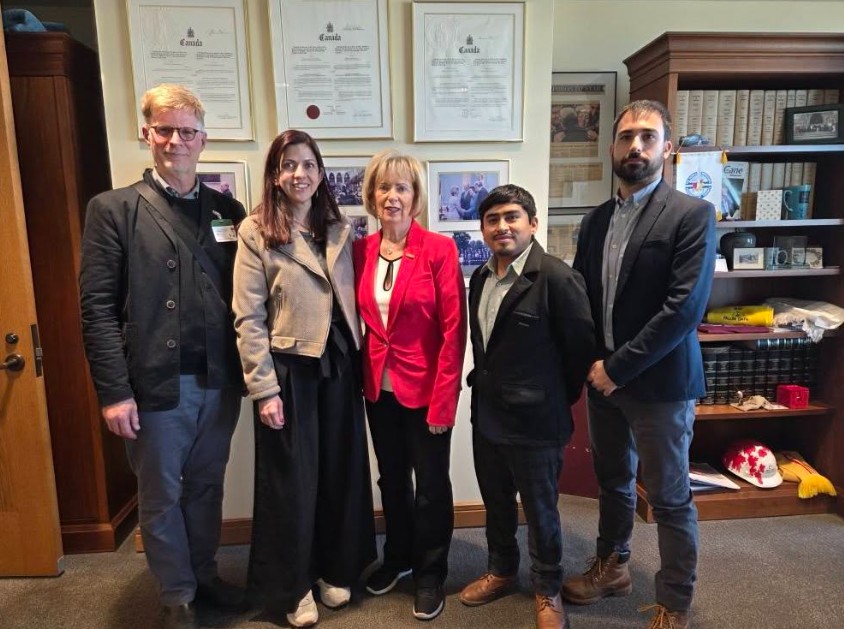
Photo (from left to right): Frances Mahon, Shaylynn Sampson, Corey Jocko, Sleydo’ (Molly Wickham), Quinn Candler.

Mary Lawlor, the United Nations Special Rapporteur on human rights defenders, has posted on social media: “#Canada: In Feb, the B.C. Supreme Court found there had been racist & violent behaviour by the RCMP during the arrest of 3 Wet’suwet’en #HRDs in a peaceful protest against the Coastal GasLink pipeline, yet the HRDs continue to be criminalised for the peaceful defence of human rights & the environment. I will be closely following their sentencing in April @CanadaGeneva”

Last month, APTN reported: “[BC Supreme Court Justice Michael] Tammen says in a ruling delivered in Smithers, B.C., on Tuesday that criminal contempt carries a maximum sentence of five years in prison, but those convicted typically receive short sentences. The case will be back in court on April 3 to fix a date for sentencing.”

We continue to follow this too.

Further reading:

Canadian judge finds RCMP C-IRG violated Charter rights of three land defenders in “extraordinarily rare ruling” (February 19, 2025)

RCMP C-IRG snipers repeatedly deployed against Wet’suwet’en land defenders and water protectors (February 20, 2025)

Amnesty International could designate three Indigenous land defenders in Canada as prisoners of conscience (February 21, 2025)

The human rights implications of the Brookfield-Isagen Sogamoso dam and La Guajira wind farm in Colombia

Photo: Opposition to the Brookfield-owned Isagen “invad[ing] Wayuu indigenous territories and desecrat[ing] sacred sites to install wind power projects without consultation.” 

The Toronto Stock Exchange-listed Brookfield Asset Management Ltd. describes itself in a recent media statement as “a leading global alternative asset manager headquartered in New York with over $1 trillion of assets under management…”

While the decision in October 2024 to move the head office of Brookfield from Toronto to New York “to make its shares more attractive to US investors” has garnered some recent media attention, its investment decisions are also of interest to defenders in Colombia accompanied by Peace Brigades International.

On January 13, 2016, The Globe and Mail newspaper reported: “Brookfield buys Colombia’s Isagen stake for $2.8-billion.”

The Brookfield website highlighting “renewable power generation in Colombia” notes: “Since our acquisition of the business in 2016, Isagen has executed several strategic initiatives that will provide additional growth opportunities. In 2021, the company signed the acquisition of its first two solar generation projects, which when complete, should add 138 megawatts of capacity. The company is also developing its first wind farm, with an installed capacity of 20 megawatts that is expected to be completed in 2022.”

Brookfield and the Sogamoso hydroelectric dam

Isagen owns the Sogamoso Hydroelectric Power Plant in the department of Santander in Colombia, and is in the jurisdiction of several municipalities including Barrancabermeja and Puerto Wilches.

In May 2016, the European news website Euractiv reported that, according to a report by Oxfam, German companies “are complicit in human rights violations through hydroelectric projects in countries such as Brazil and Honduras.” That article also cites: “The Sogamoso dam in northern Colombia, where, between 2009 and 2014, six activists have been killed and many more disappeared without a trace.”

Among the environmental concerns about the dam, in March 2020 El Espectador reported: “The fishermen of the San Silvestre wetland, in Santander, denounce that since the middle of February there is a fish mortality in the place. According to them, this emergency is due to the fact that Isagen, a company in charge of the Sogamoso dam, opened the floodgates to feed the river that bears the same name.”

PBI-Colombia accompanies the Regional Corporation for the Defence of Human Rights (CREDHOS) that in turns accompanies the Federation of Artisanal, Environmentalist, and Touristic Fishermen and Women of Santander (FEDEPESAN) who fish in the San Silvestre wetland impacted by the Sogamoso dam.

Photo: PBI accompanying FEDEPESAN and CREDHOS leaders on the San Silvestre wetland, June 2022.

Brookfield and the La Guajira wind farm

On March 20, 2021, Colombian environmental defender Oscar Sampayo tweeted: “The Canadian investment fund @Brookfield owner of @ISAGEN in Colombia, violent and disrespectful sacred sites of the Wayúu community in northern Colombia.”

Sampayo’s tweet follows the tweet from the Nacion Wayuu ONG that says: “Isagen invades Wayuu indigenous territories and desecrates sacred sites to install a wind project in an inconsistent and arbitrary manner.”

At that time, Nación Wayuú ONG called “on the Colombian State, national and international control bodies and Isagen, to refrain from continuing to implement their project until the fundamental right to free and informed prior consent to which indigenous peoples are entitled is fulfilled.”

On February 20, 2025, the Associated Press reported: “Construction started on the La Guajira 1 wind farm — which looms over the cemetery near Cabo de la Vela [in the northern region of La Guajira] — in 2020 after a mix of legal processes, government backing, and controversial negotiations and unsatisfactory prior consultation. It faced significant opposition from the Wayuu and has been producing electricity since 2022, but is not yet hooked up to the interconnected system.”

Image of social media post highlights additional concerns.

PBI-Colombia accompanies the José Alvear Restrepo Lawyers’ Collective (CAJAR) that supports the efforts of the Wayúu Indigenous people of La Guajira to bring legal actions to protect themselves from the impacts of the Cerrejón open-pit coal mine. CAJAR may also be supporting the Wayuu in relation to this wind farm.

Photo: PBI with CAJAR lawyer Rosa Maria Mateus in Bogota, July 2022.

PSI report on Isagen privatization

In May 2024, Public Services International (PSI) and the Centre for International Corporate Tax Accountability and Research (CICTAR), together with the Colombian trade unions SINTRAISAGEN, ORGANISA, SINTRAE, SINEDIAN produced a report on the consequences of this purchase, “the second largest privatisation deal in Colombian recent history.”

In the media release about that report, Mark Hancock, the President of the Canadian Union of Public Employees (CUPE), commented: “CUPE has always opposed the privatization of public assets in Canada and around the world. We support the unions in Colombia in calling for a re-evaluation of Brookfield’s troubled privatization of a key electricity provider in Colombia and its impact on workers, communities, consumers and financing of public services.”

We continue to follow this.

Photo: PBI accompanied defenders from CREDHOS and the CCALCP legal collective outside the Brookfield office in Toronto, November 2019.

Indigenous environmental defender Adolfina Kuum on “the destruction of our people’s rivers, our forests and way of life” in West Papua

Video still of Adolfina Kuum from Lepemawil Timika.

PBI-UK has highlighted the work of Adolfina Kuum, also known as Dolly. She is the founder of Environmental Care Community in Timika.

Google Maps image marks location of Timika.

Kuum says: “I see the basic rights of the [Indigenous] Amungme, Kamoro and Samopane tribes being ignored by the [Indonesian] state and Freeport [which is] a USA owned gold mining company operating in Timika.”

She highlights: “The presence of Freeport in the Indigenous territories of the Amungme and Kamoro tribes brought destruction and havoc, which led to the creation of the Women’s Movement Against Mining in Timika.”

Freeport-McMoRan map indicates the location of their Grasberg Mine.

Kuum has previously stated: “This case is about our fight against those who profit from the destruction of our people’s rivers, our forests and way of life. Our communities are experiencing the life-threatening effects of mining.”

Threats against defenders

Kuum further notes: “Me and other human rights defenders protesting against Freeport have experienced intimidation, terror and violence by thugs, company employees and the military. Between 2013 and 2023 we received direct and mobile phone intimidation, threats, destruction of meeting places and cars, and arrests under various pretexts. One of my female friends was arrested by the police on 7 April 2020, as well as myself later in August 2020. There has been shrinking of democratic space by security personnel, stopping women’s discussions and conducting interrogations at the place of activity on 10 December 2021, UN International Human Rights Day.”

She adds: “Human rights activists and environmental defenders have been stigmatised by the state as subversives, rebels, leftist groups, OPM (Free Papua Movement), and other stereotypes. Discrimination towards Papuans in particular, has resulted in the shrinking of democratic space and silencing of local media.”

The Grasberg Mine

PBI-UK has previously noted in their The Case for Change report: “The Grasberg Mine in West Papua, Indonesia, has been subject to allegations of major environmental devastation and severe human rights violations. Indigenous communities accuse the mine of polluting rivers and causing health issues. Human rights defenders and Indigenous communities protesting the mine’s operations since the 1970s have faced repression including torture, displacement and threats, amid ongoing militarisation.”

Photo: The Grasberg open-pit copper and gold mine in 2007. Photo by Alfindra Primaldhi.

Ownership of the mine

The Phoenix, Arizona-based company Freeport-McMoRan has noted: “Through its subsidiary, PT-FI [PT Freeport Indonesia], FCX [Freeport-McMoRan] mines one of the world’s largest copper and gold deposits in the Grasberg minerals district in Papua, Indonesia. In addition to copper and gold, PT-FI produces silver. FCX has a 48.76 percent interest in PT-FI and manages its mining operations.”

In July 2022, the Chicago-based Corporate Accountability Lab further explained: “Since 1967, Freeport McMoran (‘Freeport’), a US company headquartered in Arizona, has owned and operated the world’s largest gold and third largest copper mine [the Grasberg Mine], located in the mountains of Papua, Indonesia.”

Kuum calls for divestment from Grasberg Mine

In February 2024, Kuum stated: “We call on all businesses, including banks and exchanges, such as the London Metal Exchange, to end their international complicity with these mining operations. We demand to live with dignity, respect and fulfil our basic rights as dignified human beings and be able to enjoy the natural environment that our ancestors have cared for and passed on to us.”

The major shareholders of Freeport-McMoRan include the Toronto Dominion Bank (at $73.39 million in shares), the Investment Management Corp of Ontario/IMCO (at $3.21M). The Toronto-based IMCO “may manage the assets of pension plans or investment funds on behalf of the following: Ontario Government Agencies, Ontario Municipalities, Ontario Universities or Colleges, Ontario Crown Corporations.”

Payments to “a brutal security state”

The Corporate Accountability Lab has also noted: “Estimates place Freeport’s payments to the military and police between $20 and $80 million in the 1990s and 2010s. After the Sarbanes-Oxley Act passed the US legislature in 2003, Freeport began sending money to police and military units rather than to individual commanders and officers – but for years, individual security personnel received direct payments.”

They add: “It is estimated that the number of Indigenous Papuans killed by Indonesian security forces since Papua lost its independence in 1962 is close to 500,000. A covert investigation by the Catholic Justice and Peace Commission of the Archdiocese of Brisbane in 2016 concluded that Indigenous Papuans have suffered  a ‘slow motion genocide’. A 2013 study estimated that one torture incident had occurred every six weeks for the past fifty years by Indonesian security forces, the vast majority involving civilians.”

Canadian “military goods” to Indonesia

Over the last five years, Canada has exported at least CAD $30 million in “military goods” to Indonesia.

This includes $2,738,360.44 in 2019, $8,176,217.40 in 2020, $10,708,499.85 in 2021, $8,380,657.83 in 2022, and $285,120.73 in 2023.

These figures do not reflect the additional “military goods” that may have been exported to the United States then re-exported. The US State Department noted in January 2025 that: “The United States has $1.88 billion in active government-to-government sales cases with Indonesia under the Foreign Military Sales (FMS) system.”

Mining and the Canada-Indonesia CEPA

Global Affairs Canada has noted: “On November 15, 2024, Canada’s Prime Minister Justin Trudeau and Indonesia’s President Prabowo Subianto announced the substantive conclusion of the negotiations … of the Comprehensive Economic Partnership Agreement (CEPA).”

Canada and Indonesia are committed to “sign the CEPA in 2025.”

In 2023, Canada imported US$1.43 million of copper from Indonesia.

On December 23, 2024, The Globe and Mail newspaper reported: “[The Canadian government] in 2021, as CEPA talks were getting under way, projected that Canadian imports of mineral products from Indonesia would increase by 42 per cent by 2040, and imports of metal products by 18 per cent.”

Peace Brigades International

The Peace Brigades International-Indonesia Project promotes human rights in Indonesia through strengthening the capacities of human rights defenders in remote areas, with a focus on their ability to document human rights abuses, advocate to the Indonesian government and internationally, and build their personal security and protection networks.

To read the full Peace Brigades International-United Kingdom article about Adolfina Kuum, go to Life as a Papuan Woman Human Rights Defender.

Video still: PBI-Canada helped Kuum to visit Lekwungen and WSÁNEĆ territories (Victoria, British Columbia) in September 2023. The image below says: “SHUTDOWN FREEPORT – Freeport is a parasite on people and nature in Timika.”

Canada signs the OAS Belém do Pará Convention citing “increased attacks on human rights defenders”

Photo: Canada’s Permanent Representative to the OAS, Ambassador Stuart Savage signed the Convention at the OAS headquarters in Washington, DC. On March 7, 2025. Photo by Juan Manuel Herrera/OAS.

A Global Affairs Canada news release dated March 7, 2025, highlights: “The Honourable Mélanie Joly, Minister of Foreign Affairs, and the Honourable Marci Ien, Minister for Women and Gender Equality and Youth, are pleased to announce that today, Canada signed the Inter-American Convention on the Prevention, Punishment and Eradication of Violence against Women (Belém do Pará Convention).”

That news release notes: “Amid increased attacks on human rights defenders and growing global uncertainty, Canadian leadership in promoting and protecting human rights as a core element of Canada’s feminist foreign policy is more important than ever.”

Canada recognizes various categories of human rights defenders including women human rights defenders, LGBTI human rights defenders, Indigenous human rights defenders, and Land rights and environmental human rights defenders in its Voices at Risk: Canada’s Guidelines on Supporting Human Rights Defenders.

The Convention

The Convention was first adopted in 1994. As of March, 2020, 32 of the 34-member Organization of American States (OAS) have signed the Convention. The United States remains the singular non-signatory.

The six-page Convention can be read in full here.

Guatemala, Honduras and Nicaragua (in 1995), Colombia (1996) and Mexico (1998) have all ratified the Convention.

The MESECVI follow-up mechanism

The OAS has also explained: “The effective implementation of the Convention requires a continuous and independent evaluation process, which in 2004 led to the creation of the Follow-up Mechanism to the Belém do Pará Convention (MESECVI).”

In May 2023, the Committee of Experts of the MESECVI expressed “its deep concern over the increase in acts of violence against women journalists and human rights defenders throughout the region.”

The Convention, the Escazú Agreement and environmental defenders

The Center for International Environmental Law (CIEL) has also noted: “The leaders of State Parties to the Amazon Cooperation Treaty (ACT) gathered in the Brazilian city of Belém for a two-day summit [on August 8-9, 2023]. During the Summit, State Parties presented the Belém Declaration outlining their collective commitments.”

The State Parties to this Treaty are Bolivia, Brazil, Colombia, Ecuador, Guyana, Peru, Suriname and Venezuela.

At the time of that two-day summit in 2023, Carla García Zendejas of CIEL commented: “Latin America remains the most dangerous region in the world to speak out in favor of land, water, and our basic right to live in a healthy environment. Colombia and Brazil have the highest levels of violence, killings, and threats to defenders worldwide. Yet the Belém Declaration fails to acknowledge how conflicting forces in the region continue to put oil and gas projects and devastating extractive and infrastructure plans forward despite pushback from communities and Indigenous leaders advocating to protect the ecosystems on which they rely.”

She continued: “This makes the absence of any mention of the Escazú Agreement (the Regional Agreement on Access to Information, Public Participation and Justice in Environmental Matters in Latin America and the Caribbean), in a declaration by South American nations that is meant to solidify urgent cooperation in the Amazon region, even more egregious. This glaring omission illustrates an ongoing failure to understand the role defenders play in protecting the right of every citizen to live in a clean and healthy environment and to ensure that this right exists for future generations.”

Canada and the Escazú Agreement

On March 5, 2021, Special Rapporteur Mary Lawlor presented to the UN Human Rights Council on the threats against and killings of human rights defenders.

During that session, Canada’s Ambassador to the UN Leslie E. Norton stated: “Some states have established specific protection mechanisms to prevent risks and attacks against HRDs and to intervene when need be. Canada wants to stress these important milestones such as the Escazu Regional Agreement in Latin America and the Caribbean.”

Nicaragua (in March 2020), Mexico (in November 2020) and Colombia (in August 2023) have ratified the Agreement. Guatemala signed the agreement in September 2018, but has not ratified it. Honduras has not signed the agreement.

We continue to follow this with specific attention to the safety and security of human rights and environmental defenders.

PBI-Nicaragua accompanies the block of Nicaraguan migrant women at International Women’s Day march in Costa Rica

Photo: The banner says: “In Nicaragua there is a dictatorship we demand an end to the repression”.

PBI-Nicaragua has posted on Instagram:

Another 8th of March in which Nicaraguan women cannot march in their country.

For the past 7 years, Nicaraguan women refugees in Costa Rica, due to political persecution, have participated in the M8 marches organized in this country.

Here they call for freedom for political prisoners and chant slogans such as “Exiled women, never silenced” or “You will flourish Nicaragua, free and feminist” along with those shared with the Costa Rican women’s movement such as “Not one less, free we want” thus joining the denunciation on the increase of femicides in the host country where Nicaraguan women are also murdered.

PBI accompanied the block of refugee women in the march. We recognize the courage and resistance of Nicaraguan women defenders who far from being silenced have consolidated their activism from exile.

#8M #WomenDefenders #womenrefugees

La Prensa further reports that “dozens of Nicaraguan women” took part in the protest in San Jose, demanded the release of political prisoners in Nicaragua, and that the “block of women from Pinerola” carried banners with messages including “Against macho tyranny, here we are feminists”.

Photo: The banner says: “Freedom for political prisoners”.

EFE also reported: “In the march, the participants also launched slogans against the government of Daniel Ortega in Nicaragua, which they called a dictatorship, and also expressed their support for Nicaraguan women who have had to go into exile to flee violence and repression in their country.”

That article also highlighted the situation in Costa Rica, notably: “Data from the Observatory of Gender Violence against Women and Access to Justice of the Judiciary of Costa Rica, indicate that at least 30 femicides occurred in 2024, while so far in 2025 at least 11 have been counted.”

Photo: The sign says: “Nicaraguan migrant women also resist”.

In November 2024, Nicaraguan feminist activist Ana Quirós commented how the criminal code in Nicaragua criminalizes abortion despite repeated efforts to align the law with international human rights standards. She also stated that there had been 64 femicides and 158 attempted femicides so far that year.

For more on the work of PBI-Nicaragua, click here.

And to read the PBI-Nicaragua article about the IWD mobilization, click here.

PBI-Guatemala observes IWD march, shares photo of poster in the Plaza de la Niñas of Luz Haydee Méndez Calderón

On March 8, PBI-Guatemala posted on Facebook:

“Today, #PBI observes the march for the commemoration of #InternationalWomen’sDay. Different women’s groups showed their rejection and repudiation of hatred, discrimination, persecution, violence and decisions that violate the human rights of girls, adolescents, women and the LGBTIQ+ community. They also demanded the fulfillment of their rights to education, decent working conditions, health, access to justice and security, among others.

The march culminated in the Plaza de la Niñas where a ceremony was held to remember the violent death of 41 girls and adolescents as well as 15 injured in the fire at the Hogar Seguro de la Asunción eight years ago on this same day.”

The Plaza de la Constitución was renamed Plaza de las Niñas de Guatemala 8 de Marzo in memory of the 41 teenage girls (ages 13 to 17) killed in the fire at the Virgen de la Asunción Safe Home on March 8, 2017.

One of the photos PBI-Guatemala shared in their Facebook post is a large poster of a painting of Luz Haydee Méndez Calderón.

Mendez Calderon was forcibly disappeared on March 8, 1984. She was 36 years old and the mother of two children aged 9 and 11.

The Vancouver Sun provides this biographical background on her: “She was born in 1948 to a family that ran a modest bakery. Affectionately known as “La Chapparita,” or “Shorty,” as a child, she sold bread in the streets. Méndez Calderón’s father participated in the pro-democracy revolution of 1944, bringing about a decade of reforms, before the U.S.-backed coup in 1954 triggered the civil war. At university, Méndez Calderón participated in progressive movements and wrote for the student newspaper.”

Journalist Sandra Cuffe has also reported: “At the time, Mendez Calderon was secretary of international relations for the Guatemalan Labour Party, which had been forced underground after a United States-backed coup in 1954 and became one of the armed fighter groups involved in a 36-year conflict with the military.”

The article by Cuffe in Al Jazeera adds: “The Diario Militar, or Death Squad Diary, documented the abductions, torture, disappearances and executions of 183 people, including Mendez Calderon, between 1983 and 1985. The military intelligence dossier includes a section with a numbered list of the 183, with their names, affiliations, photograph, date and location of abduction, and other basic details.”

The CBC has also reported: “At the time, the Guatemalan army, supported by U.S. military aid, said it was fighting terrorists bent on a Communist overthrow. Government opponents said they were merely struggling to provide more rights to impoverished Mayan peasants being squeezed off the land by fruit growers and coffee conglomerates, or employed by those same companies for low wages.”

That article further notes that Mendez Calderon’s daughter Wendy arrived “in Vancouver in 1985 as political refugees after the disappearance of her mother.”

Update on #CasoDiarioMilitar

PBI-Guatemala has been accompanying the #CasoDiarioMilitar court hearing process that began in May-June 2021.

In May 2024, PBI-Guatemala commented: “Currently, the process is moving very slowly and is practically at a standstill. However, the families and friends of the people who appear in the [military diary} commemorate the publication of this document every year [on May 20, 1999], in the hope of learning the whereabouts of their loved ones and raising awareness about the importance of this document in the history of Guatemala.”

Most recently, in December 2024, Prensa Comunitaria also reported: “Currently, the case is paralyzed.”

Accompaniment

PBI-Guatemala now accompanies the Association of Relatives of the Detained and Disappeared of Guatemala (FAMDEGUA). They note that FAMDEGUA “is playing a key role in the Diario Militar case.” FAMDEGUA was accompanied by PBI from 1992 until 1999, when PBI’s Guatemala Project was temporarily closed. In 2023, after receiving a renewed request from the organization, PBI began accompanying FAMDEGUA again in April 2024.

We continue to follow this.