Home Blog Page 388

PBI-Guatemala accompanied Peaceful Resistance of La Puya seeks to be heard as World Bank arbitration process on mine unfolds

Photo: The Peace Brigades International-Guatemala Project observed the eviction against the La Puya camp on May 23, 2014 that involved a disproportionate use of force by the police who were providing protection to the mining company.

In March 2012 residents from San José del Golfo and San Pedro Ayampuc – an area known as La Puya, just north of Guatemala City – set up a peaceful, 24-hour a day blockade at the entrance of the Vancouver-based Radius Gold Inc. El Tambor mine.

By August 2012, the Canadian company sold El Tambor to US-based Kappes, Cassiday & Associates, but retained an economic interest in the mine (including quarterly royalty payments on the gold production from the mine).

By February 2016, the Peaceful Resistance of La Puya won a Guatemalan Supreme Court ruling that provisionally suspended the mining licence because there had not been prior consultation with affected communities, as is required under Guatemalan and international law, in particular the International Labour Organization’s Convention 169.

In response, Kappes, Cassiday & Associates filed a $300 million claim with the International Centre for Settlement of Investment Disputes, a World Bank arbitration mechanism, claiming its investor rights under the Dominican Republic–Central America Free Trade Agreement (CAFTA-DR) had been violated.

In its latest Bulletin (pages 10-13), the Peace Brigades International-Guatemala Project notes in reference to the World Bank arbitration:

“The Peaceful Resistance La Puya is forming legal alliances and solidarity across national and international organizations and groups.

According to the Resistance itself, their objective is to make their voices heard in this exclusionary procedure and to create an antecedent that favors, not only the Resistance itself, but many other community processes that defend land, territory and water against projects which exploit natural resources.

In this way they seek to prevent supranational arbitration processes from becoming the Trojan horse of mining and extractive companies.”

The PBI-Guatemala article also provides the context that:

“’ISDS [investor-state dispute settlement] claims … have been widely condemned for privileging corporate interests to the detriment of local communities and the environment.’

[To comply with these free trade agreements], States must advance legislative and regulatory changes that privilege foreign investment in an economic model that would contravene the self-determination and way of life of populations affected by these projects.

In January 2019, the then President Jimmy Morales … indicated that the State of Guatemala had received a demand requesting arbitration regarding the decisions of the high courts to suspend mining activities and indicated that it would be years before all Guatemalans could pay these indemnities to foreign companies.

This was interpreted by different analysts as a warning message addressed to the various existing resistances in Guatemala.”

In contrast, Michel Forst, when he was the United Nations Special Rapporteur on the situation of human rights defenders, recommended: “Trade agreements with countries where environmental defenders are under threat should contemplate measures to prevent, investigate and remedy violations against activists.”

Eight years after the defenders with the Peaceful Resistance of La Puya began their blockade of the then Canadian-owned El Tambor mine, they must now continue to seek justice as the World Bank arbitration process on the investor-state dispute settlement challenge enabled by a free trade agreement unfolds.

While Canada does not currently have a free trade agreement with Guatemala, its agreements with Colombia, Honduras and Mexico include investor-state provisions.

To read the full PBI-Guatemala article, please see: International Arbitration against the Guatemalan State: The El Tambor Mine Case (pages 10-13 in Bulletin No. 43).

ALERT: COPINH warns about a new suspension in the hearing of David Castillo

On September 7, the Peace Brigades International-Honduras Project posted on its Facebook page: “COPINH, an accompanied organization, warns about a new suspension of the David Castillo process after the defence presented a challenge. Now waiting for a response from the Court of Appeals.”

The COPINH alert states: “Hearing against David Castillo, co-author of the murder of #BertaCáceres, suspended. Defence of David Castillo presents a challenge against the court in charge of the case. Once again the process against Castillo is hampered by delaying actions of his defence.”

COPINH also issued the media statement (in English) below:

The Peace Brigades International-Honduras Project began accompanying the Civic Council of Popular and Indigenous Organizations of Honduras (COPINH) in May 2016, three months after the murder of COPINH co-founder Berta Cáceres.

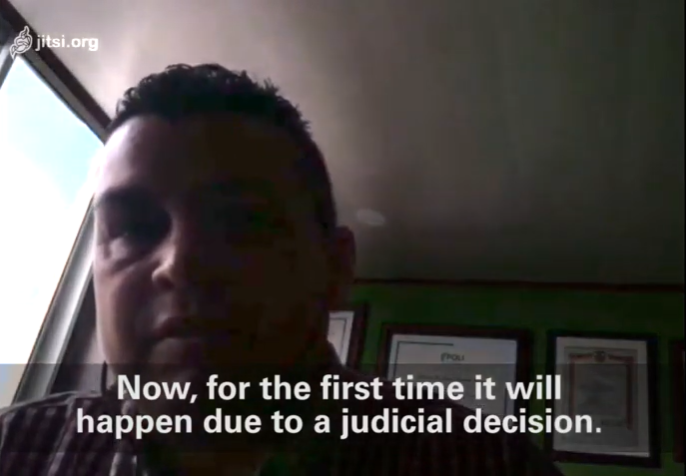
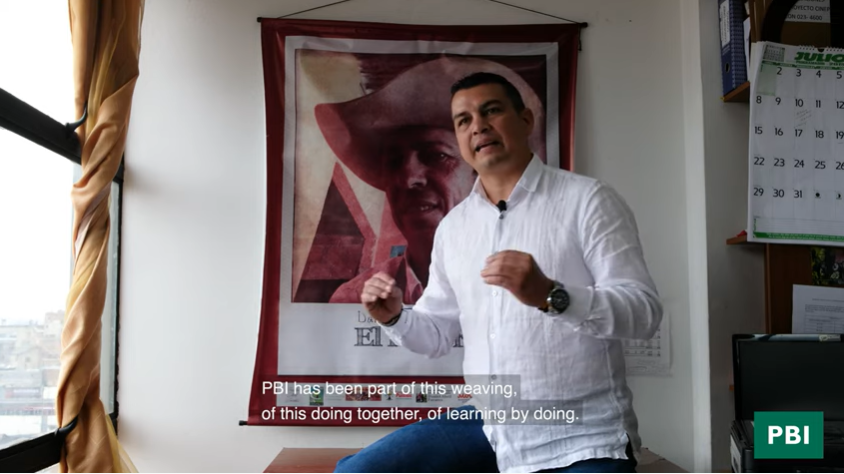
PBI-Colombia accompanied COS-PACC president Fabian Laverde on court ruling recognizing the right to defend rights

Peace Brigades International-Colombia Project article & video – Fabian Laverde: “We are right when we make denouncements.”

Fabian Laverde’s story as a human rights defender began in 1993 when he was still in high school, during a strike led by peasants who were drowning under predatory loans. They took to the streets to achieve better conditions and prices for their coffee.

Two years later, in another strike, he met an inspiring agrarian leader, Fernando Lambona. Lambona’s murder, just a few months later, taught Laverde about the risks involved in being a spokesperson for the forgotten people.

In 2004, Laverde had to leave his rural home after receiving death threats. His land had become a battlefield and the guerrilla presence was used against the peasants.

Paramilitaries sought to eradicate any possible social mobilization. Due to violence against the population, selective murders, enforced disappearances, and malicious prosecution, many people abandoned their lands.

Shortly after leaving his home for Bogotá, he learned of and joined the Social Corporation for Community Advisory and Training Services (COS-PACC), an organization that accompanies victims of grave human rights violations.

Laverde and the other members of COS-PACC have been detained, persecuted, surveilled, and threatened, among other kinds of persecution.

In the search to implement protection measures for defenders, on December 10, 2019, ten persecuted leaders, including Laverde filed a tutela (writ of protection of constitutional rights) with the motto “the right to defend rights.”

On March 25, 2020, the 45th Civil Circuit Court ruled in favor of the petitioners and recognized the fundamental right to defend human rights. The ruling was later confirmed by the Civil Chamber of the Superior Court of Bogotá.

Laverde applauds the court decision. After two decades of persecution, for the first time a court is obligating the Government to dialogue.

Laverde insists that the protection is not for him and the others who filed the tutela, but for organizational initiatives.

He says: “The ruling orders the National Government to implement collective protection measures that are decided upon with the social organizations.”

Laverde believes it is important to strengthen the indigenous, Cimarrona [maroon], and peasant guard initiatives [nonviolent unarmed Indigenous and Afro-Colombian collectives whose purpose is to protect their territories, ancestral cultures, and communities from all forms of violence].

“These are alternative options, that aren’t armed, but are based on grassroots power, from a community and peaceful perspective, with political territorial control.”

For Laverde, the National Protection Unit shouldn’t focus its efforts on providing protection with guns and bulletproof vests for at risk leaders and defenders, instead it should guarantee prevention measures, and recognize and support social processes.

At a time with shocking numbers on the murder of human rights defenders – 107 during 2019, according to the United Nations registry – Laverde celebrates this judicial victory that creates new opportunities for social movements.

To read the full Peace Brigades International-Colombia article, please click on “WE ARE RIGHT WHEN WE MAKE DENOUNCEMENTS,” FABIAN LAVERDE. To watch a 5-minute PBI-Colombia video interview with Fabian (with English subtitles), click here.

Additional video: “PBI has accompanied COS-PACC for more than ten years. Casanare has been an extremely victimized zone mostly because of the business that engages in the extraction of natural resources, especially petroleum.” – Fabián Laverde

When German peace activist and PBI supporter Petra Kelly visited Vancouver in 1986

Climate activist and author Shaena Lambert recently wrote in the Toronto Star: “I met Petra Kelly and the general in 1986. As the co-ordinator of a peace festival for Vancouver’s Centennial, I arranged for them to fly in to speak at the Orpheum Theatre.”

“When she took to the stage, not only did she speak truth to totalitarianism, but she took Canada to task for its treatment of Indigenous peoples. Leaning forward at the microphone, sweeping her boyish blond-brown hair from her eyes, she wove together a passionate vision of ecology, feminism, love for the planet, rights for First Nations, equity for the poorest nations and, always, the need for freedom for Tibet.”

Lambert comments: “I was shaken by how deeply she saw connections between issues, and how brilliantly she shook out the blanket that held all of them. It was, I realize, my first experience of what’s now called intersectionality.”

Several years after her visit to Vancouver, Kelly wrote in Nonviolent Social Defense: “The ending of the cold war has brought little change in our militaristic outlook. As old weapons systems are dismantled, they are replaced by new, more sophisticated ones.”

“We spend billions on weapons research and millions training our young people at military academies. Why not invest in peace studies and peace actions? We need training centers, public campaigns, and educational materials.”

And we are honoured that she then highlighted: “We need to support groups like Peace Brigades International that intervene nonviolently in situations of conflict. We need to work concretely to realize peace and nonviolence in our time.”

Petra would have been familiar with Peace Brigades International in part through her work with PBI co-founder Hans Sinn during the 1980s.

Almost 28 years after Petra’s death in the fall of 1992, PBI-Canada continues to draw inspiration from her vision of the interrelationship between peace and non-violence, ecology, feminism and human rights and her wise caution that: “There can be no peace if there is social injustice and suppression of human rights.”

To read Petra’s books Fighting for Hope, Nonviolence Speaks to Power, and Thinking Green!, please click here and scroll down the right hand column for the full books online.

Lambert’s novel Petra was released on September 1. Check your local independent bookstore for the paperback. The book is also available for purchase on the major online platforms. For more, please see Lambert’s website.

Témoignage d’une volontaire de PBI Mexique sur Facebook, 14 de Septiembre

Section française des Brigades de Paix Internationales (PBI-France) a publié:

Aurore Guyard a été volontaire dans l’équipe Sud de PBI Mexique 🇲🇽 dans les Etats de Oaxaca et Guerrero.

Lors de cet événement en direct sur Facebook, elle reviendra sur son expérience d’un an et demi auprès des défenseur.se.s de droits humains de la région, en 2017 et 2019. Elle évoquera également le processus de sélection, le travail sur le terrain, le fonctionnement interne et ses expériences personnelles.

⏰ 19h – 19h45 : Retour sur son experience

⏰ 19h45 – 20h15 : Réponses à vos questions et commentaires

Pour en savoir plus, veuillez consulter https://www.facebook.com/events/1708534889300974/

#PBIaccompagne

25th anniversary of the police killing of Aazhoodena land defender Anthony ‘Dudley’ George in Ontario, Canada

It was 25 years ago today that a police sniper shot and killed unarmed Aazhoodena land defender Anthony ‘Dudley’ George who was seeking a return of his ancestral lands near Sarnia, Ontario that were being used as a Canadian military base.

George’s family was one of 18 families displaced from the Stony Point First Nation in 1942 when the federal government expropriated the land to build the base. The government had promised to return the land after World War II, but at the time of George’s death, 53 years after that dispossession, the land was still occupied by the military.

George’s family moved back to Stony Point, then known as Camp Ipperwash, in 1993. Then, after decades of writing letters, meetings and signing petitions, 35 land defenders began a reoccupation of Ipperwash Provincial Park on September 4, 1995.

Notably, the park, also situated on Aazhoodena land, contained burial grounds that the defenders said were not being respected or protected.

On September 5, Ontario Premier Mike Harris met with several government officials. The provincial Attorney General later testified that Harris shouted: “I want the fucking Indians out of the park.” A recording also emerged of police officers discussing the premier’s view that the government had “tried to pacify and pander to these people far too long.”

On September 6, heavily armed Ontario Provincial Police Officers dressed in riot gear launched a nighttime raid against the land defenders.

That is when Dudley George was shot by a police sniper.

After Dudley was wounded, his sister Carolyn and brother Pierre had to drive him to the hospital because the authorities did not have an ambulance in place.

The reoccupation of the park continued and by September 9 the provincial police, further escalating the situation, requested assistance from the Canadian Forces, including two Huey helicopters to be placed on standby.

On September 10, the Peace Brigades International-North America Project (PBI-NAP) reported that it had received a verbal invitation to: “be observers for First Nations people if needed; be present during discussions between the different groups as a nonpartisan witness; do accompaniment for anyone fearing further violence on the part of the police; write nonpartisan reports on what we witness and hear.”

By July/August 1996, PBI-NAP reported: “PBI has made three more visits to the area of Ipperwash.” That included an interview on May 30, 1996 with Bernard George, Dudley’s cousin who was beaten by police on the night of Dudley’s death.

In that interview, Bernard commented:

“[When we said we wanted our land back] the excuses [the military gave] were that there were bombs there, and there’s still need for [the army base] cause there’s wars, and we’ve got to train people to fight wars in other countries.”

“There was a little camping area, way down in the corner, right on the other side of the road in what they call Ipperwash Park where all the military took their wives and their children, and it was a family camp resort and they let their kids run over the hills to the beach there – and they called it a dangerous area.”

“When our people wanted to go in there and pick medicine, peel bark off the trees or whatever, they were right there chasing them around, with two or three jeeps, saying you need permission to come in here, this is a dangerous area.”

“[We would say] ‘Hey this land is where our grandfathers lived, and we want it back. You said you’d give it back to us, so stick to your truth. Where is your honesty?’”

Camp Ipperwash is now closed, but the federal government still “owns” the land on Aazhoodena territory. The Department of National Defence says it will take 25 years to clear the unexploded grenades and artillery shells and to decontaminate the land. Aazhoodena families are now living on the closed base but lack clean drinking water.

While the lands continue to be in a long process of being returned to the community, the trauma of almost 80 years of displacement and violence remain.

Photo: Carolyn George holds a photo of her brother Dudley George on the 25th anniversary of his death. Photo by Kate Dubinski/CBC News.

Photo: This commemoration marks the site where Dudley George was killed.

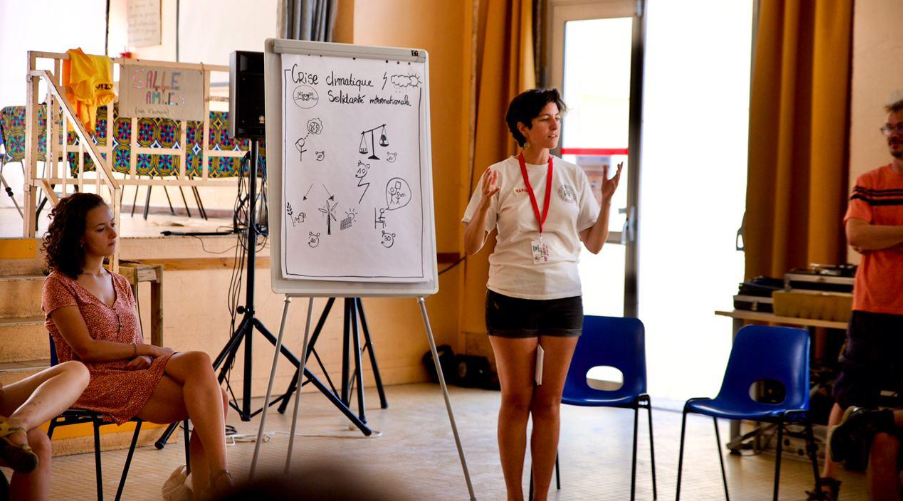
PBI-France leads workshop on climate crisis and solidarity at Non-Violent Action training

Photo by ANV COP21 Besançon.

On August 21, ANV COP21 Besançon tweeted: “’Climate crisis and international solidarity’ was the workshop led by @PBIFrance: 2h30 on #humanrights, food sovereignty and #extractivism. Heavy debates! #CampClimat.”

ANV COP21 refers to Non-Violent Action COP21, a movement founded in 2015 to carry out non-violent actions before, during and after the 21st United Nations Conference of Parties (COP) climate summit in Paris in December of that year.

It has been referred to as the “resistance” or direct-action branch of Alternatiba (alternatives in Basque), that works on proposing solutions to the climate crisis.

ANV COP21 and Alternatiba may be best known for their months-long civil disobedience campaign last year that involved removing portraits of the President of the French Republic from city halls across the country and then marching with them – held upside down – at the G7 summit in Biarritz, France in August 2019.

On August 22, Alternatiba tweeted: “Citizens are already preparing the back-to-school mobilizations: 19 #CampClimat2020 take place all over the country, including 9 this weekend: Doubs-Jura, Toulouse, Nantes, Strasbourg, Touraine, Nord, PACA, Nancy and Rennes.”

PBI-France participated in the Doubs-Jura training.

maCommune.info reports: “From 20 to 23 August, the Camp Climat Doubs Jura took place in Port-Lesney, a camp for ‘training in the strategy of non-violent struggle for climate and social justice’. More than 140 people attended the conferences, and various workshops offered by the organizers ANV COP 21 Besançon and Alternatiba Besançon.”

Port-Lesney is a commune (township) in the Jura department (province) in eastern France, situated about 400 kilometres south-east of Paris. In turn, Besançon is located about 40 kilometres north of Port-Lesney.

At least three of the eleven founders of PBI (including Charles Walker, Lee Stern and Gene Keyes) who were at the August-September 1981 meeting on unceded Algonquin territory (south of Ottawa, Ontario, Canada) that first established the organization had previously spent time in prison for participating in non-violent direct actions.

Furthermore, George Willoughby, who sent the invitation letter for the founding meeting and who remained a key figure in the organization for the following decade, had previously sailed a boat onto the South Pacific to stop the US Navy from testing an atomic bomb. He and other crew members were sentenced to 60 days in jail for that action.

Notably, it is said that his action inspired the formation of Greenpeace and the Sea Shepherd Conservation Society years later on the lands of the Squamish, Tsleil-Waututh and Musqueam peoples (Vancouver, British Columbia, Canada).

Given the past experiences of the founders of PBI, it’s likely not surprising that our founding statement noted: “We are building on a rich and extensive heritage of nonviolent action, which no longer can be ignored.”

The next United Nations climate summit, COP26, is now scheduled to take place November 1-21, 2021 in Glasgow, Scotland. The summit was to take place in November of this year but was postponed due to the COVID-19 pandemic.

COP26 is being seen as a significant moment because it marks the 5+ anniversary of the signing of the Paris agreement and countries are expected to present their next round of commitments to reduce their carbon emissions.

Photo by maCommune.info.

PBI calls on public development banks to prioritize human rights at the upcoming Finance in Common Summit

Peace Brigades International organized a meeting in Ottawa, Canada for Colombian human rights defenders from CREDHOS and the CCALCP legal collective to raise concerns about fracking and the practices of Canadian oil and gas companies with representatives of Export Development Canada in November 2019.

Peace Brigades International has signed this letter that highlights: “The activities of PDBs [public development banks] have repeatedly exacerbated poverty, widened inequalities and fuelled human rights violations (such as reprisals, land grabbing and forced evictions) without access to any useful remedies for affected communities.”

That letter, signed by more than 200 organizations, calls on the French Development Agency (AFD) to prioritize human rights, including the right to free, prior and informed consent, at its upcoming Finance in Common Summit.

AFD is convening The Finance in Common Summit: The First Global Meeting of All Public Development Banks that will take place on November 10-12 in Paris, France with a mix of in-person and digital session formats.

The summit will focus on three questions, including: “How can [public development banks] implement the transition towards a low-carbon and resilient economy?”

And their website notes: “The Summit is intended to contribute to the COP26 agenda [the United Nations climate summit, November 1-12, 2021 in Glasgow, Scotland] and the G20 Summit [November 21-22 of this year in Riyadh, Saudi Arabia].”

Sandrine Dixson-Dècleve (Club of Rome), Hindou Oumarou Ibrahim (Indigenous leader) and Bas Eickhout (Member of the European Parliament) recently commented on the Finance in Common summit in an opinion piece published by Thomson Reuters titled: First summit of global development banks must deliver on ending fossil fuel finance.

They highlight:

“Overall, public finance institutions still present an obstacle to the energy transition. Climate science shows that we need a rapid transition from fossil fuels to renewable energy in order to limit global warming to 1.5ºC. Yet governments worldwide plan to produce 120% more oil, gas and coal by 2030 than is compatible with the 1.5ºC warming limit – supported by huge volumes of public money.”

And they specify:

“Canada, the ​second-largest financier​ of fossil fuels in the G20 (per capita, it’s the highest), has given government-backed Export Development Canada a major role in the COVID-19 response, through two major financing programs that ​specifically prioritise the fossil fuel industry, without clarity on a financial ceiling for these programs.”

In July of this year, our friends at Oil Change International, Above Ground and Environmental Defence noted in relation to the COVID-19 crisis:

“Export Development Canada (EDC) already provides on average nearly fourteen billion dollars in support to oil and gas companies each year. …Now the federal government is using EDC to channel even more support to the oil and gas sector, which has been intensely lobbying the government for a bailout package of up to $30 billion.”

Controversially, on April 28 of this year, EDC signed an agreement to loan up to $500 million to TC Energy/Coastal GasLink to assist them to build a fracked gas pipeline on Wet’suwet’en territory (in British Columbia) despite the climate impacts of such a pipeline and the lack of free, prior and informed consent for the megaproject.

EDC has also previously provided a loan to Toronto-based Frontera Energy for its oil operations in Colombia (which were later found to have violated the rights of an Indigenous community); provided up to $250 million in loans to Calgary-based Parex Resources (despite concerns about its oil operations in Colombia); co-organized a visit by sixteen Canadian oil and gas companies to Colombia; and presented fracking in Colombia as an investment opportunity for Canadian businesses (despite serious human rights concerns).

The Rios Vivos movement in Colombia has also drawn attention to EDC’s financing (between $500 million and $1 billion) of the Ituango hydroelectric dam on the Cauca River and related human rights violations, including the murders of Rios Vivos members.

And CEHPRODEC in Honduras has raised concerns about EDC loans to Canadian mining companies “without adequate controls to prevent the violation of human rights in the countries where the companies that receive these benefits operate.”

Along with the Finance in Common letter, Peace Brigades International-Canada concurs with the key demands made by Oil Change International, Above Ground and Environmental Defence to the Government of Canada including:

– “Complete the 2018 legislative review of the Export Development Act. Amend the act to end EDC support for fossil fuels, including support provided through the Canada Account.

– Corporations with a record of human rights violations, including violations of the United Nations Declaration on the Rights of Indigenous Peoples, should be denied support.”

PBI-Canada will continue to monitor these issues of concern as the Finance in Common Summit approaches.

The conversation to come on Canada’s new warplanes and racism

It has been noted by David Swanson, the Executive Director of World Beyond War, that the United States has dropped bombs on people in over 30 countries since 1945, and by Jeff Faux, a Distinguished Fellow at the Economic Policy Institute, that the US has invaded, occupied or bombed 14 Muslim countries since 1980.

As the Canadian government prepares to award a $19 billion contract in 2022 to one of three transnational corporations now bidding to build 88 new fighter jets to meet its NATO and NORAD commitments, the top procurement official at the Department of National Defence has acknowledged that the United States will play a role in the “ultimate certification” of Canada’s selection of a warplane.

A US Embassy official in Ottawa has also stated: “We continue to believe in the importance of NATO and NORAD interoperability [the ability of weapons systems to work together] as a crucial component of Canada’s acquisition of defence assets.”

What should we make of this? What do NORAD and NATO do? Can one apply the lens of racial justice to military alliances and related spending?

To begin with, the North American Aerospace Defense Command (NORAD) is a military alliance formed between Canada and the US at the time of the Cold War with the Soviet Union to “maintain the sovereignty of North American airspace.”

And the North American Treaty Organization (NATO) is a military alliance that includes the US, Canada and twenty-eight other countries.

A former US Ambassador to NATO recently noted: “The US has been the acknowledged leader of NATO since its founding in Washington DC in 1949.” Given the size of the US military, it also very likely leads NORAD as well.

Canada’s fighter jets have engaged in NATO bombing missions in Kosovo in 1999 and in Libya in 2011. Beyond these NATO missions, they have also participated in US-led bombing missions in the Gulf War in 1991, as well as in Iraq and Syria from 2014 to 2016.

Racism and military interventions

In this article for the Transnational Institute, Phyllis Bennis, a Program Director at the Institute for Policy Studies, observed: “In the history of our movements for peace and for justice, the most strategic activists, analysts, and cultural workers were always those who understood the centrality of racism at the core of US wars.”

Bennis further highlights: “They grasped the ways in which US militarism relied on racism at home to recruit its cannon-fodder and to build public support for wars against ‘the other’ – be they Vietnamese, Cambodians, Nicaraguans, Iraqis, Syrians, Libyans, Somalis, Yemenis, Afghans, or anyone else.”

Professor Walden Bello has also commented: “The American Way of War is marked by the marriage of advanced technology and racism that is intended to limit the expenditure of lives on one’s side while inflicting massive devastation on the other side — under the guiding assumption that white lives are precious and colored lives are cheap.”

And Bianca Mugyenyi of the Canadian Foreign Policy Institute has written: “Each and every time we consider Canadian support for … military interventions, we must take into account the standpoint of the largely Black and brown countries that make up most of the world.” She has also noted the need to address anti-Black racism in Canadian foreign policy.

The conversation to come

CODEPINK: Women for Peace co-founder Medea Benjamin has noted: “As we chant Black Lives Matter, we should include the lives of black and brown people being blown up by US bombs in Yemen and Afghanistan.”

Given the concerns noted above about racism (racialized militarism) in decisions about war-making, and the growing awareness about the various forms of state violence (including the militarization of local police forces), this is a crucial time to find ways to engage in intersectional conversations about how #BlackLivesMatter, #BIPOCLivesMatter, #DefundThePolice and #NoNewFighterJets can connect and support each other on the path to peace.

To send an email to Prime Minister Justin Trudeau and key decision-makers to express opposition to Canada buying new warplanes, please click here.

Photo: F-18 fighter jet.

“Criminalizing us is their only game.” – Haudenosaunee land defender Skyler Williams

Photo: 1492 Land Back Lane.

The land defenders at 1492 Land Back Lane are seeking to protect Haudenosaunee territory in southern Ontario from a housing development.

They have maintained a camp at that construction site since July 19. The Ontario Provincial Police (OPP) say they have now arrested 17 people in relation to this. Those arrested include One Dish, One Mic independent media journalist Karl Dockstader on September 2 and Yellowhead Institute research fellow Courtney Skye on September 3.

In a recent Facebook post, land defender Skyler Williams noted: “The OPP fly their helicopter low over the camp and position cruisers within 100 yards of one of our camps.”

He later comments: “Criminalizing us is their only game.”

Criminalization is an important concept in land defence struggles.

It can be understood as a negation by the state (through governments, the court system and the police) of the violence and dispossession of colonization. Mohawk lawyer Beverly Jacobs has noted in reference to 1492 Land Back Lane: “This is a historical land claim going back a couple of hundred years that has not been addressed.”

One example of criminalization is a court injunction, a tool commonly used by business interests to remove Indigenous peoples from their own lands.

Significantly, Kate Gunn, a lawyer with First Peoples Law, has pointed out that an injunction is not a determination of which party is right, rather it seeks, in principle, to preserve the status quo until the underlying dispute is resolved.

That means, for instance, that a land developer, can more easily persuade the court that the economic harm is greater to them than communities seeking to protect their culture and traditions from centuries of land dispossession.

In the media and public opinion, however, a court injunction can take on the weight of a determination of right and wrong, and the justification for police action.

This statement from Haudenosaunee women succinctly explains: “Injunctions authorize police violence against our people.”

They add: “Our sovereignty is inherent while Canada’s perceived authority is a product of violent colonialism and genocide. Injunctions seek to make this reality invisible, a tool of the court to sanction more violence and dispossession.”

The 1492 Land Back Lane now expects the OPP and sheriff’s office to present a court injunction to the camp this morning.

In response, Williams says: “For us it is a peaceful occupation of our territory, and so to them to come and threaten violence again – because I think that’s what our people are taking those injunction readings as, is as a threat of violence – because we’ve been sitting here around the fire peacefully occupying our territory for the last 47 days now and have maintained the peaceful nature in which we started it.”

The land defenders have set up this GoFundMe account to help with their legal costs associated with this criminalization. They are also asking for financial support to help them maintain their presence and build winter ready buildings through e-transfers to landback6nations@gmail.com.