
Home Blog Page 369

PBI-Honduras accompanied National Union of Rural Workers (CNTC) supports call for a massive reforestation plan

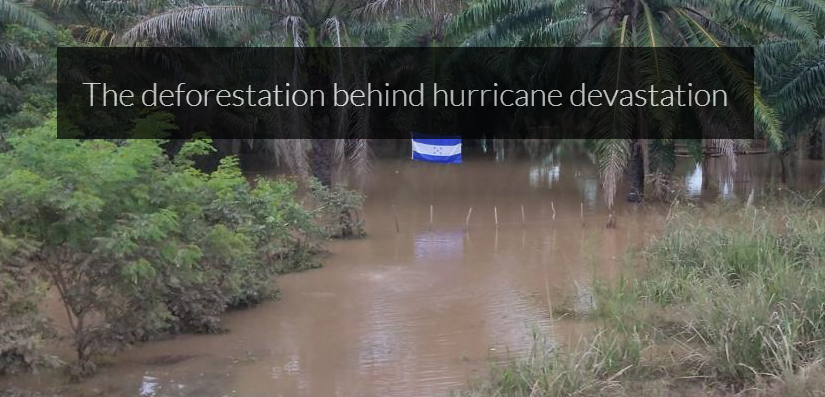
The Peace Brigades International-Honduras Project has posted a new article titled: The deforestation behind hurricane devastation.

Hurricanes Eta and Iota brought widespread flooding to Honduras and forced hundreds of thousands of people from their homes.

PBI-Honduras notes: “The massive amounts of rainfall brought to the country by Hurricanes Eta and Iota caused the Chamelecón and Ulúa Rivers to burst their banks.”

It then highlights: “Experts increasingly point to deforestation as one of the main causal factors for such massive floods. …Over the past two decades alone, Honduras has lost between 23,000 and 58,000 hectares of woodland per year.”

Between 1990 and 2005, Honduras lost 37 per cent of its forest cover, and between 2007 and 2011 the deforestation rate tripled in Honduras. This deforestation worsened the disaster by contributing to landslides in various parts of the country.

Miriam Miranda of the Black Fraternal Organization of Honduras (OFRANEH) says: “We must demand that these predatory companies that are destroying nature stop at once. How will these rivers ever stop flooding, when in the highlands, where the water sources are, there are not only people but also megaprojects that are destroying our forests?”

Juan Mejía of the Wide Movement for Dignity and Justice (MADJ) also points to businesses practices such as large-scale construction projects in fragile environments, mining, and hydroelectric dams and the diversion of rivers that are “connected to an economic model that impoverishes and kills anyone who opposes these practices.”

And Felicita López of the Lenca Indigenous Movement of La Paz (MILPAH), says: “The Forest Conservation Institute [a Honduran government agency] grants the concessions without consulting the affected communities and without investigating the environmental impact these projects will have on the communities’ water sources.”

López has spent years defending natural heritage from hydroelectric interests with ties to a Deputy in the National Congress of Honduras as well as working to prevent the 26 logging concessions and environmental permits that currently threaten the area.

The PBI-Honduras article concludes by noting that the National Union of Rural Workers (CNTC) and Via Campesina presented a draft Emergency Law this past February that includes the call for “a massive reforestation plan.”

The Peace Brigades International-Honduras Project began accompanying the National Union of Rural Workers (CNTC) in May 2018.

PBI-Guatemala accompanied Maya Q’eqchi defender Bernardo Caal Xol writes from prison about dams and dispossession

Bernardo Caal Xol is a leader of the Peaceful Resistance of Cahabón, a collective of 38 Maya Q’eqchi communities in Guatemala.

The resistance was formed to oppose the construction of the Oxec and Renace dams on the Cahabón River and its tributaries in the department of Alta Verapaz.

In November 2018, Caal Xol was sentenced to seven years and four months by a court on allegations that lack objective evidence. Amnesty International has declared that Caal Xol is a prisoner of conscience who has been wrongfully imprisoned.

On December 6, Caal Xol posted: “And where do they carry the electrical energy produced by the rivers of Alta Verapaz?”

In a series of tweets, he adds:

“The department of Alta Verapaz inhabited by the Q’eqchi ‘people; its rivers sequestered and piped to make hydroelectric power plants work. However, Q’eqchi’ communities do not have electricity, remain in darkness, they continue to use the famous ‘candle’.

And then, where is the electrical energy taken? This is called: dispossession, exclusion, discrimination and racism.

Recently, the company ‘Cobra’ of Florentino Pérez, president of the Real Madrid Club, Spain, built several hydroelectric plants on the Cahabón river, carrying the sacred Cahabón river in a tunnel for his torture and murder.

In the vicinity where the ecocide was committed, by Florentino, with the passage of tropical storms ETA and IOTA, it left large floods because the rainwater no longer found its underground passage that has had it for thousands of years.

These days some analysts speak of the crisis of the State, for the native peoples, the State has always kept us in poverty and crisis in the face of the dispossession of our natural resources.

Bernardo Caal Xol

1039 days of prison torture for invoking ILO Convention 169 prior consultation before imposition of hydroelectric projects in Q’eqchi ‘territory.“

His handwritten letter can also be read in full on Facebook here.

To read a timeline of the struggle against the Oxec and Renace dams and the criminalization of Bernardo Caal Xol, please click here.

PBI-Guatemala has accompanied the Resistance since July 2017.

Amnesty International Canada supports Colombian defender Jani Silva with Write for Rights action on December 10

Photo: Jani Silva is accompanied by the Inter-Church Justice and Peace Commission, which in turn has been accompanied by PBI-Colombia since 1994.

Our friends at Amnesty International Canada are mobilizing through their Write for Rights campaign in support of Colombian environmental defender Jani Silva.

Amnesty International Canada notes:

“Born in the heart of the Amazon, Jani Silva has dedicated her life to defending the trees and land that are everyone’s lifeblood. From the age of 16, she has supported the campesino farmers of Putumayo, a region brimming with unique biodiversity.

Jani co-founded the Association for the Integral and Sustainable Development of the Amazonian Pearl (ADISPA) in 2008. Through it, she protects the environment and rights of those living in the Amazonian Pearl, a campesino reserve in Putumayo.

Jani’s work placed her at odds with the Ecopetrol oil company, which got a license to operate in areas overlapping with the reserve. In 2009 the license was transferred to the Amerisur oil company. Since then, at least two oil spills have poisoned the water sources that local communities depend on.

Defending a healthy environment is dangerous work in Colombia and increasingly so for women and their communities in isolated areas. Armed men followed Jani and threatened her with death. Amid the COVID-19 pandemic, state protection has been reduced, while assassinations skyrocketed.“

You can read more from Amnesty International Canada about Jani Silva and how to take action on December 10 by clicking here.

They are asking people to write the President of Colombia to “tell him to protect Jani and all ADISPA members from harm so they can safely defend the land and water their communities depend on.”

They are also asking for letters to be sent to Jani and her fellow ADISPA (c/o the PBI-Colombia accompanied Inter-Church Justice and Peace Commission) to share with them “how much you admire their brave efforts.”

To sign up and take part in Amnesty International Canada’s Write for Rights day of action on December 10, please click here.

#W4R20

PBI-Colombia accompanied CSPP and CREDHOS warn of death threats against environmental defender Nini Johana Cárdenas

The Peace Brigades International-Colombia Project accompanied CSPP and CREDHOS have drawn attention to death threats against Nini Johana Cárdenas.

On December 2, BLU Radio reported: “The social leader and environmental advocate, Nini Johanna Cárdenas, spokesman for the organizing committee against mining and hydrocarbons in Carmen del Chucurí, Santander, reported that she was the victim of threats she received through phone calls.”

“It should be remembered that on 28 February strangers entered the house of Johanna Cárdenas where they found belongings and documents of the environmental processes led by the social leader in the Magdalena Medio area in Santander.”

Infobae adds: “Environmental and social organizations warned of the safety of leader Nini Johana Cardenas, who was threatened with death in the morning hours of December 1. Cárdenas lives in the municipality of El Carmen de Chucurí, Santander, and received two calls that apparently came from members of the paramilitary group Los Caparros.”

“According to these social organizations, the criminal group has murdered teachers and social leaders for not collaborating with them”

One of the organizations, the Alliance for a Colombia Free of Fracking, has also posted on Facebook: “We alert to serious threats against the life of Nini Johana Cardenas, communal leader of El Carmen de Chucurí (Santander), and member of the Fracking Free Colombia Alliance. We demand the authorities protect her life.”

“NINI JOHANA CÁRDENAS develops the leadership in this municipality for the defense of territory, nature and life, by denouncing extractivist projects in the region, which have affected or may affect the fauna and flora, water sources, crops as well as other collective goods of those living in the municipality; it also develops a scientific experimentation of bee pollination at this time.” – To read the full Urgent Action on the CSPP website, click here.

Tyendinaga Land Defenders Legal Fund established to help with court costs related to Wet’suwet’en solidarity action

Image by junnygirldecolonized.

A Tyendinaga Land Defenders Legal Fund is accepting donations for the legal costs of the 20 Mohawk land defenders and water protectors criminalized for standing with Wet’suwet’en land defenders this past February in opposition to the construction of the Coastal GasLink fracked gas pipeline on their unceded lands.

You can read more about this on this Facebook page, in this tweet, and in this Instagram post. Donations can be e-transferred to tyendinagalanddefenders@maatlegal.ca.

Ma’at Legal Services is a Scarborough, Ontario-based social justice law firm that provides representation in areas such as human rights law.

This past February, solidarity actions were organized across the country when heavily armed Royal Canadian Mounted Police (RCMP) officers raided unceded Wet’suwet’en territory to remove unarmed land defenders opposed to the construction without consent of the TC Energy Coastal GasLink fracked gas pipeline on their lands.

Twenty-eight land defenders were arrested on Wet’suwet’en lands despite this resolution from the United Nations Committee on the Elimination of Racial Discrimination weeks earlier that called for construction on the pipeline to be stopped and the RCMP to be withdrawn.

On February 25, Global News reported: “Ontario Provincial Police [OPP] arrested ‘several’ people at a railway [protest] in Tyendinaga, which was set up nearly three weeks ago in solidarity with anti-pipeline protests in northern British Columbia.”

CTV also noted: “All ten people were charged with mischief over $5000 and disobeying a court order, as well as a Railway Safety Act charge of entering land where line work is situated. Three people are additionally charged with resisting arrest. One person is also facing a charge of obstructing police.”

Then on July 9, the OPP arrested Kanenhariyo, the main Mohawk liaison with the police during the Tyendinaga rail shutdown in February.

It was also reported at that time: “OPP Detective Karin Richer, who arrested Kanenhariyo, informed him that the OPP was looking to charge another ‘9 or 10’ people that they hadn’t yet reached because of Covid-19.”

The Unist’ot’en have stated: “We acknowledge that many still face charges for courageously standing in solidarity with the Wet’suwet’en, and that this fight is far from over. We are forever grateful for the solidarity and support from our relatives and allies.”

Defenders of land rights, culture and natural resources can find themselves facing powerful interests and brutal opposition. Some in Colombia, Guatemala, Honduras and Mexico have approached Peace Brigades International field projects for protection after they have been attacked or their colleagues assassinated. Many others have been subjected to criminal prosecutions based on spurious charges.

PBI-Canada observes the National Day of Remembrance and Action on Violence Against Women

Today is the National Day of Remembrance and Action on Violence Against Women. We remember that on December 6, 1989, fourteen women at the École Polytechnique in Montreal were murdered because of their gender.

Author-activist Judy Rebick has commented: “I think [what happened on December 6, 1989] was both an act of terrorism and an extreme form of the violence women face every day. The best way to remember these fourteen women is recommit ourselves, women and men, to the fight for women’s liberation and an end to violence against women.”

About 238 women are murdered every day around the world.

United Nations human rights expert Dubravka Šimonović recently called for the universal establishment of national initiatives to monitor and prevent femicide.

In Canada, direct federal funding to women’s organizations is less than 0.01% of total federal program spending and lack the secure, multi-year core operational funding needed to work for the protection of all women.

Šimonović made her call for national initiatives just prior to the International Day for the Elimination of Violence against Women on November 25.

Peace Brigades International projects in Colombia and Mexico accompanied marches that took place that day in Yondó, Antioquia and Mexico City.

PBI-Mexico commented: “We express concern over the current crisis of femicides and disappearances and remember the obligation of the authorities to ensure the safety of women, journalists and defenders.”

PBI-Guatemala accompanies the TzK’at Network of Ancestral Healers of Community Feminism which was formed in the context of political risk for Mayan and Xinca women who came from experiences of territorial defence opposing mining licenses, the logging of forests, the presence of hydroelectric dams on rivers, and cement plants.

TzK’at says: “When a megaproject is implanted in a territory, it is as if they penetrate your body in a sexual violation. This is how we feel. …In addition, we run the risk of being sexually abused by the company’s workers.”

We also remember that the National Inquiry into Murdered and Missing Indigenous Women and Girls determined that “state actions and inactions rooted in colonialism and colonial ideologies” are in part responsible for the thousands of Indigenous women and girls who have been murdered or gone missing in Canada.

That report described this as a Canadian genocide.

Sharon McIvor, Pamela Palmater and Shelagh Day have written: “Discrimination against Indigenous women is as old as Canada. It is a marker that defines Canada as a colonial, patriarchal nation-state.”

It is within this context that we recognize the risks faced by Indigenous women land defenders within this country opposed to megaprojects including the Coastal GasLink fracked gas pipeline on Wet’suwet’en territory, the Trans Mountain tar sand pipeline on Secwepemc territory, and the Muskrat Falls hydroelectric dam on Innu lands.

PBI-Canada is committed to a vision of a world free of violence. We stand in solidarity with women impacted by gender-based violence and with all who strive to end femicide, discrimination, harassment, and hate.

PBI-Guatemala meets with the Peaceful Resistance of La Laguna about the water scarcity crisis

On December 5, the Peace Brigades International-Guatemala Project posted: “Yesterday we met with members of the Peaceful Resistance of La Laguna in San Pedro Ayampuc. Today they called for a demonstration due to prolonged water scarcity in the municipality.”

Nina Lakhani has written in The Guardian: “Water shortages and poverty are causally linked to the country’s skewed land distribution: roughly 2% of the population control 70% of all productive farmland.”

National Geographic has also reported: “Guatemala is consistently listed among the world’s 10 most vulnerable nations to the effects of climate change.” The United Nations has cautioned that globally: “Extreme weather events are making water more scarce, more unpredictable, more polluted or all three.”

And Americas Quarterly has explained: “Guatemala is part of the region of dry forest extending throughout Central America, where droughts have driven down food production. Extremely dry conditions have increased poverty and created food insecurity, putting residents at risk of starvation and driving migration from Central America.”

PBI-Guatemala has previously explained that the Peaceful Resistance of La Laguna opposes “the installation of an electrical distribution plant and a high voltage power station in the municipality and defending the right to water and a healthy environment.”

Their main concerns were the “possible environmental and health consequences, such as deforestation, the reduction of the amount of water available and the contamination of the water supply with harmful chemicals.”

Peace Brigades International affirms access to water as a fundamental human right.

On July 28, 2010, the United Nations General Assembly, through Resolution 64/292, recognized the human right to water and sanitation and acknowledged that these rights are essential to the realization of all human rights.

PBI-Guatemala has accompanied the Peaceful Resistance of La Laguna since November 2015 due to threats made against the group.

Photo: The banner reads: “No more dirty water”. The UN says that much of the surface water in Guatemala has high levels of pollution from the accumulation of garbage and other factors that make it unfit to drink.

PBI accompanied Dina Meza and Reinaldo Villalba Vargas to receive Sir Henry Brooke Award on December 7

Proceso Digital reports that human rights defenders Dina Meza and Reinaldo Villalba Vargas will receive the Sir Henry Brooke Award on December 7.

The awards, presented by Peace Brigades International-United Kingdom and the Alliance for Lawyers at Risk, are an opportunity to celebrate the commitment of Sir Henry Brooke and the lawyers and other human rights defenders we protect to the rule of law.

The article notes that Dina Meza is a journalist, the director of the Association for Democracy and Human Rights of Honduras (ASOPODEUH), the founder of PEN-Honduras, and the director of the digital newspaper Pasos de Animal Grande.

Reinaldo Villalba Vargas is a lawyer with the Colectivo Jose Alvear Restrepo (CCAJAR) in Colombia. He is currently representing Senator Iván Cepeda in legal proceedings against a former president of Colombia, Álvaro Uribe Vélez.

Meza has been accompanied by PBI-Honduras since 2014 and CCAJAR has been accompanied by PBI-Colombia since 1995.

Sir Henry Brooke, who passed away in January 2018, was the founder of the Alliance for Lawyers at Risk and a sponsor of PBI-UK.

He stated: “PBI is a unique institution. When I meet the lawyers from Colombia and other countries, I am very struck by how single-minded they are. They put their clients’ interest first and foremost, long before their own safety. PBI provides them with accompaniment without which they could not do their work… they save them from being killed.”

The Alliance website further notes: “The Alliance was founded in 2010 by Peace Brigades International UK patron, the late Sir Henry Brooke, and has since then been collaborating closely with PBI in providing legal expertise to the human rights defenders PBI accompanies.”

To watch the one-hour ceremony of the third annual Sir Henry Brooke Awards for Human Rights Defenders, fill out this PBI-UK webinar registration form.

PBI-Colombia accompanies ACVC-RAN at ‘Building peace from the territories’ meeting

On December 3, the Peace Brigades International-Colombia Project posted: “Today, PBI accompanied members of ACVC-RAN holding the inter-institutional meeting Building peace from the territories. The organization, accompanied by PBI since 2007, participated in the space as part of an initiative of the Colombian Northeast protection route.”

ACVC-RAN refers to the Campesina Association of the Cimitarra River Valley – National Agroecological Network.

The “protection route” noted above, also referred to as the Collective Protection Route, is a set of actions adopted by Colombian authorities to prevent risk, counteract threats and minimize the vulnerabilities of groups and communities.

PBI-Colombia has previously noted: “PBI accompanies the ACVC who focus their work on the Campesino Reserve Zones (ZRC) and sustainable development, the development of agricultural projects in areas of education and health.”

The ACVC’s economic development projects, designed to guarantee food security for the peasant farmer population in the valley, includes small-scale rice farming, as well as sugar cane production.

PBI-Colombia has also explained: “The Campesino Reserve Zones are an example of community-driven resistance [that] promote food security and sustainable agriculture, challenging the economic model based on the extraction of natural resources and large-scale land exploitation through agribusiness.”

PBI-Colombia has also noted: “The hydrocarbon industry has played a fundamental role in the economic activity of the [Cimitarra River Valley] region, generating approximately 70% of the total economic value produced there.”

Further to that point, International Action for Peace has noted: “There was talk [at the Festival for Culture and Peasant Dignity in Puerto Nuevo Ité that was hosted by ACVC-RAN in 2018] about the problem of fracking and the threat of this activity in the Serranía de San Lucas and the wetlands of the Magdalena Medio.”

PBI-Colombia began accompanying ACVC-RAN in 2007 and has since expanded its accompaniment emphasizing political advocacy to raise awareness about the problems faces by the organization and the region in which they carry out their work.


RCMP racism, misogyny and pro-industry bias must be addressed to stop the criminalization of Indigenous land defenders

The impartiality of state institutions and the upholding of human rights obligations towards Indigenous land defenders are crucial elements in making space for peace both globally and on Indigenous territories within Canada.

In February 2015, The Globe and Mail reported on an RCMP intelligence assessment—dated January 24, 2014—obtained by Greenpeace Canada.

That article notes: “The report extolls the value of the oil and gas sector to the Canadian economy, and adds that many environmentalists ‘claim’ that climate change is the most serious global environmental threat, and ‘claim’ it is a direct consequence of human activity and is ‘reportedly’ linked to the use of fossil fuels.”

Earlier this year, the Canadian Press also reported that the United Nations Committee on the Elimination of Racial Discrimination had called for the RCMP and other security and police to withdraw from Wet’suwet’en traditional lands.

The UN further stated that the construction of the Coastal GasLink fracked gas pipeline on those lands should be stopped until the megaproject had the free, prior and informed consent of the Wet’suwet’en peoples.

At that time, the RCMP stated: “We want to emphasize that we are impartial in this dispute and our priority is to facilitate a dialogue between the various stakeholders involved.” And yet within weeks, 22 Wet’suwet’en land defenders and supporters had been arrested during a militarized RCMP invasion of their unceded territories.

And now, APTN reporter Angel Moore reports: “A former criminal intelligence analyst for the RCMP who reported that an energy project in New Brunswick was up against ‘violent Aboriginal extremists’ was also the administrator of a Facebook group which featured current and former Mounties, at times, making racist and disparaging remarks about Indigenous Peoples. For six years Tim O’Neil’s duties included putting together reports for the top brass at the RCMP on issues including threats to energy projects in Canada by Indigenous groups or environmental organizations.”

One of the reports written by this RCMP analyst was titled: Criminal Threats to the Canadian Petroleum Industry.

In reference to that report, Elsipogtog land and water protector Lorraine Clair says: “Criminal threats to the Canadian petroleum industry. Criminal threats… and we were criminals now because we are defending our land, we’re protecting our water we’re you know defending our children’s and grandchildren’s inherent right, really?”

Clair adds: “This guy is smearing pretty well every Aboriginal movement that has occurred to defend land, water and what do you call it, treaty rights they are not even stating this is why we are doing it you know we are defending our rights.”

Furthermore, former Supreme Court justice Michel Bastarache told a House of Commons committee yesterday about his ‘Broken Dreams, Broken Lives’ report that documented a toxic, misogynistic culture in the RCMP.

Bastarache wrote in his report: “The level of violence and sexual assault that was reported was shocking. Indeed, over 130 claimants disclosed penetrative sexual assaults. Other claimants described a sexualized environment in RCMP workplaces. This was characterized by the frequent use of swear words and highly degrading expressions that reference women’s bodies, sexual jokes, innuendoes, discriminatory comments with respect to the abilities of women and unwelcome sexual touching.”

Mi’kmaq lawyer Pam Palmater has also noted: “The report details how the RCMP treated Indigenous women even more poorly than other women. In addition to the humiliating and degrading behaviours experienced by other women in the RCMP, Indigenous women were also referred to as ‘squaw’ and ‘smoked meat’ and ‘were, at times, forced to watch RCMP members treat other Indigenous people brutally’.”

Palmater has also written: “The only way we are ever going to stop RCMP racism and brutality against Indigenous peoples is to declassify, deconstruct and defund the institution itself. … Anything less will result in continued police racism and brutality and the loss of more Black and Indigenous lives.”

Globally, violence by state security forces against environmental human rights defenders is recognized as a serious impediment to their work and safety.

For instance, a recent PBI-Honduras report noted: “The National Network of Women Human Rights Defenders in Honduras explains that in Honduras 70% of the attacks against women defenders the aggressors are state security forces, especially police or the military.”

PBI-Canada supports the call for an end to state violence and stands with land defenders, water protectors and environmental human rights defenders.