Home Blog Page 359

US Rep. Ilhan Omar visits Indigenous land defenders opposed to Canadian Line 3 pipeline being built in Minnesota

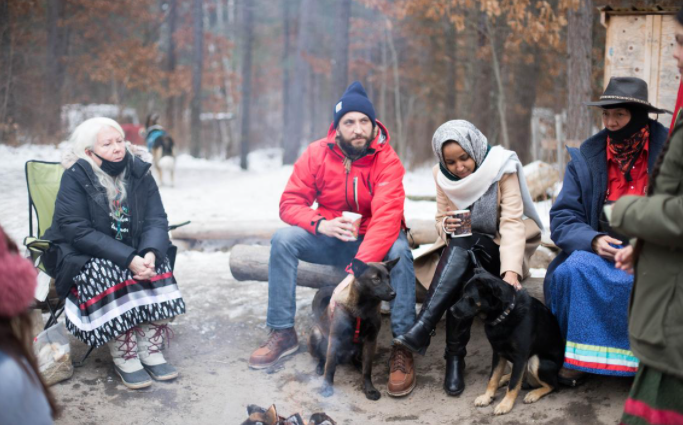
Photo: (left to right) Audrey Thayer, Tim Mynett, Ilhan Omar, Lorna Hanes and Tara Houska meet at a Line 3 opposition camp. Photo by Hannah Olson/Bemidji Pioneer.

On January 30, U.S. Representative Ilhan Omar met with Indigenous land defenders and water protectors opposed to the Line 3 pipeline.

Omar, the member of Congress for Minnesota’s 5th congressional district, tweeted: “I am in Northern Minnesota meeting with indigenous leaders organizing to #StopLine3. We owe it to future generations, to the indigenous communities we’ve signed treaties with, and to every living being on this planet to stop building fossil fuel infrastructure.”

The Giniw Collective, an Indigenous-women, 2-spirit led frontline resistance movement, also posted about Omar’s visit.

“Today, Giniw Collective hosted Congresswoman Ilhan Omar, a longtime ally of Indigenous peoples. We visited the proposed crossing of Line 3 tar sands under the Mississippi River headwaters. We visited a Line 3 pipe yard. Sheriffs followed and threatened to intervene the entire trip, but Congresswoman Omar is committed to uplifting our voices and the voice of our Mother. This is what solidarity looks like.”

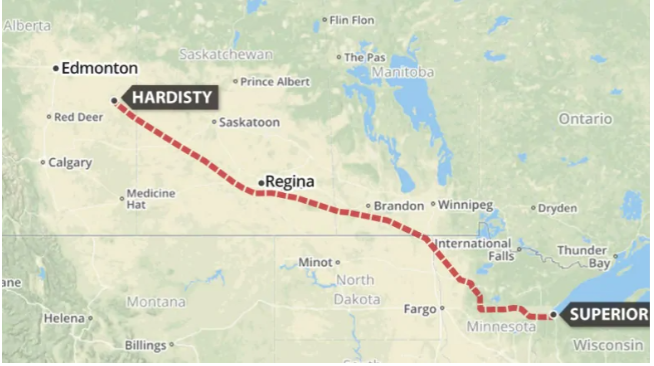
The Calgary-based Enbridge Inc. 760,000 barrel per day Line 3 tar sands pipeline would run from Hardisty, Alberta to Superior, Wisconsin. It would be 1,659 kilometres in length, of which about 585 kilometres would be in the United States.

Prime Minister Justin Trudeau approved the construction of the Line 3 pipeline in Canada in November 2016. Enbridge has reported that the Canadian portion of the pipeline is complete and began commercial service in December 2019.

The Rainforest Action Network has documented that the top five financiers of Enbridge are Canadian banks: TD Bank, Bank of Montreal, Scotiabank, RBC and CIBC. Collectively they have provided billions of dollars in financing to Enbridge.

RAN has further noted: “The [542 kilometre] Minnesota stretch of the pipeline is all that remains to be built. In November 2020, the Minnesota Pollution Control Agency approved the final permits for the pipeline.”

Work on the pipeline began in Minnesota on December 1 and is expected to take 6 to 9 months to complete.

On January 12, Resist Line 3 tweeted: “The good news is, resistance to the pipeline is growing. On-the-ground action to stop construction is led by Indigenous womxn and Two-Spirit folks at @GiniwCollective, with @nfld_al3, @MN_350, and @SunriseMvmtTC all working together with them to #StopLine3.”

Resist Line 3 also highlighted: “There’s a new Indigenous-led Line 3 resistance camp on the map – Camp Miigizi! Follow them on Facebook to support Miigizi as it takes flight.”

On January 14, the Giniw Collective tweeted: “[This morning] water protectors locked to each other inside a Line 3 pipe segment, halting construction at an Enbridge worksite as dozens more held space.”

That action was preceded by another on January 9 in which water protectors and Anishinaabe jingle dress dancers walked onto a Line 3 worksite.

Eight people were arrested at that action.

Tara Houska, founder of Giniw Collective, commented: “We saw Minnesota’s police officers protecting a Canadian tar sands pipeline.”

Peace Brigades International-Canada, which supports the accompaniment of Indigenous land defenders and environmental human rights defenders in Latin America, is following this situation with great concern.
Corte colombiana falla en contra de la solicitud de orden judicial de Parex Resources con sede en Calgary

Parex Resources Inc., con sede en Calgary, opera el campo petrolero Aguas Blancas en el municipio de Simacota, Santander, en el noreste de Colombia.

La operación de Parex en Simacota se ubica en la región del Magdalena Medio que incluye los municipios de Barrancabermeja, Puerto Wilches y San Martín. La región se conforma por siete departamentos, entre los que se encuentra Santander (donde se encuentra Simacota), Antioquia y Cesar. Es una región central para la extracción y refinación de petróleo, así como para las amenazas contra los defensores de derechos humanos ambientales.

Fallos judiciales

El 29 de septiembre de 2020 Parex interpuso una acción de tutela contra Yolanda Pico y Segundo Adolfo Salinas, líderes de la Junta de Acción Comunal de la vereda El Diviso, La Colorada, ubicada en la zona baja del municipio de Simacota.

El 13 de octubre, el Juzgado Municipal de Simacota desestimó esta impugnación.

Una tutela es una orden judicial que tiene como objetivo proteger los derechos constitucionales cuando son violados o amenazados por la acción u omisión de cualquier autoridad pública.

Esta figura judicial está incorporada en el artículo 86 de la Constitución; una tutela puede proceder bajo varias circunstancias, incluso cuando el actor (demandante) se encuentra en una situación de indefensión en relación con la persona (demandada) contra quien se interpone la tutela.

Parex declaró que entre el 4 y el 18 de marzo de 2020, sus operaciones en el proyecto Aguas Blancas se vieron afectadas de manera injustificada por algunos miembros de la comunidad, incluidos la Sra. Pico y el Sr. Salinas. El informe presentado incluye un bloqueo a la entrada de la planta principal de producción que impidió que los trabajadores ingresaran al sitio.

El fallo señala que el 17 de marzo Parex presentó un derecho de petición a los imputados para responder sobre sus declaraciones contra la empresa. El 27 de marzo, los imputados respondieron que no estaban obligados a responder a ese derecho de petición.

En carta fechada el 23 de septiembre, Parex resumió su argumentación para proteger su buen nombre y honor de las afirmaciones de Pico y Salinas.

El 13 de octubre, el Juzgado Municipal de Simacota declaró la inadmisibilidad de la acción de protección. Asimismo, dictaminó que los imputados (Pico y Salinas) ejercieron su derecho a la libre expresión y que en ningún momento violaron los derechos del demandante (Parex).

El fallo también determinó que no existía dependencia o subordinación de uno con respecto al otro (como se requiere en una acción de tutela) y que la protesta pacífica de los imputados no violó los derechos del demandante.

Rueda de prensa

El 21 de diciembre, el presidente y la abogada de la organización de derechos humanos de Barrancabermeja y acompañada por PBI Colombia,  CREDHOS, Ivan Madero Vergel y Leidy Irreño, el vocero de CRY-GEAM ((el Grupo Corporativo Regional Yariguíes de Estudios Extractivos, Ambientales y Sociales del Magdalena Medio) Oscar Sampayo y el líder ambiental Raúl Barba hablaron sobre este caso en rueda de prensa.

El video de 22 minutos de esa conferencia de prensa puede verse aquí.

La rueda de prensa denunció la criminalización de los líderes sociales por parte de Parex. Contextualizandolo de modo más amplio, el Comité de Solidaridad con Presos Políticos (CSPP) ha señalado que “entre 2012 y 2019 se han judicializado 249 líderes sociales y el 74% de ellos eran defensores del medio ambiente y la tierra”.

Los ponentes también destacaron esta reciente amenaza de las Águilas Negras contra dieciocho líderes ambientales del Magdalena Medio (incluido Sampayo).

Las amenazas contra líderes ambientales y comunitarios ejemplifican la intensificación del conflicto armado en la región. CREDHOS ha destacado esta situación en su informe de octubre de 2020: “El silencio armado: pactos y disputas en el Magdalena Medio”.

Preocupaciones ambientales

Son varias las preocupaciones ambientales sobre la operación de Parex en Aguas Blancas que se han expresado en los últimos años.

El campo petrolero ha recibido la oposición de las comunidades locales y los ambientalistas, en particular por la adquisición irregular de la tierra y el impacto ambiental de sus operaciones. En septiembre de 2015, cuando Parex firmó un acuerdo con Ecopetrol, la expectativa era que el acuerdo podría permitir que el campo Aguas Blancas aumentara a 10,000 barriles por día para 2020.

CRY-GEAM  comenzó a expresar sus preocupaciones poco después de que Parex completara la perforación de sus primeros cuatro pozos en Aguas Blancas.

CRY-GEAM publicó en Facebook este video en enero de 2017 señalando sus preocupaciones ante la ausencia de los documentos ambientales necesarios y estas fotos en abril de 2017 expresando preocupación por un camión volcado y el derrame de hidrocarburos en el río la Colorada.

En abril de 2017, CRY-GEAM también publicó este video en Twitter con el texto: “Parex en Simacota, Campo Aguas Blancas, sin plan de manejo arqueológico, sin permiso ambiental, por encima de la ley y las comunidades. ¿Quién responde?”.

A pesar de esto, Export Development Canada, la agencia de crédito para la exportación del Gobierno de Canadá, ha proporcionado financiamiento y apoyo a Parex que incluye: $ 50-100 millones (27-05-2019): $ 50-100 millones (22-02-2019); y $ 25-50 millones (05-07-2018). 

Seguimiento

Peace Brigades International continúa siguiendo de cerca la situación en Aguas Blancas y afirma el derecho fundamental de las comunidades a expresar sus preocupaciones sobre los impactos ambientales de esta corporación canadiense de petróleo y gas.

United Nations Special Rapporteur David Boyd calls on Colombia to pass law to prohibit fracking

A still from this 8-minute video of David Boyd’s speech (in Spanish).

On January 29, El Tiempo reported: “United Nations special rapporteur on human rights and the environment, David Boyd, mentioned that the Colombian government ‘must pass a law to prohibit fracking’.”

“In light of its obligations under constitutional, international, human rights and environmental law, fossil fuels must be replaced by renewable energies. I respectfully maintain that the government of Colombia must pass a law to prohibit fracking’, he pointed out.”

“In his speech [to a House of Representatives public hearing convened on a bill that seeks to prohibit fracking] he assured that Colombia is a party to the United Nations Framework Convention on climate change and the Paris Agreement.”

“Two agreements in which the countries commit to reduce their greenhouse gas emissions and move towards clean economies, something that would go against the grain if the country developed this hydraulic fracturing technique to extract gas and oil.”

The article also notes: “[Boyd] mentioned that Costa Rica, Uruguay, France have already enacted laws prohibiting fracking. In the case of Colombia, he recommended that a low-carbon and climate-resistant future should be urgently sought.”

Boyd’s speech was also reported on in Semana and Caracol Radio.

The first licence for a fracking pilot project was awarded by the National Hydrocarbons Agency (ANH) on November 25, 2020 to the Colombian state-owned oil company Ecopetrol for its Kalé project near Puerto Wilches, Santander.

On January 27, the Colombian Minister of Mines and Energy, Diego Mesa, said that two more contracts for fracking pilot projects will be signed in the coming weeks.

One of those contracts could go to ExxonMobil in partnership with Toronto-based Sintana Energy Inc. (and its Colombian subsidiary Patriot Energy) that would likely involve the VMM-37 block in Puerto Wilches, Santander.

Oilprice.com recently reported: “The commercial development of fracking has the potential to be a game-changer for the Andean country’s oil industry because national oil company Ecopetrol estimates that Colombia possesses up to 12 billion barrels of recoverable shale oil and 100 trillion cubic feet of natural gas resources.”

In contrast, environmentalists have called for a global ban on fracking given it “torpedoes our global efforts to tackle climate change and violates basic human rights.”

Boyd was appointed as the UN Special Rapporteur on human rights and the environment for a three-year term commencing August 1, 2018. He is an associate professor of law, policy, and sustainability at the University of British Columbia.

PBI continues to follow this issue and to provide accompaniment to human rights defenders who oppose fracking in Colombia.

New report by UN Special Rapporteur Mary Lawlor: Final warning: death threats and killings of human rights defenders

Photo by Dara Mac Dónaill/ Irish Times.

The United Nations Special Rapporteur on the situation of human rights defenders Mary Lawlor has released a new 23-page report titled: Final warning: death threats and killings of human rights defenders.

The report was prepared for the 46th session of the Human Rights Council that will take place from February 22-March 19.

Among the key points in her report:

(5) According to information gathered by OHCHR and supplemented by credible sources, at least 281 human rights defenders were killed in 2019. Since 2015, a total of 1,323 have been killed. Latin America is consistently the most affected region, and environmental human rights defenders are the most targeted. Those collecting data agree that underreporting is a common problem and that killings are fuelled by widespread impunity.

(16) Human rights defenders working on some issues appear to be particularly vulnerable to attack. They include environmental human rights defenders, those protesting land grabs or those defending the rights of people, including indigenous peoples, by objecting to Governments that are imposing business projects on communities without free, prior and informed consent. One in two victims of killings recorded in 2019 by OHCHR had been working with communities around issues of land, environment, impacts of business activities, poverty and rights of indigenous peoples, Afrodescendants and other minorities.

(34) The Guiding Principles on Business and Human Rights clearly establish that businesses have a responsibility to respect human rights and to address any adverse impact on rights arising from acts or omissions of their own or of their business relationships (principle 11), including the rights of human rights defenders. In order to meet their responsibility to respect human rights, they should carry out human rights due diligence. This should be an ongoing process, which includes assessments of actual and potential human rights impacts (principle 17) and involves meaningful consultation with potentially affected groups (principle 18 (b)). Where businesses identify that they have caused or contributed to adverse effects to human rights, they have a responsibility to actively engage in remediation, which does not displace the responsibility of States to ensure access to effective remedy for those affected (principle 22).

Her report also notes several examples of death threats against defenders, including:

(77) Many defenders experience multiple threats. Jani Silva is a woman and environmental human rights defender in Colombia. In January 2020, an unidentified person followed her home and to her workplace. In May 2020, it was revealed that she was among at least 130 people under illegal digital surveillance by army cyberintelligence. In July 2020, the organization Comisión Intereclesial de Justicia y Paz received information that an armed group was planning to kill Ms. Silva. Because of the threats, dating back to 2017, Ms. Silva has personal protection provided by the State, which includes a conventional vehicle and two security people. In addition, she has been assigned a mobile telephone and a bulletproof vest.

Jani is accompanied by the Inter-Church Justice and Peace Commission, which in turn has been accompanied by PBI-Colombia since 1994.

The report concludes with more than two pages of recommendations. Among those recommendations:

(108) Foreign embassies, in consultation with human rights defenders who receive threats, should publicly denounce the threats.

(109) Businesses and international financial institutions should: (a) Develop and publish human rights defender-specific policies, in consultation with human rights defenders, in order to better protect defenders; (b) Commit to mandatory human rights standards and environmental due diligence.

(113) Businesses and international financial institutions should: (a) Invest in additional capacity to strengthen support for human rights defenders; (b) Acknowledge that land and environmental defenders and those defending indigenous peoples’ rights are at specific risk.

The full report can be read here.

Please also see:

Mary Lawlor on her priorities as the Special Rapporteur for human rights defenders and the role of PBI (June 2020)

“Governments are not doing enough to protect human rights defenders”: Mary Lawlor, UN Special Rapporteur (October 2020)

West Moberly First Nations struggle against Site C dam on Treaty 8 territory enters crucial period

Photo: Land defender Helen Knott and West Moberly First Nations Chief Roland Willson.

The Vancouver Sun reports: “West Moberly [First Nations] will be in court next year, claiming infringement of its treaty rights and damage to its traditional territories from construction of Site C and other BC Hydro dams on the Peace River.”

“The case is set down for 120 days of court time, starting March 14, 2022.”

The reservoir is scheduled to be filled in 2023.

Chief Roland Willson has highlighted: “[The United Nations Declaration on the Rights of Indigenous Peoples] commits to the obtaining of the free, prior and informed consent of Indigenous persons before adopting and implementing legislative or administrative measures that may affect them.”

The article notes: “Willson [has now] also called on the government to suspend work on Site C pending a final decision by the cabinet on outright cancellation.”

This is because of the violation of Indigenous rights and the destruction of Indigenous cultural and spiritual sites that would come with the flooding caused by the dam, but now also because of geotechnical and safety issues.

In July 2020, the British Columbia government noted there were geotechnical problems with the dam and appointed Peter Milburn to write an independent report on the project.

Then earlier this month, the BC Premier John Horgan said the government had appointed two international dam safety experts to assess a solution to the geotechnical problems and would release Milburn’s report once that assessment had been done.

Now, the West Moberly First Nations is seeking the release of all documents related to the geotechnical problems, the Milburn report, and all documents shared with the two international dam safety experts.

Land defence and more from the United Nations

In December 2015, Treaty 8 land defenders and allies set up a camp at Rocky Mountain Fort on the south bank of the Peace River to protest the dam. But by February 2016, the Supreme Court of British Columbia had granted an injunction to BC Hydro ordering the land defenders to be removed from the area.

At that time, land defender Helen Knott of the Prophet River First Nation stated: “We do not wish to be arrested. We wish to see Canada respect the rights of indigenous people in accordance with its international obligations.  We remain strong, united and firm in our opposition to this unnecessary project. We will do everything in our power to ensure Canada lives up to its commitments to indigenous peoples.”

The legal proceedings against the dam began in January 2018.

In December 2019, the United Nations Committee on the Elimination of Racial Discrimination called on Canada “to immediately suspend the construction of the Site C dam, until free, prior and informed consent is obtained from West Moberly and Prophet River Nations, following the full and adequate discharge of the duty to consult.”

In a follow-up letter dated November 2020, the Committee further states: “The Committee regrets that the State party has provided no information on measures taken to address the concerns [about the development of the Site C dam project, as well as the Trans Mountain and Coastal GasLink pipelines] raised by the Committee in its decision of 13 December 2019.”

We follow this situation with interest.

—

Peace Brigades International has accompanied opponent to hydroelectric dams including: ASODEBICOQ vs the Santa Lucia dam, the Pajuiles community vs the Los Planes dam, and COPINH vs the Agua Zarca dam in Honduras; the Peaceful Resistance of Cahabón vs the Renace and Oxec dams in Guatemala; Totonac communities vs the Puebla 1 dam in Mexico; and the CCALCP legal collective vs the Sogamoso dam in Colombia.

Colombia to award two more contracts for fracking pilot projects within weeks

In a Global Action Against Fracking protest in Bogotá on December 11, 2020, the logos of ExxonMobil (that works in partnership with Toronto-based Sintana Energy Inc.), Ecopetrol and Drummond Energy were carried. Photo by Óscar Sampayo.

On January 27, Semana reported: “The Minister of Mines and Energy, Diego Mesa, said on Wednesday [January 27] that in the coming weeks the country will have two other contracts for fracking pilot projects signed.”

Mesa said: “We look forward to having at least two more investigative contracts in this first quarter of 2021.”

The article adds: “The other two companies that are already enabled to make unconventional deposit pilots in Colombia are Drummond and ExxonMobil [in collaboration with Toronto-based Sintana Energy Inc.]. The company that is in the process of enabling fracking pilots is Argentina’s Tecpetrol, which should have the go-ahead in February.”

“ConocoPhilips [and Calgary-based Canacol Energy Ltd.] had been enabled to do fracking pilots but by ‘matrix decisions’ and coronavirus pandemic affectations has decided to refrain from continuing with such projects in Colombia.”

And the article notes there will be four fracking pilot projects: “Three of the four projects will be carried out in the Middle Magdalena Valley basin, while the other initiative will be carried out in the Cesar-Ranchería basin (La Guajira).”

The first licence for a fracking pilot project was awarded by the National Hydrocarbons Agency (ANH) on November 25, 2020 to the Colombian state-owned oil company Ecopetrol for its Kalé project near Puerto Wilches, Santander.

From the Semana article noted above, the contracts to be awarded in the first quarter of this year (before March 31) are likely to be to Drummond, ExxonMobil, or Tecpetrol.

ExxonMobil in partnership with Sintana Energy (and its Colombian subsidiary Patriot Energy) would likely pursue the VMM-37 block in Puerto Wilches, Santander.

Puerto Wilches is situated in the Magdalena Medio region, a focal point for oil extraction and refining, as well as for threats against environmental human rights defenders.

In November 2020, Infobae reported: “18 social and environmental leaders of the Middle Magdalena were threatened with death through a pamphlet, signed by a paramilitary structure that called the ‘Black Eagles, Middle Magdalena Block’.”

Six of those threatened are members of the Alliance for a Colombia Free of Fracking, including Óscar Sampayo (who took the photo at the top of this article).

Environmentalists have called for a global ban on fracking given it “torpedoes our global efforts to tackle climate change and violates basic human rights.” Moreover, a researcher with the Columbia Center on Sustainable Investment has highlighted concerns that fracking could endanger the fragile peace process in Colombia.

In November 2019, Peace Brigades International hosted an advocacy tour in Canada with representatives from Barrancabermeja-based CREDHOS and Bucaramanga-based CCALCP speaking against fracking. Both Barrancabermeja and Bucaramanga are situated in Santander and within proximity of Puerto Wilches.

Trial for the alleged material authors of the murder of Raramuri land defender Julian Carrillo Martinez delayed until February 1

On January 27, El Diario reported:

“With two material detainees and no intellectual author, the start of the trial in the case of Julian Carrillo, a Raramuri defender of the Coloradas de la Virgen community, who was murdered two years ago, was postponed until next Monday, according to Amnesty International Mexico.

The trial was scheduled for yesterday Tuesday; however, it was postponed until February 1st while the fight to find those responsible will continue, in addition to the fact that Carrillo’s family continues to be displaced for fear of returning to their community since the authorities have not provided them with protection.

Carrillo Martinez was murdered in October 2018, weeks after his community denounced a mining concession in their territory, as well as being an activist for the environment and against illegal logging, for which Amnesty International Mexico continues to demand justice.

The family of the Raramuri defender was the victim of a wave of violent attacks and murders, in just two years they killed five of its members, which is why those who remain fear for their lives.

In January 2019, the General Prosecutor of the State arrested two alleged minor material authors; however, due to various injunctions promoted by the defense, the process has been delayed and postponed at various times.”

La Verdad has previously reported that a Special Prosecutor had announced that 29-year-old José Feliciano R. M. and a 17-year-old with the initials PCC had been arrested “without revealing the motive for the homicide”.

Mining and logging concessions

Aristegui has previously reported: “One of these concessions was granted to Mario Humberto Ayub Touche, an important businessman from Chihuahua, and two sons of Artemio Fontes Lugo, a local chief [who in April 2007 was granted permits by Mexican environmental authorities] to exploit the forest of Coloradas de la Virgen.”

That article adds: “It was then that indigenous Rarámuri and Odami, advised by the organization Alianza Sierra Madre [ASMAC], decided to undertake a legal struggle to request the cancellation of forest harvesting permits and for the recognition of their right to the territory they have occupied for generations.”

The ASMAC website also notes: “In addition to committing murder and property theft, [Artemio Fontes Lugo] began to strip [Coloradas de la Virgen] of the forest resource, thereby bringing the loss of other natural resources essential to cultural survival.”

And Kathy Price at Amnesty International Canada has noted: “The assassination came just a week after Julian spoke out against the environmental impacts of a mining concession awarded by authorities to a Canadian mining company without the free, prior and informed consent of the Indigenous people whose lands would be impacted.”

The Peace Brigades International-Mexico Project has accompanied the Sierra Madre Alliance (Alianza Sierra Madre, A.C. or ASMAC) since 2018.

In the coming weeks, Isela González, the director of ASMAC, will be featured on a webinar jointly organized by PBI-Canada and PBI-Mexico. More on that soon.

Photo: On October 24, 2019, PBI-Mexico accompanied ASMAC at the public ceremony in front of the Government Palace of Chihuahua marking the one-year anniversary of the murder of Julián Carrillo Martínez.

PBI-Colombia accompanied Nydia Erika Bautista Foundation continues the search for the forcibly disappeared

On January 26, the Nydia Erika Bautista Foundation tweeted: “The legal team of the Nydia Erika Bautista Foundation has identified the need to promote the search for the cases of disappeared [in the department of] Casanare.”

Their Facebook post adds: “Following demands made of Sandra Herrera, the coordinator of the group for the search, identification and delivery group of missing persons, the Attorney General’s Office has managed to set up a work table to promote the search for the missing in Casanare belonging to [the Families Colombia – Founding Line] ‘for the forcibly disappeared’ and the Nydia Erika Bautista Foundation.”

PBI-Colombia has previously explained: “The ‘Nydia Erika Bautista’ Foundation for Human Rights (FNEB) is an organization of relatives of the victims of forced disappearance from five regions around the country (Bogota, Valle del Cauca, Meta, Casanare and Putumayo) and an interdisciplinary group of lawyers, social workers and experts in social archives and communication, who accompany people who have suffered the disappearance of one or several loved ones.”

Yanette Bautista has been fighting against forced disappearances in Colombia since the disappearance of her 32-year-old sister Nydia Erika on August 30, 1987. Members of the Battalion of Intelligence and Counterintelligence (BINCI) of the Colombian National Army have been named as responsible for the disappearance of Nydia Erika.

In 1999, Yanette, while in exile for her own safety, founded the Nydia Erika Bautista Foundation which is dedicated to the fight against forced disappearances.

The United Victims Registry (RUV), the government body in charge of registering war victims, has registered 150,000 forced disappearances between 1986 and 2017.

Peace Brigades has accompanied FNEB occasionally from 2007 and signed a full accompaniment agreement with them in 2016.

Yanette has previously commented on the significance of PBI accompaniment: “We felt very important, when we began to arrive at meetings with authorities alongside PBI, with their green vests, the authorities started to look at us differently.”

To see a 2-minute PBI-Colombia 25th anniversary video featuring Yanette, please click here.

PBI-Switzerland notes referendum on free trade deal with Indonesia as Canada launches consultation on similar agreement

Still from Papuan Lives Matter documentary.

Peace Brigades International-Switzerland has posted this article about the European Free Trade Association (EFTA) agreement with Indonesia that was signed on December 16, 2018. The agreement was approved by the Swiss Parliament on December 20, 2019.

The PBI-Switzerland article notes: “On 7 March, the ‘Stop Palm Oil’ referendum will go to the polls. It is opposed to the free trade agreement between Switzerland and Indonesia because it facilitates the import of palm oil.”

Palm oil can be found in lipstick, instant noodles, shampoo, ice cream, chocolate, detergent, soap, cookies and many other products.

PBI-Switzerland highlights: “Human rights defenders on the ground have been drawing attention for many years to the negative consequences of palm oil cultivation for small farmers, indigenous people and the environment.”

Mongabay has reported on the scale of these plantations: “The combined area of oil palm concessions in the Papua region, comprised of the provinces of West Papua and Papua, is 18,099 square kilometers, according to the latest figure from Papua Atlas.”

IWGIA significantly notes that 50 per cent of the 2.7 million inhabitants of West Papua and Papua are Indigenous peoples.

Now, Radio Canada International reports: “The federal government is launching public consultations on the merits of a possible free trade deal with Indonesia, International Trade Minister Mary Ng announced.”

That article adds: “Canadians across the country and abroad are encouraged to participate in the online public consultation process, which will take place until Feb. 23, 2021, Ng said.” Comments can be emailed to Consultations@international.gc.ca or mailed to the Global Affairs Canada address that can be found here.

The Government of Canada has noted: “Indonesia’s top agri-food and seafood exports in 2019 were palm oil, crude palm oil, frozen shrimp and prawns, coffee and palm kernel oil. …Canada was Indonesia’s 40th-largest market for agri-food and seafood products in 2019, representing a 0.4% share.”

Peace Brigades International supports local activists in partnership with the Jakarta-based Institute for Policy Research and Advocacy (ELSAM).

ELSAM signed this recent Indonesian NGOs Joint Statement that calls on the European Union to prioritize due diligence considerations, support smallholders of palm oil plantations and Indigenous peoples who have backed anti-deforestation policies, as well as recognize the impacts of deforestation on human rights.

ELSAM also produced the 24-minute documentary Papuan Lives Matter with Nalar TV that notes the relationship between the Indonesian government’s investor-friendly policies, the mining, energy and agribusiness sectors, and the criminalization of human rights defenders who oppose the resulting environmental degradation.

PBI-Canada will follow the consultation on a Canada-Indonesia comprehensive economic partnership agreement and amplify Indonesian civil society commentary on it in relation to its potential impacts on human rights and Indigenous land defenders.

Indigenous land defenders call on US President Biden to end the Dakota Access fracked oil pipeline

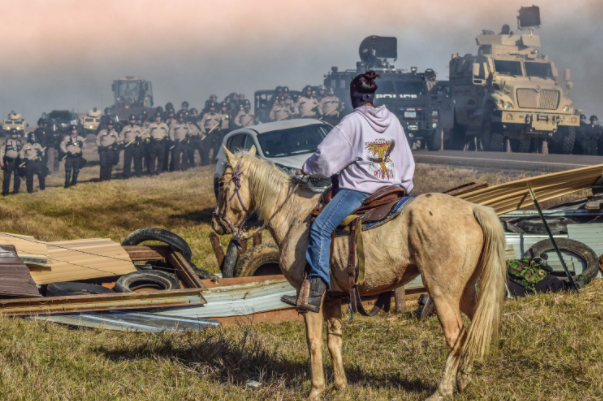
Photo by Ryan Vizzions.

The Dakota Access Pipeline (DAPL) carries 557,000 barrels per day of fracked oil from North Dakota through South Dakota and Iowa to Illinois. There it connects with the Energy Transfer Crude Oil Pipeline (ETCOP) that carries the oil to Texas.

The Indigenous Environmental Network has further noted that the Bayou Bridge Pipeline would be the final link from DAPL and ETCOP to refineries and ports in Louisiana.

In April 2016, Indigenous land defenders established the Sacred Stone Camp at the Standing Rock Indian Reservation (which is situated in North and South Dakota) as a focal point of opposition and resistance to the construction of the Dakota Access Pipeline that threatened cultural sites and their drinking water.

Sylvia McAdam (Saysewahum), who is from the nēhīyaw Nation and now a member of the PBI-Canada Board of Directors, visited the camp.

McAdam says: “It was tense and frightening. Even during the day, there was the airplane and the helicopter that was circling and circling. You couldn’t even rest. I was shocked. I came away from there shocked and astounded at how much military were there. I don’t think people realize how much military activity was directed against that camp.”

After months of resistance, and the criminalization and arrest of many Indigenous land defenders, that camp was cleared by police in February 2017.

Around that time, the then-United Nations Special Rapporteur on the rights of Indigenous peoples Victoria Tauli-Corpuz wrote: “While the actions taking place have been almost completely non-violent and peaceful, there has been a militarized, at times violent, escalation of force by local law enforcement and private security forces.”

After then-US President Donald Trump approved a permit allowing construction of the pipeline to be completed under Lake Oahe, the pipeline began operation in June 2017.

In July 2020, U.S. District Judge James Boasberg order the pipeline to be shut down and drained pending a review of its impact on land and water.

But Dakota Access has appealed the ruling and, as of November 2020, a court decision on the shutdown order was expected within the next couple months.

If the review is approved, the pipeline could be shut down for about 13 months.

With the election of US President Joe Biden, the Indigenous Environmental Network and others are calling on the president to put an end to DAPL.

While the pipeline is entirely within the United States, there are Canadian corporate interests involved in it.

Toronto-based TD Securities provided $360 million in financing for the US$3.8 billion Dakota Access Pipeline project. And Calgary-based Enbridge owns a $1.5 billion/30 per cent interest in the Bakken pipeline system, that includes DAPL.

It has been repeatedly highlighted that the Dakota Access Pipeline has not secured the free, prior and informed consent of the Indigenous peoples impacted by it.

PBI-Canada continues to watch this situation, particularly in relation to the criminalization of Indigenous land defenders defending their territories, the right to free, prior and informed consent, and the involvement of two Canadian corporations – TD Securities and Enbridge Inc. – in the financing and operation of this pipeline.