Home Blog Page 353

Braided Warriors attacked by police at protest against AIG insuring Trans Mountain pipeline

Still from Braided Warriors video.

Braided Warriors were attacked by the police on Friday February 19 in the lobby of the Vancouver branch of AIG Canada, a transnational finance and insurance company that is insuring the Trans Mountain tar sands pipeline in violation of Indigenous rights.

About half of the 1,150 kilometre-long pipeline is set to cross unceded Secwepemc territory without their free, prior and informed consent.

Secwepemc land defender Kanahus Manuel has tweeted: “@BraidedWarriors were violently arrested at #stoptmx #stopinsuringGenocide at AIG Insurance to demand insurance companies stop underwriting #TransMountain pipeline.”

Manuel asks that funds be e-transferred to Braidedwarriors@gmail.com.

Four youth were charged with mischief and obstructing a police officer. At about 11 pm PST the Braided Warriors tweeted: “The four youth who were arrested at the BMO tower have been released. A sacred fire is being held outside police station.”

For a first-hand account of the police violence and arrests, please see this 11-minute Braided Warriors video on Instagram.

The Braided Warriors had also occupied the lobbies of Liberty Mutual Group and Chubb Insurance Co. of Canada earlier in the week.

Eleven companies, including AIG, have been providing about $508 million in liability insurance for the Trans Mountain pipeline.

Kukpi7 Judy Wilson of the Union of British Columbia Indian Chiefs has stated: “The companies insuring Trans Mountain are complicit in Indigenous rights violations.”

When those insurance policies were set to expire on August 31, 2020, AIG Canada was sent this letter asking that it not renew their coverage of the pipeline.

That letter stated: “Human rights groups and communities along the Trans Mountain route have cited concerns over the expansion of tar sands pipelines through communities because of the risks that pipeline workers housed in temporary ‘man camps’ pose to Indigenous women in rural communities. Man camps have been recognized by the United Nations to bring increased sexual violence to communities.”

And it highlighted: “We call on you to adopt, as part of your insurance policies, a requirement to obtain and document the Free, Prior and Informed Consent of impacted communities, especially Indigenous communities.”

Similarly, the United Nations Committee on the Elimination of Racial Discrimination passed this resolution in December 2019 that calls on Canada “to immediately cease construction of the Trans Mountain Pipeline Expansion project and cancel all permits, until free, prior and informed consent is obtained from all the Secwepemc people, following the full and adequate discharge of the duty to consult.”

The Tyee now reports: “The 11 companies currently insuring the Trans Mountain Pipeline expansion project to the tune of US$508 million are set to renew their involvement with the project this summer.”

The Braided Warriors describe themselves as: “Indigenous youth in səl̓ilw̓ətaʔɬ, sḵwx̱wú7mesh, and xʷməθkʷəy̓əm territories defending the land and the people from capitalist colonial violence.”

You can follow them on Twitter, Instagram and Facebook.

Video of the attack posted by Secwepemc land defender Kanahus Manuel as well as other video here.

PBI-Colombia accompanies the Corporation for Judicial Freedom in Ituango where forced displacements are happening now

On February 19, PBI-Colombia tweeted: “PBI accompanies the Corporation for Judicial Freedom (CJL) in Ituango, Antioquia where they draw attention to the lack of security guarantees for human rights defenders and the rural population of the area: 327 people are displaced due to clashes and insecurity.”

The CJL also tweeted: “The Corporation for Judicial Freedom arrived at Ituango with PSG [Social Guarantee Process] and PBI-Colombia. There we were able to verify the difficult situation that the communities of the different villages are going through that today are forced to leave their territories. In total 327 displaced people.”

For a short video and additional tweets on this, click here.

RCN Radio reports: “The mass departure of the peasants occurred after several community leaders received a series of calls and messages from people claiming to be members of illegal armed groups and threatened to attack the population.”

And El Tiempo has explained: “The paramilitaries of the AGC [the Gaitanista Self-Defense Forces of Colombia] began attacking last Sunday [February 14] a group of FARC dissidents, the ’18 Front’, who were returning to a territory from where they had been expelled by the Army, according to [the news agency] EFE.”

Isabel Cristina Zuleta of the Ríos Vivos organization says: “As a result of these combats, the [FARC] dissidents threatened the population as a form of pressure to get the Army to the area and lessen the attack they were experiencing from the paramilitaries.”

The article adds: “Faced with these threats [from the FARC], the [AGC] paramilitaries responded with new intimidations toward the population and assured them that they would burn the houses of those who fled.”

Zuleta says: “The situation is frightening, there are hundreds of families suffering in the village and hundreds of others walking because the paramilitaries, to try to avoid travel, threatened the transport company.”

Zuleta is opposed to the Hidroituango dam. In 2016, Export Development Canada (EDC), Canada’s export-credit agency, provided a $466-million loan to Empresas Publicas de Medellin (EPM), the company building the dam.

PBI-Colombia has previously posted: “Several of the cases that CJL is working on focus on defending the environmental rights of communities, and more specifically, the right to water. One of the sadly famous cases in this area is that of the controversial Hidroituango hydroelectric project, located in the municipality of Ituango.”

PBI-Colombia has accompanied the Corporation for Judicial Freedom, which was was founded in 1993 by a group of lawyers and law students, since 2000.

PBI accompanies other international accompaniment organizations

On February 18, PBI-Colombia posted on its Instagram page: “Did you know that PBI sometimes accompanies other international accompaniment organizations?”

“Here in this photo, PBI brigade volunteers share with colleagues from FOR @peace_presence and Palomas @operazionecolomba in an accompaniment to the San José de Apartadó peace community in Urabá.”

“In other parts of Colombia, we have accompanied by hand with @iapcolombia and @ecapcol, among other international organizations.”

The organizations noted above are FOR Peace Presence (United States), Operazione Colomba (Italy), International Action for Peace (Spain) and Christian Peacemaker Teams/ECAP (US and Canada).

PBI-Colombia highlights: “Together we are stronger!”

Upcoming webinar!

PBI-Canada and PBI-USA are working together on a webinar on Sunday February 28 at 3:30 pm EST for individuals interested in becoming a frontline volunteer with PBI accompanying human rights defenders in Colombia, Guatemala, Honduras or Mexico.

To register for that brigadista webinar, please click here.

CREDHOS meets with Barrancabermeja water utility on concerns about landfill contamination of wetland

On February 18, the PBI-Colombia accompanied organization CREDHOS tweeted: “Meeting with executives of @AguasdeBarranc1, Sinaltrainal, environmental leaders and #Credhos. Analyzing the contamination situation of the #Cienaga #SanSilvestre and the quality of the water that Barranqueños consume.”

Aguas de Barrancabermeja is a Colombian state-owned utility that provides potable water and wastewater services for the residents of Barrancabermeja (Barranqueños). SINALTRAINAL is a trade union, the National Union of Food Industry Workers.

And Cienaga San Silvestre is the San Silvestre wetland/ecosystem, the source of fresh water to nearly 300,000 inhabitants of Magdalena Medio, including Barrancabermeja.

Semana Sostenible has reported: “The Santander Regional Autonomous Corporation (CAS) authorized, between September 2013 and July 2014, the environmental licenses for the construction of two garbage dumps (Anchicayá and Yerbabuena).”

Dr. Yesid Blanco has written: “In my work as both an environmentalist and a physician I have drawn attention to mercury contamination of the city’s water supply associated with a sanitary landfill that threatens a protected wetland, and I have actively opposed fracking in the region in light of the threat it poses to the water supply, among other reasons.”

That landfill, situated in the village of Patio Bonito in Barrancabermeja, was operated by Rediba (but is now operated by the French transnational Veolia).

Blanco adds: “I participated actively in a campaign to remove the mayor of Barrancabermeja for failing to act to protect the public health and the environment, earning me the wrath of certain local political and economic elites.”

Dr. Blanco was forced into exile in November 2018.

On January 20 of this year, shots were fired at the home of environmental defender Yuli Andrea Velázquez of the Federation of Environmental and Tourist Artisanal Fishermen of the Department of Santander (FEDEPESAN) and the Association of Fishermen of the Swamp of San Silvestre (APESCASAN).

After that attack, El Tiempo reported: “Yuli is recognized in her region for denouncing an alleged corruption with the resources that the [state-owned oil] company Ecopetrol [that operates a refinery in Barrancabermeja] and the Santander Regional Autonomous Corporation (CAS) invest to clean the wetland, unclog the pipes and make an environmental recovery of all the wetlands of Barrancabermeja, especially that of San Silvestre.”

Velázquez believes the motives behind the attack she suffered may be related to her defence of the wetland and the allegations of corruption she has made.

She says: “In the year 2018 that I linked to work with APESCASAN I began to identify the impacts we had in the Ciénaga, the problem with Aguas de Barranca and the health filling of the municipality, which throws its waste into a pipe.”

PBI-Canada has also taken note of the potential relationship between the health of the wetlands and a Canadian corporation.

In March 2019, El Espectador reported that fishers have denounced fish mortality in the San Silvestre spout that they attribute to the Sogamoso dam. Mongabay has also reported that fishers have expressed concern about the nearby Llanito wetland due to the dam.

In 2016, Toronto-based Brookfield Assets Management bought a majority share in the Colombian company Isagen which owns the dam.

In November 2019, CREDHOS president Ivan Madero along with Julia Figueroa and Andrea Nocove from the CCALCP legal collective stopped at the Brookfield office in Toronto during a PBI organized advocacy tour.

PBI-Canada & Amnesty International Canada webinar on the impact of Canadian mining on Indigenous rights in Mexico, March 11

Peace Brigades International (in Mexico and Canada) in collaboration with Amnesty International Canada is hosting a webinar with Isela González, the director of the Sierra Madre Alliance (ASMAC) and Neftalí Reyes Méndez, a coordinator with Services for an Alternative Education (Educa Oaxaca).

The webinar will take place on Thursday March 11 a 3:30 pm EST.

To register for the webinar, please click here.

The Mexican Network of Mining Affected People has highlighted: “65 per cent of foreign mining companies in Mexico are listed in Canada.”

ASMAC accompanies Indigenous communities such as Coloradas de la Virgen in the Sierra Tarahumara region in the northwestern state of Chihuahua.

Indigenous Rarámuri defender Julián Carrillo had spoken against the environmental impacts of a concession near his community granted to a Canadian mining company without free, prior and informed consent just a week before he was murdered.

Educa Oaxaca also accompanies Indigenous communities that defend their territories from extractive projects, notably those impacted by the Vancouver-based Fortuna Silver Mines Inc. owned mine in San Jose del Progreso in the southwestern state of Oaxaca.

That mine also lacks free, prior and informed consent from affected Indigenous peoples (including in the community of Santa Catarina Minas) and has impacted the drinking water in the nearby community of Magdalena Ocotlán.

This webinar will highlight:

– the experiences of the Indigenous communities of Coloradas de la Virgen and Santa Catarina Minas with Canadian mining companies

– the need for Canadian companies operating in Mexico to respect the UN recognized Indigenous right to free, prior and informed consent

– what people in Canada can do to hold the Canadian government and mining companies accountable for the infringement of human rights.

To register for this 90-minute webinar – that will be in both Spanish and English – click here.

PBI-Mexico has accompanied ASMAC since 2018 and Educa Oaxaca since 2013.

PBI-Honduras accompanies the National Union of Rural Workers at media conference on food insecurity and agrarian crisis

On February 18, PBI-Honduras posted: “On Tuesday we observed the press conference called by organizations articulated in Via Campesina Honduras (CNTC Tegucigalpa, CODIMCA Honduras, UCIH, CILAH and FRENAJUC*) where they communicated their position on the agrarian crisis in times of pandemic, Eta and Iota.”

“They stated that ‘66% of the population in Honduras is affected by food insecurity.’”

PBI-Honduras adds: “In view of this food crisis, exacerbated by the pandemic, the passage of hurricanes and climate change, they demand the approval of the Emergency Law for the Reactivation of the Agricultural, Livestock and Forestry Sector.”

Pasos de Animal Grande reported: “Organizations brought together by Via Campesina demanded on February 16, 2021, in front of the National Congress of Honduras the approval of an emergency proposal submitted on February 06, 2020 to restore agricultural institutionality; end the militarization of the sector, pass credit laws for women, and create an instance that aims to increase productivity and production and combat poverty and unemployment.”

Earlier this week, Al Jazeera reported: “The Sula Valley, Honduras’s most agriculturally productive, was so heavily damaged by hurricanes Iota and Eta that international organizations have warned of a food crisis.”

That article adds: “The World Food Programme says three million Hondurans face food insecurity, six times higher than before the hurricanes. The dual hurricanes affected an estimated four million of 10 million Honduran people. The area is also Honduras’s hardest-hit by COVID-19 infections.”

The Emergency Law that is being demanded by the groups at the media conference is summarized in these 8-points that can be read here.

One of those demands is: “Grant agricultural credit to small and medium-sized producers at 0% interest for five consecutive years over those affected by drought, climate change and exclusionary public policies.”

The Peace Brigades International-Honduras Project began accompanying the National Union of Rural Workers (CNTC) in May 2018.

*CODIMCA – Council for the Integral Development of Peasant Women

UCIH – Union of Indigenous Campesina of Honduras

CILAH – Lenca Indigenous Environmental Council of Honduras

FRENAJUC – National Peasant, Indigenous, and Afro-descendant Youth Front

A TV news report on the media conference can be seen here.

PBI-Colombia accompanies CREDHOS at meeting with FEDEPESAN that has received threats for their defence of the environment

On February 18, CREDHOS tweeted: “#Credhos providing legal and political support to the Federation of Environmental and Tourist Artisanal Fishermen of the Department of Santander – #Fedepesan – in the face of #Threats and #Attacks received for their work in defense of the #Environment and against #Corruption.”

Last month, CREDHOS tweeted: “CREDHOS accompanies environmental organizations and the leader Yuli Velazques of [FEDEPESAN] in the face of events that threatened her life and integrity in Barrancabermeja.”

El Tiempo had reported: “On Wednesday, January 20, the environmental engineer, environmental defender and member of the Barrancabermeja Fisheries Federation, Yuli Andrea Velázquez, was the victim of an attack on her home.”

Several shots were fired at her home by gunmen on a motorcycle.

El Tiempo has also reported: “Yuli is recognized in her region for denouncing an alleged corruption with the resources that the company Ecopetrol and the Santander Regional Autonomous Corporation invest to clean the swamps, unclog the pipes and make an environmental recovery of all the swamps of Barrancabermeja, especially that of San Silvestre. Since, according to her complaints, these resources are not reflected in the recovery of these ecosystems. She has also denounced the contamination of the San Silvestre swamp and the El Llanito swamp.”

Sputnik now reports: “For Yuli, the motives behind the attack she suffered may be related to her activity in defence of the wetland and to the allegations of corruption she has made.”

“She says that as a result of identifying the sources of pollution, it was realized that the environmental authority of the department, which is the Regional Autonomous Corporation of Santander (CAS), had resources to care for, clean and maintain the wetland.”

That article adds: “Velasquez reports that the company that won the tender did not hire the fishermen of San Silvestre but carried 30 people from another deceived region, who paid them less for their fees and who left them lying in the wetland as if they were displaced.”

FEDEPESAN also recently took part in the protest against fracking in Puerto Wilches that took place on February 11. The organizers of that protest, the Committee for the Defense of Water, Life and Territory of Puerto Wilches (AguaWil), have also received threats.

PBI-Mexico accompanied ASMAC continues to seek justice for Rarámuri land defender Julian Carrillo

Photo: PBI-Mexico accompanied ASMAC at the media conference in which Amnesty International released their report on the situation faced by Indigenous land defenders in the Sierra Tarahumara region in the state of Chihuahua.

Two suspects in the murder of Julian Carrillo, a Raramuri defender of the Coloradas de la Virgen community, were arrested in January 2019.

Now La Jornada reports: “The Attorney General’s Office of the State of Chihuahua issued a conviction against one of the murderers of the activist and defender of the territory of the Sierra Tarahumara, Julián Carrillo Martínez, who was killed on October 24, 2018, in the Coloradas de la Virgen community, municipality of Guadalupe and Calvo.”

That article adds: “The custodial sentence imposed on P.C.C. is based on the National Law of the Comprehensive Criminal Justice System for Adolescents; In accordance with Articles 145 and 164, on the rules for the determination of sanction measures.”

The day prior, February 14, El Diario reported: “The criminal proceedings followed by Feliciano Q.M. for the murder of indigenous activist Julián Carrillo are characterized by extreme security measures. Unlike other Oral Judgments, this case specifically has specific measures that guarantee greater discretion than usual.”

The Sierra Madre Alliance (ASMAC) accompanies the community of Coloradas de la Virgen. In turn, PBI-Mexico has accompanied ASMAC since 2018.

The right to territory for the Rarámuri and Odami of Coloradas de la Virgen is under threat from forest harvesting and mining concessions.

Kathy Price at Amnesty International Canada has noted: “The assassination [of Julian Carrillo] came just a week after he spoke out against the environmental impacts of a mining concession awarded by authorities to a Canadian mining company without the free, prior and informed consent of the Indigenous people whose lands would be impacted.”

Independent journalist Martha Pskowski has also noted that the murder of Carrillo discouraged some Rarámuri people from speaking out when Calgary-based TC Energy began building a natural gas pipeline through the area.

Webinar on March 11, 3:30 pm EST

Peace Brigades International and Amnesty International-Canada are co-hosting a webinar on March 11 featuring Isela Gonzalez, the director of ASMAC, speaking about Indigenous rights and the impact of Canadian mining in the state of Chihuahua.

To register for that webinar, please click here.

PBI-Colombia accompanied CCALCP concerned about the forced eradication of coca crops

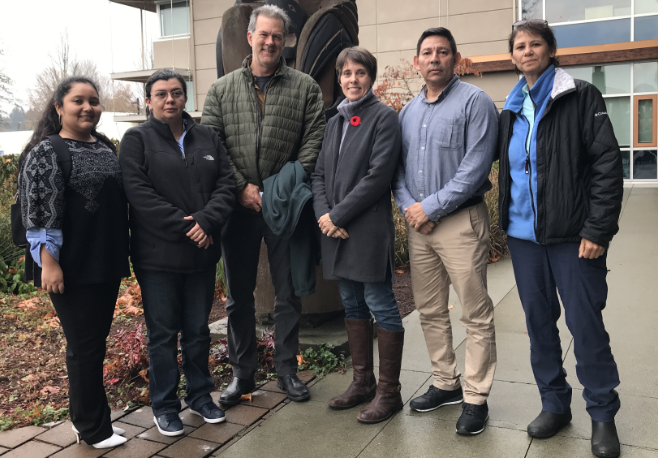
Photo: In November 2019, Julia Figueroa met with Sonia Furstenau, now the leader of the Green Party of British Columbia, and shared her concerns about the health, social and environmental impacts of the resumption of glyphosate spraying in Colombia.

When Julia Figueroa and Andrea Nocove from the Luis Carlos Perez Lawyers’ Collective (CCALCP) took part in a PBI advocacy tour in Canada in November 2019 they highlighted concerns about the forced eradication of coca crops in Colombia.

Earlier this week, Colombia Informa reported: “The peasant communities of Catatumbo, North Santander, reported that the National Army has been carrying out forced eradication operations for more than a week.”

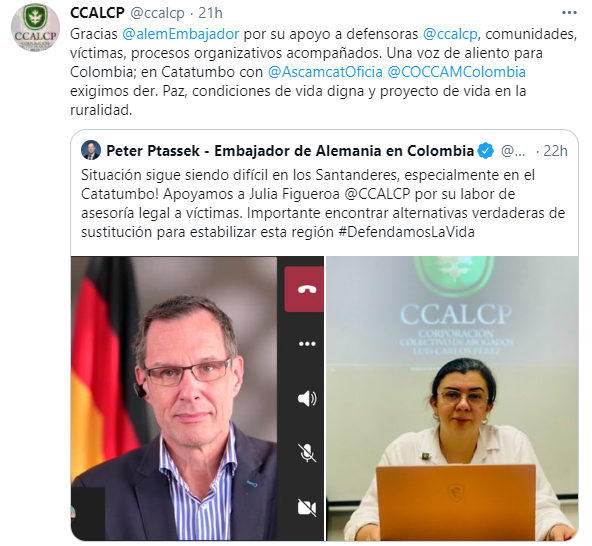
And yesterday, the German Ambassador to Colombia tweeted: “The situation continues to be difficult in Los Santanderes, especially in Catatumbo! We support Julia Figueroa of @CCALCP for her work of legal advice to victims. It is important to find true substitute alternatives to stabilize this region.”

In response, CCALCP tweeted: “Thanks @alemEmbajador for their support of defenders @ccalcp, communities, victims, accompanied organizational processes. A voice of encouragement for Colombia; in Catatumbo with @AscamcatOficia @COCCAMColombia we demand peace, decent living conditions and life project in rural areas.”

Colombia Informa also notes: “Junior Maldonado, a member of Ascamcat, denounced at the end of January that the Ministry of Defense and the Anti-Narcotics Directorate informed the mayor of the municipality of Hacarí about the start of the Programme for the Eradication of Illicit Crops through Terrestrial Spraying from February 1 of this year.”

Latin America Reports has also noted: “Colombia could be just a few weeks away from restarting its controversial fumigation program that sprays the herbicide glyphosate from airplanes to try and kill coca plants, a government official said.”

“After halting the fumigation efforts in 2016, Colombia will again become the only country in the world to use the dangerous chemical via aerial spraying.”

That article adds that the Colombian government wants to resume aerial spraying in April.

The Programa Nacional Integral de Sustitución de Cultivos de Uso Ilícito (National Comprehensive Program for the Substitution of Illicit Crops) is a key part of the 2016 Peace Agreement between the Government of Colombia and the FARC.

The German newspaper Deutsche-Welle has previously highlighted: “By not giving farmers the help they need to make the transition, Isabel Pereira [an analyst with Dejusticia] believes the Duque administration is actively weakening the 2016 deal and threatening the possibility of a lasting peace.”

PBI-Colombia has accompanied CCALCP since 2006.


CREDHOS accompanied AguaWil water defenders receive threats for their opposition to fracking in Puerto Wilches, Colombia

Numerous organizations took part in the recent AguaWil organized cacerolazo protest against fracking including the Association of Fishermen (FEDEPESAN) and the Union of Workers of the Petroleum Industry (USO) whose banners can be seen in this photo.

On February 17, Infobae reported: “On Tuesday, February 16, the Colombia Free Alliance of Fracking reported on threats suffered by several young people from the Committee for the Defense of Water, Life and Territory of Puerto Wilches (AguaWil) for their stance on this practice of hydraulic fracturing in oil wells.”

AguaWil is accompanied by the Regional Corporation for the Defence of Human Rights (CREDHOS), which in turn is accompanied by PBI-Colombia.

The Infobae article adds: “Since December [AguaWil] has led peaceful actions of an educational, cultural and mobilization nature to express their opposition to the ‘Integral Research Pilot Projects – PPII’ [otherwise known as fracking pilot projects].”

Caracol also reports: “A letter to President Ivan Duque, signed by 33 congressmen, has denounced the alleged threats of armed men against a group of young water defenders in Puerto Wilches, Santander.”

That article adds: “In the missive [letter to the Colombian president] they ask the government to protect the lives of these young people belonging to the Committee for the Defense of Water, Life and territory (AguaWil).”

Polls show opposition to fracking

Meanwhile a new Oil Barometer poll shows that 69 per cent of people in Puerto Wilches would not agree with fracking being carried out in their municipality. Nationally, 73 per cent of Colombians would not agree with fracking being carried out in their municipality.

Colombia Reports has also highlighted that “more than 90 per cent of Colombians are against fracking, according to a [February 2019] poll.”

UN Special Rapporteurs say fracking is inconsistent with human rights

On January 29, UN Special Rapporteur on human rights and the environment David Boyd stated: “In light of its obligations under constitutional, international, human rights and environmental law …I respectfully maintain that the government of Colombia must pass a law to prohibit fracking.”

Then on February 12, the UN Special Rapporteur on toxic substances and human rights Marcos Orellana stated: “New investments in this field are incompatible with the protection of human rights. …It violates the right to live in a healthy environment and undermines sustainable development.”

Canadian company bids to frack near Puerto Wilches

While the National Hydrocarbons Agency (ANH) has already awarded a contract to Ecopetrol to conduct a fracking pilot project near Puerto Welches, three more such contracts are expected to be awarded on March 30.

One of those contracts could go to ExxonMobil in partnership with Toronto-based Sintana Energy Inc. (and its Colombian subsidiary Patriot Energy) that would likely involve the VMM-37 block also situated near Puerto Wilches.

With Colombia suffering the highest number of human rights defenders killed last year, PBI-Canada expresses its concern about the threats against the young water defenders and the possible involvement of a Canadian oil and gas company exacerbating the situation.

#SOSPuertoWilches