Home Blog Page 352

PBI-Guatemala makes observation visit to Petén to meet with social organizations and learn about the human rights situation

On February 25, PBI-Guatemala posted: “During our observation visit in Petén, we met with representatives of Otran trans Petén; El Frente Petenero; Cooperativa La Otra; Mujeres de Petén Ixqik; Asociación De Mujeres Ixmucáne – Petén; Dejando huella and the Delegación Permanente de la Sierra Lacandón y Laguna Del Tigre.”

PBI-Guatemala adds: “We were able to collect information on the human rights situation, especially on the effects caused by the Covid-19 pandemic, the passage of tropical storms and the great concern regarding the increase in cases of disappearance and violence against children and women in the department.”

In December 2020, Guatemala’s National Coordinator for Disaster Reduction (Conred) reported that most of the people displaced by the Eta and Iota storms are located in the departments of Alta Verapaz, Peten, and Izabal.

Explica has reported that there three alerts for missing minors in Peten at this moment, that there have been 15 disappearances so far this year in Peten, and that the country is shocked by the death of 8-year-old Sharon Figueroa Arriaza earlier this month.

The British ambassador to Guatemala also visited Peten this month and is providing funds to provide personal protective equipment (PPE), COVID-19 medical kits, and to support outreach to reaise awareness about COVID-19 in rural communities.

PBI-United Kingdom has previously noted: “Although we do not accompany in this department, every six months PBI-Guatemala undertakes a visit as a way of following up on the human rights situation.”

It adds: “PBI-Guatemala holds meetings with different social actors, to advocate around various problematic issues: protected areas (evictions, agrarian conflicts illegal detentions, restricted freedom of movement); militarization; women’s rights; megaprojects (tourist and investment projects, hydroelectric dams, etc.); and palm oil.”

For our December 2019 article on PBI-Guatemala’s visit to the department, please see PBI-Guatemala visits environmentally-threatened department of Petén.

Ecopetrol president updates investors on fracking pilot project in Puerto Wilches as social leaders warn of harm to water and biodiversity

On February 24, the president of the Colombian state oil company Ecopetrol, Felipe Bayón, and other executives updated investors on fracking in Colombia.

Here is an overview to understand the context of his update yesterday:

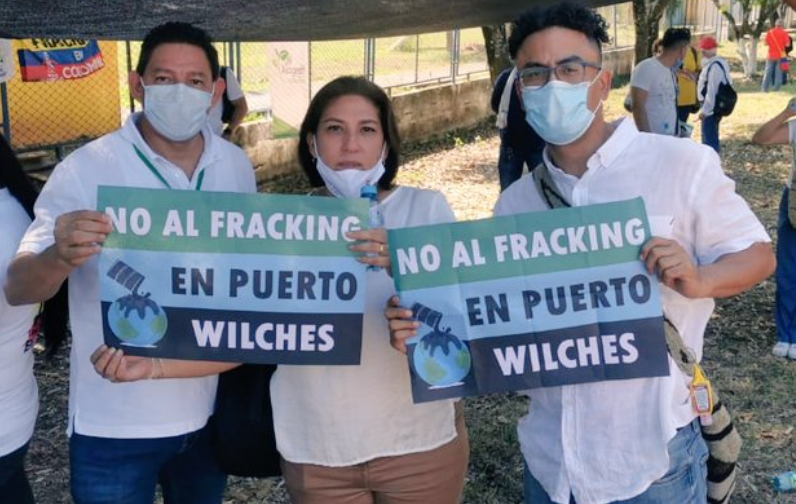
Protests against fracking in Puerto Wilches

The first licence for a fracking pilot project in Colombia was awarded by the National Hydrocarbons Agency (ANH) to Ecopetrol on November 25, 2020 for its Kalé project near the community of Puerto Wilches, Santander.

Hundreds of people in Puerto Wilches protested against this pilot project on December 13 and then again on February 10 of this year.

Blu Radio reports: “[The fracking pilot project] provoked protests from social organizations that say the pilot does not have a social license because it will affect the biodiversity of the area, especially the wetlands [ciénagas] of Paredes and Yariguí, in addition to the damage it will cause in species such as manatee, which is endangered.”

This recent Oil Barometer poll found that 69 per cent of people in Puerto Wilches oppose fracking and that 73 per cent of Colombians are opposed to fracking.

Threats against social leaders opposed to fracking

Reuters also reports: “Environmentalists have called for the project to be suspended after threats against anti-fracking activists.”

Bayón says: “We emphatically reject those threats. We have said this is an exercise where everyone has to have an opinion.”

Despite this assurance from the oil company president, the reality remains that 177 human rights defenders were murdered in Colombia last year. And in 2019, 64 land and environmental defenders were killed in Colombia.

7 billion barrels of oil in Puerto Wilches

Oilprice.com has previously reported that Ecopetrol estimates that Colombia may have up to 12 billion barrels of recoverable shale oil. Valora Analitik now reports that Bayón says there may be up to 7,000 million (7 billion) barrels of oil in the pilot area.

Council of State scheduled to meet on March 11

The Valora Analitik article also notes: “Bayón explained that on March 11, the State Council [the supreme judicial tribunal with jurisdiction over administrative issues in Colombia] will begin the discussion on the regulation of fracking ‘which will take several months.’ But, he said, the regulation of the pilots is in force and they will continue.”

Caracol Radio adds: “Juan Pablo Sarmiento leading environmentalist of the Santanderes [the department/province of Santander where Puerto Wilches is located] who participated in establishing this process [at the Council of State, says] groundwater pollution is very risky and this type of extraction should be avoided.”

Baseline measurements have now started in Puerto Wilches

Blu Radio reports that Ecopetrol has now set up three air monitoring stations in Puerto Wilches that will measure air conditions there for the next three months to get baseline readings before the Kale fracking pilot project begins.

Three months takes us to about the beginning of June.

Fracking to begin by the end of 2021

Valora Analitik adds: “Bayón confirmed what was said yesterday in that for that pilot he hopes to have the licence by the end of 2021 and to be able to start with the activity in the area as soon as that happens.”

Three more fracking pilot projects to be awarded on March 30

BNAmericas has reported that four companies have prequalified for a second round of licensing for fracking pilot projects in Colombia: ExxonMobil (in partnership with Toronto-based Sintana Energy), Ecopetrol, Drummond, and Tecpetrol.

That article notes: “ANH [the National Hydrocarbons Agency] has said it hopes to award an additional three contracts in the second round, which will include acreage in the Cesar Ranchería and Middle Magdalena Valley basins.”

UN Special Rapporteurs and human rights concerns

On January 29, United Nations Special Rapporteur on human rights and the environment David Boyd called on the House of Representatives in Colombia to prohibit fracking. Boyd stated: “In light of its obligations under constitutional, international, human rights and environmental law, fossil fuels must be replaced by renewable energies.”

Then on February 12, UN Special Rapporteur on toxic substances and human rights Marcos Orellana stated: “New investments in this field are incompatible with the protection of human rights. This, because fracking generates toxic pollution, which threatens life, health and ecosystems; aggravates the planetary emergency and climate change; it violates the right to live in a healthy environment and undermines sustainable development.”

PBI accompaniment

In November 2019, Peace Brigades International hosted an advocacy tour in Canada with representatives from the human rights organizations CREDHOS and CCALCP.

We continue to amplify their concerns about fracking, the risks faced by environmental defenders, and to monitor the human rights implications of fracking in Colombia.

Analyst highlights the legal, reputational and market valuation risks transnational corporations could face in Colombia

Photo: A still from this video of eight social leaders from San Luis de Palenque in custody after protesting against Toronto-based Frontera Energy.

A recently published article in Americas Quarterly highlights the risks associated for transnational corporations in relation to human rights violations.

The article by Raul Gallegos, a Bogota-based Director at the global firm Control Risks and their head of the political risk practice in the Andean region, can be read in full at ‘Companies Should Examine Their Troubled Pasts – Before Courts Do It for Them’.

Deals with the police could carry risks for companies

Gallegos writes: “Multinational companies operating in Colombia continue to strike financing deals with the police, the military and the prosecutor’s office in exchange for protection from criminals, armed actors and activists who sabotage their operations.”

He adds: “These controversial accords remain legal for now, but journalists and NGOs have repeatedly denounced them for fostering corruption within the security forces, and for possibly underwriting the killing and intimidation of activists and community leaders.”

In this report to the Human Rights Council last year, then-United Nations Special Rapporteur on the situation of human rights defenders Michel Forst raised (in point 30 on page 9) the situation of Toronto-based Frontera Energy signing contracts with the military that appear to be related to the subsequent criminalization of eight social leaders in San Luis de Palenque concerned by the impacts of this Canadian company on their community.

Relying on impunity is a dangerous underestimation of risks

Gallegos notes: “Companies also believe that being held accountable in a court of law remains unlikely. But in a world focused on fixing environmental, social and governance wrongs, this is a dangerous underestimation of legal and reputational risks ahead.”

Human rights violations can cut a company’s market valuation

He also writes: “Credit rating agencies are incorporating social and environmental considerations into the credit scores of sovereign and corporate bonds, which means lenders and markets will become increasingly sensitive to human rights abuses by governments and companies. A recent working paper by the University of Oxford’s Nathan Lane has shown that human rights accusations can already cut a company’s market valuation by an average of $100 million. “ For more commentary on that report, click here.

It should also be noted that Shin Imai and Sarah Colgrove of the Justice and Corporate Accountability Project recently reported that stock in Vancouver-based Tahoe Resources dropped from $27 to $5 a share after a string of lawsuits and violent conflicts related to Indigenous opposition to their Escobal mine in Guatemala.

Drummond executives could face jail for paramilitary killing of union leaders

And Gallegos cautions: “Colombia’s prosecutor general recently accused executives at [the Alabama-based] Drummond, a global coal producer, of links to paramilitaries who assassinated union leaders nearly 20 years ago – one of the highest-profile cases of alleged human rights violations by a company in a conflict zone. The case can mean potential jail time for senior executives if they are found guilty, a first in this war-torn nation.”

BNAmericas reported earlier this month that Drummond had passed a final qualification stage and was authorized to submit an offer for a fracking pilot project in Colombia by March 8 (for a contract to be awarded on March 30).

PBI-Canada continues to follow these issues raised by Gallegos particularly in relation to the weaknesses in existing mechanisms to address corporate wrongdoings as well as the concerns being raised by Colombian social leaders about the operations of Frontera Energy (noted above), Calgary-based Parex Resources and its Aguas Blancas operations near Simacota and the possible bid by Toronto-based Sintana Energy (in collaboration with ExxonMobil) for a fracking pilot project near Puerto Wilches.

COSPACC rejects the capture of social leader Miguel Yesid Daza who defends the rights of communities against oil projects

On February 23, COSPACC tweeted: “We reject the capture of Miguel Daza, human rights defender from [the Social Corporation for Community Advice and Training – COSPACC] and [the National Peasant Association José Antonio Galán Zorro – ASONALCA] because Being a Social Leader is Not a Crime. No more judicial setups against social leaders.”

Colombia Informa further reports that Daza was captured in his home at around 4 am on February 23 in the municipality of Aguazul, Casanare.

That article highlights: “Daza has promoted mobilizations for the defense of its territory and for the rights of communities in the area of influence of oil projects.”

The organizations also affirm: “The capture is within the framework of a policy of political extermination through the judicialization of the social movement in Casanare. The extermination seeks to dismantle the social fabric and clear the territory so that the oil companies carry out their policies without any opposition and so that they continue with the breaches towards the communities and social compensation.”

And Violeta FM adds: “Unofficially, it is said that the person in charge of the investigation is the Prosecutor, Harles Max Cortés, who specializes in issues against organized crime. …It is the same Prosecutor who largely led the process of the eight social leaders of the municipality of San Luis de Palenque…”

Following the capture of Daza, the Peace Brigades International-Colombia Project tweeted this report by COSPACC, the Committee in Solidarity with Political Prisoners (CSPP) and allies titled: Criminalization of the defence of human rights in Colombia: The judicialization of defenders of land, territory, environment and peace.

PBI-Colombia commented in that tweet: “Alarming the figures of judicialization of the defense of human rights defenders in Colombia. Of the 249 defenders prosecuted between 2012-19, 74% of them exercised environmental leadership.”

That report highlights the “emblematic case” of the eight social leaders in San Luis de Palenque, Casanare criminalized by Toronto-based Frontera Energy:

Excerpts from this report also note:

The full report can be read here.

PBI-Colombia has accompanied COSPACC since 2009.

PBI-Colombia accompanies NOMADESC at verification mission meeting with embassies in Buenaventura

Photo by NOMADESC.

On February 22, the Peace Brigades International-Colombia Project accompanied the Association for Research and Social Action (NOMADESC) on a verification mission meeting in Buenaventura, Valle del Cauca.

NOMADESC tweeted: “National and International On-site Verification Mission that expects to follow up on the commitments made by the State and take legal, political and social measures to overcome the current humanitarian crisis in the main port of Buenaventura.”

NOMADESC adds the verification mission includes representatives from the embassies of France, Germany, Norway, Ireland, the United Kingdom and Sweden as well as the European Commission and the Office of the United Nations High Commissioner.

It also notes that the Civic Unemployment Committee, dhColombia and the Equipo Jurídico Pueblos are participating with Oxfam and Peace Brigades International present.

Earlier this month, WOLA had highlighted in this tweet: “Social justice groups are asking [Colombian president] Ivan Duque, the UN and the OAS to support creating an international mission that would document how state neglect and structural racism are behind the crises of violence and poverty in Colombia’s biggest port city Buenaventura.”

Ten days ago, PBI-Colombia also accompanied NOMADESC on a march in Cali (the capital city of Valle del Cauca) calling attention to the situation of escalating violence and human rights violations in Buenaventura.

PBI-Colombia has also previously noted that NOMADESC has undertaken research “to show how the current port expansion and infrastructure development are linked to the human rights violations” and that a report by the Inter-Church Commission for Justice and Peace explains how living conditions in Buenaventura have deteriorated due to the development and continued expansion of the port.

In May 2017, Buenaventura residents held a 22-day civic strike to protest investment in the port rather than the spending needed to build a local hospital and provide access to potable water. The Colombian government responded with the ESMAD riot police.

Canadian organizations – including CUPE, PSAC, CUPW and the Steelworkers – have worked in solidarity with the leaders of that strike.

PBI-Colombia has accompanied NOMADESC since 1999.

The trial for Guapinol water defender Jeremías Martínez begins today in Tegucigalpa, Honduras

On the morning of February 22, Libertad para los defensores de Guapinol (Freedom for the defenders of Guapinol) tweeted: “Minutes from the start of the trial of Jeremías Martínez, one of the 8 defenders of water and life.”

Jeremías is one of the defenders who has been imprisoned for protecting the Guapinol River from being polluted by the Inversiones Los Pinares mine.

He has introduced himself as follows:

“I’m Jeremias & I’m 64 years old. I’m a father and a member of a peasant enterprise of the Unified Peasant Movement of Aguan (MUCA). I have been in jail since December 8, 2018, for defending the Guapinol and San Pedro rivers in Honduras.”

His trial, which is taking place in Chamber 1 of the Court of Judgment in Tegucigalpa, is expected to conclude on Thursday February 25.

Timeline

In April 2013, Emco Mining (now Inversiones Los Pinares) requested two mining concessions in the Montaña de Botaderos Carlos Escaleras Mejía National Park.

On December 16, 2013, the Honduran Congress cut 217 hectares from the core zone of the park from which construction was prohibited. On January 28, 2014, the first licence was granted to Emco Mining for their planned open-pit iron oxide mine.

By 2017 the Municipal Committee for the Defence of Public and Common Goods had been created and called for public consultations so that community members could decide whether they wanted a mine in their area.

Then in March 2018, the company began building an access road to the planned mine site and community members reported that the Guapinol River, a vital source of drinking water for them, had become muddied.

By August 1, 2018, the community established an encampment that blocked the construction of the access road.

Then on October 27, 2018, more than 1,500 police officers and military personnel began the forceful expulsion of the protest camp from the road worksite.

As noted above, Jeremias has been in pre-trial detention since December 8, 2018.


ASMAC director Isela Gonzalez to speak on Indigenous rights and Canadian mining in Chihuahua, Mexico on March 11

Photo: Isela Gonzalez, director of the Sierra Madre Alliance (ASMAC). Photo by PBI-Mexico.

This upcoming webinar jointly organized by Peace Brigades International and Amnesty International Canada will feature Isela Gonzalez, a nurse turned activist and director of the Sierra Madre Alliance (ASMAC).

PBI-Mexico has accompanied ASMAC since 2018 and in turn ASMAC accompanies Indigenous communities such as Coloradas de la Virgen in the Sierra Tarahumara region in the northwestern state of Chihuahua.

The Guardian has reported: “Isela Gonzalez has been threatened more times than she can remember by university-educated men in suits, whose business interests – in logging, mining, agriculture and narcotics – are challenged by her work as director of Alianza Sierra Madre to protect indigenous land rights in Mexico’s western Sierra Madre.”

“Armed guards have been deployed by the state to provide Gonzalez with 24-hour protection, panic-buttons have been installed in her office, locks have been upgraded in her home, and she and her staff have received crisis training.”

That article adds: “To defend the Tarahumara’s rights, Gonzalez has organized protests, led occupations of government offices, filed lawsuits and compiled dossiers for the national government, the Inter-American Court for Human Rights and the United Nations. Part of her motivation is to ensure the deaths of her friends is not for nothing.”

Canadian mining in Chihuahua

The Mexican Network of Mining Affected People has highlighted: “65 per cent of foreign mining companies in Mexico are listed in Canada.”

In December 2019, this civil society statement highlighted:

“In Chihuahua, in the Ráramuri community of Coloradas de La Virgen, located in the Sierra Tarahumara, four mining concessions were granted without guaranteeing the people’s right to their ancestral lands and consultation: three to individuals and the fourth to the mining company Evrim SA de CV, which belongs to the Canadian group [Vancouver-based] Evrim Resources Corp.”

In June 2020, Evrim Resources Corp. merged with Renaissance Gold, Inc. to form a new royalty business named Orogen Royalties Inc. based in Vancouver.

The civil society statement adds:

“Resisting death plans in this region where extreme violence reigns has a cost: comrade Julián Carrillo, from the Network in Defense of the Indigenous Territories of the Sierra Tarahumara, was assassinated on October 24, 2018, shortly after the community denounced the existence of these concessions.”

Two suspects in the murder of Julian Carrillo were arrested in January 2019. On February 13, 2021, one of those two suspects was convicted in court and sentenced to three years in jail. The trial of the second person accused continues.

Other Canadian mining concessions in Chihuahua include: Magna Gold Corp. and the Margarita Silver project in Satevo; Monarca Minerals and the San José project; and Silver Spruce Resources Inc. and the Pino de Plata Ag project. There is also Evrim Resources/Orogen Royalties and the Cerro Cascaron project.

To register for this webinar — ASMAC & Educa Oaxaca on Indigenous rights and Canadian mining in Mexico — on March 11, please click here.

New legislation further criminalizes land defenders and water protectors in Canada and the U.S.

Photo of a round dance on a CN railway track in Edmonton, Alberta in solidarity with Wet’suwet’en land defenders; February 2020. Photo by Postmedia News.

Legislation is being proposed in Manitoba as well as Montana, Minnesota, Arkansas and Kansas that would further criminalize peaceful protests against oil and gas infrastructure (including pipeline construction sites) and mines.

Similar legislation already exists in Alberta as well as fourteen American states.

This legislation appears to be in reaction to the solidarity protests against the Coastal GasLink fracked gas pipeline on Wet’suwet’en territory in Canada as well as the Standing Rock resistance to the Dakota Access fracked oil pipeline in North Dakota.

An article in the Huffington Post begins with the story of Indigenous land defender Dawn Goodwin who recently participated in a protest in Minnesota against the Line 3 tar sands pipeline being built by the Calgary-based transnational corporation Enbridge.

It reports: “Without realizing it, she’d stepped over an invisible border and had officially trespassed into a construction site. Had any of her fellow activists caused even minor damage to equipment at the site, [the proposed bill in Minnesota would mean Goodwin could have faced] up to 10 years in prison and $20,000 in fines.”

The article further notes that the legislation in Arkansas proposes up to 6 years in prison and a $10,000 fine for people who enter or remain in a fenced off area associated with natural gas and oil production and storage designated as critical infrastructure.

It is also conceivable under that bill that painting protest slogans on construction materials at a pipeline construction site would be seen as causing “damage” and result in up to 20 years in prison and a $15,000 fine.

The legislation in Montana proposes up to 6 months in jail or a $1,500 fine and then quickly escalates to up to 30 years in jail and a $150,000 fine (or both) if (the vaguely defined offence of) “tampering” with the facility is involved.

The article highlights: “State disclosure records routinely show lobbyists for companies such as [Calgary-based] Enbridge, Exxon Mobil Corp., Koch Industries and Marathon Petroleum consulting lawmakers on the legislation.”

In Canada, Bill 1, the Critical Infrastructure Defence Act, received Royal Assent and came into force in the province of Alberta on June 17, 2020.

The Act means that a blockade or protest against pipelines, oil and gas sites or mines, could result in 6 months in jail and fines ranging up to $25,000.

Similarly, the Manitoba Energy Justice Coalition has noted: “The provincial government introduced Bill 57, the Protection of Critical Infrastructure Act, on November 2, 2020… The bill aims to further criminalize people participating in protests that block roads, railways, and potentially other infrastructure deemed critical.”

The text of Bill 57 will reportedly not be available until the spring session of the Manitoba Legislature later this year.

In stark contrast, Global Witness has highlighted that governments should: “guarantee that defenders’ human rights are protected”, “legally legitimize the role of land and environmental defenders” and “safeguard the rights of defenders and protesters to free assembly and speech, as well as potential recourse to civil disobedience.”

The UN Human Rights Council has also passed this resolution that affirms: “Environmental human rights defenders must be ensured a safe and enabling environment to undertake their work free from hindrance and insecurity, in recognition of their important role in supporting States to fulfil their obligations under the Paris Agreement.”

PBI-Canada expresses the concern that the legislative acts being proposed and passed undermine fundamental human rights and further criminalize and put at risk land and environmental rights defenders and their allies.

Birch Narrow Dene Nation land defenders in Saskatchewan set up blockade to stop uranium company on their territory

On February 21, CBC reported: “A northern Saskatchewan First Nation blockaded a road and issued a cease and desist order against a Toronto uranium company. Birch Narrows Dene Nation officials say they took action after Baselode Energy workers started surveying the band’s traditional territory without consent.”

The article adds: “Birch Narrows trapper and elder Ron Desjardin discovered the survey crew earlier this month on one of the community’s trap lines 600 kilometres northeast of Saskatoon. A teepee blockade was set up across the road and Birch Narrows leaders issued a cease and desist order against the company.”

“Desjardin said the endangered woodland caribou are his biggest concern. [The area is home] to endangered woodland caribou, lynx and other wildlife. Birch Narrows wanted a detailed wildlife and habitat impact study conducted before things went any further.”

“Baselode board chair Stephen Stewart said in an inteview the company obtained all necessary provincial permits. He said the initial survey would have next to no environmental impact. Stewart said they started work because it has to be done when the ground is frozen, but he admitted waiting a week until after the second meeting with the First Nation wouldn’t have mattered. Stewart said he and his officials will work closely with Birch Narrows. He’s now promising the project will not proceed unless Birch Narrows agrees.”

Given these assurances, “The blockade is no longer up, but Birch Narrows members are patrolling the area regularly.”

The article further notes: “The province [of Saskatchewan] takes the position that a traditional land use study is not required by law. In the statement, the official said ‘deliberately blocking Crown lands is illegal’ and could be referred to RCMP.”

Earlier this month, Desjardin posted on Facebook: “When I come to the end of my days, I want to be able to look at our young people in the eyes knowing that I did whatever I could to preserve the land for them.”

UN Security Council to discuss the implications of climate change for world peace on Tuesday

Agence France-Presse reports that the 15-member United Nations Security Council will hold a video-conference summit this coming Tuesday February 23 to discuss the impact of “global warming on world peace.”

Little is known about the agenda, but an ambassador has commented it “will be focused on the security aspects of climate change.” There is also the suggestion that a special UN envoy post on climate-related security risks could be created whose job it would be to improve UN efforts involving risk assessment and prevention.

The Brussels Times further reports: “In addition to [British prime minister Boris] Johnson, whose country presides over the Council in February, dignitaries scheduled to address the summit include United Nations Secretary-General Antonio Guterres, United States Special Envoy for Climate Change John Kerry, French President Emmanuel Macron, President Kais Saied of Tunisia, China’s Foreign Minister and the Prime Ministers of Estonia, Kenya, Norway and Vietnam, according to diplomats.”

At their meeting, the UN Security Council members should:

Acknowledge the climate impacts of militarism

War drives climate change. For example, the Iraq war was responsible for 141 million tonnes of carbon emissions in its first four years.

Costs of War has highlighted: “The U.S. Department of Defense is the largest institutional consumer of fossil fuels in the world and a key contributor to climate change. Between 2001 and 2017, the U.S. military emitted 1.2 billion metric tons of greenhouse gases. More than 400 million metric tons of greenhouse gases are directly due to war-related fuel consumption. The largest portion of Pentagon fuel consumption is for military jets.”

Require military emissions in the Paris Agreement

And yet while the automatic exemption the military had under the Kyoto Protocol was removed in the Paris climate agreement, it is still not mandatory for signatory countries to track and reduce their military carbon emissions.

Stephen Kretzmann of Oil Change International says: “If we’re going to win on climate, we have to make sure we are counting carbon completely, not exempting different things like military emissions because it is politically inconvenient to count them. The atmosphere certainly counts the carbon from the military, therefore we must as well.”

Redirect military spending to the public good

Last year, the Stockholm International Peace Research Institute (SIPRI) reported that total global military expenditures rose to $1.917 trillion.

The five permanent Security Council members accounted for the majority of that spending: United States ($732 billion), China ($261 billion), Russia ($65.1 billion), France ($50.1 billion), and the United Kingdom ($48.7 billion).

Phyllis Bennis of the Institute for Policy Studies has written: “To fund the Green New Deal, with all of its component parts, we must transition away from the current war economy that pollutes the planet, distorts our society, enriches only the war profiteers.”

Prioritize climate financing

While the $1.917 trillion is driving militarization, $5.2 trillion in annual public subsidies to oil and gas corporations is fuelling climate breakdown.

At the same time, the world’s wealthiest countries are falling short of meeting their COP15 climate summit pledge of $100 billion a year in climate financing intended to support developing countries build resilience to climate impacts and align their development strategies to a net zero carbon future.

The Feminist Foreign Policy Working Group recently noted: “Human rights defenders advocating for environmental protection and in support of their rights to territory, land, and water – often in the face of intensive resource development projects – face increasing criminalization, threats, and violence around the world.”

The Working Group then recommended: “Climate financing initiatives must recognize the threats to these activists and must include direct support to them [to] enable these courageous activists to carry out their work in safety and dignity.”

Next steps

The United Nations COP26 climate summit will take place on November 1-12 in Glasgow, Scotland. Prior to that, US President Joe Biden will host a Leaders’ Climate Summit on April 22 aimed at catalyzing greater climate ambition at COP26.

To avert the worsening human rights catastrophe of climate change and help stop the killing of hundreds of land defenders every year, the UN Security Council must commit to climate justice and a profound shift in spending priorities.
